-->
Showing posts with label Wisner Trust. Show all posts

Tuesday, July 08, 2025

What's in it for her?

Does anyone else find it strange that the mayor of a city purporting to face a budget crisis would go so far out of her way to sabotage a solid source of future revenue already blessed by a court ruling and careful negotiations with high profile concerned parties? It seems strange to me. But here we are

Mayor LaToya Cantrell on Monday vetoed $20 million New Orleans had promised for renovations to Charity Hospital, deepening a feud over the city's right to proceeds from a donated swath of oil-rich Louisiana coastline.

The city's $20 million pledge to Tulane University, which plans to turn the long-vacant Depression-era hospital into a new research center, emerged from negotiations over who should receive proceeds from the 38,000-acre plot around Port Fourchon, which is owned by the Wisner Trust. Tulane is one of several legacy recipients of money generated by that land.

Up until this point, the mayor's (illegal, according to the judge) extension of the Wisner Trust granted her wide discretion over the funds to distribute as personal political patronage, even if it deprived the city of a larger pot of revenue overall.  While that's not an ideal situation, it's not hard to understand her motivation to maintain control over the money. But Cantrell won't be the mayor much longer so it's not clear why it matters to her that the office she is vacating maintain control over the smaller pot of money going forward.  

What piece of this story are we missing?  


Sunday, August 04, 2024

The incredible shrinking administration

The New Orleans Saints opened training camp last week.  And the question on everyone's mind is, who is paying for Mayor Cantrell's tickets?

At the National Urban League press conference, Cantrell was all smiles despite the legal troubles surrounding her. Once she was on stage, she stayed on the theme, pointing to the political moment the nation is in and the challenges that may arise.

Cantrell is also facing a federal investigation into her dealings with Randy Ferrell.

WWL Louisiana reporter Alyssa Curtis tried to ask Cantrell about the investigation as she hurried away.

"Mayor Cantrell, did you attend the 2019 NFC championship, and who paid for the ticket?" Curtis asked. 

Cantrell's team responded, "We’re not going to do that. I told you all that this morning. We’re going to keep moving." 

All credit to Alyssa Curtis, of course, for at least trying. But I do have to say that this is very similar to the question I said I wanted to ask the mayor at the budget townhall last Monday.  It turns out they cancelled that anyway

Mayor LaToya Cantrell's office has cancelled a town hall meeting scheduled for Monday night, citing the death over the weekend of longtime political consultant Bill Rouselle.

The meeting, where city officials were set to brief residents on the city's plans for its 2025 budget and take input on how tax dollars should be spent, was scheduled to take place at the University of New Orleans. The city cancelled the event late Sunday "due to the integral role" Rouselle's firm, Bright Moments, played in planning the budget presentation, a city spokesperson said.

The city will announce a new date for the town hall "in the near future," the spokesperson said.

No doubt, the passing of a monumental figure like Rouselle is worthy of remembrance. But it's difficult to understand why a basic public information function, like these budget sessions, would be so reliant on one private PR contractor. Or if we take that much for granted, does the unfortunate passing of the firm's founder leave its staff incapable of going ahead with what surely had to have been a fully prepared presentation by that time?  Or was Bright Moments always just Rouselle?  This really raises more questions than it answers. So why did they cancel the townhall? As that WWL story suggests, it probably has more to do with not wanting to face difficult questions from reporters and the public about various overlapping controversies surrounding the mayor right now.  

I have to say I'm at least a little sympathetic with the mayor about some of that. The celebrity gossip nature of the way local TV has handled the Vappie affair should be beneath all of us. And the way the media has made a hero out of this politically connected wealthy socialite who involved herself in it is regrettable as well. At the same time, though, the mayor's did react to her with the familiar clumsy and bullying abuse of power that has become one of the hallmarks of her time in office.

Remember, also, that if we look past the soap opera stuff, some of the allegations are actually serious. They just haven't been named in any indictment... yet.  But this story strongly suggests that the mayor moved to fire a city permits official in order to protect a crooked contractor. Yes, the one who gave her the football tickets. Even though he doesn't know how to spell her name. 

In a recording that WWL obtained of a meeting held Aug. 19, 2019, Chan complained to Cantrell that Cecil was “charging me with things” and creating a “hostile work environment.” Cantrell responded by praising Chan and asking, “Do you believe that we have what we need internally to fill leadership gaps should they become open? So, like running OneStop, that sort of thing?”

In an interview in March of this year, Cantrell denied having discussed Cecil with anyone else before firing her. She also denied that Cecil’s firing was a “favor” to anyone.

But Farrell claimed at least some credit. Last September, the TV station reported, Farrell wrote in an email to current Safety and Permits Director Tammie Jackson that “I had asked Mrs. Lotoya (sic) Cantrel (sic) to Look into Jennifer Cecil's Toxic environment at Safety and Permits and she chose to remove her.”

Adding to the intrigue is the appearance, once again, of controversial businessman Fouad Zeton who has shown up as a comic relief character in several Cantrell episodes. 

Farrell may have been introduced to Cantrell by Fouad Zeton, a friend and business partner of his who boasted of relationships to many politicians, including Cantrell. One of Zeton’s businesses was raided by the FBI in 2021; in addition to a series of paintings, the government seized his phone, which contained communications with Cantrell and others.

Zeton has pleaded guilty to falsely reporting a dozen or so paintings as stolen and then inflating their value – with the help of a New Orleans cop – in order to land a big insurance settlement. He is set to be sentenced Sept. 19.

Adding to the irony in this case is the fact that the tickets Farrell allegedly got for Cantrell were to the Saints-Rams NFC Championship game now infamous for its "no-call" pass interference ending which should remind us all that there really is no justice anywhere.  After all, the Supreme Court tells us that municipal bribery is basically legal now anyway. So maybe none of this matters. Still it sure would have been fun to go to the budget meeting and ask the mayor how many football tickets it would cost a person to be named the next Night Mayor.  But now we don't get to ask about that. Or about anything. Which is not good because, as it limps into the final year of its term, the Cantrell Administration looks to be falling apart. 

Take STR enforcement, for example. On second thought, maybe that's a bad example since there hasn't been a time when STR enforcement was actually functional. In any case, the regime such as it is, appears to be in complete disarray now.  The process for handling cases is toothless. The department doesn't want to assign lawyers to attend hearings. Oh and also the whole Zoning Department just up and quit for some reason. 

At the same time, Morrell told Mulligan in his July 17 letter that he was concerned Mulligan was now pushing hearings at a pace the understaffed STR office can’t handle.

Mulligan mentioned in his letter that the Zoning Division, which is supposed to be conducting STR hearings, hasn’t been able to have any “because its entire staff left earlier this year.” Mulligan doesn’t explain why the entire staff left.

As a result, Code Enforcement has been handling them in the meantime, while the Cantrell administration works to create a new office that handles hearings across nine city departments.

As of May 31, there were only 14 employees in the STR office, despite the office having a budget for 26 positions. According to Morrell, the 14 employees are now supposed to handle 40 hearings in two weeks.

Compare that with the 50 hearings per month previous memos estimated a staff of 23 employees could handle, and staffers now have more than twice that workload.

“When understaffed officers are forced to rush adjudications, mistakes are inevitable,” Morrell wrote. “There is a difference between quality and quantity of enforcement.”

Driving staff to quit en masse and overworking those who remain while refusing to fill the open positions sounds bad. But consider, also, that this phenomenon is hardly isolated to a single department. In June, we read about the similar (arguably far worse) situation at Public Works; the department responsible (for now, anyway) for keeping your streets un-flooded by clogged catch basins. You may think that's pretty essential work. The city, though, has purposefully made it less and less a priority.

It’s work that requires manpower, usually three to four to a crew. Two operate the equipment and at least one person for the manual labor that Casby was doing on a recent afternoon.

The problem for New Orleans is: There’s not many employees like Casby left.

An Algiers native, Casby, 58, joined the public works department in the late 1980s, when its maintenance yard on Norman C. Francis Parkway — then named for Confederate president Jefferson Davis — had more than 400 employees like him.

Today there are fewer than 30.

The city used to have its own rock crusher that ground asphalt that an army of frontline workers used to patch roadways. Now the city is down to just one pothole crew.

Because of the lack of staff, the city can only operate three of its four vacuum trucks full-time. In a good month, the in-house crews can only clear around two-thirds of the amount of catch basins needed to meet a benchmark previously set by the city.

“They just started cutting back,” Casby said about the late 1990s, when the city began outsourcing a lot of its work. “And everyone started moving out.”

Every story about the city's failing infrastructure can trace back to the 80s and 90s advent of austerity, privatization and outsourcing. This is not merely a New Orleans issue. Rather it is a long running policy regime that has emaciated public services in cities across the country. The turn against support for urban governance began with neoliberal technocrats in the 1970s and was put into practice by reactionary conservatives in the 1980s who passed billions of dollars worth of cuts in federal aid to cities. During the 1990s, cynical Democrats regained and held onto political power by fully adopting the reactionary rhetoric and consultant-driven policy grifts around notions of "reinventing government." 

It's worse now.  Over time, what might have once been dismissed as disingenuous Clintonite triangulation, metastasized into basic conventional wisdom. Anyone who had ambitions to become anyone in politics, especially at the local level in cities, had to learn to parrot tropes like "run government like a business," which was what our CEO Mayor Ray Nagin promised to do, or "do more with less," which became a frequent mantra during the Mitch Landrieu years. But those were just the poseurs.  

The current generation of politicians and administrators, like our Gen-X Mayor Cantrell, grew up as true believers in this stuff. The ideology was baked into the firmament of their careers before they even arrived.  It's the world they were trained for. No one in city administration actually believes in hiring people to do jobs. They're just looking to become conduits for outsourcing public funds to "private partners." And so it was inevitable that the Cantrell administration, from the first day it took office, could only have been ideologically opposed to governing. No one in charge there believes in the basic function of hiring staff to provide services to citizens. They don't think that is something a city should do.

There are real consequences for that. The understaffed and overwhelmed zoning and public works departments are just two examples of what happens when those who are charged with conducting the people's business do not take that task seriously. Even the things that they clearly want to do, such as, collect money from motorists via robotic cameras, can't get done in time to comply with new laws.  Last month, a key rental assistance program ran out of money because the administration didn't bother to request a renewal from the feds. 

Nor did they bother to answer reporters' questions about why. 

Monet Brignac-Sullivan, a spokesperson for council member JP Morrell, said the Cantrell administration didn't inform the council about the depleted funds or request more money in its mid-year budget adjustment.

"The Council is ready and willing to help solve problems when program administrators alert us there is one," wrote Brignac-Sullivan. "To date, there has been no communication from the program."

The Cantrell administration did not respond to a request for comment on why no additional funding was requested.

Nobody seems to be answering the phone at all over there anymore. According to this Axios story, that's a deliberate choice. We just hope the last whole department to resign remembers to turn out the lights before they go.
Friday, January 26, 2024

CEO

Last summer a judge ruled against the city council in a lawsuit against the mayor's office in pursuit of greater oversight of how the city disperses funds derived from the Wisner Trust.  The already complex matter of the trust has only become more convoluted in recent years after Mayor Cantrell took the controversial step of negotiating a deal with the Wisner heirs and other parties to the, technically, expired trust.

It had been thought that when the original trust expired, its assets would transfer permanently to the city. But the mayor's deal effectively establishes a new, apparently perpetual, arrangement that maintains the terms of the original trust, keeping the Wisner heirs, LSU, Tulane, and the Salvation Army as co-beneficiaries. This sounds like a bad deal for the city. But because it allows the mayor maximum discretion to distribute the city's cut with minimal oversight from the council or the public, it is a very good deal for the mayor. And, really, that's all that matters, isn't it? 

Anyway, here is how that money gets used now

Mayor LaToya Cantrell’s administration improperly paid a city contractor tasked with cleaning up blighted lots and then tried to rush through a renewal of the contract, according to a report by the New Orleans Office of Inspector General that alleged the payments made by City Hall may have violated the state constitution.

The report, issued Thursday by Inspector General Ed Michel and based on interviews with city employees involved in the contracting process, also includes allegations that one employee was forced to resign after trying to slow down the contract renewal.

While it is not clear if the agreement with the Center for Employment Opportunities was eventually renewed, the OIG found that the administration violated its own contract — and possibly the state constitution, which prohibits anything that could be considered giving public money without a public purpose — by paying the group $500,000 without verifying that work it was hired for had been performed.

It feels like a story as old as time in New Orleans.  You've got a seemingly good cause. (We're cleaning up blight! We're helping incarcerated people transition back to work!) But look further and there is no documentation any of that work is done or information about how they go about it. It's a bit reminiscent of the NOAH home remediation scam back during the Nagin Administration. This isn't likely to draw as much attention, though. We're in a different era now. The volume of graft that goes on has magnified several times over and the capacity of the press to keep up is so greatly diminished that it all seems to wash over us like water from a busted main. If a scandal doesn't involve some salacious bit about the mayor's rumored paramour, it barely even registers.

But, alright, fine. Just for laughs, please tell us more about this Center for Employment Opportunities. 

The Center for Employment opportunities, known as CEO, is a New York-based nonprofit that employs recently incarcerated people and aims to help them get back on their feet.

In December, 2021, CEO signed a $1 million contract with the city to clean up abandoned lots, to be paid using money from the Wisner Trust fund. In addition to providing cleanup services to the city, the contract also required CEO to provide support services for the recently incarcerated people it employed. As part of the contract, CEO was to document the work it did and the services it provided to its workers.

But city employees said that documentation for some of that work was never requested nor submitted, according to interview summaries attached to the OIG report. CEO was also told it didn't have to submit invoices, despite contractual provisions requiring them, employees told OIG investigators.

If nothing else, the name of the organization has to be a red flag, right?  Why does the leadership of a supposedly charitable non-profit want its acronym to evoke in our minds the image of ruthless business moguls?  It's amateurish and insulting on its face. 

Or maybe it's just showing off. After all, there's nothing to stop any of this. Not, really. An Inspector General's report can sound like a dressing down, but the accountability is rarely likely to go beyond that. Especially when patronage scams like this are the bread and butter of city politics. And, frankly, that is the reason City Council keeps fighting with the mayor over the Wisner money. They don't necessarily want this sort of thing to stop. It's just that the way the mayor has structured the terms of the trust has frozen them out of the action. For now, anyway.

Tuesday, November 07, 2023

3-D Spidermans

Amusing bit from this past weekend's T-P politics round up.  The issue at hand here is the ongoing legal dispute between the mayor and the city council over who gets to pass around Wisner trust money to whose patrons. The council's position is that the mayor is "wrongfully handing over city money to private parties." And that is, of course, true. But the only reason the councilmembers are so hot to challenge her on this is because, in their estimation, wrongfully handing over city money to private parties is supposed to be their job

Really, both sides are kind of right. Ordinarily they all work together to figure out all the spoils. But lately nobody at City Hall is getting along with anyone else. When that happens the little understandings that normally obtain start to break down and the system can no longer function. For instance...

Below the surface, the case involves a more fundamental question: Can the council sue the mayor, as an independent component of city government?

No, it cannot, the 4th Circuit Court of Appeal ruled in June, a decision that is now before the Louisiana Supreme Court. Before that is settled, however, the council is trying a new tactic, one that will test its power in a different way.

The council on Thursday voted to order the City Attorney’s Office to make the city a plaintiff in the lawsuit, even though city lawyers have already made arguments on Cantrell’s behalf. The strategy is to pre-empt any dismissal based on the council’s lack of authority to independently sue the mayor. And the result, if it works, will be a spectacle: a mayoral administration suing a mayor. Might New Orleanians have the privilege of witnessing one city lawyer arguing against another in open court? Seems highly unlikely, but one can dream.

The headline for this column makes reference to the Spiderman-pointing-at-Spiderman meme but doesn't explain the joke in the text of the article. On the one hand, it's refreshing to see the T-P assume even a minimal degree of sophistication in its readers. On the other hand, maybe some clarification is in order. We're pretty sure they mean the two Spidermen here are the hypothetical dueling city lawyers. But they could also be every councilmember and the mayor pointing at each other in every direction as well. Maybe it's all of that.

Wednesday, February 02, 2022

One of life's impenetrable mysteries

 Some day they will tell us what happened here. For now, we can only guess.  

Decades after the Wisner Donation was first established, Port Fourchon — which serves more than 90 percent of deepwater oil production in the Gulf of Mexico — was built on the land, leasing it from the trust. The trust was supposed to terminate in 2014, its 100th anniversary, which would have reverted the land and the millions of dollars in rental income it produces to the city alone. 

But the March 2020 agreement Cantrell signed extended the trust, and its shared control, in perpetuity. It’s not clear why Cantrell approved the extension. She has either declined or failed to respond to repeated requests for comment from The Lens over the past year, including for this story. 

An attorney for the plaintiffs also declined comment for this story.

Some day maybe we will also find out what exploded last week. But not now. 

In the meantime, anyone curious about the Wisner backstory is still free to peruse the AZ archives.  See if you can figure it out.

Friday, June 15, 2018

Budget season is coming

Latoya at the podium
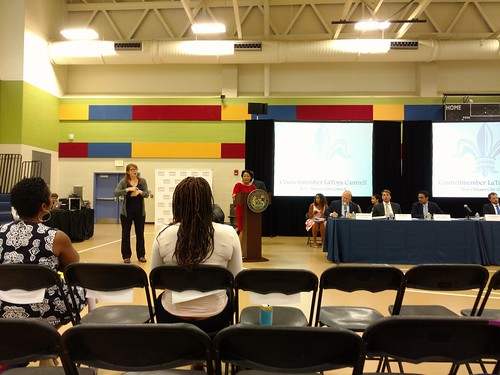
Then Councilmember LaToya Cantrell addresses the District B Community Budget Hearing July 2016


Sorry, I know the legislature still has another special session to do this year so I need to be more specific.  City budget season is coming and we're all very interested to learn about the new mayor's approach to the process. Already she's got a few things to say about how her predecessor went about it.
To provide New Orleans police officers with a pay raise starting in 2018, former Mayor Mitch Landrieu tapped into an initial lease payment to the city from the team redeveloping the former World Trade Center. Over the next two years, the Four Seasons project will remit $20 million to City Hall.

Even with that money, the NOPD faces what current Mayor LaToya Cantrell calls a "structural deficit" of around $3.6 million for the current fiscal year. While the Four Seasons lease payments have gone toward NOPD raises, they aren't enough to cover the overtime officers earn at the higher pay rate.
There isn't enough space here to go through the whole WTC backstory. But for now, just recall that Mitch strong-armed and restarted the bidding process a few times. This resulted in years of delays, litigation, and legislation, before we finally arrived at the current deal with Four Seasons. That  may not, in fact, have been the best deal as its scoring appeared to be inflated by estimates of future property tax revenue based on speculative assumptions about the real estate market.  But, it's the deal Mitch wanted.  And now LaToya isn't happy with the way he's used part of the one-time lease payment* to cover recurring costs in the police department.

This probably won't be the last time we hear her complain about the way Mitch appropriated funds, by the way.  The Landrieu administration has also been criticized for improperly redirecting property tax revenue dedicated to various purposes in order to fill obligations to a state pension fund.  There will be more like this as the Cantrell people dig further into the nuts and bolts of how things work. Wait til they get a look at the Wisner trust, for example. Also, here is a recent FOX 8 interview where LaToya says some things about replacing contractors and architects Mitch had working on S&WB projects she isn't happy with. Also there is a "FEMA bottleneck" to deal with. (There is always a FEMA bottleneck to deal with.)

Anyway, the point is even mayors who have six month transition periods still have a pretty steep learning curve to deal with once they get their hands on the city budget. Right now they're still figuring things out. As the years go on, we'll learn more and more about how the Cantrell people decide bend the rules in exactly the same way Mitch did except in service of slightly different priorities. Sunrise, sunset, etc. etc.

Meanwhile, summer is here and as budget season... um.. heats up, we're curious as to whether or not Cantrell wants to continue Mitch's program of community input meetings such as the one pictured at the top of this post.  If so, we should expect to see a schedule soon.  It isn't a given, though.  These meetings have been criticized in the past as pointless dog and pony shows. There was never any evidence that the public input collected there ever had much effect on the actual budget.  But they were fabulous venues for people to show up and yell at the mayor about whatever was bugging them and I always think we need more of that whatever the circumstances. 

LaToya likes to talk about how important is for her to "listen to my people" so you'd think this sort of thing would be right up her alley. On the other hand, they're also the sort of place one is likely to encounter a "community uptick" from time to time. It's not clear whether she thinks those are good or bad, exactly.  Maybe the answer to that will help determine the fate of the meetings.


*The city was also due a one million dollar payment from Four Seasons recently that it declined to collect for some reason. Maybe that needs to be revisited too.

Friday, July 21, 2017

The money pit

Hammer's report on the still shuttered and bankrupt African American Museum in Treme has all sorts of fun stuff going on including Irvin Mayfield, First NBC, and Wisner Trust funds which I think may be some sort of super trifecta. 

Some of this is just the comedy of organizational chaos. But it's also a window into the way the local non-profit sector spreads public subsidies around among the same familiar circles of professional fund-raisers, bankers, and lawyers operating in New Orleans.  Some of them, like the unfortunate Mayfield, tend to get themselves into sticky situations and become scapegoats.  But, really, it's a whole system of backslapping corruption that brings together neighborhood associations, historic preservation purists, and start-up entrepreneurs along with the aforementioned money people to direct public and private money toward feel good projects that don't really help anyone not invested in tourism or real estate. 

This sector has done well for itself under the Landrieu administration. As the post-Katrina money begins to dry up, the party may be ending for the con-profiteers. It's never a bad time to have a friendly mayor in the pocket, though. LaToya Cantrell, you may notice, delivered her platform vision thing speech last week at Irvin's Jazz Market.  There's probably more to that than just symbolism.

Thursday, September 03, 2015

The half is not being told

In one of their trademark "website reports" items yesterday, NOLA.com pointed us to this report in the Louisiana Record.
NEW ORLEANS – Of the $371 million in Deepwater Horizon settlements awarded to local governments last month, Louisiana law firms stand to rake in a hefty percentage of that in legal fees.

The influx of cash to local governments, part of a $687.4 million settlement oil giant BP made to state and local governments across the Gulf Coast due to the oil spill, means big paydays for a handful of politically connected Louisiana law firms.
The article goes on to name several of the firms benefiting from the settlement process. If any of this looks familiar to you, you may have been reading Jason's far more in-depth reporting stretching back over several years now.  If you find time go back and read through the saga. It's been pretty much shut out by the local press for reasons no one can begin to fathom.
 

Thursday, February 26, 2015

How do you get to be the sole trustee of a dissolved trust?

Neat.
It makes me wonder if Mitch is deluded or simply unaware of the reality.  It seems like he thinks he owns everything, including Port Fourchon, and he thinks he's going to do whatever he wants with it.  What he wants, as I suggested back at the beginning of this battle, is to sell the land while he's still in office using the proceeds however he sees fit.  And by the looks of many of the donation recipients he sees fit to pay off his peeps and lucrative voting blocs (I have more coming on that issue soon).
How much for all the land? When Jason first started writing about this, Mitch selling the whole thing off at once seemed like the most likely outcome to me.   Starting to look more likely.  And, hey, maybe it's the right thing to do.  It's all gonna melt into the sea, anyway, right?

Wednesday, February 11, 2015

The Wisner list that counts

Dambala posted the Wisner grant proposals.  This doesn't tell you exactly how much was awarded in each case, but these ballpark figures are better than just the list of grantees the city released yesterday.   Anyway, I'm sure Dambala would explain further but he seems distracted by something.

Tuesday, February 10, 2015

Throw me something, Wisnah

It's Carnival time and the mayor is throwing out trinkets.
Mayor Mitch Landrieu on Monday unveiled the list of local groups receiving Edward Wisner grants this year, apparently signaling the status quo remains in place for the contested piece of coastal real estate that has produced the revenue for Wisner grants going back decades.

More than 60 organizations, ranging from the Louisiana Children’s Museum to St. Augustine High School, will share about $1.2 million this year.
Back in September the Wisner heirs fighting to maintain control of the land trust that produces these grants lost rather decisively to the city in court but are still holding out hope that the State Supreme Court will take up their appeal.

The Advocate doesn't list all of this year's recipients but the city's website does if you are interested.

If there are further details as to the amounts distributed, they aren't posted in an obvious place. As you can see from the list, though, this money (however much of it might be waste or patronage or wasted patronage or whatever) actually does a lot of good.  Which is one reason the thought that the city might sell this golden goose is concerning.
Some of the heirs have said they worry Landrieu will simply sell off the land, part of which holds Port Fourchon, a hub for vessels serving offshore rigs.

The proceeds of such a sale would presumably be split among all of the beneficiaries that get a cut of the land’s proceeds today, including the city, Tulane University, the Salvation Army, LSU and a collection of some 50 different individuals. But the land would be gone as a regular source of income.

The mayor so far has not made any moves in that direction, although he said Monday that his administration is in the middle of evaluating how much the land is really worth.

He compared it to the Public Belt Railway, another city property that Landrieu has said he would be willing to at least consider selling. “I’m going to make sure that asset is valued correctly,” he said.

Like the Public Belt, it's not an easy asset to value.  For instance, it might depend on how many Georges family members are interested in buying. 

There's also the problem of just how long term an investment in land in that area really stands to run. Now might, in fact, be the time to get out of that sinking plot.

Monday, September 22, 2014

Perhaps he will want to "sell that sucker"

Not sure what the mayor plans to do with the Wisner land.  But given its value to the energy and shipping companies who have been paying rent all these years, and the fact that it will all dissolve into the sea soon anyway.   Maybe now is the time sell it for a lump sum.

Sucks to be the various arts and non-profits whose grant funding relied on the continuance of the trust, though.

Saturday, September 20, 2014

Found money

The mayor's budget proposal should be coming out some time in the next few weeks.  If you listen very closely you can hear the sounds of City Hall couches being inverted in search of loose change. 

Quite often, they find some.
Mayor Mitch Landrieu’s administration is adding $7.8 million to the city’s budget for the current year, with half of the money going to the New Orleans Police Department and the rest to be used to help satisfy court orders directing the city to improve conditions at Orleans Parish Prison and to meet the city’s obligations to the Fire Department’s sagging pension fund.

The $4 million that will be dedicated to the NOPD had been in the original budget the City Council adopted last fall, but it was stripped out last month because it was viewed as “surplus.” The city has been trying to recruit new cops, but the NOPD’s ranks have been shrinking faster than new officers can be hired and trained, meaning the department’s budget had extra money in it.

The restored money will allow the department to buy a range of supplies, according to the Landrieu administration: 100 new vehicles, 50 in-car cameras, 100 body cameras, 150 desktop computers, plus software, servers and other technological equipment.

Of the remaining $3.8 million, $2.6 million will go to the Fire Department to help pay the city’s pension obligations and $1.2 million will go to Sheriff Marlin Gusman to cover the costs of housing mentally ill Orleans Parish Prison inmates at the state’s Elayn Hunt Correctional Center.

The administration attributed the cash infusion to new retail stores and the city’s “more aggressive collection efforts.”
That last bit is interesting.  During his community budget hearings this year, the mayor frequently touted the city's "97% collection rate" on property taxes.  But sales taxes are a different story.  At least, according to the Inspector General, they are. Still, there's a bright side to that story.
The Landrieu administration's lax tax-collecting procedures have caused delays in getting money to the cash-strapped city, according to a report released Wednesday (Sept. 10).

Inspector General Ed Quatrevaux looked at 35 sales tax audits performed by the city's Bureau of Revenue between Jan. 1 2011 and Dec. 31 2012. In many of the cases, the files lacked required documentation, were not completed in a timely manner and didn't comply with state law, according to the report.

The 35 audits had a total of $2.8 million in tax liabilities but as of this week, the city had collected only $1.6 million.

In a written response to the report, First Deputy Mayor and Chief Administrative Officer Andy Kopplin disagreed with many of the Inspector General's findings and pointed to an increase in city sales tax as proof that the city's policies and procedures are working.

The city collected $151.6 million in sales tax in 2013, which represents a 9.6 percent increase over the previous year.
So, even if we still do a crappy job of collecting, sales tax revenue is going up.  And, keep in mind, this is happening even before Toby Keith's I Love This Bar And Grill at The Riverwalk is fully operational.   Things are definitely looking up.

Meanwhile, there are more couches to turn over.
Amid mounting controversy over the size of New Orleans’ new jail, Mayor Mitch Landrieu has appealed to Gov. Bobby Jindal to remove several hundred state prisoners from Orleans Parish Prison, a move the mayor contends will save tens of millions of dollars and avert the need for the city to build additional jail space.

Landrieu, in a letter dated Thursday, complained that OPP has been “warehousing hundreds of extra state inmates and prisoners from other parishes” who aren’t required to be jailed in New Orleans. In underlined type, he asked that the Department of Corrections “take immediate steps” to remove the approximately 380 state prisoners currently housed at OPP, saying it’s clear the Sheriff’s Office “needs to dedicate all its energy and resources” to local inmates.
 Oh dear. And here we thought Mitch and Gusman had come to an understanding. 
The one-page letter, which was copied to the local legislative delegation but not to the Sheriff’s Office, underscored the growing frustration Landrieu has expressed over his lack of control over the jail despite the city’s legal obligation to pay for the care of inmates. The city’s attorneys have explored possible legal actions they could take to try to force Gusman’s hand at reducing the number of state prisoners, whose housing costs are paid for by the state, but the mayor’s written plea to Jindal seemed to carry more than a whiff of desperation as the city has reached a critical crossroads in the long-running jail debate.
Should make for some interesting hearings when the Sheriff's budget comes up before the City Council.

Meanwhile there's a decision in the ongoing Wisner Trust litigation which could be very good for the city or very bad depending on how you interpret it.  Go help Dambala figure it out.

Thursday, August 14, 2014

Budget time

Might not have mentioned yet here but the Mayor's Traveling Budget Circus is indeed happening.  It begins Monday in Council District C at L.B. Landry High School. (District C gets a Westbank meeting. Sometimes East Bankers try to organize their own but I haven't heard anything about that yet.)

Anyway here is the rest of the schedule.

Many fun things to be discussed this year. I've got a draft post that talks about some of those things in greater detail which I hope is up next week.

But one budget-related item that post probably won't go into is the Wisner trust fund where there is action this week for the first time in a while. You can catch up on that business via Dambala here and here.  And here is a new Lens report on the contentious process by which Wisner money is distributed to local non-profits. 

More to come next week. 

Update: See also, this.
Over the objection of the Fraternal Order of Police, which called for using the money to increase officers’ salaries, the City Council voted Thursday to transfer more than $4 million in surplus cash from the New Orleans Police Department’s 2014 personnel budget to pay for other city obligations.

Monday, June 09, 2014

BP shield law

The important thing to keep in mind about the "Kill-The-Lawsuit-Bill" Bobby Jindal signed last week is that it may not even actually kill the lawsuit.

Here's what we know for sure it does.
SB 469 appears to have been written and deliberately designed by lawyers who represent the oil and gas industry in order to shield, reduce, or eliminate their clients’ exposure to civil damages on a wide range of pending and future claims, including, most notably, BP’s liability for billions of dollars in outstanding claims related to the 2010 Deepwater Horizon catastrophe. Indeed, according to people intimately involved in the legislative process, no one lobbied harder for the passage of SB 469 than those associated with BP.

It might also kill the SLFPAE lawsuit but that hasn't been determined just yet.  Which is why Jindal is still punishing board members who supported the suit in the first place.

Anyway, renowned idiot Don Briggs is happy.
Oil and gas industry lobbyists had pushed hard for the bill during the 2014 legislative session, which passed both the state House and Senate by relatively healthy margins. They lauded the governor's decision Friday.

"The signing of SB 469 is a huge victory for the oil and gas industry as well as the economy for the state of Louisiana," said Don Briggs, president of the Louisiana Oil and Gas Association. "While there is still much work to be done, this piece of legislation is a big step in the right direction."
Recall that Briggs' deposition was taken in advance of a frivolous LOGA suit brought in hopes of slowing down the SLFPAE suit.  You can think of SB 469 as a similar obstruction with regard to the SLFPAE suit. It means we have to make time for one more round in the courts.
Backers of the lawsuit filed by the Southeast Louisiana Flood Protection Authority-East are expected to challenge in court the new law Jindal signed. The authority's lawsuit that generated so much attention is already in federal court.
Which means at least one more round of legal wrangling stands between now and the time we take any meaningful steps toward saving the Louisiana coastline. But hey, take your time there, right?


But as far as the oil industry is concerned, that lawsuit is really just one claim.  If it stands up in court, SB 469 shields them from many many more claims.  It looks like they're aware of this.


Monday, March 10, 2014

Mitch sticks the Wisner heirs with the franchise tag

There's a lot going on in this AZ post.  Basically the city is treating BP settlement money like the NFL salary cap. The object is to keep gaming the system in order to keep the spending money as flexible as possible.
Getting back to the Wisner heirs complaint filed with U.S district court, Eastern District of Louisiana  and the items within it I found to be of the greatest significance...the main problem with the JV attorneys representing the City, OPSO and Wisner is the potential for them to "horse trade", as Wisner heir Michael Peneguy refers to it on Page 28, item # 20 of the complaint.  The scenario being that the JV attorneys could be using the Wisner settlement as leverage to increase the amount on other settlements they are representing such as the City's or OPSO's.

After having followed this story for over a year, I believe this is exactly what is happening.  Keep in mind that any money awarded to Winser by BP has very strict guidelines in how it must be spent...but not so with the City.
The city's position is that the Wisner property is all theirs anyway.  The Wisner heirs think they've been unfairly franchised.  

Thursday, December 05, 2013

$1500 cell phones

I'm not sure what to make of Dambala's Wisner-to-Ceasefire money trail here.  Might be a bunch of nothing. But the smart phone item is kind of an eye popper... depending on what it means, exactly.

In any case, the post does provide some links to less than glowing evaluations of Ceasefire's efficacy, you probably should read.

Sunday, November 24, 2013

Shit my Jackie says

Technical issues with the council's video embed have obligated Dambala to go back and emphasize the comment I was going to add to this post. This means it's now basically complete and you can go read it.

I happened to be watching this session live.  But I also recommend taking in council meetings... especially the budget hearings.. at your leisure.  (I do not recommend "binge watching" them, though, unless you absolutely hate yourself and your life.) 

The budget hearings are instructive in just how little councilmembers seem to know about what most departments actually do. Or if they do understand what's going on, then you get to see them pretend to a certain plausible ignorance as a favor to friends. This, I've come to believe, is what Jackie Clarkson is doing most of the time.
For some reason the video embed link only has 7 seconds. You can find the video at the CC website here, scroll down to the November 6th City Council meeting.  The Wisner issues first start at about 28 minutes into the session with Head addressing Cedric Grant.  It picks back up at 57 minutes into the session...although you may want to skip over Jackie Clarkson cackling about how she doesn't think the Wisner funds should go through the Council because they never have before and this Mayor doesn't need to be scrutinized.  Then finally at 1:12, the conversation between Head and Erica Beck takes place.
I don't recommend skipping that part. I think it's the most telling moment of the hearing. 

Tuesday, November 12, 2013

See no evil

La. Supreme Court upholds ruling against N.O. anti-begging law.
Between 2010 and May, nearly 1,300 people were charged under the law at New Orleans Municipal Court, according to figures provided earlier this year by Court Clerk Chris Sens.

He did not respond to requests last week for updated figures; Municipal Court was closed for Veterans Day on Monday.

After Hunter’s ruling, the city attorney told the Police Department to no longer enforce the ordinance, said Tyler Gamble, a spokesman for Mayor Mitch Landrieu. Gamble said the city is researching how to amend the law to comply with the judge’s decision.

City Councilwoman Susan Guidry, a lawyer, said after Hunter’s ruling in May that there was no evidence the council had ever been informed of the law’s flaws.
Nice touch with that "Guidry, a lawyer," thing they did there.  I can't decide if this means she's saying, "Nobody told me there was a problem here," or, "You can't prove we had any knowledge there was a problem,"  or which of those would be worse.

Of course this isn't the first time Guidry, a lawyer, has had difficulty comprehending First Amendment issues so we shouldn't be too surprised.

On the other hand, maybe she's got a point. Councilmembers seem to left out of all kinds of things lately.
The budget does not, however, include more than $1.5 million in Wisner-funded grants the city usually gives to local charities. As long as the lawsuit is winding through appeals courts, the city doesn’t plan to allocate any Wisner grant money. That could put some of those charities in a bind.

But even if the money were included, Landrieu’s General Counsel Erica Beck said, the council would have no control of it.

“The council has traditionally not appropriated any of that grant money,” Beck told the council. “We’ve received no indication from the judge that we need to change.”

But as blogger Jason Berry recently pointed out, New Orleans Municipal Code appears to give the council control of the fund. In fact, Berry reported, that “check and balancewas central to the city’s argument that the fund should be declared public.

“If there is in fact council oversight,” asked Head, “and there is a check and balance for this government fund, when do I have that council oversight that is part and parcel to that check and balance?”

During her remarks on the Wisner Fund, Head also objected to the process for handing out NOLA for Life grant funds, saying it wasn’t transparent, which led to funds going to charities that lacked proper financial documentation.

Berry adds here that the administration's attempt to have it both ways on the question of city oversight grants the Wisner fund an amorphous "Public-ish-iness" quality.

I watched some of that meeting on TV. My favorite part of the discussion on oversight of the Wisner property was when Jackie Clarkson, a real estate agent, blithely accepted Beck's argument at face value agreeing  that it was basically none of the Council's business.  But unless we can produce "evidence the council had ever been informed" of the city's arguments in the Wisner case, they'll keep pretending not to see them.

Thursday, October 31, 2013

Assholes

Get a load of these assholes.
I believe there was a concerted effort on the part of the Mayor to oust the people from the Advisory Committee he didn't like and replace them with his own cronies.  I've also suggested that LSU and Tulane colluded with the Mayor's wishes by removing their appointees in order to replace them with folks who would follow the Mayor's wishes, Ron Gardner and Anthony Lorino.

Once these cronies were appointed, they immediately followed Sherman's lead to fire the Wisner Trust's counsel on the BP lawsuit, Waltzer and Wiygul, and replace them with the JV attorneys you see listed in the email thread above.

It's pretty vulgar stuff.
I guess it's more grown-up to just shrug off this behavior as the matter-of-course that it obviously is.  But I think it's worth stopping every now and again to just remind ourselves what colossal assholes the people who play the game of running stuff for us invariably are.  It may not be immediately helpful to do this. But it's always instructive.