-->
Showing posts with label Susan Guidry. Show all posts

Friday, April 27, 2018

Not so silent piling

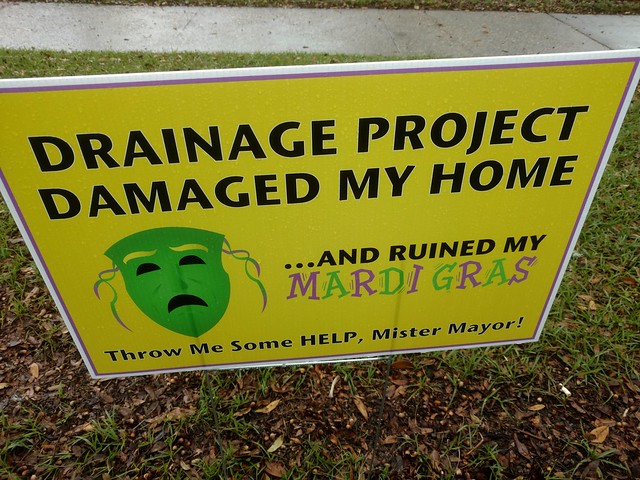
Drainage project damaged my home

Earlier this month, Mitch Landrieu told the Sewerage and Water Board the city's entire drainage system is in need of an overhaul the cost of which could run into the billions of dollars.  Oh, also, he said coming up with that money is going to be very difficult.
Landrieu also warned that while both the city and the S&WB have been able to dip into FEMA money and other federal funds since Hurricane Katrina, the city alone will likely have to find the money it needs going forward.

"This board is going to have to shoulder the responsibility of the next major thing to help this city survive," Landrieu said.

"There is no way to do this, there is zero way to do this, without a new revenue stream that comes from the people of New Orleans," he said.
This week, outgoing District A Councilwoman Susan Guidry and her replacement Joe Giarrusso spoke at a public meeting about the challenges S&WB faces. One of those challenges is they don't seem to know how much revenue they're supposed to be collecting from people now.
One woman in the audience told Guidry that she seems to get no bills for several months in a row, then a single massive bill in a “lump sum.” Another resident said he receives his bill every month, but that “two months out of three” are an estimate, indicating that no one actually read his meter.

The high bills are the latest in a litany of failures by the agency that City Council members are continuing to learn about since its catastrophic collapse during the flooding rain last August, Guidry said. The billing software is riddled with bugs, and its implementation was “terrible,” she said. Meanwhile, turnover among agency employees is so high that she recently heard an estimate that they have 400 vacancies.

“Where this will end, goodness only knows,” Guidry said with a wry laugh. “It’s astounding. I think I’ve heard everything, and then I hear something else.”

Further, there seem to be problems now with the actual readings, Guidry said. The problem may be growing so large and so complex that a solution may not even be possible, she said.

“It does seem to me that there should be a lawsuit that comes out of this for all the people who paid too much. Some entrepreneurial attorney is going to figure it out,” Guidry said. “The Sewerage & Water Board has been in such bad shape lately that I’m afraid it’s just going to go bankrupt. I can’t sugar coat this. Everything that could be wrong is wrong.”
Well here is something else.  Just when you thought they needed to come up with a lot of money they don't have, it turns out they will have to come up with more money they don't have.
One homeowner said the drainage construction on Napoleon Avenue made his house "shake, shift and jump," according to a judge's ruling in Orleans Parish civil court. Another neighbor, whose house sits a few blocks from the construction on Jefferson Avenue, said jackhammers had "caused his kitchen cabinets to fall off of the wall."

They are among five homeowners now entitled to collect more than $500,000 collectively from the Sewerage & Water Board, based on a ruling handed down Wednesday (April 25) by Orleans Parish Civil District Court Judge Nakisha Ervin-Knott.

The ruling is from a lawsuit filed in 2015 against the Sewerage & Water Board by about 300 residents and business who claim the utility should compensate them for property damage resulting from the Southeast Louisiana Urban Flood Control Project, a massive regional drainage improvement undertaking that began in 1996.
The lawsuit succeeded at demonstrating to the judge that the damage sustained by homes along Napoleon Aveneue was due to excessive vibrations from the construction that the Corps and S&WB contractors did not take very seriously.
The homeowners' attorneys also argued that vibrations from work sites often breached the maximum intensity allowed under the Army Corps's contracts. However, "under-reporting" data made it complicated to pinpoint exactly how many times the vibration exceeded allowable limits, Ervin-Knott found, backed by testimony from homeowners that contractor personnel tasked with monitoring vibrations were at times not present on-site. On one occasion, a homeowner said she caught a vibration monitor sleeping on the job.
Back at the beginning of the Napoleon work, we were introduced to the "Silent Piler." It is a hydraulic machine that was supposed to minimize vibrations while driving metal sheet pilings into place.  I know these definitely got used. I managed to get some photos of them in action. They're pretty cool, actually.

Sheet pile driving

Apparently cool is different from actually quiet. Or maybe the pile driving wasn't the only source of the trouble. In any event, here is one more thing S&WB has to find "new revenue streams" to pay for. So yay.
Thursday, March 15, 2018

Striking the right "balance"

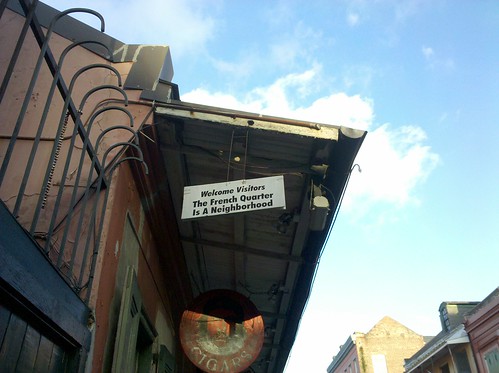
The French Quarter is a Neighborhood


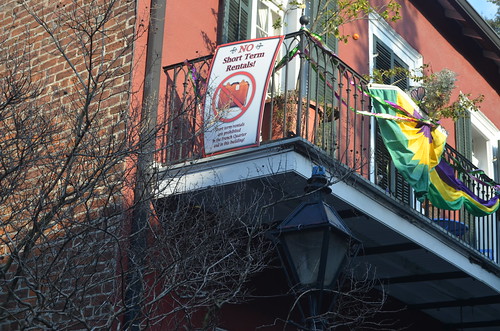
Last week Latoya Cantrell and Jason Williams called a fair amount of attention themselves for suggesting that it might be time to take some (limited and dubious) action on the short term rental front. Cantrell's bold idea is what they're calling a "soft cap."

Under the current law, people who own property in most non-residential zoning districts are guaranteed the ability to get commercial short-term rental licenses, which allow them to rent entire homes or apartments every day of the year.

There’s no limit on the number of such licenses in each building, so an apartment building can become, in effect, an Airbnb hotel.

Some large apartment buildings in the city have dozens of commercial, short-term rental licenses. The Lens recently reported on a small Bywater apartment building that’s in the process of being converted to full-time Airbnbs.

Cantrell’s proposal would allow just two commercial, short-term rental licenses in each building. Anything beyond that would have to be vetted by the City Planning Commission and approved by the city council — hence the council’s description of the limit as a “soft cap.”

The proposed change would apply to two types of zoning districts: one type of mixed-use district and one type of low-density, commercial district.

Notably, it will not affect some downriver neighborhoods, including Faubourg Marigny and Bywater, which have some of the highest concentrations of Airbnbs in the city.
The vetting process here is the same as one that applies already where there are limits in place. Most of the city is already under a "soft cap."  This process has already come under criticism for being a glorified system of spot-zoning where the determining factor in each decision tends to be the amount of money and influence on the city council an individual property owner can wield. For example, in a few weeks, we'll see how much political sway the developers of the Sun Yard hold. Their poshtel/pool bar proposal was rejected by the Planning Commission. But Counicl can override that for any reason if they want to.

LaToya and Jason also agreed it is time to do a "study on the effects of short-term rentals." That is encouraging. A good time to start learning about a problem is a year or so after your supposed remedy has been enacted into law.  Also the information they're looking for is already available. JPNSI has been compiling and distributing it for a few years now. They're releasing a study this month, in fact. One thing they've found, unsurprisingly, is concentrated wealth.

A few corporations and individuals are gobbling up chunks of New Orleans real estate to profit from the expanding short-term rental market.

"We're talking about 10 individuals (or corporations) that have taken 568 homes off the market and have redirected them toward tourists," said Breonne Dedecker with the Jane Place Neighborhood Sustainability Initiative. "Every unit of housing that is removed from the long-term-residential market has an affect on the market around it."
The city's law is, still, in this very story, described by Mitch Landrieu's spokespeople as "a model for other cities trying to limit, regulate and tax short term rental platforms." But their model is just turning neighborhoods into resort villages to the profit. It needs substantial revision.

LaToya Cantrell would tell you it needs "balance" and that she will do some listening or whatever to determine how that works. But there are obvious actions that should be taken immediately. Here are the two most popular ideas. Short term rentals of "whole home" units should be be banned from residential neighborhoods.  Licenses should be limited to one per individual.  Those are the two most direct means of stopping the conversion of structures into virtual hotels via the STR process.  LaToya's spokesperson claims she is against that.
"The mayor-elect does not support converting structures into virtual hotels via the STR process, especially when those structures can house our residents. She is currently working to strike the right balance on this issue so that the right regulations are in place that protect the cultural fabric of neighborhoods," Mayor-Elect Cantrell's Communications Director Mason Harrison stated in an emailed response.

Recall that Susan Guidry proposed limiting licenses to one per homestead exemption in the original ordinance. LaToya made a big to-do during the mayoral campaign of her having voted for that amendment (although it was clear it wasn't going to pass at the time.)  So why isn't she offering a similar proposal now? 

Jane Place points out that much of the luxury condo development in the CBD has sustained itself through the STR market. 
Dedecker recently took to Twitter to point out two corporations, Stay Alfred and Sonder, have more than 100 STR permits in New Orleans each. 

Stay Alfred, which is based in Spokane, Washington has more than 30 permitted STR in The Maritime apartment building in the Central Business District.

Neither Stay Alfred or The Maritime returned FOX 8's request for comment. 

"[The Maritime] has 106 apartments in it. As of last week, there were 61 permitted short-term rentals in the apartment building with another 21 permits pending, which means 82 out of 106 units are currently or about to be used as short-term rentals. That is 80 percent of a residential building basically being utilized as a hotel," Dedecker said.
Last week, we mentioned Sonder, in relation to its presence in another faux-tel development in Mid-City.  That development's owner, Joshua Bruno, has a history of getting LaToya to listen to him and "balance" things in his favor from time to time. Until she makes a solid commitment to clamping down on STR expansion, we have to assume she's still listening to people like Bruno.

And that is a problem because next they will want to "balance" the French Quarter too. This morning's T-P allows Quarter landlords to whine that the total ban on STRs there is cutting into their racket now.

Michael Wilkinson, also of French Quarter Realty, said that some of his clients have been converting short-term rentals into "what they should've been in the first place: Long-term rentals."

"We're seeing that, which we kind of expected, and some people are keeping them for themselves," he said. "It's put a lot of things on the rental market because of that."
But the large inventory of long-term rentals has made things challenging for landlords. John Ferrara, a longtime French Quarter landlord and a former resident, said it's as challenging to find long-term renters as ever.

"People who had condos and second homes in the Quarter, they used them periodically and then they rented them out the rest of the time. Now they can't do that," Ferrara said. "You can't rent -- I have vacancies for over a year now."
Wither the pied-a-terres? It sounds a lot like the ban is actually doing what it's supposed to do. Notice nobody in this story ever takes a minute to wonder if the problem might have to do with the rent being too damn high. The pro-Airbnb and YIMBYist crowd loves to talk about the sacred value of "supply and demand." At least they do as long as those dynamics are favorable to the investor class. When it doesn't, though, somehow that's a bad thing.
For years, he said French Quarter Realty used to have handouts with listings of apartments and corresponding photos running one to two pages. But now, "we have four pages of apartments."

"I have one client that just rented a $1,200 apartment, a guest quarters behind the main house, that he had on the market and after a year he finally got someone," Ripley said. "It's just been very difficult because it impacts the investment buyer, and now is competing with a whole new market in the CBD."
The "whole new market in the CBD" is where all the STRs are, of course. Real estate just isn't very successful in New Orleans if it is wasted on housing people who actually live  here.

Friday, December 01, 2017

What are they doing in France?

I mean, besides running up the ol' city credit card again har har har... But what is that specific roster of folks doing in France? Here is a thread.

Saturday, April 29, 2017

Who does and doesn't trust our criminal justice system

Of all the things that one could say about Orleans and Jefferson Parish District Attorneys and their fake subpoena tactics this week, City Councilwoman Susan Guidry got to the point most directly.
The Jefferson Parish District Attorney’s Office acknowledged Thursday that it, too, has sent fake subpoenas to reluctant witnesses to get them to talk to prosecutors. The practice will stop immediately, the office said in a written statement.

The admission comes a day after the Orleans Parish DA’s office abruptly announced it would end the practice after The Lens informed the office that it was about to publish a story reporting that legal experts said the practice is unethical, if not illegal.

Criticism of the practice in New Orleans mounted Thursday. Two City Council members said the fake subpoenas, as well as other aggressive tactics by the DA’s office, probably have eroded the public’s faith in the criminal justice system.

No wonder people in our community don’t trust our criminal justice system,” Councilwoman Susan Guidry said at a meeting.
The fake subpoenas are bad. But they're really just the tip of the iceberg as The Lens also pointed out this week with regard to Cannizzaro's activities
Cannizzaro’s office has been accused of overly aggressive tactics. Prosecutors frequently use the state’s habitual offender law to secure long sentences, even for nonviolent crimes. They have charged witnesses with perjury if they recant their testimony.

And earlier this month, the watchdog group Court Watch NOLA found several cases in which the DA’s office obtained arrest warrants for victims of crimes because they did not cooperate with prosecutors.

New Orleans City Councilman and defense attorney Jason Williams said the use of fake witness subpoenas fits into a pattern of overzealous prosecution.

“I can only imagine how dangerous this could potentially be,” he said. “If older assistant district attorneys are encouraging younger, less experienced [assistant district attorneys] to do this, it creates a culture.”
That "culture" of prosecutorial licentiousness runs deep in Louisiana. And it is enabled by a political culture too often content to look the other way. The DAs and Sheriffs are powerful people. They're currently in Baton Rouge lobbying against a set of modest, humane, and broadly supported sentencing and parole reforms meant to reduce the state's obscenely bloated prison population.  They haven't succeeded quite yet but give it time. DAs and Sheriffs are dangerous people.

We mean that literally. Some recent high profile examples include these Iberia Parish beatings, the  as yet unsolved murders in Jennings. Here, also from The Lens is an op-ed by William Barnwell about the prisoner abuse in Louisiana via the practice of solitary confinement. Notice who he singles out.
Popular support for the lock-’em-up-and-throw-away-the-key approach to sentencing has begun to lose ground nationally among both conservatives and liberals. Even Louisiana, appalled  by both the inequity (close to 80 percent of the people we incarcerate are African American) and ineffectiveness of mass incarceration — not to mention spiraling costs — has begun to inch toward reform. But the problem is compounded by hardened district attorneys who seek maximum punishments and by parish sheriffs who lobby to keep their jails full because their budgets depend on the income from the state for each jailed person.
"It's no wonder people in our community don't trust our criminal justice system." The power to protect and serve the public is habitually abused to terrorize the defenseless while the power to prosecute or just as importantly not to prosecute is abused in ways that protect the establishment. Next week sometime we're expecting an announcement that there will be no civil rights prosecutions in the murder of Alton Sterling by Baton Rouge police. But officials are being extra careful about how and when they make that announcement because they are worried about the tension that arises in a community when nobody trusts the criminal justice system.

The proposed reforms in the legislature are a nice start should they pass. And, despite its problems and imperfections, the NOPD consent decree has probably been of at least some help. But if we're serious about addressing this head on, we should recognize that the abuses which lead to a lack of trust in the criminal justice system are bound to repeat as long as the classes who benefit from it maintain political power.  Which means, once again, in order to fix the policies, we have to first go out and do the politics.

Today there is an election for Civil District Court.  That may seem disconnected from the criminal justice stuff above but it really isn't. Politics is always about more than just the one office at stake in any election.  Instead it is about building and testing the strength of coalitions.  Every election is an opportunity to see which side can maintain power and influence. This race in particular is a fairly strong litmus test in that regard. It's a citywide race coming just a few months ahead of a major municipal election. And it could provide an early read on some of the dynamics that will be in play then.
Saturday's runoff for a seat on the Orleans Parish Civil District Court bench will be decided along racial lines, if last month's primary results offer a clue.

The battle is sketched in black and white as attorneys Rachael Johnson, 40, and Suzanne "Suzy" Montero, 53, make their final push for votes, with a slender turnout expected for the only contest on the Orleans Parish ballot.

Montero, who is white, won nearly 88 percent of the white vote and just 2 percent of the black vote on her way to claiming a spot in the runoff, according to an analysis by University of New Orleans political science professor Ed Chervenak.

Johnson, who is black, came in 600 votes behind Montero while taking 80 percent of the black vote and 7 percent of the white vote.

Montero won 45 percent of the overall vote, to 43 percent for Johnson. Attorney Marie Williams, who is black, trailed with 11 percent, mostly from heavily black precincts.

"When you have a biracial election, a very low-stimulus election where we don't have a lot of information about the candidates and their qualifications, people tend to fall back on shortcuts like race," Chervenak said.
Now, Chervenak is not being entirely honest here.  He might mean to say the average voter may not have followed the news very closely. But anyone who has will have all of the information we  (his word) have about the candidates, which is plenty. Here is a the usually excellent Antigravity election guide to this race. There's a few more points one could add. And I'm disappointed that they end on a no recommendation. But besides that it's a quite good sampling of the information we all have.  But let's take at face value that we do have a low profile but citywide election between a "Who is White" and a "Who is Black."  That should tell aspiring mayoral candidates a little bit about the relative strengths of each block.

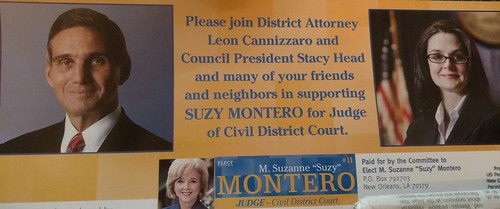
That isn't all we'll be watching, of course. Beyond just race, we're looking at how the influence of specific interests and individuals can be brought to bear in 2017. For example the Johnson campaign is being handled by powerhouse politico Karen Carvin while Montero's is supported by PR work from Cheron Brylski. Both of those names will be all over the fall elections.  Montero seems to have had a bit more money to play with. She's certainly had more ads flying around TV and social media sites. But where this really gets interesting is where the endorsements start to line up.  Here is a quick list of people whose names have appeared on Montero's fliers and ads over the past few weeks.

Charles Foti
Jackie Clarkson
Peggy Wilson
Harry Connick Sr.
Suzanne Haik-Terrell

And, of course, these two beloved friends of the people.

Leon and Stacy heart Suzy

What we have here is a fine sampling of the small section of our community who actually likes the criminal justice system just fine the way it is. Before you go vote today you may wish to think about whether you care to see such people emboldened by the results of a citywide contest. Today's election doesn't directly have a lot to do with that issue. In a vacuum it's about which one of these equally qualified individuals could be a Civil Court judge. They both could. That's why Antigravity doesn't endorse either.  But politics doesn't happen in a vacuum and a single office alone isn't really the point. It never is.

Friday, March 24, 2017

Nadine Ramsey should try taking the ferry to work

She doesn't seem very clear on who the infrastructure she's voting to build is actually for. Maybe if she actually had to rely on it for her daily commute she would see this better.
City Councilwoman Nadine Ramsey on Thursday (March 24) made no apologies for supporting a plan to demolish the Canal Street ferry terminal, a decision some of her constituents say will make it more difficult for them to get to work. But it was clear that she was playing defense after one key opponent said neighborhood groups tried and failed to get Ramsey to oppose the plan for its lack of a pedestrian connection.

"I've heard comments that this is being built for tourists. That's crap," Ramsey said Thursday ahead of the City Council's vote on demolition. "Any conversation or any comment that includes any indication that I am not protecting my district or protecting Algiers can kindly leave because I know the work I've done for Algiers for my district and that I'll continue to do."
Maybe she should have checked with the Mayor first. 
(Kristin Gisleson) Palmer said that many of the comments about the terminal being built for tourists are rooted in concern over remarks Mayor Mitch Landrieu made during a private meeting with stakeholders on Monday. The mayor was asked why funding was weighted so heavily in favor of a $5 million terminal building with no funds included for a pedestrian bridge.

"He clearly stated that this is for the 8 million tourists that are going down there every year," Palmer said. The mayor's office did not immediately respond to a request seeking confirmation of the comment.

But the perception of a tourist-focused terminal located next to a proposed Four Seasons hotel did seem to carry weight with at least one City Council member. Councilwoman Susan Guidry said she agreed with opponents who raised the concerns about the $5 million building, saying, "it had to be a conscious decision not to have those elements for the sake of having a very beautiful building."

"That's not right," Guidry said. "I just think we need to put these things on the table. That was just not right to design it that way and that is obviously a design to suit the desires of very big companies ... and to look good for tourists. That just needs to be said."
Of course Guidry can say these things because she's retiring now and doesn't have to answer to any "very big companies" anymore. Ramsey is in a different position. 

Thursday, March 09, 2017

"Kick me"

No idea what your councilmembers are actually squabbling about here. The action in question was already approved by citywide referendum in November.  It looks like they're just arguing over whose name goes on the ordinance. Or, I guess, over who gets "kicked" in the process.
All four of the council members who voted with Brossett said they came to the council meeting prepared to vote on the ordinances. Both Head and Guidry said they were led to believe the ordinances would go through committee. At one point, Head accused Brossett of using Thursday's meeting to "kick" Guidry and called him "horrifically unprofessional."

"There's still some subtle reason I haven't figured out that we're not going through" the normal process, Head said. "Let's assume it's a perfect ordinance. Why is it not going through committee when there are concerns articulated by your colleagues?"
Not sure why Guidry would even care all that much about credit since she's retiring anyway. As for Head, I think it's interesting that she cares so much about eh "normal process" here given that she ran ahead with her plan to gut city pensions before the legal review process was complete there. But that's a whole other can of worms. 

Thursday, March 02, 2017

Filling slots, getting the titles in order

It's the traditional time in the municipal elections process where we sort out the "Who-Is-Blacks" and the "Who-Is-Whites" and figure out which of those runs for what.
It's been an unwritten political rule in New Orleans for decades that each of the two seats goes to one black and one white candidate. The trend has been bucked only twice since the mid-1970s, and both times at special elections that were held after Hurricane Katrina.

If it holds in this election, Williams, who is black, one could take one seat, while Moreno, who is white and Hispanic, could take the other. Moreno, for her part, said Thursday that she would make up her mind on that point as soon as next week.

Of course, no law would prevent black candidates like District D Councilman Jared Brossett from also seeking the seat, as he is considering doing. All at-large candidates now run for a designated seat, rather than in a single field, as was long the case.
One thing to consider is that, if things are starting to line up this neatly this early, it's a sign that the regular process of deciding everything behind the scenes is going forth undisrupted this year. That's probably a bad thing. 

Gone Guidry

Chaos city council float
A prescient representation of Councilwoman Susan Guidry on the side of a Chaos float this year


Well this changes things a bit.
After serving two terms representing Uptown, Mid-City and Lakeview on the New Orleans City Council, Susan Guidry said Thursday morning that she plans to retire next year instead of seeking another office in the fall elections.

Guidry is term limited, and had been considering a run for one of the council’s two at-large seats. Instead, she said she will serve out the remainder of her term that ends in May 2018, without running for any office in the Oct. 14 election.
This isn't the first time Guidry has publicly spoken about getting out. But she sounds serious this time. Guidry wasn't a a perfect councilperson but she did some good things. In this brief interview she talks about her work on criminal justice reform. She admits it isn't finished.  But mostly this is a good assessment of what she and others have accomplished. A bit optimistic, I guess. But that's ok. 
Guidry: “I don’t think you could ever stop working on criminal justice reform in this city. I would like to turn my attention to supporting program that are preventative, to provide the 0-5 age group support and parenting. There’s a chance I can do that outside political life. 

“The jail is still a major issue, but I’m very happy with the work being done by Director Maynard. Initially, we walked into office, and [the sheriff] was planning five buildings, with something like 5,000 beds. To have not only put the brakes on the size of the jail, but also to have educated the public about our seriously harmful penchant for over-incarcerating our citizens has been a major accomplishment.

“We ended ‘per diem’ budgeting, so we’re not just looking at how little can one person live on per day. It had the incentive for the jailer to keep people in jail longer than required to be. The consent decree litigation was filed on behalf of inmates, but the city has supported that litigation, and supported the plaintiffs rather than fighting them. That has made all the difference in terms of the progress that we’ve made.”
The Trump era is about to undo a lot of this, especially if the Sessions (?) DOJ drops the consent decrees. So that's one reason to see why Guidry might be burning out a bit.  Of course this also means now is exactly the wrong time to lose a strong reformist voice at the municipal level.  In addition Guidry became a better and better advocate for fair housing policies during her tenure on the council. That may also be missed.

With Guidry out of the way, Helena Moreno would be a clear favorite for the open At-Large seat. Whether or not she would be as strong on these issues as Guidry remains to be seen.

Thursday, February 02, 2017

Look at what you can get the "platforms" to do

No To STRS

That super-innovative first of its kind package of STR regulations New Orleans just passed are already behind the times.
Airbnb told Portland officials Tuesday that it would block local users from listing multiple properties in violation of city rules.

The website, which allows homeowners to rent their private residence to vacationers, said its new "one host, one home" policy would help protect Portland's housing stock from being converted into vacation rentals and adding to the squeeze on renters in the city.

The company previously introduced the policy in New York and San Francisco.
Susan Guidry and Jared Brossett proposed a similar policy for councilmembers to consider in October and December. Their amendments would have limited STRs to one per homestead exemption in Orleans Parish.  It failed, though, in large part because the mayor's staff insisted "buy-in" from Airbnb was more important than protecting affordable housing.  Unfortunately, a majority of the council acquiesced to the mayor's position.
"We've got a deal with Airbnb and there are other ones out there and more coming. ... So a deal with Airbnb is not the answer," said Sandra Stokes, a member of the Louisiana Landmarks Society. "The homestead exemption is essential to make this work. You've got to have some housing left for the residents of this city."

Councilman Jason Williams said that a vote against the ordinance is a vote in favor of allowing short-term rentals to proliferate.

"We are creating an effective enforcement mechanism that not a single other city in this world" has adopted, Williams said. "Councilman's Brossett's amendments were good, but it would've broken the deal and sent us back to where we were last year with absolutely no enforcement."
Looks like other cities have gotten better "deals" than the one Williams voted to protect. Williams also talked a lot about the possibility of going back to "tweak" things later on.  Maybe it's time to start tweaking.

Saturday, January 14, 2017

The Stah-mi-nah

Every now and then we get the impression that Susan Guidry is done with politics. At one point there was talk that she wasn't interested in running for reelection. She did, though, and easily won her second term.  Maybe that contributed to my impression that she was done after this one was up but, well, here she is.
New Orleans City Councilwoman Susan Guidry, who is term-limited in her District A seat, is considering a run for one of the council’s two At-Large seats this fall, and two attorneys from Uptown and Lakeview are planning to run for the seat she will vacate.
Like all councilmembers, Guidry has made some bad decisions in office. But she is very far from the worst of this lot. She made a good effort to make the recent Short Term Rental deal less bad. Unfortunately her proposal to tie STRs to homestead exemptions failed, but it's something voters should remember if she runs citywide.

More recently, she did this which is a big deal
NEW ORLEANS -- After a tie vote in September, the City Council unanimously approved a bail reform ordinance Thursday during a city council meeting.

The ordinance would allow people who've been arrested for relatively minor, non-violent offenses to be released without posting bail on a promise to appear in court. The reform applies to municipal and traffic courts.

Introduced by Councilmember Susan Guidry in September, the ordinance was developed to address the concern among various legal and civil rights groups that the existing bail system for minor offenses unfairly punishes poor defendants.
With idiots like Leon Cannizzaro and Jeff Landry deliberately trying to ruin people's lives for the sake of their own political advancement, it might be good to that Guidry is thinking about sticking around.

Tuesday, September 20, 2016

Stupid or lying or... ?

One important way in which I tend to read news and politics differently from a lot of my liberal fellow travelers is I almost never assume that the "other side" is over there on the other side because of simple stupidity or ignorance.  Like the great majority of Americans, I'm kind of stupid and not especially expert in any one thing. I figure most people are pretty much just like me. It follows, then, that if I have read about or have a basic understanding something, then whoever I'm talking to probably knows it as well or better than I do. So it's not incumbent on me to educate anyone.

In public affairs, there usually isn't one "right" answer that can satisfy everyone if only the "stupid other side" would be less stupid.  Political questions are not about finding the most inherently good policy but are instead about what policy choice will benefit whom. So those people on the other side, they're not stupid. They're just full of shit.

Take this peculiar City Council vote yesterday over bail reform, for instance.  
A meeting that started with skepticism about a measure to essentially eliminate bail for nonviolent crimes at New Orleans' Municipal Court boiled over Monday into ill-tempered spats among City Council members and recriminations between advocates seeking to end the practice and judges and bail bondsmen fighting to keep the status quo.

After a Criminal Justice Committee meeting that lasted more than three hours, the measure failed to garner enough support from council members to be formally sent on to the full City Council. However, Councilwoman Susan Guidry, the sponsor of the proposed ordinance, said she planned to bring a revised version back in the future.
Here is the problem Guidry's ordinance is attempting to address.  The jail is a profit center for people whose business depends on collecting ransom for minor offenses. Inevitably this penalizes those who can't afford to pay the ransom.  A recent Vera Institute study showed fourteen percent of the jail population at the time of the survey were there simply because they couldn't afford to be out.
Out of the 451 people in jail who were assessed for risk and given a risk score, 216—or 48 percent—were found to present a low or low-moderate risk. Those 216 people represented 14 percent of the entire jail population.

These low and low-moderate risk arrestees were held in jail because a judge decided they had to pay a financial bond to get out. One-hundred and eighteen of them were held on a $25,000 bail or less, an unaffordable sum to many: New Orleans’s poverty rate is almost twice the national average. Eighty-five percent of people who go through the criminal justice system are too poor to hire a lawyer.

That isn't hard to understand. Guidry made the point again, though, just to be certain everyone heard it.
"We're talking about misdemeanor charges that are nonviolent, and the only people who get stuck in jail before their first appearance are the ones who can't come up with those few hundred dollars," Guidry said. "Are we saying poor people are by their nature more dangerous?"
Which is why, if you take the actions and statements of the councilpersons at face value, you have to conclude that all of them except for CM Guidry, are unbelievably stupid. You might think Jason Williams was so stupid he didn't know what the ordinance said.
Williams said he had concerns the plan would not provide enough scrutiny for those accused of domestic violence, although the ordinance requires they be held until a judge has time to evaluate them, and it could still allow for some kind of bond.

More broadly, he argued that if the city wants to reduce the number of people languishing in jail, it should stop arresting people, rather than changing how bail is treated.

"The real issue here is arresting people who we as a community don't believe should be arrested or detained at all," Williams said, specifically questioning whether the Police Department is abiding by council policies aimed at making sure they are not targeting black residents for arrest.
He certainly has a point about the police department although the two problems are hardly mutually exclusive. He knows this, though. He's just full of shit.

You might also think Stacy Head is so stupid she doesn't understand what a nonviolent crime like those addressed by the ordinance actually is.
Head, who usually is an ally of Guidry, seemed skeptical of the proposal, repeatedly suggesting that something is needed to keep people who are "raping and pillaging" the community in jail. But she later said Guidry's plan could work with some changes to narrow its scope.
She just wanted to say "raping and pillaging" a lot, probably.  Notice, though, that Head ended up supporting the ordinance anyway.  Why? Well we're getting to that. First, take a look at Sheriff Gusman and his pastor friends.  
The financial issue is also a key part of the thrust behind the ordinance, as Guidry and others on the council have sought for years to whittle down the jail population. Sheriff Marlin Gusman has fought against those plans, and a group of pastors who have previously backed him were among those opposing the ordinance Monday.

You might think a lot of these pastors would be sympathetic to the bail reform. It's likely the problem Guidry describes is affecting members of their own flocks in disproportionate numbers. Are they just stupid? Nah.. more likely they're more sensitive to parishioners with money to donate. 

This is from another argument between the Vera Institute and some of these pastors over a pre-trial services program with a similar aim as Guidry's bail reform. 
Stuart was followed at the microphone by the Rev. Tom Watson, the senior pastor at Watson Memorial Teaching Ministries, who complained that Vera got its role screening accused criminals for pre-trial release without competitive bidding.

“That’s unfair and unjust,” Watson said. “I call them carpetbaggers. We have a lot of people who could go to the jails (and screen the defendants) for a lot less.”

A second pastor, the Rev. Joseph Merrill, of New Kingdom Missionary Baptist Church, said it was “nonsense” to have “folks from New York come to try to solve our problem.”

Merrill was followed by bail bondsman Matt Dennis, owner of dennisbonding.com, who said the Vera program “is turning the offender into a victim.” He added, “They’re trying to drive us out of business.”

The pre-trial program represents a financial threat to the bondsmen because the defendants get released without having to post bond.

The back-and-forth comments prompted a response from only one City Council member, Susan Guidry.

Guidry, who chairs the council’s criminal justice committee, said Vera had come to New Orleans in 2007 at the council’s request and was involved in discussions for two years before this year’s program began. She said the Justice Department chose Vera, which is why the program had not been put to through competitive bidding process. “It would be a very big mistake for us to pull the people who have been with the program for two years,” Guidry said. “It’s been a success.”

The Rev. Antoine Barriere, senior pastor at Household of Faith Family Worship Church International, had earlier endorsed Vera’s work before the council, saying the project “was going in the right direction.”

Afterward, in an interview, Barriere said the opposition to Vera surprised him since the critics had just surfaced.

“Now they come in and divide everyone,” Barriere said. “Somebody is connected to somebody who is getting bail bond money.”
Simply put, there's a lot of money in the sleazy business of leveraging the criminal justice system to extract profits from the vulnerable.  Those councilmembers who voted to maintain that system aren't stupid. They're benefiting from it.  Similarly, those who voted to shut it down.. including the reluctant Head despite her "rape and pillage" crowing... aren't benefiting and are jealous of those who are.

None of these actors is stupid. They're all acting rationally.  But none of them is doing anything simply because it's the objectively moral policy choice.

Thursday, May 05, 2016

For the record

Let's remember they did say these things.
Councilwoman Susan Guidry reiterated her opposition to whole-home rentals Thursday and her opposition to any kind of short term rentals in the French Quarter.

Councilwoman Stacy Head, who previously had led the council's efforts to come up with its own plan, also referred to a proliferation of short-term rentals that is "horribly destructive to our neighborhoods." She also pledged that if whole-home rentals were allowed at all, they would be the mostly highly restricted type of rental.
Sounds nice but we'll see how it goes. 

Thursday, March 17, 2016

Freedom

Your beneficent New Orleans City Council declares, on this Holy Feast Day of St. Patrick, that they are pretty much okay with your use of recreational green herbs. Sort of.
An ordinance that would punish marijuana possession in New Orleans with a fine rather than jail time got some tweaks Thursday from the New Orleans City Council, which plans to vote on the amended proposal in two weeks.

The changes to the proposed law, which has been pushed by Councilwoman Susan Guidry, would still allow police to treat pot possession as essentially a minor citation punishable by a fine of between $40 and $100. By contrast, penalties under state law start with a fine of up to $300 and 15 days in jail and can range as high as eight years in prison.

Officers could choose whether to enforce the state law or the local ordinance.
Meaning they're cool with it as long as you're still prepared to pay $100 or possibly even still go to jail depending on whether or not a specific police officer happens to like you. So definitely let's expect a few discrimination lawsuits to come our way between now and whenever the state legislature decides to do the rational thing.  Which is to say, expect a lot of lawsuits. over a long period of time. 

Thursday, March 03, 2016

Probably just could skip this step altogether

If you want to legalize marijuana, maybe let's just go ahead and do it rather than sit in this odd limbo where discriminatory abuses are practically inevitable.
Under the revised ordinance, the first time someone is convicted of possessing marijuana they would be fined $40, the second time would yield a $60 fine and the third an $80 fine. Fourth and subsequent convictions would be punished with a $100.

Those penalties would reset if someone went two or more years without a conviction.

Because nothing the city does can override state law, police officers would be able to use either the city ordinance or state law if they come on someone in possession of marijuana.

Councilman Jared Brossett said he had concerns about that policy, since it could allow officers to discriminate against minorities by slapping them with the stiffer state penalties.

Guidry has said that the city’s experience with it’s current pot possession ordinance, which allows officers to issue a summons rather than taking a suspect to jail, has shown that the New Orleans Police Department is not using that discretion in a discriminatory way.
Not so sure about that, Susan. I mean it definitely sounds like these guys have ideas about how the law should be applied that are borderline at best. 
Jefferson Parish Sheriff Newell Normand and Orleans Parish District Attorney Leon Cannizzaro issued stern warnings Tuesday (Feb. 23) to New Orleans city leaders pushing local police agencies to ease up on enforcement of the state's marijuana possession laws.

"This drug-legalization issue is absolutely incredible," Normand said at the Metropolitan Crime Commission's annual awards luncheon. "You want us out of the drug business? We're out. But I guarantee you this: More policemen will live and more of you will die. Bank on it."

Cannizzaro agreed, saying drug demand in New Orleans would "skyrocket" if enforcement is relaxed. 
The general momentum out there suggests that legalization is coming sooner or later either way.  So, unless you want to to put up with more aggressive stupidity from the Normands and Cannizzaros of the world, let's just get it over with now. 

Tuesday, January 26, 2016

Speaking of steps we'd like to skip

It's tiresome that we have to go through this awkward stage of marijuana sorta legalization.  In order to arrive at a common sense policy (if we ever do.)
Smoking a joint in New Orleans could be treated like a minor traffic infraction if an ordinance drawn up by City Councilwoman Susan Guidry becomes law.

The proposed change builds on Guidry’s previous effort to have police de-emphasize arrests for possession of marijuana. An ordinance passed in 2010 allowed officers to issue summonses rather than arrest those with small amounts of the drug.
Not to come down too hard on Guidry’s idea  (it's good to push the envelope as much as one can) but until the state legislature moves for full decriminalization,  you're going to end up with some confusing scenarios. This kind of officer discretion, for example,  looks like an equal protection or racial discrimination lawsuit waiting to happen.
Officers would still be able to make arrests under the more punitive state law instead of the municipal code, something Guidry suggested could be used in cases where a known drug dealer is caught with only a small amount of marijuana on him. State law allows for a fine of up to $500 and up to six months in jail for a first offense when an offender has more than 14 grams of marijuana and up to eight years in prison for a fourth offense.

If the ordinance is passed by the council and signed by Mayor Mitch Landrieu, officers would be able to choose whether to use the city ordinance or the state law when deciding how to deal with suspects found in possession of small amounts of marijuana.

Because nothing the city does can override state law, officers would always be able to choose which one to use in any given case. Guidry said having the two sets of laws would allow officers to continue to make arrests if they feel the situation warrants it.
Yeah, see, that is.. not ideal.  If you're gonna get into these weeds, you might as well go ahead and legalize it altogether.

Tuesday, December 01, 2015

Famous last words

Are you sure this is what you want?
"At this time, I am not co-sponsoring this ordinance because the Council has not had an opportunity to vet the proposal, which I just received from the Mayor's office yesterday," Guidry said. "One of a number of issues that is not clarified in the proposed ordinance is what will happen to the monuments after they are removed. New Orleanians have communicated that removal of these monuments is an important issue, and I believe the public deserves the opportunity to speak to the entire Council about their concerns."
I mean, I'm cool with it.  I'll set the DVR and pop some popcorn for as many public shout fests as you guys want to host. But I thought y'all were trying to limit that stuff because of ... decorum or whatever.

The council can choose to take up Landrieu's ordinance as soon as its Dec. 10 meeting, but Williams said he hoped discussions of the monuments will be deliberate, measured and respectful.

"What's the point of having an open, public dialogue if we're all screaming at each other?" he said.
See, there it is.  You guys keep saying you don't want to be yelled at anymore.  I tend to agree with Oliver Thomas here where he says we actually need more of that.
“In New Orleans, to me, we have half-a-day politics now, with 24-hour problems,” Thomas said. “Our political officials brag that our meetings end early. Well, how can you brag about getting along when you got issues in the community? We don’t need you to get along; we need you to debate. We need you to provoke thought; we need you to challenge. ... This whole idea about decorum has duped people into believing that things are great. So what are we finding now? They’re not.”
But obviously not everyone does.  Anyway... coming to a theater near you, I guess. 

Friday, October 02, 2015

Thanks for clarifying

Please make an adjustment to the style guide.  In the future, when referring to "whites" on the City Council, use the term, "preservationists."
The memo included several comments arguing that race may play a factor in divisions on the council and urged the groups to continue efforts to hire a black spokesperson to combat perceptions they are all-white organizations.

“This council, and I as council president, will not tolerate any clandestine attempt to marginalize any council member,” Council President Jason Williams said.

Several speakers at the meeting also made reference to Brylski’s memo, and a half-dozen residents sat in the back of the room holding signs supporting Ramsey, who thanked Williams, Gray and Councilwoman LaToya Cantrell, all of whom spoke against the contents of the memo, for “being with me at this time.”

Councilwoman Susan Guidry, who also was discussed in the memo and who said she doesn’t know Brylski, took issue with the email’s assertion that she and Head feel “ ‘isolated’ as the ‘whites’ who are against development.”

“I would not think that,” Guidry said. “I would think that they would think Councilmember Head and I were preservationists.”
Also worth noting


Also too 


Saturday, June 27, 2015

Nobody actually lives here

Here's a site that maps local Airbnb listings and attempts to break down the data in ways that show their impact on the local housing market.
Airbnb hosts can list entire homes/apartments, private or shared rooms.
Depending on the room type, availability, and activity, an airbnb listing could be more like a hotel, disruptive for neighbors, taking away housing, and illegal.
The site's creator found that 67% of local Airbnb listings are for "entire home/apartment"  meaning those locations are more likely to be completely off the local rental market. Airbnb doesn't share data on actual rentals. So the owners of this site have taken some educated guesses based on the listing's minimum stay, price, and the number of reviews posted by customers.

That's not a perfect indicator of what's happening, but it's a decent starting point.  What it shows, generally, is that over 90% of local Airbnb listings are "highly available" most of the year for short term use and likely off the local rental market. It also suggests there are strong incentives for an unregulated market to swing toward more short term rather than long term rentals.  If we filter the data for landlords who are listing entire apartments on Airbnb as the property's primary use, we find an estimated monthly income of $2,348.  HUD calculates "fair market rent" for a one bedroom apartment in Orleans Parish at $767.

The site also reveals a trend toward individuals or companies who operate multiple Airbnb listings. Something like 42% of the Airbnb hosts in New Orleans have multiple listings ... sometimes in multiple cities.


Proponents of short-term rentals talk about their business in terms of what we've come to call the "sharing economy" where people rent out micro-units of their labor or their living space on an as-requested basis via the internet. This is problematic in and of itself, but we'll leave that for another time. (Here's Robert Reich on the subject if you're interested.) But from a branding standpoint, the image you're supposed to conjure is of a million little entrepreneurs scraping out some extra money on the side here and there.  But if the data we have available now is even remotely reliable, something very different is going on. Airbnb is not a tool of wealth creation. It is a means to further concentrate it.

Here's a quick and dirty analysis of the US housing market from Zero Hedge. They're looking at new home sales here. What they find is a kind of "recovery" for the investor class amid continuing disaster and displacement for "the rest of us."
Because while the US housing market suffered a depression-level collapse after the housing bubble burst in 2006, median new home prices had a modest dip and proceeded to levitate to new record highs without interruption until the last few months of 2014, when they hit an all time high of just over $300,000. Since then they have fallen to $282,800 but clearly they have a long way to go to match the implied supply/demand dynamics seen the last time housing sales were at this level. In fact, one can say that new home prices are about 3 times higher than where they should be to promote a housing recovery for "the rest of us" and not just Chinese "investors" and foreign oligarchs (who are buying existing homes anyway instead of new homes).

This also means that despite the "best efforts" of the Fed and the government to blow yet another housing bubble, this has proven far more difficult than reflating the stock bubble. And as a result of the failure of fiscal and monetary policy to trickle down to the common man, there is far less demand for new housing at these prices and hence, far less supply.

Until and unless prices tumble far more to where new homes are affordable for most, the unprecedented failure of new home sales to pick up in line with the general "recovery" will continue. It will also mean that most Americans will be destined for a life of renting instead of owning, something we already know courtesy of the latest homeownership rate plunging to multi-decade lows which means that rental prices across the US will continue rising to new record highs with every passing quarter.

That's a general look at what's happening across many different local markets. But the phenomenon of multiple properties being swept up by investors and converted to use as Airbnbs or vacation pieds a terre in New Orleans falls right in line with the pattern.   And that means, for most people, the rent is going to be too damn high for the forseeable future.
One in five renter households making $45,000-$75,000 a year are considered "cost-burdened," meaning they spend more than 30 percent of their income on rent, according to Harvard's State of the Nation's Housing 2015 report.

In the country's most expensive cities -- like San Francisco, New York and Boston -- almost half of renters making $45,000-$75,000 annually face "disproportionately" high payments.

Rent prices have been rising faster than paychecks -- especially among the middle class. "Income growth for those folks has been especially weak," said Keith Gumbinger, vice president of HSH.com.

As an increasing number of people are renting, vacancy rates have plummeted and rents are rising at twice as fast as overall inflation, according to the report.

According to the Data Center, 37% of Orleans Parish households were considered "severely cost burdened" in 2013. That's up from 24% in 2004.  The proliferation of short term rentals is in no way the sole cause of the problem. But it's clearly not helping.

It's important to remember, also, that the Airbnb data is not the entire picture. There are other players on the short-term rental market. Homeaway lists 917 available units in New Orleans. Here are 919 on VRBO. There are other sites. It's likely there are duplicate listings of properties across all of them. But it's good to note that as many short term rentals as there are listed on Airbnb, there are probably a significantly larger number of them operating.

If you're interested in confronting the housing crisis through local politics, the Airbnb problem seems like a good start. The first step would be getting elected people to take it seriously. Kalen Wright has been pursuing it for a few years now. The results have been slow.  She recounts some of this experience in a Humid City post this week.
I began asking Mayor Landrieu the following question at the District C Community Meeting in September of 2011:
In the French Quarter, one of the biggest threats to the residential base is the proliferation of illegal short-term rentals. What action will the city’s Administration take to stem this tide and enforce the laws on the books? This is a potential revenue stream for our cash-strapped city. These operations don’t pay the hotel/motel taxes and they undercut legitimate hotels and bed & breakfasts. They reduce the availability of rental units for people who wish to reside in this neighborhood.
At the District C Community Meeting in 2012, I repeated that question — word for word — and received an equally lackluster response.

In 2013, I briefly referenced the subject again, but instead of repeating the question noted, I chose to use that opportunity to address the mayor by advocating on behalf for the New Orleans Police Department’s budget, as it had become obvious by that time that addressing the issue of illegal short-term rentals was not a priority for our city’s administration.

Last week the city aborted an attempt at enforcing its prohibition against short term rentals under the vaguely implied threat of a lawsuit. Stacy Head is leading an effort to legalize the practice. An advocacy group of landlords led by former City Attorney Bob Ellis is pushing for legalization also.

It should be noted also that three council members own rental property themselves. Stacy Head owns at least six.
When asked by NOLA.com | The Times-Picayune to disclose any financial interests in such properties, Councilwoman Nadine Ramsey said she owned three rentals.

Council President Stacy Head did not respond to the question, but records show that there are at least six residential properties in the city that are owned by limited-liability companies associated with her or her husband, Jeremy Head.

Councilwoman Susan Guidry said she owns a single rental unit, which is on the property of her personal residence and would therefore be exempt from the requirements, according to a recent draft of the ordinance.
LaToya Cantrell is not a landlord and has been publicly vocal about gentrification concerns lately. At a recent public forum hosted by Tulane Hillel, Cantrell was asked about the Airbnb problem.  Unfortunately, her response, toward the end of the video here, was not encouraging. Cantrell more or less conceded the point that short term rentals are driving up rents.  But when it came to the possible policy response, she stressed the need for "balance" and reminded us that "we are a destination city."

We're still months away from seeing what a city ordinance on Airbnb might look like. But LaToya's comments strongly imply that so long as the tax revenue looks good, councilmembers don't care so much whether anybody actually lives here.

Update:  Stacy Head says she is close to introducing a new ordinance.  One thing she wants to do is use Airbnb permitting as an incentive to encourage rehabilitation of "blighted" property.  Funny how she imagines this working, though. 
One solution to the 10,000 blighted properties in the city could involve allowing people who purchase them and fix them up to fully rent them out to short-term tenants for several years, giving the neighborhoods they are in a chance to stabilize to the point where longer-term rentals are possible, Head said.
Brilliant. Head's idea is, let's put blighted property to work for Airbnb first and then maybe there is a "chance to stabilize to the point where longer-term rentals are possible."   No guarantee, of course. Meanwhile she sounds a lot more optimistic about the plan eventually leading to... more full time Airbnbs.
And that, in turn, could lead to a situation where it might be less of an issue to ease the restrictions on short-term rentals elsewhere in the city.

“There are so many blighted properties that if all of our efforts to get them into commerce were successful, it’s possible there would be a place for non-owner-occupied short-term rentals,” she said.
I still don't see anything  that directly deals with the problam of  the rent being too damn high to the point that nobody actually lives here.  But that's probably not the point of any of this.

Friday, May 08, 2015

Susan Guidry has totally checked out

I've noticed more than a few of these recently so I figured I might as well start making note of them.  District A Councilwoman Susan Guidry is far from the worst of our local pols. In fact, there's been quite a lot to like about her tenure.. insofar as it is decent to like any of these people, anyway.  

Sometimes, though, she says something that makes you wonder if she's even trying anymore. For example, here she is talking about the mayor's final approval of the WTC renovation.
“I’m very excited about the Carpenter/Woodward venture,” Councilwoman Susan Guidry said. “Bringing the Four Seasons brand to New Orleans should be a game-changer.”
What could that possibly mean?  Guidry could have submitted any bland complimentary statement about the hotel project and the company's reputation and that would have been fine.  But something in her brain went, "Oh say 'game-changer.'  That sounds like an exciting thing to say."  She can't have actually meant that the Four Seasons "brand" alone would represent some radical upheaval of the local hospitality market. That would be nonsense. 

Of course there's nothing  wrong with it either.  It's just that it's the kind of thing a person says when she doesn't actually care what she's saying anymore.

Anyway, like I said, I've noticed this a few times but I'm sorry I haven't got any more examples to show you than just this one. It's not terribly important, either. It's just a funny thing I've picked up on.  I'll try to keep a running log as one imagines the term-limited Guidry is likely to remain on autopilot for the next few years.

Meanwhile, I'm a bit worried about Mitch Landrieu.  While Guidry talks like she's already thinking about retiring after her term is up, Mitch is sounding more megalomaniacal every day. Here is his comment on the project.
Referring to a rendering of the final plan, Landrieu drew a stark contrast between the existing, vacant building and “the way the river could have always looked, had we done it right.”

“We’re going to reveal to the world New Orleans the way it always should have been,” he said.
Now we know he doesn't mean to say it like this. He can't mean that everybody who has had a hand in shaping this city from God to Bienville to Adrien de Pauger to Carlos Marcello, to Dave Dixon to Dutch Morial to freaking... I don't know.. Brad Pitt..  has profoundly fucked things up but now Mitch is going to, finally, put it right.  But it sure sounds that way.

Thursday, April 16, 2015

The feudal sharing economy

At least they're starting to admit who they are.
The "vision" of Mr Brian Chesky, the celebrated CEO of the other billionaire new kid on the block of the sharing economy: AirBnb, comes very close to this new feudalism. That's what he said in an interview reported by Venture Beat: "In essence, Brian Chesky wants a world more like the villages of old: highly trusting and filled with micro-entrepreneurs who shared their assets to make a living. Cities used to be generally villages, and everyone was essentially kind of like an entrepreneur,” he told a packed room at the Atlantic Aspen Ideas Festival. “You were either a farmer, or you worked in the city as a blacksmith, or you had some kind of trade. And then the Industrial Revolution happened". Just put the word "serf" where he uses "entrepreneur", and you've got the whole picture. He likes this world so much, this is our bright future in his vision, with the multitude being those micro serfs depending on the moods of the Lord of the Village, Brian Chesky himself of course
Today the front pages of your local newspapers are trumpeting the city council's recent licensing of UberX to operate in Orleans Parish.  Everyone is very gung-ho.
City officials have said they would be able to start processing applications from ride-hailing services as soon as the regulations become law.

“We are stepping out of our comfort zone and leading on a cutting-edge issue,” Councilman Jared Brossett, who drafted the regulations along with Councilwoman Susan Guidry, said in a statement. “This law strikes the right balance. It serves the needs of our citizens and visitors in adding a new high-tech model to complement our traditional for-hire industry. The bottom line is that this will lead to a strengthened transportation environment for all.”
But the so-called Sharing Economy is, by its very nature, not built to "serve the needs of our citizens."  Unless, you limit your concept of "our citizens" to the very wealthy which Susan Guidry and Jared Brossett very well might. 
Covering the latest app has become commonplace because it’s the latest thing, and therefore it must be cool and life-changing. While it’s “cool” to most of the world, it’s only “life-changing” to those who can shell out the cash for the lifestyle—which is a lot of the journalists writing about them.

Matter’s Lauren Smiley, who lives in the building in which her story is set, referred to these apps’ users as members of the “Shut-In Economy.” The piece describes them as aware of their #whitepeopleproblems, but unapologetically so. “Basically, people a lot like herself,” Smiley wrote, referring to a woman who epitomized this new economy: the class of men and women who are late 20s to early 30s, have a high income and use on-demand services without batting an eye. “That’s the common wisdom: The apps are created by the urban young for the needs of urban young.” Last week, New York Magazine’s Annie Lowrey took it a step further and lived with only these modern conveniences for two weeks. Her piece was slapped with a painfully tone-deaf headline: “Will the New Concierge Economy Mean the End of the Errand?"

Of course not. For the vast majority of us, the inconvenience of running errands doesn’t outweigh the financial costs of doing it ourselves.
High income 20 and 30 somethings. Those are the only people who have any representation in city government these days. Even if those aren't the people who actually live here, they do comprise the population New Orleans's political class aspires to represent.  We've only been slightly more successful than Baton Rouge at affecting this demographic change.  But just look at how sad it makes them.
The parish's birth rate and international migration basically carried the area's population growth. And according to Louisiana demographer Elliott, Stonecipher, that's not good.

International migration, it's safe to assume, is mostly derived from Latin America, he said -- mainly from Mexico. These newcomers mostly work in low-wage jobs, and in many cases are not in the country legally. Therefore, they pay little or no taxes.

"That's why you hear politicians (talk of attracting) quality in-migrants," Stonecipher said. "It's not a value judgment."

Leaders of most metropolitans, and especially in Baton Rouge, actively seek to attract young, educated professionals who are currently busting at the seams in places like Austin, Texas, to grow and maintain their tax base.

While population data for Baton Rouge might appear to reflect younger, quality migrants, Stonecipher said it's not likely the case. Hispanic migrants tend to be younger and of childbearing age, so international migration growth can be easily confused to suggest growth of quality, domestic migrants.
You really have to feel for these "metropolitan leaders." They're trying to select a better quality of people to serve but keep ending up with all these dang Mexicans.  This is literally the complaint they are making. Seems like democracy was supposed to work the other way around. But who knows anymore.

In any case, they're probably too quick to dismiss their competitive advantage since "concierge apps" are only possible when you have a ready supply of cheap and desperate labor to feed them.
There are still only twenty-four hours in a day. When “downtime” is turned into work time, and that work time is unpredictable and low-paid, what happens to personal relationships? Family? One’s own health?

Other proponents of on-demand work point to studies, such as one recently commissioned by Uber, showing Uber’s on-demand workers to be “happy.”

But how many of them would be happier with a good-paying job offering regular hours?

An opportunity to make some extra bucks can seem mighty attractive in an economy whose median wage has been stagnant for thirty years and almost all of whose economic gains have been going to the top.

That doesn’t make the opportunity a great deal. It only shows how bad a deal most working people have otherwise been getting.
And maybe this is the future of regionalism in South Louisiana.  Nobody actually lives in Orleans Parish but it's a swell place to vacation (or own property if you can afford it.)  So get yourself to NOLA, luxury citizen! While you're there you can call on a vast army of chauffeurs and errand do-ers to keep you comfortable simply by punching some buttons on your phone. They live just outside the city or just up I-10 a bit.

Of course, when you do get here,  you'll need a place to stay and/or rent out at too damn high prices.  The city council is working on that for you too.