-->
Showing posts with label books. Show all posts

Sunday, October 27, 2024

Popping in with a couple of overdue book reviews

For whatever reason, I've taken up a project of transferring several years backlog of book notes I've had sitting in a spreadsheet onto more fleshed out reviews for Goodreads, an app I've been on forever but never really got into using.  What is the purpose? Who even knows?

Anyway, in the process of going through these, I hit upon a couple titles I read in 2021 that seemed to pair well for a blurb here. Especially, so if one is in the mood to think about where we've been and where the US political economy has been and where it might be going a week out before, "the most important election of our lifetimes" again. 

Anointed With Oil: How Christianity and Crude Made Modern America by Darren Dochuk (2019)

This is a sweeping history of the American oil industry with a focus on its peculiar relationship to American Christianity. The book describes political and religious tensions throughout the history of oil between the rationalizing paternalistic ecumenism of the major firms vs the independent libertarian evangelism of the wildcatters.It's a division we can recognize as threaded through the long Hamiltonian vs. Jeffersonian archetypes of American political economy although I don't recall Dochuk stating this in the book. 

In part, it explains why we see the inheritors of the Rockefeller and Pew fortunes involved in supporting liberal-ish causes today through legacy NGOs while a contrasting strain of evangelical cosmology can fold concepts like “peak oil” and climate change into their expectation that the Apocalypse is near and the fact they feel fine about that. 

For an example of the latter, here is Dochuk writing about Ernest Manning, Premier of Alberta in the 1950s and an evangelical thought leader. 

Manning, like Aberhart before him, held to a dispensational premillennialist view, which encouraged him to decode signs of societal strain as evidence that Christ’s return was nigh. His eschatology grafted onto contemporary theories of petroleum geology. At that moment, M. King Hubbert, a founder of the social movement known as Technocracy, which underscored the importance of engineers in the management of society and had ties to Social Credit, crafted his theory of “peak oil” holding that US domestic production would crest by 1971, then steadily decline. This prediction confirmed Manning’s belief that the world was entering its last phase. Not only did time seem to be running out on America - God’s City On A Hill - but it was now favoring non-Christians located in the very place to which Christ would return: the Middle East. His response was twofold: first, to train Western Christians’ eyes on the Middle East, where rising oil production and politics seemed to portend Christ’s return, and second, to extract expeditiously whatever oil was left under their soil before their dispensation expired. In Manning’s scheme, wildcatters offered North Americans a last glimmer of hope: they alone had the courage to find new reserves and inspire patriots with pure capitalist drive.

In other words, the rational response to “peak oil” was to keep on producing oil as quickly as possible. The mere prospect of a cataclysm is not necessarily going to cause a change in behavior. Which is why, now, as the climate crisis worsens in ways that more and more Americans can feel in their daily lives, the policy response from a rather loud faction of our body politic continues to be an unreserved chant of, “Drill, baby, drill!” 

Anyway, in his conclusion, Dochuk entertains the notion that the wildcatters have "won" their battle with the patricians. Or at least, it appears their political and religious expression has retained a surprising power and resonance. Here is the key graph there.

Battered by oil’s bloody cut-throat system, yet determined to follow their calling, they clung to a personal trust in the supernatural, which came with a transaction. Place your faith in a higher being and honor his rules for holy living, the logic read, and ride the capricious offerings of the earth and the markets to heavenly fulfillment - no matter the heavy human (and ecological) costs. Place your trust in a God who giveth and taketh suddenly, but who is always there, and watch (and feel) the pain of oil’s boom-bust cycles and ever-present maladies melt away in the face of his saving grace. Our current age, in which the fluctuations of economy have intensified on a global stage and during which the inequalities of capitalist society have calcified, has only emboldened that ethic all the more. Its promises of spiritual and, in unpredictable moments, financial returns on the magical, miraculous workings of oil, its allowances for stark enigmas and contradictions in the modern condition - between hope and futility, empowerment and despair, hyperwealth and utter poverty - and its panic to drill, find and sell redemption before the Messiah returns have proved more than prescient and resilient.


Ages of American Capitalism: A History Of The United States by Jonathan Levy (2021)

A history of the United States from colonial times up until the time of the 2008 financial crisis. Much in the way Taylor Swift divides her career into eras, Levy breaks the American economy up into “ages.” There is an Age of Commerce (1660 until 1860), an Age of Capital (1860 to 1932) an Age of Control (1932 to 1980) and the Age of Chaos which we, presumably, are experiencing now. 

After acknowledging the elusiveness of a proper definition of capital, Levy settles on this phrase: “The process through which a legal asset is invested with pecuniary value, in light of its capacity to yield a future pecuniary profit.” The political push and pull over the nature and direction of those investments; the tension between short term hoarding and long term redistribution is central to his narrative. 

Obviously, this is a story told on a big sprawling scale. But it’s one well worth diving into for students of US history. One doesn’t need a whole lot of background in economics to access it. Rather than get too far into the discussion, here are a few items I wrote down in my notes as I read. 

1) Levy’s commentary on Herman Melville’s The Confidence Man illustrates that a "booming" market in short term speculation is fundamentally the same thing as a stagnant economy. 

Melville’s novel parses three contradictory desires and emotional states. His analysis was correct: the capitalist credit cycle of boom and bust, only just emerging in his day, is motivated by a contradictory drive of speculative investment. The contradiction consists in the fact that while credit-fueled and energetic speculation can lead to genuine capitalist investment booms, instigating wealth-generating enterprise, individuals can also succumb to the temptations of short-term speculation alone, in which, benefiting from the transactional liquidity of capital markets, they simply move their bets in and out of assets, confidently seeking short term gain. But speculations may not fix on objects of investment long enough for long-term economic development to happen. Capital just spins its top. And the speculative desire to leave all potential investment options open is only a fantasy. For if all options are kept open, but never exercised nothing actually ever happens

2) Nostalgia is also a symptom of stagnation. 

Capitalism demands an orientation of economic life toward the future, and so the constant urge to look back, and nostalgically stamp past ages “golden” is probably some kind of psychic compensation for the unremttingness of that demand, especially in moments when, to many, it feels difficult to muster a positive vision about the future. 

3) By the time of the 1970s neoliberal turn, capacity for a coherent collective economic policy was diminished by a politics of alienation, fractionalization and “individual practitioners of narcissism.” 

The federal government simply did not have the mechanisms at hand to master inflation. There was no notion of a unified public interest on the basis of which to act anyway. Instead the polity was splintering into Nixon’s Silent Majority, black nationalists, “back to the land” farmers, white ethnic revivalists (including neo-Confederates), Friends of the Earth, pro-live evangelical “family values” Christians, radial lesbians, international bankers, advocates of Indian sovereignties, Business Roundtable CEOs, black women activists of the National Welfare Rights Organization, white nationalist Vietnam veterans, and last but not least, individual practitioners of narcissism. 

4) Finally, this book (along with Malcolm Harris’s Palo Alto later on. I may post about that one too, eventually.) drove home for me the huge impact Herbert Hoover has had on the American political economy of the 20th Century and beyond. Ideologically, Hoover was the equivalent of today's centrist Democrats. He believed the nation's business leaders should contribute to progress. But he wanted that to happen through public-private partnership or at his polite request. 

On the telephone and at two White House conferences, the president personally pleaded with the corporate executives of the largest, most regulated industries to increase capital investment expenditures. In 1930 railroads and utilities obliged. Yet everywhere else, especially in residential construction, fixed investment kept falling. Hoover recognized that during the 1920s, corporate profits had run ahead of wages, and he believed that high wages would stabilize spending, a good thing. “The first shock,” he declared, “must fall on profits and not wages.” Whether because of Hoover’s promptings or not, the nation’s largest employers agreed not to slash wages, even as they continued to fire their less desirable employees, a pattern that would persist. Proudly, Hoover said the agreements were, “not a dictation or interference by the government with business.” Rather they were the result of “a request from the government that you co-operate in prudent measure to solve a national problem.” The president boasted, “This is a far cry from the arbitrary and dog-eat-dog attitude of the business world of some thirty for forty years ago.” Hoover believed his “associational state” transcended the Jacksonian sphering of public and private, state, and market, which under the banner of equal commercial opportunity, had withered state action throughout the Age of Capital. But he drew one line in the sand. He would not coerce capitalists to invest

This is famously the path to failure. And yet it has persisted as canon for respectable politicians and pundits far and wide. Case in point, here is Joe Biden in 2021 taking the Hoover approach with insurers and utility companies after Hurricane Ida. 

“I’m calling on the insurance companies at this critical moment. Don’t hide behind the fine print and technicality. Do your job. Keep your commitment to your communities you insure,” he continued. “Do the right thing. Pay your policy holders what you owe them to cover the cost of temporary housing in the midst of a natural disaster. Help those in need. That’s what all of us need to do.” 

Biden also expressed that, throughout the week, he’d expressed that same message to local officials and utility and energy company representatives during virtual meetings.

How has that approach worked out?

A Louisiana State University survey last year found that 17% of Louisiana homeowners reported their provider canceled their policy. Sixty-three percent of policyholders said the cost of their insurance coverage increased from the prior year, the survey found. 

There was roughly a 10% to 12% increase in homeowners’ insurance costs last year in the United States, said Mark Friedlander, spokesperson for the Insurance Information Institute, a nonprofit industry association.

You can't just ask these people to be nice. You have to force them. These “commitments to community” Biden imagines exist in corporate America are more tenuous than ever, if they even existed at all. And today’s political leaders, having abandoned the lessons of the New Deal, are less equipped to deal with that reality as a result.

Monday, October 30, 2023

Spooky Season Reading

The older I get, the more I find myself becoming a creature of ritual. I don't know why, exactly. I think it has to do with wanting to mark the accelerating passage of the year. At my age, it can slip by almost completely unnoticed if you don't make a special effort to feel it happen. This requires us to participate in the seasons; make the gumbo when the weather turns cold, eat the king cake on Jan 6... wait, are these all gonna be food?  

Maybe not all of them. I'm also in the habit of trying to find the best spooky books to read during this time every year. That's easier said than done. So much horror in books and movies turns out to be trash. It's easy enough to be grossed out by cheap schlock. (And hey sometimes that's exactly what we're in the mood for!) But, like I said, I'm doing these rituals for the sake of.. I dunno... spiritual communion with the season, or something like that. The good Halloween books are more atmospheric than shocking. In the best ones you might even find something profoundly moving.

This October I read six spooky books covering a wide variety here of style, of form and of audience.  There are picture books for children, a graphic collection for teens, as well as some fiction for adults. Anyway, here's list. 

The Skull by Jon Klassen (2023)

Klassen might be my favorite children's author and illustrator.  A girl runs away into the woods. We aren't told why, exactly. She comes to an abandoned house where she befriends a disembodied skull. The skull can talk. It can move a little bit. It can even taste the food and drink the girl feeds it. Or at least it politely says that it can. Like the girl, though, the skull is also hiding from something it will need her help to escape. Klassen's re-telling of this folk tale is, I think, about processing trauma and what it means to choose your own family. The illustrations are lovely and the text is imbued with his trademark existential wit.

How To Sell A Haunted House by  Grady Hendrix (2023)

There's a lot to like in this novel it but it was maybe a little too much TV melodrama for me. The title says, haunted house, but really this is a haunted doll story. A single mother is a tech engineer in Silicon Valley when she learns that her parents way back home in Charleston have suddenly died. This requires her to fly across the county and settle the estate with her estranged fuck-up of a brother. What ensues then is a plot where unfinished family issues must be confronted and secrets... um... unearthed. Drama tropes and horror tropes abound.  Still, it's clever and even a little funny in spots and there are some interesting ideas in it about art and performance and memory.

In The Dark by Kate Hoefler (2023)

This is a picture book about community and acceptance of outsiders. Pages depict alternating points of view between villagers witnessing a mysterious group of newcomers (witches?) to the nearby woods and a competing narrative told by the newcomers themselves. The brief text and gorgeous pictures make this a great read aloud. 

A Night of Screams: Latino Horror Stories Edited by Richard Z. Santos (2023) 

Mostly a collection of sketches, many of them quite short. Some compelling ideas, though. Does a hurricane leave ghosts in its wake? Is an aging couple stalked by El Chupacabra or the idea of death? Is the noise next door La Llorona or an even more terrifying reality? Little evocative ideas are often better than drawn out novels in this genre.

Through The Woods by Emily Carroll (2014)

This graphic collection was recommended to me on Bluesky after I began a thread of these. The stories here have moody elements of folk tales and Victorian gothic. Much like the short story sketches in "Night of Screams" these vignettes are evocative pieces to read at night. Both of those books were great for Halloween mood setting. 

The Marigold by Andrew F. Sullivan (2023)

A not-too-distant future Toronto is falling apart. Its physical and social infrastructure are neglected and rotting away amid the forces of capitalism and climate change. Gig workers and civil servants struggle to keep heads above water (often literally as street floods and sinkholes proliferate.) At the top of the precarious social order, a territorial battle is taking place between a corporation in charge of a "smart cities" style privatized district and an old line set of real estate developers trying to maintain family legacies. 

The titular "Marigold" tower is one such legacy. Permitted, we learn, through a ritualistic boardroom gathering of oligarchs somewhat reminiscent of a Comus ball and built, in accordance with custom, on top of a literal human sacrifice, the building is a manifestation of the city's longstanding way of doing business. One of Sullivan's characters describes it this way.

"They would say they aren't monsters. The system works out, so their hands are clean. In the past, people were walled into these places alive. Now when they do it, they'll say it's humane. These people don't care, and they want you to not care either. Everything you own comes from bodies and blood, one way or another. Your phone. Your clothes. The good things you have are primarily drawn from the misfortune of others. Blood, sweat, tears. All of it literal."

In the face of the economic and climate crisis, though, the condo development, like the entire city, is failing. Meanwhile, a mysterious mold is growing out of the ground where all this blood and exploitation was sewn and is beginning to threaten everyone. 

The Marigold is set in Toronto but I kept thinking about New Orleans.  You could probably insert any city into this narrative. For example, it was hard not to read this novel without thinking of the conglomeration of private real estate developers, university boards, and tax exempt non-profits in control properties like Charity Hospital

Nearly five years after a team of developers was selected to bring Charity Hospital back to life, the landmark building's renovation is at least two years behind schedule and in need of more money to get the project back on track.

Officials involved with the project have recently brought in a new developer to help jump start the renovations, which have seen delays due to the pandemic and soaring construction costs.

According to one person familiar with the project's financing, the costs have risen to well north of $500 million from around $300 million two years ago.

The image of a city's social elite literally building their wealth on top of the bodies and bones of the poor comes further into focus with this macabre bit I remembered from having read Kathryn Olivarius's Necropolis: Disease, Power, and Capitalism in the Cotton Kingdom last year.

If we were to travel back in time to October 1833, when John Wyeth was digging mass graves, and sat in the Cabildo's public gallery to listen to the deliberations of New Orleans's city council, we might not realize that the city was in the grips of its worst yellow fever epidemic in a generation. We would hear detailed discussions concerning the oyster shells being used to pave a new road out to Lake Pontchartrain; debates about city attorney salaries; estimates for the amount of wood needed for a flying bridge; and fights about the cost of lantern oil for the cotton exchange. Across the road in the mayor's office, the conversation might center on city finances or the schedule of the city guard. There would be little to no discussion about the horrific situation at the Charity Hospital less than a mile away, where unclaimed corpses baking under the sun outside had recently exploded. Nothing either about the roughly 300 immigrants around the corner in Marigny who had just died from yellow fever. 

The elite culture of apathetic fatalism ran deeper than silence. New Orleans's city fathers actively avoided discussing yellow fever, even at the height of epidemics, instead preoccupying themselves with finances, zoning, and parochial matters like bread weights. Aldermen considered it a poor use of political capital to seek out means to resolve or ameliorate disease. Some believed the fatal status quo was intractable and that there was nothing to be gained by raising controversial topics like quarantine, which did little but produce shouting matches and inflame the ire of businessmen. Others were weary of discussing disease which inevitably morphed into conversations about other sensitive issues like taxes, regulation or immigration

There's much in Olivarius's book about Yellow Fever that foreshadows the political response to COVID, no doubt. But the larger point, I think, is illustrated in Sullivan's novel, where the fundamental issue, as always, comes down to who decides who gets what, no matter the circumstances, and the futility of thinking that those fundamentals could ever change. As one of his protagonists concludes, "It didn't matter what you knew. The future was owned by someone else, someone bigger than you, someone or something that didn't even pay taxes." 

Anyway, Happy Halloween.  I suppose it was the spirit of this real estate horror novel that inspired this year's Jack-O-Lantern.  I give you, Joe Jaeger's Crumbling Plaza Tower of Terror.

Plaza Tower of Terror 

And one more passage from Sullivan describing what's going on with one of his characters whose family has parlayed its wealth from slumlording into luxury condo development.

Another revenue stream, another way to maximize return on tragedy. A building wouldn't do anymore. The very act of holding onto a property was immoral. He reconciled himself to that years ago, welcomed his role as the villain. To be an owner, to be a landlord, meant someone had to be subjugated. The other developers who talked around those facts were kidding themselves, doing their best put some polish on an ancient profession. Humans couldn't survive without a roof over their head. A building gave you more time, sometimes decades. To deny anyone that, well, you'd need to be a monster, wouldn't you?

Friday, February 17, 2023

A parade of picture books

So I'm on Day 10 of COVID protocols today.  According to the medical science practitioners I've consulted this means that I'm basically, pretty much, almost, okay-ish.  I know I'm among the last people on Earth to have encountered it at this point but it's been an experience. Even when you have all the shots and stuff, this is not a fun thing to get. There's a couple days of knock-you-on-your-ass fever followed by a lot of sniffling and coughing. Then you just don't have any energy for a few days. And finally, when you think it's almost through, there's a knock-you-on-your-ass migraine that sends you back to bed for a day.  In the meantime, also, your spouse tests positive and begins a similar cycle so you can sing this in a round if you like. 

The other thing that happens, inevitably, is Mardi Gras comes along right in the middle of all this. That's been disappointing for us. We were hoping this year would get us back into something like our pre-COVID pattern of cooking and hosting friends on (at least some) parade nights.  But we're not going to be able to do that now.  In a way, though, this is what Carnival is about; understanding we are all subjects to an impenetrable chaos and adjusting accordingly.  And that's what I've been doing.  Stepping out when and where I can to catch whatever vibe is there and then begging off to recover for the coming marathon.  I feel like that is paying off.  I'm definitely better now than I was. And medical science says by this point I'm probably not contagious anymore either so I'm trying to trust that as well.  Cautiously, though. 

Last night I went out by myself with the chair, the camera, and a couple of diet cokes.  They pull a sign at the front of this parade that says, "Carnival Begins When Babylon Rolls" so, really, it's as if I hadn't missed anything. 

Gates of Ishtar

Babylon's floats always look amazing. Their theme this year was Wonders of the World or some such. I think this float was the Hanging Gardens. 

Hanging Gardens

People don't like to hear this but the Chaos floats also always look good. Sure, their content can go in some unpleasant directions. This year there was a Hunter Biden laptop float, a float that depicted Paul Pelosi drunk driving, and a particularly racist float about Ron DeSantis sending immigrants to New York.  On the other hand, when they come off the right wing cable news schtick and do something local, they can nail it. 

This one, for example, was about local developer Joe Jaeger and the various troubled properties he currently holds, including the Jung Hotel, the defunct Poland Ave Naval Station, and, of course the crumbling Plaza Tower

Jaeger Bomb

The linked article above says the Plaza Tower is now up for sale. 

NEW ORLEANS (WVUE) - Developer Joe Jaeger has decided to give up efforts to bring one of New Orleans’ tallest buildings back into commerce, opting instead to try selling the deteriorating Plaza Tower, a City of New Orleans spokesman confirmed Tuesday night (Feb. 14).

Jaeger told the New Orleans Advocate he was “disappointed” to be giving up on the 44-story tower at 1001 Howard Ave. But Jaeger has owned the vacant skyscraper since 2014 with little progress and come under fire as it has fallen into a hazardous state of disrepair.

Jaeger has enlisted the real estate advisory and brokerage firm HREC (Hospitality Real Estate Counselors) to help find a buyer for the property, though no asking price has yet been listed.

A spokesman for Mayor LaToya Cantrell said City Hall hailed Jaeger’s decision and was eager to find a new steward for the property.

The city is eager to be a co-investor with any development team that can bring this potentially catalytic project back into commerce, including Mr. Jaeger,” city spokesman John Lawson told Fox 8. “What the city has made clear is that we will not continue to let the property languish.”

The city still can't wait to "co-invest."  I'm sure we're all very confident in that prospect. It's sad to see the city use that language, though. Because it is true that whatever transaction takes place will involve a lot of public money.  In a better world, that would mean the public should have a real stake in how that property is used and for whose benefit. What the Cantrell spokespeople actually mean, though, is they are happy to just give our money away to help their rich friends do land deals. 

With the protective netting shored up, Jaeger’s real estate agent Lenny Wormser says he’s confident of a sale soon.

“If you take advantage of the tax credit, you could almost buy the building for free because of tax credits of up to $25 or $30 million,” said Lenny Wormser, with HREC Investments.

You could get it for free! What are you waiting for?  Okay well, what would you do with it? Let's ask the "experts."  Or maybe let's not ask them because, Jesus! 

Real estate experts say the building could be a natural for Air BnBs, especially since the city has been encountering resistance from residential areas that don’t want them in their neighborhoods.

“It’s got the best views in the city of New Orleans because there’s a five-story height limit in the warehouse district. No one will ever block those views and you have the Superdome,” said Wormser.

The Downtown Development District is eager to see a new buyer come in and restore this long-vacant property and rejuvenate a section of the CBD that needs a lift by utilizing new incentives which are now before congress.

We’re working with legislators in hopes of Congress passing a ‘revitalizing downtown bill,’ which would provide tax credits for these developments,” said DDD Public Policy Director Alexis Kyman.

Downtown real estate is hot, with several new buildings recently constructed and rapidly filling up.

With state and federal tax credits amounting to nearly 40% of construction costs, Wormser is confident that a new buyer can put together a package that would help restore this long-blighted property and make it an asset in a section of the CBD that they believe is ripe for redevelopment.

Trapolin says Air BnB development could be a big part of the Plaza Tower’s future. He says the return on investment for such properties is nearly double what you can get if you rebuild as apartments.

Terrific, more public subsidies for these guys.  Also the specific thing we are putting our money in to help them do is make "nearly double" what they would make building housing while turning downtown New Orleans into a tourist sacrifice zone

The huge impact of the so-called sharing economy on the tourism sector is currently a well-recognized reality [29,30,31,32]. Beyond the effect on other activities (such as automobile transport or tourist guide services), the phenomenon with the highest economic, social, and spatial impact doubtless corresponds to the rapid and massive expansion of housing rentals for use by tourists supplied via online platforms (Airbnb, HomeAway, Housetrip, etc). Indeed, it can be stated that it has become the decisive phenomenon in the functional transformation of central zones of the world’s major cities, which have shifted from being residential and commercial to becoming spaces devoted to tourist lodgings with higher intensity depending on the tourist attractions present in each city. 

The fundamental moral issue here, as always, is a city belongs to its people. There is no section of it that we are obligated to sacrifice to rent seeking leeches just so that they can turn it into a theme park. This is especially germane when public money is subsidizing the development.  There has to be public benefit.  Downtown is a neighborhood. The French Quarter is a neighborhood.  Residents come first in neighborhoods.  If you want Disneyworld, go to Disneyworld.

There's a clear line of division happening here between people who want to live in a healthy community and the monsters who want to suck the profits out of the land.  After Mardi Gras is over, the people  who style themselves our "representatives" on the City Council will, once again, consider the city's regulatory regime around these issues.  Let's all watch which side of that division they choose to place themselves on. Sounds exciting. 

Anyway, where were we?  Oh yeah, it's Mardi Gras and we're trying to watch some parades. When I planted my chair and sat my pathetic COVID ridden grandpa self down last night, I wasn't sure how long I'd be there. It's chaos weather season now and the temperature just dropped 30 degrees overnight. When that happens they always called for rain.  I was afraid Irma Thomas might be forced to sing the hits while riding in the Muses shoe.  Turns out, though, she wasn't. 

Irma Thomas

The rain did come, though.  But it was polite enough to wait until after we found out who this year's Dead Rock Star was.  (It was Jam Master Jay) After that I figured I could go on in and rest. 

Before that, though, I was delighted to watch a parade about picture books. 

Parade of Picture Books

This is something of an area of expertise for me. Would you like to see a thread of favorite picture books of 2021 curated by me?  What about one from 2022 that is even longer?  The point is, I read a lot of these. Some of the classic titles riffed on by Muses are among my favorites as well. Here's Mo Willems's famous Pigeon, for example. 

Don't Let The Pigeon Drive the Float

The Very Hungry Councilpillar, here, is supposed to be the City Council "eating into" the mayor's authority over city budget and staffing matters. Pretty clever.

The Very Hungry Councilpillar

I don't care for the way Muses lets its business class MSNBC brain get in the way of having an actual thought sometimes. This take on 'The Day The Crayons Quit' (really good book, by the way) got into some embarrassing "Third Way" can't we all be purple nonsense. 

The Day the Red and Blue Crayons Quit

But, it's the little things that you still have to appreciate. I like the "#LookAtThisFuckingFloat" touch on this roadwork float. 

Where the Sidewalk Ends and Construction Begins

All in all, pretty neat.  And even though I'm not going at it hard, it's still possible to catch a bit of a vibe out there. Tonight I'm going to try and approximate the normal rituals and make a pot of jambalaya before walking out.  We'll see how it goes.

Tuesday, February 22, 2022

A little bit of fun's never been an insurrection

Parking 
We are parking according to our own individual levels of risk aversion this year
These signs were eventually explained by the mayor, btw. Good luck figuring out what she means

I've been thinking a lot about the importance of rituals lately.  Actually let's call "lately" the last couple of years. Beginning around the time of 2020's Carnival of bad vibes and portents, and then throughout everything that followed that time, I think we've probably all become a bit more introspective spiritually.  Early on during that season, probably the first Sunday, (I have foggy memories) I received a talisman.

Valerio

Surely the appearance of the jaguar, our city's adopted avatar of defiance in the face of oppression, was a sign.  Our spirit animal had come to give us strength in trying times. As it turned out we would need it. Carnival 2020 was a difficult tumult of bad scenes and bad vibes that played out under the shadow of a crumbled Hard Rock hotel, the husk of which still held the remains of victims trapped by its collapse. Throughout the season, the universe seemed to be signaling its disapproval.  The chaotic weather caused controversial cancellations and reschedulings of some of the season's main events. Not one but two parade goers were shockingly crushed to death by floats. The city was headed for a major reckoning over these events before the pandemic drew everyone's attention to even worse problems. 

I kept the jaguar around my neck through all of that.  Did it help?  Maybe. Valerio didn't stop the bad things from happening.  But that isn't how talismans work. Their magic is not so profane. We keep them close and observe their rituals for a higher purpose. They are objects of contemplation, inspiration or humiliation if necessary. The fable of Valerio is about our will to freedom and a warning of what happens when we are unprepared to win it. It also tells us that tragedies and ecstasies travel in each other's wake.  On Thoth Sunday, 2020, my bike ride back uptown after getting off the float took me through the Quarter. I go the long way around so that I don't have to cross over the parade route during Bacchus. As I passed near the Hard Rock sarcophagus, I stopped, clasped the jaguar figure around my neck and gave it a kiss.  The bad vibes Carnival 2020 was about wind down.  A few days later we would close it out watching a Rex parade titled "Omens and Auguries." 

Omens and Auguries

Whatever it was we may have done wrong in 2020, the pandemic has forced us to wait a full two years before we've had a chance to break the spell. I have decided to treat this Carnival as more of a sacrament than a party. If we do it correctly, there will no doubt be some room for joy. But the fundamental focus is on performing the rituals. For me, thus far, this has meant paying homage to parade season's iconic totems as they roll down the street. I have dutifully visited and genuflected before the following:
 
 The Phunny Phorty Phellows streetcar
 
Phellows 2022
 
 
The fabulous Krewe Du Vieux
 
House of Fauci
 
 
The enigmatic AllaGator 
 
AllaGator
 
 
The majestic Sparta helmet
 
Sparta Helmet
 
 
And the mighty Pygmammoth
 
Pygmammoth
 
I have heard the rapturous sounds of the Southern University Marching Band leading the Krewe of Femme Fatale on a Sunday morning. I have been greeted by King Arthur.  I have taken communion a few times over in the form of consecrated moonpies handed down from the deacon riders.  I've met Elvis.

I even made my own king cake. 
 
Iced king cake
 
A little bit, uh.. rustic looking, I guess. But home baking is more about the meditative process than it is about style. I'd never done this before and this seemed like the year to try. It's a simple recipe I can post it later. [Update: There it is!] The result wasn't as light and fluffy as your Gambino's or Randazzo's or what have you. But it also wasn't as dense and bready as Rouses so I think that's a success. And if we happened to exorcise any demons in the process, well, that's all the better.  There are still plenty more to face.  
 
The pall cast over 2020 still hasn't been satisfactorily vanquished. We never got to have the promised citywide discussion about parade safety. Instead the mayor and the police have made the summary decision to shorten most of the routes. The new routes emphasize only the most tourist-intensive parts of town and have been described as "ruinous for locals."

Many krewe members and parade goers said they have emailed and continue to email City Hall to request that their neighborhood parade continue without change.

“This whole plan is ruinous regarding Carnival for local residents and families,” said Richard Parisi, who has watched Thoth line up near his house for over 40 years. “Thoth is for locals more than for visitors — and this arrangement is going to ruin that.”

The Krewe of Thoth originally did not parade to Canal Street, Larson said. It was solely an Uptown parade until the early 1960s, when Mayor Chep Morrison requested the krewe extend its route to pass in front of his newly built City Hall.

Now, Larson said, the krewe is willing to go back to its roots and give up the downtown part of the route to keep Thoth on Henry Clay.

The city didn't take Thoth's offer to trade the downtown part of its route in order to keep its traditional pass in front of Children's Hospital and other uptown homes for "shut-ins."  No explanation was given.  Nor was it explained why similar favors were granted to Zulu and to Endymion each of which was allowed to maintain the unique traditional portions of their routes with minimal changes near downtown. Although, one could argue, in Endymion's case, that cutting out the Howard Avenue portion just makes sense given that it would take the parade by the troubled Plaza Tower. Why take the chance of anyone even having to think about a collapsing building during Mardi Gras this time around.  

It has been suggested by apologists for Cantrell and NOPD that the route changes are temporary. But there is little evidence for that in the actual statements made by either of them.

Officials stressed that these changes are temporary but did not say how much additional manpower the city would need to go back to the original routes.  

“If that traditional spot that you’re used to being on … has changed this year, just know that we will consider that again coming for 2023 and future parade years to come,” Police Chief Shaun Ferguson said. “But we must be real with what we have right now and work with the capacity in which we can to make sure that the city is safe.”

Meanwhile, the fix for 2020's other lingering issue could hardly feel any more temporary, or at least thrown together for the sake of expedience. The plan for avoiding a repeat of the horrific accidents that killed two parade goers last time out is to simply slap a little piece of netting along the gaps between tandem floats

In an interview earlier Wednesday, float builder Barry Kern said a City Hall representative asked him several months ago to design something to make tandem Mardi Gras floats safer. Kern, CEO and president of Mardi Gras World and Kern Studios, said he’s conceived a device that is “basically like a cargo net” strung between float segments on “heavy duty bungee cords.” The device, which is still being designed, will be translucent, flexible and “not super complicated,” he said.

Look, I really hope Kern's "not super complicated" solution is the right fit. I wasn't too happy with some of the more draconian ideas floated earlier such as barricading the entire route or having escorts walk along the floats to shoo people away. This idea preserves the experience much better. But is it actually any safer?  I saw a few of these over the weekend and I can see why some might doubt it. 

Probably the bright orange netting seen here during Cleopatra on Friday night...


Orange netting

 
 ...is a little bit better than the all black netting seen here during Sparta on Saturday night. 

Black netting

At least at night, anyway.  Day or night, the thought also occurred to me that the netting might actually make the floats into more of a hazard if someone happened to get caught up in it.  Maybe that's unlikely.  I don't know. Just don't go tugging on it or trying to climb around like Spiderman while you're out there. I'll sleep better knowing you didn't. 

Anyway, that only covers matters of bad vibes left over from early 2020.  Since that time, new disturbances have arisen.  For example, one question on everyone's mind now: is there even such a thing as an ex-superkrewe? Or maybe the term is ex-so-called superkrewe.  We need a new word for this, whatever it is. 

NEW ORLEANS (WVUE) - This year will look different for the Mystic Krewe of NYX.

“We are rebuilding our sisterhood. We’re very excited about having a smaller group to just rebuild and restart and reconnect with each other,” said Julie Lea, Captain of NYX.

The dramatic decline in membership came after a controversial social media post by Lea at the height of the Black Lives Matter movement. Some NYX members even staged a protest, calling for her to resign.

In 2021, former riders sued Lea in civil district court claiming a list of accusations including improper use of krewe funds. Her attorney denied those allegations.

Take a spin through our archives following the NYXcapades over the years and ask us if we could possibly have seen anything like this coming.  NYX always struck us as some kind of scam. The overt racism is really just the last straw. Of course, one of the things you do learn in the multi-level marketing game is that, sometimes losing 3,000 of your nearest and dearest suckers is really the best thing that could happen to you.  At least that's what Julie says. 

In 2020, NYX staged its largest parade ever with 82 floats and 3,400 riders.

For 2022, the krewe will present 17 floats with 240 riders.

“It is a big change,” said Lea. “And I think what we’re finding just moving forward is, again, those personal connections. When you’re over 3,000... 3,400, it’s very hard to make the personal connections.”

“Even though we did it, and everyone was very friendly with each other, it was hard to get to know folks on a one-on-one.”

Really looking forward to making a few one-on-one connections with the NYX rump this Wednesday.  They're rolling with 7 percent of the folks they brought along on their last parade but the odds that any one of them might throw you a confederate flag have skyrocketed. 

As the newly self-appointed spiritual adviser to Carnival 2022, my guidance to you, in case this does happen, is to just let it drop.  Kick it away if you have to, like the woman at Gallier Hall says she did in this story. But if you happen to catch any confederate flags or "Lee Circle" beads or anything like that what you should not do is post them. Do not put them on Instagram and tag the mayor in for comment. Do not call Doug MacCash to manufacture some cheap NOLAdotcom content out of it. These are evil talismans. They are anti-Valerio. Cycling them up through the media only gives power to them and to the trolls who choose to wield them.  Just look at the curses already conjured by their cult.

Co-chair James Reiss III, a representative of the Rex organization, warned against the tossing of "illegal/political” throws, perhaps heading off incidents of recent years such as distributing Confederate flag beads or beads advocating the preservation of the Robert E. Lee monument in New Orleans.

Reiss cautioned against the overly enthusiastic tossing of throws at the Gallier Hall reviewing stand, where visiting VIPs gather. And he said bands should pause to perform at Gallier Hall for only 30 seconds.

Have we ever seen anything like this before?  In over a hundred years of these style of parades have we ever had an official warning from the city government (well, it's James Reiss so it's from the shadow government but close enough) that the "VIP"s are worried about being beaned by "overly enthusiastic" float riders? This is bad vibes all around.  The antagonists on either side of it feed off of each other. 

Again, my advice, don't look at it, Marion. The only revelation to be found is destruction.  I mean, I don't think anyone ought to throw confederate flag beads either. But "political" can mean a lot of things. You see a lot of political commentary at Mardi Gras. There is political satire from the left (well, center-left anyway) in Krewe du Vieux or from the right in Chaos and Krewe D'etat. Muses is often politically themed although played straight down the conventional center for the most part.  You can agree or disagree with or be amused or offended by any of that. But what you really do not want is the likes of James Reiss deciding for you what kind of political is and isn't acceptable. 

There is an inherent politics in Carnival. But its appeal is more universalist than partisan.  Carnival rituals, most of the time, end up reinforcing existing hierarchies through the absurdist pantomime of their inversion. But they also serve to stoke the imagination and maintain the idea that subversion is achievable. In an early chapter of the recently published The Dawn of Everything the late anthropologist David  Graeber and his co-author the archaeologist David Wengrow have this to say about Carnivalistic traditions.

What's really important about such festivals is that they kept the old spark of political self-consciousness alive. They allowed people to imagine that other arrangements are feasible, even for society as a whole, since it was always possible to fantasize about carnival bursting its seams and becoming the new reality. In the popular Babylonian story of Semiramis, the eponymous servant girl convinces the Assyrian king to let her be "Queen for a Day" during some annual festival, promptly has him arrested, declares herself empress, and leads her new armies to conquer the world. May Day came to be chosen as the date for the international workers' holiday largely because so many British peasant revolts had historically begun on that riotous festival. Villagers who played at "turning the world upside" would periodically decide they actually preferred the world upside down, and took measures to keep it that way.

Carnival offers people a dream of a different world. These are rituals of hope. There is something political buried in them but it is politics of a deep spiritual nature. The city's attempts to restrain it, over-police it, and reduce it to a wholly commercial product are an act of sacrilegious political repression. They're a strike at the civic soul. 

How do we defend ourselves from this kind of spiritual warfare?  Well we have our mantra supplied by the (occasionally lapsed) priest Arthur Hardy. Every year his Mardi Gras bible publishes the same Mardi Gras FAQ. Our favorite call and response verse:

Q: Is Mardi Gras staged for visitors?

A: Not really. While the "greatest free show on earth" draws hundreds of thousands of visitors, that is not its purpose. Mardi Gras is a party the city throws for itself.

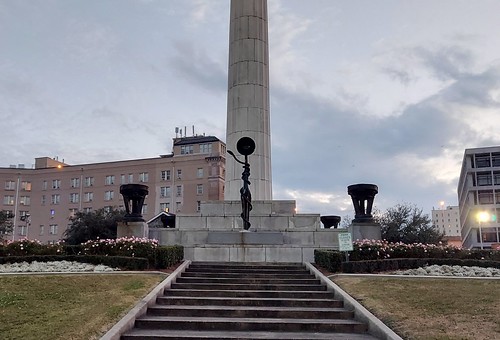
We have our Sentinel supplied this year by the artist Simone Leigh. This is her Prospect 5 installation at the circle we once named after Robert E Lee.

Mami Wata

The text below the sculpture reads:
 

Simone Leigh’s bronze sculpture Sentinel (Mami Wata) is sited at the base of the pedestal that once held a monument to Confederate General Robert E. Lee. The title of this work means “guard” or “watchman,” and it honors the work done by activists, citizens, and New Orleans city officials to remove symbols of white supremacy from public view, while also suggesting the possibility for a new protective spirit at this central downtown location. Sentinel (Mami Wata) takes the diversity of African cultures in New Orleans as a starting point, evoking African folklore and spiritualities. Mami Wata, a water spirit or deity, is known under many names across the African diaspora, including Yemaya, Yemoja, and Iemanja. Leigh’s sculpture holds forms of knowledge that have been passed down through spiritual and masking traditions in the city and beyond, wherein masking signifies transformation, not simply concealment.

Celebrating rituals and practices throughout the African diaspora that includes New Orleans, Sentinel (Mami Wata) marks a new chapter in the history of the renamed Egalité Circle, wherein the site represents one point in a larger constellation of public art, conversation, and historical memory. This constellation decenters whiteness and the legacies of colonialism, renewing access to knowledge and culture that has been suppressed by the falsehoods of white supremacy. Rather than perched atop the imposing multistory column that served as the pedestal for the Lee monument, this new work of art sits at ground level, not looming over people but emerging from among us. Leigh's sculpture is a temporary proposal for what could stand in the place of the previous monument—Sentinel (Mami Wata) will remain at Egalité Circle for a brief period before making space for other histories and narratives.

And, of course, we have our patron St. Valerio. Ready as ever to guide us through another ordeal as we solemnly seek to purge the demons of past seasons of misrule.

 It's Carnival time again. Meet me on the other side, another direction.

Monday, August 10, 2020

Pandemic Summer Reading

Whoa, hey it is already time for Back-To-School (except not really.)   I really have lost track of time.  How was everybody's summer? Did you see anything interesting?


It sure does feel like everything is happening [at once/too fast/too much/forever] and it can be difficult to unplug and re-focus.  So maybe this won't help at all but sharing some recent book notes probably won't hurt. Maybe there's something here you'd like to check out while watching the next month or so of school and sports... but definitely not rent... get cancelled.


China Dream by Ma Jian translated by Flora Drew (2018)

Chinese dissident Ma Jian's short satire of totalitarian corruption is by turns funny, surreal, and disturbing. Protagonist, Ma Daode is a high ranking functionary in the city of Ziyang's "China Dream Bureau" tasked with promoting President Xi's propaganda. His department is at work on a "China Dream device" which is supposedly a microchip implant that would replace the actual dreams of individuals with one collective "China Dream." This isn't really elaborated on in a technical sense except that it becomes clear that the idea is as far-fetched in the story as it would be in real life.

Meanwhile, Ma Daode's own persistent nightmarish memories of his experience during the Cultural Revolution are threatening to unravel his psyche and undermine his position. As suppressed guilt metastasizes to paranoia, Ma Daode struggles to maintain his slipping status in the bureaucracy where the worst thing a person can do is lose his composure. Or, as Ma Jian writes, "Like a live crab dropped into boiling water, as soon as you turn red hot, your life is over"

We're Still Here: Pain and Politics in the Heart of America  by Jennifer M. Silva (2019)

A few years back there was a boomlet in journalism and publishing for works aimed at upper middle class liberal audiences where an author would study "working class" Trump voters as though they were mountain gorillas. Exemplars of this genre like Hillbilly Elegy and Strangers in Their Own Land have been picked apart elsewhere for their condescension, and their class and racial biases. 

But Silva does not reproduce those failures here. Instead, this is a study of a multi-ethnic down and out working class living in the Pennsylvania Anthracite coal region during 2016.  The election is really only background noise in the book much as it is in the lives of these interview subjects most of which are several generations of despair removed from  a time when politics could have anything tangible to offer them.  Recommended for anyone with questions about the depth of social and political isolation in America who also isn't seeking superficial or self serving answers.

Biloxi by Mary Miller (2019)

Louis McDonald is going through some stuff. His wife has recently left him and his father has just died. Already having trouble adjusting, he has retired a few years early in anticipation of an inheritance that may or may not actually be coming to him. And that's when he sort of accidentally adopts a new dog. 

The setting is familiar, the story is not very complicated. Miller's voice and dry sense of humor expressed through her sarcastic and often flustered first person narrator are enjoyable. You'll probably finish this in a day or two.

Kochland: The Secret History of Koch Industries and Corporate Power in America by Christopher Leonard (2019)

Leonard takes us through the half century of Charles Koch's career at the head of the oil company he inherited from his father then expanded and diversified until it came to dominate massive industrial sectors of the American economy and therefore wield a staggering influence over political system as well.

Probably you are aware of this story. But having it all laid out like this can still be a revelation. We see Koch Industries swindle Native Americans,  bust unions,  skirt and rewrite environmental regulation, trade derivatives, and game markets for oil, electricity, chemical fertilizers. Almost everything that makes the modern world possible, is skimmed or outright controlled by Charles Koch in one way or another. 

The company's internal culture is deliberately ideological and often evangelistic in nature. Not only for the sake of its own growth and profits but also as a kind of a messianic cult.
The unity among Koch Industries' employees was hard to overstate, or even to articulate to outsiders. This was a cadre of people who worked for a secretive company that made the world work. They operated the mind-numblingly complex machinery that lay just beneath the surface of modern society: the pipelines, refineries, fertilizer plants, clothing factories, and trading desks. The stupendous profits that they realized from doing so only seemed to reinforce their sense of superiority over the outside world.  When it came time to fight the outside world, it wasn't done with malice or disregard. It was done with a sense of pity.  People outside the Koch campus seemed misguided, uneducated, somewhat oblivious to what it took to keep the lights on. Koch Industries would patiently work to correct these problems and make the world a better place.
It's becoming fashionable to speculate about our world's descent into a neo-feudalist order and what that sort of thing might look like.  One thing to take away from a book like Kochland is there are some actors out there who believe an outcome like that might be just what the world needs.

Lights All Night Long by Lydia Fitzpatrick (2019)

15 year old Ilya has been admitted to a study abroad program that has taken him out of his deteriorating Russian gulag town and placed him with a suburban family in (what we surmise to be south central or south west) Louisiana for a year. But he has also just learned that his brother has been arrested and accused of murder.  The novel then alternates settings between flashback chapters about the events leading up to Ilya's departure and his time adjusting to life in America while also searching for evidence that can clear his brother's name.

Obvious contrasts are drawn between the poverty of Ilya's hometown and the relative luxury enjoyed by his host family. But also we see similarities between life in the two towns both of which are dominated by oil production. The book's title describes the lights of the refinery in Ilya's town that would penetrate the windows of his family's home at night.  The core of theme, though, is about the heartbreaking effects of opioid addiction which we also see in both settings.

There is an unevenness to this set-up, though. Because the dominant narrative takes place in the Russian setting, the Louisiana scenes can feel a little.. less developed. There are characters and events there but they don't really matter enough to occupy half a book in this format.

Still this is very much worth recommending but maybe more for a YA audience.


I picked this up right at the beginning of our quarantine lockdown and, boy, is it ever the perfect thing to read while thinking about the governmental, institutional, and socio-political failures that not only  exacerbate the harm inflicted by a public health crisis but also ensure that it takes forever for anyone to learn from those failures if ever.

Brown's research into the Chernobyl aftermath brings to light tens of thousands of deaths she links to fallout spread far and wide through ecological contamination and the food supply chain.  Scores of poor people are basically deemed insignificant and sacrificed in order to accommodate profit, power and international politics. Not only do Soviet bloc governments in Ukraine and Belarus suppress information and deny medical care but Western powers and NGOs including the International Atomic Energy Agency and World Health Organization are also complicit in covering up the full extent of the damage on behalf of the nuclear power industry.  

Anyone concerned with the cost/benefit calculations of policymakers responding to the current public health disaster will find this an eye opener to say the least.

Other Words For Home by Jasmine Warga (2019)

A young Syrian girl's point of view story about migrating to the United States told in affecting free verse.  As life in her home town becomes dangerous during the Arab Spring uprisings, narrator, Jude, travels with her mother to stay with an uncle in Cincinnati leaving her father and brother behind. There she describes the challenges of cultural adjustment on top the typical pre-teen worries about fitting in, making friends, and trying out for the school play.  The family worries over intermittent news from home while also expecting a new arrival. 

Recommended for ages 10-15

Zed by Joanna Kavenna (2020)

Hoping to see this one show up on a few "best of" lists when this infernal year finally does come to an end.  Zed is first and foremost a dystopian satire about Big Tech and the hyper-surveillance state. But it's also something of a meta-commentary on the fraught politics and language we use to describe and combat those phenomena now, however ineffectively.

In the book, a company called Beetle is now THE tech giant uniting all the functions of e-commerce, logistics, data, entertainment, media etc. currently dominated by, you know, these guys.  Naturally, Beetle is even more tightly entwined with the state than our tech lords currently are. City streets are a grid of autonomous taxis. There are cameras everywhere. And, of course, the public safety is maintained by an automated police force acting under the guidance of a predictive algorithm. But when the system fails to foresee an unexplained murder, several characters must scramble to explain the failure as a human error or "Zed event" and ensure that no more random events happen in the future. 

So the premise seems pretty straightforward but there is a lot more going on here. Kavenna isn't just writing about technology, politics, police, and media.  She's writing about how we interpret those things through literature, through art, and even through our understanding of physical science.  One disturbing suggestion is that the total quantification and therefore commodification of human experience really does decontextualize and obviate any human objection.  

Thankfully, she doesn't beat you over the head with any of this heavy stuff the way a lesser writer might. Instead this is an absurdist story that owes more to Joseph Heller or even Douglas Adams (and certainly the authors she cites in this column) than it does to Orwell.  There is ironic commentary on the nature of causality and on the meaning of authenticity. The character in charge of maintaining the algorithm, one Douglas Varney, is a haggard and disheveled figure who has to appear in  "Real Virtuality"  chat rooms as a cool-faced avatar called @TheRealDouglasVarney.  Near the end of the story, as things begin to unravel a bit for the regime, we get this. 

The point was made across all free media. Nothing you are told is real. Remember this, until we tell you something you are being told is real. Actually, the thing we are telling you, that nothing you are told is real, is actually real. That thing is real, about nothing being real. Just that thing, though and nothing else. Is that clear?

Highly recommended. Would be my favorite novel of the year so far if not for...

The Mirror and the Light by Hillary Mantel (2020)

The third and final installment of Mantel's best selling, prize winning and otherwise much celebrated fictional history of the life of Thomas Cromwell.  Mantel's books draw on  20th Century scholarship that revised the traditional view of Cromwell as a power hungry villain and cast him as a uniquely competent, even progressive, reforming administrator.  Historians continue to argue over these interpretations but Mantel's work has clearly moved the more sympathetic version of Cromwell into the popular imagination where it is likely to stay for some time. 

He is a compelling character for modern audiences.  An unlikely rise from blacksmith's son to mercenary soldier to legal aide and finally to first minister and political fixer for Henry VIII defies the feudal social conventions still in place during Tudor times and presents to us as sort of a "rags to riches" meritocratic ideal.  So Mantel's Cromwell becomes a bit of an avatar for the early emergence of a capitalist order.  In a scene from the first book in this series, Wolf Hall, Cromwell reflects on certain members of the English nobility's misconception of where power lies in the new age.

The world is run from Antwerp, from Florence … from Lisbon, where the ships with sails of silk drift west and are burned up in the sun. Not from the castle walls, but from counting houses, not by the call of the bugle, but by the click of the abacus, not by the grate and click of the mechanism of the gun but by the scrape of the pen on the page of the promissory note that pays for the gun and the gunsmith and the powder and shot.

In the middle of reading Mirror, I also picked up Thomas Piketty's Capital and Ideology which paired particularly well because of this. Piketty's book compares different historical "inequality regimes" and the ideological underpinnings that rationalize each regime's structural distribution of power and wealth. One such contrast is between the medieval "trifunctional" (3 estates) order based on rigid social hierarchy vs the "proprietarian" capitalism based on the primacy of individual property rights that replaced it. 

Cromwell may be a man of the new era, but he has to operate within the fading but still dominant norms of the old. In one scene from Mirror he is investigating a murder when a colleague stops to advise him he isn't relating to the commoner witnesses he interviews in the correct fashion.

Listen, Cromwell, you don't get a good name among the lowly by sharing their concerns and handing out coin. You get their respect by overlooking them, as if you did not understand their sort, and your own belly had never been empty. 

One facet of Piketty's argument is that our 21st Century neoliberal regime may be devolving into a neo-trifunctionalism where a corporate dominated cultural elite divides governing responsibilities with state police powers while the majority working class is, well, overlooked. So there are resonances between these books that might also be harbingers. 

Another familiar political theme throughout the Cromwell novels is the problem of navigating an authoritarian regime headed by a spiteful narcissist.  One simple way to describe these books, in fact, is to say they are a story about how to survive under totalitarianism until you don't.  

By the time we reach the third book, Cromwell has survived and thrived because he has understood better than any of the courtiers around Henry that the imperative is always give the king what he wants.  It's a rule that supersedes all considerations of morality and law and meeting its requirements demands ruthlessness. The further Henry's appetites strain against what should be his boundaries, the greater the danger increases. Not to Henry, of course. There are consequences for his transgressions but as Cromwell reflects at one point...

But the law is not an instrument to find out truth. It is there to create a fiction that will help us move past atrocious acts and face our future. It seems there is no mercy in this world, but a kind of haphazard justice: men pay for crimes, but not necessarily their own.

But Cromwell is not an amoral actor. He has agendas of his own both personal and religious which he has been able to advance by staying on top of the gossip, knowing who to do favors for, and by "arranging his face" so as never to give the game away.  In other words, office politics but with actual beheadings. 

Now we see all of that unraveled as the realities of that haphazard justice begin to catch up with him. We can rise to great heights learning to work the system and flatter even the most dysfunctional sort of  power only to discover we are, in fact, as captured by and subject to its caprices as everyone else. Frustrated by his inability to advance the cause of Protestantism beyond that part of it that fits the king's whim, unable to defend friends and allies without compromising himself, knocked back by one particularly stinging personal rejection, Cromwell begins to resemble, ever so slightly, that red hot boiling crab described by Ma Jian.   

Cromwell's enemies conspire against him in plain sight but there is no recourse other than to continue arranging one's face and acting as though everything is under control.  Until, inevitably, it isn't.  Once the disaster is set in motion, the only move is to allow it play out.  Whatever the strength of our convictions, talents, or resolve, ultimately we are at the mercy of terrible forces greater than anything within our grasp.  All we can do is wait on those forces to mete out what punishment they will.

While awaiting his sentence, Cromwell imagines what Hell might be like.

That is how it will be-not pain itself but the constant apprehension of pain; the constant apprehension of fault, the knowledge that you are going to be punished for something you couldn't help and didn't even know was wrong; and the discord in Hell will be constant, repeating for ever and ever, a violent argument being carried on in the next room.

If Pandemic Summer 2020 had a more definitive mood than that, we would be hard pressed to name it. 

Tuesday, January 21, 2020

A Muse or a Nyx or whatever

Looks like an interesting memoir to add to your reading list this Carnival season.
“Singing Out Loud: A Memoir of an Ex-Mardi Gras Queen” chronicles Eaves’ life in New Orleans, her struggle with mental health, her unease with the city’s hierarchical social code and her journey to selfhood — standing on her own two feet and deciding for herself what she wanted in life. In some ways, the book could be about almost any questioning young woman born in the early 1940s who did not yet have the strength of the feminist movement to bolster her. But in other ways, it could only have happened here.
Deb Interrupted, maybe?  This article hints that readers will get some insight into the social and racial dynamics of Carnival society. It also notes that Eaves's daughter produced one of the more compelling documentaries that covers much of the same ground.

I'm not sure how to read this quote. It doesn't have to mean she thinks it's all better now. But it can suggest that. 
Homesickness brought the couple back to New Orleans, where Eaves discovered Carnival traditions had expanded to include many more forms of expression, well beyond what she described as the restrictive, hierarchical practices of the old line krewes.

“During the time that we were gone, Carnival expanded so much,” she said. “Now, anyone who wants to can be part of the festivities in their own way. They can be a Muse or a Nyx or whatever suits them. It’s a wonderful evolution of the culture.”
You can be a Muse or a Nyx or whatever now. It's progress, I guess.

Thursday, October 31, 2019

Fall reading

Crainz

Happy Halloween, everybody.  For some reason we stopped posting the book blurbs almost as soon as we started it over the summer.  Let's correct that now.

The Missing Season by Gillian French (2019)

Actually, this YA novel is the reason I'm posting these on Halloween in the first place. Clara's family moves from town to town as her father chases the next demolition job. The latest move is to the fictional town of Pender, Maine where the paper mill that had been the economic heart of the town has closed. For Clara it means adjusting to a new school and new friends again. But it also means a possible encounter with the town's urban legend.  Every year around Halloween, at least one young person seems to turn up dead in the woods around Pender.  Officially the deaths are violent accidents or drug overdoses. But others say a mysterious figure known as "The Mumbler" is to blame.   Clara's family has arrived at Pender in mid-October. Could she become the next victim?

This is a terrific novel for young adults. French's treatment of teenagers, their problems and relationships is realistic and thoughtful. It's also the best kind of horror writing in that it relies on the characters' real life sense of dread rather than shocking imagery or situations.  The fading town and diminishing prospects for its children is a major component in that as well.  I would have liked the ending to have resonated with those themes a bit better.  This one seemed abrupt and just a little out of synch.  Otherwise, a good little Halloween story.

White House Warriors: How the National Security Council Transformed the American Way of War by John Gans (2019)

This keeps the Halloween theme a little bit in a banality of evil sort of way. This dry and anodyne account surveys the evolving role of the National Security Council in generating and executing US foreign policy. Gans focuses on individual staff members serving under each President since the NSC's inception to describe major events (the bombing of Cambodia, the Lebanon intervention, Iran/Contra, the Iraq troop surge, etc) through the eyes of these somewhat behind the scenes actors. The NSC is either an unaccountable "common law" deep state or a flawed but necessary crutch that serves Presidents who would otherwise be overwhelmed by the bureaucracies at DOD and State. Is any of this a good thing or a bad thing? Gans says it's a little bit of both, although the suggestion is it's gotten to be more of the former over time. Either way we're left trying to decide if the sprawling American empire is more chaotic than it is legalistic. All of which causes us to wonder what difference that really makes.

Chaucer's People : Every day lives in Medieval England by Liza Picard (2019)

Picard uses Chaucer's archetypal characters as entry points to brief essays about the lives of the real sorts of people they represented. For example, the Wife of Bath describes what it was like for wealthy travelers of the Middle Ages to go on pilgrimages to the Holy Land. (They had to buy Rick Steves videos on VHS back then.) The Ploughman chapter talks about how labor conditions in the wake of the Plague led to official wage suppression, a more rigidly controlled economy and a peasant's revolt.  The Cook's chapter has lots of odd recipes.  The Physician chapter describes the horrifying state of medieval medicine... which I guess is a good place for us to land on our Halloween theme again.  Anyway, you get the idea.

Remaking New Orleans: Beyond Exceptionalism and Authenticity edited by Thomas Jessen Adams,  and  Matt Sakakeeny (2019)

Actually I want to write more about this later.  It's difficult to sum up in a paragraph without simplifying. It's a collection of essays intended to dispel certain myths about the history and culture of New Orleans that have been commodified by the tourism industry while elevating ignored facets of our story that emphasize the city's working class and what has been done to it in various ways over the centuries. Again, that is an extreme simplification but it's what I would say is the gist of this very eclectic assemblage of topics by various authors. It's one of the most original and important books about New Orleans I've read in a while. At the same time I've noticed a few negative reactions from certain corners that have me confused. The common criticism I've noticed, that the book is for and by "gentrifiers," seems to me 180 degrees contrary to the book's actual purpose. It's so surprising, in fact, that I've wondered if it is even offered in good faith (or if some of these critics have actually read the book.)  But, like I said, this is all a subject for a longer thing I want to write.  For now, just know that this exists and that more people should give it a look.

Sunday, September 15, 2019

Just impeach the MFer already

There is still plenty time left for them to do it. They obviously don't want to do it but that only underscores their own selfish cowardice. But we talked about this already a few months ago.

Wednesday, September 04, 2019

In the public health department

Tim Faust at Garden District Books

Let's see what day was this?  It was a long weekend and I have no idea what I did with most of it.  Was it Friday?  I think it was Friday.  Anyway I went to see Tim Faust speak at Garden District Book Shop.  The book he's promoting is called Health Justice Now: Single Payer and What Comes Next.  I'm sure it's very good. I did buy a copy but it's at the bottom of a pile quite similar to if not worse than this one from the middle of the summer. I'll get there eventually.  If you've seen, read or heard any of Faust's work advocating for a better health care system than the nightmare we live and die at the hands of today, then, well, this talk was very much like that.

In his talk, Faust says the US is "the most dangerous place to be sick the most dangerous place to be poor, the most dangerous place to be black or brown, the most dangerous place to be disabled, the most dangerous place to be queer..." There is a mutually reinforcing relationship between poverty and illness. The so-called "health-wealth gap" in the United States adds up to a 20 year difference in life expectancy between the richest and poorest. All of these states of precariousness are direct reflections of an unjust health system. 

By that, he means the US health care delivery apparatus is fraught with such waste and unfair distribution that the negative health outcomes compound upon each other. "In the US all prices are fake," says Faust. The costs of primary and preventative care are grossly inflated as large corporate providers force smaller health clinics out of business in order to charge hospital rates for everything. And, of course, insurance companies can only profit by denying patients care when they need it. 

Unjust wealth allocation leads to unequal health outcomes in all sorts of ways.  Faust travels all over the country talking to people about health care and gave a few examples. In Houston the prisons have become warehouses for people with untreated mental illness. In Memphis environmental racism has led to a situation where black children die at 20 times the rate of white children.  When Indiana Governor Mike Pence inhibited needle exchange programs during the height of an opioid crisis, it  resulted in "one of the biggest HIV outbreaks in decades."  These are all essentially questions of resource allocation.

The day after I saw Faust talk, I read in the Advocate that the state has finally responded to public pressure at least to the point of agreeing to study the effect of the Denka neoprene plant on cancer rates in St. John Parish. As we know, the State of Louisiana subsidizes the proliferation of plants like Denka to the tune of billions of dollars each year.  Poor Louisianians are subsidizing the profits of the petrochemical industry with their very bodies.

The US spends over $3.6 trillion annually on health care. According to Faust at least 1/3 of that is "waste." It would cost approximately 10 percent less to implement a single payer system. And the savings can be applied to giving people better housing, better transit, better food access, a fairer criminal justice system etc. all of which support better health outcomes.  So the fight for health justice really is at the center of a struggle for a radical societal overhaul.  Efforts to combat the problem at the margins via schemes like Obamacare or Medicaid as we know it are not good enough. It is in Faust's words a question of giving people "insurance or emancipation."

Which is why the expansion of Medicaid under Obamacare that John Bel Edwards' reelection campaign touts as a major accomplishment doesn't get us where we want to go. In Louisiana, Medicaid is privatized. And the MCO contracts, in addition to just being inefficient means of shoveling money to for-profit insurers and providers, amount to one of the biggest slices of political patronage a Governor can hand out. This year, the dispute over those contracts has left over half a million Medicaid patients in a wholly unnecessary state of uncertainty just as the start of open enrollment for next year looms. 


Finally, Faust fielded a few skeptical questions from audience members about whether or not a single payer system would garner support from doctors, some of whom, at least, might find certain aspects of their practices less profitable. But, while that isn't really true for most doctors,  the question did remind me that a professional association of Louisiana doctors has endorsed Ralph Abraham for Governor.
The Louisiana Medical PAC hasn't issued an endorsement in the most recent governor's races, but jumped at the chance to endorse one of their own.

“It’s been a number of years since we decided to take a position in the governor’s race, but we have one of our own running,"  Dr. Robert Bass, chairman of the PAC, said in a statement. "We believe that physicians supporting physicians is important, and when you have a candidate like Dr. Abraham, it’s very easy to make this decision.

"Dr. Abraham has a wealth of knowledge that is critical to helping Louisiana improve healthcare outcomes."
That's interesting. As it happens, this week the Bayou Brief provides us with an example of one health outcome Dr. Abraham has used his "wealth of knowledge" to bring about.
“Opioids—mainly synthetic opioids (other than methadone)—are currently the main driver of drug overdose deaths,” states the CDC. “Opioids were involved in 47,600 overdose deaths in 2017. A staggering 67.8% of all drug overdose deaths are due to opioids, and while nationwide these numbers have declined, Louisiana is one of a handful of states in which deaths from opioid overdoses have increased.

During the past year, overdose deaths went up by 4.7% in Louisiana.

“Louisiana also ranks among the top 10 states with the most opioid prescriptions written per capita, according to its state’s lawsuit against 17 companies, including Purdue Pharma,” according to a report published yesterday by APG Wisconsin. “Since 2007, the state has spent at least $677 million ‘for treatment of opioid use and dependence.’”

During the seven-year timeframe, Abraham’s pharmacy in Winnsboro doubled the number of opioids it dispensed to patients; opioid prescriptions filled at his pharmacy in Mangham, which is located near his former medical clinic, surged a staggering 67%.

In Mangham (2017 population: 638), Abraham’s pharmacy supplied enough opioid medication to provide every man, woman, and child 6.1 doses every year (or 43 pills in total) for seven consecutive years; his pharmacy in Winnsboro (2017 population: 4,652) could have provided every resident 4.4 doses per year (or 31 in total). (Note: Annual doses per person were based on Census estimates, not the most recent American Community Survey).
If a single payer system focused on health justice for all means a less profitable pill pushing scheme for Dr. Feelgood that's just something we are going to have risk.