-->
Showing posts with label homelessness. Show all posts

Tuesday, January 14, 2025

Camp Bernhard

I've had less time to be annoying online lately. That should change soon. But 2025 has been a monster already. Not only because the world seems to be on fire in various ways but also because of a series of personal crises.  Hopefully that gets dealt with soon enough.  

Even so, it's hard to know what there is to say anymore. Nobody has to work very hard to explain the cruelty and corruption that happens every day.  It's all so blatantly on the table now. I'm not even going to say anything here. Just putting the relevant bits in bold for you.

As part of a sweeping effort to spruce up New Orleans before the Super Bowl on Feb. 9, Gov. Jeff Landry said Monday his administration will begin clearing homeless encampments downtown, moving some residents to a Gentilly warehouse miles away and others to undisclosed locations out of state.

The 70,000-square-foot shelter is expected to open by Wednesday, when state authorities plan to begin relocating those living on the streets around the Caesars Superdome, French Quarter, I-10 and US 90. Notices were being posted at some encampments on Monday, warning that failure to move to the new shelter “may result in enforcement action or legal proceedings.” The notices indicate that transportation and storage will be provided.

The warehouse, located at 5601 France Road, will serve as a temporary shelter and can accommodate 200 people, according to a proposal by Workforce Group, the company that Gov. Jeff Landry’s administration has tapped to operate the facility.

The building is owned by the Port of New Orleans and sits along the Industrial Canal across from Pontchartrain Park, far from the city's tourist-laden core. It will be subleased to the state for at least two months at an estimated cost of $11.4 million, with a possible one-month extension that would increase the price tag to $16.2, according to budget documents. That time frame ensures the shelter will be operational through Mardi Gras on March 4, another massive tourist draw. 

Okay I will say one thing to move the story forward. Many have pointed out that the state could spend 16 million dollars on the same people and probably get them all housed or well on the path to being housed. Instead they are putting them in a concentration camp. Are they doing that because they think its efficient? Probably not. Or they doing it because "the cruelty is the point"?  Maybe.  Is there some other reason as well? Well, see...

Baton Rouge-based Workforce Group is a disaster recovery firm that helps state and local officials with federal grants, data management, staffing and insurance claims, according to its website. Workforce Group is owned by The Lemoine Company, a Lafayette firm backed by Bernhard Capital Partners.

Yes, that Bernhard Capital


Monday, November 25, 2019

Let's all cosplay against homelessness

Hope everybody had a good time at the LARP.
On a balmy November night in New Orleans, 230 people filled the rooms and courtyard of Covenant House, a residence for homeless youth on the edge of the French Quarter.

They came from as far away as Texas, Alabama and Mississippi. Starting around 6:30 p.m., they placed large pieces of cardboard on the sidewalk around the building, and later that night they slept shoulder-to-shoulder in sleeping bags on the cardboard for the center’s eighth "sleep-out," an annual event that raises both funds and awareness for the city’s homeless youth.

By dawn the next morning, the event had raised $610,000 in pledges, over 10% of the facility’s $6 million annual operating budget.
I don't know, guys. Seems like the donors could have just mailed in some checks without going through the little demonstration. Better yet, we could just tax these people a bit more so we can fund true public services that aide and house the needy instead of just allowing them to throw their money at a corrupt religious non-profit like Covenant House. But since like 70 percent of the local economy relies on flattering the well off into thinking they are the real heroes anyway, I guess it's a natural fit.

Tuesday, November 19, 2019

The real problem with caring for the homeless is there's no money in it

Ozanam Inn is being kicked out of its building after 64 years. The reason is it turned out, finally, to have been bad business?
According to its tax filings, St. Vincent de Paul over the past four years has seen a sharp step-down in gross receipts, from nearly $900,000 in the year ended September 30, 2016 to below $600,000 in the year to end September, 2018, the latest tax year filed.

Expenses have consistently outstripped revenues, and in the latest year, the accounts show an unexplained $311,000 write off in the value of its assets which, together with the deficit, meant assets fell to $1.75 million from $2.1 million.

The society at one point operated a half dozen thrift shops in New Orleans, but this has contracted in recent years so that it now operates just one shop on the Westbank, on 4th Street in Marrero.
The article points a bunch of fingers at the St.VdP director. And who are we to say anything about that situtation. But the bigger question here is, was booting a homeless shelter out in favor of a "hotel and parking garage" during a housing crunch really the best solution?  Who decides these things anyway?

Maybe it's just plain old capitalism at work where all parties compete on perfectly equal footing in the fair and free market.  Right?
Demma went on to say that Ozanam Inn would have the right of first refusal to buy the Camp Street building if they could come up with $100,000 "earnest monies" and reach a deal on the final amount.

Last month, Demma told members that 843 Camp Street had been sold to an unnamed developer. Documents showed that the building was sold for a nominal $100 and that St. Vincent de Paul issued a $2.69 million mortgage note to Excel Advertising Group LLC, a company registered in Delaware, which is the official buyer.
Ozanam says their $3.5 million offer was rejected in favor of this $100 dollar up front investment. So whose money is that?  Stay tuned because it is a mystery.

Although the story does provide us with a tantalizing lead.
Excel lists Michael Boudreaux, a New Orleans property management agent, as its sole officer and he signed the sale document. Also, John Holmes of True Title in Metairie was listed as the buyer's authorized agent on the sale. Neither responded to requests for comment.

Several people who have been privately briefed and didn't want to be quoted by name said the owner is a long-time New Orleans developer who has built hundreds of condominium units, sub-divisions and commercial real estate in and around the city, including the conversion of a landmark riverside historic property into condominiums.
LOL, they obviously know who it is. Is it Sean Cummings? That sounds a lot like Sean Cummings. It could be several other people too. (I think the suggestion that it could be Marcel Wisznia is kind of elegant since it makes sense that the guy building a "co-living" development would be interested in a homeless shelter.) But why give us this many clues and not just say who it is?  I'll bet John Georges knows who it is.
John Georges, who along with his wife, Dathel, owns The Times-Picayune|The New Orleans Advocate, said the company — a direct neighbor of Ozanam Inn — is interested in jointly developing the proposed parking lot.

"We would certainly welcome the redevelopment, and I was happy to hear Ozanam Inn has opportunities for other locations that should be announced before the end of the year as part of a master plan to address the homeless situation," said Georges.
So instead of Ozanam buying the building for $3.5 million, we have this alternate transaction where it transfers (for $100!) to a mystery "long-time New Orleans developer" and John Georges is possibly cut in on it in some way.  Of course that looks real bad if it means actually booting homeless people onto the street. We're gonna need some help to keep that from happening.  Luckily the city has already stepped in to facilitate.
Ozanam Inn's plans depend on a broad agreement with homelessness agencies being negotiated with the city of New Orleans.

"We are aware of the recent sale of Ozanam Inn's building, and we're in close contact with their staff and board of directors as they determine their next steps," said a spokesperson for the City, who declined to comment on talk among homeless advocates that city land on Poydras Street near South Claiborne Avenue had been earmarked as an alternative location for Ozanam Inn and other housing.
This looks like it's been in the works for quite a while. Rich developer gets a free building. Local magnate gets a piece. The city gets to maximize the property's revenue potential. All they had to do was scoot a decades-old charitable institution out of the way. Remains to be seen what the city's homeless advocates and their clients end up with out of the deal.  We sure hope it's a "fair share."

Friday, October 04, 2019

Aggressive enforcement

What is a nuisance bar? Nuisance to whom?
The proposals often have pitted bars and their owners against nearby residents and other businesses, with bar operators contending that the new rules will hurt an industry that's important to tourism and the city's easygoing culture, while their opponents want more city actions against nuisance bars that disrupt neighborhoods' quality of life.

The contours of the most recent fight were set in large part under Mayor Mitch Landrieu and the previous City Council. In 2017, former Councilwoman Stacy Head put forward new rules, supported by Landrieu, that at one time or another included a requirement that bars install exterior surveillance cameras tied into the city’s crime camera network, a ban on outdoor seating, and rules that would have prevented a bar counter from being within 10 feet of a business’ door, among other provisions.
A lot of the time this just means there is activity in the neighborhood after dark. Some people have a very low tolerance for that. Not everyone does.  But the assumption when this comes up is invariably that everyone shares that same low tolerance.  Some of us actually kind of like it when, say, the laundromat across the street is hosting a late night all ages show. It doesn't have to be something we necessarily want to participate in. It's just kind of neat to see that someone is enjoying something. I'd say that's good for my "quality of life."  But our use of that term also is loaded with the fears and hostilities shared only among a specific class of property holders.

Our city government will always act to protect this class first. Yesterday City Council moved closer to passing a set of rules that will grant the Chief of Police, the Chief of the Fire Department, the ABC board, or the Department of Safety and Permits "emergency" powers to unilaterally shut down a bar deemed to be.. well.. a nuisance according to the prejudices of the protected class of property holders concerned about "quality of life issues."  The delay now is only about what the appeals process might look like. Originally, there wasn't even going to be one.

One thing worth remembering also is that these rules are left over from a process begun under the Landrieu administration. They were designed with input from attorney Scott Bergthold who Mitch brought in specifically for his expertise in shutting down strip clubs across the country. The purpose of these laws is to have a little due process built in as possible. The city has already decided whose side it is on.  Right now they're just figuring out how aggressive they can get away with being.

And we can expect that to be, well, pretty darn aggressive.  At least that is what LaToya Cantrell said during her budget town-phone-ca-hall thingy this week. 
After a French Quarter resident complained about a lack of public bathrooms and a lack of enforcement of laws against public urination, Cantrell said she was looking to "retool" the French Market Corp., though she didn't provide specifics. She also suggested a crackdown on quality-of-life violations in the tourist district.

"We will be enforcing the laws on the books relative to the quality of life. This is going to be more aggressive as time goes forward but also more consistent," Cantrell said.
Now one could read a question like that and consider that maybe it's the actual lack of public bathrooms and other such support for the city's homeless that is negatively affecting their "quality of life."  But we know that isn't what LaToya is talking about.  Her solution is "more aggressive" enforcement of  "laws on the books."  Because the law already favors the side she cares about.

Friday, July 12, 2019

No opportunity wasted

The city had an excuse to get out and confiscate some tents and stuff from homeless people and they took it.
But just outside of the New Orleans Mission, there were some homeless residents that weren’t too happy with the city’s approach to encampment sweeps.  “We just got wiped out,” one woman, who lives under the Pontchartrain Expressway overpass, told The Lens. “They took our tent and everything.”

The woman asked to remain anonymous, saying that some of her family didn’t know about her current situation. Her husband, who said he worked as a dishwasher in a nearby restaurant, also asked to remain anonymous because he didn’t want his employer to find out that he is homeless.

As part of its preparations, the city conducted sweeps all along Claiborne and Calliope streets, Babcock said. During the sweeps, city employees removed debris that could be thrown by strong winds while homeless outreach workers spread the word about the extra capacity at the shelters.  But like any encampment sweep, city officials also took “unclaimed” property, including tents. Some of the items confiscated during sweeps are stored by the city until their owners can come get them.

However, at a City Council Quality of Life Committee meeting in March, the city’s Director of Housing Tyra Johnson Brown told city council members that only four people had come to retrieve their belongings over the last five years.  Some large items, such as tents and mattresses, aren’t stored and are simply thrown away, Avegno told The Lens in May.

“I wasn’t even here for it,” the woman who said her property was removed told The Lens. “I was at a meal. All I know is when I came back my home was gone. I lost my tent, my bed, my blankets, everything. Now we got a tropical storm coming.”
 Well, at least we can't say they aren't being "intentional."  We know they like to do that. 
Still, the woman living under the overpass said she made her decision, and wished she still had a tent to provide at least some protection.

“I think it’s cruel and intentional to come out here and steal our tent like that,” she said

Sunday, May 26, 2019

Is the rent too damn high?

I wish somebody would tell me because there is just no way to know for sure.
Still, in cities like New Orleans where job opportunities haven’t kept pace with rapidly rising housing prices, advocates are worried that recent gains may be reversed.

Before Katrina, half of all apartments in the city used to rent for less than $500. Now, it’s difficult to find anything under $1,000. At the same time median household income in New Orleans has fallen from $39,000 in 1999 to $37,000 in 2017 when adjusted for inflation, according to a February report by The Data Center.

The same report found that, between 2004 and 2017, median gross rent — rent plus utilities — rose from $742 to $962 in New Orleans, a 30 percent increase after adjusting for inflation.
That's actually contextual background in a story about homelessness in New Orleans.  Earlier this month the City Council passed an ordinance requiring a more aggressive regime for clearing out encampments under the overpasses.
If the new ordinance becomes law, the city would theoretically institute more regular cleanings and would have to post notices 24 hours in advance of any cleaning. The ordinance also mandates store-and-release practices for people’s possessions, to address complaints that camps were basically clear-cut by city sanitation workers, who cut up tents and threw them into garbage trucks along with people’s other meager possessions.

UNITY’s advocacy committee thought the law missed the mark. “The ordinance would increase the amount of time and attention spent on removing homeless people’s possessions and moving homeless people around, neither of which will reduce homelessness,” they wrote in a letter to the council.

“People are already so stressed living on the street. They are so stressed,” said Nan Roman, who heads up the National Alliance to End Homelessness and supports the idea of a clean camp environment. Still, she opposed the new ordinance because it seemed too focused on “moving people around.”
This doesn't seem like it's going to help anybody find a home any faster.  It helps councilmembers appear responsive to people emailing them complaints about having to look at tents when they drive downtown, though.  The mayor's office has tried to push back on it. That's to their credit.  There had even been some talk of a veto at one point but I'm not sure that would stick.

Anyway, it's tough to keep up with the bills around here. If they don't save me a spot under the bridge I might have to start working on a new fallback.

Tuesday, March 26, 2019

City of No we don't want to hear about it

It's not clear why the mayor ditched this effort to count the number homeless who die on the streets of New Orleans each year. Her spokespeople only say here that she "would certainly consider" something like it in the future.
City officials effectively killed the effort through what Miller describes as widespread indifference and a refusal to devote any resources to ensure every homeless death was counted.

So last year’s count stopped at 40. No one knows how many more people died. The final number could be 80. It could be 100. It might be more. It might be less.

Mayor LaToya Cantrell, who initially agreed to an interview to discuss the issue, instead issued a statement saying her administration is dedicated to “finding inclusive and responsible ways to address homelessness.”

The mayor “took an interest in the report put together in prior years,” Communications Director Beau Tidwell said in reference to Miller and Burchfield’s work. “As mayor, she would certainly consider instituting an official annual accounting of homeless deaths. Our health department will be evaluating best practices from other cities.”
The article makes an effort to show that other cities do work like this. It also suggests that Cantrell's commitment to it wavered after she moved from City Council to the mayor's office.  But neither she nor anyone interviewed here provides an explanation as to why.  There must be something we aren't hearing.

Monday, March 26, 2018

Basically, Stacy called them whores

When I wrote about the strip club thing last week, I left this bit out because I wasn't 100 percent sure I heard her correctly.  But, yes, it turns out  Stacy Head did indeed imply that the strippers who showed up to testify against her attempt to put them out of a job were prostituting themselves.
City Councilwoman Stacy Head, who failed last week to persuade her colleagues to put a limit on the number of Bourbon Street strip clubs, is rarely shy about expressing her opinions on the council dais.

So it might have come as no surprise Thursday when she chided some of the two dozen dancers who spoke out against the proposed cap on the clubs for accepting a financial incentive from their employers in exchange for their opposition.

Head said two clubs under the Larry Flynt brand, Hustler and Barely Legal, offered to waive 10 so-called “house fees” for any dancer who showed up to oppose the cap. Dancers must pay such a fee to the clubs each time they perform on stage.

“That’s selling yourselves out,” she said.
You see this sort of thing pretty often. It's a common trope among conservative plutocrat types seeking to deligitimize popular opposition.  This is why we are told the March For Our Lives this weekend was secretly organized by "Soros" or some nefarious actor.  The other night I saw a lady on Twitter accuse Airbnb critics of shilling for  "the hotel industry." In New Orleans we hear often from the Stacy Heads of the world that council chambers have been packed with "paid protesters" over any number of issues.  It's a small glimpse at the contempt with which the politcal insiders and City Hall regulars regard anyone outside of their own social class. 

Stacy is an accute and often cartoonish example of this.  Last week, she suggested that policymakers should consider homeless New Orleanians as though they are of lesser "value" than other residents.  Clearly she has similar notions about the Bourbon Street dancers.  But while Head is particulary nasty, it's worth noting these attitudes are spread more widely than that. I dare say they hold a majority among our political class many of whom would be advised to reflect on their own actions before accusing others of "selling themselves out."

Friday, October 13, 2017

How much money is Ron Forman's con-profit stealing this time?

Do we even ask that sort of question anymore? Or is it just a matter of course that the oligarchs always get a cut?
Another point of confusion over how far along designs are for the bridge depended on the involvement of the Audubon Nature Institute, which Berni said "will be in charge of construction" of the bridge and will "take part in the design process." The mayor's office's announcement last week revealed the new bridge would be built on property owned by Audubon and connecting with the nonprofit's Aquarium of the Americas. Berni said Wednesday that the city is currently working out a cooperative endeavor agreement with Audubon to make use of the property for the bridge.
Meanwhile, they're having trouble explaining to councilmembers why the pedestrian bridge costs so much.  One thing they are sure they don't want to spend any money on, though, is giving homeless people a place to get out of the rain. Even if that means, you don't get one either.
Pressed by Guidry, Berni further hinted that aside from added costs, one impetus for keeping the bridge roofless might be to discourage homeless people from being there.

"Yeah, I think that's probably one reason," Berni said. "But I'm sure there are many others, including cost."

Thursday, September 21, 2017

The Distractor tax

We're still trying to get this much needed low barrier homeless shelter built. It appears to have cleared the latest hurdle in this real estate survey.
The city's only plan for the former VA hospital so far is to build a low-barrier homeless shelter on the building's first floor, which spans about 43,500 square feet. The entire building is 746,000 square feet and tops 1 million square feet when the garage is included.

The city acquired the former VA hospital in a property swap that allowed the new VA to be developed on city-owned land next to University Medical Center in Mid-City.
 
JLL took plans for the low-barrier shelter into consideration when it conducted its analysis, and asked potential developers and tenants whether the homeless shelter would be an issue.

"It was generally deemed that the presence of the facility would serve as a distractor," JLL wrote. "However, the opportunity prevails to successfully plan the various uses to create separate entrances, arrival areas and divisions in order to mitigate the impact."
Can't have too many "distractors" getting in the way of our development. They sound like some dickhead coach telling his players to "stick to football."  Cities are diverse places. There are distractors everywhere.  They aren't always great for maximizing profits so we do everything we can to eliminate them. Or at least, we move them across town.

It's interesting to see now that LaToya Cantrell has successfully NIMBYed the homeless shelter away from Ben Kleban's charter school and over to the VA site, that she wants to be credited as one of its most prominent advocates.   At least today's article provides some of the context, even if it does let her get away with the claim. Her statement is OK, although it still couches everything in terms of ROI than in anything human.
"The value of the low barrier shelter far outweighs the speculative value of redeveloping the site without the shelter there," Cantrell said. "Eventually, the city and its partners could end up recouping much more value from reduced E.R. and jail costs than it could if the shelter were not in the VA to begin with."

She added that "we need to be focused on the long term viability and best use of the property, not the short-term return for what was a non-income producing property to begin with."
Regardless, whoever takes on the site, is going to refer to this study eventually.  It's how they're going to justify whatever big tax break they inevitably end up asking for.
The analysis suggests that any developer who would be brought on to convert the property to a commercial use would need a "financial enhancement" because of the cost.
When they do, they can expect Mayor(?) Cantrell will have a sympathetic ear.  During last night's forum she talked briefly about economic development saying, "We have to roll out the red carpet" with "incentives" for developers. Adding that the current climate is "too politicized." In a nutshell, she was saying she favors more public giveaways to developers done more quickly with less public oversight and accountability.  Which is why anytime the real estate industry successfully identifies a "distractor," it means the rest of us will have to pick up the burden of that for them.

Wednesday, July 19, 2017

Solving the homeless problem

One way to do it is to remove the homeless
Metropolitan New Orleans area has seen almost a 90 percent drop in its homeless population in the last decade, from nearly 12,000 individuals to about 1,300 in a count this year, according to Ellen Lee, director of the Office of Community Development for New Orleans. Some 300 people left the streets in the past year alone, an achievement she attributes to outreach efforts by the city and nonprofit groups.

Counting Coleman and her children, Grace at the Greenlight has helped 1,003 people into a home — most of them in cities outside New Orleans, said Sarah Parks, the group’s executive director.
Back in December LaToya Cantrell fought like hell to keep the city from opening a low-barrier homeless shelter in Central City because some charter school assholes didn't want to have to look at it. They moved it to, like, a dumpster behind the VA hospital or something. But, I guess, a bus out of town is ideal, really.

Wednesday, March 15, 2017

Congrats to the Nimbys

They've successfully located the "low barrier" homeless shelter away from where anybody will notice it which is, of course, the important thing.
The former Veterans Affairs hospital site in downtown New Orleans has been picked for redevelopment into a new low-barrier homeless shelter in a joint project of the Downtown Development District and the city with financial backing from tourism and convention groups, according to a draft agreement.

The old hospital has been replaced with the new VA medical facility in Mid-City, although a renovated wing of the building still houses a day center for the homeless to access services at 1530 Gravier St.
Congrats, also, on apparently squeezing some money out of the Convention Center to help pay for it. For some reason they have too much control over too much money that really ought to go to the city directly for things like this.  

Tuesday, October 04, 2016

Low barrier

This week, the mayor announced plans for a new "low-barrier" homeless shelter on Erato street at S. Derbigny just uptown from the Calliope overpass. The shelter is a good idea and deserves to be supported. Not everybody thinks so, of course.
The new shelter, which Mayor Mitch Landrieu’s administration plans to build at 3101 Erato St. in the B.W. Cooper neighborhood, is just two blocks away from two public school buildings. They are Sylvanie Williams College Prep and the shuttered Booker T. Washington High School, which is expected to reopen in the near future.

Critics worry that piling many of the city’s homeless in one space could pose a threat to students and residents because the shelter would be open to all comers, including people who are mentally ill or struggling with alcohol and drug addictions.

“What we are saying is: Our children are a top priority,” said Ben Kleban, an Orleans Parish School Board member-elect and the founder of the charter management group that runs Williams. “Safety for them is a top priority. And this shelter, by design, will concentrate some of the most in need … in a neighborhood that is already in need of services.”
"Think of the children!" says Ben Kleban even though there is no reason to believe any children would be harmed by there being better services available for the homeless population.  Kleban, by the way, is an OPSB "member-elect" as a consequence of having been unopposed in one of what could have been a pivotal slate of school board races.   Yet another reason these elections matter. The barriers for entry to these offices shouldn't be quite so low.

Thursday, May 19, 2016

Fence goes up, fence comes down, fence goes up

Look, first of all, there are perfectly good reasons to put a fence up along Bayou St. John during this festival. Every year people jump in the damn bayou and swim around as if everything is perfectly okay with that.  As if there aren't 50 million forms of flesh eating bacteria and brain eating amoebas in there. As if there aren't aggressive alligators. As if there aren't abandoned vehicles and sometimes also corpses littering the bottom.

But, apparently, that wasn't what the fence was actually for
The temporary fencing, which blocked off the Moss Street side of Bayou St. John was erected "to encourage more people to participate" in the free festival, according to a Facebook post signed by the MotherShip Foundation, which organizes the annual event. The idea, it seems, was that by blocking off one section, it would push more festival-goers into the official grounds, where they can buy the drinks and merchandise that fund the event.
Also it has been theorized that they're experimenting with ways to cordon off and charge admission to their event. Also it was to keep the unsavory folks out. Sort of like this
NEW ORLEANS —New fencing going up along Calliope Street underneath the Pontchartrain Expressway is forcing homeless to go elsewhere.

“I'm out here just trying to get a job, get my SSI before my arms and legs give out,” said Kunta Smith.

He has several health problems and lives under the Pontchartrain Expressway in downtown New Orleans. Smith said the new fencing going up is forcing the homeless out and elsewhere.

“Once they put the gates up we have no place to go. The next thing to do is go to parks, someplace to sleep,” said Smith.

As the homeless are being forced out, new paid parking lots will go in. In a statement issued by the city of New Orleans:

“Four parking lots under the Expressway along Calliope Street from St. Charles Avenue to S. Rampart Street/Loyola Avenue will be fenced so that they may be returned to commerce as managed parking.”
I know our eyes glaze over at the sight of things being "returned to commerce" now. But wasn't this public space?  Isn't it more accurate to say it's being turned to commerce?  Either way, the goal is to limit access to the unclean. And it's nothing new. This article is about New York, mostly, but it could describe many urban places. 
Today it is common for public spaces to be designed to discourage the homeless — think of how nearly all city benches have partitions to prevent sleeping — but this did not begin in earnest until the mid-eighties.

In Grand Central, for example, Metro-North removed all but one set of benches to prevent congregating and sleeping. In Port Authority, officials replaced wooden seats with flip seats that “require so much concentration to balance that sleeping or even sitting for long is impossible.”

But these initiatives failed for the same reason homeless people still congregate in public spaces today: they have nowhere else to go.
Jackie Clarkson once famously led a similar effort in Jackson Square.  This is from 2002.
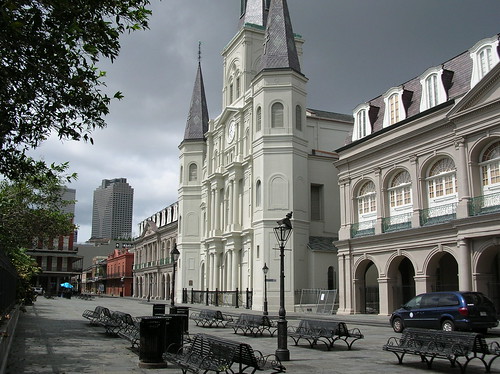
Benches in Jackson Square, often used as daybeds by the homeless, have been removed and will be re-installed with built-in dividers to prevent people from lying down. In a city known for its tolerance for public drunkenness, the police have been quicker to arrest the obviously inebriated. 

The cleanup has been compared to the transformation of Times Square under Mayor Rudolph W. Giuliani. 

''I took my cue from Giuliani,'' said Jacquelyn Clarkson, the City Council member who has led the cleanup.
Sadly, Jackie has retired from public life and is back at her first love, enjoying the ungodly fortune she made in real estate. But her successors are carrying on her work today. The sooner you can fence the undesirables out of a space, the sooner you can turn a profit from it. Looks like Bayou Boogaloo had a similar thought. Unfortunately for them, it wasn't just some homeless people's space they wanted to put "into commerce." 

Thursday, March 03, 2016

Fenced out

Last week when we brought up this mess at The Fly, I was certain there wouldn't be anything anybody could do to interfere with Ron Forman and Tom Benson and their various friends in the Uptown clubs doing whatever they want with the open space along the riverfront.  I might have been wrong about that.
Adrienne Petrosini, representing the Save the Fly movement, requested Thursday (March 3) that the City Council consider creating an interim zoning district for The Fly, which would require any development on the property to earn City Planning Commission and council approval.

The council voted to receive the request and forward it to its Community Development Committee, which can consider the creation of an interim zoning district.    
The Boosters want to fence off a large space currently open to the public and build a new soccer field which, unlike the open soccer fields that already exist there, they can collect rent and concession sales from operating. Open public shared space shouldn't be fenced in for private profit like that.  It's good to see the City Council at least take this principle into consideration.

On the other hand, maybe they don't really care.
The city’s new fence, which will enclose the parking lots that extend along Calliope Street from St. Charles Avenue to South Rampart Street in the Central Business District, will force out dozens of homeless people, some of whom were camped there on Wednesday. The city plans on having it up by mid-April.

Reopening the parking lots, which have been chained off since 2012, also is designed to provide relief in a neighborhood where parking spaces are in high demand. And turning them into managed, paid parking facilities, as the city plans, also is expected to bring new revenue for the city.

Before the city closed the area to parking in 2012 to combat homeless encampments, the lots were under the state’s jurisdiction, and parking was free.

The New Orleans Building Corp. plans to ask for bids from would-be lot managers this spring. Officials said revenue estimates won’t be available until after an operator is chosen.

“Because of the limited number of on-street parking spaces available, returning this area to commerce will decrease traffic congestion and increase accessibility, which will ultimately improve commerce,” said Cedric Grant, the Building Corp.’s acting chief executive officer and the Sewerage & Water Board’s executive director.
"Returning" previously free parking "to commerce," says Grant. Good lord.  He's not wrong, though. Parking is a booming business in New Orleans these days.   Maybe the Carrollton Boosters can be persuaded to trade their current racket for this one.  It's worked out well for the Landrieus, after all.
 

Wednesday, December 31, 2014

The Year Of Enforcement

Empty Jackson Square
Jackson Square in 2008. The dividing "armrests" on the benches are innovations introduced by former Councilwoman Jackie Clarkson. They are intended to prevent homeless people from sleeping there. Somehow they manage anyway.

This quote is from Councilmember Cantrell speaking at Monday's Year End municipal press conference hosted by the Mayor and every other public official who wanted to speechify for no particular reason. 

I used to think Stacy Head was the new Jackie Clarkson but that's probably an out of date assessment considering how far to the right the entirety of city government has moved in recent years.  Stacy is now Peggy Wilson.  Latoya is the new Jackie.

If 2015 is going to be The Year Of Enforcement, Cantrell has already gotten a head start on that in 2014. This year she worked hard at shooing homeless people off of the streets under the Calliope overpass and shooing some of the fun off of the streets during Carnival.

She also, sort of mysteriously, allowed the demolition of one property under strange circumstances having to do with a faulty enforcement mechanism. Not sure whatever came of that. But the message at the time was, if you've got the money, we'll let you do whatever you want.

Anyway, the fact that she mentions "short term rentals" is interesting.  Most likely what she means is that they're going to be made more widely legal, though.

She doesn't mention the noise ordinance.  But I guess, since we're already putting bar employees in jail over it, 2015 can't really get much more enforcey than that.


Note: Yes, everyone involved in that Jax noise enforcement story seems pretty terrible for one reason or another.  But it's the jail for noise violations bit that really stands out.  Especially given the location. Tonight there will be a party there which will probably garner some attention.  I hope it doesn't get too loud..

Thursday, October 02, 2014

"Eventually we're going to run out of rich people to buy all the new luxury condos, right?"

Urban policy in Nashville is much like it is in New Orleans.  Build a bunch of nice stuff for rich people.  
NASHVILLE — To bolster his argument that the cavernous and almost-famous music room known as RCA Studio A should be spared from the wrecking ball, Mike Kopp, an artist manager, dropped a needle onto an LP, playing one of the thousands of songs recorded here over the last half-century.

It was Dolly Parton’s “Jolene,” and on a recent morning it filled the empty studio with the same minor-key pathos and galloping urgency that it must have exuded back when Ms. Parton sang it here in 1973.

Today, booming Nashville is trying to decide whether the tone is appropriate for the crusade that Mr. Kopp and others are waging to save Studio A, a recording room that is steeped in music history and that is scheduled for demolition to make way for a luxury condominium project.


And then watch everyone else have to squirm away.

Nashville's median household income approaches $46,000. Using the classic 30 percent rule, that's $1,200 set aside for rent. That, as we've seen, is tough to find. A median family income of $56,000 puts the ideal rent at $1,400, which is more or less where Sylvan Heights is today — with its host of two-bed-one-bath, six-decades-old houses. But if the pattern holds, things will be higher there soon.
"Eventually we're going to run out of rich people to buy all the new luxury condos, right?"

Cunningham asks wryly. "Nashville was appealing because of its relative cost of living, and attracted lots of transplants from other 'desirable' cities because they could live an urban life without being priced out. Once that goes away, so will likely go It City status."

People are moving back to the city, and that's good. A vibrant, bustling urban center has benefits both tangible and aesthetic. But high demand can homogenize a city into a glistening walled palace only for the wealthy, forcing workers to chase inexpensive living far from the benefits they helped make possible. If prices continue to rise, without a proportional raise in income or affordable housing, Nashville may learn there are more desirable things to be than It.
New Orleans and Nashville aren't the only "It Cities" out there.  Your city really doesn't have to be all that "It" to experience this.  Basically what's happened in a 2-act play.

1) Affluent whites in the 20th Century: "This city is full of degenerates. Let's go build sprawling suburbs"

2) Children of those affluent whites: "These sprawling suburbs suck. Let's go kick the degenerates out of the city and make them live here."

Me, I'm staying until they come boot me out.  My original fallback was to go live under the Calliope overpass. But Latoya Cantrell won't even let me do that now.

The Mission seems nice.

Thursday, September 11, 2014

What if Camp Calliope showed its Green Wave spirit?

By all accounts last weekend was a sparkling success for fans and neighbors (really more neighbors than fans) of the Tulane football program.  According to Uptown Messenger, the campus and immediate vicinity were transformed into small festival.
The university was successful in coaxing the majority of the game-day mania onto campus, where the main quads designated as official tailgating zones were brimming with Green Wave fans partying under tents with tables laid with all kinds of grilled food, tossing bean bags while bands played on a small stage.

The closest residential street to the stadium, Audubon Boulevard, was the center of much of the opposition to the stadium when it was first announced, but it was largely quiet on Saturday, perhaps even moreso than usual. Tulane fans walked in small groups down the sidewalk toward Willow Street, but virtually no traffic passed on Audubon, where printed signs politely “reminded” against tailgating in the neutral ground.

The corner of Hickory Street and Audubon Boulevard, where the edge of Yulman Stadium rises over the rooftops, had a dozen or so residents and their guests sitting in lawn chairs and grilling on the front porch. The residents — many of whom had moved onto Audubon Boulevard within the last year or so — were pleased with the way the first game unfolded.

“We’re excited about the stadium, but the construction process was tough,” said Audubon Boulevard homeowner Christian Chauvin.

The boulevard was only accessible to residents or their guests with parking passes, with police and parking attendants posted at each entrance to it, in keeping with a promise university officials had made to residents before construction began.

“It’s actually nicer on this street with the game going on,” said Madelaine Feldman, a guest at the gathering near Chauvin’s house.
They put of a few tents, obstructed a few rights of way, pretty much moved their living situations out into the street and had a great time of it.

So why does the city want to shut down all the fun?
The clock is ticking for the residents of a homeless encampment under the Pontchartrain Expressway to pack up their tents and other items.

Hours after homeless advocates held a press conference denouncing Mayor Landrieu and the New Orleans City Council for passing an ordinance last week making such tent cities illegal, a sign taped on an expressway pillar in front of a collection of tents warned of a 72-hour deadline to remove "obstructions" such as tents, tarps, couches and mattresses from the area.

"I really don't have an idea where I'll go," Juston Winfield said Wednesday night (Sept. 10) outside the tent he's been living in for the last month or so under the expressway at Calliope and Camp streets.

Winfield said he saw the sign go up around 7:30 p.m. He and others of the camp,which they dubbed "Camp Jesus Christ," previously lived in a larger camp under the bridge between South Claiborne and St. Charles avenues. The city cleared that camp on Aug. 14, sending its residents either to local shelters or - like Winfield - further toward the river.

"Anywhere I go in this city, I'm breaking the law," he said, just steps from the sign that read, in part: "Any object that obstructs a public place or right of way is prohibited under the law."

"We're breaking the law right now, just standing here," he said.
On the other hand, last weekend's activities suggest that "just standing there" in anticipation of a Tulane football game might be some sort of exception to the law.  So here's what we should do.

I spent a little time fumbling around the Tulane athletic department's "official store."   I can't find any tents with the school logo on them.  That was kind of a surprise to me but I guess they are pretty new to this tailgating business over there.  If you know where I can find a Tulane tent please send that on.

In the meantime, though, you can get these car window flags for only $13.95  a piece.


Here's a lawn chair for $32.98


Maybe throw in a few of these folding tables and garden flags. Then we'll set all that stuff up under the overpass. Suddenly we'll have transformed an unlawful obstruction back into a pleasant tailgate. Is it okay if we bring our own keg?

Friday, September 05, 2014

"Frat boys"

Kind of a busy news day yesterday so the passing of the tent ordinance may have been missed. At least one City Councilmember chose not to be a hypocrite.
(Nadine) Ramsey said she was uncomfortable that the ordinance does not require the city to provide prior notice to people who are in violation of the law before their belongings are removed.

“We know that’s not constitutionally right,” said Ramsey, a former Civil District Court judge.

The administration said that even though such language would not be codified in law, it would be included as part of the city’s policy for dealing with homeless encampments. That policy will be presented to the council in the form of a resolution at a later date, City Attorney Sharonda Williams said.

“My concern is you’re going to have the most vulnerable people being subjected to the whims of whomever is out there that day,” Ramsey said. “I think any protections we can give ... because we can say this is not about homeless people, but it is. That’s why it came up.”
 She'll learn eventually, though.  She's new. Stacy and Latoya are old pros now. 
This ordinance builds on that action with the intention of protecting public health, Cantrell said.

“The purpose of this ordinance is to update the city’s authority regarding public rights of way and public spaces,” she said. “The bill is not just about the recent issues we have had in protecting health and public safety when the homeless encampments were removed under the freeway but proactive ways to address those concerns before they reach that level.”

Councilwoman Stacy Head said the ordinance’s impact would extend beyond the homeless, citing “frat boys” as an example of another group with a tendency to erect tents on the neutral ground and in other public places.
Were there any "frat boys" in the encampment under the overpass?  I remember they found one LSU Tiger.
On Thursday, Malcolm Scott, a hulking 52-year-old with arms like tree trunks, beckoned a reporter over to where he sat nibbling on a donated ham sandwich.

A former football standout for LSU, Scott played two seasons as a tight end in the NFL before getting injured.

He said he’s working an occasional construction job for minimum wage, while spending his nights at shelters.
“I’ll stay at the mission for 21 days, the Oz for 14 days, then maybe with a girl until she kicks me out,” he said. “I’ve been stuck here for a long time.”

“The TV stations almost did a story on me,” he added. “If you write about me, make sure you mention I’m an LSU Tiger.”
Maybe that's close enough.   I can't think of any other cases where one might find frat boys in tents around town.  Oh unless she means this.


Pretty sure those tents will still be allowed.  But we'll check back during Carnival just to be sure.  Maybe we should move the homeless to the parade route. 

Sunday, August 24, 2014

Beautification

The best way to make that space look more inviting to visitors is to put up a big fence.
One week after the city removed about 160 homeless people from an area underneath the Pontchartrain Expressway, the City Council voted Thursday to turn much of the area into a fenced-off parking lot, provided that the state agrees.

A second measure, which appeared aimed at making it easier to crack down on future homeless encampments, was deferred after a period of debate made clear that the council was divided on the idea.

Both measures were introduced by Councilwoman LaToya Cantrell at the request of Mayor Mitch Landrieu’s administration.
The proposed tent crackdown is actually just a slight adjustment in language to what is already an existing section of city code.
Likewise, city law already prohibits the obstruction of streets, sidewalks or other public land by “any debris … or any other articles whatsoever.” On Thursday, Cantrell will ask her fellow City Council members to add the following sentence to the law, spelling out more specifically that tents, mattresses and furniture are unacceptable obstructions as well:
Unless lawfully permitted, the erection or placement of any tent, item of household furniture not intended for outdoor use, or other semi-permanent structure shall be considered an encumbrance/obstruction when placed on any of the public places or rights-of-way set forth in this Section. Permanent obstructions shall be prohibited.
The original law — which applies citywide — already contained that idea, but the new language puts that intent into writing. The language, Cantrell said, should assist the NOPD and other city agencies when they are dealing with the issue.
The law is pretty egregious as it is already. It includes language prohibiting the the installment of basketball goals near streets or sidewalks.  Plus there is this section. 
If any person by performance of any outdoor act or activities causes a crowd to gather, and if the crowd makes passage by pedestrians inordinately difficult or conducts activities which impede access to the public rights of way the department of police shall have the authority to order such person(s) to cease performance of their act or activities
Pretty much anything can fall into that category.  It's interesting language to encounter while the Ferguson, MO demonstrations are still going on.  Police don't need much of an excuse to break up an assembly, it seems.

Anyway back to this parking lot idea.  I'm a little confused since I thought it was already a parking lot.  It's a paved space with street access where people often park cars (particularly during Saints games.) That is usually a pretty big giveaway.   So what's the angle?
The ordinance authorizes the mayor to enter into an agreement with the state to transfer control of four sections of the site — all between Simon Bolivar Avenue and Carondelet Street — to the New Orleans Building Corp., the public-private entity that operates as the city’s real estate arm.

Cantrell did not mention the former encampment when explaining her support for the measure.
“Given the need for parking in the CBD, I am encouraged that we would make the most of all available space we have for parking,” she said.

The proposed agreement, between the NOBC and the state Department of Transportation and Development, calls for the NOBC to manage and operate a parking lot at the site on behalf of the city. The agreement would be in effect for five years.

Landrieu aide Eric Granderson said the Mayor’s Office has not decided whether the area will be used as parking for city employees or leased to a third party to operate as a private lot. The second option would require further City Council approval.
Oh, of course.  There are potential leases to sign and fees to charge.   Problem isn't fully solved until we've taken a public space and turned it into something someone can profit from.