-->
Showing posts with label BP. Show all posts

Saturday, April 05, 2025

Who gets the money, then?

Jeff Landry took another step today toward throwing the state's biggest coastal restoration project into the trash.

Gov. Jeff Landry's administration has ordered a 90-day pause on work on Louisiana's biggest-ever coastal project, the controversial Mid-Barataria Sediment Diversion, arguing the state cannot afford the more than $3 billion plan and stressing that it must be smaller in scale.

The decision, confirmed by the state's coastal officials, halts nearly all work related to the project, which has been planned and studied for years and broke ground in August 2023 on the west bank of Plaquemines Parish near Ironton. Funds related to the 2010 BP oil spill are intended to pay for it, but state coastal officials say rising costs mean Louisiana will be on the hook for hundreds of millions of dollars, if not more.

The story goes on to say that there are contingency funds available through NOAA (which *probably* still exists?) to cover some increases in costs, although not increases in costs that directly result from the Governor sabotaging the project with delays.  There's also the possibility of another $744 million from Chevron if that judgment holds up on appeal. But if Landry isn't interested in spending the BP money on the coastal projects it was intended for, then it's unlikely he will apply that appropriately either.  

Which raises the question, what does the Governor intend to do with this money, if anything? It's also possible he's holding those funds and these projects for hostage pending another go at his tax reforms that just failed at the ballot box.  But who knows. 

Friday, July 31, 2020

Murdered Gulf

BP really got away with one.  Who woulda thought, right? 
Published in the journal PLOS One in June, Montagna’s full analysis of his 10-year-old samples showed damage to seafloor organisms stretching across at least 124 square miles. That’s nearly two times larger than the 66-square-mile footprint described in the abbreviated report Montagna turned over for the disaster’s Natural Resource Damage Assessment.

The NRDA process helped determine how much BP owed for the harm done to marine organisms, from the little mud-dwelling creatures Montagna studied to the dead dolphins and oil-drenched pelicans that washed up on Louisiana’s shores. In April 2016, the case was settled for $8.8 billion. It was both the largest environmental settlement in the nation’s history and the biggest infusion of cash for restoration purposes the state had ever seen.

But it might have been larger had the full scope of the damage been known.

“BP got a good deal by settling early,” Montagna said.
How did they get away with it? Well one thing they did was exercise control over the scope of the research that eventually determined their liability. 
Keeping watch over every step was a BP representative.

“He asked a lot of questions, and was with us 24-7,” she said.

Company officials carefully documented each sample’s chain of custody.

“BP didn’t want anybody spiking the samples with oil,” Montagna said.

BP and Montagna “had many difficult conversations” over how to conduct the sampling. BP wanted a narrow focus, concentrating the sampling close to the well. Montagna wanted to travel farther afield, gathering cores from a wider area. Montagna won out on the scope, but not on which samples to analyze for the damage assessment. On that count, BP got its way, zooming the focus on the 58 samples taken closest to the well.

The company used that tighter scope to its advantage. In a statement in 2013, BP said the 58 samples “confirm that potential injury to the deep sea soft sediment ecosystem was limited to a small area in the immediate vicinity of the Macondo well-head.”

BP required all the samples to be kept in a locked cage in a secure, air-conditioned storage room. That is, until the settlement was reached.

“There was zero interest the next day,” Montagna said. “No one cared.”
As for the lasting environmental damage done to the sea floor, we're still learning about how bad it really is.  But, well, it's bad. 
Montagna says plenty of evidence is waiting quietly at the bottom of the Gulf. Recent check-ins by other scientists have revealed little improvement since 2010. Slow to degrade thanks to the deep sea’s cold, dark and sterile conditions, the oil remains nearly as potent as the day it soaked into the mud and formed black pools on the seafloor.

“There’s been almost zero recovery, and it’ll likely stay that way for a long, long time,” Montagna said.

Monday, April 20, 2020

Happy BP Day!

Wow has it been 10 years already?  It seems like only yesterday that Cat Island... existed.
For decades oil and gas companies dug exploration canals in the marshlands, which allowed for saltwater intrusion and blocked the hydrological flow of the wetlands. These factors caused the land to erode, subside and disappear at some of the highest rates in the world. Add sea level rise to this, and "we are sinking like a rock," Hahn said.

"You hear all the time, 'Louisiana is losing a football field every 45 minutes.' And when you are with these old timers, they're like: 'This used to be marsh, this used to be land.' You don't get your mind wrapped around it till you get out there."

Talking about Cat Island, Hahn said, "I saw it, not only in my lifetime ... it was only a couple of years ... you could actually see this piece of land shrinking until it was finally gone and became open water."

The oil from the 2010 disaster dramatically worsened the threat to coastal Louisiana. Researchers from LSU found that the BP oil spill accelerated land loss by almost 300% in the first six months after the spill.
For the most part we've been ignoring the problem since then.  Has it gotten better?  You would think it must have. Otherwise the Trump administration wouldn't be rolling back emissions limits now, right? In fact we're pretty sure everything is just fine out there now.

So, yay, we made it! Ten whole years. To celebrate, we're giving away as much crude oil as you can take.


Wednesday, February 12, 2020

Toxic Gulf

This development probably doesn't surprise many but a new study says the BP Horizon oil spill (which is about to turn 10 years old, holy shit) was worse for the health of the Gulf Mexico than previously thought.
“The impact of the oil’s toxicity is larger than previously assumed,” said Igal Berenshtein, a University of Miami marine scientist and the study’s lead author. "It's important to account for the toxicity that's invisible and also the three-dimensional nature of the (oil) plume, and our study does that."

He estimates the extent may be 30% larger than 2010 satellite imagery indicated. The imagery was widely accepted by the public and scientists as showing the spill’s reach, but a growing body of field data collected just after the spill indicates the oil had a much larger footprint. Berenshtein and the study’s other scientists combined data from water, seafloor and beach sampling, fish toxicity studies and oil transport models to track oil invisible to satellites.

Thursday, October 24, 2019

Out of sight out of mind

Apparently it is worse than they would have expected.
Mark Benfield, a professor of oceanography and coastal sciences at LSU, led monitoring of visible marine animals, called megafauna, for about a year after the Deepwater Horizon spill. He found the lack of vitality seen in the video "disturbing."

The video offers the first glimpse of the site since visual inspections ended in 2011.

"Given the amount of time that's passed, I figured that the site would look normal or well into recovery," Benfield said. "I was surprised."
Recall that BP's primary response to the Macondo disaster was to spray the slick with a chemical dispersant called Corexit.  Workers exposed to the chemicals during clean up operations also complained of serious health problems. Their symptoms were positively liked to that exposure.   As early as 2012, it was found to have caused major disruptions to the Gulf marine food chain.
In April 2012, Louisiana State University’s Department of Oceanography and Coastal Sciences was finding lesions and grotesque deformities in sea life—including millions of shrimp with no eyes and crabs without eyes or claws—possibly linked to oil and dispersants.
The shocking story was ignored by major U.S. media, but covered in depth by Al Jazeera. BP said such deformities were “common” in aquatic life in the Gulf and caused by bacteria or parasites. But further studies point back to the spill.
A just-released study from the University of South Florida found that underwater plumes of BP oil, dispersed by Corexit, had produced a “massive die-off” of foraminifera, microscopic organisms at the base of the food chain. Other studies show that, as a result of oil and dispersants, plankton have either been killed or have absorbed PAHs before being consumed by other sea creatures.
But the important thing to remember about Corexit as it relates to the sea floor anyway, was its purpose. It wasn't intended to clean up the oil so much as it was to sink it. Get it out of sight and out of mind as fast as possible.  Seems like that strategy is still paying dividends. 
The video and study were only possible because researchers were near the site for an unrelated project.

No one is funding research into the impact of the Deepwater Horizon spill on the surrounding sea floor, said Craig McClain, director of LUMCON. Getting money for deep sea research can be difficult because it's "out of sight, out of mind," he said.

But damage to the sea floor ecosystem can permeate through the food chain to commercial fisheries and disrupt the process by which oceans pull carbon from the atmosphere and store it in the deep sea.
All we have is a brief glimpse of the undersea wasteland around the well head. No telling how bad it really is.

Monday, July 15, 2019

Liz was the Ken Feinberg of Dow Chemical

The reason these claims clearinghouse operations is to limit the financial damages and liability incurred by the offending party. Probably the most familiar case of this for us would be the Gulf Coast Claims Facility set up by Kenneth Feinberg in the wake of the BP disaster of 2010.  For those unfamiliar with how that played out, there are archives here and here and, yeah, here too

In this case it's Dow Chemical looking to limit the size of its payout after having put a thousands of people's health at risk.  Liz was there to help them put out the fires.
When Dow Corning faced thousands of lawsuits in the 1990s from women saying they’d become sick from the company’s silicone gel breast implants, its parent firm, Dow Chemical, turned to one of the country’s leading experts in corporate bankruptcies: Professor Elizabeth Warren.

Warren, now a Democratic presidential candidate, has never publicly discussed her role in the case. Her campaign said she was “a consultant to ensure adequate compensation for women who claimed injury” from the implants and that a $2.3 billion fund for the women was started “thanks in part to Elizabeth’s efforts.”

But participants on both sides of the matter say that description mischaracterizes Warren’s work, in which she advised a company intent on limiting payments to the women.

“She was on the wrong side of the table,” said Sybil Goldrich, who co-founded a support group for women with implants and battled the companies for years. Goldrich said Dow Corning and its parent “used every trick in the book” to limit the size of payouts to women. The companies, she added, “were not easy to deal with at all.”

Monday, March 25, 2019

Learn to live sick

The Berkley Law Clinic is suing the EPA on behalf of environmental groups in Alaska and Louisiana over its failure to adequately restrict the use of Corexit to "disperse" oil spilled into the sea during the Valdez and Macondo disasters.

This article (and presumably the lawsuit) cites several "recent studies" indicating the harmful effects of these dispersants.
Recent studies have indicated dispersants caused lung irritation, rashes, nausea and other illness in humans, as well as a host of problems for fish, deep-sea coral and other marine life. Dispersants can kill or inhibit the growth of oil-eating microbes, weakening nature’s ability to cleanup spills. New research also indicates that dispersants can have the unintended effect of transforming oil into a toxic mist able to travel for miles and penetrate deep into human lungs.

Those of us old enough to remember the 2010 Macondo spill will remember also that this was all widely understood and observed at that time.  None of that stopped BP from insisting everything was perfectly safe, of course.  So it is no surprise they are continuing to do so now. There is a BP contractor quoted in that story who says, "many of Corexit’s ingredients are shared by common health beauty products." So, you know, nothing to worry about. It's like Botox for the ocean.

Of course that doesn't help the many workers and fishers on the Louisiana coast who have documented health problems from exposure to these chemicals over the past decade. 
Arnesen, whose family business fishes for Gulf shrimp, crab and reef fish, said she continues to suffer from respiratory problems and headaches eight years after exposure to dispersants. She was aboard a vessel sprayed with dispersant while in Barataria Bay, an area hard-hit by the spill.

“Dispersant is nasty stuff to deal with,” she said Monday. “You learn to live sick.”

Tuesday, January 08, 2019

I like that one of these is called Atlantis

When you are expanding production of the fossil fuel industry most responsible for putting South Louisiana under the ocean, that is an appropriate name.
The $1.3 billion Atlantis Phase 3 development is the latest example of the British oil company’s strategy of growing oil production through its existing facilities in the Gulf, he said.

BP is the operator of Atlantis and holds a 56 percent working interest, with BHP holding the remaining 44 percent. BHP is expected to make a final decision early this year on whether to proceed with the expansion.

The announcement comes amid a four-and-a-half-year offshore oil bust that has cost the Houma-Thibodaux area about 16,000 jobs. Over the past few months, several reports from economists and consultants have predicted an uptick in the Gulf this year, forecasts that hinge on how high oil prices rise above current levels of about $50 a barrel.

BP’s announcement comes a day after Danos, an oilfield service company based in Gray, said two new contracts in the Gulf prompted it to hire 150 workers.

BP’s actions come after recent the company’s recent breakthroughs in advanced seismic imaging and related technology that revealed an additional 400 million barrels of oil in place at the Atlantis field, officials said.

The same innovation helped the company find an additional 1 billion barrels oil at its nearby Thunder Horse field, officials said.
Long story short, BP has found 1.4 billion more barrels of oil in the Gulf and is moving it into production.  It's nice to know things are working out for them after everything that's happened. It's a good thing we didn't overly burden that company with the task of rebuilding the coast they have played such a prominent role in despoiling.  Otherwise they might not be around to profit from these discoveries today.

And then what would we do?  After all, as bad as this activity has been for the global environment generally and Louisiana in particular, the "job creation" more than makes up for any of those unhappy side effects. And now BP is bringing the good times back. Right?
The new projects are the latest examples of a trend in which offshore oil companies drill several deep-sea wells then transfer the oil to existing platforms then later onshore by pipeline. The so-called “tiebacks” have helped drive down the break-even cost of producing oil so companies can profit at lower oil prices but have stripped business from major employers in the Houma-Thibodaux area that build and service the platforms.

Atlantis Phase 3, which operates in 7,000 feet of water, will include the construction of a new subsea production system from eight new wells that will be tied into the current platform, the company said. Scheduled to begin producing oil next year, the project is expected to boost output by about 38,000 barrels a day at its peak. It will also access the field’s eastern reaches, where advanced imaging identified additional reserves.
Oh well, that's just capitalism, though.  Gotta get more and more efficient.  Ideally, BP would be able to churn through the wetlands and suck out as much oil as the atmosphere can choke on without employing anybody except maybe a few guys to polish the robots.  They're not there yet but they're trying.  And we're grateful to have them here doing it. 

Saturday, April 07, 2018

The resilience economy

Not sure what the big deal is here.
Coastal towns would enjoy an economic boon from a massive oil spill in the Great Australian Bight, BP claimed in newly revealed documents from a 2016 drilling bid.

The oil giant said any cleanup operation following a huge spill would bring a “welcome boost to local economies.” The claim was uncovered via a freedom of information request by the U.K.-based Climate Home News website.
It's true, though, right? At least that's what New Orleans's political and business leaders have been telling us for years. As Ray Nagin once famously said, "There's big money in disasters."  Ray was always an idea man, though.  It wasn't until the following administration that we really professionalized the notion of resilience as an economic development opportunity

BP, Ray, Mitch, et al are really the optimists here. Sure, climate change is going to destroy cities, threaten food supplies, and endanger millions. But we chose to allow that to happen a long time ago. The challenge now is for global corporations,  political elites,  and well placed entrepreneurs to go to work figuring out how to profit by it.  That's just what leaders do.

Friday, June 03, 2016

How much does criminal conspiracy to defraud investors and obstruct justice cost?

If you are BP, it costs basically nothing.
BP Plc said it agreed to pay $175 million to settle claims by U.S. investors that its managers lied about the size of the 2010 Gulf of Mexico oil spill to prop up its stock price, removing the company’s last major overhang from the disaster.

The investors, who blamed BP for massive losses when the true scope of the spill was revealed, had sought as much as $2.5 billion. The settlement averts a trial that was set for July in Houston federal court.

Tuesday, April 19, 2016

Happy Macondo Day

Six years ago today a deepwater oil rig in the Gulf of Mexico exploded killing 11 workers and spilling over 200 million gallons of oil into the Gulf over a period of 87 days. A judge would later find well operator BP guilty of "gross negligence" in the matter leading to the largest monetary settlement in US history. Investigators cited BP and Transocean and Halliburton for systemic failures with regard to equipment maintenance,  cementing techniques,  and adherence to safety procedures concluding that,"absent significant reform in both industry practices and government policies, might well recur."

Today, Louisiana US Representative Steve Scalise is leading the charge to prevent such reforms from ever taking hold.
“He’s a rock star on our stuff, there’s no question about it,” said Stephen Brown, vice president of federal government affairs for Tesoro Corp., which refines and markets petroleum products. “He’s probably your go-to person for the oil and gas industry. If he can’t be for it, it’s not going to happen.”

Scalise’s rise was almost derailed two years ago after the disclosure of a 2002 speech to a white supremacist group, an episode that could have sunk any lawmaker’s career. But he said that making the speech had been a mistake and was able to persevere, now serving in a Republican leadership team headed by House Speaker Paul Ryan.

That’s turned out to be good news for the oil industry at a time when it can use some friends in Washington.
It was important that "big oil's rock star" not have his career derailed by some inconvenient matter of associating with white supremacists. So it didn't happen. And aren't we all grateful for that.

UPDATE: Yes I know the Macondo blowout happened on April 20. That isn't the problem.  The problem is I woke up thinking today was April 20. So... good morning everybody

Wednesday, December 02, 2015

No harm no foul

Well.. okay.. there was definitely harm.  But still, no foul.
NEW ORLEANS -- All 11 felony manslaughter charges were dropped against two company men on BP Deepwater Horizon for the 11 rig workers killed in the 2010 explosion.

Don Vidrine, the BP company man who erroneously said the Macondo well passed a last key pressure test before removing the protective drilling mud from the hole, pleaded guilty to a misdemeanor pollution charge Wednesday. Meanwhile the 11 grossly negligent manslaughter charges against Vidrine and the substitute well-site leader who was serving with Vidrine, Bob Kaluza, were all dropped. That means 22 felony charges against each company man have all been dropped.
This will surely be a lesson to the next guys who might blow up a well. 

Thursday, October 22, 2015

Who is panicking now?

The Hayride's pollster has Gomer all the way up to 40% That seems a bit much. Looks to me like they've either lost track of or purposefully reassigned a big chunk of undecideds.  I'd have a hard time believing that 4.3%  (down from 15% in one month!) is a raw number.
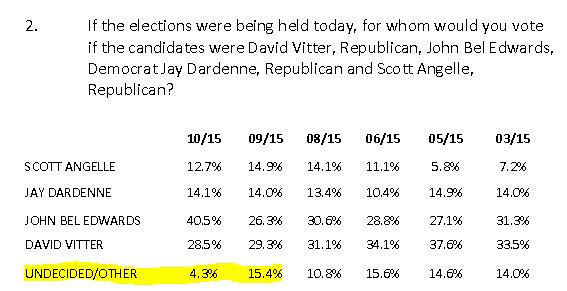
Hayride poll

If you read the post at the Hayride, you'll see they're already blaming Dardenne and Angelle for failing to decide which one of them should have dropped out months ago.  The real problem, though, is everybody hates Vitter... when they're not afraid of him anyway.  And the more vulnerable he looks as a candidate, well, the less afraid people become.

But as Vitter's weakness becomes more and evident, you'll notice some of the folks relying on him becoming Governor are beginning to panic. Yesterday we mentioned Phyllis Taylor's wavering, for instance.
It's unclear why Taylor has started giving money to Angelle's PAC over the past few months, while not contributing to Vitter's recently. A call to the Patrick F. Taylor Foundation in search of Taylor was not returned on Tuesday (Oct. 20).

But of the four major gubernatorial candidates, Angelle has made the strongest statements about keeping the TOPS program very similar to the way it operates now. The other candidates have been more willing to talk about tweaking TOPS, such that the scholarship would not necessarily cover the entire cost of college tuition in the future.
This doesn't have anything to do with TOPS.  Taylor's foundation is one of many conduits through which oil money is piped into the Louisiana political process.  And right now, since "Big Oil's Boy" David Vitter looks like he's in trouble, that money is looking for somewhere more productive to go.

Why such urgency? Because the oil companies have come to view the attack on Vitter as a direct assault on them.  Only a few days ago, BP's Head of State and Local Government Affairs speaking at a business luncheon said that lawsuits, not falling prices, are "the biggest threat to the oil and gas industry" in Louisiana. 
The constant threat of a potential lawsuit has dampened industrial growth in the state, especially in the Houma-Thibodaux area, Ellis said. He said small businesses may not hire more people and delay plans to add new equipment or projects out of fear of a lawsuit. 

“I believe in the legal system; I believe in its fairness and impartiality. I don't believe in a system that measures justice based on the depths of your pockets,” Ellis said, citing a 2013 U.S. Chamber of Commerce report that ranked Louisiana 49th among lawsuit climates. “The oil and gas industry in Louisiana...are threatened not as much by the decline in oil prices and market prices as they are by the attitude that some have that the industry's deep pockets make for good lawsuits.”
Tyler Bridges corroborates this somewhat writing in the Washington Post this week that "trial lawyers" have been out to get Vitter from the beginning.
But this year, as he has pursued his gubernatorial bid, a Baton Rouge law firm has spent $1.6 million to broadcast television ads — using video clips and shots of sensational headlines — to remind voters of the scandal.

The trial lawyers behind the ads want to defeat Vitter because he has promised to kill lawsuits filed by the firm that accuse oil and gas companies of polluting land and aquifers throughout the state, as well as destroying coastal wetlands.
John Bel Edwards is the only candidate who has expressed at least some middling degree of support for legal action against the oil industry.  If Vitter can't protect them, it looks like Big Oil is gonna need another boy.

Luckily they've got plenty of those laying around.  For example, Phyllis Taylor's new favorite.
But Angelle, who used to be a Democrat, is trying to appeal to moderates in that party. Angelle is a social conservative, who said he switched parties primarily because national Democrats weren't backing up the oil and gas industry like they should have.

Angelle has close ties to the oil and gas industry. He majored in petroleum land management at the University of Louisiana–Lafayette. As the head of the Department of Natural Resources, he helped regulate the oil and gas industry for the Blanco and Jindal administrations.

Angelle sits on the Sunoco Logistics board of directors, for which he gets paid almost $390,000 – as long as he attends all of the meetings – according to federal filings. U.S. Sen. David Vitter's campaign has called foul on that relationship, implying Angelle used his positions in state government to get the board post. 

Angelle said he has not been involved in regulating the company while sitting on its board. If elected governor, he said he would step down from the position.

Oilman and gas CE0 James Flores has also donated $1.25 million to Angelle's affiliated PAC, called Louisiana Rising. Flores' mega-donation has raised some eyebrows.
It's a bit late in the game, but some of these money people are starting to realize just how damaged David Vitter is.  If he makes it to the runoff there is a very good chance Edwards can actually win.  And even though Edwards is himself a fairly moderate to friendly figure toward oil and gas, the industry would nonetheless interpret this as a disaster. So now they are pulling out all the stops to get a stronger horse into the runoff.

And this is why I found it telling that Angelle was the candidate pushing Dambala's hooker investigation during the debate this week. The trial lawyers may have started the ball rolling with this but, in a fun bit of irony, it looks like having the scandal catch fire in the final week before the primary is the oil industry's best hope to ensure it has a candidate in the runoff who can win.

If Vitter makes it anyway, take a look at whether the scandal stays in play.  The Edwards campaign really hasn't mentioned it all. If it stays on the airwaves, it will have to come from somebody's PAC.  But whose?
Monday, October 05, 2015

Everything about the BP settlement and NRDA report

See Mark Schleifstein's report at NOLA.com.

Still a win for BP

The Justice Department announced the finalization of a settlement it reached with BP back in July.  There are a lot of self-congratulatory quotes from officials in this story.
Interior Department Secretary Sally Jewell said the settlement will sustain one of the largest natural resource restoration efforts ever undertaken in the United States.

"This agreement brings renewed hope for a fully restored Gulf of Mexico to millions of Americans who value the Gulf for its contributions to our economy, our environment and plentiful recreational opportunities," Jewell said.

Louisiana is expected to get more than $6.8 billion in addition to the $2 billion the state already received from the oil company, Louisiana Attorney General Buddy Caldwell said in a news release.

"This settlement is the largest environmental settlement in history, and I am extremely proud to have led Louisiana's litigation efforts," Caldwell said. "With this recovery, we can move forward to begin rebuilding our coast and repairing the damage caused by this spill rather than dealing with the uncertainty and delays of trial and appeals."
You probably already understand why the settlement is not near enough to cover Louisiana's dire need to fix its coast.  It's not, nothing, but it's not enough.  Back in July we also explained why this is a pretty good deal for BP overall.  Nothing about today's announcement changes any of that. 

Thursday, September 03, 2015

The half is not being told

In one of their trademark "website reports" items yesterday, NOLA.com pointed us to this report in the Louisiana Record.
NEW ORLEANS – Of the $371 million in Deepwater Horizon settlements awarded to local governments last month, Louisiana law firms stand to rake in a hefty percentage of that in legal fees.

The influx of cash to local governments, part of a $687.4 million settlement oil giant BP made to state and local governments across the Gulf Coast due to the oil spill, means big paydays for a handful of politically connected Louisiana law firms.
The article goes on to name several of the firms benefiting from the settlement process. If any of this looks familiar to you, you may have been reading Jason's far more in-depth reporting stretching back over several years now.  If you find time go back and read through the saga. It's been pretty much shut out by the local press for reasons no one can begin to fathom.
 

Thursday, July 16, 2015

Turns out dumping oil all over the coastline wasn't the best way to save it

Go figure.
Hopes that the Deepwater Horizon would be a larger economic boon to the Master Plan always rested on BP being held to maximum penalties for fines under the Clean Water Act and restitution required under the Natural Resources Damage Assessment. Some of those estimates ranged as high as $22 billion for Louisiana alone.

For example, BP faced a maximum fine of $13.4 billion for Clean Water Act violations based on the judge’s rulings on the amount of oil spilled and that “gross negligence” on the part of the company led to the accident.

However, the settlement allows BP to pay only $5.5 billion for the Clean Water Act fines.

The RESTORE Act, championed by Louisiana’s congressional delegation, will split 80 percent of that, or $4.4 billion, between the five Gulf states. Louisiana’s share comes to about $800 million.

The state always figured to do better under for the Natural Resources Damage Assessment, and it does.

That process measures how much damage the oil did to fish, wildlife and wetlands, and presents the bill to the polluter.  Some estimates put Louisiana’s possible take from a complete damage assessment — which was underway when the settlement was reached — as high as $12 billion. But the oil giant stopped that process by agreeing to pay $7.3 billion to all five states and the federal government.

Since most of the oil landed on Louisiana’s coast, it will receive 76.8 percent of that total, $5 billion.
Now the reality of the situation is, had BP been pressed for the maximum penalties, it's unlikely they would have ever paid anything close to what they'd been assessed.  The precedent there is Exxon; fined $5 billion for the Valdez spill, they were able to fight that back down to $500 million over a 20 year appeals war of attrition.  

So while the BP settlement is far less than the law technically entitles us to, it's also far more than we could have reasonably expected and far sooner. Still, in all, it's far far less than Louisiana will need to get going with coastal restoration efforts. So the idea that despoiling the wetlands with petroleum represented any "last best hope" to save them is every bit as absurd a proposition as it sounds.


Hey, also, the Rising Tide X schedule is starting to roll out this week.  The future of the Louisiana coast.. and by implication the city of New Orleans.. will again be a heavy topic there. Take a look at the program here.  

Thursday, July 02, 2015

Cutting the cake

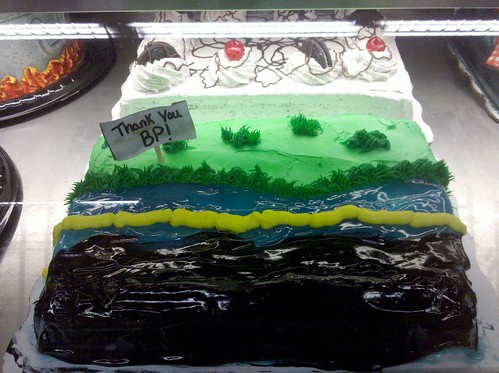
BP Cake

Louisiana's slice:
BP has agreed to pay $18.7  billion to Louisiana, four other states, and the federal government to settle lawsuits filed in the aftermath of the Deepwater Horizon disaster, which killed 11 and unleashed one of the largest oil spills ever in 2010.

Louisiana Attorney General Buddy Caldwell announced Thursday (July 2) that the state will receive more than $6.8 billion from the settlement, including $5 billion for natural resource damages and $1 billion for state economic damage.
The settlement comes after the US Supreme Court refused BP's appeal of a ruling back in January which was, itself, already favorable to BP.
Edward F. Sherman, a professor at Tulane University Law School, told the New York Times that, even though Judge Barbier didn’t explain clearly how he came to the 4.0-million-barrel estimate, his choice to take the middle road between the two group’s estimates was smart. 

“At times we claim precision,” he said, but “there’s no way to precisely find the numbers, so why not pick a number as he did, reasonably between the two numbers provided by the parties?”

Still, the ruling is good news for BP, as it lowers the amount of fines it faces from $18 billion to $13.7 billion.

“Today’s ruling is a major victory for BP and reduces by billions their potential liability,” David Uhlmann, a law professor at the University of Michigan, told Bloomberg.

After the appeal confirmed BP's "major victory" wasn't going to get any more major, they went ahead and settled for it. They're still coming out pretty well anyway.

But how did we do?  Well, relative to everyone else, not so great
Under the settlement, Florida gets $3.25 billion, Alabama gets $2.3 billion, Mississippi gets $2.2 billion and Texas gets about $1 billion.
Yes, Louisiana gets the biggest settlement.  But, given the unique fragility of the Louisiana coastline and the fact that it took the brunt of the damage from the Macaondo event, it doesn't look like the state's share of the settlement is of the appropriate portion.

Probably good news for Alabama football fans, I'm sure.

Others will point out that $5 billion over 18 years is more than zero.  But that's hardly the point.  This is a story about BP's ability to mitigate its own financial losses and, so far, they're doing pretty well at that. Check back with us in 18 years to see how much of this settlement is ever actually paid.

Of course, we'll take what we can get. We need it to launch our "moon shot" coastal restoration project. According to the, likely conservative, estimate provided through the state's coastal master plan, we'll need at least $50 billion to make that happen.  BP is giving us about a tenth of that.

Yesterday, NOLA.com published some blurbs from various local luminaries asked to ruminate on "the future of New Orleans."  By far, the most relevant responses were this one from Tulane geologist,  Torbjörn Törnqvist.
For me, there are two ways of looking at the future of New Orleans. Without any action, 50 years from now the city will increasingly have evolved into a 'peninsula' sticking out into the Gulf of Mexico. I would expect the city will still be livable, but the end will be in sight. Without any action, by that time it will also be clear that catastrophic sea-level rise is unavoidable and planning for abandoning and/or relocating the city will have started.

If serious action is taken, however, the positive effects of large river diversions will have started to be noticed. These effects may not be noticeable in the first few decades after diversions have been put in place; this is a slow process aimed at the longer term.

While the rate of sea-level rise will continue to accelerate even with global efforts to curb greenhouse gas emissions, it will follow a more manageable trajectory (perhaps less than a foot of global sea-level rise within the next 50 years). Still, things will be worse in coastal Louisiana due to the high subsidence rates. Nevertheless, the future of the city will be brighter and it is less likely, under this scenario, that we will seriously discuss relocating the city 50 years from now.
And this even stronger one from John Barry.
The question isn't what kind of future New Orleans has. It's whether New Orleans has a future.

Right now there's a lot of complacency because we have so-called "100-year protection" against hurricanes. That's an Orwellian phrase. Sounds great, but it's the lowest standard in the civilized world.

New Orleans will only have a future for one of two reasons: either because of dumb luck, and I do mean dumb, or because the people of New Orleans get as active as they were right after Katrina and do whatever it takes to get that higher standard of protection.

So far I haven't seen that demand. The business community has sat on its hands, afraid of offending one of the biggest causes of our increased vulnerability: the oil industry. And the elected officials have done the same thing. Everybody points fingers at the federal government and keeps their mouth shut about the big guy down the block.

When the physician heals thyself, that's when I'll know people are serious, and that's when we can start talking about the future of New Orleans.

Until then, it's just a roll of the dice every time there's a storm in the Gulf.
Barry is fresh off a long losing fight to sue the oil and gas industry for the staggering destruction it wrought upon the Louisiana coast beginning long before the Macondo well was ever drilled. Bobby Jindal put an end to that and now he is off to run for President.

Meanwhile, the "business community" has largely moved on.  After all, there's too much money to be made buying and selling dirt in New Orleans in the short term to worry about this existential question of whether there will even be any dirt left here in 50 years.  Better to squeeze what value you can out of it while you can, right?

Monday, April 20, 2015

How many more?

Nobody knows how many more.
Almost 5 years after the BP spill riveted everyone's attention on the risks of offshore oil production in the Gulf of Mexico and beyond, we're still relying almost entirely on pollution reports submitted to the government by the polluters themselves who are, of course, subject to fines and other sanctions for those spills. Evidence of non-reporting and chronic under-reporting of oil spills was uncovered by our 2012 analysis of NRC reports and comparison with satellite imagery, an analysis recently validated in a peer-reviewed study published by scientists at Florida State University.
SkyTruth has also mapped every spill since 2010 that they know of. It's a lot.

Most of the time, very large spills can go on for years and years with little or no attention paid.  Every now and then something truly spectacular like the Macondo event will happen. The horrific deaths of 11 people in an explosion followed by months of uncontrolled release of petrochemicals is harder to ignore.

At least, while it's happening it is, anyway.  Afterward, we go right back to business as usual.  
But critics say energy companies haven’t developed the corresponding safety measures to prevent another disaster or contain one if it happens — a sign, environmentalists say, that the lessons of BP’s spill were short-lived.

These new depths and larger reservoirs could exacerbate a blowout like what happened at the Macondo well. Hundreds of thousands of barrels of oil could spill each day, and the response would be slowed as the equipment to deal with it — skimmers, boom, submarines, containment stacks — is shipped 100 miles or more from shore.

Since the Macondo disaster, which sent at least 134 million gallons of oil spewing into the Gulf five years ago Monday, federal agencies have approved about two dozen next-generation, ultra-deep wells.

The number of deepwater drilling rigs has increased, too, from 35 at the time of the Macondo blowout to 48 last month, according to data from IHS Energy, a Houston company that collects industry statistics.
Despite all the caterwauling about "economic survival" in the face of a "job killing" moratorium, we're now drilling deeper, riskier, and more wells than we were in 2010.  

Meanwhile, Louisiana's fragile coastal marshes and barrier islands are devastated, our fisheries are in a state of ruin, researchers are finding the damage to undersea ecosystems is even greater than previously understood. And, of course, another Macondo could happen any day. But that's supposedly a good thing because the real story we're supposed to be telling here is about "resilience."  Or, at least, that's what Norman Francis would say.

Sunday, April 19, 2015

Thanks, BP

Norman Francis treasures his relationship with you.