-->
Showing posts with label John Barry. Show all posts

Wednesday, July 15, 2020

50 failed states

Former Federal Reserve Chairman Ben Bernanke had an op-ed published in the New York Times yesterday.  He says he wants us to run the dang money printer.
States and localities are in desperate need of additional federal intervention before the bulk of the CARES Act funding expires this summer. Budget gaps like the one in New Jersey cannot be closed by austerity alone. Multiply New Jersey’s problems to reflect the experiences of 50 state governments and thousands of local governments and the result, without more help from Congress, could be a significantly worse and protracted recession.

The CARES Act allocated $150 billion to state and local governments. This new aid package must be significantly larger and provide not only assistance for state and local governments but also continued support for the unemployed, investments in public health and aid as needed to stabilize aggregate demand and restore full employment.
As it stands right now, unfortunately, there isn't much to suggest that we're actually going to see the kind of action Bernanke is calling for.  If anything the Trump administration is leaning toward more austerity. Consider the sabotage going on at the Post Office, for example.
The Trump administration has consolidated control over the Postal Service, traditionally an apolitical institution, during the pandemic by making a financial lifeline for the nation’s mail service contingent upon the White House political agenda. President Trump in April called the agency “a joke” and demanded it quadruple package rates before he’d authorize any emergency aid or loans.

The Postal Service’s future needs to be as a low-cost package carrier, industry analysts contend, as parcels make up a growing portion of the agency’s volume and profits, and paper mail volumes continue to decline as coupons and bills increasingly move online. Postal leaders project the agency could run out of money between March and October 2021.

“If this is true, it would be a real concern to customers if service were slowed, especially in light of the fact that the Postal Service may get more rate authority, meaning higher rates, later this year or early next year,” said Art Sackler, manager of the Coalition for a 21st Century Postal Service, an industry group whose members include Amazon, eBay, Hallmark and other commercial mailers.

“This is framing the U.S. Postal Service, a 245-year-old government agency, and comparing it to its competitors that could conceivably go bankrupt,” said Philip Rubio, a professor of history at North Carolina A&T State University and a former postal worker. “Comparing it to U.S. Steel says exactly that ‘We are a business, not service.’ That’s troubling.”
There are no such thing as public services in the hellworld we've built.  Everything that isn't an all-out grift, just isn't viable.  We've already seen the hostility with which conservatives are attacking public education. This week's threatening demands that schools reopen under dangerous circumstances is only the latest round of that particular gaslighting operation.  Yesterday, Senator Kennedy responded to the pleas for the safety of teachers and students from education professionals by inviting them to "kiss my ass."   Meanwhile, Stephanie Grace picked up on another startling comment from the Vice President during his visit yesterday.
And between congratulating the state for having flattened the curve (before it unflattened) and offering the obligatory paean to LSU football (Coach O was in the house), Pence offered this genuinely shocking statement: “We don’t want CDC guidance to be a reason why people don’t reopen their schools.

Even if the Centers for Disease Control’s guidance suggests they can’t be reopened safely just yet in some places, and under some circumstances? Really, Mr. VP?

Yes, really, according to the administration’s push to get localities to fall in line with President Donald Trump’s insistence that all is basically well, despite an alarming increase in coronavirus cases in Louisiana and many other states. Pence, Education Secretary Betsy DeVos and others said that of course schools would have to be opened safely, but avoided getting into the specifics.

Those specifics, of course, are at the heart of what federal agencies such as the CDC do; assessing risk is a key part of their mission. Does Pence also think we should ignore warnings from the National Hurricane Center if we’d rather not evacuate? Take unproven medications without worrying about side effects? Start smoking, because the Surgeon General can’t tell us what to do?
Apparently, yes, that is precisely the point.  Not only does the Trump administration mean to ignore the advice of CDC, it wants to cut the agency out of the loop entirely.
WASHINGTON — The Trump administration has ordered hospitals to bypass the Centers for Disease Control and Prevention and send all Covid-19 patient information to a central database in Washington beginning on Wednesday. The move has alarmed health experts who fear the data will be politicized or withheld from the public.

The new instructions were posted recently in a little-noticed document on the Department of Health and Human Services website. From now on, the department — not the C.D.C. — will collect daily reports about the patients that each hospital is treating, the number of available beds and ventilators, and other information vital to tracking the pandemic.
Under the same sort of logic that brought us, "If we didn’t do any testing we would have very few cases,” we now have, if CDC can't give us any advice, then we won't have to follow it.

Yesterday, John Barry wrote that, as cases spike, we are now facing a "second chance" to get the shutdown right.
During the 1918 influenza pandemic, almost every city closed down much of its activity. Fear and caring for sick family members did the rest; absenteeism even in war industries exceeded 50 percent and eviscerated the economy. Many cities reopened too soon and had to close a second time — sometimes a third time — and faced intense resistance. But lives were saved.

Had we done it right the first time, we’d be operating at near 100 percent now, schools would be preparing for a nearly normal school year, football teams would be preparing to practice — and tens of thousands of Americans would not have died.
But getting the response "right" this time would require our leaders to take seriously their roles as stewards of public health and safety.  It would mean extending public services rather than gutting them. It would mean protecting teachers rather than bullying them. And it would mean listening to doctors rather than silencing them. The Trump administration is doing none of that.

Worst of all, despite Benrnake's plea, the Congress is no nearer to offering the states the support they will need to see their people through the economic consequences of a second shutdown. In fact, this week, Republicans there are demanding even more austerity measures as unemployment benefits are set to expire. All the conditions are in place to leave us with 50 failed states grappling with an even bigger pandemic come the end of the year.  Barry closes out his article about the second chance by writing, "we won't get a third."  But from the looks of things, we're going to have to at least hope there is a chance number two and half in there somewhere.
Monday, August 03, 2015

What do you think of when you think about "public safety"?

Here is an essential op-ed by John Barry that ran in the New York Times over the weekend.  I say "essential" in that it lays out, for a national readership, the continuing challenge of protecting New Orleans, not only from flooding during the next inevitable major hurricane, but from sinking into the Gulf of Mexico altogether. For us locals, though, much of this is just review. Or so I thought, anyway.

Barry goes through the unique geology of South Louisiana, the problems of flood control and soil subsidence, and the special political challenges of holding the oil industry responsible for its sizeable contribution to the problem. His conclusion is dark.
Right now the city is safer than it was pre-Katrina, but it’s hardly secure, and it’s growing more dangerous every day. Even in the face of rising seas, however, it can be made much safer. The state has enough money to start its program, even if it doesn’t have nearly enough to continue, much less complete, the necessary work, once the BP settlement runs out. There is an unfortunate precedent. After Hurricane Betsy in 1965, the federal government began building the city’s hurricane protection. In 2005 when Katrina struck, that system remained unfinished.

On the 10th anniversary of Katrina, there will be much congratulating over how far the city has come. Mayor Landrieu has declared rebuilding over and is preparing to make New Orleans an international showpiece for its 300th anniversary in 2018. If the city and state focus on the one existential threat they face. New Orleans could have a sustainable future. But if focus dissipates, if politics blocks action, the 300th anniversary will most likely be the last centennial the city celebrates.
We've already seen politics block action. Barry experienced that first hand and writes about it in his article.  But that other part about "if the focus dissipates," that's worrisome. Barry pointedly places it aside the mayor's upcoming Tricentennial celebrations. Even this year, the official tone of the city's 10 year Katrina commemoration is one of great triumph. 

Meanwhile, the impending crisis has settled far to the back of our collective mind. I put the Barry article on Twitter the other day. Its title "Is New Orleans Safe?" generated immediate responses from many who assumed it was about crime.  We'll be arguing about whether or not we're safe from crime for as long as we're here. We haven't got much time left to decide how long that's going to be.

Thursday, July 02, 2015

Cutting the cake

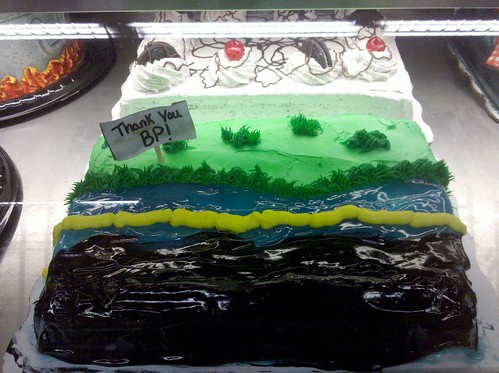
BP Cake

Louisiana's slice:
BP has agreed to pay $18.7  billion to Louisiana, four other states, and the federal government to settle lawsuits filed in the aftermath of the Deepwater Horizon disaster, which killed 11 and unleashed one of the largest oil spills ever in 2010.

Louisiana Attorney General Buddy Caldwell announced Thursday (July 2) that the state will receive more than $6.8 billion from the settlement, including $5 billion for natural resource damages and $1 billion for state economic damage.
The settlement comes after the US Supreme Court refused BP's appeal of a ruling back in January which was, itself, already favorable to BP.
Edward F. Sherman, a professor at Tulane University Law School, told the New York Times that, even though Judge Barbier didn’t explain clearly how he came to the 4.0-million-barrel estimate, his choice to take the middle road between the two group’s estimates was smart. 

“At times we claim precision,” he said, but “there’s no way to precisely find the numbers, so why not pick a number as he did, reasonably between the two numbers provided by the parties?”

Still, the ruling is good news for BP, as it lowers the amount of fines it faces from $18 billion to $13.7 billion.

“Today’s ruling is a major victory for BP and reduces by billions their potential liability,” David Uhlmann, a law professor at the University of Michigan, told Bloomberg.

After the appeal confirmed BP's "major victory" wasn't going to get any more major, they went ahead and settled for it. They're still coming out pretty well anyway.

But how did we do?  Well, relative to everyone else, not so great
Under the settlement, Florida gets $3.25 billion, Alabama gets $2.3 billion, Mississippi gets $2.2 billion and Texas gets about $1 billion.
Yes, Louisiana gets the biggest settlement.  But, given the unique fragility of the Louisiana coastline and the fact that it took the brunt of the damage from the Macaondo event, it doesn't look like the state's share of the settlement is of the appropriate portion.

Probably good news for Alabama football fans, I'm sure.

Others will point out that $5 billion over 18 years is more than zero.  But that's hardly the point.  This is a story about BP's ability to mitigate its own financial losses and, so far, they're doing pretty well at that. Check back with us in 18 years to see how much of this settlement is ever actually paid.

Of course, we'll take what we can get. We need it to launch our "moon shot" coastal restoration project. According to the, likely conservative, estimate provided through the state's coastal master plan, we'll need at least $50 billion to make that happen.  BP is giving us about a tenth of that.

Yesterday, NOLA.com published some blurbs from various local luminaries asked to ruminate on "the future of New Orleans."  By far, the most relevant responses were this one from Tulane geologist,  Torbjörn Törnqvist.
For me, there are two ways of looking at the future of New Orleans. Without any action, 50 years from now the city will increasingly have evolved into a 'peninsula' sticking out into the Gulf of Mexico. I would expect the city will still be livable, but the end will be in sight. Without any action, by that time it will also be clear that catastrophic sea-level rise is unavoidable and planning for abandoning and/or relocating the city will have started.

If serious action is taken, however, the positive effects of large river diversions will have started to be noticed. These effects may not be noticeable in the first few decades after diversions have been put in place; this is a slow process aimed at the longer term.

While the rate of sea-level rise will continue to accelerate even with global efforts to curb greenhouse gas emissions, it will follow a more manageable trajectory (perhaps less than a foot of global sea-level rise within the next 50 years). Still, things will be worse in coastal Louisiana due to the high subsidence rates. Nevertheless, the future of the city will be brighter and it is less likely, under this scenario, that we will seriously discuss relocating the city 50 years from now.
And this even stronger one from John Barry.
The question isn't what kind of future New Orleans has. It's whether New Orleans has a future.

Right now there's a lot of complacency because we have so-called "100-year protection" against hurricanes. That's an Orwellian phrase. Sounds great, but it's the lowest standard in the civilized world.

New Orleans will only have a future for one of two reasons: either because of dumb luck, and I do mean dumb, or because the people of New Orleans get as active as they were right after Katrina and do whatever it takes to get that higher standard of protection.

So far I haven't seen that demand. The business community has sat on its hands, afraid of offending one of the biggest causes of our increased vulnerability: the oil industry. And the elected officials have done the same thing. Everybody points fingers at the federal government and keeps their mouth shut about the big guy down the block.

When the physician heals thyself, that's when I'll know people are serious, and that's when we can start talking about the future of New Orleans.

Until then, it's just a roll of the dice every time there's a storm in the Gulf.
Barry is fresh off a long losing fight to sue the oil and gas industry for the staggering destruction it wrought upon the Louisiana coast beginning long before the Macondo well was ever drilled. Bobby Jindal put an end to that and now he is off to run for President.

Meanwhile, the "business community" has largely moved on.  After all, there's too much money to be made buying and selling dirt in New Orleans in the short term to worry about this existential question of whether there will even be any dirt left here in 50 years.  Better to squeeze what value you can out of it while you can, right?

Monday, January 12, 2015

Links

  • John Barry takes on a favorite rhetorical ploy set out by the oil and gas industry in its argument against the SLFPA-E's lawsuit.
    It's not the levees.

    For years the state has been told that the levees have caused the tremendous land loss across coastal Louisiana, even where land loss was greatest — Terrebone, Lafourche, and western Jefferson Parish. But it ain't so. 

    Don't take my word for it. Ask the Louisiana Mid-Continent Oil and Gas Association, the trade association for Exxon Mobil, Chevron, Shell, BP, and other major oil companies. True, a U.S. Geological Survey study including industry scientists concluded that across most of the coast oil and gas operations caused "only" 36 percent of the land loss. But the percentage varies from place to place. Mid-Continent studied the area of greatest land-loss — Terrebone and Lafourche — and concluded that there "canal development tended to be the overwhelming cause of wetland losses." 

    Mid-Continent did not say what percentage was due to this "overwhelming cause," but in 2006 the Louisiana Department of Natural Resources did. DNR attributed a whopping 76 percent of land loss in the Barataria and Terrebone basins to industry canals and the "altered hydrology associated with oil and gas exploration and drilling." In that part of the state, it's not the levees.
    Last year, the legislature passed a law designed to squash the lawsuit.  Bobby Jindal is defending that law in court. 
  • Uber but for news.  Disruption has come to journalism in a big way
    The writing software, called Quill, was developed by Narrative Science, a Chicago company set up in 2010 to commercialize technology developed at Northwestern University that turns numerical data into a written story. It wasn’t long before Quill was being used to report on baseball games for TV and online sports outlets, and company earnings statements for clients such as Forbes.

    Quill’s early career success generated headlines of its own, and the software was seen by some as evidence that intelligent software might displace human workers. Narrative Science CEO Stuart Frankel says that the publicity, even if some of it was negative, was a blessing. “A lot of people felt threatened by what we were doing, and we got a lot of coverage,” he says. “It led to a lot of inquiries from all different industries and to the evolution to a different business.”

    Narrative Science is now renting out Quill’s writing skills to financial customers such as T. Rowe Price, Credit Suisse, and USAA to write up more in-depth, lengthy reports on the performance of mutual funds that are then distributed to investors or regulators.

    “It goes from the job of a small army of people over weeks to just a few seconds,” says Frankel. “We do 10- to 15-page documents for some financial clients.”

    Now that it's putting them out of work too, I wonder if maybe the mainstream of our press corps will finally pick up on how this is not such a terrific trend for people in various other industries also.... before they're all replaced by robots that is.


  • Get ready for months and months of Obama legacy talk.  You might think that this NY Mag article has blurbed it to death already, though.  Some of those are ok.  Andrew Bacevich and Mike Davis get in a few pretty good shots.  But a lot of it is pretty dumb too.

    Here's a better look at Obama's legacy  (and the useless punditocracy that enabled it) from Tom Frank.
    But let this pass. When historians seek to explain the failures of the Obama years, they will likely focus on a glaringly obvious, and indeed still more hard-headed explanation that the apologists for Obama’s enfeeblement now overlook: that perhaps Obama didn’t act forcefully to press a populist economic agenda because he didn’t want to. That maybe he didn’t do certain of the things his liberal supporters wanted him to do because he didn’t believe in them.

    Think about Obama’s legacy in this context: The most consequential issue facing Americans these days is the gradual reversion of their economy to a 19th-century pattern. In a matter of 30 years, talking about this transformation has gone from being the kind of thing you hear at union strike meetings to something that wins the National Book Award and that almost everyone recognizes to be true—I mean, even George W. Bush acknowledged the problem of growing inequality back in 2007.

    Yet the current leadership of the Democratic Party has been unable either to reverse the trend or to make political capital out of it.
  • Survival condos! Perfect marriage of the the victory of the one percent over everything with the  fetish for apocalypse survivalism so pervasive in pop culture.  At first glance, you'd think that there'd be a market for this in New Orleans.  "How much did you pay for your evacuation condo?" But I think the wealthy people buying up all of our housing are already using it as second homes anyway.


  • Speaking of people being priced out of cities in favor of nice stuff for rich people, here's Detroit.
    — A group of shopkeepers who survived 30 years of retail decline on downtown's Woodward Avenue have been given court-ordered eviction notices just as the area booms with new upscale life.

    The small retailers were based on the ground floor of the Himelhoch building, which is surrounded by hundreds of millions of dollars in investment that has meant the rebirth of historic buildings such as the Broderick Tower and the adjacent David Whitney Building. The M-1 Rail streetcar, slated to open next year, will have its Grand Circus Park stop in front of the Himelhoch's Woodward Avenue entrance.

    The seven-story Himelhoch is home to 72 rental apartments available to low-income residents, and for 31 years, most of the ground floor was leased by Larry and Dianne Mongo. The husband and wife ran everything from beauty shops to restaurants in the Himelhoch. With partner John Enot, they were spending thousands of dollars to open two small restaurants in the coming weeks.
    Thanks for staying interested in this neighborhood all the people who matter allowed to crumble for 30 years. They want it back now, though. Bye.  Coming soon to Oretha Castle Haley Blvd, btw.


  • Here's a look at the city council's proposed smoking ban.  A key issue to watch is how the new rules will work in... um... concert with the noise ordinance.
    But the prospect of having people loitering outside late at night to smoke and perhaps drink worries owners of some bars tucked away in residential neighborhoods.

    “It’s the city that’s putting this rule in place, and they’re putting more of these quality-of-life issues on the table without a real good solution to the problems that are going to arise out of them,” said Bill Walker, who has co-owned the Lost Love Lounge in the Marigny since 2010.

    Walker is in the awkward position of also serving as the head of One Marigny, a neighborhood association.

    Cantrell told The New Orleans Advocate last week that she has a solution for that, too: She plans to revive discussion on New Orleans’ seemingly dormant noise ordinance once work on the smoking ban is finished.

    “It’s kind of like having to vet it again with the new members of the council,” she said about the proposed noise ordinance, which drew widespread criticism and prompted a parade of musicians to storm the council chamber a year ago to voice their disapproval. “But I think a lot of work went into that, and that’s why I feel like we’ve got to pick it back up, because of the work, and we’ve got to finish the job on that.”
    All of a sudden you're pushing more quiet neighborhood bars into the dreaded "nuisance bar" category simply as a result of their complying with the law.  A suspicious person would suggest that the neighborhood associations who back the Latoya Cantrells of the world are just interested in shutting down bars by any means necessary anyway.  But since we're all "One City One Voice" nowadays there's really no room for suspicious people anymore.

Thursday, July 03, 2014

What, then, was the point?

The "Kill the Lawsuit" bill does not appear to have actually killed the lawsuit.
The attorneys will definitely challenge this bill on several grounds. Let me name just two:

First, Act 544 does prohibit “local government entities” — except for parishes — from suing over any oil-related damages in the coastal zone. However, a local government entity has a very precise legal definition, and that definition does not fit the flood authority. So the bill actually does not prohibit the flood authority from suing. That is a very strong argument that the attorneys will make.
Obviously there's more to Barry's post there but the highlighted part is what's interesting to me.  It suggests the bill's authors may not have had the levee board lawsuit in mind specifically even if that was the ostensible reasoning behind the bill. 

Friday, June 06, 2014

Everything you need to know about the lawsuit bill

Lamar has you covered.

That is a comprehensive article by Lamar. It doesn't miss a beat. But perhaps its most crucial observation comes here.
Oil and gas industry attorneys weren’t merely “involved;” they wrote the bill. According to those who were there, lobbyists and lawyers for BP seemed to play an outsized role.

Earlier tonight, John Barry, the former chairman of the SLFPA-E and the internationally acclaimed author of Rising Tide: The Great Mississippi Flood of 1927 and How It Changed America, told me, “A lot of people mentioned to me how omnipresent BP lobbyists were, more than the other major oil companies were (though all of them showed plenty of interest), so much more that it got a lot of people wondering, ‘What’s in the bill for them?’ It certainly got us wondering.”

I also spoke with State Representative John Bel Edwards, who echoed Mr. Barry’s concerns. Oil and gas lobbyists already knew Representative Edwards was opposed to the legislation, he said. They didn’t even waste their time trying to convince him otherwise. But lobbyists, particularly lobbyists associated with BP, spent a lot of time with some of his colleagues.

When the Attorney General expressed his doubts about the bill earlier this week, the reaction of Jindal's legislative allies who pushed it through appeared to indicate that they had only a vague conception what was in the bill in the first place. Robert Adley and Bret Allain's comments basically boil down to, "Well why didn't you tell us any of this stuff before?" Now we know why that is.  Most of our legislators don't seem to really know or care what they're doing beyond just following orders.

Tuesday, February 11, 2014

Blade of Orleans

This is pretty cool.
The author of Rising Tide: The Great Mississippi Flood of 1927 spent much of the last year championing a lawsuit, that Jindal opposes — a lawsuit against oil companies to pay for damages they caused to the wetlands. On Saturday, Barry will lead the irreverent krewe and its procession of brass bands and satirical, racy and offbeat floats. A regular viewer of the parade, Barry embraced the crown with his own theme.

"I'm going to be John of Arc, the Blade of Orleans," Barry says. "When I walked into the (Krewe du Vieux) den, it occurred to me. It seemed perfect. You have a crusade — trying to protect Orleans. Instead of the Maid of Orleans, it's the Blade of Orleans."

Did he have thoughts about Joan of Arc burning at the stake?

"I'm sure (retiring Coastal Protection and Restoration Authority chairman) Garret Graves would like that image," Barry says.
 There's also this graphic from last summer that fits the theme pretty well.

Wednesday, December 04, 2013

Who pays?

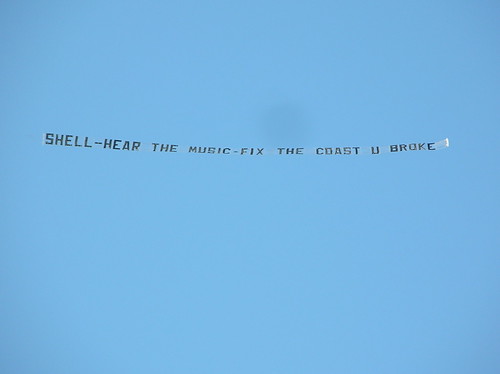
Jazzfest Presented By Shell

Moseley on the various coastal lawsuits:

Louisiana is trying to find a funding mechanism through which the rest of the country will help us pay to save our coast. Whether we skim more royalty revenues from the federal treasury or sue the corps (or both), we have no choice but to share the immense financial burden of our coastal mega-problem with the rest of the country.

America’s Wetland? It’s not just a catchphrase. Ours is vastly the most delicate and significant coastal ecology in the nation, the source of the preponderance of America’s seafood, not to mention the buffer healthy wetlands provide against another Katrina.

The oil and gas lawsuits — Barry’s and now copycat suits from the parishes — are pieces in the same puzzle. Sure the industry will squeal like a stuck pig at having to invest more to rebuild the coast that supports so much of its infrastructure and workers. But we all know that Big Oil will just pass the additional costs along to motorists.

I asked Barry about this during the announcement of his new organization, and he didn’t dispute that the burden would ultimately fall on the consumer. He figured that, roughly speaking, the additional cost would be negligible. We’re not even talking a cent added to a gallon of of gas. More like one cent more per tank.

And there's your key difference between Jindal's and Graves's preference for royalties and suing the corps over Barry's approach of going directly after the oil companies. The remedies J & G emphasize ask far more of the average taxpayer than Barry's does of the average consumer.  In essence the Jindal plan asks the average American to shoulder more of the costs of fixing the mess the oil companies made. 

Thursday, November 21, 2013

No time to rest

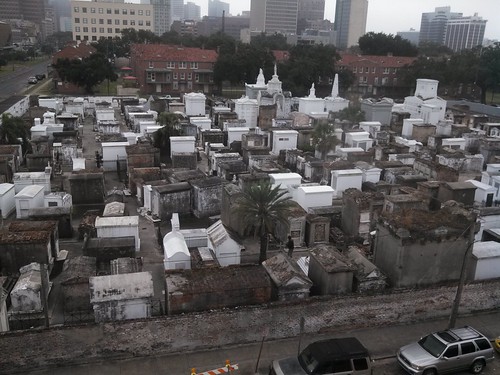
St. Louis Cemetery
St. Louis Cemetery from the fourth floor window of the Basin Street Station

This morning, at a ridiculously stupid hour, The Lens hosted a brief interview with John Barry about his role in the Southeast Louisiana Flood Protection Authority's controversial lawsuit against 97 oil and gas companies operating in Louisiana.  The event took place at the restored Basin Street Station. The Governor refused to reappoint Barry to SFLPA-E at the expiration of his term this year because of his displeasure with the lawsuit.  Barry has founded a nonprofit advocacy group to continue advocating on behalf of Louisiana's fragile coastal environment called Restore Louisiana Now.

If you've been following the story of this lawsuit and the Governor's subsequent acts of political retribution, you probably wouldn't learn anything new from this talk.

Barry described the reasoning behind the lawsuit.   The SLFPA-E is charged with protecting a vulnerable part of Louisiana from storm surge flooding.  The cost of maintaining this protection is going to increase significantly for the foreseeable future and become impossible altogether unless action is taken immediately to save the vanishing coastline.

The state has nowhere near the funds available to meet these costs without significant help.  Because oil and gas exploration has had such a significant effect on wetlands destruction, it follows that the companies who profited by this activity should participate in mitigating the damage.

According to Barry, the State Coastal Protection Authority had been in negotiations with oil industry representatives for a time.  He didn't offer much in the way of details about what sort of deal might have been worked out but it was clear that the slow progress of those talks played a hand in SLFPA-E's decision to go ahead with the lawsuit.

There was further commentary on the details of the suit none of which hasn't already appeared in various reports.  Key to the suit is a long standing law covering "Servitude of Drainage" which, in addition to being the title of a kick-ass Megadeath album, is a.. well here Bob Marshall explained it months ago.
By turning marsh to open water, the projects increased the amount of storm surge that moves into the metro area during tropical storms and hurricanes. The suit claims that violates a principle of civil law called “servitude of drainage,” which prohibits one person from increasing the flow of water onto someone else’s property. The properties do not have to be contiguous.

While most of the attention in this case centers around the loss of land at or above the surface, the filing also lists 10 other oil industry impacts, including road dumps, watercraft navigation and impoundments.

Is “servitude of drainage” a reach for the plaintiffs?

Not at all. This is a well-established point of civil law going back to Roman times; it’s been a regular issue in Louisiana courts since people started clearing low-lying coastal areas for development.

Of course, the key here is proving that the loss of wetlands increased the flow of water against the authority’s levees.
One interesting quote from Barry came during the Q&A.  In answering a (fairly standard on this topic) question about how soon will it be too late to save what's left of the coast and how much money do we need, Barry talked about the State of Louisiana's 50 billion dollar Coastal Master Plan. Barry described that price tag as "a political number" meaning, among other things, that it's probably a gross underestimate.

Asked whether Senator Mary Landrieu had taken a position on the lawsuit, Barry allowed that she has been "as supportive as she can be politically."  Interestingly, Barry says he has a meeting scheduled soon with Mary's brother who has, thus far, been silent on the issue.

In a bit of a surprise this afternoon the board voted not to suspend the lawsuit as Barry's replacement on the board had recently suggested.  If Mitch does make any public statement now, he won't have the luxury of speaking on a moot issue.

Update: Mark Moseley cites several recent reports and commentaries which seem to indicate a "grand bargain" between the state and the industry is currently in the works.
Barry already spent thousands of words essentially appealing to Jindal to take the credit. Take the lead on Louisiana’s great existential issue. Guide the conversation about coastal accountability.  Preside over a “grand bargain” in which a booming industry would concede a slice of its enormous profits to the equally enormous costs of the Master Plan. Do these things, Barry wrote, and Jindal can become perhaps “the greatest governor in Louisiana’s history.”

It’s an incomprehensible prospect (on so many levels). But heck, if Nixon can go to China, perhaps Jindal can go to Chevron.

One thing is for certain: there is now more political momentum towards a deal to force Big Oil to  fix the coast they helped shatter than at any other time in recent memory.

A few months ago Yancey Duplantis of Hornbeck Offshore, a transport firm that services the petroleum industry, responded to the levee board’s lawsuit by saying: “Negotiation, not litigation, is the answer.”

Amen!
I would be very skeptical of the suggestion that a Jindal-negotiated settlement will do anything other than protect the interests of the Chevronese.  Given what we know about the immense cost of fixing our problem and assuming a mutually agreed upon settlement will produce a number significantly short of that cost I'm less inclined to shout out the praise.

Upperdate: Some post-pub editing.  I never proofread anything. 

Sunday, October 13, 2013

Some links for Sunday

  • James Gill's column this morning is about ION Chariman Jay Lapeyre and his role in helping Bobby Jindal bring the SLFPA-E to heel.
  • Lapeyre is not just a big shot in Texas. He is most active in his home state of Louisiana where, for instance, he chairs the committee that nominates candidates for seats on the Flood Authority. The committee gives Gov. Bobby Jindal two to choose from when a member’s term expires, which (John) Barry’s has.

    Barry was a certainty for reappointment until Jindal lost his rag over the lawsuit. None of the official reasons for the administration’s dudgeon make any sense, but the oil and gas industry has never lacked friends in high places. At Lapeyre’s urging, four members of the committee joined him in voting against Barry. That produced a 5-5 vote, and Barry was a goner.

    “Whew,” the roomful of ION customers would exclaim, “that was a close one! Where would we be without Jay?”

    Various civic and educational institutions are represented on the nominating committee, where Lapeyre’s sponsor is the Campaign for a Better Louisiana. Not that much better, though. A blatant conflict of interest is evidently still jake.

  • Also from The Advocatea front page feature on the still very much in doubt future of Avondale shipyards. Avondale currently employs 1500 of its one time 5,000 strong workforce and is scheduled to close once the final order from its Navy contract runs out next month.

  • As various players scramble to put together a new strategy for the shipyard, the bulk of the 3,500 displaced workers are still in limbo.
    Amid the slowdown, it’s hard to gauge what’s has become of the yard’s nearly 3,500 displaced workers.

    Ault said he has had a hard time convincing people to drive or move the 120 miles to Pascagoula, where thousands of openings remain unfilled. He said the union has kept in touch with laid-off members, and many of them have stuck around. “Bringing back people would be a fairly rapid transition,” he said.

    Bollinger — who employs about 3,000 people in Louisiana and whose firm typically has hundreds of openings, mostly at its repair facility in Amelia — said he expected to be deluged with resumes when Avondale’s closing was announced. But it didn’t happen, and his company has hired only about 50 former Avondale employees.
    Neither going to Pascagoula nor working for Boysie Bollinger seems particularly appealing to these folks for some reason.

  • Google's plan to turn your every idea or public discussion about anything into an advertisement.
    When the new ad policy goes live on Nov. 11, Google will be able to show what the company calls shared endorsements on Google sites and across the Web, on the more than two million sites in Google’s display advertising network, which are viewed by an estimated one billion people. If a user follows a bakery on Google Plus or gives an album four stars on the Google Play music service, for instance, that person’s name, photo and endorsement could show up in ads for that bakery or album. Such product endorsements, especially from friends and acquaintances, are a powerful lure to brands, replicating word-of-mouth marketing on a broad scale. Social advertising — which includes a wide range of ads, including endorsements — is a $9.5 billion business, according to eMarketer, accounting for 8 percent of digital ad spending.


  • Related: Here is Thomas Frank writing about the Silicon Valley (which we really should think of as the new Madison Avenue) obsession with monetizing "creativity" whatever that might be.

    Those who urge us to “think different,” in other words, almost never do so themselves. Year after year, new installments in this unchanging genre are produced and consumed. Creativity, they all tell us, is too important to be left to the creative. Our prosperity depends on it. And by dint of careful study and the hardest science — by, say, sliding a jazz pianist’s head into an MRI machine — we can crack the code of creativity and unleash its moneymaking power.

    That was the ultimate lesson. That’s where the music, the theology, the physics and the ethereal water lilies were meant to direct us. Our correspondent could think of no books that tried to work the equation the other way around — holding up the invention of air conditioning or Velcro as a model for a jazz trumpeter trying to work out his solo.

    And why was this worth noticing? Well, for one thing, because we’re talking about the literature of creativity, for Pete’s sake. If there is a non-fiction genre from which you have a right to expect clever prose and uncanny insight, it should be this one. So why is it so utterly consumed by formula and repetition?


  • Here's an amusing stunt by comedian Sam Hyde who passed himself off as a presenter at a TED show. For the uninitiated, TED is kind of a tent revival circuit of motivational talks for middle managers who worship the Creativity consensus thinking Frank describes. Hyde bullshits his way onstage and delivers... well.. this.


  • Bill Moyers on the House Republican rump:
    Despite what they say, Obamacare is only one of their targets. Before they will allow the government to reopen, they demand employers be enabled to deny birth control coverage to female employees; they demand Obama cave on the Keystone pipeline; they demand the watchdogs over corporate pollution be muzzled and the big bad regulators of Wall Street sent home. Their ransom list goes on and on. The debt ceiling is next. They would have the government default on its obligations and responsibilities.

    When the president refused to buckle to this extortion, they threw their tantrum. Like the die-hards of the racist South a century and a half ago, who would destroy the union before giving up their slaves, so would these people burn down the place, sink the ship.
  • From Abraham Lincoln's Cooper Union speech:
    But you will not abide the election of a Republican president! In that supposed event, you say, you will destroy the Union; and then, you say, the great crime of having destroyed it will be upon us! That is cool. A highwayman holds a pistol to my ear, and mutters through his teeth, "Stand and deliver, or I shall kill you, and then you will be a murderer!"

    To be sure, what the robber demanded of me - my money - was my own; and I had a clear right to keep it; but it was no more my own than my vote is my own; and the threat of death to me, to extort my money, and the threat of destruction to the Union, to extort my vote, can scarcely be distinguished in principle.


  • Yesterday, as the shutdown talks moved back to the Senate, Harry Reid kept up the hardball stance.
    At an afternoon news conference, Reid said he wanted a shorter period for stopgap funding and a longer extension of the Treasury’s borrowing authority. Reid particularly wants to scale back deep automatic spending cuts known as the sequester, which were passed during the 2011 debt-ceiling showdown and will take effect every January for the next decade, unless Congress amends them.

    Exclusive footage of Senate negotiations between Reid and McConnel


  • Speaking of stomping on the Tea Party, the Saints kickoff in New Engaland in about an hour and a half. This means, among other things, I'm going out for beer. Here, via B&G Review, is a moment of greatness for you to ponder in the meantime.

    Tuesday, October 01, 2013

    Barry: SLFPA nominating commitee has "betrayed the public trust"

    Not really surprised. Would have been nice to see them make Jindal say no, though.  Here's the gist from Bob Marshall's live-blog of the meeting.
    To repeat, an effort to renominate John Barry, the leader of the suit against the oil and gas industry, failed on a 4-4 vote. This was preceded by some committee members openly acknowledging threats by Gov. Jindal to veto his nomination because of that suit.

    The New Orleans nominees are Billy Marchal, who worked for the Flood Protection Alliance, a nongovernmental group based in New Orleans and was member of Gov. Jindal's transition advisory committee on flood protection and coastal preservation.

    The second name - they just send two - is lawyer Lambert J Hassinger, who currently is chairman of the Non Flood Protection Asset Management Authority.
    As you can also see from that link, Barry disagreed with the decision. 
    After Hurricane Katrina, the people of Louisiana demanded a levee board made up of professionals instead of political appointees. 94% of the people in Orleans Parish demanded that change. They created a nominating committee and trusted them to carry out that charge. Today, several members of the committee betrayed that trust. I hate to use the word “betray” but that’s what they did. Politics dominated the process and dictated the outcome. Several committee members explicitly announced that politics was dictating their vote. Perhaps the clearest sign of just how deeply politics dominated their thinking was their failure to nominate Tor Tornqvist, one of the leading coastal scientists in the world. Their not nominating him disappoints me more than their not nominating me.
    Tornqvist is the chair of the Tulane geology department and has a long list of environmental science bonafides. This site describes some of the coastal research projects he heads there.

    The board chose, instead, to nominate Billy Marchal who was, as The Lens points out, a member of Jindal's transition team. Marchal has some other interesting political and business associations. Here is his bio page describing his position with the Trust for Public Land.

    Mr. Marchal, a New Orleans native, holds a degree in Industrial Engineering from Georgia Tech and a Masters of Business Administration from Tulane University. He served in the U.S. Navy as Electrical Officer on the guided missile cruiser USS ALBANY (CG-10).

    Following Katrina, Mr. Marchal worked full time on the Drainage and Flood Control committee of the Bring New Orleans Back Commission formulating plans and generating new ideas to enhance the safety of New Orleans and the surrounding parishes.  This effort has included bring together the Corps of Engineers, Sewerage and Water Board, engineering firms, the Lake Pontchartrain Basin Foundation, and other environmental groups to help develop a consensus of the best way to proceed for both the short and long term.

    Drawing on the success of the BNOBC planning, Mr. Marchal organized the Southeastern Louisiana Recovery Committee consisting of two dedicated citizens and one senor elected official from each of the parishes of the region, experts on coastal restoration and staffers from congressional offices.  The purpose was to identify water-related projects and iron out any differences among the parishes before the projects were forwarded up the line to state officials, La. congressional delegation, and Corps of Engineers.

    Mr. Marchal served as the Executive Director of the Flood Protection Alliance, a group of civic, business, and environmental leaders working behind the scenes to insure timely, robust flood protection for the metropolitan New Orleans area by coordinating, facilitating, and sometimes instigating.  Mr. Marchal was appointed to Governor-elect Jindal's Transition Advisory Committee for Flood Protection and Coastal Preservation. 

    Mr. Marchal sits on the Executive Committee of the Horizon Initiative, the NGO that spearheaded the effort to form the public-private partnership for economic development in New Orleans.  He chairs its Infrastructure Committee which includes over forty private sector members of water related businesses and representatives of the Sewerage & Water Board, City planning dept., City hazard mitigation dept., La. DEQ, Tulane, UNO, Loyola, LSU AgCenter, GNO Inc., and Rand. Corp., to name a few.
    In other words, the "apolitical" nominating committee passed on an imminently qualified pure academic for someone whose qualifications rest as heavily on his political connections as they do on his technical background.

    Friday, September 13, 2013

    It's been fun

    The process of undoing the levee board reforms begins today.
    A nominating process that is likely to end with the ouster of two prominent supporters of a local levee board’s suit against almost 100 oil and gas companies will get underway Friday as a committee of engineers, academics and policy experts begins poring over a half-dozen applications from those seeking seats on the board.

    Southeast Louisiana Flood Protection Authority-East President Tim Doody and Vice President John Barry, whose terms have expired, each face two challengers seeking their spots on the board. State law requires the nominating committee, which holds its first meeting today, to recommend two people for each slot to Gov. Bobby Jindal.

    While several board members have kept their thoughts on the recently filed suit private, the Jindal administration has been sharply critical of it. Administration officials have said a candidate’s support or rejection of the suit — which potentially seeks billions in damages from energy companies for the destruction of coastal wetlands — will be a key factor in the appointments.

    To be very clear, the governor has said that the lawsuit is a litmus test. Period,” said Coastal Protection and Restoration Authority Chairman Garret Graves, who has been the administration’s chief spokesman in criticizing the lawsuit.
    At  least they're up front about whose side they're on. 

    Wednesday, September 11, 2013

    Strategy

    Over the Labor Day weekend, Bobby Jindal's coastal czar Garret Graves contributed some quotes to this New York Times feature on the SLFPA-E lawsuit. Graves claims the suit messes up the state's grand strategy to fight coastal loss over the long run. 
    Mr. Graves does not dispute that damage was caused by industry, but does deny that opposition to the suit is about politics. He said the state had worked for years to build a broad coalition, including environmentalists and representatives from oil companies, to finance and implement a $50 billion coastal master plan. 

    There’s a bigger strategy that they’ve come in and really screwed up,” he said. 

    Mr. Graves said the state was focused on three areas: attaining penalties and legal remedies from the BP spill, pushing legislation that would bring Louisiana a substantial share of offshore drilling royalties currently going into the federal treasury and battling with the Army Corps of Engineers over its management of the Mississippi River. 
    I'm not sure what "battling with the Corps of Engineers" means in any practical sense at this point. We'll leave that aside for now.

    The argument over offshore drilling royalties is ongoing and complicated.   Under the terms of the Gulf Of Mexico Energy Security Act of 2006  energy producing states like Louisiana are scheduled to begin receiving a more substantial share of drilling royalties..... in 2017.   At that time Louisiana's take is estimated to start at $385 million and reach as much as $630 million per year.... eventually.

    Besides, as Mark Moseley pointed out yesterday afternoon, offshore royalty payments are taxpayer funds to begin with.
    Royalties, or more accurately, severance taxes, are compensation for the right to extract non-renewable mineral wealth like oil. It’s for removing mineral wealth, like oil, that can only be exploited once. Royalties are not a repair cost for extraction, or compensation for environmental impact.

    Everyone who touts increased royalties as the smart play toward funding the coastal reconstruction Master Plan is misleading you. They are trying to link royalties and coastal restoration in the public’s mind, as a solution to the problem.

    So Graves's strategy for doing anything like asking oil and gas to "put the coast back like they found it", as Russel Honore says, is wait for the BP litigation to play out and then hope that's enough.  But even then the best outcome provides remuneration for only the very latest oil and gas atrocity committed against Louisiana.

    It won't be nearly enough anyway. Louisiana's coastal restoration master plan (the one Graves constantly trumpets) requires $50 billion to fully implement.   Even in the best case scenario, the BP trial won't result in anything close to that kind of payout.  Last week Bob Marshall laid out the complex series of conditions by which a judgement against BP could eventually filter down to the Louisiana coastal project.  There's less there to rely on than you might think.
    The Clean Water Act sets fines at up to $1,100 per barrel if there is no finding of “gross negligence” and $4,300 a barrel is there is such a finding. The government has claimed 4.9 million barrels were spilled, but U.S. District Judge Carl Barbier has ruled BP can subtract 800,000 barrels that it collected.

    Assuming maximum fines depending on Barbier’s ruling on gross negligence, the total awarded for 4.1 million barrels spilled would be between $4.5 billion and $17.1 billion.

    BP is fighting the negligence charge and likely will appeal the ruling on the volume of oil spilled. Some legal experts say proving “gross negligence” is going to be legally challenging.

    In an article entitled “Innumerable Shadings of Grey“ in the Columbia Business Law Review, Laura Umbrecht reports that one of the few cases to define the term under the Clean Water Act held that “gross negligence requires the intentional failure to perform a manifest duty in reckless disregard of the consequences as affecting the life or property of another; such a gross want of care and regard for the rights of others as to justify the presumption of willfulness and wantonness.”

    But the article goes on to point out numerous other cases in which the bar was lower, or even higher.

    What it means for Louisiana: Under funding splits prescribed in the law and explained below, the only guarantee Louisiana has is one-fifth of Pot 1, a sum that will fall somewhere between $300 million and $1.8 billion.

    How much the state gets from the other pots will be determined largely by the Council. But if it were to draw a one-fifth share from each of the pots, Louisiana’s total take would be between $900 million and $3.42 billion.
    The "pots" Marshall is referring to are divisions of the total eventual BP penalty defined under the terms of the RESTORE Act which come with different rules as to how the five Gulf states can distribute it among themselves and then spend their portion. I'd encourage you to read the rest of Marshall's article for a fuller explanation of the pots.

    The upshot is, in the best possible case, Louisiana's share of the BP "winnings" pays for less than 10 percent of the cost of saving its sinking coastline.  And this is the full fruit of the delicate strategy, Garrett Graves and Bobby Jindal believe the SLFPA-E's lawsuit puts in jeopardy. 

    Over the same Labor Day/Katrinaversary weekend that Graves made his complaint to the Times, John Barry published an op-ed in National Geographic explaining once again the dire circumstances South Louisiana faces and the reasons for the lawsuit. 
    To put it simply, we want the industry to fix the part of the problem they created. We want them to fix what they broke, and what they promised to fix. The industry also wants the coastal buffer restored to protect its own enormous investment in infrastructure—pipelines, wells, and 20 percent of the nation's refining capacity. Chris John, head of Louisiana Mid-Continent Oil and Gas, an industry trade association, says "our viability depends on" the buffer. But the industry wants taxpayers to pay for a problem it, the most profitable industry in the world, created.
    Outside of waiting on a sure to be insufficient BP judgement, Graves's and Jindal's strategy relies completely on the expectation that taxpayers will pick up the tab for a problem the oil and gas industry created. That strategy needs to be reconsidered.

    Friday, August 23, 2013

    Everybody hates Bobby... and he hates them too

    Pass the popcorn.

    America's most unpopular governor and his officials are digging in their heels against the Southeast Louisiana Flood Protection Authority- East (SLFPA-E) and its lawsuit against the oil and gas industry. 

    Over the course of the past week or so, SLFPA-E Vice President John Barry has been on a public relations tour of sorts.  He has written op-eds for the Times-Picayune and The Lens,. He spoke Monday at the Baton Rouge Press Club and has made several pointed statements to the media about the lawsuit.  His comments have been firm but measured with obvious invitations to the Governor, and to the industry to sit down and negotiate a resolution.

    The Governor, through his officials, has... not so politely.. declined.  Instead they began looking for ways to gut the Authority's.. um.. authority.. and to remove Barry as soon as possible.
    But ever since the offer was tendered, Garret Graves, the head of the state Coastal Protection and Restoration Authority, has done a thorough job of showing the Flood Protection Authority that the olive branch won’t bear fruit.

    Central to the levee authority’s offer was a willingness to consider a 45-day “pause” in some aspects of the lawsuit if the administration convened a task force with representatives of the oil and gas industry.

    Graves quickly made it clear that the administration wasn’t going to “let the tail wag the dog.” Since then, the dog has been busy.

    On Monday, Graves said that the administration would use the annual process of replacing expired seats on the levee authority board to seat new members who agree with its position.

    At Wednesday’s monthly meeting of the Coastal Protection and Restoration Authority, Graves led the group to a unanimous vote opposing the suit and promised more aggressive court action soon.

    He seemed to shred the last leaves from the olive branch with this comment about the future of the Flood Protection Authority: “I don’t see any scenario where this levee district doesn’t get gutted — or, say, ‘reformed’ — in the next legislative session.”

    And then it got worse.  Today the Attorney General's office sent out an official rebuke of Barry.  Meaning they wrote up a press release saying explicitly that they were rebuking him.
    The state Attorney General’s Office issued a press release entitled “AG’s Office Rebukes John Barry in Levee Board Lawsuit.”  The rebuke was for statements by Barry that the AG’s office had told the flood authority’s attorney, Gladstone Jones, that the oil and gas law suit “did not negatively impact the state’s efforts to collect damages from B.P. in the Deepwater Horizon oil spill litigation.” The AG’s office said that never happened. However, the release did not say the office thinks the flood authority suit is interfering with the state’s case against BP.
    In other words, the AG's office doesn't necessarily disagree with this thing they are alleged to have said.  But they do not want people going around saying that they said it. Anyway it merits a "rebuke," I suppose.

    Not that that means anything, especially in Louisiana political circles.  The most famous "rebuke" I can recall happened in a 2006 mayoral primary debate.  I'm sure if I dug around I could find video but, for now, we'll just have to settle for my description of it at the time.
    The classic moment of the campaign came later when Rev. Tom Watson challenged Nagin to explain his "double talk" meaning his tendency to contradict his own statements depending upon the make up (race) of his audience. Watson admonished Nagin not to "apologize for being a black man." Watson also challenged Nagin's assertion that the state is "holding up" reconstruction funds and let fly at Nagin with all of the fire and brimstone he could muster here declaring, "Ray Nagin is the problem! Ray you are lying! You are a liar!" At one point in this exchange Watson actually used the words "I rebuke you." Nagin's response to all of this was even better. During the reverend's tirade Nagin affected to bless Watson making the sign of the cross and shouting, "Pastor! God bless you!"
    That was on April 19.  By May 11, Watson had endorsed Nagin in the runoff.  Here's how Watson described the "rebuke" then.
    But at a joint press conference Thursday at Li'l Dizzy's Cafe on Esplanade Avenue, Watson said his past criticism of Nagin was "heated, emotional fellowship."
    I'm not sure we can describe the rift between the SLFPA-E and the Jindal administration in those same terms but, since we do know that un-rebukes do exist, we'll hold out hope that one is still possible in this case.  Maybe the Governor can issue an un-rebuking when he appears on Meet The Press this Sunday. On the other hand, all the questions will probably be about Chris Christie.

    I suppose, there could also be one or two questions about what it's like to be America's most unpopular Governor. But, as Clancy Dubos correctly points out in this strange but amusing column, that's likely to be met with a rebuke of its own. 
    Team Jind cautioned against putting faith in so-called “independent” polls that show Our Beloved Supreme Leader’s popularity dropped from 37 percent to the mid-20s. Such numbers are “pure fiction,” Team Jind says, because they are the work of Democrats, liberals, bloggers and other undesirables.

    Thursday, August 22, 2013

    "That’s all we want: Fix the part they broke"

    Jazzfest Presented By Shell

    John Barry explains the SLFPA-E's lawsuit in this Lens op-ed.
    Our case is based on the fact that we are forced to maintain and possibly build more elaborate flood protection defenses because of land loss. The industry’s failure to comply with permits — its failure to do what they voluntarily agreed to do and to obey the law in exchange for taking hundreds of billions of dollars out of the state — has destroyed land.

    That land loss means there’s no buffer to block storm surge, and that sends more water pounding against our levees. As the saying goes, the levees protect the people, and the land protects the levees.

    The land is disappearing so fast that by 2100, if nothing is done New Orleans will be basically an island. The levees will be beach-front property. Much of the rest of the Louisiana coast will simply cease to exist.

    Louisiana law also embodies a concept going back to the Romans called “servitude of drain.” This prohibits one party from increasing the natural flow of water from its property onto another’s. The destruction of land is sending more storm surge pounding against our levees.

    We believe the oil and gas industry violated the law, and these violations have endangered the people we are responsible to protect.

    Our suit does not ask that the industry restore the entire coast. But they must restore the part of the coast they destroyed. They must fix the part of the problem which they created. That’s all we want: Fix the part they broke.
     There's much more.  Read and share with your closest 500 friends. 

    By the way, "Servitude of Drain" was probably the best Pantera album.  Pity, Gambit didn't ask Phil Anselmo about it in this interview.

    Tuesday, August 20, 2013

    Gret Stet of Texaco

    John Barry speaking Monday to the Baton Rouge Press Club:
    Barry summed up opposition to the lawsuit against the oil and gas industry with one word: Politics.

    “People used to say the flag of Texaco flies over the State Capitol. People have to ask themselves if that’s still true,” he said during a lunchtime gathering.
    Barry did not comment on whether the State of Texaco could ever have been "bigger than Texas." But the implication that the state government is wholly owned by oil and gas could not be more appropriate given the lengths the Governor and his allies in the Legislature have gone to to shut down the Flood Protection Authority's lawsuit.  In a Gambit column this week, Clancy Dubos doesn't pull any punches on this point.
    No one should be surprised by Jindal’s duplicity. He has never let irony, or truth, or even a fundamental sense of right and wrong stand in the way of his ambition. And right now his ambition tells him to do whatever he can to ingratiate himself to the energy companies that he hopes will help bankroll his future political moves.

    In late July, SLFPA-E sued 97 oil, gas and pipeline companies that have carved up Louisiana’s coast for the past eight decades, seeking to make them pay their fair share of the costs of repairing the marshes and protecting southeast Louisiana against the increased risks of flooding. Ever since, Jindal and his wetlands czar Garret Graves have been trying to put the kibosh on the lawsuit.

    They tried to intimidate commissioners, who voted unanimously to file the lawsuit, into changing their minds. That didn’t work. Jindal now hopes to replace commissioners whose terms have expired, particularly historian John Barry, who has been outspoken in favor of the litigation. Barry, who wrote Rising Tide, is one of the nation’s leading authorities on flood control policy.
    To be certain, the lawsuit is a long shot.  But it's a necessary long shot given the desperate Hail Mary situation South Louisiana finds itself in with regard to the  safety of its residents and the future of its coast.  The Lens' Bob Marshall explained shortly after the suit was filed.
    Decades of drilling and dredging by the oil and gas industry have contributed to the dramatic loss of wetlands in southeast Louisiana, which help reduce storm surges pushing against the region’s flood protection levees. About 2,000 square miles of land have disappeared in Louisiana; various studies say the oil and gas industry is responsible for anywhere from 16 to 50 percent of that.

    The Southeast Louisiana Flood Protection Authority-East claims that the loss of wetlands in its jurisdiction means levees and floodwalls must be built higher, resulting in a dramatic increase in their costs for building and maintaining levees and floodwalls.

    The agency wants 97 companies named in the lawsuit to repair the damage, and if that’s not possible, to help defray the cost of flood protection now and in the future.
    Back in February, Marshall reported on the dramatic costs the SLFPA-E was facing down as it assumed responsibility for maintaining the new and complicated flood control system from the Army Corps of Engineers.
    The costs include $14 million for annual operation and maintenance of the system – a figure that does not include future levee raising — as well as $20 million a year for the next 30 years as part of the state’s cost-share for the whole project.

    If the flood protection authority can’t find a fix, officials said, the only alternative would be bond issues at rates that could be ruinous to some communities.

    “We’ll soon be facing a $600 million question,” the authority’s vice president, John Barry, said with reference to the 30-year cost sharing burden. “Who is going to pay?”
    The lawsuit proposes that instead of placing the burden of financing the ever-increasing expense of protection on the public debt of residents, why not seek recompense from the parties responsible for putting them in this position in the first place?  It's a simple and desperate call for justice.

    But no one is living under the illusion that's really within reach. 

    Last week's legislative hearing demonstrated the oil industry's muscle pretty plainly.
    After the meeting, Adley told reporters there wasn’t anything the Legislature could do about the suit until the next session, which begins March 10.

    He and Rep. Jones both said, however, that they strongly expect multiple lawmakers to file bills seeking to either limit the authority of the levee boards or block this specific suit.
    Meanwhile, Louisiana's Master Plan for coastal restoration is largely dependent upon a favorable result of the current Clean Water Act litigation against BP stemming from the 2010 Macondo disaster.  In May, The Lens hosted a forum dramatically but aptly titled "Last Call For Louisiana's Coast." There Barry said bluntly, "Were it not for the BP spill, we would not have any dollars coming" in time to even get started with the necessary work of saving what's left of the wetlands.

    Now even that assertion seems hopeful. Anyone who has been following BP's increasingly defiant stance recently can't expect the state will reap an award anything near sufficient to its needs from those proceedings... certainly not in time to do what desperately needs to be done with it anyway.

    Simply put, "Last Call" means it's time to start trying whatever desperate move might be left available before it becomes time to pack up and float away.  And taking 97 oil companies to court is about as desperate a move as one can make.  But even then, Barry has made it clear that the suit is an opportunity for negotiation.
    I ask the governor this: Why not solve the problem? Our suit addresses only New Orleans. The entire Louisiana coast needs help. The governor has been good for the coast. I ask the governor to be great for the coast. I ask the governor to negotiate a solution acceptable to everyone. I would support this. I hope the governor and the Legislature would, too.
    Of course, any good faith negotiation would have to start with taking the Texaco flag down off the Capitol building and running the Pelican back up in its place.  But even that may be too much to hope for.

    Thursday, August 15, 2013

    It's like a TV timeout

    Or maybe one of those stoppages in play so we can get the crazy fans who stormed the field (Robert Adley, Garett Graves, Bobby Jindal)  rounded up.  Whatever it is, we're taking a breather.
    The New Orleans levee authority on Thursday passed a resolution to consider placing a 45-day pause on its lawsuit against about 100 oil, gas and pipeline companies. The authority said the pause would let the group work further with the governor’s office and set up “a task force to examine and review all ramifications of the lawsuit.“

    The levee authority also passed a resolution reaffirming its resolve to continue with the lawsuit, claiming that oil, gas and pipeline companies are contributing to land loss and erosion. If the levee authority is victorious, companies would be required to repair any wetland damage that increases the risk of hurricane storm surges overtopping local levees.
    The "four hour closed door session" with Graves must have been exhausting.  Anybody would want to take a break after that. Still it's good to see they're all resolute in reaffirming their resolve to continue and all.

    In my opinion, John Barry has been pretty careful and reasonable in his public statements since the suit was filed.  He also sounds like he knows he's played a strong card.
    But Barry and other authority commissioners said they respect Jindal and his office’s work in coastal restoration issues and would prefer to move forward with Jindal’s office if it finds a better way to work with the oil and gas companies.

    “If someone can prove that there is a better path, then I would withdraw the lawsuit without a second thought,” Barry said.

    Thursday, July 25, 2013

    That's a wrinkle

    I'm working on a more comprehensive post about yesterday's adventures with the Governor and the Southeast Louisiana Flood Protection Authority.  But this morning's Advocate brings up an issue I haven't considered in this editorial.
    The scale of the lawsuit and its potential impact on public policy underscore the Flood Protection Authority’s obligation to conduct its business in the public interest. We must wonder if the authority’s strategy for advancing the lawsuit meets that standard.

    The board did not publicly debate its decision to file the suit, a troubling move given the potentially sweeping consequences of the litigation. The board didn’t vote publicly to file the suit, although it did vote to hire attorneys who are now representing it in the litigation.

    That omission raises troubling legal questions of its own. The board’s actions seem to violate the spirit if not the letter of the Louisiana Open Meetings Law.

    Monday, April 27, 2009

    Swine, Limbaugh..

    Pretty much synonymous, anyway.

    Also in that category... this morning, on WWL radio, Bob and Monica conducted an embarrassing interview with Dr. Brobson Lutz during which Bob asked an incredulous Dr. Lutz a) if Hospitals were intentionally kept extra-cold in order to prevent the spread of germs and b) is it safe to eat Mexican pork?

    Finally, if you're concerned about the flu but would prefer to learn something interesting rather than just sit around freaking out, I highly recommend John M. Barry's The Great Influenza : the epic story of the deadliest plague in history about the 1918 flu outbreak. Many New Orleanians have read Rising Tide and are already familiar with Barry's ability to write engagingly about the intersection of science and politics. That same theme runs throughout The Great Influenza. If you've missed this title, now would be a good time to pick it up.