-->
Showing posts with label Kristin Palmer. Show all posts

Wednesday, July 07, 2021

Property rights

At first glance it might seem at least a little bit insensitive of Kailas to even bring this up.  

The developers of the ill-fated Hard Rock Hotel have sued the city over a new measure that would restrict the height of future construction at the site of the building collapse, alleging that it’s a politically motivated ploy from City Council member Kristin Gisleson Palmer.

The developers say that lowering the maximum building height allowed at the site from 190 feet to 70 feet constitutes an illegal taking of their property, and they’re asking an Orleans Parish Civil District Court judge to declare a motion sponsored by Palmer null and void. 

After everything that happened here, the damage, the disruption, the cost, the injuries, the deaths, the exposure of the corrupt systems that underlie all of it, you'd think that the property owner doesn't  just say "my bad" and start over.  But we're so far off the edge of the map with regard to oligarchic late stage capitalism now that all the human questions about what should happen with that space now must take a back seat to the sacred "property" rights of people like Kailas to suck maximum value out of it.

Also he's probably just thinking the developers own their own judges now anyway. Might as well put that work. 

The developers’ preemptive lawsuit says that the process leading up to the June 3 vote was fatally flawed and that a judge should order it reversed. The lawsuit claims that an April report from the City Planning Commission cited only vague generalities about economic damage instead of specific violations of the city's comprehensive zoning ordinance.

The lawsuit has been assigned to Judge Jennifer Medley. The city declined to comment.

Thursday, June 24, 2021

The end of the criminal legal reform era

 Just how big an industry is the tax farming business now

Across the United States, court debt has ballooned as states have turned to court costs, fines, and fees as revenue streams. A recent report by watchdog group Fines and Fees Justice Center found that court debt in the U.S. now totals at least a staggering $27.6 billion. That figure is a low estimate, the group noted in the report, because it relied on incomplete data collected from only 25 states.

To handle the collection of that debt, states and municipalities — as well as the Internal Revenue Service — are increasingly turning to private firms, which in some states can add up to 40 percent surcharges onto the fees. In aggregate, that can translate into billions of dollars of payouts for the debt collectors.

Those of us old enough to remember the birth of the Black Lives Matter movement following the murder of Mike Brown in Ferguson, Missouri will recall the central role that municipal fines and fees played in the system of predatory racism against which the people there rose up.  And here we are a thousand years, and several cycles of murderous police actions and uprisings later and still very little has fundamentally changed. 

In New Orleans, one could argue there has been some progress. But what's happened has been slow and slight. A 2020 law re-directs court fee  revenues away from control of the judges who impose them but does not abolish them altogether.  The City Council appeared to at least try and defy that law when it resolved to return the fees collected but I don't think we've been updated on how that's worked out.  As of this April, a series of lawsuits have resulted in a system whereby Orleans Criminal Court judges promise a kinder, gentler bail regime

A joint order from the judges in February formalized new bail rules that paved the way for the settlement. The agreement comes after drawn out wrangling over how judges in New Orleans can impose bail or fines and fees on thousands of defendants each year, the vast majority of them poor.

Under the new order, defendants must have an attorney when their bail is set. The judges also promise to inquire into defendants' ability to pay, to consider alternatives to cash bail and to explain their reasoning when they do keep defendants behind bars.

We'll see how that goes.  Last week, the City Attorney announced a mass dismissal of some 385,000 cases of municipal violations which should reduce the likelihood you will be ensnared by an attachment from some unpaid traffic fine from 10 years ago. That's all good news. But it's minimal compared to what is needed here and in every city where billions of dollars worth of bounties are still hanging over the heads of highly vulnerable people. 

Meanwhile the time for further progress is running short.  Local media is already daily beating the drums of crime wave panic and the tide is beginning to turn toward reaction. (In fact, here is WDSU specifically blaming lax collection of court fees.) Our newly elected "reformist" DA is already breaking his promise not to try children as adults. Major candidates jumping into the marquee race in this fall's municipal elections are already taking up demagogic "tough on crime" rhetoric in their initial messaging.  All of this is only going to get worse as that election approaches.  Afterwards, this group of politicians will go back to work with a new mandate to "get tough" and new rules that will allow them to do just that.  

Mr. Biden emphasized that state and local officials in areas experiencing surges in gun violence can use $350 billion in Covid-19 relief funding to hire more law-enforcement personnel, even if it raises the total number beyond its pre-pandemic level.

The window of opportunity to make real and lasting change is always so short. And when it shuts it can stay that way for a long time. Business as usual, on the other hand can last... well that's why they call it business as usual.

Thursday, August 27, 2020

Nobody wants this big pile of money

Last week, City Council passed a non-binding resolution instructing the Criminal District Court to stop collecting conviction and bail fees from defendants and to return money to people from whom they've already collected these fees.  Supposedly, the idea is to discourage the courts from hoovering up unnecessary money from the poor and indigent who make up the vast majority of people wrung through our brutal criminal justice system. But there are problems.

To begin with, at least some of these fees (the bail fees) are mandated by state law which supersedes the council's authority so at least some of this money has to be collected. The courts are already in a state of limbo regarding that money since a different state law passed this year instructs them to hand it over to the city.  The new law is intended to eliminate a perverse incentive whereby the courts use these fees to fund their own operations. As a result of a 2018 lawsuit ruling that forbids the judges from keeping the funds, they've been collecting in a separate escrow account. 

Anyway that's as good a job as I can do summarizing the Lens's article.  The point is, because we haven't yet managed to ban cash bail altogether, there is a tub full of money that the courts aren't allowed to keep but the city council asserts that it does not want.  

OR maybe they do want it. 

At a City Council Criminal Justice Committee meeting last week, prior to the passage of the resolution, Councilwoman Helena Moreno wondered what would happen with the money judges do not have discretion over collecting. 

“So let’s say that the judges say, OK, the city isn’t going to collect, so it’s not worth imposing some of these additional fines and fees,” Moreno said. “But for those that through state law — statutorily — they have to, and it ends up in the escrow account, what do we do with the money in the escrow account?”

Will Snowden, executive director of the Vera Institute of Justice’s New Orleans office, said that money from mandatory fees would go to the city, as is prescribed by state law. 

“This resolution can’t address those mandatory fines that the judges are required to assess on an individual. I know specifically, the bail fee is not something they have discretion in not imposing. That’s a fee that is assigned to every bail that is already set. So my understanding is those funds going into the escrow account — those bail fees — that escrow account will go on to the city as it is currently prescribed.”

“So then it would be up to [the annual city budget passed by the council] on how we use the escrow account, is that right?” Moreno asked.

The subsequent discussion between Moreno and Kristin Palmer there suggests the council could return the money to individuals themselves.  Something tells me that's going to be more easily said than done. 

Something else tells me, it won't be what they choose anyway.

Tuesday, June 09, 2020

Sharp elbows

Whoa hey watch out!
On Monday, in an extraordinary power play, Peterson ousted the highly regarded chairman of the gambling board, Ronnie Jones, during a private session of the Louisiana Senate where senators could exercise a little-known authority to veto appointees of Gov. John Bel Edwards and other statewide elected officials to dozens of boards and commissions.

Besides representing New Orleans in the Senate, Peterson is the long-time chair of the Louisiana Democratic Party, so her surprise decision also puts her at odds with Edwards, the state’s most prominent Democrat. On Tuesday, he sharply criticized the failure to confirm Jones without mentioning Peterson.

Peterson’s move, which she has not explained publicly, targeted Jones and four other appointees, including Walt Leger III, a former colleague in the Legislature and speaker pro tem who has now lost his job as chairman of the Ernest N. Morial Convention Center in New Orleans.
The Advocate spends a lot of space in this article focusing on KCP's personal gambling problem which she has publicly admitted to and sought help for. The implication is that Jones was responsible for leaking that information originally and this action is from Peterson is payback for that.  While that might be possible, it seems a bit petty and I would rather think there is something more than just that going on.

And anyway, KCP's dispatching Jones isn't even the really interesting thing going on here. Her ejecting Walt Leger from the Convention Center board is. 
Leger, meanwhile, was an influential member of the state House for 12 years before term limits last year sidelined him. Edwards tabbed him to chair the Convention Center. The governor had to choose him from a list of names forwarded by the hospitality industry.

“I couldn’t have been more surprised to hear that I wasn’t confirmed and how that went down,” Leger said Tuesday. Asked about his relationship with Peterson, he said, “We’ve worked very closely to represent the same constituencies.”
This part of the story seems like the much bigger deal and we would hope to find more follow-up on it soon. The Convention Center and its slush fund are a major flash point in city politics right now.  This Lens op-ed from representatives of the Fair Fund coalition explains.
As in previous emergencies, the COVID-19 crisis brought out the best in many of us. Countless heroes distinguished themselves from a handful of people who put their own narrow business and political interests first.  Such was and continues to be the case with the Ernest N. Morial Convention Center and its governing board, the Exhibition Hall Authority (EHA).

A group of recently laid-off hospitality workers, unions, and advocacy organizations knew the board could do more to help our city. We formed the Coalition for a Fair Fund for Hospitality Workers and formulated the demand that the board of the Convention Center transfer $100 million, the equivalent of $1,000 per hospitality worker, to an independent fund with robust community oversight that could administer relief directly to all tourism and hospitality workers in a fair, legal, and transparent way.

Asked by these activists to put some of the $200 million plus ($235 million according to this article) they've stolen from the public over the years to good use helping out hospitality workers displaced by the pandemic, the Convention Center board recently voted instead to "donate" an infinitesimal fraction of that money to private non profit foundations managed by their wealthy compatriots. Not only is the amount an outright insult, when filtered through the usual con-profit money laundering circle of philanthropic elites and cronies connected to the board members, it's as if they're spending it on themselves anyway.

In days past, it would have been fairly simple for the board to roll over workers like this.  But the politics are a little more volatile these days and things get messy as the players scramble to reposition themselves.  This is cause for some optimism, I suppose, but it's also important to remain skeptical.  For example, many have taken notice of the city council's willingness to support the hospitality workers with words and with non-binding resolutions.  However, others of us are not impressed yet.  I mean, at first, it seems like Kristen Palmer is saying the right thing here. But is she?
Earlier this month, City Councilwoman Kristin Palmer said, in an interview with The Lens, that there was a fundamental shift in power that had to occur within the industry. Palmer wasn’t speaking directly about the coalition’s demand for $100 million. But she said that the Convention Center should be more focused on direct short-term relief for workers and less focused on its long-term development plans worth more than $1 billion.

“Their value systems are wrong,” she said. “My shtick now is: Poverty is expensive and charity doesn’t work. That’s the reality. It’s a power structure. The power structure is ‘look how great it is we’re giving to these people.’ That’s a power structure that needs to be changed.”
Being concerned about how the political power structure affects poverty in New Orleans, is your new "shtick" now?  That's nice. Please give us some notice when you want to workshop the act again sometime.

Mayor Cantrell is also trying to make sure her act plays to the right crowd in these changing times. Although the mayor is frequently a lighting rod for criticism, she's proven more than adept at navigating difficult political situations over the course of her first term. By which we mean she has a fantastic instinct for duplicity. Cantrell spent much of 2019 appearing to wrangle with the hospitality industry over various piles of dedicated funds. The fight may have embellished her "populist" image in the media but the deal she struck actually ended up being a huge capitulation to the tourism owners.

This was accomplished thanks, in no small part, to Walt Leger who, as a State Rep. wrote and shepherded the legislation that allowed Cantrell to claim "victory" while also legitimizing the convention center's reserve fund of misappropriated tax revenue.  As a reward for these services, Leger was given a seat on... chairmanship of, even... the Convention Center board immediately after leaving the legislature. By the end of 2019, the tourism cabal was happy, LaToya was happy, Walt was doing well. Working class people in New Orleans were still being victimized by the political aristocracy.  Everything was in equilibrium.

But then a series of new crises came along and knocked everything apart. The Hard Rock collapse created new points of tension between the mayor and the city's land development and tourism class, exposed her to new political flack, and opened a crease in city finances. All of this was exacerbated by a Carnival season fraught with multiple tragedies and the city's controversial handling of its response. By the time the COVID crisis turned the whole world inside out, the happy feelings between the mayor and her sometime friends in business community had all but disintegrated.

So, despite all of the previous year's efforts, the mayor still finds herself at odds with tourism promoters.  This week, even as the city cautiously prepares to move into a "Phase 2" reopening, the reactionary crowd of tourism business tyrants has grown bolder in criticizing the shutdown. Critics have become so bold, in fact, that rumors had been circulating about a possible "Business Community" candidate challenging Cantrell in the next election. That would seem ill advised for a number of reasons but there's no accounting for these people and their sense of entitlement.

In any case, it's interesting that we find Cantrell's friend and ally, KCP taking a sharp elbow to Leger now given this context. Was she sending a message? It's been a busy week since, so this story has faded into the background a bit but we'd like to hear more.

Saturday, April 04, 2020

Quote of the week

If we can get only one big win out of the post-COVID New Orleans political war, bringing the Convention Center heel would be pretty nice one to have. What's interesting about this board meeting is it sounds like there is caution (or at least embarrassment) over the fact that their big hotel project is still proceeding.  But one also gets the sense that nobody knows how to halt its momentum.
“My bigger point is, I want to make sure we’re thinking about this before we go put up $80 million, $90 million or whatever it is in site costs and other things,” Berni said. “The demand side is going to be different. It’s like post-9/11 or post-Katrina, we’re just living in a different world.”

But Convention Center President and General Manager Michael Sawaya told Berni and the rest of the board that the projects weren’t on pause, at least behind the scenes. Although the virus and related government restrictions have pushed back certain public-facing benchmarks and votes, negotiations with private developers have forged ahead.

In a meeting this week, Sawaya again reported that negotiations on the hotel deal, which were expected to be done in January, were ongoing and that the center’s attorneys were working on a counter-offer that they hoped to send to the developers this week.
At least they're sensitive to the public impression all of this makes.  The tide had been turning against the Convention Center in the months before the virus crisis. But now the emergency has caused longstanding questions about what it does with the hundreds of millions of dollars in public money it is sitting on to gain even more potency. 

And now look what's happening.  I don't think we'd have ever seen a statement like this from a sitting New Orleans City Councilmember before now.
“This whole thing reeks,” Councilwoman Kristin Palmer said in a Thursday phone interview.

“Why do we want to create something that’s going to take away from existing businesses? Because it very well could. I don’t understand what they’re trying to do. Are they trying to create this district that’s like Disney World with the Convention Center so people never have to leave?”

That, she said, would defeat the whole purpose of the Convention Center: to attract visitors (and their highly coveted out-of-town cash) and fill up existing hotels and businesses.

“These tourist leaders, these hospitality leaders are saying, ‘We need a whole other thing to attract people to this city,’ ” she said. “I call bull on that. We have so many things that we aren’t marketing that we already have. … We need to flip the script. We need to define tourism on our own level.
I want to know more about what Kristin thinks we need to "market" differently.  It still sounds like she may think this is question of selling out smarter or something.  But we'll come back to that.  Leaving that aside, this is good to see.  It's about thirty years too late. But it's still good. 

Monday, November 18, 2019

Pretty late in the game to be asking questions now

Did Kristin Palmer express support for Mayor Cantrell's Fair Sham bargain while the push was on to pass its enabling bills through the legislature? At the time it seemed like area politicos were presenting a united front. If an elected person had any questions at the time, I'd like to think I would have noticed.  I had plenty. But it sure felt like I was alone in that.

Anyway all that stuff passed months ago and now we have to deal with the consequences.  Which is why it's frustrating to see that now we're hearing complaints that should have been raised way back when.
The merger will transfer $8 million in annual funding and all but one or two of NOTMC’s employees to New Orleans & Company, NOTMC CEO Mark Romig told the New Orleans City Council at a Friday meeting. In Romig’s proposed 2020 budget, $1.8 million would remain with NOTMC for some lingering responsibilities, while $3.9 million would go to the city for infrastructure funding.

But some council members expressed concerns about accountability for the public dollars and other remaining uncertainties with the merger.

Councilwoman Kristin Palmer, who sits on the board of NOTMC along with council members Jay Banks, Helena Moreno, and Jason Williams, complained earlier in the week that she had yet to see a written plan for the merger.

“There are three other council members who sit on NOTMC and we have repeatedly requested information on any type of transition in writing, which we have yet to receive,” she said at a Monday meeting. “And meanwhile, [New Orleans and Company] is like absorbing and hiring all the NOTMC employees and we don’t know what’s going on.
What's going on is what was always in the plan since the deal was first announced. The public money that used to go to NOTMC (a public board) will now go to NO and Co. (a private entity) where there will be far less public oversight. This is in no way surprising to anyone.

Of course city council wouldn't really have much reason to speak up until it came time to start hashing out the budgetary implications of all of this. Which is why we're seeing this discussion now. In the same article we see there are also concerns about NO and Co.'s share of the short term rental tax passed over the weekend. Interestingly, the city still has a bit of leverage to play.
In July, the council voted to put the tax on the November ballot. But before it did, council members raised similar concerns about accountability and public input.

“The accountability and transparency question, the mayor recognizes that’s a concern for the council,” Cantrell’s Chief of Staff John Porciau said at the July meeting. “It’s a concern for her.”

If the ballot measure is approved on Saturday, it wouldn’t institute the tax right away. It would simply give the council the ability to levy a 6.75 percent tax. The council would have to vote again to actually put it into effect. It would also have to approve a cooperative endeavor agreement that would funnel the 25 percent from the city to New Orleans & Company.

“That is where we have our say regarding the transparency piece,” said Councilwoman Helena Moreno. “It’s on the CEA for that 25 percent that we’re going to have some control in making sure those tax dollars are used properly.”

She also said that the council has the option to refuse to approve the agreement until they find it to be acceptable. Until then, she said, the money would go into an escrow account that’s out of reach of New Orleans & Company.
It's a bit of a cop-out, though, for City Council members to wait until there's nothing they can do about these issues until they have to deal with the fall-out. The "accountability and transparency question" isn't new.  It was well understood even at the time that the mayor was negotiating the deal. Council is dealing with it now because she conceded on points her predecessor would not.
A push to merge the two groups in 2010 floundered over many of the same issues. Then-Mayor Mitch Landrieu objected because he wanted the organization that resulted from the merger to be a public body, not a private one like New Orleans & Company, according to the Times-Picayune. The NOTMC board ultimately voted against the merger in 2010.
Having given up the fundamental issue of whether or not public money should fall under public governance, we've backed ourselves into a position where we're hoping to negotiate over a small portion of what we still sort of control.  Maybe someone could have asked about that sooner.

Tuesday, November 12, 2019

Nobody could have predicted.. nobody can predict... nobody will have predicted

Can you believe it? The City Council's STR regulations aren't actually clamping down on STRs.
Councilman Joseph Giarrusso had questions of his own on short-term rentals. He asked Smith whether the city had seen the “radical increase” in commercial permits that some short-term rental critics had feared would occur this fall. He specifically asked about Mid-City.

The new rules passed in August include a 25 percent cap on the number of units within large commercial buildings that could be used as Airbnbs. However, that will not apply to permits that are approved before Dec. 1. Some short-term rental critics urged the council to put a moratorium on new commercial permits until Dec. 1 to prevent a rush of applications meant to lock in rentals above the 25 percent cap.

“I wouldn’t use the word radical, but there has been an increase, especially in some of the commercial units that just came online,” Smith said. “We don’t expect that trend to continue.”

Smith was referring to a new gated community in Mid-City called 37Hundred Bienville. According to city data, all 20 of the luxury condos have commercial short term rental permits, which allow the owner to rent out the unit 365 days a year.

The permit holder for all 20 units is Hosteeva LLC, an international rental platform based in Metairie. A unit in the new development is advertised on their site at $142 a night.

According to city data, the number of active commercial short-term rental permits has increased by 331 since the new rules were passed by the City Council in August, up to a total of 1,371.
"We don't expect that trend to continue." Does that mean after December 1?  Because, sure, I guess. But it should have stopped before it began in August. It isn't just a problem with this site either.  The Charity Hospital deal also has "grandfathered" STRs over the new limits baked into it. Everybody knew this would happen. Even idiots like me knew it would happen.  Councilmembers certainly knew it would happen.  On the day the regulations were passed, people in the council chambers literally were chanting "Freeze commercial permits!" It's why Giarrusso even asks the question here.

People are shocked and all but I have no idea why that would be.  Remember, Council only came back to pass these insufficient rules because they were embarrassed that people had noticed how insufficient the last set of rules passed under Mitch had been. The current council members aren't stupid. Most of them were elected during a year when voters were mad about STRs so they want to at least look like they tried to do something about it. On the other hand, these politicians don't actually care if you have an affordable place to live. Ultimately, they all work for the real estate vampires.  Which is why the new rules have gaping loopholes in the zoning language in addition to this deliberately planned three month "gold rush" on grandfathering.

What's remarkable, though, is despite having obviously sold housing stressed New Orleanians out more than once, this Council still gets to play Good Cop during the city budget hearings. But only because it turns out the mayor is a more ham-fisted bad actor than they are.
Palmer, along with Councilwoman Helena Moreno, also once again questioned whether the city was properly allocating millions of tax dollars that are specifically earmarked for short-term rental enforcement.

“I’m talking about making sure that the money that’s coming in for enforcement is actually being used on enforcement,” Moreno said.

Monday’s meeting was part of the council’s annual budget process, which includes hearings on the proposed 2020 budget on a department by department basis. The council has until Dec. 1 to tweak and approve the budget. The Department of Safety and Permits — which is responsible for much of the city’s short-term rental enforcement efforts — was one of the five departments or agencies to present their budgets to the council on Monday.

As The Lens recently reported, Cantrell administration officials have gradually walked back plans for beefing up enforcement over the course of 2019. In March, Chief Administrative Officer Gilbert Montaño sent a memo to the council explaining that “in order to ensure the city is adequately staffed to handle Short-Term Rental Enforcement,” 16 new employees would be needed.

But now, the Department of Safety and Permits only plans to hire a quarter of that. According to the presentation from Safety and Permits Director Zach Smith, the department is adding four new employees to enforce the new, stricter short-term rental rules that the City Council passed this summer — two attorneys and two code enforcement inspectors.
The trick here is the mayor doesn't really want to do anti STR enforcement. She wants them to proliferate. This week, in fact, the mayor and her PAC are campaigning hard in favor of a local tax on Short Term Rentals on the November 16 ballot.  Just how much revenue that tax will produce is still a matter of dispute. And we've written plenty about how this part of the "Fair Sham" is as inadequate fiscally as it is damaging to the affordable housing supply. Most crucially, as the DSA election guide points out, the new tax enters the city into a Faustian bargain with exploitation.
Turning to short term rentals for revenue only further lets the elite off the hook while actively worsening conditions for cost-burdened workers. This tax would create a perverse incentive for the city to encourage STR growth to gain more tax revenue. In fact we are already seeing the effects of that.
Knowing what we know now about the failures of even the latest set of STR regulations, it isn't hard to imagine a future moment when City Council has to revisit the issue yet again. If the STR tax passes and we end up having to argue against a vital revenue source just to prevent our homes from becoming full-time hotels, it's all going to be a lot harder.  Your mayor and council members understand this now.  But rest assured they will have not difficulty affecting surprise later.

Thursday, August 08, 2019

Municipocalypse 2019: The final STR shitshow

Well it is early August now and the first thing I gotta say is it looks like we may have picked the wrong week to stop taking kratom.  There's so much going on all of a sudden! For those of us accustomed to a long summer's nap this is very jarring. Seriously, how is it football season again already? We haven't even gotten to see the Commissioner's deposition over the NFC Championship debacle and somehow we're already doing the 2019 fake games and everything.

That is to say we will be doing that  Friday if we first survive what could be the most intense City Council meeting of the year on Thursday. Expect a full day shout-a-thon. Public commenters may, in fact, be lining up even as I type this. The reason for that, in a word, is gentrification.
Property values across New Orleans jumped by more than 18% in the last four years, an increase that is expected to result in a sharp rise in property taxes for many residents, according to preliminary estimates from the city's assessor.

The jump is far larger than has been seen in years in New Orleans as the spread of gentrification has caused prices to rise both in the already expensive historic core of the city and in more outlying areas that had remained relatively affordable until recently.
Mayor Cantrell took care this month to make sure nobody blames her for the rise in assessments. For example, during this video session, Cantrell urged us to complain to assessor Erroll Williams's office and not hers.  "It’s not us doing something to you,” she says. But that isn't really true.  In fact, her office is expected to ask City Council to for a millage roll forward in order to maximize revenue windfalls from the new assessments. That is apparently on top of a proposed new tax of 3 mils.
Chief Administration Office Gilbert Montaño has suggested the city would be looking to roll its property tax rates forward, arguing that New Orleans’ budget is about $100 million short of what it should be to meet the city’s needs.

In addition, the mayor’s office and council are currently sparring over a 3-mill tax proposed by the administration. Council members, in part responding to complaints from residents who have already received their notices of higher assessments, have sought restrictions on how that money could be spent, arguing that they could not ask residents to pay even more unless the money was specifically dedicated to infrastructure.

Administration officials argue they need to have flexibility to deal with unforeseen future needs.
Now before we get too far with this, we should probably emphasize that we here at the Yellow Blog are sufficiently orthodox in our socialism to understand the importance of funding essential government services. We also recognize the relatively progressive approach of a property tax as compared to, say, fines and fees generated by hyper-aggressive policing.  But the tax burden in New Orleans still falls disproportionately on poor and working class people and jacking up the millage is not going to repair that discrepancy.  The higher assessments combined with higher tax rates are almost certain to push poorer homeowners to cash out and move likely leading to further concentration of wealth in the city overall. Renters are also likely to suffer as higher taxes are passed on to them by landlords and fewer rental properties are available at affordable prices. This is what the mayor's 3 mil tax is doing to you.

Meanwhile, the mayor isn't exactly doing anything  for you either. LaToya swears assessments are "not her job." But she does consider it her job to push for millions of dollars in tax breaks and "incentives" to hand out to wealthy real estate developers who build more nice things for rich people.  All of which ultimately leads, again, to higher assessments, higher rents, higher taxes. The cycle (vicious or virtuous depending on which side of the wealth divide you find yourself on) keeps driving property values higher until you've got block after block of attractive speculative assets where nobody actually lives.
NEW ORLEANS — Tandra Smith has been living in her Fairgrounds neighborhood home since 2008.

"A lot of my neighbors have been here longer than I have," Smith said. She said she likes the area, mainly for its affordability, but after seeing her recent property assessment skyrocket she fears she won't be able to live here much longer.

She said her assessment last year valued her property and home at $167,000, which she said was reasonable because she purchased her home at $135,000. This year's assessment, which by law has to happen at least once every four years, put her house value at $416,000.

“I wanted to cry,” Smith said. do  
There are several factors pumping gas into this speculative bubble. But the one thing New Orleanians have been most loudly asking their elected representatives to do that could take some of the air out is get a handle on the explosive growth of short term rentals.
Robinson says it's something that's effected everyone on her street.

“So last year I paid one rate, and this year it’s a full 100% higher," she said. "The remaining six neighbors on this block, yes, there are only six of us left, theirs have gone up 300-450% higher.”

Ask her why, and she has one answer

"I believe 45% of the homes here in Treme are AirBnBs or Short Term Houses," she said. “That’s a business, but technically that’s a residence. So now we’re comparing their property taxes to my property taxes.”
City Council is planning to take up the short term rental ordinances this Thursday.  As a courtesy to all of us who enjoy a long and rancorous meeting, they have also wisely punted the property millage question that very same date. Expect a total shitshow of confused rhetoric. No doubt there will be landlords arguing in favor of more STRs in order to compensate for the rising taxes.  Also expect to hear that we need to hold the property taxes down specifically so that we can impose more fees on STRs. But these are false choices. Councilmembers can choose to protect people from rising housing costs without playing the drivers of those costs off against one another.  It's not at all clear that they understand this, unfortunately.

For example, here is Jay Banks saying some troubling things to WWLTV just a couple weeks ago. Talking about STRs, in particular, Banks says they "allow regular people to participate in this tourism economy."  By regular people, we have to assume he means individual landlords holding single properties.  But that is a gross misapprehension of the STR landscape in New Orleans. A report published by Jane Place last year showed that the bulk of the business is controlled by a handful of international corporations.
JPNSI found that 18 percent of all operators control roughly half of all STRs in New Orleans. Gambit’s recent review of licenses issued by the city found the top 10 operators - including Sonder, Hosteeva and Stay Alfred - hold more than 400 licenses, with several operators holding several listings per license; JPNSI says those top 10 operators have 568 listings.
Since then, that situation has almost certainly gotten worse. More to the point, though, there's no way Jay Banks wouldn't have been made aware of the data by now. But here he is pretending otherwise and saying defeatist things like, "we can't put this genie back in the bottle" and  "we've got to come to a happy median somewhere." Uh oh.

Similarly confused, or at least saying similarly confusing things is Mayor Cantrell. It's been difficult to pin her down on the specific ordinances being considered this week. But the comments she has made lead us to suspect she's not especially sympathetic. Just last Tuesday, councilmembers expressed frustration with the mayor's lack of commitment to enforcement. Even under the current overly liberal rules, there are an estimated 5,000 or so STRs operating illegally. But the mayor's staff are reluctant to do anything about that because of a circular argument I'm not even sure they understand.
The mayor’s representatives, however, said they could not bring on new staff until they figure out how stricter rules on Airbnb and HomeAway rentals would affect the amount the city now brings in from taxes on short-term rentals, whether they’re operating legally or not.

“We have to be careful about what we’re greenlighting to see how the market reacts to these issues,” said Gilbert Montaño, Cantrell’s chief administrative officer. He said uncertainty about how much will be brought in once short-term rentals are curtailed makes it “vitally prudent to hold off on hiring $2 million” worth of new staffers.
I think what  Montaño is saying is they are waiting for "the market" to decide what the law actually is. So that's encouraging.

That same day, LaToya was interviewed by Norman Robinson for a WLAE show called "Housing Matters"  primarily to promote the city's having landed $28 million in new grants and tax credits with which to "incentivize" the creation of new housing.  Cantrell doesn't always do a great job of explaining things. She mentions various applications for the grant money; soft second mortgage programs, home repair grants (probably distributed via non-profit partners) and, of course developer incentives. To the extent that money trickling down through those infamously sticky pipes is helpful, it's still mostly about chipping away at the symptoms of the housing crisis without really getting at the causes. Of course, there's only so much $28 million can do.  But for the sake of perspective, it's estimated that at best we're talking about 620-640 added "affordable units."  Currently the Greater New Orleans Housing Alliance estimates we need upwards of 30,000 to adequately address the need.

Norman also asked Cantrell to speak about East New Orleans in particular which led to some more confusing double talk.  The mayor was naturally eager to show that she wants the often neglected East to benefit from the new pile of money. But her choice of phrase, "New Orleans East is somewhere we want to push people towards" with regard to housing is ominous.

Generally speaking, the mayor's philosophy with regard to housing policy is neoliberal in the extreme.She even ducks a question about the demolition of the Big Four housing projects after Katrina choosing instead to fixate on a right wing policy paper about the 2008 financial collapse which she connects to a drying up of the state and federal "incentive" pipeline she prefers to just about any other possible solution.  What's worse, Cantrell is not at all convinced that STRs are a serious problem.  She sort of admits that they "don't help," but continually brings the conversation back to the need to find "balance" with the tourism industry in light of the fact that New Orleans is "a destination city."

So LaToya doesn't want to talk about it. But we should probably take a moment to explain what the City Council will actually be debating at this meeting.  We'll try to keep it simple.

Kristin Palmer has introduced a set of ordinances based on the most recent round of Planning Commission recommendations which would create two basic sets of rules. In residential zones STRs will be restricted only to properties whose owner also claims a homestead exemption there. The intent is to effectively outlaw the so-called "whole home" short term rental on any residentially zoned property.  In commercial or mixed-use zones, the ordinance would limit owners of large apartment buildings to convert only 25 percent of available units to STR while also requiring a 1-1 affordable unit match.

But that was before a consultant's report came back at the end of July and argued against the affordable match and 25 percent cap.  Essentially, their recommendation was for no restrictions on commercial STRs whatsoever. That seemed pretty shocking at first. But after The Lens pointed out the consulting firm, HR&A had some pretty glaring conflicts of interest, it started to make more sense.
The real estate consulting company that wrote the report, HR&A Associates, has worked for Airbnb at least four times since 2012, producing glowing reports about its local economic benefits and job creation bonafides. Most recently in 2017, the company produced “Sharing for a Stronger New York” on behalf of Airbnb.
HR&A responded a few days later but even if we take their argument in good faith, it doesn't add up. The problem begins with the treatment of the commercial and mixed use zoned properties as though it occurs in a wholly separate universe what happens in "residential areas."

HR&A says the scope of their report was to focus on the commercial zones only. But this is really a warping of perspective.  In practice, commercially zoned properties are a necessary component of any residential area. The corner grocery, the neighborhood bar, the hardware store, the gas station, laundromat, etc. these are all part of what makes a neighborhood a neighborhood. Here is the city's land use map.  If you look around at the zoning, you can see commercial properties running through the city along transit corridors or highly trafficked areas, or just occasionally on a corner lot maybe. So allowing unlimited STRs  to proliferate in commercial or "mixed use" zones doesn't protect these neighborhoods at all. It aggressively disrupts them.

We could see every affordable housing unit along a major transit line turned into an STR. This, in turn, will cause businesses along these commercial corridors; Magazine Street, St. Bernard Ave., Oretha Castle Haley, etc., to cater primarily to visitors rather than residents with further negative ramifications for the surrounding areas. Land use policy is supposed to be about managing an interdependent urban system. HR&A is structuring an argument that treats the different zones as if they exist as completely independent municipalities.   It's a deliberate obfuscation to tell us a tale of two cities where in fact there is only one.


The second thing HR&A wants to tell us is that we need to maximize STR proliferation in the commercial zones because that will, through a series of bank shots and hypothetical fees and plans that do not exist yet, generate money for "affordable housing" at some point.
But Phillip Kash, the lead author on the study, said the study’s recommendation to promote affordable housing primarily by imposing fees on such commercial short-term rentals would give the city the most bang for the buck.

“We came at it with the (idea) that the goal was to generate the most subsidized units or the most money for affordable housing,” Kash said this week. “We thought there was consensus on that point; now I hear there is less consensus on that point.”

But what that means in practice is sacrificing every commercial and mixed use corridor to tourist hosting and services. It means we are leaving the entire "historic" or "high ground" portions of the city (and then some) vulnerable to accelerated gentrification.

Meanwhile, the affordable housing hasn't been built yet. Remember, LaToya wants to filter the funds HR&A says we're going to generate back down through a series of developer incentives and bank loans in order to build a number of housing units woefully insufficient to meet the city's need.  Plus, once that even happens, because we have willingly failed to protect our core neighborhoods, whatever newly affordable housing we create will inevitably be cited in further flung and lower elevated neighborhoods. In other words, residents are displaced to less desirable areas. Perhaps New Orleans East where the mayor has already said she wants to "push people."

Unfortunately the study, flawed and corrupt as it may be, appears to have had some impact on the policy direction. On Wednesday evening even Palmer appeared to have given up on the one-to-one affordable match for commercial properties.  And the 25% cap also could be in serious trouble if Jason Williams decides to move on it.
Gisleson Palmer’s team said there will likely be several amendments, mostly technical updates, but they don’t expect a lot of push back. Except for one: A proposal to remove the 25 percent cap on short-term rentals in large scale commercial buildings in the CBD.

“That basically means you could take an entire apartment complex building and turn it into a short-term rental, a de facto hotel, which would basically kill the residential life within the CBD,” Gisleson Palmer said.

Council members said Jason Williams is the main author behind the amendment, but his staff told FOX 8 he’s still debating on whether to propose it.
He very well may do it. Remember Jason already has a handshake agreement with Sonder and Mike Motwani to convert a building near the foot of Canal Street into a de-facto STR hotel.  Because God forbid our tourist facing downtown corridor ever go "under-retailed." Not when Pottery Barn is right there waiting.
Peter Bowen, Sonder New Orleans’ general manager, said he hopes to have the three projects up and operating within three years.

On Monday, City Council President Jason Williams expressed optimism that Sonder’s approach would help efforts to bring more big-box retailers, such as an Apple store or Pottery Barn, to Canal.

“New Orleans is significantly under-retailed, but it’s not because we don’t have people with resources who want to spend money,” he said. “It’s because of our lack of investment over a period of time.”
On the other hand, maybe he will back down. If so, the result might not be too bad.  The match can be revisited later and the cap is a good enough imperfect place to start.  One thing is for sure. There will be a lot of yelling and speechifying between now and the time that we arrive at that place.
Thursday, May 16, 2019

In the endgame now?

At City Hall this morning they're getting set for what is likely the penultimate council hearing on short term rental regulations.  At least for this phase. The franchise can always be rebooted and probably will. There will be plenty of loose ends to pick up on;  lawsuits, enforcement issues, spot-zoning creep, it's all baked into the set of rules currently on the table.

The current chapter has been a long time in development. To get a sense of it,  I tried to find the earliest mention of Airbnb on the Yellow Blog.  That's not a perfect barometer, especially now that I've gotten so lax about my note taking. I've been writing about gentrification on this blog since before Katrina.  Anyway, here's a post from 2013 that mentions Airbnb in San Francisco. But that was really just a link to a story about the "sharing economy" in general.  The oldest post here about New Orleans that I specifically tagged "Airbnb" was this one from 2014

The point is, it's been a long time coming to get us to this point where our electeds might start taking substantive action to rein the problem in.  Kristin Palmer is pleased with the work "some of" them have done.
”I’ve been pleased with the attention to the different aspects of short-term rentals and how engaged some of the council members have been,” said Councilwoman Kristin Gisleson Palmer, who has led the charge on the issue since taking office last year. “A lot of the stuff that’s coming out now is actually more restrictive than what we originally envisioned.”
And, as we said at the top, this isn't quite the last episode.  Today is about revising and approving the Planning Commission's recommendations. They still have to come back in a few months to pass an ordinance.  A copy of today's proposed amendments is attached to this NOLA.com article. Mostly these deal with tweaks to what is and isn't allowed in residential zones and whether or not those rules can be overridden by city council through conditional use permission.  It looks like they're leaving the question of affordable housing set asides in larger commercial developments for later.

Further complicating matters is Jimmy Harris's HB 43, up for consideration in a State Senate committee today, coincidentally.  This is the part of the tourism Grand Bargain that imposes a new 6.75% sales tax on STRs in New Orleans and gives a portion of the revenue to Sewerage and Water Board. Why not all?  A quarter of it goes to New Orleans and Co. for some reason. It's an indication of what a rotten deal LaToya has struck with the tourism cabal. But that's a subject for another post.  The problematic nature of tying vital infrastructure funding to the success of an industry that displaces residents should be obvious. The pro-STR lobby is already trying to exploit that, in fact. According to Palmer, that isn't going to fly. But time will tell.
The architect of the proposed regulations, Councilwoman Kristin Gisleson Palmer, was critical of the letter, describing it as a “weak attempt to try to split the (Cantrell) administration and the council and make STRs a wedge." But she acknowledged the legislation is going to cause issues with raising more money for affordable housing.

The mayor, meanwhile, remains curiously on the sideline. As a councilperson her record on this issue has been neutral-to-not very good.  At some point she's going to have to weigh in. 

In the meantime, stage lights are going up at City Council. Enjoy the show today.

Monday, February 25, 2019

Hollow victories

This is not an "affordable housing" plan.  It is a scheme to allow developers to build nice things for rich people all up and down the riverfront and excuse that decision with a worthless token.
The council voted 6-0, with Councilman Jason Williams absent, to direct the commission to review amendments to the zoning ordinance that would require developments along the riverfront in Marigny and Bywater to include at least 10 percent affordable housing units in order to qualify for additional density and height limits, up to a maximum of six stories or 75 feet.

The affordable units would be reserved for households with incomes equal to or below 80 percent of the area median income; at least half must contain two or more bedrooms.
The story says this development was "counted as a victory by affordable housing proponents."  If that is true, then these "proponents" have a very low bar for what counts as a victory.  Just to give you a sense of what this says, here is a quick calculation based on what I think are the correct numbers.

Median income for the city of New Orleans is estimated at $38,721. But this says Area Median Income which, in Census terms refers to the New Orleans-Metarie-Kenner region for which the median income is $50,528. So the "affordable" set aside here is priced for households earning $40,422.  An "affordable" unit should not cost more than 30 percent of that which means, again, if I'm doing the HUD math correctly, that this action by City Councils should "affordable" housing units that cost about $1000 a month to live in. 

Remember also this requirement applies to 10 percent of the units in each of these now permitted high rise developments. So what we've done is give a green light to luxury condos throughout Bywater in exchange for pretty much nothing.  But councilmembers will now claim they achieved an affordable housing "victory."  Why would anyone let them do that?

Thursday, February 07, 2019

Park of broken promises

It's important to remember how much of the current housing crisis in New Orleans is a crisis we entered into by choice. When City Council voted to knock down the "Big Four" public housing complexes and turn them over to people like Pres Kabacoff who explicitly talk about poor people as "a drag on the city's economy" the clear implication was they were voting to remove as many poor people as possible from the valuable downtown real estate they were such a drag on.

Of course we were promised (some of) the affordable housing destroyed in the process would be replaced.  We were never promised where or when that would happen explicitly.  But we were led to believe certain properties in the city's hands could be used for that purpose.  Like, for example, the cite of the former St. Aloisious High School. Well now, of course, even that is controversial.
A long-vacant plot of land straddling the Treme and 7th Ward neighborhoods in New Orleans has become a focal point of tension between nearby residents’ desire for a park and the city, which is backing a housing development with affordable units.

Neighbors and supporting local groups say they want a community park space there that they’ve committed to paying for and maintaining themselves. Some have been pushing for a park since 2011, pitching design and fundraising plans they say have fallen on deaf ears at City Hall under two different mayoral administrations.
And, of course, Real Estate professional Kristin Palmer is leading the charge.  Palmer swears housing is still a priority.  Just not here. Not now. 
Even so, Palmer, whose council district covers the Esplanade site, highlighted a recent land survey that found more than 200 lots are vacant in the surrounding area. She said the city could still achieve its goals for more affordable housing while granting neighbors their wishes for a park.

“This is not an ‘and-or’ (situation),” Palmer said. “We have the ability to have everything we want if we talk about it with a collaborative approach.”
 What does "200 vacant lots" mean, exactly?  Are these privately or publicly held?  What sort of  "collaborative approach" happens to get them developed?  Here we have a piece of land we can make a decision on today.  And look what our priority is for that.  Will it be any different with the next lot? Or the one after that?

Friday, December 21, 2018

We love our cameras

Cyndi Nguyen and Kristin Palmer are bringing last year's narrowly scuttled mass surveillance ordinance back to life.
Less than a year after a similar measure was dropped, a proposal from members of the New Orleans City Council could require "nuisance" bars, clubs and liquor stores to install live-streaming video cameras inside and outside their businesses, part of a proposed ordinance that tightens restrictions for businesses that sell alcohol.

The proposed ordinance — which mirrors parts of a scrapped plan from former Mayor Mitch Landrieu — also gives the mayor’s office or New Orleans police superintendent the ability to revoke or suspend an alcohol license, if the city or its Alcoholic Beverage Control Board determines that the business “directly endangers the health, safety and welfare of the community.”
I still don't understand the universal enthusiasm for sticking cameras everywhere. Particularly since it obtains among a set of elected leaders who profess often to care very much about social justice. It's possible they all suffer an acute case of cognitive dissonance. Although Occam's razor, as always, suggests they're just full of shit.

More to the point, they're predisposed to be full of shit on account of the fact that so many of them have a personal interest in or close association with the real estate business. Which is why, for one thing, this ordinance is being carried by Palmer and Nguyen. More importantly it is why its major point of the ordinance isn't just about installing cameras. Rather the cameras are one piece of a plan that is really more about shutting down as many neighborhood bars as possible. 

Bars and music venues also can’t be built within 300 feet of a playground, church, public library or school — unless the owner has a sworn affidavit from 75 percent of property owners within a 300 foot radius.

They’d also be forbidden within “residential or park area,” and would grandfather in existing neighborhood bars, unless there’s a six month lapse in their permits and licenses.

MaCCNO also warned that real estate speculators and developers, including short-term rental operators with multiple listings, which proliferated in recent years, could abuse the complaint process to shut down area bars.

“This is an aggressively pro-gentrification ordinance and presents a clear and present danger to every small grocery, pharmacy, bar and music venue in the city,” MaCCNO said.
This ordinance is slated for committee discussion  on January 31. Between that and the Jan 10 motion on STRs, it's going to be a busy month.


Thursday, December 20, 2018

#CityOfYesTR-day's news

The pro-Airbnb lobbying group Alliance for Neighborhood Prosperity has "parted ways" with its sometimes-coherent head, Eric Bay.  His replacement seems to have even wackier ideas about stuff.
Meanwhile, the largest pro-short-term rental group, the Alliance for Neighborhood Prosperity, announced the departure on Wednesday of its president, Eric Bay. The organization will now be led by Mary Margaret Keane, a realtor who filed an ethics complaint against Palmer over the summer because Palmer briefly held a short-term rental license that she said she returned without using.
Councilmember supposedly trying to rein in STR abuse had a legal STR license so the pro-STR people are mad at her.. or something.

Oh also in that story, a bunch of people took over the lobby during the council meeting today to speak out against the short term rental effect on affordable housing. Kristin Palmer's proposed motion on the matter has been deferred to January 10.

Friday, December 14, 2018

Please rush

Short Term Rentals. We're in the endgame now.
The most wide-ranging aspect of the proposal would require any property used as a short-term rental in a residential neighborhood to have a homestead exemption verifying that the owner lives on the site. That would limit the practice to owners renting out one or more rooms in their own home or, for example, half of a double house when they live in the other half.

That change would eliminate the licenses that now allow entire homes to be rented out for up to 90 days a year, whether or not anyone lives there full-time.

Such rentals are the most common type in the city and have been in the cross-hairs of critics who argue that they allow investors to amass multiple properties, reducing the supply of housing for residents and often leading to neighborhoods emptied of most residents and overrun with hordes of partying tourists.
A homestead exemption requirement has been the most important priority for housing activists since this argument began and it's taken a few years to get us to a point where that goal is close to being realized. As always, the devil is the details. This says the restriction applies in residential neighborhoods which implies it is tied to zoning which further implies that commercial or "mixed use" areas might still be vulnerable to exploitation.

Oh and while I'm typing this, yes, here is the story that lays out that exact problem.
The proposal would also create three categories for short-term rental permits in commercial and mixed-use districts. “Single unit” commercial permits would be similar to residential permits, but for properties in commercial and mixed-use zoning districts, including condos and single-family homes. The permit would require a homestead exemption.

“Small scale” commercial permits would allow properties with four units or less to use the entire building for short-term rentals, except the first floor, which would be reserved for commercial use unless the first floor is already being used for residential.

“Large scale” commercial permits would be for properties with five or more units. These buildings would only be allowed to use 30% of their units as short-term rentals, and would have to add one affordable housing unit for each short-term rental.
The "large scale" permit looks like an acquiescence to the notion that the CBD is a sacrifice zone for wealthy tourists and part-time residents.  They do get us an "affordable" set-aside written in. And, I know housing activists have been more or less conditioned to fight for inclusionary zoning policies lately (and with good reason.) But that's really just indicative of how far the goal posts have been moved. Generally speaking, set-asides are a sop to developers looking to rationalize public approval and/or subsidies for the nice things for rich people they want to build.  Will the "large scale" commercial STR permit described above create enough "affordable housing" to be considered worth the trade?  Probably not.  But we'll wait and see how they end up defining "affordable." 

The "small scale" deal looks tailored to set up STRs all along commercial corridors through neighborhoods.  I'm thinking especially here about the cultural overlay districts along Oretha Castle Haley or Freret Street where you can see developers already trying to figure this out. There's even one on LaSalle Street where there's the possibility of renewed tourism interest.

Still, even though we'd like to see it expanded, it's important that the homestead exemption requirement passes.  Expect a fight.  Even now, several years into the debate, the pro-STR side is worried about regulations being "rushed though."
“We've long been committed to working with the city leaders to find fair, reasonable regulations for short-term rentals, but this proposal was crafted in a backroom without input from key stakeholders like hosts who rely on home sharing and short-term rental platforms,” an Airbnb spokeswoman wrote in an email after being informed of the proposal. “We urge the council not to rush this through."
Uh.. if "rush this through" means getting us about 50 percent of what we want four or five years after we started asking for it, then, yeah, let's rush it through, please. 
 

Thursday, December 06, 2018

Kick them out

It's well past time to get the State Troopers out of New Orleans.
An attorney for a man who was shot by a state trooper early Sunday said her client was a civilian agent with the U.S. Army who was visiting New Orleans, and that he pulled out his gun after feeling threatened by a group of juveniles who were following him.

Meanwhile, the Army's Criminal Investigation Command, or "CID," on Tuesday confirmed that it was investigating after one of its civilian special agents had apparently been shot by a state trooper while the agent was on vacation in the city. The agent is "suspended from all law enforcement duties pending the outcome of the investigation," said a statement from Chis Grey, the CID public affairs chief.
Mitch invited the Troopers to augment downtown policing on what has become a permanent basis, for all intents and purposes back in 2014. But they had already been working special events and serving other long stints in the Quarter for some time.  Their tenure here has drawn controversy on several occasions. It's not clear, for example, what "security" is gained by having the Troopers write tickets for expired brake tags. That may be preferable, though, to just letting them loose in the streets to attack people at random. The Troopers are not subject to the mandates of the NOPD consent decree intended to bring that department into constitutional compliance. As such they tend to act out from time to time. Examples of this behavior include but are not limited to:

This incident where they assaulted two young men one of whom happened to be the son of an NOPD officer.

This assault on a man who just happened to be locking up his business at a time when the Troopers were looking for somebody else.

This assault on a man who happened to be local musician Shamarr Allen.

Or this incident that happened to make national news where the Troopers body slammed a tourist on Bourbon Street.

And, again, these are just the events that happen to get attention.  The Troopers harass people all the time down there.  And it's not just them you have to worry about.  
The security situation in the French Quarter doesn’t make a lot of sense to New Orleans City Councilwoman Kristin Gisleson Palmer.

In addition to the New Orleans Police Department, the city’s busiest neighborhood is patrolled by four different agencies, some of whom don’t coordinate with each other, at a cost of nearly $8.8 million a year. A supplemental sales tax charged only in the French Quarter, approved three years ago, pays for $2.9 million of that, but there’s a variety of different funding going to a variety of different places – a situation Palmer says has become unwieldy.
Palmer is looking, specifically at the State Police, the independent security forces run by the French Market Corporation and the Downtown Development District as well as taxpayer funded French Quarter Task Force which manages a separate NOPD detail.

But, at times, there are even more layers of complexity than this. The State Supreme Court is in the Quarter and, despite sitting directly across the street from NOPD's 8th District HQ, has its own security force. They shoot people sometimes.  A few years ago, Attorney General Jeff Landry put together his own little gang to run around the Quarter searching people for weed for a while. Also there briefly existed a posse of civilian "quality of life" officers known as "NOLA Patrol." And, of course, we're all familiar with Sidney Torres and his crime fighting hi-jinx.

Palmer is just asking questions at this point, but it sure does look like she's on to something.  If we must be policed in the first place, it's likely the safest, and most cost effective way to go about it is  see to it that the actual Police Department is responsible for handling that task. Kick everyone else out of there and focus on getting that right.

Thursday, October 18, 2018

No more $1000 bike tickets

Well, maybe that's not a guarantee.  But we do know you aren't required to register your bike anymore so there's some positive news.
For private citizens, bike registration is now voluntary, though the cash fee to do so will jump from $3 to $5 on Jan. 1, 2019.

“Bicycle registration was initially put in place to ensure the safe return of citizen’s property, and we hope people will continue to utilize the program,” said Councilwoman Kristen Gisleson Palmer, who authored the ordinance, in a statement.

The ordinance also moves bike registration management from the purview of the New Orleans Police Department to the Department of Safety and Permits. Under the NOPD, registration has been a cumbersome process for those without proof of purchase for their bikes.
Someone will still have to explain to me how registering your bike helps you with "the safe return of your property."  At least please show me someone who got their bike back because of that.

Thursday, September 27, 2018

Ok now let's ban the background check

City Council advanced a "ban the box" ordinance out of committee today.  It's expected to pass the full Council easily.  That's good news. But it's really just a small step.  To begin with, the ordinance only writes a currently established city policy into law. It broadens the rule to include city contractors as well.  But it can't stop there. Ex offenders looking for private sector work have rights too.  It's only the anti-democratic practice of state level preemption that keeps our locally elected government from extending its protection to them.

Another reason we can't stop here is banning "the box" doesn't actually remove the stigma ex offenders face when applying for a job. It only pushes it further back in the process.
The ordinance bars the city from requesting information on job applicants’ criminal history on initial employment applications and requires that criminal background checks only be conducted after an applicant has been through an initial interview. Advocates argue that the delay gives people with criminal history a chance to make the case for a job before their record comes into play.

“Moving this screening further into the process allows applicants to show the best version of themselves at the outset,” Palmer said.
That's a helpful change but it's not really justice. Why not ban the background check altogether?  People can't be held in a second class of citizenship simply because they've been processed through our criminal legal system. And employment discrimination isn't the only barrier they face.

Even after a much lauded voting rights reform law passed this year, felons still have to endure five years of disenfranchisement after their sentence has ended. That's not good enough.  Even after a law barring ex-cons from running for office for 15 years was declared unconstitutional, the legislature has created a constitutional amendment that would restore that ban at 5 years. That would be a step back in the wrong direction.  Louisiana voters have an opportunity to defeat that amendment on their November ballot this year. They probably won't, though. Which, again, means there's a lot of work to do beyond just banning the box.

Tuesday, September 18, 2018

Can we call it the Palmer Purge?

Maybe that's a little dramatic since today she only got one out of the twenty four Audubon Commission members. But it's alliterative and therefore valid.  It's not clear what Kristin Palmer's overall purpose is in combing through every municipal board's makeup but following it should make for an interesting civics lesson.
Councilwoman Kristin Gisleson Palmer, chair of the council’s governmental affairs committee, is examining all of the city’s 75 boards and commissions regarding their composition, attendance and other structural issues. Starting alphabetically with the Audubon Commission, Gisleson Palmer said she found that the 1886 act of the City Council establishing the 24-member Audubon Commission specifically required that all of its members be “citizens and property-tax payers.”

That requirement, however, was apparently lost at some point in the commission’s 140-year history, so Gisleson Palmer proposed restoring it, updating the archaic “citizens and property-tax payers” to the more modern standard of city residents. The Audubon Commission’s own handbook, she noted, also says the members must be 24 registered voters.

“What we’re doing today is in line with how the commission was first formed, and how it acts today,” Gisleson Palmer said during the Aug. 30 governmental affairs committee meeting. “It logically flows that members should have inherent interests in this city and be stakeholders in New Orleans.”
The updated rules forced one resignation today. This was not because of the residency requirement but because the new rules make it clear that only the mayor can appoint members and it turned out one guy was chosen by the Commission itself as a mid-term replacement.

Riveting stuff, I know. But these boards really do have a lot of power. Regardless of what Palmer thinks she's getting out of it, it's a worthwhile exercise to take a close look at who they are and what they do. 
A broader issue — not included in the ordinance, but easy to address through future appointments — is the lack of geographic diversity on the Audubon Commission, Gisleson Palmer said. Her office identified 20 of the commissioners as living “above Canal Street,” with only one in Algiers, one in New Orleans East and one in Gentilly — even though the majority of the commission’s holdings are well outside of Uptown, such as the Aquarium and Insectarium, the new parks along the wharves, and the wildlife center on the Westbank.
In the meantime, there is an opening on the Audubon Commission. (Current members include such luminaries as Boysie Bollinger, Olivia Manning, and Gayle Benson)  I'd nominate Valerio but he's just another Uptown resident so that might not be wholly in the spirit of all this.

Saturday, September 08, 2018

Just waiting until it all blows over

One thing to emphasize immediately here is that the thing that is "one step closer" to approval is just a temporary wait-and-see maneuver.
The city’s freeze on the most popular type of short term rental license got one step closer to being codified in municipal law on Thursday.

The city council unanimously voted to accept the recommendations of the City Planning Commission, which endorsed the temporary ban in July.

There is only one more council vote standing in the way of the moratorium’s formal establishment in city law. That vote must take place within the next 90 days, at which point Mayor LaToya Cantrell will be forced to weigh in by either signing the amendment into law or vetoing it.

Councilwoman Kristin Gisleson Palmer said the vote would take place “in a few city council meetings.
Four months into the nine month freeze and it's very near to becoming officially a freeze. As we pointed out in May that freeze itself looked like a delay tactic meant to move the STR question as far away as possible from an election where it was an issue on everybody's mind.  In July we noted that the momentum for Council to act on behalf of renters instead of landlords was already fading.  Last month the planning commission pushed back the timeline on its much anticipated "study" at least a few more weeks.  The longer the process drags on and the more settled the new councilmembers are the more responsive they become to commercial and real estate interests they hear from every day relative to the voters they're only accountable to once every four years.

In the meantime, the lobbyists pushing to expand STRs in the city have written up their own policy proposals, and embarked on a series of barnstorming promotional townhalls. This week we saw a proposal filed to build this wholly commercial STR development on Magazine Street. The somehow controversial "freeze" didn't prohibit that.  

But the mayor won't even commit to the ineffectual moratorium. And, really, she hasn't said much of anything on the issue at all since she helped kick off the delay process by asking for the study in the first place. 
Since her inauguration, Cantrell — who pushed for a study on the effects of short-term rentals toward the end of her time as a council member — has mostly remained quiet on the council’s moves to restrict the short-term rental market. Cantrell’s Communication Director Beau Tidwell said that she had no comment on Thursday’s vote.
Like everyone else charged with protecting housing cost burdened New Orleanians from profit seeking real estate vampires, it looks as though she'd prefer to just wait around for the political moment to blow over.

Thursday, September 06, 2018

The future of transit

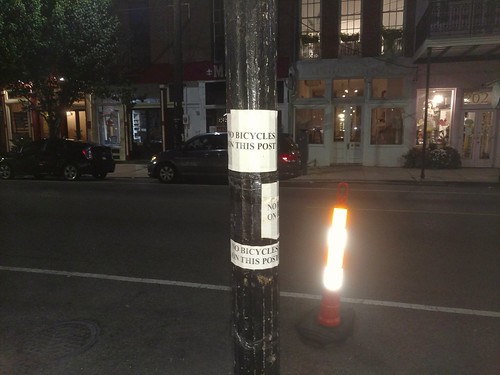
No bicycles

Kristin Palmer introduced an ordinance today. At least, it was on the agenda today. I haven't seen any reporting from the meeting yet so I don't know what its status is currently. (Aside: There are far fewer reporters on the City Hall beat these days. And what they produce is not as consistently detailed as it once was either. I assume Kevin Litten will have something pretty decent out by the end of the day but it's no guarantee anyone else will. So it goes.)  Anyway the ordinance says you can't park your bike pretty much anywhere anymore.


I've been trying to figure out for a while now what the big obsession is with bike parking. I see signage like that photo at the top of this post all over town lately.  That's still a mystery to me. But I do know what Palmer's issue is. She wants to adjust the law in a way that makes it easier for the scooter rental companies to operate.

With input from Mayor LaToya Cantrell’s administration, District C Councilmember Kristin Gisleson Palmer is drafting three ordinances to regulate app-based electric scooter rental companies, which have moved rapidly into U.S. cities and are prepared to roll out in New Orleans.

But Palmer wants to pump the brakes until her office has put together a package that’s “enforceable and good for the public,” with laws that build out the city’s two-wheeled infrastructure and prevent New Orleans from falling into the same kinds of legal problems and traffic headaches that have cropped up in the scooters’ wake across the country.
Sorry if that inconveniences any of Palmer's actual constituents. But it's important to make sure we're going out of the way to accommodate these universally praised scooter operators
It’s the most recent leg in a race to replace or compete with the entire concept of mass transit, “disrupted” by companies with billion-dollar valuations. Companies now have inserted themselves into the public part of public transit with an ad hoc network of "shared" bikes, scooters and cars. And those companies are moving quickly to shape the future of transit — “public” in nature but private in its terms. A $2 bus or streetcar fare is replaced with a $10 Uber ride. Bike rentals (or “bikeshare”) kiosks dot popular urban centers, adding more options for transit in areas already dense with them.
And who doesn't want to be part of "the future of transit," right? Specifically the part you will play is ceding your right to share the commons so that Lime can profit from "sharing"  its products.

Update Council passed this rule unanimously.  Palmer says they've accounted for the bike parking problem.
But the rule passed Thursday seeks to address one earlier concern: that bikes attached to stop signs or poles might be pulled off city streets if bike racks are full or absent in neighborhoods where they travel.

It also paves the way for plans to store dockless scooters in spots marked by painted lines on city streets.

“We want to ensure that there’s no collateral damage in terms of the removal of bicycles that can be chained (to spots other than bike racks), due to lack adequate safe bike parking,” said City Councilwoman Kristin Gisleson Palmer, who chairs the council’s transportation committee and has led the effort to usher in scooter share.

The wording was a change from what was proposed previously.
What she means is they won't come take your bike if it's locked up. But she adds, "due to lack of adequate safe bike parking" which suggests there may come a point when they deem the parking "adequate" such that they can make you stop tying up to posts and signs. She says they're working on that now.
Palmer said at the time that she would work with the city to install more racks. City crews are also planning to stripe portions of streets with lines designating parking for scooters and bikes, a step that would cost less. 

But while those plans are being finetuned, people will still be allowed to lock up their bicycles to posts and poles, as they do now, she said Thursday. Scooters won't be allowed on city sidewalks, but plans are in the works to carve out space for them on city streets, council staffers said.
In other words, they're still coming for your bike. Just not yet.