The officers noticed two surveillance cameras mounted to a public light pole on the block. They looked very much like hundreds of crime cameras that have been installed across New Orleans since 2017. Those are owned and controlled by the city, all transmitting video to the Real-Time Crime Monitoring Center on North Rampart Street.Burkhardt tells The Lens he doesn't know nothing about no cameras. Also he tells them they are "fake news." But, see, the thing is he's got it pointed at his ex-wife's house. And he has NOPD logos on it. And he is the contractor who makes and installs these things. And this is all very normal.
In addition to being attached to city-controlled property, the cameras on the Lakeview light pole bore the New Orleans Police Department’s logo.
The problem: They weren’t city-owned cameras. The officers didn’t know who owned them.
“The camera mounted at 6119 Vicksburg is not a City-owned camera, is not integrated to the Real-Time Crime Center, and is unauthorized to be on the light pole,” said Laura Mellem, the public engagement manager at the New Orleans Office of Homeland Security, which oversees the city’s surveillance system.
Nor was it owned by the Lakeview Crime Prevention District, a security district that maintains cameras in the neighborhood, LCPD President Brian Anderson told The Lens in an interview.
“That is without a doubt not one of ours,” Anderson said.
The victim of the alleged car burglary told the police that the cameras belonged to Jeff Burkhardt, according to the police report.
Burkhardt, whose wife owns a house on the block, is the vice president and chief operations officer for Active Solutions, LLC, a crime camera supplier and installation contractor for the city. The camera on the block bears a resemblance to Active Solutions’ Neighborhood WatchCam model. The Neighborhood WatchCam draws its power from streetlights, according to the company’s website.
Showing posts with label crime cameras. Show all posts
Showing posts with label crime cameras. Show all posts
Friday, June 21, 2019
Impersonating an... officer?
Is that what you'd call this? What is going on here?
Friday, January 04, 2019
Who watches who and why
Here is a map to all of the traffic cameras in New Orleans that are no longer active as of the new year. It's the mayor's way of.. almost.. keeping a campaign promise.
Oh also, this doesn't mean they're actually getting rid of all 31 deactivated cameras. Some of them are just getting moved.
What is the public's feeling on mass police surveillance, though? I'm sure there's some depressing poll out there that says everybody is for it. I just haven't seen it yet. No doubt our councilmembers have, though, since they're all gung-ho about reviving Mitch Landrieu's failed camera-in-every-corner-bar ordinance this month. It doesn't have to be a poll, actually. It's really just a matter of the right feedback from the right money to get them to move even on something as morally objectionable as this.
It's an interesting contrast, though. Generally speaking we hate the cameras pointed at our cars in case we run a few miles over the speed limit. But we love the cameras pointed at other people in case they... happen to be hanging out on the corner in a way that makes us uncomfortable. What do you think the major distinction is?
As of Jan. 1, 20 of 31 cameras outside of school zones, including the one southbound one in front of Scoggin’s home, were shut off, in a boon for motorists who have long complained about being ticketed on their way to work or school.Montano's phrasing is rich. A different way of putting it would be they deactivated the cameras that were providing the least about of revenue and kept the 11 that enable the public to "help" keep the city budget in balance by graciously continuing to be "nickel-and-dimed" as the mayor once put it.
Left up are the city's most lucrative non-school-zone cameras. Also still rolling are dozens of cameras in about 50 school zones, though the devices have been adjusted to only issue tickets during school zone hours.
The changes balance the need for motorists' safety with the mayor’s desire to remove a financial burden on the city’s residents, said Cantrell’s Chief Administrative Officer Gilbert Montaño.
“We took the cameras that were providing the least amount of tickets and turned those off,” he said in a Friday interview. “The 11 that remain on were ones where we still need a little bit of help from the public.”
Oh also, this doesn't mean they're actually getting rid of all 31 deactivated cameras. Some of them are just getting moved.
Meanwhile, non-school zone cameras deactivated under the rules will likely be relocated to school zones, Montaño said. Although those locations haven’t been determined, he said the city is considering placing more cameras near high schools since most cameras now are located near schools with younger children.Whatever part of this qualifies as LaToya keeping her campaign's founding promise is getting more and more difficult to see. But there probably isn't going to a be a political price to pay. The traffic cameras are unpopular, generally. But the public seems to be grudgingly ok with the ones in the school zones.
What is the public's feeling on mass police surveillance, though? I'm sure there's some depressing poll out there that says everybody is for it. I just haven't seen it yet. No doubt our councilmembers have, though, since they're all gung-ho about reviving Mitch Landrieu's failed camera-in-every-corner-bar ordinance this month. It doesn't have to be a poll, actually. It's really just a matter of the right feedback from the right money to get them to move even on something as morally objectionable as this.
It's an interesting contrast, though. Generally speaking we hate the cameras pointed at our cars in case we run a few miles over the speed limit. But we love the cameras pointed at other people in case they... happen to be hanging out on the corner in a way that makes us uncomfortable. What do you think the major distinction is?
Friday, December 21, 2018
We love our cameras
Cyndi Nguyen and Kristin Palmer are bringing last year's narrowly scuttled mass surveillance ordinance back to life.
More to the point, they're predisposed to be full of shit on account of the fact that so many of them have a personal interest in or close association with the real estate business. Which is why, for one thing, this ordinance is being carried by Palmer and Nguyen. More importantly it is why its major point of the ordinance isn't just about installing cameras. Rather the cameras are one piece of a plan that is really more about shutting down as many neighborhood bars as possible.
Less than a year after a similar measure was dropped, a proposal from members of the New Orleans City Council could require "nuisance" bars, clubs and liquor stores to install live-streaming video cameras inside and outside their businesses, part of a proposed ordinance that tightens restrictions for businesses that sell alcohol.I still don't understand the universal enthusiasm for sticking cameras everywhere. Particularly since it obtains among a set of elected leaders who profess often to care very much about social justice. It's possible they all suffer an acute case of cognitive dissonance. Although Occam's razor, as always, suggests they're just full of shit.
The proposed ordinance — which mirrors parts of a scrapped plan from former Mayor Mitch Landrieu — also gives the mayor’s office or New Orleans police superintendent the ability to revoke or suspend an alcohol license, if the city or its Alcoholic Beverage Control Board determines that the business “directly endangers the health, safety and welfare of the community.”
More to the point, they're predisposed to be full of shit on account of the fact that so many of them have a personal interest in or close association with the real estate business. Which is why, for one thing, this ordinance is being carried by Palmer and Nguyen. More importantly it is why its major point of the ordinance isn't just about installing cameras. Rather the cameras are one piece of a plan that is really more about shutting down as many neighborhood bars as possible.
Bars and music venues also can’t be built within 300 feet of a playground, church, public library or school — unless the owner has a sworn affidavit from 75 percent of property owners within a 300 foot radius.This ordinance is slated for committee discussion on January 31. Between that and the Jan 10 motion on STRs, it's going to be a busy month.
They’d also be forbidden within “residential or park area,” and would grandfather in existing neighborhood bars, unless there’s a six month lapse in their permits and licenses.
MaCCNO also warned that real estate speculators and developers, including short-term rental operators with multiple listings, which proliferated in recent years, could abuse the complaint process to shut down area bars.
“This is an aggressively pro-gentrification ordinance and presents a clear and present danger to every small grocery, pharmacy, bar and music venue in the city,” MaCCNO said.
Thursday, December 20, 2018
"Colossal Brother"
Holy cow
In August 2017, three months before former-Mayor Mitch Landrieu announced the opening of the city’s $5 million Real Time Crime Monitoring Center, the city spent $2.8 million to buy a suite of software from Motorola Solutions that includes artificial intelligence and object detection to help law enforcement sift through the thousands of hours of footage recorded every day.At several junctures during the evolution of the surveilance "canopy," as city and police officials like to call it, that, despite our supposed hysteria, the cameras were minimally intrusive. But here we are wondering if we need to be more mindful of our "dwell time" in public.
The package includes software called BriefCam, CommandCentral Aware, CommandCentral Analytics, and CommandCentral Predictive.
“My initial reaction is, holy cow, this is not just big brother. This is colossal brother,” said Bruce Hamilton, a staff attorney at the ACLU of Louisiana. “When you take a step back, you really get the sense that the surveillance state is rapidly expanding here in New Orleans.”
Still, with the software the city does have, the NOPD could, for example, pull up every piece of footage that includes a man in a red shirt on a blue bike riding north on Esplanade Avenue. Or it could pull up every person with a backpack that appeared on the corner of Broad Street and Orleans Avenue, displaying them all simultaneously on one screen with timestamps over their heads to indicate when they were there.Everybody loves it, though.
“My question is, what does it mean to say you’re not using facial recognition technology when you’re using something that’s equally powerful?” Hamilton said. “So for instance, the city may not be able to identify me by my face, but if the city knows what I’m is wearing, or what I drive, I mean there’s any number of factors they can use to track you from place to place.”
BriefCam can also produce “heat maps” of dwell time, object interaction, and common paths. In a YouTube video from March, the head the Hartford, Connecticut crime center illustrated how he used the software to track the movement paths of everyone who walked in the frame of one of the city’s cameras to track which homes they were coming in and out of. He claimed that the analytics helped him locate a drug operation.
“How long did that take me to do?” he said in the video. “That took me a minute.”
Friday, December 07, 2018
LaToya sure does love the cameras
Oooh we're upgrading to the platinum plan.
Ordinarily I'd think that maybe they're exaggerating a little bit. But this Lens story suggests they very well may not be. Police may be labeling camera footage as evidence provided by "undercover officers" in their reports. In the case the story cites, it seems pretty clear there is a cop sitting behind a camera zooming in on people from afar.
LaToya doesn't sound too concerned about the Fourth Amendment. She is a true believer in this stuff. Watch her during the press conference here say that the cameras literally "in real time prevent crimes from happening." Also she concludes, quite forcefully, "It will live within the fabric of the city of New Orleans for generations to come." Teach your children to expect they're being watched, I guess.
The New Orleans Police & Justice Foundation SafeCam NOLA program has 6,000 cameras in its index, made up of privately owned cameras that are registered with the program to be accessed by law enforcement.What they're doing here is plugging thousands of privately owned cameras into the city's "Real Time Crime Monitoring" center. Last year the Independent Police Monitor issued a critical report on these cameras questioning both their efficacy and constitutionality. The mayor and her staff don't seem to share those concerns. Some of their quotes this week, are downright chilling. Homeland Security director Collin Arnold refers to a "canopy" of cameras. LaToya proudly beams, "We will grow. We have only scratched the surface.” The implication is wherever you are in the city, chances are a cop will be watching whatever it is you are doing.
SafeCam Platinum — which began its soft launch in October — integrates cameras installed outside homes and businesses into the center’s network, creating a “21st century neighborhood watch,” foundation director Melanie Talia said at a press conference recognizing the first year of the city's Real-Time Crime Center.
Ordinarily I'd think that maybe they're exaggerating a little bit. But this Lens story suggests they very well may not be. Police may be labeling camera footage as evidence provided by "undercover officers" in their reports. In the case the story cites, it seems pretty clear there is a cop sitting behind a camera zooming in on people from afar.
When asked if there was in fact an undercover officer at the scene, NOPD spokesperson Gary Scheets told The Lens that the “NOPD does not publicly discuss investigative tactics employed during surveillance operations… In the case that is the subject of this inquiry, investigators conducted a surveillance operation from an undisclosed location that provided a clear and unobstructed view of the events that transpired.”
For Bixby, this raises concerns about how the NOPD is labeling their video surveillance operations in police reports. She also believes the surveillance and search and subsequent arrest may have violated the Fourth Amendment and infringed upon Carter’s reasonable expectation of privacy.
LaToya doesn't sound too concerned about the Fourth Amendment. She is a true believer in this stuff. Watch her during the press conference here say that the cameras literally "in real time prevent crimes from happening." Also she concludes, quite forcefully, "It will live within the fabric of the city of New Orleans for generations to come." Teach your children to expect they're being watched, I guess.
Thursday, June 07, 2018
Spirit of Charity
Who will win the Charity redevelopment derby? We are down to three contestants already.
We're not yet to the stage of this where we get to see the actual proposals but if we're wondering what they will look like, all we have to do is check out what these same developers proposed the last time this was tried.
In a particualry strange episode of this kabuki last week, John Bel vetoed a bill that would have banned local "inclusionary zoning" requirements. That's fine. That bill, like most state-level attempts at preempting local political authority, should have been vetoed. The Governor's veto statement, though, was almost as nonsensical as the bill itself saying, basically, that local governments will have to use it or lose it.
Anyway, from the looks of things, our new mayor is something of a branding enthusiast herself. And, as such, she is as on board as anyone with applying the new language of faux affordability and "vibrant, job creating, inclusive and equitable innovation" or whatever toward the same old program of handing out money and favors... oh I'm sorry.. "incentives" to the real estate mavens who elected her.
Luckily, she has friends in Baton Rouge willing to help. Cantrell has chosen State Rep Neil Abramson to serve as her point person in the legislature. Last week, he introduced her (and New Orleans Saints mascot Gumbo) to the House so she could greet members with a brief speech about how much fun she had at D.C. Mardi Gras and congratulate them on the fine work they've done this year. (This is really what she told them. I am not making that up.)
In addition to this service, Neil (on the days the House was not considering anything involving abortion) also managed to pass some legislation on the city's behalf.
For example here is HB 684 passed during the regular session. What this does, basically, is remove a cap on the size of the tax break the city can give private entities who have entered into cooperative endeavor agreements with them. Previously, if a "private partner" were to donate "cash, equipment, goods, or services" to a city infrastructure project, then they could collect a tax break equal to one half the value of the donation or $500,000 whichever is less.
Say, for example, the management company running the St. Roch Market were to install a new sidewalk or something. They could then recoup half of their investment in tax subsidies. Now, under Neil's version of the law, the "incentive" payment has no limit. So, in theory, a thousand dollar "donation" could merit a million dollar "incentive."
You go out and buy some new signage.. ooh.. or maybe some cameras... and the city can more or less guarantee you're going to come out ahead. That ought to get the ol' spirit of charity up and running. Especially if it applies to whatever deal governs the Charity development which I think it probably will. But you can see the possibilities extend well beyond that too.
LSU has selected three development teams it says are qualified to bid for the right to redevelop Charity Hospital, the downtown New Orleans facility that was abandoned after Hurricane Katrina.Let's see who is in here. Well there's Pres Kabacoff which is not going to surprise anybody. There's also this guy who is sort of the Kabacoff of Dallas but with a larger, international portfolio. But this group is the true curiosity.
The three selections were made after a process announced in April that opened up what's long been seen as a prime redevelopment opportunity to competitive bidders. LSU officials said last month that they would select developers that "have the vision, experience and financial capability" to complete a project.
1452 Tulane Partners: This is an ownership group that includes New Orleans-based CCNO Development LLC and El Ad US Holdings, part of the Tshuva Group, a commercial real estate conglomerate based in Israel. El Ad's holdings are in Israel, Europe, Asia and North America. They include the Plaza Hotel in New York, and more than 10,000 rental units in 10 U.S. states. CCNO projects include the adaptive reuse of the former McDonogh 16 school building and a few multi-unit residential developments. Joseph Stebbins, a former Housing Authority of New Orleans official, architect Michael Lee Mattax and contractor Richard Mithun are the principals in CCNO.Hey, it's a good thing the City Council made sure to reject the BDS movement, right? Otherwise these guys would be out of the running for this big pot of money and that's the real injustice, right?
We're not yet to the stage of this where we get to see the actual proposals but if we're wondering what they will look like, all we have to do is check out what these same developers proposed the last time this was tried.
Previous competitive bids outlined a vision for Charity Hospital in 2015 that included a bid from New Orleans developer Joseph Stebbin that proposed a 600-unit apartment building, an extended-stay motel and housing for medical students. The company formed to bid on the property offered $30 million for the 1 million-square-foot building; overall development costs at the time were pegged at $275 million.So, basically, they're going to do fancy apartments glommed on to whatever window dressing best flatters the public fashion and/or nostalgia. Here is Andy Kopplin back in April illustrating that with some empty slogan salad. I highlighted my favs.
Also bidding on the property was New Orleans-based HRI Properties, which proposed a $194 million renovation that included apartments and a medical research tower.
"After more than a dozen long years, this effort to adaptively repurpose the iconic Charity Hospital building presents an exciting opportunity to bring back a place that is sacred to many New Orleanians," Kopplin said in a statement. "Even more exciting to us here at the Foundation is the potential for using this initiative to kick-start long-standing efforts to develop the neighborhood surrounding Charity into a vibrant, job creating, inclusive and equitable innovation district that celebrates the spirit of charity and that everyone in our region can claim with pride."In recent years, the marketing strategy for these kinds of developers has also picked up the phrase "affordable housing" because they've learned that is something people worry about. The Advocate quotes Stebbins hitting that note in this story.
“It’ll be a modern, vertically integrated development no matter who does it. You’re going to have residential pieces, and you’re going to have an affordable (housing) piece,”Although, as we've seen, the developments themselves rarely contribute much in the way of actually addressing the housing crisis. Token set asides (the "affordable piece") are in there to mollify the growing public concern on the one hand and to qualify for various public subisdies and land use exemptions on the other. The more juice housing gains as a political issue, the better our politicians and developers who fund them are learning to rebrand their schemes in ways that co-opt the language of activism without actually changing the course of public policy.
In a particualry strange episode of this kabuki last week, John Bel vetoed a bill that would have banned local "inclusionary zoning" requirements. That's fine. That bill, like most state-level attempts at preempting local political authority, should have been vetoed. The Governor's veto statement, though, was almost as nonsensical as the bill itself saying, basically, that local governments will have to use it or lose it.
“If local governments in Louisiana do not actively pursue these policies over the course of the next year, I will conclude that it is not their will to utilize these strategies and I will be inclined to sign a similar piece of legislation in the 2019 regular session,” Edwards stated in his veto.If cities aren't implementing this policy in the first place, why ban it? I don't know.
Anyway, from the looks of things, our new mayor is something of a branding enthusiast herself. And, as such, she is as on board as anyone with applying the new language of faux affordability and "vibrant, job creating, inclusive and equitable innovation" or whatever toward the same old program of handing out money and favors... oh I'm sorry.. "incentives" to the real estate mavens who elected her.
Mason Harrison, a spokesman for Cantrell, said stimulating development activity and business growth are priorities of the new mayor.
"A great deal of opportunity exists in returning vacant buildings to commerce, generating tax revenue," he said. "Businesses, however, must be offered the kinds of incentives that will make that possible, and the mayor-elect believes that we are losing to other parishes on that front."
Luckily, she has friends in Baton Rouge willing to help. Cantrell has chosen State Rep Neil Abramson to serve as her point person in the legislature. Last week, he introduced her (and New Orleans Saints mascot Gumbo) to the House so she could greet members with a brief speech about how much fun she had at D.C. Mardi Gras and congratulate them on the fine work they've done this year. (This is really what she told them. I am not making that up.)
In addition to this service, Neil (on the days the House was not considering anything involving abortion) also managed to pass some legislation on the city's behalf.
For example here is HB 684 passed during the regular session. What this does, basically, is remove a cap on the size of the tax break the city can give private entities who have entered into cooperative endeavor agreements with them. Previously, if a "private partner" were to donate "cash, equipment, goods, or services" to a city infrastructure project, then they could collect a tax break equal to one half the value of the donation or $500,000 whichever is less.
Say, for example, the management company running the St. Roch Market were to install a new sidewalk or something. They could then recoup half of their investment in tax subsidies. Now, under Neil's version of the law, the "incentive" payment has no limit. So, in theory, a thousand dollar "donation" could merit a million dollar "incentive."
You go out and buy some new signage.. ooh.. or maybe some cameras... and the city can more or less guarantee you're going to come out ahead. That ought to get the ol' spirit of charity up and running. Especially if it applies to whatever deal governs the Charity development which I think it probably will. But you can see the possibilities extend well beyond that too.
Saturday, February 03, 2018
Dance like the cops are always watching

It's the first weekend of parade season. And so now is the time when we perform the ritual of the Carnival Ordinances Reminder Press Conference. This year, we've got an exciting new venue in the NOPD Real Time Crime Center surveillance camera batcave. As you can see, it is a fantastic space for comfortably arranging a dozen or so public officials behind one podium as is in keeping with local tradition.
Tuesday's event featured performances by the heads of NOPD, NOFD, Parks and Parkways, Homeland Security, as well as BOTH MAYORS. Take it away, kids. And I mean, literally, they are taking stuff away.#FBI New Orleans SAC Eric Rommal participates in a #MardiGras press conference with Mayor Landrieu and city officials to discuss safety and security during the upcoming Mardi Gras season. SAC Rommal also encouraged all visitors that if you #SeeSomethingSaySomething. pic.twitter.com/atmjCHDvUO— FBI New Orleans (@FBINewOrleans) January 30, 2018
During a news conference about Mardi Gras safety preparations Tuesday, city officials said ladders already set up before Friday's parades will be removed during sweeps. Crews will begin sweeps Tuesday and continue them into next week.Sure enough, within an hour of the end of today's presser, crews were spotted out on St. Charles ripping down ladders and hauling them away. Probably the highlight of the press conference was Parks and Parkways Director Ann Macdonald delivering the shot heard round the Krewe Of Chad.
Officials said ladders and setups on public green spaces -- like the neutral ground or the sidewalks -- will be disposed of during the sweeps. Items cannot be placed on the parade route more than 24 hours ahead of a parade.
In addition to the sweeps, officials said people will not be able to claim their items if they are removed. City officials said they plan to only dispose of the items that are collected.
“You’re creating a barrier. We have bolt cutters,” she said. “You can’t reserve a piece of public green space. That paint means absolutely nothing.”
We have bolt cutters and we know how to use them. I can't tell you how gratifying that was to hear. If you've followed this blog for any length of time you'll probably be aware that we've been on the Carnival ladder beat for pretty much ever. I contributed some comments for a Gambit story in 2013. The year before that I wrote this article for NOLA Defender. I've watched the problem become worse in little steps each year. But I've also watched the city's response slowly become better and better. This year it looks as though they are finally taking it seriously.
They're also following a smart game plan. Start the season off by making a big show of it. We all know that once the parades start rolling, there isn't going to be time to focus solely on enforcing this stuff. But on the first day, when everyone is paying attention and there aren't a million things happening at once, that's when you go out, find some ladders and make an example of them.
City sanitation and parks crews had commenced "constant sweeps" to remove any ladders placed on public spaces such as neutral grounds more than 24 hours prior to the start of the first parade on Friday, Macdonald said. The sweeps would continue through next week, she continued, and any property taken away would not be returned.If I had to guess, I'd say the sweeps probably aren't as "constant" as they are claiming there. But that's fine, actually. Pretty soon we'll be at a point where we're always 24 hours away from one parade or another anyway. The point was to get on TV early so that people see that this is an issue. Maybe they'll be watching Channel 4 where, for some reason, they've decided to frame the whole story as thought the space-hogging ladder people were the real victims. But it doesn't matter. As long as the message gets across that there are rules in place and the city might actually enforce those rules, I think people might start to police their own behavior a bit better.
"All items will be disposed of," Macdonald said. "We will not be cataloguing any ladders or personal items."
While it's nice to see the city start to do something, it's concerning to see the rationale they provide for stepping in.
The city code appears to allow tents along parade routes, requiring only that "ladders, tents, grills and other personal effects" must be set back 6 feet from the curb.Umm.... no. A tent is not a "homeland security threat." I agree they can be a threat to a good fun shared experience when they needlessly appropriate large chunks of the neutral ground. They impinge on the communal experience of the street festival that Carnival is at its best. And preserving that experience is really where the city officials should be focused. Obviously, they have other priorities this year.
But Mayor Mitch Landrieu's administration has decided that tents with walls, as opposed to open-sided canopies, constitute a "barricade" that might "obstruct passage along public property," something that's prohibited.
“This is a homeland security threat,” Landrieu said. “We need to be able to see. There can be tarps, but there can be no tents.”
We've already seen the emphasis on security manifest in the plan to "streamline" the parade route and format. We're also seeing it up on street corners up and down the parade route.
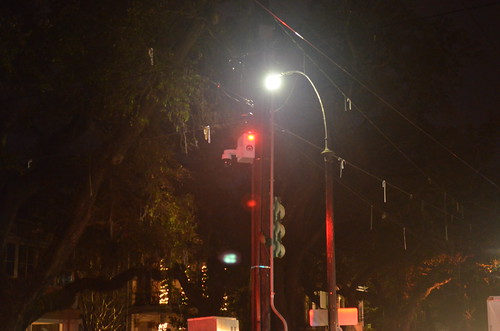
We're told the "Real Time Monitoring Center" where these cameras all feed into is fully staffed now. We're also told FBI will be monitoring your social media feeds. So if you are going out to the parades this week, remember to be on your best behavior and dance like the cops are always watching.
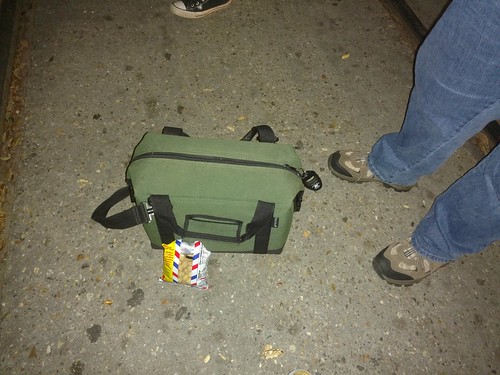
I haven't had a chance to FOIA the tapes yet but if my hangover is any indication, they will show that we went a little too hard for the first Friday night. I should know by now that's way too early to get out the whiskey. This is Miller Lite time only. Not that there wasn't any Miller Lite. The Green Thing was full of those. But I ended up using it to trade with a street vendor for peanuts.
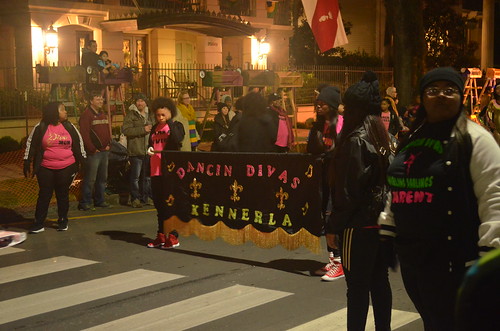
I'm interested in seeing how krewes adjust to the new restrictions on the number of bands and marching clubs that can appear between floats. Oshun's solution appears to have been to just start the parade with nine or ten dance teams in a row. The Dancin' Divas here were one of many.
You never expect Oshun to do anything elaborate anyway. But line of dance troops followed by the several court floats of "Goddesses" kind of made it feel like the parade was taking a while to actually start. Eventually the emotional support peacocks showed up and everything was fine.

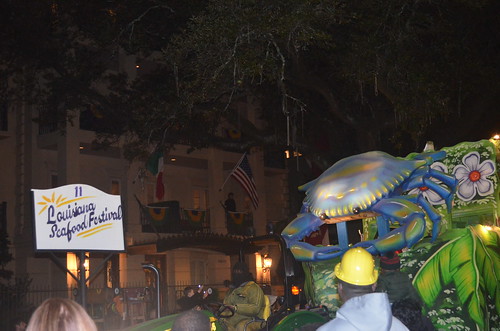
Oshun's floats were themed around Louisiana festivals. There are enough of those these days to make a parade that spans the globe. Certainly, the streamlined route would never fit it anyway. So they had to pick just a few. Here's a Seafood Festival.
And a Po-Boy Festival

And, well, you get the idea. There was one float I didn't get a photo of but couldn't figure out. The signage said, "Louis Armstrong Festival" but the figure on the float was definitely Michael Jackson.
I think Cleopatra might be hungover this morning too. If I was taking swigs off the whiskey too early in the season, this krewe was going for the big guns earlier in the year than we are used to seeing them. Here is St. Aug leading the parade.
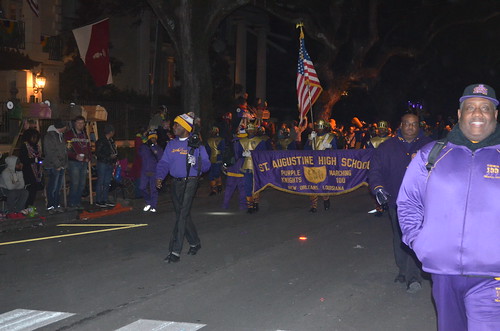
Maybe this is the new normal now that all of the West Bank parades roll Uptown. Cleopatra is a bigger event than what we've been used to. Bigger floats, bigger throws, just bigger in general. The themeing is still very first weekend. That's okay.

No peacocks in this one. But there were other kinds of birds; roosters and ravens and turkeys.
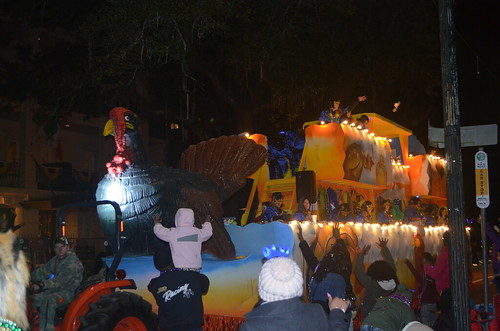
What was surprising, though, was the appearance of so many marching clubs. Fancy ones too. Elvi, Sirens, Muff-A-Lottas, and others not pictured here.
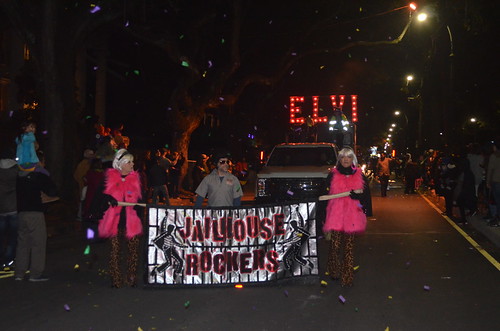
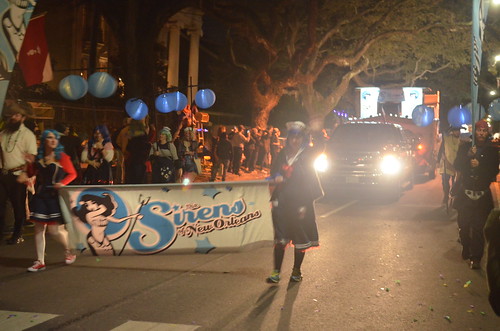
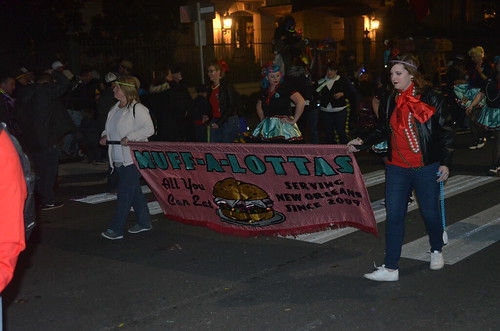
And, well, yeah. That was Friday. I gotta shake off the.. uh.. shakes and go see Pontchartrain before the ladder people get all the good spots. I trust the real time monitors will let me know when they get here.
Thursday, November 30, 2017
What if your best practices are actually the worst?
Leaving aside the general corruption, arrogance and preference for predatory capitalism that characterizes all of American politics at all levels, is there anything more annoying than the common reliance on groupthink driven circular rhetoric? Few have mastered this idiom more thoroughly than Waning Mayor Mitch Landrieu. Nobody condescends more confidently and less substantively than he does.
Politics is, in fact, the process by which elite class individuals like Mitch Landrieu instruct you on the things you have to get used to now. We call these, "best practices." A best practice, loosely defined, is the lowest common denominator derived from the set of things everybody is already doing. A best practice is self-legitimizing. If it happens to be a horror, it is your responsibility to adjust. We call that resilience.
Maybe the Independent Police Monitor disagrees but it hardly matters. At least they tried.
Waxing Mayor Cantrell just finished up a campaign where she hammered hard on the theme of "listening" to people. Will she be more likely to take legitimate complaints about surveillance seriously? She isn't starting from a very encouraging position.
Landrieu first described his public safety initiative after a shooting on Bourbon Street in November 2016 left one dead and nine injured. Paid for with money from the city and the Ernest N. Morial Convention Center, the plan focuses heavily on increasing surveillance, both by adding city-owned cameras and by accessing feeds from cameras owned by private individuals and businesses, though the latter policy still needs City Council approval.You may have concerns about abuse of state power, threats to privacy, civil liberties, etc. Maybe some of those concerns are legitimate. Maybe some aren't as bad as you might think at first. There's a lot to discuss. Maybe you thought politics was the process by which you raised this discussion. But that's not how it works.
Officials cut the ribbon on the central hub for monitoring all those feeds last week, and Landrieu responded to questions about the potential privacy implications.
"If you’re out in public, it is highly likely in this day and age you’re going to be filmed by some camera or somebody holding a phone," he said. "I just think that’s the new day and age that we’re in, and people should conduct themselves accordingly.”
Politics is, in fact, the process by which elite class individuals like Mitch Landrieu instruct you on the things you have to get used to now. We call these, "best practices." A best practice, loosely defined, is the lowest common denominator derived from the set of things everybody is already doing. A best practice is self-legitimizing. If it happens to be a horror, it is your responsibility to adjust. We call that resilience.
Maybe the Independent Police Monitor disagrees but it hardly matters. At least they tried.
In a public letter issued Wednesday, the Office of Independent Police Monitor also questioned whether the $40 million plan, which the mayor first unveiled almost a year ago, will have a substantial impact on crime.The IPM's letter didn't just raise these questions, it also examined some of these "best practices" in other cites where similar surveillance systems are installed. It cites evidence of abuse in Great Britain where, unfortunately, only Benny Hill was available to operate the cameras.
“As with any law enforcement data system housing private information about citizens, there is a potential for mismanagement, poor information security, public record law compliance challenges and user abuse,” the letter warned.
It added that while surveillance capabilities are being beefed up, the plan does not "earmark resources or personnel to monitor the implementation of the plan.”
A review of 592 hours of government-run CCTV monitoring system footage in London found that 10% of surveillance of women lasted more than one minute, and 15% of surveillance of women for shorter periods was voyeuristic. In 2007, a police supervisor in Worcester, England was suspended after improperly manipulating surveillance cameras to focus in on women’s breasts and buttocks.It also lists instances of stalking, assault, and evidence tampering by police using surveillance systems in New York, California, and Ohio. It points out the racism inherent in the way the systems are deployed. Here is a congressional study referenced in the letter which found that even the cameras themselves are racist.
According to a 2017 study from the House Committee on Oversight and Government Reform, other technologies implied by the plan but not explicitly mentioned, such as facial recognition cameras, have been shown to disproportionately misidentify black people as suspects.There are other issues raised. How long will data be retained? Is it available to third parties? Does it make sense to spend public money on this stuff when there are other budgetary priorities? Most importantly, there's no clear evidence the cameras reduce crime. The letter also cites multiple studies to make this point.
A 2008 study by the University of Southern California (“USC”) found that Los Angeles’ camera network made no statistically-significant impact on reducing violent crime, property crime, or quality of life crime, such as prostitution or public drunkenness. Similarly, a 2009 study by the University of California at Berkeley found that San Francisco’s cameras made no statistically significant impact on reducing violent crime, drug crime, or quality of life crime, while only making some impact on reducing property crime. A 2005 review of 13 studies in England found no statistically-significant impact on reducing violent crime, and a statistically-significant reduction in property crime in only two of the thirteen locations studied, one of which was a parking lot. A 2008 review by USC of 44 studies in the United States and abroad concluded that none of the domestic studies found a statistically-significant impact on reducing crime, and that any impact found in foreign studies was limited to property crime.So the "best practices" are actually quite problematic and behaviors aren't changing despite the fact that everybody is on camera now. "People should conduct themselves accordingly," says Mitch to all that. But, even if we accept this as a desirable outcome, it still isn't happening no matter how many times he asserts that it should.
Waxing Mayor Cantrell just finished up a campaign where she hammered hard on the theme of "listening" to people. Will she be more likely to take legitimate complaints about surveillance seriously? She isn't starting from a very encouraging position.
Landrieu said his administration is working with the City Council to write legislation that would require bars to install surveillance cameras that will feed into the center.Oh dear.
Landrieu mentioned the possibility of consequences if businesses don't allow the city security cameras to be placed outside on public streets. He said the cameras are in businesses best interests.
"This is public safety and it really matters both inside and outside. Of course as soon as something happens outside an establishment they call the police, they want them there," Landrieu said. "I can't imagine them not cooperating. It would just make a lot of sense for them to do that and we'll work on what the consequences … in unison with the City Council."
“It’s better and better than I ever imagined,” Mayor-elect LaToya Cantrell said of the center and its capabilities. “This is the right step in the right direction at the right time.”
Saturday, January 28, 2017
Dizneylandrieu closes at 3

Krewe of Spank's 2014 Guide To Dizneylandrieu. The greatest Carnival throw of all time.
This week, Mayor Landrieu issued a public objection to rhetoric about the state of American cities included in President Trump's (I know. It's difficult to say.. right?) inaugural address. I believe this was the offending passage.
But for too many of our citizens, a different reality exists: Mothers and children trapped in poverty in our inner cities; rusted-out factories scattered like tombstones across the landscape of our nation; an education system flush with cash, but which leaves our young and beautiful students deprived of knowledge; and the crime and gangs and drugs that have stolen too many lives and robbed our country of so much unrealized potential.Trump is a deliberately incoherent demagogue. He is President today because his campaign successfully evoked the.. to borrow his word.. carnage our growing inequality has wrought on the American middle class and because his confused rhetoric presented a badly distorted picture of that carnage and its actual causes. In his statement, Mitch said Trump "paints with a broad brush." It's more like he just flings paint at a wall. There's a lot of noise and motion in the act but the resulting image is more color and feeling than precision.
"Inner cities" is a useless descriptor for today's urban landscape anyway. It was always something of a racist dogwhistle and certainly Trump means for it to be here. Today's "inner cities" are less the sort of places where the poor are "trapped" than they are places the poor are being forcibly removed from by waves of gentrification. Trump should know all about that. Evicting poor people from their homes in order to make room for his empire of (government subsidized) luxury real estate development has been the core driver of Trump's fortunes for decades.
Mitch Landrieu knows all about this too, of course. The "Resilient New New Orleans" he proudly hypes everywhere he goes is a study in execution of the very same model. Here's a long thing I wrote about that just after Landrieu's own inauguration speech in 2014. Since then, the city's enabling of its predacious oligarchs has only gotten worse. Their most recent victory in the short term rental debate may give the final lie to Trump's image of the "inner city." How can anyone be trapped in poverty in the city if nobody actually lives there?
It's telling that Mitch's statement fails to call Trump out on the hypocrisy of lamenting the plight of an urban poor rendered far poorer through his own actions. Perhaps because the notion hits too close to home for Mitch himself. Or maybe he's just oblivious. In either case, Mitch merely objects to the negative tone set by the image itself. For him it's all about the branding.
And anyway despite Trump's and Landrieu's best efforts at removing them, there are still a lot of poor people living in our cities. According to a recent Data Center report 63 percent of income earners in New Orleans earn $35,000 a year or less. In 2015, the child poverty rate in New Orleans was measured at 39 percent. Our Kabacoffs, Jaegers and Torres's are doing all they can to remedy that by pricing the scourge of poverty out of the city. They aren't there yet, obviously. But, with a little less negative thinking, we'll get there. At least that's what Mitch seems to be saying.
He's had trouble maintaining the upbeat tone lately, though. It's been especially difficult for Mitch to have Attorney General Jeff Landry in town dishing out his own Trump style demagoguery over violent crime.
Landry has been locked in a bitter dispute with Mayor Mitch Landrieu, whose administration has invoked the city's home rule charter and warned Landry that he lacks the authority "to engage in active law enforcement in New Orleans."
Landrieu, a Democrat, has portrayed Landry, a first-term Republican, as a cowboy seeking to exploit the city's crime epidemic for political gain.
The mayor also has accused Landry of failing to coordinate his efforts with the State Police and the New Orleans Police Department, whose officers are subject to a rigorous federal consent decree that controls virtually every aspect of the NOPD's interactions with suspects and citizens.
"You need clear command and control," Landrieu told reporters Monday. "What (Landry) cannot do is go out by himself and rip and run and do whatever he wants outside of the command and control of the police. He's been told that by a federal judge. We believe that we're right."
It's even worse when Landry's antics serve to empower the mayor's political enemies who are themselves all too happy to pile on.
The officials backing Landry’s task force cited the Police Department’s manpower shortage and the city's high levels of violent crimes in the letters released Thursday.Landry's task force, ostensibly in town to deal with violent crime, has mostly been busting people for marijuana possession. This puts him at odds with the New Orleans City Council who decided last year that police and prosecutorial efforts were better focused elsewhere. This, along with council initiated reforms to juvenile detention policy, eventually put councilmembers at odds with Cannizzaro who has taken an increasingly hard line with regard to this stuff.
District Attorney Leon Cannizzaro, Sheriff Marlin Gusman and the Police Association of New Orleans have all had pitched political battles of their own with Landrieu’s administration in recent months. But their letters allow Landry to point to local support for his initiative.
“We need all hands on deck if we are going to turn the corner on this public safety crisis,” Cannizzaro said. “I have never seen an attorney general who takes not only an active interest in the public safety of this city, but who also is willing to devote his precious government resources to accomplish the mission of making our streets safer.”
The DA has also been cranky about losing 5 percent of his budget to the struggling Public Defender's office. He has been so cranky, in fact, that he recently decided to take out his frustration by coming down harder on poor people facing misdemeanor charges. These squabbles, among other things, have escalated tensions between Cannizzaro and councilmembers Guidry and Williams in particular as well as the mayor whom Cannizzaro is all too happy to taunt by way of endorsing Landry's grandstanding. Add to Cannizzaro's gripes the long running feud between the mayor and Sheriff Gusman, the rumored political ambitions of Sidney Torres, and the approach of a new round of municipal elections getting everybody charged up in general, and you can see how Landry's stupid political stunt can easily stir up a hornets' nest.
So the mayor and the governor, under attack from their enemies, must have felt obligated to respond somehow. Here is what they came up with.
NEW ORLEANS – There will be more lighting in the French Quarter, much of Bourbon Street will be closed off to vehicular traffic during busy times, bars will be forced to close their doors at 3 a.m. and there will be additional crime deterrence measures in other ‘hot spots’ in the city as part of a $40 million plan to keep the city safer.When in doubt, close some bars. Also buy some shiny things. Surveillance cameras are a great way to look like you're spending money on a high tech solution. And, of course, in the Trump era, they're quite well in line with the zeitgeist. Mitch even takes on Trump's bullying rhetorical style here. As he warns us that the mere act of standing in the public streets of the city renders one subject to close scrutiny by law enforcement, Mitch relishes the tough guy role.
Governor John Bel Edwards, Mayor Mitch Landrieu along with law enforcement leaders announced the additional security measures, as well as proposed changes, at a press briefing Monday.
In addition, Landrieu said extra lighting, infrared cameras and more security would ensure that everything can be seen.There's a video in that WWL link. I recommend watching it just to get the full smirking effect. Mitchy Moussolini is in charge here, y'all. Dizneylandrieu closes at 3.
"When you go on Bourbon Street, everything you do will be seen," said Landrieu. "Do I need to let that sink in?"
The theater of this is stupid. Mitch is on television pretending to warn would be troublemakers they're being watched. But his actual audience is Channel 4 evening news viewers. You know, the "Murders not monuments" crowd who've been in his face for the better part of a year; the people Jeff Landry's presence is intended to rile. That's who Mitch is trying to win back over.
It's hilarious that Landrieu began the week smugly chastising Trump's "broad brush" demagoguery of urban crime and ended it in a fit of Trumpist bloviating about the situation in New Orleans. But then Mitch and Trump do share a certain authoritarian streak. This 2014 Lens piece by Tyler Bridges remains the definitive examination.
The Lens interviewed more than 30 New Orleans residents who said that the mayor mistreated or punished them after they expressed a contrary view, or that they had firsthand knowledge of the mayor’s heavy-handed behavior. They include current and former elected officials, business people, a wide range of civic activists, attorneys and an opponent in the 2010 mayoral race.Also referenced in that article, political consultant Cheron Brylski, who made a stir at the time for publicly describing Mitch as a "productive asshole." This week, she's similarly pleased.
Some of them say the mayor withheld funding or cut off city contracts. Others say he forced them from city boards or jobs. Still others say he chastised them with curse words over the phone or accosted them in public.
About a dozen of them were willing to speak on the record.
“He will steamroll anyone,” said Babs Johnson, a youth advocate and one-time supporter who said she drew the mayor’s wrath in 2010 by questioning the direction of his recreation department. She believes the mayor has now blackballed nonprofit groups associated with her. “People are afraid of him.”
It was Mitch who lobbied hard for the continued presence of the Louisiana State Police in the French Quarter. Until Landry barged into town threatening to usurp his authority, Landrieu didn't have a problem with outside troops occupying the local territory. I thought about that this week when Donald Trump more or less threatened to declare martial law in Chicago. I don't know why Mitch gets so upset with this guy. They're basically steeped in the same sort of strong man ideology. But these days, it seems like there's way more fascists running around out there than we ever cared to admit. I blame Godwin. Anyway here we have a situation where Landrieu, while feuding publicly with Landry and Trump, launches a policy initiative that basically caves to their agenda and style. I believe the Trump fans like to use the word "cuck" in this circumstance.
Of course the mayor's security plan makes no sense. At least, as a crime fighting initiative, it doesn't. Jeff Asher's analysis here, rather politely, points out that a plan to reduce violent crime probably shouldn't be so focused on French Quarter.
If anti-crime measures directed at the French Quarter are successful then they’re most likely to effect relatively low level UCR Part I crimes such as pickpockets and purse snatching. Indeed 84 percent of Bourbon Street crime last year and 70 percent of French Quarter crime were either pickpocket, theft or shoplifting incidents. Reducing property crimes and simple robberies in the French Quarter is a noble idea though it’s worth remembering that the vast majority of violent crimes are occurring elsewhere in the city.But this isn't a crime fighting plan at all. Primarily, it is a political document. It's a PR response to Landry's encroachment and Gusman's and Cannizzaro's criticism. It is also a classic bit of political opportunism. It takes advantage of a critical moment to ram through a bunch of hobby horse issues that have been floating around the clubhouse for years. Here is the document Mitch's staff produced this week. Imagine if Jackie Clarkson had written the Patriot Act. This is what it might look like.
Crime, and specifically violent crime, is pretty low given the sheer quantity of people in the French Quarter every year. That’s why Tulane geographer Richard Campanella said of Bourbon Street “when one divides the all-too-high number of crimes by the astronomical number of total pedestrians in this space, Bourbon’s busiest blocks paradoxically transform from an apparently dangerous place to a relatively safe one.”
In addition to the cameras and barricades and virtual stop-and-frisk policy imposed on anyone entering the Quarter, there is language in the plan about reducing the "culture of permissiveness" through actions such as enhanced parking enforcement and graffiti removal. There's a bit in there about discouraging "negative behaviors" by replacing benches.* There's the ever-popular threat to crack down on or ban entirely street performers and tarot readers. There is also a paragraph about land use and "branding" because somehow that is relevant.
In the near term, the City will In the near term, the City will seek to limit issuances of adult use occupational licenses, enhance requirements for live entertainment venues, and revise the Vieux Carré Commission design guidelines to enhance safety and security measures. Overall, this action will lead to a rebranding of the French Quarter and Bourbon Street’s image as a cultural destination.It's difficult to understand, without indulging a long leap of imagination, just what any of this has to do with reducing violent crime. But it does present a neat compilation of long standing wishes on the part of those who have aspired to create a more Disneyfied French Quarter along the lines of the number noted Trump ally Rudy Giuliani** did on Times Square. As a matter of fact, the mayor's report specifically cites Times Square along with several other questionably sanitized and gentrified urban case studies as an example to follow.
So we're taking advantage of a political moment to strengthen the police state, shut down the bars and strip clubs, and clean out the dirty people we don't like to see making our tourists uncomfortable. But that's not all. We're also taking advantage of an opportunity to spread a little money around to friends. The Advocate started breaking down how this works the other day.
To begin with, there's the matter of who we're going to buy the crime cameras from. Some of us recall that issue in particular caused the previous administration a fair amount of trouble. We're told that this and other capital expenses in the plan are "one time expenditures" and will be paid for by the Convention Center out of their big pot of hotel/motel tax money.*** There is also an estimated $3.8 million in annual expenses expected to be incurred directly by the city for things like stepped up code enforcement, graffiti removal, parking enforcement, towing, and this "flushing" thing.
An additional flushing of Bourbon Street, to begin at 3 a.m., will be added to the routine sanitation schedule and will be carried out by the Department of Sanitation’s contractor with support from NOPD. The contractor will complete the flushing process two more times before 10 a.m. on Bourbon Street with the second pass followed by a mechanical street-sweeper.Is that Empire Services? Or did a different sanitation contractor score this? The Advocate story gets some quotes from Jared Brossett who sounds concerned.
Brossett said Wednesday that the council needs more information about the financing of the proposal, including how the city plans to pay the ongoing costs, whether enough money is going to areas outside the French Quarter and whether all the elements of the plan are really related to public safety.The answer, of course, is it isn't. But that's not really what any of this is about. Rather, like just about anything else that goes on in city government, this is about scoring political points and doing favors for friends largely to the greater detriment of the city's residents and their ever-diminishing quality of life. As it is in Trump's America, so is it also in your city. The demagogues capitalize on our anxieties to get what they want. We continue to find ourselves harassed, over-policed, poorer and less free. Dizneylandrieu is a small world after all.
“$39 million is a significant investment, and I want to make sure that these resources will be adequately utilized across the city to combat crime,” Brossett said. “I would say there are going to be some questions about (things like money for) tow truck operators and sanitation enforcement — I mean, how is that going to combat crime?”
*New Orleanians with long memories will recall Jackie Clarkson's crusade to install less comfortable benches in Jackson Square in order to discourage the homeless from sleeping on them.
** Rudy! has, like Mitch, also been praised by conservatives for being a "productive asshole."
***That money, by all rights, should be paying for better schools and roads and stuff but instead gets redirected to nice things for "tourism leaders" because everything in this town thoroughly rotten... but that's a longer story than we're here to tell right now.
Monday, January 02, 2017
Only seven more months until qualifying day
There's no rest for New Orleanians weary of politics in 2017. Under ordinary circumstances, this would have been a quiet year. But as it happens folks will need to keep their voting arms good and warm for a full round of municipal elections happening this fall.
The scheduling change was enacted a few years back in an effort to move the elections away from the busy winter/spring social season. This is probably for the best. But, since we aren't moving inauguration day until the following cycle, we do end up with a weird little one-time quirk.
That's just about the same amount of time, by the way, between now and the July deadline for candidates to qualify for these races. So, sure, let's start trying to figure out who is running for mayor.
We're pretty sure LaToya Cantrell is in. She was most recently spotted delivering this demagogic over-the-top praise of the city's latest installation of surveillance cameras.
We also know Michael Bagneris is in although nobody can figure out, exactly, why. Back in October, Bagneris told Danae Columbus that running for mayor "is in my DNA." Medical science has not yet developed a treatment for this condition.
J.P. Morrell might run. He was a vocal opponent of City Council's disastrous decision to legalize short term rentals last year. Affordable housing figures to be a major issue in these elections. Morrell also recently held a high profile fundraiser at the home of wealthy trash magnate Jimmie Woods which could signal big plans.
Speaking of wealthy trash magnates. This guy exists.
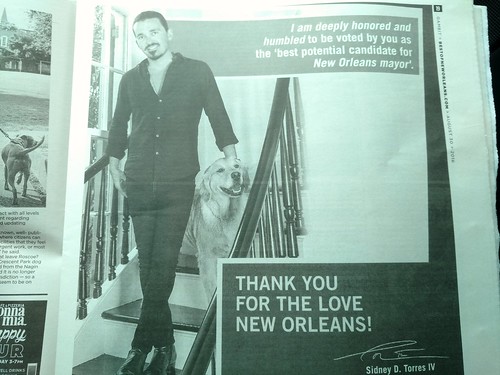
At the same time, there's this annoying familiar feeling in the back of our minds here. Something about a wealthy, charismatic entrepreneur/reality TV guy who nobody took seriously until it was too late. Can't quite place it, though. It's probably nothing.
Jason Williams is frequently mentioned as a potential candidate. This is mostly on the strength of the impressive victory by which he was elected Councilman At-Large in 2014. In that seat, though, he's possibly dampened enthusiasm a bit. Councilman Williams often seems cautious to a fault.
When he ran, Williams was emphatic about his belief in the council's role as "a check and balance on the administration." "It's not supposed be a rubber stamp," he said. And yet, during the STR debate, Williams proved to be among the more gullible followers of the administration's party line. Williams parroted the prevailing argument about the overwhelming imperative to "appease the platforms" insisting that we could always go back and "tweak" the permissive ordinance later. Hilariously, at that very same time, Williams' Facebook page featured an obviously hollow statement of support for the DAPL protesters.
State Rep. Walt Leger has certainly sounded at times like he might be running. That shouldn't be too surprising given that things didn't go as he'd hoped in Baton Rouge last year. He's also not the only member of our local delegation who might be fed up with the situation up there. Karen Carter-Peterson, for example, may have had quite enough of that cake already. There's also State Rep. Helena Moreno who, though her name has popped up regarding the mayor's race, is more likely to run for Stacy Head's Council At-Large seat.
Is that everybody? Probably not. Clancy DuBos also mentioned Troy Carter and Nadine Ramsey during a recent TV blurb. We'll see about that. There's also this guy @LarryLarmeu from Twitter who has threatened to run for various offices every few months or so for years now. Larry now says he is moving to England. We'll see about that too, I guess.
What we really need now, though, is polling data. It's never too early. This has been frustratingly difficult to come by in recent local elections. So this year we're not waiting around for UNO or SMOR to throw out their one anti-climactic survey a week before the election. Instead we're making our own. Poorly, of course, but so what. What is our method? Well, we just threw a bunch of names into a Twitter poll. There were... um... problems with this.
First off, Twitter only allows you to create polls with four options. But, as you can see from all of the above, we've identified quite a few more potential candidates than that. So we had to put them into two separate groupings. The names appeared in these groups randomly in the order that I happened to think of them. As it happened, the first grouping received almost 20 more total votes than did the second. Does this make the second group the "kiddie table"? Maybe. Is this in any way fair or valid? Hell no. That's not really our purpose here today or ever, really.
Suffice to say, even for a Twitter poll, the methodology here is highly suspect and pretty stupid generally. So we're looking forward to doing more of these periodically at least until qualifying day. Anyway here are the results. You can click here to see the groupings. Or, if you like, I've tallied up the total number of votes for every candidate along with each candidate's percentage of the 126 total votes cast. And so, here is your very first, very blurry snapshot of the 2017 race for Mayor of New Orleans.
J.P. Morrell 19% (24 votes)
LaToya Cantrell 17% (22 votes)
Larry Larmeu 15% (19 votes)
Jason Williams 14% (18 votes)
Karen Carter-Peterson 11% (14 votes)
Sidney Torres 9% (11 votes)
Walt Leger 8% (10 votes)
Michael Bagneris 6% (8 votes)
The big takeaway here, I guess, is that things are pretty tight at this early stage! And, hey, look at all those votes that suddenly become available once Larry leaves the country. Anybody's game, right?
The scheduling change was enacted a few years back in an effort to move the elections away from the busy winter/spring social season. This is probably for the best. But, since we aren't moving inauguration day until the following cycle, we do end up with a weird little one-time quirk.
The swearing-in switch would be delayed until after June 1, 2018, a political compromise that lets Mayor Mitch Landrieu and the current council serve full, four-year terms through May 2018 regardless of the vote's outcome. But that also means the next round of city leaders, if elected in October 2017, would have to wait more than six months to take office.So, after the November run-off, we're going to go through an awkward transition where we have a newly elected government just kind of hanging around in the background all the way into May. Ray Nagin used to complain about the "shadow government" in this city but this takes things a bit literally. Imagine a local version of the uncomfortable dual Presidency we've been enduring for the past month and a half but extended for half a year. Should be fun.
The first January inauguration would take place in 2022.
That's just about the same amount of time, by the way, between now and the July deadline for candidates to qualify for these races. So, sure, let's start trying to figure out who is running for mayor.
We're pretty sure LaToya Cantrell is in. She was most recently spotted delivering this demagogic over-the-top praise of the city's latest installation of surveillance cameras.
The department won’t specify where the cameras will be located, but said they would be stationed first in high-traffic areas and crime hot spots.Never mind the confused bit about racial profiling. That is, of course, always a concern. But it isn't the primary complaint against panoptic tracking of everyone's public movements by the police which we probably shouldn't have to point out is just inherently bad. But it's that "My constituents not only want to feel safe, they want to be safe," comment that really floors me. LaToya clearly doesn't recognize these cameras as the quintessential example of ineffective, expensive security theater that they are. In fact, she seems to be describing them as precisely the opposite of that. This is worrisome.
“Crime is out of control, shootings are up,” said Councilwoman LaToya Cantrell. “We need to be proactive in terms of catching criminals and deterring crime.”
Cantrell stresses that the readers are not for profiling or harassing people on the street, but for tracking vehicles used in crimes.
“It has nothing to do with profiling at all,” she said. “It doesn’t show you who’s in the vehicle, what they’re wearing, their skin color. It’s totally focused on that license plate as well as the make and model of the car.”
Cantrell said it will be a tool in the crime-fighting arsenal that the city so badly needs.
“My constituents are saying that crime is their number one issue. They not only want to feel safe, they want to be safe.”
We also know Michael Bagneris is in although nobody can figure out, exactly, why. Back in October, Bagneris told Danae Columbus that running for mayor "is in my DNA." Medical science has not yet developed a treatment for this condition.
J.P. Morrell might run. He was a vocal opponent of City Council's disastrous decision to legalize short term rentals last year. Affordable housing figures to be a major issue in these elections. Morrell also recently held a high profile fundraiser at the home of wealthy trash magnate Jimmie Woods which could signal big plans.
Speaking of wealthy trash magnates. This guy exists.
"One of the reasons I like private [solutions] is because I am looking at my bottom line," he said. "I'm not looking at what's politically correct. I'm not looking at what makes sense in how I am going to get to my next office or who's going to vote for me so I can keep my job as a politician."At first glance, Torres would appear to have at least two things working against him. First, the local political memory still retains at least some of the lessons it learned from its last experience with putting a not-a-politician "business leader" in charge of stuff. Second, it's not clear that New Orleans voters really take Sidney all that seriously. He won "Best Potential Candidate For New Orleans Mayor" in the most recent Gambit "Best Of New Orleans" poll which most readers took to be something of a joke. Sidney took out a full page ad to thank them anyway.
Coincidentally, Landrieu's term ends in 2018, and Torres is said to be considering a run of his own. Until that decision is made official, "Trashanova" is returning to the trade that first proved profitable. With the noncompete clause from selling his waste business in 2011 expiring in June, Torres is launching a new waste-management company, IV Waste, slated to begin serving private customers in early August.
"Business leaders should get involved — not just financially involved, but get their hands dirty and find a cause to help out," he said. "I think it's important."
At the same time, there's this annoying familiar feeling in the back of our minds here. Something about a wealthy, charismatic entrepreneur/reality TV guy who nobody took seriously until it was too late. Can't quite place it, though. It's probably nothing.
Jason Williams is frequently mentioned as a potential candidate. This is mostly on the strength of the impressive victory by which he was elected Councilman At-Large in 2014. In that seat, though, he's possibly dampened enthusiasm a bit. Councilman Williams often seems cautious to a fault.
When he ran, Williams was emphatic about his belief in the council's role as "a check and balance on the administration." "It's not supposed be a rubber stamp," he said. And yet, during the STR debate, Williams proved to be among the more gullible followers of the administration's party line. Williams parroted the prevailing argument about the overwhelming imperative to "appease the platforms" insisting that we could always go back and "tweak" the permissive ordinance later. Hilariously, at that very same time, Williams' Facebook page featured an obviously hollow statement of support for the DAPL protesters.
Right now "part of" Jason Williams is in Standing Rock asking if they can tweak the pipeline back out later maybe. pic.twitter.com/06mmu1G7KA— skooks (@skooks) December 1, 2016
State Rep. Walt Leger has certainly sounded at times like he might be running. That shouldn't be too surprising given that things didn't go as he'd hoped in Baton Rouge last year. He's also not the only member of our local delegation who might be fed up with the situation up there. Karen Carter-Peterson, for example, may have had quite enough of that cake already. There's also State Rep. Helena Moreno who, though her name has popped up regarding the mayor's race, is more likely to run for Stacy Head's Council At-Large seat.
Is that everybody? Probably not. Clancy DuBos also mentioned Troy Carter and Nadine Ramsey during a recent TV blurb. We'll see about that. There's also this guy @LarryLarmeu from Twitter who has threatened to run for various offices every few months or so for years now. Larry now says he is moving to England. We'll see about that too, I guess.
What we really need now, though, is polling data. It's never too early. This has been frustratingly difficult to come by in recent local elections. So this year we're not waiting around for UNO or SMOR to throw out their one anti-climactic survey a week before the election. Instead we're making our own. Poorly, of course, but so what. What is our method? Well, we just threw a bunch of names into a Twitter poll. There were... um... problems with this.
First off, Twitter only allows you to create polls with four options. But, as you can see from all of the above, we've identified quite a few more potential candidates than that. So we had to put them into two separate groupings. The names appeared in these groups randomly in the order that I happened to think of them. As it happened, the first grouping received almost 20 more total votes than did the second. Does this make the second group the "kiddie table"? Maybe. Is this in any way fair or valid? Hell no. That's not really our purpose here today or ever, really.
Suffice to say, even for a Twitter poll, the methodology here is highly suspect and pretty stupid generally. So we're looking forward to doing more of these periodically at least until qualifying day. Anyway here are the results. You can click here to see the groupings. Or, if you like, I've tallied up the total number of votes for every candidate along with each candidate's percentage of the 126 total votes cast. And so, here is your very first, very blurry snapshot of the 2017 race for Mayor of New Orleans.
J.P. Morrell 19% (24 votes)
LaToya Cantrell 17% (22 votes)
Larry Larmeu 15% (19 votes)
Jason Williams 14% (18 votes)
Karen Carter-Peterson 11% (14 votes)
Sidney Torres 9% (11 votes)
Walt Leger 8% (10 votes)
Michael Bagneris 6% (8 votes)
The big takeaway here, I guess, is that things are pretty tight at this early stage! And, hey, look at all those votes that suddenly become available once Larry leaves the country. Anybody's game, right?
Tuesday, August 24, 2010
Thursday, September 17, 2009
Deus Ex Camera
Popping popcorn
A company trying to intervene at the last moment in the closely watched civil trial over the city's crime-camera contracts alleged late Wednesday that it was jilted by the plaintiffs in the same way that they claim computer giant Dell Inc., former city tech chief Greg Meffert and his friends filched their work.
The plaintiffs -- local firms Southern Electronics Supply and Active Solutions -- say they had a 2004 agreement with Dell to sell crime cameras to New Orleans, but that Dell, Meffert and firms owned by Mark St. Pierre conspired to use Southern and Active's product for their own deal with the city.
Attorneys for CamSoft Data Systems Inc. of Baton Rouge, which served as a subcontractor to the plaintiffs during the project's pilot phase, appeared a day before this week's trial began to say they actually designed Southern and Active's system and deserve at least one-third of anything they might win in the lawsuit.
Thursday, April 16, 2009
Oyster has a client
YRHT:
Cedric Richmond isn't exactly "non-establishment" but he is a probable 2010mayoral congressional* candidate.
Question: If traffic cameras are "unconstitutional and violate the privacy of vehicle occupants," can't we say the same thing for crime cameras? Or is the constitutionality specifically tied to whether or not the device in question actually works?
Update: Oh BTW, while we sit here worrying about the "constitutionality" of photographing traffic signals, the standard for determining such things is dropping through the floor.
*As a couple of commenters have pointed out, Richmond is likely running for Congress in 2010. My bad. Still, the point remains. A candidate for high-profile office in the New Orleans area in 2010 seems to be attempting to score points off of the traffic cameras.
As I've been saying for over a year, there is hidden political power in this traffic camera issue. Hardly anyone likes the damn things, and a great many people hate them.
Again, I implore all insurgent and outsider political candidates to heavily exploit this issue. Own it! This is one of those kinds of issues that channels frustration into a surprising groundswell of support on election day. Non-establishment candidates should make use of it. I'm serious! Make hay out of the incredible efficiency of the traffic cameras compared to the lackluster inefficiency of the crime cameras: cops not cameras! working traffic lights not cameras!
Cedric Richmond isn't exactly "non-establishment" but he is a probable 2010
BATON ROUGE -- City- and parish-operated cameras that monitor speeding and traffic-signal violations would be unplugged starting Jan. 1 under a bill filed by a New Orleans legislator.Maybe this issue is too good to keep out of the mainstream.
House Bill 480 by Rep. Cedric Richmond, D-New Orleans, and co-sponsored by Rep. Jeff Arnold, D-Algiers, would prohibit cities and parishes from setting up cameras to monitor traffic violations. Some parishes that have already set them up have generated millions of dollars in revenues but have come under fire from critics who claim the systems are unconstitutional and violate the privacy of vehicle occupants.
Question: If traffic cameras are "unconstitutional and violate the privacy of vehicle occupants," can't we say the same thing for crime cameras? Or is the constitutionality specifically tied to whether or not the device in question actually works?
Update: Oh BTW, while we sit here worrying about the "constitutionality" of photographing traffic signals, the standard for determining such things is dropping through the floor.
*As a couple of commenters have pointed out, Richmond is likely running for Congress in 2010. My bad. Still, the point remains. A candidate for high-profile office in the New Orleans area in 2010 seems to be attempting to score points off of the traffic cameras.
Wednesday, March 11, 2009
Jim Letten is not your friend
Dambala has something to add to yesterday's post. I'll just repost his comment in its entirety with annotations added in parentheses for clarity.
(quoting me in regard to the possibility of federal prosecutions)
"- I'll believe such things when I see them."
I hate to sound conspiratorial, but I am seriously starting to doubt the intentions and integrity of Letten and our branch of the U.S. attorney's office. I have so much info I can't yet put out....because I can't get the sources to come forward...that seriously brings into question the intent of the Fed.
(quoting Schroeder)"- But really, what a bunch of idiots we have in this town! Just seize the frakking email server!"
they have....the FBI already conducted a forensic audit on every computer in his administration. They have all the missing emails and much, much more. Why they're not coming forward with that info is what I don't understand....unless they're 1. building a case or 2. covering it up.
I don't know if you guys remember this but Meffert pulled this exact same thing back in 2003 when the Yacht story first came out. They were so stupid in the beginning that they were using city servers to transfer all their blackberry messages....when Gordon R. put an FOIA request in....Meffert shut down the entire system for two days and wiped out all the emails that had been generated on the servers. He directed everyone in MIS to erase all their emails as well. He then said the email database had been accidentally lost while performing a "system upgrade".
It concerns me that Meffert is now the big cheese in the local RNC and I'm seriously beginning to wonder if Letten isn't sheltering him. I really don't know what the hell is going on but if Jones goes down alone....I am going to call bullshit on Letten and his office.
All they have to do to bust Meffert and crew is pull Imagines credit card statements from 2001 to 2004. Meffert bragged that he ran up over 80k in charges at the Gold Club, The International House, etc. on his Imagine credit card while he was the acting CTO. I know the Fed knows this because I've talked to the people working with Meffert who were interviewed by the FBI and told them all this information and more.
To make matters worse....I was just informed today that Meffert is now back in the MIS department...seriously. That's got to be my Holy Shit moment of the year.
Patsy
T-P's David Hammer:
Dambala noticed and has much more.
Last week, when the city's independent inspector general alleged years of questionable contracting and $4 million in overpayments for an often-inoperable network of crime cameras, Mayor Ray Nagin's administration released its own audit of the camera program. It focused almost entirely on the last two years of the project, when Jones was interim chief technology officer.
Dambala noticed and has much more.
Subscribe to:
Posts (Atom)