-->
Showing posts with label bicycles. Show all posts

Thursday, August 01, 2019

The robot cops we needed

If I had a robot

Have you ever parked without paying the meter? Have you paid but gone over the time by a few minutes?  What was the reason? Maybe you stopped in front of a meter to run and drop something in the mailbox across the street. Maybe you left the car somewhere for a brief moment to pick up a friend. Maybe you were stuck in a meeting a few minutes longer than you expected.   Sometimes, if you are unlucky that day, the attendant will happen by at exactly the wrong moment and you end up with a ticket. But on most days you get away with it.  Does that seem fair to you?  Most of us would probably say so.

After all, the purpose of metered parking is to dis-incentivize the hoarding of a scarce resource. In highly trafficked areas, such as an urban commercial corridor, there are often too many cars and too little space to put them all at once.  In order to keep things moving, we make it expensive for any one vehicle to occupy a space indefinitely. A parking fine is like a library fine in that its primary function is to encourage people to share a scarce resource. If you've parked your car at a meter for a minute or two without paying, or if you've gone over the limit a smidge, you really aren't violating the spirit of the law.  Technically you can still be ticketed.  But it's probably fair that you aren't always ticketed.

Of course some people have a different understanding of what the law is for.  Certain city officials, for example Ramsey Green and Jay Banks here, want to use it to punish bicyclists for violating traffic laws originally written to apply to motor vehicles. It's difficult to know how much of that comes from the ever-expanding quest for new ways of shaking money out of people vs how much of it is just general hostility.

There's less confusion over what motivates  LaToya Cantrell's decision to fiddle with the school zone cameras.  Emails and memos uncovered by the Daily Georges show that the primary motivation was to grab as much revenue from unsuspecting motorists as possible. The hostility came as a bonus reaction from the mayor once people started to notice.  
Digging in her heels despite public uproar, Mayor LaToya Cantrell this week defended her surprise move to reduce the speeds that prompt traffic camera tickets in New Orleans, saying her goal was to increase safety.  In a 30-minute interview with her own staffers posted online late Wednesday, the mayor said that dropping the allowable speed for cameras in school zones and elsewhere was a way to protect children. She didn't address why drivers weren't told about the change beforehand.
That article does an okay job of relaying the mayor's comments. But you really have to watch the video to get the full experience of her bullying belligerent style. The main thrust of her message that day was New Orleanians are a bunch of slackers and she is not going to tolerate that anymore.
Letting people take a laissez-faire approach to following the rules often leads to larger problems, she added.

"We have to shake this image of being 'the Big Easy' where you can do whatever you want to in the city of New Orleans," Cantrell said.

This isn't the first time a mayor has lectured us about our insufficiently submissive attitude toward the rules. Mitch Landrieu once argued that we should close all the bars in town at 3 because our "culture of permissiveness" was what was causing all the murders. Our mayors love to tell us our problems can be traced to some inherent character flaw. It's almost as if there's something in their culture of authority that drives them to this. Whatever it is, LaToya has certainly taken to it well.

If a motorist enters a school zone and happens to slow down to 25 mph instead of 24 before the camera tags them, well "that's illegal!" Cantrell shrieks in the video. "We can't pick and choose" how we handle something like that. "Cyclists will be ticketed!" she says, pounding the table. Discretionary enforcement in order to uphold the spirit of the law while accounting for the human elements that might lead to its technical violation from time to time has no place here.

Which brings us back to the parking meters. This week we learned they are getting "more efficient."
NEW ORLEANS — New Orleans is testing out a high-tech system to write parking tickets, without you ever seeing a parking enforcement officer. Placed at two different spots downtown, new meters monitoring parking electronically are currently gathering information the city will study.

"There's always room for improvement on trying to make things more efficient," Deputy Director of Operations Josh Hartley said. "We're looking at the vehicle types that park here, looking at the violations that come in, how long people are actually parking here."

So how does it work? After you park your car, you find your spot number and put your money in the meter. If your time runs out, a sensor in the spot will tell a camera nearby to take a picture of your plate and you could get a ticket.

"There's potential with this technology that if there's a violation activated, this system could automatically generate a ticket," Hartley said. "Versus having staff actually have to come walk to this site and issue a paper ticket you'd normally see on a windshield."

The meters are expected to make enforcement easier by adding extra lenses, instead of eyes, to the street.

"We are wanting to make things more efficient," he said. "This does not eliminate jobs, what it actually does is it would allow us to utilize our resources better in other parts of the city that we normally are not monitoring."

Well at least it does not eliminate jobs. We like that.

Meter Maid Mural

It's this "holding people accountable for their parking" bit that is concerning.  For all of the reasons stated above, it seems to us we're already doing that well enough without adding robots. But, hey, it's a free trial offer so...  
And if all goes well, installation around town could be put into drive, holding people accountable for their parking. The trial is free for the city, it's unclear how much the system would cost if implemented. It's already being used in other cities in the United States.  If the city of New Orleans moves forward with the meters, it's expected they'll first be put into the busy parts of downtown and then into other areas.
Speaking of which, how did the free trial come about? According to a press release this week, the vendor is something called Municipal Parking Services Inc.  The product is called a "Sentry SafetyStick" As the WWLTV article says, it is being used in other cities.  Here is a story from Bridgeport, CT where they were removed last year because people were already tired of being "threatened" by them.
As previously reported, a year after installing the high-tech meters, Mayor Joe Ganim’s administration has cried “uncle” in response to complaints the equipment was too aggressive and hard to operate, poorly publicized, and hurting the local economy.

The meters will be replaced with a different model that offers the same conveniences — like accepting credit cards — without the cameras that caught violations and helped to issue tickets-by-mail.

Ricci and Nkwo on Thursday offered members of the council’s contracts committee additional details about the overhaul.

Ricci said the existing meters, built and installed by Municipal Parking Services out of Minnesota, will be replaced with less “threatening” ones supplied by IPS Group of California and already in use in other municipalities.
As usual, though, New Orleans is jumping on board with a scheme that's already failed elsewhere and calling it a "best practice."  Where do they get these ideas?  Well here is one possibility. About a month ago the mayor attended the US Conference of Mayors get together in Hawaii. There was some grousing on talk radio about that but mayors go to these things all the time.  Mitch was actually the President of the USCM for a time.

Basically, it's a trade show.  The mayors get together and congratulate one another on the fantastic and visionary jobs they are all doing. And, of course, there is ample opportunity for them to receive further flattery from potential "corporate partners" who are there to sell them things. Sponsors and presenters at this year's conference include Verizon, Wells Fargo, Bank of America, AT&T, Interise, Google, Facebook, and our very favorite friend of urban policymakers everywhere, Airbnb. I didn't find Municipal Parking Solutions on the agenda, but it's a fair bet they had a rep or two in the room at one or another discussion on "Smart Cities" or "Intelligent Transit Solutions" and whatnot.

Not that this mayor needs much convincing that her citizens and their "Big Easy" attitudes need to be watched more carefully.  But it's nice to know the market may have provided just the robot cop product she needed.
Thursday, October 18, 2018

No more $1000 bike tickets

Well, maybe that's not a guarantee.  But we do know you aren't required to register your bike anymore so there's some positive news.
For private citizens, bike registration is now voluntary, though the cash fee to do so will jump from $3 to $5 on Jan. 1, 2019.

“Bicycle registration was initially put in place to ensure the safe return of citizen’s property, and we hope people will continue to utilize the program,” said Councilwoman Kristen Gisleson Palmer, who authored the ordinance, in a statement.

The ordinance also moves bike registration management from the purview of the New Orleans Police Department to the Department of Safety and Permits. Under the NOPD, registration has been a cumbersome process for those without proof of purchase for their bikes.
Someone will still have to explain to me how registering your bike helps you with "the safe return of your property."  At least please show me someone who got their bike back because of that.

Thursday, September 06, 2018

The future of transit

No bicycles

Kristin Palmer introduced an ordinance today. At least, it was on the agenda today. I haven't seen any reporting from the meeting yet so I don't know what its status is currently. (Aside: There are far fewer reporters on the City Hall beat these days. And what they produce is not as consistently detailed as it once was either. I assume Kevin Litten will have something pretty decent out by the end of the day but it's no guarantee anyone else will. So it goes.)  Anyway the ordinance says you can't park your bike pretty much anywhere anymore.


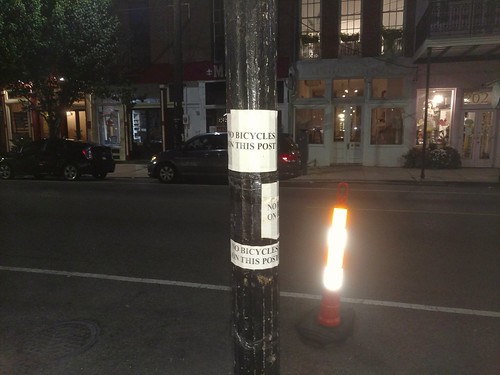
I've been trying to figure out for a while now what the big obsession is with bike parking. I see signage like that photo at the top of this post all over town lately.  That's still a mystery to me. But I do know what Palmer's issue is. She wants to adjust the law in a way that makes it easier for the scooter rental companies to operate.

With input from Mayor LaToya Cantrell’s administration, District C Councilmember Kristin Gisleson Palmer is drafting three ordinances to regulate app-based electric scooter rental companies, which have moved rapidly into U.S. cities and are prepared to roll out in New Orleans.

But Palmer wants to pump the brakes until her office has put together a package that’s “enforceable and good for the public,” with laws that build out the city’s two-wheeled infrastructure and prevent New Orleans from falling into the same kinds of legal problems and traffic headaches that have cropped up in the scooters’ wake across the country.
Sorry if that inconveniences any of Palmer's actual constituents. But it's important to make sure we're going out of the way to accommodate these universally praised scooter operators
It’s the most recent leg in a race to replace or compete with the entire concept of mass transit, “disrupted” by companies with billion-dollar valuations. Companies now have inserted themselves into the public part of public transit with an ad hoc network of "shared" bikes, scooters and cars. And those companies are moving quickly to shape the future of transit — “public” in nature but private in its terms. A $2 bus or streetcar fare is replaced with a $10 Uber ride. Bike rentals (or “bikeshare”) kiosks dot popular urban centers, adding more options for transit in areas already dense with them.
And who doesn't want to be part of "the future of transit," right? Specifically the part you will play is ceding your right to share the commons so that Lime can profit from "sharing"  its products.

Update Council passed this rule unanimously.  Palmer says they've accounted for the bike parking problem.
But the rule passed Thursday seeks to address one earlier concern: that bikes attached to stop signs or poles might be pulled off city streets if bike racks are full or absent in neighborhoods where they travel.

It also paves the way for plans to store dockless scooters in spots marked by painted lines on city streets.

“We want to ensure that there’s no collateral damage in terms of the removal of bicycles that can be chained (to spots other than bike racks), due to lack adequate safe bike parking,” said City Councilwoman Kristin Gisleson Palmer, who chairs the council’s transportation committee and has led the effort to usher in scooter share.

The wording was a change from what was proposed previously.
What she means is they won't come take your bike if it's locked up. But she adds, "due to lack of adequate safe bike parking" which suggests there may come a point when they deem the parking "adequate" such that they can make you stop tying up to posts and signs. She says they're working on that now.
Palmer said at the time that she would work with the city to install more racks. City crews are also planning to stripe portions of streets with lines designating parking for scooters and bikes, a step that would cost less. 

But while those plans are being finetuned, people will still be allowed to lock up their bicycles to posts and poles, as they do now, she said Thursday. Scooters won't be allowed on city sidewalks, but plans are in the works to carve out space for them on city streets, council staffers said.
In other words, they're still coming for your bike. Just not yet. 

Wednesday, June 27, 2018

Stop and frisk on wheels

Uptown Swingers

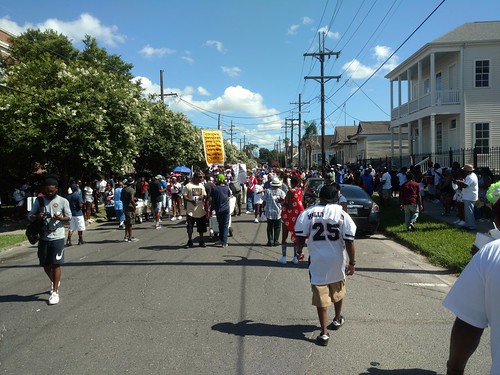
This weekend we walked for a few blocks with the Uptown Swingers parade and second line. It was very hot out. Luckily there were some guys in the crowd pulling coolers of water and other beverages for sale. Nobody asked if they had permits to do that. Nobody called the police. Maybe it would have been different if they were on bikes.

That is very nearly a $1,000 ticket just because a cop decided to check and see if the dude had a $3 to $35 tag on his bike. Is that real? Jules is reliable source and all but, geeze, is that real?

It's real.
So, there Louis was in the empty pre-dawn, riding that raggedy bike in a striped bike lane, only now he was pedaling against the ghosts of would-be traffic. That is technically a violation, though one every cyclist in the city can attest to breaking. Louis himself has done it plenty of times before because he feels safer knowing cars aren't coming at his back.

That's when two New Orleans Police Department cars rolled up on him, lights flashing.

"I immediately went to the 'don't shoot' position," Louis said.

An officer ran the driver's license Louis handed over while Louis called his father, and he sat on the curb, thinking it all over.

He did not, Louis reasoned, look like somebody out to commit a crime.

So the local bicycle wars have been a subject of some interest here on the ol' Yellow Blog over the years so I feel obliged to say a few words about the political background to these rather expensive citations.

As bicycling has become more popular over the past decade or so, authorities in city government and law enforcement have sought to exert more control over it for various purposes most of which are bad. The city is interested in new ways to shake down residents for fees and fines . Politicians and real estate people like to cultivate at least the appearance.. often only the appearance.. of "bike friendly infrastructure." And, of course, law enforcement is always looking for new pretexts to do stop and frisk.

Here is a Gambit article from 2010 about a proposal to "reinstate a bicycle registration program that hasn't been enforced since before Hurricane Katrina." The fees it proposed were ridiculous, as you can see in the section below, but the reason the measure ended up getting tabled was because it was clear NOPD couldn't be trusted with it.
Jatres says the MBC's biggest concern is the fee hike — a 500 percent increase for non-commercial registration. As for the "commercial" fee, the ordinance does not make clear who would need the $75 license.

"A lot of people bicycle for economic reasons, that's their form of transportation. Having low income people (pay) a $15 fee can be a significant burden," Jatres says. "The $75 fee for commercial use — it's left fairly vague. Could be couriers, bike rentals, anything. If you use a bicycle as transportation for work, could that be broadly defined as commercial? It left it vague enough where that line between commercial and personal could be blurry."

The ordinance does not spell out how NOPD would enforce registration, which Jatres and other cyclists fear could result in potential harassment. The MBC says it's received complaints from cyclists saying NOPD officers have stopped them and told them to ride on the sidewalk or to wear a helmet, neither of which are laws in Louisiana.

"There seems to be a lot of misunderstanding among at least some officers within the department, which leads to the concern — here's one more tool that can be interpreted or misused, either out of ignorance of the law or intentions to harass cyclists," Jatres says. "That was what hit Councilman Carter, 'OK, we really need to get everyone in a room to talk about this.'"

Every now and then a new NOPD initiative proposes to crack down on existing but dormant regulations.  Last year City Council passed an ordinance presented as "protection" for bicyclists but really it just created new ways to bring them under the enforcement regime.  Jared Brossett's quote tips it.  The primary purpose of this was to crack down on cyclists. 
The new rules, recommended by the city’s Bicycle and Pedestrian Safety Advisory Committee, explicitly prohibit motorists from driving in designated bike lanes or harassing cyclists, clarify that pedestrians have the right of way in crosswalks and require that bikes must be equipped with lights or reflectors plus bells or other devices that can provide an audible signal to those nearby in emergency situations.

“All roadway users have a responsibility to use roads safely,” said Councilman Jared Brossett, who sponsored the ordinances.


At the same time, the city has heralded its placement of bike lanes all over town as a signal of its progressive orientation.  But cycling advocates have complained the painted lanes are more ornamental than useful and often are safety hazards themselves.  This suggests our new bike centered infrastructure, including the recently launched for-profit bike share program, isn't designed to meet transit needs as much as it is to boost real estate values.
Those bike-docking stations, however, also give Fleming pause. He resists using the term "bike share" to describe them. Instead, they are "bike rental kiosks," he said.

His reasoning is economic. He worries that a kiosk in a low-income neighborhood would give landlords with properties nearby license to label that block "up-and-coming" and raise rents.

In other words, he sees a bike-sharing program as a harbinger of gentrification and its unsavory cousin: the displacement of the poor.
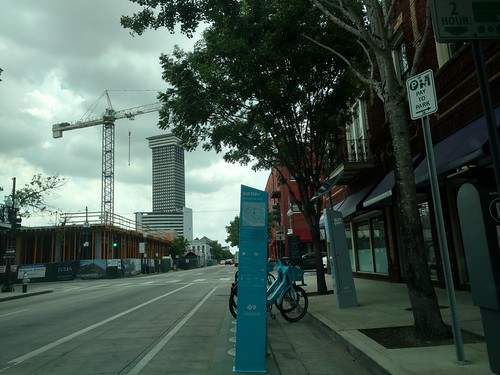
Blue Bikes downtown

Over the weekend, I heard a few stories about bikes tied up near the convention center receiving warning stickers that they had been improperly parked. In recent years, new prohibitions against parking bikes in what one would think are harmless places have sprung up in an ad-hoc fashion all over town. We've documented some of these. It's probably a coincidence that we're being made to feel less free about riding our own bikes in downtown neighborhoods at the same time that the Blue Bikes monopoly is spreading out over the same area. But the lifestyle is becoming more regimented in any case. A thousand dollar ticket for not being "registered" is sure to make anyone more wary.
"That's more than my rent. That's more than a number of different things," Louis said.

"I think the police has a lot of discretion in terms of issuing a citation," Charlie Thomas, Louis' attorney said.

Thomas works with the firm Huber, Thomas and Marcelle. They are statewide attorneys for bike law. He is calling the prices for these citations outrageous and believes there is no use registration ordinance in the city.

"Even though NOPD might have your bicycle information on file, we're unaware of any circumstance where this has led to the recovery of a stolen bike or really any sort of benefit," Thomas said.
The benefit to NOPD doesn't have anything to do with solving bike thefts, though. It's just a tool for city officials to use as they continue to embrace widely discredited "broken windows" policing techniques. LaToya's recently expressed enthusiasm for surveillance "Quality and Neighborhood Safety" cameras indicates that's not going to change any time soon.

On the other hand, that WWLTV story does say that the mayor personally emailed Louis about his ticket this afternoon and is "willing to work with him," whatever that means. So the lesson here for cyclists is, if you get stopped and harassed by a cop, (and manage to avoid getting shot, of course) make sure you get yourself on the news.  This mayor seems to respond if the uptick is big enough. Not sure if that really scales up as a citywide policy but, to be fair, I have not yet fully grasped the #CityOfYes ethos. Maybe it has something to do with being intentional.

Friday, April 21, 2017

Protections and responsiblilites

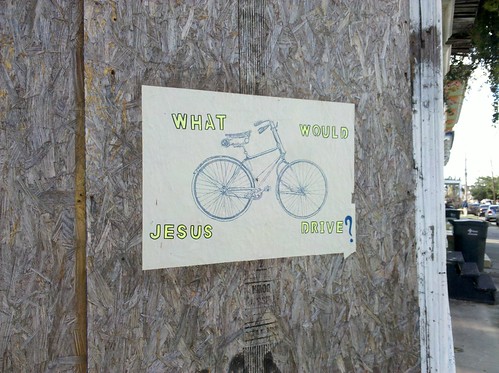
What would Jesus drive?


I don't see anything in here that offers any "new protections" to bicyclists or motorists.
Bicyclists in New Orleans will get new protections — and some additional responsibilities — under a package of ordinances passed unanimously Thursday by the City Council.

The new rules, recommended by the city’s Bicycle and Pedestrian Safety Advisory Committee, explicitly prohibit motorists from driving in designated bike lanes or harassing cyclists, clarify that pedestrians have the right of way in crosswalks and require that bikes must be equipped with lights or reflectors plus bells or other devices that can provide an audible signal to those nearby in emergency situations
In effect, all this really does is provide a new pretext for police to randomly stop people just for being outside. It's stop and frisk on wheels. So, you know, stay in your lane because they are serious about that stuff these days.

Another problem with bicycle policymaking in general is that it always combines the worst possible panders to the motorists who hate bicyclists with the worst possible panders to the bicyclists who love bicycling a little too much. Bikes and cars are different in the same way that cars and pedestrians are different. Cars are big and dangerous and the rules and infrastructure should protect everyone else from them. This is different from simply demanding that all vehicles on the road should have to follow exactly the same traffic laws.  That doesn't make any sense no matter how cranky and loud drivers tend to be about it.

Meanwhile here's every cycling activist asking to be saddled with "additional responsibilities."


Stop doing that. Nobody cares. There are many great and good reasons to get around the city by bicycle when you can. But these are the top two.

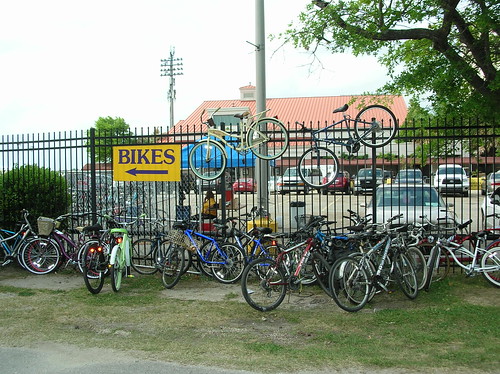
1) It is convenient to be able to tie up anywhere instead of worrying about where and how expensive the parking might be.  But a look around town will show you the universe of arbitrary rules is offering less and less protection there.

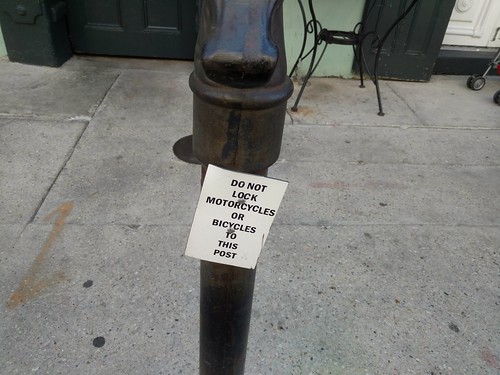
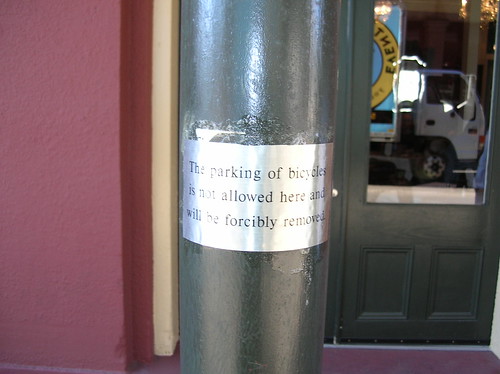
Do not lock to post

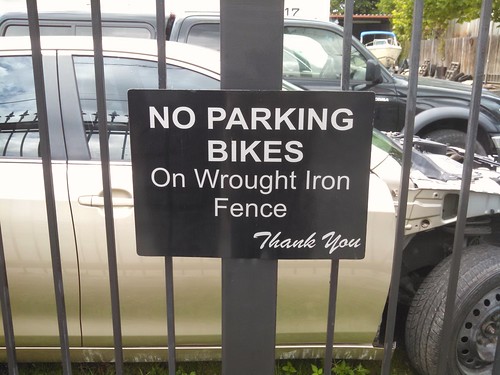
No Parking Bikes

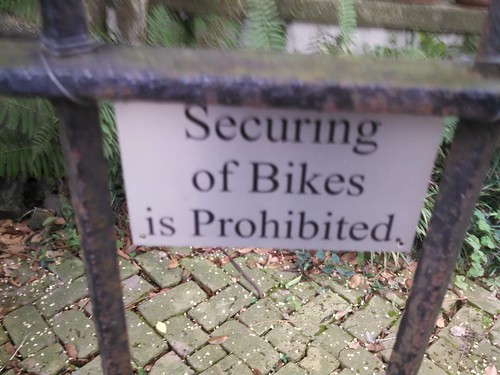
Securing of bikes

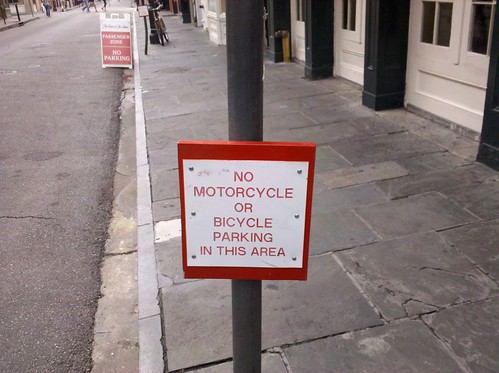
No bike parking

Obnoxious signage at Muriel's

2) It is the best way to avoid getting snagged in one of these.
NEW ORLEANS -- Police will be looking for drivers under the influence Thursday night.

The New Orleans Police Department is conducting a sobriety checkpoint at an undisclosed location from 9 a.m. to 5 p.m.
(FYI: The "undisclosed location" was Louisiana and Tchoup last night, if the reports are to be believed.) Now that police have got a reason to watch for non-compliant bicycles just like they go after expired brake tags, I guess this advantage is going away too.  Maybe the best answer is just for everyone to never leave the house. 


Also, what kind of protection does a "bell or other device" offer that just saying "excuse me" with one's own voice can't?  Let's leave the horns on the trains where they belong

Thursday, April 06, 2017

Any excuse to collect more money from poor people

The pretext here is bicycle safety. The inevitable result, though,  is more revenue-driven harassment of bicyclists and pedestrians to match that which motorists already endure. 
The City Council is expected to take steps Thursday (April 6) to rectify that by considering a raft of laws meant to better outline the relationship between bikes and motorized vehicles sharing the road. The actions would bring city code closer to what is already on the state's law books.

A big contributor to the convenience of biking around town is the assurance that the cops probably won't bother you (heh.. yes, I know..  if you're white, anyway.)  And that you won't be ticketed by a meter maid or some camera somewhere. It's getting to where we're just taxing you for being outside.

Not that this matters to your councilpersons so long as there's money to squeeze out of poor people. And it's hard to think of a package of traffic fines imposed on people who rely on bikes for transportation as anything other than that.

Meanwhile, in a somewhat related matter, take a look at this Lens report on the efficacy of traffic cameras.  Basically, there is zero evidence they do anything at all to improve safety.
New Orleans Mayor Mitch Landrieu says safety, not money, is behind a major expansion of traffic enforcement cameras in the city.

But his administration has produced no evidence the cameras reduce wrecks, injuries or deaths on New Orleans streets.

It does have data on how many tickets have been issued and how much money they brought in.

The city is adding 45 stationary cameras and 10 mobile ones to catch drivers speeding or driving dangerously in school zones. The new cameras are expected to bring in about $5 million a year after the vendor takes a $3 million cut.
So we already know that revenue supersedes safety when it comes to traffic regulation. It's actually worse than officials simply not being able to justify their own rhetoric with data. In some cities, they've also been caught deliberately making the roads less safe
As privately operated red-light cameras proliferate across the country, cities and towns shortening yellow lights spike the number of tickets, and thereby increase revenue. The profits come at a social cost, as shorter yellow light times have been associated with an increase in car accidents.

While not new, the profit-driven development continues across the country, with private companies like Redflex Traffic Systems reaping the rewards. In February, the city of Fremont, California, pledged it would refund at least $490,000 in tickets to drivers after it was revealed that for a period of time in 2016, yellow-light times at two key intersections were shorted from 4.7 to 4 seconds, driving an increase in tickets. Each of those intersections was outfitted with red-light cameras run by Redflex Traffic Systems.
This is one reason to keep an eye on Paul Hollis' bill in the coming legislative session which would put an end to the traffic camera scheme statewide.  I say keep an eye on it, but don't expect it to pass. Not with so much money tied up in maintaining the ripoff.

But as City Council moves toward imposing a new set of fines and fees ostensibly in the name of bicycle safety, it's worth remembering what actually spurs them to action.

Thursday, July 21, 2016

Because "public" transit is so 20th Century

This bike share idea has everything your worst neoliberal nightmare is made of. 
A City Hall selection committee chose Social Bicycles, or SoBi, from seven competitors, giving it high marks for its use of technology and capacity to find sponsors to fill shortcomings in its operating budget. Committee members said SoBi's proposal came closest to achieving Mayor Mitch Landrieu's main objectives: that a bike share program be accessible to low-income residents and that the city not pay a dime for its operations.
It's all there. Some babble about the great apps or whatever, an opportunity for ad marketing to #brands, and, of course, some platitudes about serving the public although we aren't asking the public to fund and operate this service business.  I'm sure it will be a tremendous success. At least in terms of padding some resumes and scoring some PR.

Also.. "SoBi" because please shoot me. 

Thursday, May 12, 2016

Bike share in name only

The mayor's bike share idea is not about providing a new public transit service. Rather it is about sanctioning a new fully privatized bike rental business and granting that business local monopoly status. And when you take a service that should be designed with the public good in mind and replace that approach with a profit driven business model, other public good problems are compounded.
Those bike-docking stations, however, also give Fleming pause. He resists using the term "bike share" to describe them. Instead, they are "bike rental kiosks," he said.

His reasoning is economic. He worries that a kiosk in a low-income neighborhood would give landlords with properties nearby license to label that block "up-and-coming" and raise rents.

In other words, he sees a bike-sharing program as a harbinger of gentrification and its unsavory cousin: the displacement of the poor.

"If one of these pops up in quote-unquote transitional neighborhoods, it's an open excuse to raise the rent," Fleming said. "New Orleans right now is having a huge housing crisis, and if this becomes an aid to gentrification, a lot of poor people are going to be pushed out by something I love: bicycles."
But this is the Landrieu neoliberal philosophy in a nutshell. Let's implement half of what might be a good idea under different circumstances. We'll look like we mean well even as the real life effect only exacerbates the wealth divide in the community.

Probably something similar is happening here
Rodents and snakes, rampant mold and water leaks that have collapsed ceilings and floors are among the vast list of complaints from tenants of New Orleans slumlords. But when it comes to seeking action against them, tenants seldom raise a fuss because they risk being evicted.

It's these residents who stand to benefit the most from the city implementing a rental registry, City Councilwoman LaToya Cantrell said. She plans to write legislation to put one in place, anticipating the matter to come before the full council this summer.
Sounds like a good idea. There are a lot of slumlords and substandard conditions out there.  But unless a measure like this is part of a more comprehensive affordable housing policy (new public housing, rent controls, STR bans, etc.) then most likely what we'll get is a tool that takes property out of the hands of small time landlords and puts it into the hands of large real estate management companies. Or at the very least makes Airbnb an even more attractive alternative for landlords.

On the surface it all seems very reasonable. But the real world effect is likely to be bad without further action. The further action never comes, of course, but this is the con the phonies are running. We do little things that may someday be of help, but in the meantime just create opportunities for the lords to steal more from the peasants. What they don't tell you is we always live in the meantime. So things get shittier and shittier for you little by little all the while the Mitches and Latoyas of the world get credit for their good intentions.  And that's "incrementalism." 

Saturday, October 03, 2015

All we do is win-win-win

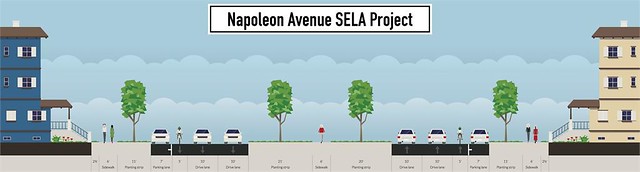
Napoleon Avenue Roadway Configuration Image.png


They're saying the new plan is full of win
City officials released a compromise plan for Napoleon Avenue on Thursday that would maintain the size of the neutral ground and add a bike lane — without reducing the number of lanes dedicated to traffic or parking.

The idea is to reduce the width of both traffic and parking lanes by 2 feet each, rather than eliminating lanes altogether or reducing the size of the neutral ground.

The final configuration will be two 10-foot-wide vehicle travel lanes, one 5-foot-wide dedicated bicycle lane and one 7-foot-wide parking lane in each direction. The neutral ground will be restored to its original, pre-construction width of 47 feet

This is a win-win-win for area neighborhoods, motorists and cyclists,” Mayor Mitch Landrieu said in a news release. “By working together, we feel confident that this roadway configuration is a reasonable accommodation for all interests.”
Is that really a "win-win-win"? Sounds more like nobody got what they wanted. Unless you count the portion of the neighborhood that wanted to make sure they didn't shrink the neutral ground, I guess. Although that wasn't the neighbors' only complaint and I'm not even sure that was their first priority.

They were also worried about the bike lanes. Specifically they were worried that a bike lane on a street like Napoleon Avenue was bound to produce a safety hazard at major intersections as they have in other places around town.  Another issue with the proposed bike lane was its placement between a lane of traffic and the on street parking which is also something that happens all over town despite being a clear safety hazard. 

Both of these issues are also frequently raised by cycling advocates to little avail so it's hard to say that this is really a "win" for them either. All they're getting now is another unsafe bike lane jammed in next to two 10 ft wide lanes of traffic which, by the way, is also not quite in keeping with the "best practices" standard for a trucking and transit artery like Napoleon Avenue.
For multi-lane roadways where transit or freight vehicles are present and require a wider travel lane, the wider lane should be the outside lane (curbside or next to parking). Inside lanes should continue to be designed at the minimum possible width. Major truck or transit routes through urban areas may require the use of wider lane widths. 

Lane widths of 10 feet are appropriate in urban areas and have a positive impact on a street's safety without impacting traffic operations. For designated truck or transit routes, one travel lane of 11 feet may be used in each direction. In select cases, narrower travel lanes (9–9.5 feet) can be effective as through lanes in conjunction with a turn lane.
The only "win" here is a slight one for the city the next time it wants to write a report about the total mileage of bike lane they've installed over the course of Mitch Landrieu's term in office. It doesn't really matter whether the bike lanes in question are actually placed where they'll be used properly or even if they do anything to protect the safety of the cyclists who have to navigate them. All that matters is that the mayor's office can make "the data show" how progressive a city we've become under their watch.
As bicycle ridership increases, the City is committed to expanding our network of bikeways. According to the League of American Bicyclists, New Orleans currently ranks fifth in the nation amongst large cities in the percentage of residents who bike to work. With the completion of the Lafitte Greenway’s bicycle and pedestrian path, New Orleans will have more than 100 miles of bikeways.
So congratulations on your 100 miles, guys.  Hope no one gets doored into a bus for the sake of it.

Aside:  Because, like you probably do, I thought the artistic rendering of Napoleon Avenue lined with beach hotels from 1920s Atlantic City looked kind of weird, I found out that the image is generated by a generic design program called Streetmix.What's great about that is, if you don't like what the city has come up with, maybe you can play around with this app and make your own Napoleon Avenue. Sadly, I can't find the button that puts the crepe myrtles back.

Monday, August 03, 2015

Is The Greenway Open Yet Dot Com

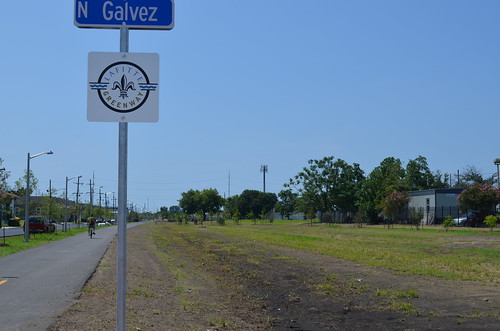
Lafitte Greenway at N. Galvez

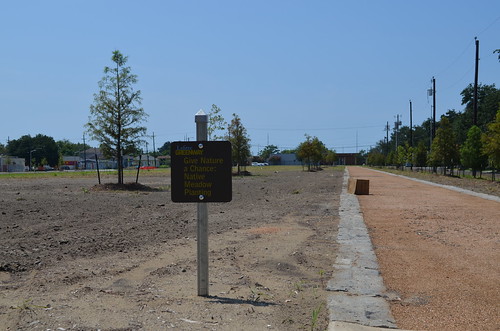
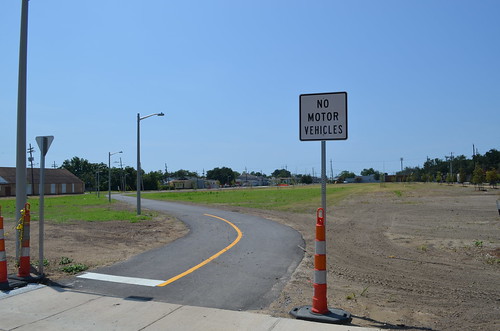
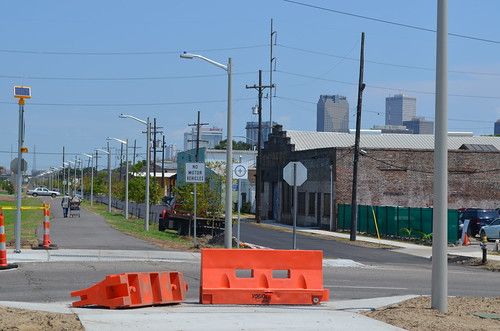
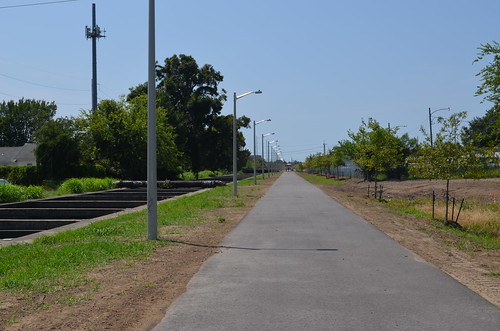
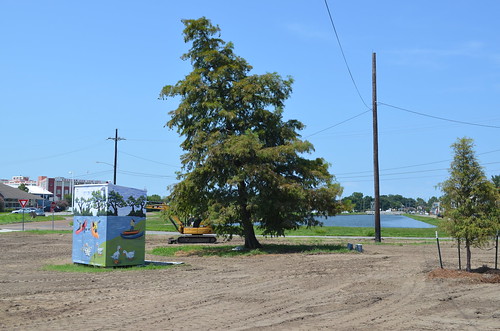
The opening of the Lafitte Greenway, originally scheduled for this spring, and then pushed back to summer, and then again to late summer is pretty much done right now. Or at least that's how it appeared this weekend on a bike trip from the Quarter out to Bayou St. John.  Work crews were still finishing up some landscaping. And I don't know if all of the signage and lighting is quite ready. But the bike trail is ready and you can definitely go there and ride on it.  It's a convenient way to get between Mid City and downtown. Plus it just looks nice. Here's some pictures.

"Give Nature a Chance"

No motor vehicles

Skyline from the Greenway


Bike path

Bayou St. John head


Thursday, July 23, 2015

Vicious cycle

Bikes

They're doing some kind of activity at the City Hall today.
Four cyclists have died this year in collisions with automobiles on the streets of New Orleans, spreading fear and outrage through the cycling community, which feels that the city treats them as second class citizens when it comes to traffic safety and infrastructure spending.

To remind the city's politicians and the driving public what's at stake, Pool and a group of his fellow cyclists are staging a "die-in" at City Hall on Thursday.

Modeled after the sit-ins of Civil Rights movement, cyclists in several cities have taken to staging events in which they lie down en masse, as if slain, to protest what they see as shoddy treatment by officials and motorists. Such die-ins are typically held in the middle of crowded, busy streets, grinding traffic to a halt.
Ok, look. This is not the Civil Rights movement. Stop making that comparison. It doesn't help anyone. But this is a serious safety issue. People have been killed in these accidents. Unfortunately it's not an issue that city leaders are taking seriously. Or, at least, they aren't handling it honestly.

Instead, they've deployed an array of  PR and "data" calibrated to facilitate the PR intended to demonstrate that  New Orleans is becoming a "bike friendly" city.
Mayor Mitch Landrieu has made bicycle friendliness a priority since taking office in 2010. He has promised that New Orleans will have 100 miles of "bikeway" infrastructure by the end of the year. Before Hurricane Katrina, the city had just 5 miles of bikeways.

As of Nov. 6, the city had 37 miles of dedicated, on-street bike lanes and 16 and 1/2 miles of off-street paths. New Orleans has 40 miles of road designated "shared," meaning there is no protected infrastructure for cyclists but there are on-street "sharrows" to remind motorists to share the road.
They've installed bike lanes. They've celebrated "Bike To Work Day" (Presented By Entergy) events.  They've encouraged NOPD to issue citations for bicyclists who glide through stop signs or ride against one way traffic.  Mileage of bike lanes installed, like the number of tickets written is a measurable data point. It's easy to haul out and recite whenever someone asked what you're doing to make the streets safer. But, as the cycling activists point out, just slapping down some bike lanes isn't necessarily making anyone safer.
Where there is infrastructure, it can be poorly designed and misunderstood, or outright flouted, by drivers unused to sharing the road with cyclists, Roe said.

He pointed to the death of Philip Geeck, who was killed in a wreck at the corner of Elysian Fields and St. Claude Avenue in 2014. Although Geeck had been traveling St. Claude in a bike lane, which ends abruptly at the intersection, a semi-truck turned across his path, crushing him beneath the trailer's wheels.
A lot of these, then, are bike lanes in name only. They're not thoroughly planned to work with vehicle traffic. Many of them are just "shared lanes" meaning we draw a little picture of a bike in the road and leave it to cyclists and drivers to work it out on their own.  But the intersections are the worst.

Here's more coverage of the Philip Geeck accident including a diagram of the confusing intersection that led to a man's death. Other intersections around town are as bad or worse. Often a bike lane will end altogether at a busy intersection leaving a cyclist to make adjustments to confused right-of-ways  on the fly.  Busy intersections are by far the most dangerous places for bicyclists and they are precisely the spots where the infrastructure fails them.   There are smarter, safer ways to do this. No one talking about implementing those solutions, though.

Instead, they're just shoehorning more bike lanes in everywhere regardless of whether they are safe or even desired. At a Corps of Engineers public meeting last month, officials unveiled plans for the redesigned post-SELA Napoleon Avenue. Among the public's many concerns with the design, bike lanes.
While the walking path on Napoleon Avenue is something residents have long sought, the narrowing of the neutral ground for the creation of bike lanes proved controversial among those at the meeting.

Faye Lieder said the last meeting on the landscaping in October gave residents no idea that narrowing the neutral ground was under consideration, leaving them “blindsided” and “stunned” when the plans were revealed Thursday.

“Bike lanes may prevent some rear-end collisions but create problems at intersections,” Lieder wrote in an email to Uptown Messenger after the meeting. “Aside from the questionable wisdom of bike lanes, why would the city (just who made this decision anyway?) want to shrink green space on this beautiful oak-lined avenue, already two lanes each way, where families gather on the median to watch Mardi Gras parades?”

Resident Richard Dimitry said at the meeting that the placement of the bike lanes next to the parking lanes would put younger riders in particular in danger of being hit by motorists opening their doors to get out of their vehicles.

“I can’t see that for the kids,” Dimitry said. “It’s not necessary to put them in danger.”
Does the bike lane work on Napoleon? Is it designed in a way that makes people more or less safe? None of this is really the point. The point is striping more mileage of bike lane so the mayor can cite statistics that impress people when next he is in Aspen.

This also explains the now infamous "pilot program" on Baronne Street where a lane installed (despite the objections of the city's traffic engineer) has caused nothing but headaches for motorists and cyclists alike.
Between 4 p.m. and 5 p.m., more than 40 cars drive down the bike lane. Two Regional Transit Authority (RTA) buses turn it into a bus lane for several blocks. Two taxicabs roll lazily down the bike lane. A Budget rental truck parks with its warning lights on in the middle of the bike lane for 35 minutes. A cyclist is forced to swerve around the truck and into traffic, then swerve back into the bike lane.

Within the same hour, one police officer drives by. No one gets a ticket.

Mike and Abby, who work at a hair salon on Baronne Street, say they've seen this scene every day since December, when the city took out one lane of vehicular traffic to create the dedicated bike lane.

"We see cars using it a lot," says Mike (like Abby, he didn't want to give his last name). "We see people riding down the wrong way sometimes. We see people on bikes still using the sidewalk or car lane. ... I'd say it's about 50 percent taxis using the bike lane, surprisingly. We haven't seen anything being enforced.

"I'd like to add," Mike says, "that the people who do ride bikes are extremely hostile."
It has definitely gotten hostile out there.
A driver bobbed his head peacefully to the reggae tune emanating from his luxury vehicle on a recent afternoon in the Central Business District, but the good vibrations did not extend to those in the car next to him, furious that he was skipping the traffic line by driving through a bike lane.

The scene was captured on a recent trip down Baronne Street, where officials replaced one of two auto lanes with a dedicated bike lane for a six-month trial period meant to assess the impact on vehicle traffic and cyclist use.
The Baronne pilot program is due for review by the end of this month.  It's hard to imagine there's any way the city will decide to remove precious bike lane mileage despite the less than stellar results. Also the grant funding for the program only paid to install the lane. The city would have to find the money to take it out. Meanwhile nobody can say with any certainty that we're doing anything to actually make the streets safer.

Instead it appears, for the time being, we are caught in a vicious cycle. First the city builds crappy unsafe bike lanes everywhere. Fatal accidents ensue.  Bicyclists stage protests. So the city builds more crappy unsafe bike lanes. Everyone is "taking action." But is anything really accomplished?

Update: Here's how the die-in went. No casualties reported.

Tuesday, May 05, 2015

SELA season

Cleverly timed. They say they've timed this for "while school is out for summer" but what they really mean is there aren't as many tourists around who will want to ride on the streetcar amusement.
You thought traffic in Uptown New Orleans couldn't get any worse. Wait until June 1.

That's when the Army Corps of Engineers, in coordination with the Sewerage & Water Board and the Regional Transit Authority, will rip up streetcar tracks at three major intersections along St. Charles Avenue to continue installing major federal drainage canals.

Those crossings, at Jefferson, Napoleon and Louisiana avenues, will be compromised for 90 days, allowing crews to do the work simultaneously to minimize snarling traffic while school is out for the summer.
This just after they finished putting in the new rail ties last year.

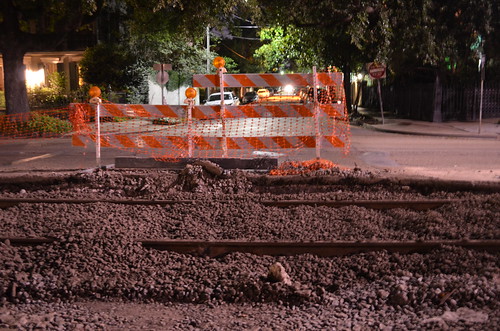
Third Street barricade

If you're Uptown, it might be a good time to make sure your bike is in good shape. Although people keep trying to make that more complicated than it needs to be as well

Saturday, February 28, 2015

The problem

Everyone is worried about what "looks cool" as opposed to what works for people.
Vision Zero, a policy pitched by non-profit transportation advocacy groups Bike Easy and RIDE New Orleans, aims to educate the public and improve public infrastructure with a goal of eliminate traffic-related death. Vision Zero started in Sweden and has been adopted by American cities like New York, San Francisco and Houston.

Brossett said creating a safe infrastructure for all kinds of roadway users is important, especially with the population of the city expected to grow, but that government agencies can’t do it alone. “One life is too much to lose,” said Brossett. “…Whatever your mode of transportation is, it should be respected and the law should be abided by.”

At-large Councilman Jason Williams called the ordinance “a huge part in making our city what we want it to be.” Williams said New Orleans takes pride in how “cool” it is, but such committees are the basis of improving the city to making it “look the way we want it to look.”
Well, it should be noted also that Brossett is interested in making people "abide by the law" which roughly translates into, "Let's figure out more ways to fine bicyclists." This is different from just doing stuff that makes biking safer like paving streets and redesigning intersections and.. even.. sometimes.. if you're doing it correctly, bike lanes. 

But we don't do bike lanes correctly in New Orleans. We just paint stripes on roads where we think it might look cool to have them.

Wednesday, February 04, 2015

Bike Wars update


Episode 1: Despite the objections of its own traffic engineer, the city of New Orleans installed a bike lane on Baronne Street.  This was allowed in order to make the nice things for rich people they're building on top of some CBD parking lots seem like a hipper neighborhood for the rich people who will use the nice things.

Episode 2: Despite the presence of a bike lane on Basin Street, valets at the Saenger theater have been parking cars there anyway.  I hope the city puts a stop to that.  But since, in this case, keeping the bike lane clear might actually impede the rich people from enjoying a nice thing, I wouldn't hold my breath.

In any case, here's the quote of the day.
There's more to becoming a bicycle-friendly city than striping in bike lanes, Duckworth said. "City Hall has an obligation to protect these essential taxpayer investments by fining scofflaws who obstruct bike lanes. Otherwise we will see more unnecessary cyclist deaths," Duckworth said.
I don't know enforcement is really what's at issue.. at least not in the sense that THE CITY NEEDS TO FINE MORE PEOPLE, as that quote suggests.  But rather, the problem is the city is for whatever keeps the important people happy. 

In any case it's very true that the city has decided being "bike-friendly" is something you measure in miles of bike lane.. regardless of whether or not the lanes are making things better or worse. 

Saturday, November 01, 2014

Bike lock

Don't think I've ever seen a restraining order against a bike lane before.
The plaintiffs' request claims that Landrieu does not have the right to reconfigure roads without the consent of the City Council.

The request cited emails from numerous city officials who expressed enthusiasm for the bike lane before carrying out a public involvement process. In a June email quoted in the court document, Chief Administrative Officer Andy Kopplin said that installing a bike lane was a "generationally significant decision to make in terms of our infrastructure/planning and is consequential in terms of the vision we have for our city and our effort to continue to improve our rankings in the eyes of national bicycling organizations."
LOL way to go all in against Big Bicycle, I guess. There's more in there about the supposedly corrupt dealings of "bicycle partisans," and such.

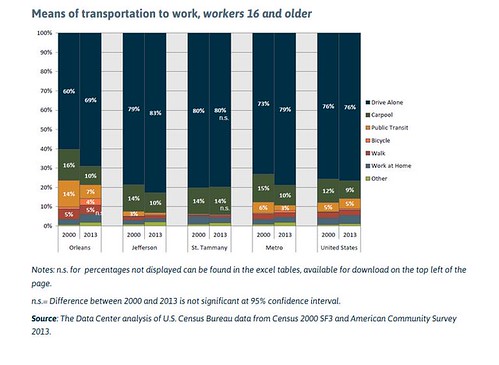
This is all very strange to me.  I'm a "bicycle partisan" of sorts. That is to say, I'm among the 4% of New Orleanians who regularly commute via bike.

bike stat
Source: The Data Center

But I also know a counter-productive gimmick when I see one. And this particular bike lane is a counter-productive gimmick designed to help sell condos at the new South Market District development.   But nobody wants to talk about that because they're involved in some oddly polarized culture war over what is essentially just a tool some people use sometimes.

Tuesday, October 28, 2014

Bike stop and frisk campaign

NOPD issued a press release today emphasizing some of the city's bicycle ordinances.  These are all regulations that have been on the books for years but one assumes this  presages an enforcement crackdown.  A lot of these are tedious and unnecessary but here is the critical one.
Sec. 154-1403. - Registration required.
No person who resides in the city shall ride or propel a bicycle upon any street unless such bicycle has been registered and a registration plate is attached thereto. This section shall be applicable to new residents of the parish at the expiration of 90 days.
No one registers their bicycle.  There are other rules on this list that few people follow but the registration bit is the one no one is even likely to know how to comply with.  It's actually kind of a mysterious process and was almost made even worse in 2010.
Bicycle registration typically is $3, but for bikes without a receipt, the city requires a notarized affidavit, and total registration can cost up to $35. At the event, Bike Easy will pay the notary, and the Fraternal Order of Police will pay the licensing fee. To register, bring your bike and a photo ID. Bike Easy also will offer free bicycle safety training from 11 a.m. to 1 p.m.

In 2010, New Orleans City Council was set to consider a sweeping bike registration ordinance but it was pulled from the agenda. It would've updated the existing law — adopted in 1987 and requiring each bike pay a $3 registration fee — to enforce a $15 fee.
 
That's from an article about a "free registration" event that took place last year.  I'm actually having trouble figuring out what the normal procedure for registering a bicycle even is.  What this is telling everyone is that the police have cause to stop you pretty much just for being on your bike.  That, and that they would like to ticket you for more things. The fine for riding an unregistered bike is apparently $100.

So anyway, be careful out there.  Maybe it's safest just to stay indoors under a blanket.  (Blanket registration $50)

Wednesday, October 22, 2014

When is a transit strategy not a transit strategy?

When it's actually a development strategy.
This doesn’t look good.  It would certainly appear that the city decided to add the Baronne bike lane and then marshaled the data to support a plan that they had already decided to move forward with.  The question then becomes exactly why the Landrieu Administration is so adamant that Baronne receive a bike lane.

The answer is redevelopment.  There are a number of new residential projects in the CBD.  Chief among them is the $200 million South Market District project, squeezed between Loyola Avenue and Baronne, which is presently nearing completion.  The city already built the farcically ineffectual Loyola Streetcar line on one side of the project, and now they seek to top it off with a dubious bike lane one block over on the other side.

The proximity to the South Market District and similar redevelopment is not coincidental.  Indeed, Public Works and the GCR specifically highlighted them as justifications for the Baronne bike lane.   It wasn’t sufficient that developers have received local tax breaks and massive federal loans.  No, that’s just not enough – the city also has to invest in useless infrastructure and give through traffic the short shrift with an ill-conceived bike lane.  The powers-that-be are so obsessed with bolstering downtown redevelopment schemes that all other considerations have become secondary.
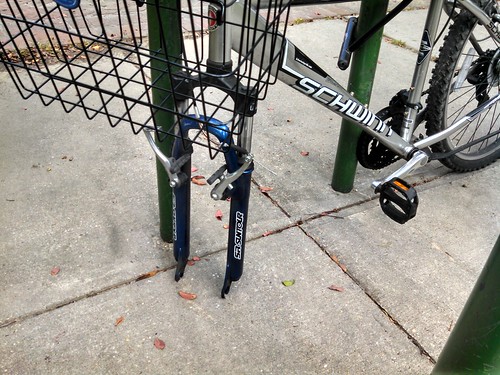
I get weary of going through this with people.  A certain segment seems stuck on the idea that anyone who criticizes the city's luxury development at all costs approach is somehow against bicycling. But I bike to work whenever I can (meaning when it isn't raining or I'm not carrying something heavy.)   So most days I'm on the bike. I'd dare say it's been my preferred way of getting around New Orleans since long before most of our present day bike lane advocates even dreamed they'd ever move here. Just last weekend I had a tire stolen because I was too stupid and lazy to lock it up properly.

Sad bike

But this doesn't have anything to do with the merits of bicycling.  Instead it has to do with the city treating its infrastructure planning as a means, not to serve its residents so much as to create accessories for developers investing in adjacent real estate.   Sometimes they even admit this is what they're doing
Pres Kabacoff, a real estate developer from the Bywater neighborhood, said he thinks the streetcar will help spur business. Kabacoff even argued that slowing down vehicle traffic might be a good thing, since having cars whip by "is not conducive for good retail development."

He added, "To the extent that people have a difficult time in traffic getting down the street it may cause them to want to live in the area and use an effective streetcar." 
If we admit that we're putting in streetcars primarily because they help us sell expensive downtown apartments to rich people, it's certainly no stretch to say we're putting in a bike lane for precisely this same purpose.

But, no, of course the only reason anyone would point this out is because they must hate bicycles. 

Friday, October 17, 2014

We should name it Thomas Friedman Lane

"The next six months will be crucial"  for this bike lane.
Baronne Street in the Central Business District will have a bike lane starting Dec. 1. The lane will remain for at least six months as officials study its impact along the corridor.
Because after we re-stripe the road and leave it like that for half a year... I'm sure going back and undoing all that will be no big deal.. you know, if we want. 

Also, not sure why McClendon gets away with putting an outright lie into his story.
City traffic engineers have said that the impact on vehicle traffic should be minimal, though that is hotly disputed by some businesses who say it will be a disaster.
Nope! Utter bullshit.
One day before Mayor Mitch Landrieu’s administration presented a plan to reduce vehicular traffic along Baronne Street to one lane and to add a dedicated bike lane, the city’s chief traffic engineer said he didn’t think it was a good idea.

Allen Yrle, in at least two emails to his boss, Public Works Department Director Mark Jernigan, said he disagreed with a city-commissioned study that concluded the loss of a lane wouldn’t have a significant negative impact on traffic. Yrle recommended that the city keep two lanes of vehicular traffic on Baronne, a one-way street, and install a shared bike lane instead.

“The analyses done show unacceptable levels of service at the Poydras/Baronne and Howard/Baronne intersections with the proposed lane reduction,” Yrle wrote in an email dated Sept. 16.

Monday, October 13, 2014

Thou shalt not speak ill of the bike lane

Not every bike lane is a good idea.  It should not be blasphemy to point this out.
One day before Mayor Mitch Landrieu’s administration presented a plan to reduce vehicular traffic along Baronne Street to one lane and to add a dedicated bike lane, the city’s chief traffic engineer said he didn’t think it was a good idea.

Allen Yrle, in at least two emails to his boss, Public Works Department Director Mark Jernigan, said he disagreed with a city-commissioned study that concluded the loss of a lane wouldn’t have a significant negative impact on traffic. Yrle recommended that the city keep two lanes of vehicular traffic on Baronne, a one-way street, and install a shared bike lane instead.

“The analyses done show unacceptable levels of service at the Poydras/Baronne and Howard/Baronne intersections with the proposed lane reduction,” Yrle wrote in an email dated Sept. 16.

Yrle did not speak at a community meeting at the Contemporary Arts Center where the plan was presented the next day, nor were his concerns directly expressed in a presentation delivered by the administration.
The street feeds a major expressway from the CBD.  Maybe you don't like the idea that people need to get on the expressway. But making them wait longer to do that isn't going to solve the problem. 

On the other hand, if you're more interested in adding "amenities" that accentuate the desirability of downtown living at a time when you're about to finish a new luxury condo development around the corner, then you might want to just paint the bike lane in regardless of the traffic realities.

Also.. once the civil service reform goes through, the mayor would be able to fire the traffic engineers who happen to disagree with a policy of infrastructure for PR and real estate's sake.   So that's nice too.

Wednesday, October 01, 2014

All this means is they're going to start writing more tickets to bicyclists

"Visions" "strategies" blah blah blah.  Ok well, not blah blah blah exactly because it means that consultants are getting paid by the city and by non-profits.

But the end result is, law enforcement will start harassing bicyclists more. So they can get paid too.