-->
Showing posts with label property taxes. Show all posts

Wednesday, January 06, 2021

They're up to something

Not clear exactly what yet but if you were listening to the press conference on Monday, there were some interesting quotes. 

Cantrell said the move ending the furloughs was the “first step on the city’s road to recovery.” She also indicated that it was also the first step in a larger plan to restructure the city’s workforce.

“We are making this move as a part of a much broader effort to restructure how we use our public servants, our public employees, in the city of New Orleans,” she said. “Everyone needs to have that shared sacrifice and do what it takes to move this city forward. … In the weeks ahead, we will come before you with specifics as it relates to emergency response, business response, community response and organizational changes as it relates to the City of New Orleans.”

They have some idea of how they want to "restructure" and it appears they may be using the emergency response and selective decisions about furloughs to get that implemented.  Kind of an ad-hoc budgeting process depending on how "optimistic" they get from month to month. 

Cantrell said the city was ending some furloughs with additional funds the city is projecting in a more optimistic outlook. If those funds don’t materialize, however, the move could cause layoffs later in the year, she said. 

The additional funds optimistically projected there refer to a possible new round of federal stimulus (which, yes, is exactly what we need but don't hold your breath) also stepped up sales tax collection if we get enough people vaccinated in time for that to help, and property tax collection which... it turns out... is now delayed by... wait for it... to much "optimism."

Waiting on your property tax bill in New Orleans? So is the rest of the city. Blame paperwork problems and overly optimistic city officials for holding up the annual notices telling property owners how much they need to pay.

Tax bills typically go out during the last weeks of December. But because of problems that prevented the certification of the tax rolls, the earliest they could now be sent is this week. None of the issues will change the taxes owed by residents. But City Hall said it will adjust the deadline for payments once the bills are sent out.

According to this, at least part of the problem comes from the way the bills were itemized. Apparently they were prepared in the expectation that the December millage reconfiguration would pass. It did not and so now things need to be revised. Of course the overall revenue doesn't change. So one would think there isn't much optimism/pessimism that comes into play.  Unless you were optimistically hoping to restructure your "emergency response, business response, community response and organizational changes as it relates to the City of New Orleans," and now you have to find an alternative means of accomplishing that.... perhaps through emergency measures. 

But we'll just have to wait and see as far as that goes.  There is one other matter in the story about the tax bills, though, and I'm not sure I understand it exactly.  

One potentially more substantive issue also is holding up the process: a disagreement between the assessor’s office and the Tax Commission about the value of “public service” property in the city, a category that largely encompasses property owned by utilities.

Under state law, those property values are set by the Tax Commission and passed along to local assessors, commission Chairman Lawrence Chehardy said. But in the final version of the tax rolls, the assessed value that the commission put on the total value of those properties is about $65,300 higher than what the assessor’s office estimated, Chehardy said. A meeting is set Wednesday to discuss the discrepancy and try to correct the problem, he said.

One way to read that is the city proposed to charge "public service" property... perhaps belonging to Entergy or maybe Cox or some such... less money than the state Tax Commission expected they should. I don't know if I'm reading that correctly but if I am then, given the assessor's recent tendency to give out tax breaks to large corporations, it's something to watch.

Thursday, December 10, 2020

These two items are not related

The way this story presents the information, a casual reader might conclude that Caesar's "pledged" to uphold its obligations under its licensing agreement because Erroll Williams gave them a tax break. Rest assured this is not the case. 

Part of Caesars' pledge on the license extension deal was that it would continue to employ at least 2,400 people and add 500 staff after the hotel was built. It also committed to pay for various state and city infrastructure projects, including $19.5 million over three years to New Orleans.

Earlier this year, Caesars got a big break on one of its biggest city bills. The casino operator was one of the prime beneficiaries of a decision by the Orleans Parish Assessor to cut property valuations for 2021 — and thus cut property taxes — for businesses in the area because of the unprecedented effects of the coronavirus pandemic. Hotels saw the highest valuation cuts, at about 58%, which translates into an annual savings for Caesars of an estimated $1.5 million to $2 million.

The license agreement has nothing to do with the property tax assessment. The license agreement was negotiated with the legislature in the spring of 2019. The tax break is part of a larger corporate giveaway cooked up by the Assessor's office this year. Just after homeowners saw their assessments go up dramatically and as housing costs remain high while workers are being laid off left and right during a pandemic, Erroll Williams and Michael Sherman arranged to hand over $42 million to commercial landlords with deep corporate pockets.  I know the placement of the two paragraphs above in today's story might make it look like this has something to do with Harrah's/Caesar's lease. But it does not.  

Meanwhile, Did You Know.. next Friday your beloved City Council and School Board are scheduled to approve a series of back-tax exemptions that would cede another $25 million to Folgers. Last month when the state Commerce board gave its preliminary approval to the exemptions, a certain parish assessor took their side

At Friday’s meeting, Folger consultant Jimmy Leonard said the company requested the delay simply because it wanted the board to consider the application along with the company’s other newer applications at the same time. Leonard also presented a letter to the board from Orleans Parish Tax Assessor Erroll Williams describing Folger as a good taxpayer that has been transparent with him throughout the process

Together Louisiana members were armed with a letter of their own — from New Orleans Councilwoman Helena Moreno — that painted a different picture.

“A recent investigation by journalist Lee Zurik on WVUE-TV brought this matter to the public’s attention in August, due to the alarming length of time of not paying millions of dollars of taxes and now seeking a loophole to get a pass,” Moreno wrote in the Oct. 26 letter. “The total owed could be as high as $12 million…We cannot afford for a large corporation to not pay its fair share when our residents and small business owners are being asked to sacrifice so much.”

The board, nevertheless, approved Folger’s application because it was up to the tax assessor to place the property on the tax rolls, which he never did, Board Chairman Jerald Jones said.

Together New Orleans has scheduled a rally and press event at City Hall to discuss the Folger's situation. Although, at the moment that page says the event is Friday in the headline and Monday in the text. So maybe check back when they have it sorted out.

Saturday, October 24, 2020

Just stripping it for parts now

We're almost past the point of abandoning pretense.  At the same time that New Orleans administrators find themselves begging for help before a hostile audience in Baton Rouge, threatening city workers with furloughs and layoffs, and drastically cutting back on public services, it has been determined that now is also an excellent moment to give away millions of dollars to corporate entities who definitely do not need them.

Some of the biggest cuts will be for the largest downtown hotels, including the Marriott on Canal Street, the Hilton Riverside, and the Sheraton, as well as Harrah's Casino New Orleans and its adjacent properties.

Each could see their tax bills drop by between $1.5 and $2.5 million, based on current millage rates and estimates from data provided by the assessor.

The assessor says this is about helping "small businesses" and the local hospitality industry. But look at where the bulk of this goes. 

According to data compiled by the Downtown Development District, almost a third of the total cut in commercial sector valuations — or about $90 million — is accounted for by 10 downtown properties, including the cluster of properties at the river end of Canal Street owned by Harrah's New Orleans Casino, a division of Caesars Entertainment of Las Vegas. Harrah's valuations were more than halved to about $15.3 million, which will reduce its property tax bill by an estimated $2.4 million, according to the assessor's office.

Similarly, the Marriott Hotel on Canal, the Sheraton, the Intercontinental, the Crowne Plaza, the Roosevelt and the Ritz-Carlton will see their property taxes halved.

All are owned by national hotel management groups, suggesting that any tax savings will head to corporate coffers outside of the city.

In order to pay for this roughly $42 million tax cut gift to mega-landlords and out of town corporate interests, we will ask  residents - that is homeowners and renters combined since residential tax increases are always passed on to renters - to  pay about $30 million a year more, collectively.

Overall it means at least a $12 million drop in annual revenue to the city and public services that depend on property taxes.  And, of course, the poorer you are, the more likely it is you rely on such services or cannot easily pay to make up the difference if they are diminished.  

How does this happen? Who would push a disaster capitalism scheme like this on an already hard-hit city?  The same people who have been robbing that city blind since Katrina, of course. They are the pros at this, after all. 

Michael Sherman, a lawyer who was land-use adviser to Mayor Mitch Landrieu and whose current clients include 30 hotel owners, was among the industry representatives who consulted with Williams on the tax changes. Sherman pointed out that Williams had the authority to make the big cuts for commercial property owners because of a revision to a flood-damage law that came into effect after Hurricane Katrina. It required assessors to consider tax cuts after various types of disasters.

Who won the pandemic? The bosses won the pandemic. The landlords won the pandemic.  The same grifters who step in after every disaster to strip the broken pieces of the social contract for parts won the pandemic. But you can't say we didn't know it would be like this.  We've gotten pretty well used to it by now.

Friday, November 22, 2019

Dire consequences

A couple months ago, New Orleans Chief Administrative Officer Gilbert Montaño told a City Council budget committee there would be "dire consequences" if the council did not agree to "roll forward" its property tax millages this year.
Perhaps the biggest criticism was around what Montaño said the consequences would be if they failed to roll forward. One potential budget cut, according to the presentation, would be laying off 500-plus city employees. Another was a 10 percent budget cut for all city departments. The options also included pay cuts across the city and cutting personnel in the police department, fire department and EMS.
After it became clear that councilmembers were unconvinced by what Helena Moreno correctly identified as a "scare tactic,"  the mayor's office lowered its demand by 50 percent. "I don't make idle threats," Cantrell warned.
Her administration has warned of things such as slower response times from police and fire, cuts to recycling, closing down rec centers or libraries -- or even longer waits to fill potholes if they can't get the extra money.

“I don’t make idle threats,” Cantrell said. “I’m telling you if we don’t see a modest roll forward -- $6.9 million? Come on. Yes, we will have to look at how we can make cuts.”
The possibility of a half-roll was still on the table come November when the mayor took a new scare tactic to the public as she argued for a 3 mill tax increase which was on the local ballot during the state election runoffs this past Saturday.

Voters were unmoved by the idle threats, however, and the property tax ballot measure failed by almost 9,000 votes. It's particularly telling that it did, too. Because all of the rest of Cantrell's "Ballot of Yes" items she campaigned for passed and all of the legislative candidates she endorsed won their races as well, this result didn't mean voters were rejecting her, specifically. It just meant they didn't buy her pitch on this particular issue.

Maybe they read the DSA voter guide.  There they would have found one of the more cogent arguments against the new tax. Maybe it's authors won't mind if we share a couple paragraphs of that here.
The new taxes would have serious impacts on the city’s cost-burdened renters and homeowners. Typically landlords pass on all or most of the cost of such increases to tenants. According to HousingNOLA, 41 percent of New Orleans homeowners are cost burdened and one third of all owner-occupied homes earn below the median income. Meanwhile, our property tax system remains riddled with exemptions handed out to developers, manufacturers, and non-profits that need to be revisited or eliminated.

The mayor claims there is no other way to raise the $10.2 million the new tax is estimated to bring in but her 2020 budget proposal includes $4.7 million in highly questionable appropriations to police and surveillance and has left the door open to funding Sheriff Gusman’s proposed jail expansion. We recognize the city’s fiscal situation is tenuous. But we also question why proposed remedies favor the privileges of wealth and bolster the police-surveillance state while heaping even more excessive burdens on poor people. We can do better.
That part about landlords passing property tax hikes on to renters, by the way, is definitely not an idle threat. My rent just went up 50 bucks this month based on the recent reassessments alone. I expect it may have been more had the millage gone up too.

Anyway nobody has to worry about that now because the final budget approved by the City Council this week is based on a deal among the council and various taxing authorities that amounts to a net cut in the overall city controlled property tax rate.
Mayor LaToya Cantrell and the City Council, which has the final say on the lion’s share of taxes in the parish, are close to finalizing an agreement that would cut the city's overall tax rate by about 5%, juggling about a dozen individual millages to come up with a deal that would, in effect, give up any revenue the city stood to gain from this year’s reassessment.
This is actually even more complicated than it already looks. So, apologies to everyone whose eyes are already glazed over. To begin with,thanks to the assessments, a lot of people's taxes are going to go up regardless of what the rate is. 
Exactly what that means for a property’s tax bill depends on the details of the city’s deal and where the property is located, since some taxing bodies cover only portions of the city.

And how well a taxpayer makes out also depends on what happened during this year’s reassessment.

Owners whose property values stayed the same will pay less. Those who saw only a slight increase will pay around the same amount as they did in 2019. But the tens of thousands of homeowners who saw substantial jumps in their property values will face significantly higher tax bills.
There's also the matter of the school board which is one of the independent authorities who voted to roll its millage forward thus capturing the reassessment windfall. Not only will this contribute to an overall tax hike for many residents, it also constitutes a shift in costs formerly assumed by the state onto local taxpayers.
The School Board on Tuesday voted unanimously to roll its tax rate forward all the way to its current level, in part because the higher assessments will trigger a $9.1 million automatic cut in state funding for the city's schools.

The roll forward will fill the gap left by that cut and provide an additional $15.1 million for New Orleans schools on top of that.
But leaving that aside, the crux of the deal that's been struck, is the library and the Audubon Commission have agreed to reductions this year in order that S&WB, the Fire Department, and NOPD can "roll forward" to pull in new revenue. That's not an ideal solution. But it's also not a disaster.  The actual numbers aren't available but this article strongly suggests that departments taking cuts can cover their expenses with reserve funds or other revenues.

For now, this will have to do. Streets and drainage improvements need funding. We'd prefer the city find the money it needs by reducing the amount we spend on police, not boosting it. Ideally, cities like New Orleans with critical infrastructure needs would have access to billions of dollars in Federal aid as part of a Green New Deal program.  But that's all in the future. Or at least we hope it is. Otherwise, the consequences could be dire, indeed.

Wednesday, October 30, 2019

What always happens

In today's nothing-ever-gets-better story, we begin with a lawsuit filed by New Orleans short term rental operators which contends that, even though the city's latest set of regulations gives them almost everything they could want, that still is not enough. These landlords have the resources to keep pushing back until they get their way.  They'll get it eventually.
The suit argues that by preventing owners who formerly held temporary licenses from continuing to operate short-term rentals, the city is violating their rights.

“We were granted a license and had a fair and reasonable expectation that we were going to be able to renew our licenses, as long as we followed the rules,” said Eric Bay, president of the Alliance for Neighborhood Prosperity.

The city did not respond to a request for comment on the suit.

When the council changes the rules on what a property can be used for, existing businesses are typically allowed to stay in operation as “non-conforming uses” as long as they do not close for more than six months.

In discussions leading up to the passage of the new rules, however, city officials said that policy would not apply to temporary rentals since they did not count as full-time uses, a requirement to be granted nonconforming status.
Not being a law talking guy, I can't say what ANP's chances are of winning in court. It sounds to me like a bad argument but you never know, with the right judge...
The case was originally assigned to Civil District Judge Robin Giarrusso, who recused herself because her son is Councilman Joe Giarrusso. It was reassigned to Judge Nakisha Ervin-Knott.
In any case, all they really have to do is keep making the argument over and over.  Their organization has enough money and influence that eventually the right councilperson will take them seriously and they win. Because that's what always happens.

In a way, the damage has already been done. Several years of STR proliferation has supercharged the already out of control speculative real estate market in New Orleans exacerbating the housing crisis. This is reflected in the sticker shock experienced by homeowners all over the city after this year's quadrennial property reassessments. HousingNOLA's Andreanecia Morris writes in this Lens op-ed about the impact of those assessments on renters, who will have the cost of tax increases passed on to them, as well as the city's most vulnerable homeowners.
One of the challenges in dealing with the affordable housing crisis is the fact that some people don’t understand that it affects everyone. The biases many people have lets them (namely middle-class homeowners) believe that they are immune. Those who own their homes are not exempt from the impacts of our city’s affordable housing crisis. HousingNOLA’s data driven process has addressed tax issues from year one. Gentrification of historic neighborhoods and increased market pressure across the city have driven increased property values every year since Hurricane Katrina. Only seven out of 72 neighborhoods include census tracts which did not see an increase in housing values between 2013 and 2017. The median home value in New Orleans has increased by twenty-five percent since 2014, according to MLS data. There is ample data to demonstrate how vulnerable Orleans Parish homeowners are to any significant changes in their tax rates:
  • Forty-one percent of homeowners are cost burdened—with nearly a third of owner-occupied households earning an annual income that is below the median income;
  • Forty-four percent of owners have paid off their mortgage or inherited their home;
  • A third of homeowners are over the age of sixty-five. Eleven percent of all homeowners in Orleans are cost burdened senior citizens.
Unfortunately, the mayor doesn't seem to have much sympathy for housing stressed residents She's also asking voters to approve a whole new 3 mils on this fall's ballot. On top of that, she appeared at a city council budget hearing this week to urge the council to "roll forward" its millage in order to capture the maximum revenue windfall from the higher assessments. She has been talked down to asking for a 50 percent roll forward in recent weeks despite having predicted "dire consequences" for not taking the full amount.  Councilmembers were not very receptive.
Council members have argued that while the city needs more funding, residents are being squeezed out of the city by higher costs of living. They argue that higher property taxes would not only be a risk to lower income homeowners, it would also be a burden to renters because  landlords are likely to pass those costs on to their tenants.

“The message we’re receiving is the city is increasingly unaffordable to live in,” Palmer said.

She again stressed that there could be other sources of revenue the city is leaving on the table. She brought up the amount of money the city could be losing because of homestead-exemption fraud and suggested hiring more sales tax collectors to make sure the city was getting everything it was owed.

In recent months, the council has also discussed cracking down on exemptions for nonprofits and manufacturers that get state tax exemptions. The council also recently created a task force to look into the possibility of creating a parcel fee for property owners.
Yeah, hey, speaking of nonprofit exemptions, here is a pretty big one in the news this week.
There have been multiple efforts to redevelop Charity since the state opted to close it in favor of building the new University Medical Center on the other side of Interstate 10.

The most recent attempt has been underway for more than 2½ years and has largely been led by the Real Estate and Facilities Foundation. That process resulted in officials last year picking 1532 Tulane Partners, a joint venture between the New Orleans-based CCNO and the Israeli company El Ad, to undertake the huge project.

The company said it has been doing due diligence on the property and refining its plans since then.

The redevelopment is expected to cost about $300 million, which will be partially funded with a variety of tax credits. Because LSU will retain ownership of the property, it will be exempt from property taxes.

The lease calls for 1532 Tulane Partners to pay LSU $11.85 million up front and yearly payments for the duration of the 99-year lease. The payments will start at $250,000 a year and increase by 10% every 10 years, eventually totaling about $39 million.

The money from the lease will be divided between the Real Estate and Facilities Foundation and the university itself.
So 1532 Tulane Partners pays LSU to lease the building, takes advantage of various public subsidies and tax credits to renovate it, and none of the money ever gets back to the city. We must be getting something nice in return for that, right?  What are they putting there anyway?
The former hospital building will include about 390 residential units plus retail shops and restaurants.

Tulane University will serve as the anchor tenant in the complex, renting a significant amount of space in the building for student housing and offices, Maurin said.

Plans for the project also include renting about 150 residential units to Sonder, a short-term rental company that already has significant operations in New Orleans. That would be about 50% more units than would be allowed for the property under short-term rental rules the City Council passed earlier this year, which bar renting more than 25% of the units in commercial buildings to tourists.

While the development plans do not need any city approvals because it is state property, the project will have to comply with the city's short-term rental rules, Maurin said. 
That's confusing. How is it they are already breaking the rules they say will have to comply with?  It doesn't say here. Maybe they're planning to be pre-grandfathered in.  Whatever it is, I'm sure they'll get whatever they want while the costs of maintaining the city government continue to fall on those who can least afford to pay. Because that's what always happens.

Thursday, October 03, 2019

The Erroll Exemption

Williams says we don't assess businesses for the cost of labor and equipment installation when calculating their tax liability. Unless we do.

Monday, September 23, 2019

Faithless assessors

Erroll Williams says his office has a great deal of discrepancy to determine whether or not large industrial concerns like Folgers need to pay their "fair share" (to use the current term of art.)  City Council is trying to nudge him a bit on this and he's nudging back.
The resolution was announced last week, the day after The Lens published a report about potential defects in Orleans Parish Assessor Erroll Williams’ process for tracking the exemptions. There are at least two properties — owned by Folgers and worth a combined $40 million — that were exempted by the assessor in 2018 and 2019, even though the exemptions expired in 2017. A request to renew the exemptions was denied by the state last year and again in February, but Williams did not take action to confirm that the exemptions were invalid until August, after more than a month of questions from Councilwoman Helena Moreno.

The resolution also calls for Williams to formally develop and adopt a written policy to monitor the industrial tax exemptions. And it asks for an annual report from the assessor on “all tax incentive policies, procedures, projects, and exemption status.”

Moreno said that the council can’t force Williams to comply because his office is a state-created agency and he is an independent elected official.

“This resolution merely urges the assessor to comply,” Moreno said at the meeting. “He is not part of a city agency therefore we can’t force him to do this, but were hoping just out of respect for the public he’ll comply.”

While Williams said he may honor some of the requests, he said he would not comply with the request for a written policy for tracking the tax exemptions.

“They’re not going to get that,” he said. “That’s none of their business. That’s an internal policy.”
Meanwhile, Williams is telling us via a message posted at his website, that questions of whether or not property taxes that affect individual homeowners and renters are completely out of his hands. Williams writes,
The only way your property taxes will increase is if any of the taxing authorities which levy property taxes (millages) raise their tax rates before the end of this calendar year. The taxing authorities CANNOT raise your property taxes unless they hold a public hearing and pass an increase with a 2/3 majority vote. Some of these taxing authorities have already scheduled public meetings to consider this increase but have not specified how they will use these additional funds.

Be aware: ALL these agencies must by law advertise the dates, times and places of meetings to consider a proposed property tax increase (or millage roll forward).
This statement is not exactly true. It is true that the various taxing authorities are required to automatically roll back their millage rate such that they remain revenue neutral or roll the rate forward by a public vote to capture the windfall created this year when Williams's office drastically increased property assessments all over town. However, even if a board decides not to roll forward, this doesn't necessarily mean each individual property's tax bill remains the same. You may find yourself paying more in taxes solely because your assessment increased as long as the overall revenue collected is static.

In other words, while the roll forwards will certainly make the problem worse, taxes are going up regardless because Erroll Williams has observed the overheated, speculative real estate currently driving New Orleanians out of their homes and written it into the tax rolls. He says that he doesn't have any choice but that isn't what he says about his prerogative to protect tax exemptions illegally extended to mega-corporations. It seems the question of what the assessor does or does not have the power to do depends mostly on who benefits from his actions. If this is the case, maybe we need an assessor who makes different choices about whom to serve.

Several years ago, a group of middle class reformers launched an agit-prop campaign to consolidate New Orleans's seven assessors offices into one.  The idea was to run a slate of candidates on something called an "I.Q." ticket.  The I.Q. stood for "I Quit" which was precisely what each of the candidates proposed to do should they capture the offices the group deemed unnecessary.  It didn't quite work out that way but the goal of consolidating the assessors offices was eventually implemented.

Imagine if a candidate ran for assessor now promising not to jack up property assessments so long as that action only accelerates the already out of control process of gentrification and displacement. Call it the Faithless Assessor campaign. Could that get any traction, you think?  Anyway, if anybody wants to give this a try my fee is one million dollars.

Wednesday, August 28, 2019

Fool me once, shame on me Fool me six times in two years....

Well then I guess it might be time to rethink things.
NEW ORLEANS — Citywide flooding events like what happened Monday afternoon are "extreme" and require a "thorough investigation," a Sewerage & Water Board spokesperson said.

As much as 5 inches of rain fell across the metro New Orleans area between about 1:30 p.m. and 4:10 p.m. Monday, creating widespread flooding that affected many parts of New Orleans as cars stalled, gridlock formed, businesses flooded and residents dealt with all-too-familiar frustration.

It's at least the sixth time during the past two years that heavy rains inundated different parts of the city following a seemingly routine summer thunderstorm.

S&WB communications director Richard Rainey said the results of Monday's flooding were "extreme," and that the flood events they've witnessed since the notable Aug. 5, 2017, flood are a phenomenon that need to be investigated. 

Was Monday "extreme"?  What does that even mean anymore?  It wasn't quite as bad as the flood we had last month.  But it wasn't nothing. I happened to be headed uptown on St. Charles when it hit. When I saw that Washington was going to be impassable for a while, I pulled over and parked on the sidewalk.  Like a lot of people, I wasn't going anywhere for a while.  Some of these larger vehicles were a little more confident.

Trucks in the flood

Bus boat

I did get out and walk around a bit. The worst of the rain had already cleared up when I took these photos.  It was brief but it dropped enough water to do this.

Belfort Mansion in the flood

It also shut down the streetcar which left packs of bewildered tourists to trudge their way up the neutral ground on foot.. provided they stuck to the high ground.  Also it wasn't long until the canoe people started to show up.  Why are there always canoe people when this happens?

Canoe

I mean I took that picture from the neutral ground just 20 feet away.  My feet weren't even wet.  You didn't need a canoe to get where you were going.  This was strictly a recreational activity.  There was more than one canoe guy too. There's always more than one.  Here you can see a canoe passing in front of the New Orleans and Company offices. Embossed lettering on their building proudly proclaims it the "Headquarters of New Orleans Tourism."

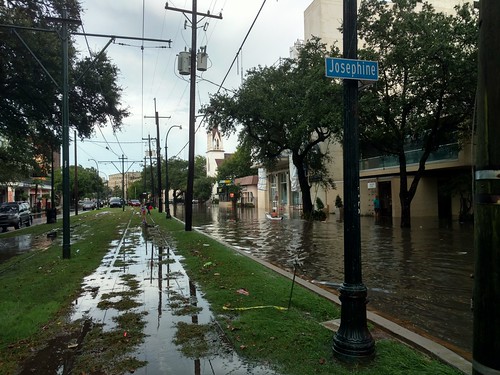
St. Charles at Josephine

Speaking of which, just across the street in front of the Avenue Plaza, I overheard someone saying, "Back in Atlanta we don't have this shit." That's right.  #OnlyInNOLA, baby.

Avenue Plaza

But, okay, probably just the fact that we're talking about seeing the canoes every time this happens means something is wrong.  How often should this be happening?  Six major street floods in the space of two years is a lot.  And it's not just the frequency of the flooding that is unusual. It's also the locations.  This stretch of St. Charles is relatively high ground. The river side tends to pool up a little bit from time to time but I can't recall seeing the whole street inundated like that until very recently.  Same goes for this stretch of Carondelet which was flooded Monday.

Carondelet and Washington

This one is from the July flood. It's Third and Carondelet. I've lived nearby for almost 20 years and I've never seen it do this.

Third and Carondelet

Something is definitely different. But what?  Here is one theory.
The S&WB is studying the effects of the massive culverts built in recent years under several Uptown avenues as part of the Southeast Louisiana Urban Flood Control Project, known as SELA. A report on the impact SELA has had on drainage in the area could be complete as early as next month, Korban said.
My goodness. Imagine if after all these years, all the money spent, all the neighborhoods and business disrupted by the construction, all the expensive property damage incurred that SELA actually would have ended up making things worse. Delightful!

Anyway, it's not just SELA they're looking at. Korban says they also want to look at the pipes under the CBD
To try to figure out what’s wrong, the S&WB plans to investigate the long length of box canals that run from Julia Street up to Drainage Pump Station 2 on North Broad Street, which is responsible for keeping the area dry. Just blocks away from that station, the S&WB is still working to clean a massive pile of debris, that included at least one car, from the canal that carries water away from the station on its way to the lake.

It's strange that it has taken them so long to admit this, But it turns out that even when the pumps are working at (near) full capacity, they can't pump the water out of the city if it's not even draining down to where they are.  So now we're gonna go down in the culverts.  We learned last week that practically anything could be down there. It's probably not going to be pretty.

But we should point out also that there is more than one reason they're looking at those downtown pipes.  They've actually been planning to go down there for some time; prior to this flood, and before even the much discussed extraction of a Mazda 626 from below Jeff Davis Parkway. In the story about that episode, we read about these negotiations
Similar inspections of pipes in the Central Business District are being pitched to the Downtown Development District to encourage it to agree to a new, $3 million tax that was negotiated as part of the Cantrell administration's infrastructure funding deal this year with the hospitality industry, Green said. 
It's not just.. or perhaps even primarily... concern about downtown drainage issues that is motivating the inspections. It's the pursuit of political leverage with a taxing authority that, really, shouldn't even exist in the first place. That doesn't mean going down to look at the pipes is a bad idea. It's just that we should be aware of why they're looking at those pipes in particular.

And to be clear, it's not just support for the new tax, the mayor is asking from DDD. She also wants them to roll their millage forward to maximize windfall from the recent property assessments.
Mayor LaToya Cantrell’s administration is asking the DDD to increase its millage by $2.5 million and dedicate that money toward drainage and infrastructure issues in the area. The district had planned to roll back its tax rate in 2020 because of higher property assessments; the additional tax would keep the rate about the same for the area.

An effort to actually identify and begin fixing the drainage problems could help convince the district’s board that such a move is needed, Weigle said.
On Monday morning, the very same day the streets flooded,  Together New Orleans presented a report to City Council about the devastating effects the skyrocketing assessments and potential property tax hikes are likely to have on the city's already severely cost-burdened homeowners and renters.  
Together New Orleans estimated that almost 2,000 households will see their taxes go up by more than $1,000 next year. And because of a recent state constitutional amendment that phases in the higher taxes on assessments that increase a property’s value by more than 50%, nearly 5,200 will have a total increase of more than $1,000 in the next four years due to this year's citywide reassessment.

Some neighborhoods will see tax increases that represent more than 4% of the average median income of the residents living there, Together New Orleans said.

“When you add all that together, there’s no way folks can continue to live here even if they make a decent wage,” the Rev. Joe Connelly, a member of the group, told the council.
Councilmembers were apoplectic. But also they seemed to be at a loss for solutions.  At one point, Helena Moreno even wondered out loud if we could just ignore the assessment and decide to collect this year's property taxes assuming the previous values. That's not likely to happen.  But it's also clear that rolling forward isn't going to be a popular option with Councilmembers either.

But City Council isn't the only body who will be making decisions about millage rates. In fact Council actually only controls something like half of them. The others are spread out among several taxing authorities including the Sheriff's office, Audubon, the Convention Center, and, yes, the Downtown Development District where it looks like the mayor, via Sewerage and Water Board has found some leverage.  It almost makes you wonder whether or not LaToya might want to think about shoving a few cars down the storm drain herself just to provide a little extra motivation.

Thursday, August 08, 2019

Municipocalypse 2019: The final STR shitshow

Well it is early August now and the first thing I gotta say is it looks like we may have picked the wrong week to stop taking kratom.  There's so much going on all of a sudden! For those of us accustomed to a long summer's nap this is very jarring. Seriously, how is it football season again already? We haven't even gotten to see the Commissioner's deposition over the NFC Championship debacle and somehow we're already doing the 2019 fake games and everything.

That is to say we will be doing that  Friday if we first survive what could be the most intense City Council meeting of the year on Thursday. Expect a full day shout-a-thon. Public commenters may, in fact, be lining up even as I type this. The reason for that, in a word, is gentrification.
Property values across New Orleans jumped by more than 18% in the last four years, an increase that is expected to result in a sharp rise in property taxes for many residents, according to preliminary estimates from the city's assessor.

The jump is far larger than has been seen in years in New Orleans as the spread of gentrification has caused prices to rise both in the already expensive historic core of the city and in more outlying areas that had remained relatively affordable until recently.
Mayor Cantrell took care this month to make sure nobody blames her for the rise in assessments. For example, during this video session, Cantrell urged us to complain to assessor Erroll Williams's office and not hers.  "It’s not us doing something to you,” she says. But that isn't really true.  In fact, her office is expected to ask City Council to for a millage roll forward in order to maximize revenue windfalls from the new assessments. That is apparently on top of a proposed new tax of 3 mils.
Chief Administration Office Gilbert Montaño has suggested the city would be looking to roll its property tax rates forward, arguing that New Orleans’ budget is about $100 million short of what it should be to meet the city’s needs.

In addition, the mayor’s office and council are currently sparring over a 3-mill tax proposed by the administration. Council members, in part responding to complaints from residents who have already received their notices of higher assessments, have sought restrictions on how that money could be spent, arguing that they could not ask residents to pay even more unless the money was specifically dedicated to infrastructure.

Administration officials argue they need to have flexibility to deal with unforeseen future needs.
Now before we get too far with this, we should probably emphasize that we here at the Yellow Blog are sufficiently orthodox in our socialism to understand the importance of funding essential government services. We also recognize the relatively progressive approach of a property tax as compared to, say, fines and fees generated by hyper-aggressive policing.  But the tax burden in New Orleans still falls disproportionately on poor and working class people and jacking up the millage is not going to repair that discrepancy.  The higher assessments combined with higher tax rates are almost certain to push poorer homeowners to cash out and move likely leading to further concentration of wealth in the city overall. Renters are also likely to suffer as higher taxes are passed on to them by landlords and fewer rental properties are available at affordable prices. This is what the mayor's 3 mil tax is doing to you.

Meanwhile, the mayor isn't exactly doing anything  for you either. LaToya swears assessments are "not her job." But she does consider it her job to push for millions of dollars in tax breaks and "incentives" to hand out to wealthy real estate developers who build more nice things for rich people.  All of which ultimately leads, again, to higher assessments, higher rents, higher taxes. The cycle (vicious or virtuous depending on which side of the wealth divide you find yourself on) keeps driving property values higher until you've got block after block of attractive speculative assets where nobody actually lives.
NEW ORLEANS — Tandra Smith has been living in her Fairgrounds neighborhood home since 2008.

"A lot of my neighbors have been here longer than I have," Smith said. She said she likes the area, mainly for its affordability, but after seeing her recent property assessment skyrocket she fears she won't be able to live here much longer.

She said her assessment last year valued her property and home at $167,000, which she said was reasonable because she purchased her home at $135,000. This year's assessment, which by law has to happen at least once every four years, put her house value at $416,000.

“I wanted to cry,” Smith said. do  
There are several factors pumping gas into this speculative bubble. But the one thing New Orleanians have been most loudly asking their elected representatives to do that could take some of the air out is get a handle on the explosive growth of short term rentals.
Robinson says it's something that's effected everyone on her street.

“So last year I paid one rate, and this year it’s a full 100% higher," she said. "The remaining six neighbors on this block, yes, there are only six of us left, theirs have gone up 300-450% higher.”

Ask her why, and she has one answer

"I believe 45% of the homes here in Treme are AirBnBs or Short Term Houses," she said. “That’s a business, but technically that’s a residence. So now we’re comparing their property taxes to my property taxes.”
City Council is planning to take up the short term rental ordinances this Thursday.  As a courtesy to all of us who enjoy a long and rancorous meeting, they have also wisely punted the property millage question that very same date. Expect a total shitshow of confused rhetoric. No doubt there will be landlords arguing in favor of more STRs in order to compensate for the rising taxes.  Also expect to hear that we need to hold the property taxes down specifically so that we can impose more fees on STRs. But these are false choices. Councilmembers can choose to protect people from rising housing costs without playing the drivers of those costs off against one another.  It's not at all clear that they understand this, unfortunately.

For example, here is Jay Banks saying some troubling things to WWLTV just a couple weeks ago. Talking about STRs, in particular, Banks says they "allow regular people to participate in this tourism economy."  By regular people, we have to assume he means individual landlords holding single properties.  But that is a gross misapprehension of the STR landscape in New Orleans. A report published by Jane Place last year showed that the bulk of the business is controlled by a handful of international corporations.
JPNSI found that 18 percent of all operators control roughly half of all STRs in New Orleans. Gambit’s recent review of licenses issued by the city found the top 10 operators - including Sonder, Hosteeva and Stay Alfred - hold more than 400 licenses, with several operators holding several listings per license; JPNSI says those top 10 operators have 568 listings.
Since then, that situation has almost certainly gotten worse. More to the point, though, there's no way Jay Banks wouldn't have been made aware of the data by now. But here he is pretending otherwise and saying defeatist things like, "we can't put this genie back in the bottle" and  "we've got to come to a happy median somewhere." Uh oh.

Similarly confused, or at least saying similarly confusing things is Mayor Cantrell. It's been difficult to pin her down on the specific ordinances being considered this week. But the comments she has made lead us to suspect she's not especially sympathetic. Just last Tuesday, councilmembers expressed frustration with the mayor's lack of commitment to enforcement. Even under the current overly liberal rules, there are an estimated 5,000 or so STRs operating illegally. But the mayor's staff are reluctant to do anything about that because of a circular argument I'm not even sure they understand.
The mayor’s representatives, however, said they could not bring on new staff until they figure out how stricter rules on Airbnb and HomeAway rentals would affect the amount the city now brings in from taxes on short-term rentals, whether they’re operating legally or not.

“We have to be careful about what we’re greenlighting to see how the market reacts to these issues,” said Gilbert Montaño, Cantrell’s chief administrative officer. He said uncertainty about how much will be brought in once short-term rentals are curtailed makes it “vitally prudent to hold off on hiring $2 million” worth of new staffers.
I think what  Montaño is saying is they are waiting for "the market" to decide what the law actually is. So that's encouraging.

That same day, LaToya was interviewed by Norman Robinson for a WLAE show called "Housing Matters"  primarily to promote the city's having landed $28 million in new grants and tax credits with which to "incentivize" the creation of new housing.  Cantrell doesn't always do a great job of explaining things. She mentions various applications for the grant money; soft second mortgage programs, home repair grants (probably distributed via non-profit partners) and, of course developer incentives. To the extent that money trickling down through those infamously sticky pipes is helpful, it's still mostly about chipping away at the symptoms of the housing crisis without really getting at the causes. Of course, there's only so much $28 million can do.  But for the sake of perspective, it's estimated that at best we're talking about 620-640 added "affordable units."  Currently the Greater New Orleans Housing Alliance estimates we need upwards of 30,000 to adequately address the need.

Norman also asked Cantrell to speak about East New Orleans in particular which led to some more confusing double talk.  The mayor was naturally eager to show that she wants the often neglected East to benefit from the new pile of money. But her choice of phrase, "New Orleans East is somewhere we want to push people towards" with regard to housing is ominous.

Generally speaking, the mayor's philosophy with regard to housing policy is neoliberal in the extreme.She even ducks a question about the demolition of the Big Four housing projects after Katrina choosing instead to fixate on a right wing policy paper about the 2008 financial collapse which she connects to a drying up of the state and federal "incentive" pipeline she prefers to just about any other possible solution.  What's worse, Cantrell is not at all convinced that STRs are a serious problem.  She sort of admits that they "don't help," but continually brings the conversation back to the need to find "balance" with the tourism industry in light of the fact that New Orleans is "a destination city."

So LaToya doesn't want to talk about it. But we should probably take a moment to explain what the City Council will actually be debating at this meeting.  We'll try to keep it simple.

Kristin Palmer has introduced a set of ordinances based on the most recent round of Planning Commission recommendations which would create two basic sets of rules. In residential zones STRs will be restricted only to properties whose owner also claims a homestead exemption there. The intent is to effectively outlaw the so-called "whole home" short term rental on any residentially zoned property.  In commercial or mixed-use zones, the ordinance would limit owners of large apartment buildings to convert only 25 percent of available units to STR while also requiring a 1-1 affordable unit match.

But that was before a consultant's report came back at the end of July and argued against the affordable match and 25 percent cap.  Essentially, their recommendation was for no restrictions on commercial STRs whatsoever. That seemed pretty shocking at first. But after The Lens pointed out the consulting firm, HR&A had some pretty glaring conflicts of interest, it started to make more sense.
The real estate consulting company that wrote the report, HR&A Associates, has worked for Airbnb at least four times since 2012, producing glowing reports about its local economic benefits and job creation bonafides. Most recently in 2017, the company produced “Sharing for a Stronger New York” on behalf of Airbnb.
HR&A responded a few days later but even if we take their argument in good faith, it doesn't add up. The problem begins with the treatment of the commercial and mixed use zoned properties as though it occurs in a wholly separate universe what happens in "residential areas."

HR&A says the scope of their report was to focus on the commercial zones only. But this is really a warping of perspective.  In practice, commercially zoned properties are a necessary component of any residential area. The corner grocery, the neighborhood bar, the hardware store, the gas station, laundromat, etc. these are all part of what makes a neighborhood a neighborhood. Here is the city's land use map.  If you look around at the zoning, you can see commercial properties running through the city along transit corridors or highly trafficked areas, or just occasionally on a corner lot maybe. So allowing unlimited STRs  to proliferate in commercial or "mixed use" zones doesn't protect these neighborhoods at all. It aggressively disrupts them.

We could see every affordable housing unit along a major transit line turned into an STR. This, in turn, will cause businesses along these commercial corridors; Magazine Street, St. Bernard Ave., Oretha Castle Haley, etc., to cater primarily to visitors rather than residents with further negative ramifications for the surrounding areas. Land use policy is supposed to be about managing an interdependent urban system. HR&A is structuring an argument that treats the different zones as if they exist as completely independent municipalities.   It's a deliberate obfuscation to tell us a tale of two cities where in fact there is only one.


The second thing HR&A wants to tell us is that we need to maximize STR proliferation in the commercial zones because that will, through a series of bank shots and hypothetical fees and plans that do not exist yet, generate money for "affordable housing" at some point.
But Phillip Kash, the lead author on the study, said the study’s recommendation to promote affordable housing primarily by imposing fees on such commercial short-term rentals would give the city the most bang for the buck.

“We came at it with the (idea) that the goal was to generate the most subsidized units or the most money for affordable housing,” Kash said this week. “We thought there was consensus on that point; now I hear there is less consensus on that point.”

But what that means in practice is sacrificing every commercial and mixed use corridor to tourist hosting and services. It means we are leaving the entire "historic" or "high ground" portions of the city (and then some) vulnerable to accelerated gentrification.

Meanwhile, the affordable housing hasn't been built yet. Remember, LaToya wants to filter the funds HR&A says we're going to generate back down through a series of developer incentives and bank loans in order to build a number of housing units woefully insufficient to meet the city's need.  Plus, once that even happens, because we have willingly failed to protect our core neighborhoods, whatever newly affordable housing we create will inevitably be cited in further flung and lower elevated neighborhoods. In other words, residents are displaced to less desirable areas. Perhaps New Orleans East where the mayor has already said she wants to "push people."

Unfortunately the study, flawed and corrupt as it may be, appears to have had some impact on the policy direction. On Wednesday evening even Palmer appeared to have given up on the one-to-one affordable match for commercial properties.  And the 25% cap also could be in serious trouble if Jason Williams decides to move on it.
Gisleson Palmer’s team said there will likely be several amendments, mostly technical updates, but they don’t expect a lot of push back. Except for one: A proposal to remove the 25 percent cap on short-term rentals in large scale commercial buildings in the CBD.

“That basically means you could take an entire apartment complex building and turn it into a short-term rental, a de facto hotel, which would basically kill the residential life within the CBD,” Gisleson Palmer said.

Council members said Jason Williams is the main author behind the amendment, but his staff told FOX 8 he’s still debating on whether to propose it.
He very well may do it. Remember Jason already has a handshake agreement with Sonder and Mike Motwani to convert a building near the foot of Canal Street into a de-facto STR hotel.  Because God forbid our tourist facing downtown corridor ever go "under-retailed." Not when Pottery Barn is right there waiting.
Peter Bowen, Sonder New Orleans’ general manager, said he hopes to have the three projects up and operating within three years.

On Monday, City Council President Jason Williams expressed optimism that Sonder’s approach would help efforts to bring more big-box retailers, such as an Apple store or Pottery Barn, to Canal.

“New Orleans is significantly under-retailed, but it’s not because we don’t have people with resources who want to spend money,” he said. “It’s because of our lack of investment over a period of time.”
On the other hand, maybe he will back down. If so, the result might not be too bad.  The match can be revisited later and the cap is a good enough imperfect place to start.  One thing is for sure. There will be a lot of yelling and speechifying between now and the time that we arrive at that place.

Friday, March 17, 2017

Enjoy your tax-free balconies

The city has agreed to hold off on the "air tax" for a while. At least until "we can figure out what is going on" or until something else captures people's attention.
New Orleans will hold off on charging property owners for balconies, galleries, steps and other architectural features that hang over city sidewalks, administration officials said Friday.

The fight over whether property owners have to pay for the "air rights" for portions of their building that are above city property began in late 2015, when Mayor Mitch Landrieu's administration began aggressively enforcing a policy that had been on the books for decades.

All of a sudden, property owners who went to the city to pull permits were forced to agree to sign agreements that in some cases promised to pay thousands of dollars a year to lease those features, even ones that dated back centuries or predated the city streets themselves.

The issue has been particularly acute in the French Quarter, though properties citywide have been affected.
I dunno... speaking as someone who does not and is not likely to own this kind of fancy property, I can't say I'm all that worried about those who can afford to pay such a tax.  On the other hand, if you are looking for a policy likely to make the city's architecture less attractive, this is probably a good one for that. 

Monday, July 11, 2016

Double dip

The Advocate doesn't seem very impressed with the idea that this will ever be enforced, but as Airbnb enters the realm of legal acceptance,  it could be a big revenue generator.
It has always been illegal to claim more than one homestead exemption in Louisiana, but starting Aug. 1, it will for the first time be a crime.

Orleans Parish Assessor Erroll Williams sent out a news release Thursday pointing out that the Legislature recently passed a law, Act 437, establishing a penalty of a $500 fine and up to six months in jail for claiming two or more exemptions. Gov. John Bel Edwards signed it.

The homestead exemption makes the first $75,000 of the value of a homeowner’s principal residence, or “domicile,” exempt from most property taxes. Disabled veterans may be eligible for a $150,000 exemption. Some people claim exemptions on vacation or second homes deliberately or because they don’t understand the law. Others neglect to cancel an old exemption when they move to a new home but still own the old property, or because of legal complications such as a divorce.

Whatever the reason, it’s now a crime to try to double-dip. But it’s likely to be a cold day in July before a judge actually sends anyone to the pokey for six months because they do it.
How many whole home short term rental owners are currently claiming homestead exemptions on their rental property? I would wager it's a lot.

Friday, January 08, 2016

I sure hope they have a very specific plan for the money

Wouldn't want BGR to jump on their case or anything. We do know how they hate dedicated millages.
The New Orleans City Council will let voters decide whether to approve $26.6 million a year in new taxes to fund an expanded New Orleans Police Department and to pay off a legal settlement with firefighters.

The council voted 7-0 Thursday to put the tax hike on the April 9 ballot. If voters approve the measure, property taxes would increase by 7.5 mills for 12 years starting in 2017.

The increase, which would not be subject to the homestead exemption, would cost the owner of a house assessed at $150,000 an extra $112.50 a year. The owner of a house assessed at $450,000 would pay $337.50 more.

The ballot measure must still be approved by the State Bond Commission in February before it can go on the April 9 ballot.
We learned last year that BGR has some exacting standards when it comes to these matters. We also know that they're gearing up to put out a report on comprehensive municipal finance reform soon. It will be interesting to see if this significant increase in dedicated tax revenue gets a pass from them under these circumstances.

Wednesday, April 01, 2015

Help is not on the way

So here we have a problem.
Negotiations have been fraught from the beginning because the two sides see the dispute from fundamentally different perspectives.

The Landrieu administration sees the firefighters' pension as yet another bill the city is required to pay but has no direct authority to control. Even though the city is responsible for funding the system, the Legislature sets its rules and firefighters largely control its board. The firefighters knew they weren't responsible for the tab, so they ordered top shelf and drank their fill, according to Landrieu.

The firefighters, not surprisingly, have a different take.

They say Landrieu blames them for a crisis of his own creation. For years, the system was in excellent health, according to firefighters. It wasn't until Landrieu began balancing the city's books on the back of the pension system, shorting the fund in order to direct money elsewhere, that the system's vital signs began to plummet.

Now that the fund is on the brink of collapse, the mayor wants to force cuts on firefighters, they say.
And, up until very recently, it appeared as though there was at least one problematic piece of the beginnings of a solution available.  But this week the mayor took that off the table.
Through most of last year, Mayor Mitch Landrieu was hot on one legislative priority: getting the Legislature to pass and then voters statewide to approve a constitutional amendment that would allow New Orleans to ask local voters to double two special city property tax millages that would help fund the police and fire departments.

Having won those permissions, however, the administration’s interest in raising the millage rates has cooled. There are no plans in place to ask local voters to approve higher tax rates for the two departments, and such an increase may no longer be needed, Landrieu said.

“We haven’t decided whether to do it or decided whether it’s necessary,” the mayor said Wednesday.

“It’s the last resort, not the first,” he said.
Weird, right?  There are a couple of ways to look at that. On one hand, it might be the city's purpose to finish the pension negotiations first so they can put the millage before the voters with a better idea of the total costs they're funding.  

Or it might be that they'd rather see if they can force the firefighters to give up their defined benefit plan and this is a way to keep the pressure on.

It could also be both. 

Saturday, March 28, 2015

Sidney Torres must have made up the difference

The mayor spent all last spring trying to get this police and fire millage through the legislature. And then spent all last fall trying to make sure it passed via statewide ballot.  So the next step now is... well, nevermind.
Having won those permissions, however, the administration’s interest in raising the millage rates has cooled. There are no plans in place to ask local voters to approve higher tax rates for the two departments, and such an increase may no longer be needed, Landrieu said.

“We haven’t decided whether to do it or decided whether it’s necessary,” the mayor said Wednesday.

Saturday, November 01, 2014

Amendments

There are 14 of them on your ballot this year.  You will need help sorting that out before you go to vote so here is the PAR guide.  Read carefully as some of the stuff that sounds appealing in one sentence becomes less so once you know the details.

Some of them, though, start off bad and just get worse from there.
Many cities and parishes already hire contractors for this work, but a recent court decision has called this legal arrangement into question. The amendment would make clear that such business deals are allowed. It would permit a contractor’s fee up of up to 10 percent, though that figure could change.

The amendment would be a boon for Archon Information Systems, which already has contracts with nearly half of the state’s parishes and two dozen cities, including New Orleans. An arm of  the state Municipal Association also would benefit financially.

The relationship between Archon and the Louisiana Municipal Association is close. Archon has a deal that provides income to a for-profit subsidiary of the Louisiana Municipal Association, and the subsidiary essentially works as a marketing agent for the company. That arrangement is dependent on Archon’s continued ability to provide its services. And Archon is the biggest contributor to the association’s PAC.

By eliminating any uncertainty as to whether such privatizing of tax collections is authorized by state law, Amendment No. 3 will cement millions of dollars worth of contracts Archon already has with local governments throughout the state and let the company continue to expand.

One state legislator told The Lens he thinks Archon may be the main reason the proposal is going to state voters.

Wednesday, June 25, 2014

You seek answers

All will certainly be revealed in the morning. At the Bureau of Governmental Research Breakfast Thingy. Where the Mayor of New Orleans will tell us about the finances and the taxes and budgets and things.

It will be live-blogged by The Lens at 8 AM.

Tuesday, May 27, 2014

Better build some more luxury housing

We've got all sorts of neat stuff we need to pay for.
With the exception of City Park, which falls under the auspices of the state of Louisiana, New Orleans foots the bill for these green spaces out of its general fund (though the city uses $1 million in federal Community Development Block Funds for recreation expenses.) Crescent Park and the greenway alone will add roughly $1 million more to a maintenance budget that tops $7 million. Parks and Parkways, which keeps up road medians, some parks and other public spaces, now swallows up $3.3 million per year. The New Orleans Recreation Department Commission is up to $3.1 million, and operating and maintenance for Crescent Park is $659,000. The greenway is still under construction, but the city estimates it will add $300,000 to the yearly maintenance tab. There have been discussions about putting a parks millage on the ballot, but nothing official has yet been announced.
As we've seen time and again, the city's official policy response to rising infrastructure costs continues to be a campaign to attract wealthier residents who can pay higher rents and property taxes. In order to keep them, though, we may have to build even more parks.
Recently, the Downtown Development District (DDD), the fastest growing census tract in town, created an advisory board to find a way to bring more parks to downtown New Orleans. Developers creating luxury and warehouse apartments in the district told the board that the professionals they rent to rank greenspace near the top of their required amenities. Sarah Olivier from the Trust for Public Land’s New Orleans office, who served on the advisory board, says that the DDD’s research showed that the district’s new residents like urban areas but they are also looking for ways to escape. “They want parks,” Olivier says.  
It's either a virtuous or a vicious circle depending on whether you're a wealthy newcomer (or "snowbird" if you like) who can afford to play the parks and condos game or if you're among the rest of us who'll be moved out of the way in order to make room for it to proceed.

Thursday, May 08, 2014

First day of the rest of them

Cities How the fuck do they work?

Here's hoping they had a lot of fun Monday at the inaugural thingy.  If you were unable to capture the magic in person, it has been archived for you here 

The Lens is doing a thing where you, the reader, can fashion yourself a participant in the drama of online journalism and vote for which of a few selected statements you would most like to see them "fact check." Ideally they would just go ahead and check any and every statement they deemed at least suspicious enough to ask us about.  The five they've highlighted seem like an obvious good start.  But the Mayor said a bunch of other strange things too which I'd like to see addressed.

You can review the full text of his speech here.  Although, I would also recommend scrolling back through WWLTV reporter Paul Murphy's tweets. They do a nice job of stripping the speech down to its essential random aphorisms.  From among these, I've collected a few write-in candidates The Lens can add to their fact-check poll.

1) "We can become a shining city on the hill"

Which hill is he talking about? Most New Orleanians can name only one and it is not a naturally occurring hill. Also, it's probably worth pointing out that had Bienville put New Orleans on a hill in the first place a lot of the stuff we worry about today wouldn't be a problem.

2) "There is hope, a new way"

I am not so sure the way we're onto at the moment is all that new. I'd like to hope but something tells me not to. At least not until the hope is fact checked.

3) "We can create the New Orleans we always dreamed of"

Thanks to something a previous Mayor talked about once, I have occasionally dreamed of a New Orleans that is made out of actual chocolate. I don't know that we can create this place.. or even if we should.

4) "We all must move forward together"

I suspect we can probably move in several different directions at different times. Mitch says otherwise but I've seen him line dance and it's not all that coordinated.

5) "Today is first day of the rest of your life"

Please tell me I can still put this off until tomorrow.

After the celebration, though, there's plenty stuff to do.
The mayor will take his oath of office Monday at the Saenger Theatre and then go back to fighting on both the expenditure and the revenue fronts, trying to hold off big potential bills due on the city’s jail and firefighters pension fund while also pushing the Legislature to at least give voters in New Orleans the option of raising taxes on hotels, cigarettes and their property.
The tobacco tax isn't doing so well. (Update: It has now failed)

As for the hotel/motel tax, things are complicated. Last week, the mayor's proposed 1.75 cent increase ran into heavy opposition from gubernatorial candidate Jay Dardenne as well as from the lodging industry's taxpayer funded (via the Convention and Visitors' Bureau) publicity arm, NEWORLEANSWILL.

The hoteliers insist they're too busy trickling down minimal wage and benefit service industry jobs on the city to contribute anything significant to solving its financial problems. The great majority of the current hotel/motel tax goes to state entities geared toward servicing the hospitality industry.  Last year, in fact, the industry asked for and was granted the option of paying a "voluntary" 1.75 percent tax provided all of that money went directly back into its own marketing efforts.

Headquarters of New Orleans Tourism

The mayor has a second proposal in his back pocket which would ask the legislature to create a special taxing district where, theoretically, all of the tax revenue from retail and hotel taxes would accrue to the city.  It was believed the targeted district would include the redeveloped World Trade Center site but negotiations over that project abruptly fell apart last week reinforcing the impression that this is a taxing district to nowhere.

More curiously, the preliminary draft of the bill authorizing the new district appears to give governing authority to the Louisiana Stadium and Exposition District board which itself is already funded by the current hotel/motel tax.  The board would, apparently, also have the authority to add properties to the special district as it sees fit. Why would LSED be asked to make decisions which appear to route tax revenue away from itself? The answer currently is that the draft is just a "placeholder bill" whose wrinkles are expected to be ironed out later. If it moves, it will be worth watching.

Meanwhile with the tobacco tax not going anywhere and the hotels refusing to budge, the Mayor is asking homeowners to take up the slack. And it's a lot of slack.
With two of his tax increase proposals on life-support, Mayor Mitch Landrieu has doubled down on a third option that would raise property taxes in New Orleans to help pay for more police officers, improvements to the parish prison and the city's debt to the firefighters' pension fund.

Through an amendment Thursday (May 1) to House Bill 111, the administration asked a state Senate committee to double two millages for police and fire protection from 5 mills to 10 mills each. The move could generate an extra $30 million a year for the cash-strapped city.
Tourism leaders who loudly proclaim their essential role in the city's economy are refusing to contribute anything to its tax coffers that doesn't come directly back to them while residents are being asked to double their burden just to keep up basic services.

Even the Monopoly man thinks this is backwards.


But backwards would appear to be the new black when it comes to urban development policy these days. Planned gentrification is all the rage. Sociologist David Madden writes about this frequently. The following is from an op-ed published in The Guardian last year.
Here's how gentrification talk typically goes: poor neighborhoods are said to need "regeneration" or "revitalization", as if lifelessness and torpor – as opposed to impoverishment and disempowerment – were the problem. Exclusion is rebranded as creative "renewal". The liberal mission to "increase diversity" is perversely used as an excuse to turn residents out of their homes in places like Harlem or Brixton – areas famous for their long histories of independent political and cultural scenes.

After gentrification takes hold, neighborhoods are commended for having "bounced back" from poverty, ignoring the fact that poverty has usually only been bounced elsewhere.

In an insidious way, the narrative of "urban renaissance" – the tale of heroic elites redeeming a city that had been lost to the dangerous classes – permeates a lot of contemporary thinking about cities, despite being a condescending and often racist fantasy.
What does this even mean?

Removing the poors and replacing them with a better sort of resident is not merely an unfortunate side effect of  modern economic development, it's often the explicit policy goal.
Evangelists for elite-dominated urbanism sometimes argue, as New York's mayor Michael Bloomberg did recently, that attracting the super-rich is the best way to help those city-dwellers he quaintly calls "those who are less fortunate". But the trickle-down argument for gentrification ignores the fact that the "very fortunate" invariably seek to bend municipal priorities and local land uses towards their own needs, usually to the detriment of their less powerful neighbors
New York and San Francisco are the most frequently cited examples of what elitist urban policy has done to  formerly working class neighborhoods. But the phenomenon is not isolated only to those places.

Thomas Frank has written a lot lately about urban planning's obsession with creating "vibrancy" via manufactured arts and culture scenes although no one is really sure what that means much less can delineate its benefits.
How does art do these amazing things? you might ask. Reasoning backwards from the ultimate object of all civic planning—attracting and retaining top talent, of course—the Art-Place website pronounces thusly:
The ability to attract and retain talent depends, in part, on quality of place. And the best proxy for quality of place is vibrancy.
Others have spelled out the formula in more detail. We build prosperity by mobilizing art-people as vibrancy shock troops and counting on them to . . . well . . . gentrify formerly bedraggled parts of town. Once that mission is accomplished, then other vibrancy multipliers kick in. The presence of hipsters is said to be inspirational to businesses; their doings make cities interesting and attractive to the class of professionals that everyone wants; their colorful japes help companies to hire quality employees, and so on. All a city really needs to prosper is group of art-school grads, some lofts for them to live in, and a couple of thrift stores to supply them with the ironic clothes they crave. Then we just step back and watch them work their magic.

This, then, is how far it’s gone. The vibrant is the public art of today. It is Official. Our leaders think it will solve the problems of the cities large and small. Our leaders believe it will help to pull us out of our persistent economic slump.

Troubled Times Will Soon Be Gone

If you have time for it, here is a remarkable conversation between Frank and Lewis Lapham where they talk about a number of things including the institutionalized co-opting of perceived "coolness" for the purposes of consumer branding.  Here Frank addresses this specifically with respect to urban revitalization schemes.
..there are cities all over America now that are investing heavily, both of their own money and with foundation money — public-private partnerships — in the idea of planned bohemias. You know about this? (Laughs) Potemkin bohemias, fake bohemias that a given city will set up. They will hire some consultant in coolness. And he’ll come and tell them how to make a neighborhood “cool.” And the reason why you would want to make a neighborhood cool? Why do you want to do that? Well, of course, in order to attract and retain top corporate talent. Get Boeing or some other big corporation to move to your town, because it’s got all these hipsters in it. We used to joke at The Baffler Magazine, “Boeing moved to Chicago because we were there.” Everything that Mayor Daley was claiming credit for. No. We were doing it. We’re the ones who were responsible. Because my friends and I were so goddamn cool in those days. By the way, this fake bohemia thing really happens. People waste tons of money on it.
In New Orleans we love to fight the "hipster" wars.  Or, at least, we love to proclaim our exasperation with the whole conversation.  "What even is a hipster?" sigh so many so often as they miss the point. "Wouldn't you rather have (INSERT HIPSTER CLICHE OF CHOICE... ARTISINAL TOAST, PERHAPS) than blighted neighborhoods? What is it about (TOAST) that so frightens xenophobes like you?"

But no one is afraid of toast, or kale, or empanadas or whatever the thing may be. People do get squeamish about being priced out of their homes in the name of "blight reduction" though. Among the mayor's statements The Lens offers to fact-check for us is this.
In four short years, we went from having the worst blight problem in America to tearing down or fixing up blight faster than anywhere else in the country.
I would urge readers not to vote for this to be the fact-check item. For one thing, they already did fact check it.  For another, fixating too much on "blight" as a bug-a-boo plays directly into the canard that "fighting blight" is such an urgent priority that we must accept gentrification as its necessary alternative.

Here is a worthwhile essay by geographer Tom Slater which attacks the notion of gentrification vs. blight as a "false choice."
In order to situate gentrification in a more helpful political and analytical register, we must blast open this tenacious and constrictive dualism of “prosperity” (gentrification) or “blight” (disinvestment) by showing how the two are fundamentally intertwined in a wider process of capitalist urbanisation and uneven development that creates profit and class privilege for some whilst stripping many of the human need of shelter. No viable alternatives to class segregation and poverty will be found unless we ask why there are neighbourhoods of astounding affluence and of grinding poverty, why there are “new arrivals” and an “Old Guard”, why there are renovations and evictions; in short, why there is inequality. 

Despite many attempts to sugarcoat it and celebrate it, gentrification, both as term and process, has always been about class struggle. When we jettison the ludicrous journalistic embrace of “hipsters", reject the political purchase of the enormous literature on the gamut of individual preferences and lifestyles of middle-class gentrifiers, and consider instead the agency of developers, bankers and state officials, then questions such as for whom, against whom and who decides come to the forefront - and we can begin to see false choice urbanism as both red herring and preposterous sham


Leaders make deliberate choices affecting the availability of affordable housing, the funding of infrastructure, and the distribution of the tax and fee burden for services.  These are political decisions, of course. But we are expected to presume they come to us as benign technocratic solutions judiciously engineered by apolitical experts in some sterile policy lab. No such place exists. Policy choices create winners and losers.  In order to at least try and calibrate those choices to best fit the will of the majority rather than that of the elite, we elect our policymakers democratically.  And still we very frequently manage to get it all wrong.

During Mitch Landrieu's term as Mayor, New Orleans has become a nexus of trendy elite urbanist theory. Partly this is because we've been tasked with the nation's biggest and most unique rebuilding job at a time when  neoliberal trends have come into ascendance. But it's also the case because Mitch just chooses to buy into a lot of it.

Landrieu is a regular at the Aspen Ideas festival of elite consensus where he talks about favorite topics like school charterization  and  "public-private partnerships" with Goldman Sachs executive Lloyd Blankfein and media parasite Ariana Huffington and the like.  He tours the country as a sort of national poster-child for neoliberal urbanism touting a "New Orleans miracle" in the same manner a somewhat less cogent Bobby Jindal is hawking a "Louisiana Miracle" in the course of his proto-campaign for President.

In a sense, neither of them is wrong to say that the city and state have experienced boom times as of late. The state has seen low unemployment numbers in recent years thanks the nation's thirst for fossil fuels. The state has failed to reap the benefits of the oil and gas boom, though, as its finances are still an unholy mess while its infrastructure,  health care and education services.. not to mention its coastline... continue to crumble. 

Cranes

Similarly the City Of New Orleans has been putting federal disaster recovery dollars to work rebuilding... well... everything at once.
When he took office in 2010, Landrieu adopted a “fix everything at once” approach to New Orleans’ myriad problems. Crime, blight, potholed streets, leaky sewerage, joblessness, homelessness — he said we had to tackle them all at the same time.

It was an ambitious strategy, to be sure, but the Landrieu administration seemed to sense it was necessary.

Without rapid improvements on all fronts, they feared, the city wouldn’t expand its tax base quickly enough to shoulder old debts and expensive new consent decree obligations.
Without quick growth, the administration feared we’d be revenue-starved and forced into a vicious circle of budget cuts, decreased services, and further population outflows.
Moseley kind of suggests in that column that a "fix everything at once" strategy might have been imprudent.  But I'm not sure there was any alternative.  The imperative of post-Katrina rebuilding more or less dictated a crane on every skyline once the money started rolling in. There's no reason to fault Landrieu for simply allowing federally funded rebuilding projects to proceed. A better criticism asks, as Slater puts it, "for whom, against whom" New Orleans has been "fixed."

In fact, Moseley does address this question, and this is really the crux of his column so here it is.
Critics are displeased and urge Landrieu to make budget cuts rather than confiscate more income from taxpayers. Landrieu’s allies say the mayor needs the tax revenues for budget “flexibility.” But giving the administration more flexibility comes at the expense of increasingly inflexible household budgets.

Another problem with Landrieu’s approach is that we’re expanding the tax base with an influx of transplants, a dynamic that has ignited housing inflation and a sharp increase in rents. 
But it's imprecise to say simply that the problem is we're looking to "transplants" to expand the tax base.  More to the point, we're looking to big money buyers (granted, mostly from out of town) to radically bid up housing prices.
But what was once a leisurely inspection has become, in some cases, a feeding frenzy. Agents now bring their clients in tow. Offers are sometimes discussed outside; agents describe offers being scribbled out on the hoods of cars.

Last week, one of the properties open on the tour was 1015 Arabella St. -- a double being rented out to tenants. By Friday morning, the listing agent, Lynne Ann Fowler of Latter and Blum, said the owner had received three offers and already accepted one that was "close" to the asking price of $375,000, although she said she couldn't say the exact offer while the contract is pending.

She said the house is in need of some renovation, depending on whether the new owners want to convert it to a single and live in it, or keep using it as rental property.
It's hard to imagine a sale like that going through solely for the purpose of maintaining an existing rental property.  New Orleans, particularly in its historic neighborhoods, is an investment now.  The wage earners and rent payers have to be moved out of the way in order for the asset traders to flourish.

This shouldn't come as a surprise. Renters and wage earners have become more or less structurally irrelevant people over the past 20 or 30 years. Going back as far as the late 1970s, as automation and globalization began to seriously affect the manufacturing sector of the economy, wages became uncoupled from productivity meaning a great deal of wealth could be produced while wages remained largely stagnant. Again, I'll refer you to that conversation between Lapham and Frank for some insight as to what happened next.
as long ago as 1985 or 1986, the money earned in the United States, the income earned from wages on one hand and income earned from rents which would be real estate, stocks, dividends and interest — together they’re considered rents. But the first time in the history of the United States, either in 1984 or 1985, that rentier income surpassed the income earned from wages. And we are developing right now a really, an extremely opulent rentier class. If you think of the profits that have been made in the stock market in the last 30 years and you think of the compound interest, that is why you now have apartments selling for $95 million. So we are getting a rentier class. There’s no question about that. The numbers are all there.
If you aren't a member of a highly specialized profession or some sort of asset speculator... in other words, if you're not a part of what Mitch Landrieu euphemistically calls the "knowledge economy" there really isn't much of a place for you.

These kinds of economic challenges are, of course, much bigger than New Orleans. They are born of long term trends and are international in scale.  The fact that they are being felt as acutely as they are  in New Orleans today is probably a perversely healthy sign as much as anything.  It means that the focus of the global economy is on us.  Unfortunately, the global economy also happens to be kind of terrible.
We are the 99 proof

Still, it matters how we react politically to these events in the little local space where our voices might make some small difference.  Of course, we react poorly.  In what has more or less become the consensus view, the city's "changing demographics" represent a change for the better. Many seem to believe the city cannot gentrify fast enough.

This consensus holds that the poor and working class of "old" New Orleans were themselves the primary cause of  the city's ills. In a recent documentary, developer Pres Kabacoff called them a "drag on the economy."

Last week, in his Uptown Messenger column, real estate agent Jean-Paul Villere sneered at the supposed apathy of "old" New Orleans  he saw manifested in a broken phone booth that had not been hauled away expeditiously enough for his taste.  And yet he cautiously holds out hope that, with a little more "new blood" we'll get our act together.
Right now people, we’re serving our clients (read: ourselves) poorly.  Because there’s always a reason to do or not to do something.  And while people can rationalize anything, your job is still your job, and if it’s worth doing, then it’s worth doing well, yes?  With all this new blood pouring into the Crescent City, between the entrepreneurial set, Hollywood types, and medical practitioners, my hope is the ‘not my job’ culture can be fixed along with all the other deficiencies we too often mistake for charm or endearment.  But I’m not convinced.  Yet. 
How many doctors, entrepreneurs, and "Hollywood types" does it take to haul a pay phone off to the dump? I can't wait to find out either.

In the meantime, though, I'd rather ask what explains all this downward looking class hostility?  To answer that, we look once again at how what's left of our middle class has been badly abused by the decline of the wage-based economy. And at the deliberate manipulations of the social compact designed to divide and conquer them politically.
Simply put, starting in the 1980s policymaking elites in the Western world were scared to death of oil shortages, inflationary spirals and the impact of jobs being shipped to lower-wage nations or made obsolete by increasingly powerful machines and computers. Something had to be done. Even as foreign policy became explicitly focused on securing access to oil, domestic policy became focused on quashing inflation while disguising wage stagnation. Either countries needed to move sharply to the left through increased worker protections and redistribution of incomes, or to the right by substituting an asset-based economy for the old wage-based economy. Most chose to go right — an understandable move at the time given that state Communism was still a threat to capitalist economies, but also a spent and discredited ideology. Ronald Reagan best made the case for the new economic model in a speech from 1975: 
Roughly 94 percent of the people in capitalist America make their living from wage or salary. Only 6 percent are true capitalists in the sense of deriving income from ownership of the means of production …We can win the argument once and for all by simply making more of our people Capitalists.
One of the chief ways that American and British policymakers put this vision into reality was by crippling organized labor. But while that certainly placed downward pressure on wages in the U.S. and Britain, labor was not so similarly affected in most of the rest of the developed world. Organized labor remains a powerful force throughout most of Europe, yet growing wealth inequality and a declining middle class are present trends there as well. The health of organized labor abroad has helped stem the tide, but has not managed to stop it. The less noticed but potentially more consequential way that policymakers across the industrialized world set about accomplishing this goal was to push their middle classes to invest their wealth into assets, especially stocks and real estate, then use the levers of public policy to inflate the values of those assets in order to disguise the inevitable declines in wages.
This was accomplished in a number of ways. The short of it, though, is that middle class life  in America  had less to do with communal interest institutions like, say, labor unions, or defined-benefit pensions. Instead our middle class began to see themselves as isolated mini-capitalists with 401(k)s, lines of consumer credit, and most likely a home mortgage which, although not purely a speculative investment for most people, at least provided them with a simulation of that experience.

Those who buy into this illusion are invited to view the people around them as competitors rather than neighbors.  When we imagine ourselves as individual entrants in a pageant of capitalistic virtue, we are quicker to jettison those deemed a "drag" or at least to wish their sloth rehabilitated through exposure to superior examples of character. Thus J-P Villere can demonstrate his industriousness by tweeting a photo to Entergy while he awaits the coming his professional brethren to further enlighten the rest of us. 

As the shock of each busted asset bubble puts more and more strain on a middle class striving to maintain its illusions, these anxieties only get worse. White collar skills previously thought to be safe prove as easily obsoleted by technology and globalization as the blue collar base that went before.  Housing prices crash, those 401(k)s haven't earned as well as advertised, long term career employment becomes less certain and suddenly everyone is an "entrepreneur."

And still our leaders completely miss the point. In his inaugural address Monday, Mitch Landrieu touted New Orleans as "a vibrant hub for young entrepreneurs."  Despite how ominous that sounds in light of everything, he meant it in a good way.

While it's fine for the mayor to act as the city's booster-in-chief, it's important to note that the proliferation of  "entrepreneurial innovation" he's celebrating can also be a sign of distress.
Some of these new companies are obviously helpful to the economy. But when you look at the kinds of businesses getting started, and who is starting them, it becomes clear that lots of entrepreneurship in the last few years has been symptomatic of our sick job market.
This is most especially a concern when it comes to the entrepreneurial activity that takes place within what is now known as the "sharing economy." 
A huge precondition for the sharing economy has been a depressed labor market, in which lots of people are trying to fill holes in their income by monetizing their stuff and their labor in creative ways. In many cases, people join the sharing economy because they've recently lost a full-time job and are piecing together income from several part-time gigs to replace it. In a few cases, it's because the pricing structure of the sharing economy made their old jobs less profitable. (Like full-time taxi drivers who have switched to Lyft or Uber.) In almost every case, what compels people to open up their homes and cars to complete strangers is money, not trust.
New Orleans does not have Uber or Lyft yet but it does produce a lot of action on Airbnb.  An extensive feature on Airbnb's local impact ran in the March issue of Antigravity.   While the service can seem like a godsend to marginalized homeowners struggling to keep up with bills, in the aggregate it's yet another constricting force acting on the housing market.
For one thing, it puts renters in New Orleans into direct competition for space with an endless churn of visitors able to pay $50 to $200 a night. For another, it subjects residential neighborhoods to wave after wave of super-short-term outsiders, a potent disruptive and destabilizing force in areas still fighting their way back to some semblance of stability. Tourists have no understanding of the neighborhoods they’re invading, and unlike longer-term residents, they have no incentive to get along with or respect those who live in the neighborhood. They’re here to party and enjoy themselves, and it’s in the Airbnb host’s economic interest to ensure they’re able to do so. On a NOLA.com article about the city’s ongoing failure to enforce the laws against illegal short-term rentals, one commenter said his experience of living next door to an illegal guesthouse was like “living next to a frat house.”
The French Quarter is a Neighborhood

Also at issue, from the city's perspective, is the potential for lost revenue.  After all Airbnb is basically one big off-the-books hotel.   The city welcomed a near-record 9.28 million visitors last year. A key challenge for the mayor and his new council faced with a severe budget crisis is figuring a way to capture the highest possible revenues from the city's most vital industry. 

The hotel/motel tax hike is already meeting with significant static in the legislature. I can't help but wonder, then, if this might help explain the dramatic rise proposed for property taxes.  Think about it. The housing market in New Orleans is on fire right now.  A lot of the pricier properties are already part time second homes.  A lot of property owners are getting into the illegal short-term rental business.  It could be that the idea here is to pay off the consent decree and fire pensions by indirectly taxing this off-the-books activity.

If this is what they're thinking, I have to admit it's kind of ingenious.  Leaving the illegal rental market alone keeps the real estate market hot. This means more house flipping, less blight, and, as neighborhoods seek to cultivate more tourist-friendly amenities, it means more "vibrancy."  The city can reach its goal of 13 million annual visitors and not one extra cent in hotel taxes need be raised. It basically hits all of the Landrieu sweet spots and takes a fiscal load off the city's back in the process.

Of course that for whom, against whom question remains troublesome. Rents, utilities, and other fees continue to rise. "Old" New Orleanians will have to stretch their entrepreneurial acumen to its limits in order to keep up. In his speech Monday, Mayor Landrieu appeared to acknowledge some responsibility to do something about that.
Our mission is to create a City of peace where everyone can thrive and no one is left behind.

Four years from now may seem a long way away, but time flies.

Those 1460 days will pass in a second. And what will we accomplish in our short time together?

What will we have done to open the circle of opportunity and prosperity to all?
So far, we haven't done much.

As noted above at some length, economic inequality is not a problem unique to New Orleans and certainly the mayor's capacity to solve it is limited. Economist Thomas Piketty has prescribed a Global Wealth Tax as his preferred policy response.  Mitch can't even get an 80 cent tobacco tax passed in the Louisiana Legislature.

"What will we have done to open the circle of opportunity and prosperity to all?"  Mitch now has fewer than 1460 days to answer his own question. Today is the first day of the rest of those.

Audubon Hotel