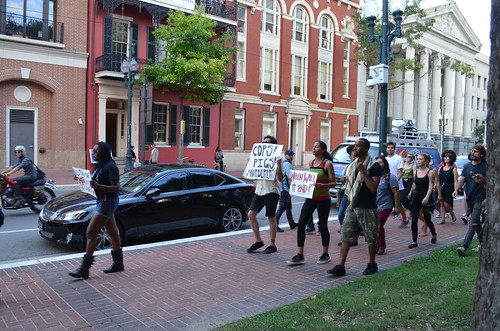
This is from a
Jarvis DeBerry column last week. He's writing about his disappointment in the President's remarks about Ferguson. But really this is a lament about the dumb nature of the job of being President.
"First and foremost," the president said, "we are a nation built on the rule of law."
You could make a stronger case that this nation was built on stolen
land; that it was built with stolen labor; that the descendants of those
who had their labor stolen are yet struggling to have their humanity
recognized.
You could, but the president of the United States cannot. Leading
America requires declaring its goodness. And not just that. Leading
America requires declaring that America always has been good, that it
always has treasured the law. Never mind that the law failed to prohibit
the destruction of one people or the enslavement of another.
DeBerry's thoughts echo those of Ta-Nehisi Coates who
wrote this in The Atlantic.
In the case of Michael Brown, this is more disappointing than
enraging. The genre of Obama race speeches has always been bounded by
the job he was hired to do. Specifically, Barack Obama is the president
of the United States of America. More specifically, Barack Obama is the
president of a congenitally racist country, erected upon the plunder of
life, liberty, labor, and land. This plunder has not been exclusive to
black people. But black people, the community to which both Michael
Brown and Barack Obama belong, have the distinct fortune of having
survived in significant numbers. For a creedal country like America,
this poses a problem—in nearly every major American city one can find a
population of people whose very existence, whose very history, whose
very traditions, are an assault upon this country's nationalist
instincts. Black people are the chastener of their own country. Their
experience says to America, "You wear the mask."
In 2008, Barack Obama's task was to capture the presidency of a
country which historically has despised the community from which he
hails. This was no mean feat. But more importantly, it was not unprecedented.
And just as Léon Blum's prime ministership did not lead to a
post-anti-Semitic France, Barack Obama's presidency should never have
been expected to lead to a post-racist America. As it happens, there is
nothing about a congenitally racist country that necessarily prevents an
individual leader hailing from the pariah class. The office does not
care where the leader originates, so long as the leader ultimately
speaks for the state. On Monday night, watching Obama both be black and
speak for the state was torturous. One got the sense of a man fatigued
by people demanding he say something both eminently profound and only
partially true. This must be tiring.
It is beyond reasonable expectation that the President would speak "for the state" and also speak truthfully. It is beyond reasonable expectation that the President would tell us anything other than a comforting lie.
Why don't we expect better of our leaders? It's not a new question. In his new book (which I've been talking a lot about, I know), Rick Perlstein looks at the last time Americans seriously asked it of themselves.
The Invisible Bridge covers the mid-70s period dominated by Watergate and the gradual rise of Ronald Reagan from fringe nut to Presidential contender.
Among Perlstein's more intriguing themes is the country's yearning for nostalgia as a means of escape from the difficult questions of the day. When confronted with harsh questions about corruption and injustice in American life, the public gravitates toward the most comforting lie. In Perlstein's telling, voters seek a kind of comfort... a belief in their essential goodness.. first from Jimmy Carter but later in more colorful, heroic fashion from Reagan.
Here is an interview with Perlstein conducted by Thomas Frank where they talk a little bit about this. It's difficult to read this book and not find multiple parallels between that time and ours both in the political and popular cultures. Here's a passage where they talk about pop culture retro fetishes.
Well. So the culture of nostalgia in the ’70s — I mean, everything from
“Happy Days” going on the air in 1975 to Bette Midler having a huge hit
with the “Boogie Woogie Bugle Boy of Company B,” to all these
restaurants like the Ground Round and Shakey’s that kind of promise this
19th century kind of…
Yes. The vogue for the 1890s—what was up with that?
…vaudeville
experience. Yeah. Or “The Sting” which is about the 30s but has music
from the 1890s. And then, the signal example being “American Graffiti,”
which literally, the tagline of the movie was: “Where were you in ’62?”
And invites people to kind of imaginatively place themselves before the
60s happens. Which was part of the huge appeal of the POWs. This idea
that they had somehow skipped the 60s. And they are these perfect
innocents. So, yeah, they were like these Rip Van Winkles. They devote a
whole hour of the “Today Show” to explaining to the POWs what had
happened in their absence. But we’re the POWs. We want to be them. We
want to miss the 60s.
Now, where the disaster rhetoric and the
nostalgia rhetoric come together most profoundly is something around
which I organized an entire chapter which is this fascinating movie
which actually did better box office than “Gone With the Wind” — “The
Exorcist.”
What year was that?
’74, January
of ’74, in which people are waiting in lines around the block in the
middle of this really vicious winter in New York. You have this symbol
of our perfect innocence, our daughters, our young daughters, who are
basically possessed by demons, which of course was happening all the
time. This was the winter of Patty Hearst.
And to make a long
story short, the plot of the movie is that science and modernity avails
us nothing to fight these demons. If you remember, there’s this kind of
faithless priest who is a psychologist, and the mom takes the daughter
to all these doctors who have all these fancy machines and they’re not
able to do anything. And finally what restores her to sanity is this
ancient orthodox priest, this medieval rite. The exorcism. And then the
last scene is really striking, because you have the mom, who I’ve heard
is based on Shirley MacLaine, who is this kind of liberated,
pants-wearing Hollywood liberal actress. And her daughter, in the last
reel when she’s exorcized, she hugs the priest who has found his faith
again, the young priest, and mother and daughter are wearing outfits
that make them look like Jackie Kennedy in 1962.
Again the throwback.
The throwback. So again, you have the disaster being redeemed by the nostalgia. Which is Ronald Reagan.
Anyway I don't want to reproduce the whole thing here but there is this last exchange which really brings the whole thing home.
Is anyone nostalgic for the ’70s?
I
am. And for the following reason: If you read my preface, I explain
that Americans at the level of popular culture, at the level of
grassroots politics, were thinking very hard about what it would mean to
have a country they didn’t believe was God’s chosen nation. What would
it mean to not be the world’s policeman? What would it mean to conserve
our resources? What would it mean to not treat our presidents as if they
were kings? That was happening! And the tragedy of Ronald Reagan most
profoundly wasn’t policy — although that was tragic enough — but it was
robbing America of that conversation. Every time a politician stands
before a microphone and utters this useless, pathetic cliche that
America is the greatest country ever to exist, he’s basically wiping
away the possibility that we can really think critically about our
problems and our prospects. And to me, that’s tragic.
As long as we're willing to accept the comforting lie, as long as we believe that, as Deberry puts it, "leading
America requires declaring that America always has been good, that it
always has treasured the law," our political apparatus is never going to allow us to think critically about our problems.