-->
Showing posts with label surveillance. Show all posts

Wednesday, October 08, 2025

Serpas Signal

 Very comforting

Last week, Gov. Jeff Landry formally requested that the president send 1,000 troops to Louisiana.

NOPD Superintendent Anne Kirkpatrick also confirmed the Guard is coming — but it’s still unclear when.

“In our society, visible presence of security is oftentimes very comforting to people,” Serpas said.

As chief of police, Serpas's main innovation was setting up random and constitutionally questionable traffic checkpoints every other week.  We were all very much comforted by that. Although it seems rather quaint in hindsight. Today there are cameras and microphones everywhere you go. Your "private messages" can prompt police to show up at your house. And, of course, masked goons are kidnapping people off the street every day.  By Serpas's count, this should be the most comfortable time in history. 

Friday, August 15, 2025

Nobody promoting a police panopticon deserves to hold public office in your city

I really wish people would stop talking so much about what Trump does every day and focus on the things their local elected leaders do that make it possible for the worst of Trump's policies to reach into your city and neighborhood. Trump lives very far away from you. Yes he wants to send militarized cops here to harass, assault, and deport you.  But also it is your city councilmembers who are explicitly inviting him to do this.  

After the New Orleans Police Department’s informal arrangement with Project NOLA was uncovered by The Washington Post in May, the city has moved to officially authorize the use of live facial recognition analysis.

The city council is currently scheduled to vote next Thursday on an ordinance that would make New Orleans the nation’s first city with a formal program that uses facial recognition to surveil people in real time, according to the Post. The proposal would expand on the council’s 2022 vote authorizing police to use facial recognition technology, but only as a last resort and only to investigate crimes after the fact.

City officials insist that their new ordinance has clear protections for civil liberties. In particular, they stress, the ordinance explicitly states that data gleaned from these cameras cannot be used for immigration enforcement.

But local advocates for immigrants’ rights insist that those protections are not strong enough to withstand state or federal pressure on the city to hand over information. They warn that New Orleans’ Democratic leadership might be setting itself up to hand ICE a powerful new tool.

Eugene Green insists that it is possible to put "guardrails" up against ICE intruding on the local surveillance dragnet. This is obviously untrue and he is obviously lying about that. Or else he simply doesn't know anything about how the federal government under Donald Trump behaves with respect to legal "guardrails" or the rule of law in general.  Maybe Green really is that ignorant of present day politics?  Probably not, though. More likely he simply agrees with draconian police state policies and wants to see them implemented.  No one with this agenda should be allowed to represent you on any governing body at any time. Especially not now. Because ultimately, it's these local offices where the actual crimes against you and your freedom are enabled and executed. 

Monday, May 13, 2024

Some of these are so easy, it's stupid

All one has to do is refer to any point in the past when Mayor Cantrell's administration acted to expand the intrusive police surveillance apparatus deployed against New Orleans residents during her term in office.

At the request of Mayor LaToya Cantrell, the New Orleans City Council introduced an ordinance on Thursday to severely roll back local restrictions on law enforcement surveillance that were put in place only 14 months ago.

The proposed ordinance, if passed, would largely reverse the council’s blanket bans on the use facial recognition and characteristic tracking software, which is similar to facial recognition but for identifying race, gender, outfits, vehicles, walking gait and other attributes. One provision also appears to walk back the city’s ban on predictive policing and cell-site simulators — which intercept and spy on cell phone calls — to locate people suspected of certain serious crimes. 

That provision could, for the first time, give the city explicit permission to use a whole host of surveillance technology in certain circumstances, including voice recognition, x-ray vans, “through the wall radar,” social media monitoring software, “tools used to gain unauthorized access to a computer,” and more.

And then follow that up with her reaction to having those kinds of tools turned back on her.  

New Orleans Mayor LaToya Cantrell filed for a temporary protective order Friday against a woman she says has stalked her for two years by taking photos and videos of her, according to Orleans Parish Civil District Court records. 

Cantrell accuses the woman, Anne Breaud, of "aggressively" taking photos and videos of her on multiple occasions, including on April 7 as she dined on a restaurant balcony.

Breaud's actions over the last two years, she wrote, "have placed me and my family in greater risk of being harmed, jeopardizing my safety especially at places I frequent."

Breaud declined to comment Friday night, and the mayor's office could not be immediately reached.

Okay maybe it's not that easy.  It is stupid but some things need clarification. The photographs she's referring to in the second story connect to a tabloid saga regarding the mayor's personal life that I don't have any interest in discussing.  The local TV stations have enjoyed it very much because it is salacious in nature which gets a lot of attention while also having zero relevant news or political content which means they don't have to think too hard about anything while presenting it. 

If the reporters did want to talk about this with any sort of seriousness, these stories would focus less on the sensationalist aspects and more on the implications of who gets to point cameras at who and to what purpose. Because as it stands currently, the cops and the mayors have so many cameras poking into our daily lives that there's scarcely a step one takes without feeling like some sort of suspect. And yet the moment we might ask the slightest question about the work our public officials are doing, or the moment we point a camera at the police, well now there's the line that can't be crossed.

Wednesday, January 25, 2023

Definitely feeling this vibe

I think it's because I'm nearly the same age as Atrios but this throwaway bit about not always having the juice to make a blog post every time something happens does hit home a little. Although I think for me it's less about feeling like I have to have something interesting to say and more about being exhausted that the same things keep happening over and over regardless of what we say about them. 

Still, the reason I put stuff here is so I'll remember what happened... even if the temptation to fade blissfully away into oblivion is stronger every time a new city council trots out yet another draconian ban on neighborhood bars because of a crime panic, to pick one example.  The same stuff keeps happening in cycles. But every time it comes around again, things are one degree shittier than they were the last time. The rent is a bit higher, the land is a bit lower relative to the sea, the cops and cameras are a bit more aggressive, the mayor is a bit stupider and meaner. The usual things, except moreso every time. And no one is coming to help. 

Anyway, for some reason I still have this compulsion to take notes. And so that's what I'm still doing.  For instance, if Billy Nungesser says this and I don't write it down somewhere, how will I know it happened?


Similarly...

Tuesday, January 12, 2021

The latest shock

Was it a coup? Is it still a coup? Will it be a coup? Who is a terrorist? Should we use that word at all?  What color is the "threat level"?  Are we frightened enough? Who knows? Does it matter? 

At the end of the day somebody is going to make a lot of money building a bigger and scarier surveillance apparatus. That's what's really important. 

Defense contractor Booz Allen Hamilton made an undisclosed strategic investment in Tracepoint, a technology startup with Baton Rouge roots. 

Tracepoint LLC, a digital forensics technology startup in New Orleans, was co-founded by Baton Rouge-based disaster response business Plexos Group and several other experts in the field in 2012. 

Plexos Group CEO David Odom said that the investment "affirms the unique value this growing company brings to the cybersecurity industry." Plexos Group develops new companies and invests in startups as part of its market strategy, according to the company. 

Tracepoint conducts background screening for employment, tenants, credit checks and drug and alcohol testing.

The new economy is built on shock-driven paranoid reaction.  Can't do anything to stop the pandemic-depression causing people to lose jobs and homes and descend into despair.  But we sure can invest in keeping an eye on them.

Friday, December 18, 2020

Don't call it a task force

Well certainly this explains everything

The investigative team was created amid the fallout from a June report from the federal monitors overseeing the NOPD’s progress in fulfilling a reform plan. The monitors said that district task forces routinely conducted questionable stops and searches.

Ferguson emphasized that the new “VCAIT” team is not a task force but rather an investigative unit.

Asked about concerns around violent crime, Ferguson said several units announced in the fall are beginning to produce results.

“It is coming to fruition. It may take some time with some of it,” he said. “We hear and we understand the community’s concerns, and that is why we are here today.”

What does the "investigative team" not do that the "task forces" were doing?  Ferguson doesn't say.  This story does say that the Investigative Team includes FBI and State Police among its number. When we learned last week that the city had been lying about NOPD's use of facial recognition technology, it came out that "state and federal partners" were key to enabling that to happen.

The New Orleans Police Department has confirmed that it is utilizing facial recognition for its investigations, despite years of assurances that the city wasn’t employing the technology.

In a statement to The Lens last week, a department spokesperson said that although it didn’t own facial recognition software itself, it was granted access to the technology through “state and federal partners.”
The good news is we learned yesterday from the tweets that City Council had passed a new ordinance that supposedly bans facial recognition and "3 other invasive, racially biased surveillance technologies."  But we see no mention of it in today's T-P/Advocate so we aren't quite up to speed on the details yet. Maybe we'll learn more when we are finished digesting the city's argument for ending the NOPD consent decree.  It appears to hinge on having met the exacting requirements set forth by Jeff Sessions. 
The Cantrell administration’s legal argument leans heavily on a 2018 memo from then-Attorney General Jeff Sessions, which dramatically limited the scope of police consent decrees. Sessions was forced to resign the same day he issued the memo, and it’s unclear whether President-elect Joe Biden’s Justice Department will adopt the same stance.
Not sure what Jeff's standard for rooting out racially biased surveillance is. Sure hope it's a good one. We should note, though, that according to the Lens, NOPD views the new ordinance more as guidance on how to use the technology rather than a ban. 

Jones told The Lens that the NOPD only used facial recognition for “violent cases,” but that “documentation of frequency of use of Facial Recognition is not currently available.” Asked whether there was any written policy or procedure regarding the technology, Jones responded by saying that NOPD Superintendent Shaun Ferguson “is currently working with Councilman [Jason] Williams on a policy as to when facial recognition tools should be used.”
So we'll see how that shakes out. Of course they could always go right back to lying about it. Or it may be that as long as they can keep coming up with new names for doing the same things, that they don't have to. 

Update: Okay here is the story about what City Council passed this week. I think this is the key point.
However, it does let officers use evidence gained by outside individuals or agencies from any of those technologies as long as no one from the Police Department requested or knew that was the source of the information.
Seems like a pretty big loophole easily exploited by a multi agency investigative team, right?

Monday, December 14, 2020

#Takeemdown

The cameras are already such a tremendous insult to everyone's dignity and general expectation of a reasonable amount of (if not quite privacy)peaceful  anonymity on the streets of their city. But add to that the lying and, it's long past time for them to go

New documents obtained by the ACLU of Louisiana through a public records request are shedding more light on how the New Orleans Police Department utilizes facial recognition software — a practice that the NOPD had denied using for years until admitting it last month.

As The Lens reported, the city has justified its previous denials on the basis that it didn’t actually own facial recognition software. Nonetheless, the NOPD has been using facial recognition since at least 2018 by tapping its intelligence partnerships with federal and state agencies, including the FBI and Louisiana State Police.

“After years of assurances from city officials that facial recognition was not used in New Orleans, the ACLU of Louisiana has obtained nearly 50 pages of email requests from New Orleans Police Department (NOPD) to the Louisiana State Police (LSP) Fusion Center asking LSP to use facial recognition on various photos and video stills,” said a Monday press release from the ACLU of Louisiana.

City Council had been considering a ban on facial recognition. But then they learned it was already in use.  Now the ban's sponsor... who was never really serious about it in the first place... has been elected DA. So, likely, nothing will happen. What should happen is the cameras should all come down.  But no one is even going to consider that. 

Monday, July 27, 2020

The problem

This is an article about the advance of workplace surveillance technologies.  Paranoid, profit-driven bosses are able to marshal a terrifying array of all seeing and all knowing machines to gain complete and intimate knowledge of workers' actions, associations and habits in order to predict and manipulate their behaviors.  We live in hell.

But we have always lived in hell.  Your boss may have super powerful computers and cameras to track you with now but the impetus to control and squeeze the absolute most value out of workers is a practice that stretches back to slavery.
In 1750, wealthy slave owners in Jamaica and Barbados would meticulously track and manage enslaved workers in order to maximize their productive output. What business schools today call “scientific management” actually has its very roots in the trans-Atlantic slave trade. Plantation owners were determined to extract every last bit of labor they could get from enslaved workers, meticulously tracking, documenting, and analyzing their every move in order to maximize productivity and profit. According to Harvard Business School researcher Caitlin Rosenthal, these techniques were then adopted widely in the United States after a slave owner named Thomas Affleck advanced those surveillance techniques to include “sophisticated calculations” that “measure productivity in a standardized way,” thus allowing “planters to determine how far they could push their workers to get the most profit.” After years of capitalist development, the plantation owners and capitalist executives of today are armed with more intelligent technology that can, in a millisecond, do what Affleck once did with only his eyes and a hand-written spreadsheet. High-tech corporate monitoring of workers today undoubtedly stems from this legacy of meticulous and detailed tracking of enslaved workers in order to extract the most profit from them, and to quell potential rebellion and collective action.
And, of course, the COVID crisis has provided yet another opportunity to expand these practices. Bosses conflate their own desire to track workers' movements with the public health concern over "contact tracing" in order to deploy new and intrusive technologies.  The bosses win the pandemic again.

Anyway the real reason I flagged this article is that it contains a single paragraph that can be cut out and inserted into any story about any social and political conflict going on in the United States in the 21st Century and it will serve as the essential context for what is really being fought over.
Due to advances in workplace technology following World War II, the productivity of the workforce has skyrocketed. Yet wages grew to a lesser extent until 1973, when output soared and wages stagnated even further. Since 1978, CEOs’ salaries have increased by 970 percent, making nearly 300 times more than their average worker. While companies are increasing their profit with these technologies, workers aren’t seeing any corresponding increase in their wages. Instead, those profits are going directly into the pockets of corporate executives.

We may live in hell and have always lived in hell, but the specific bit of hell we're in right now extends from our failure to overcome this problem in particular.  One might expect a situation like that to become unsustainable the longer it persists.  And *gestures widely at everything around us unraveling* could indicate that, yeah, it's not holding up so well at the moment.  The new surveillance technologies are one response meant to hold the fraying system together. They may work too! But, until the underlying is resolved, more draconian and frightening responses than even this will undoubtedly appear.

Friday, May 22, 2020

COVID security theater

People are very afraid of this pandemic. The safe thing to do would be to continue encouraging them to stay home and guarantee a basic level of income until it's over. But we can't do that because we still have to have bodies to feed "the economy." So what do we do? Sounds like a fantastic business opportunity.
Acadian Total Security is rolling out thermographic imaging services to interested clients across the region to “protect customers and employees from COVID-19.” The technology claims to scan the face of anyone entering the vicinity and detect elevated skin-surface temperatures. If an above-average temperature is found, an alarm notifies the business owner so further screening can be done, Acadian said in a release.
The cameras cost between $7000 and 70,000 each and are being sought after by businesses, school systems, and local government facilities all of which sounds like very smart fiscal practice during a time of heavy layoffs and austerity budget cuts.

Do they actually work, through? Depends on what you want them to do. If you want them to protect anyone from COVID 19, then, no.
There are some caveats about the use of thermal cameras, especially as protection against spreading COVID-19.

The technology isn’t intended to diagnose illness or prevent the spread of disease. Several thermal camera companies, including FLIR Systems, have released disclaimers that their products aren’t intended to stop the spread of the novel coronavirus and can’t be used to find COVID-19 infected individuals.
If you want to pretend you are protecting people so you can kind of go about your business then they work a little bit depending on whether that fools anybody. If you want to make a ton of money fooling desperate and gullible business owners and government officials into buying your cameras, then they seem to work great.

Friday, May 01, 2020

The police state also won the pandemic

Not only has the disastrous month of April 2020 shifted the dynamics of wealth and power even further to the extreme advantage of the nation's oligarchs, it has also provided new and exciting excuses for the rapid expansion of the police state.  In New Orleans, for example, we've spent the pandemic rolling out new unconstitutional(and unsafe for virus prevention) checkpoint practices while also finding new excuses to throw money at unscrupulous surveillance contractors.
On March 15, the city entered into an agreement with Israeli tech firm Carbyne, which asks users dialing 911 in crisis to agree to be surveilled without regulations or limits. A month later, NOPD began instituting police checkpoints across the city, despite public outcry that eventually ended the checkpoints.

City Council members agree that this lack of process and transparency needs to change. After halting the installation of over 100 new cameras that would have fed into the city’s Real Time Crime Center (RTCC) recently, Councilmember Jason Williams admitted, “It’s important that we be extremely concerned about the unintentional impacts that can come from a well meaning initiative.” He said the city needs comprehensive limits and regulations on surveillance tools before they are allowed to proliferate further.

It's nice of Jason to say he is "extremely concerned."  But he does want to be D.A.  I  wonder how concerned he will be as the city's top prosecutor.  I imagine his laughable assertion that a project to place security cameras up the butt of every New Orleanian was at any time a "well meaning initiative" can give us some insight into that. 

Thursday, March 12, 2020

When did you decide this?

Jason Williams has decided that maybe we shouldn't turn downtown New Orleans into a great big police panopticon after all.
New Orleans City Councilman Jason Williams announced at a Wednesday meeting that he is pumping the brakes on a contract that would add 146 new public video cameras with audio capability until the council can craft and pass a comprehensive ordinance to regulate the use of surveillance technologies in New Orleans.

“It’s important that we be extremely concerned about the unintentional impacts that can come from a well meaning initiative,” he said. “The technology is moving so much faster than government and our regulations.”
It is important that we be extremely concerned about this.  Many of us have been extremely concerned for a very long time, in fact. When did Jason come aboard? 
Williams said that the election of President Donald Trump and the progression of surveillance around the world have changed his views.

“When we had those initial conversations, the President of the United States was Barack Obama,” he said during the meeting. “After that election and the awareness of the footage retrieval and data retrieval that might have been used in a way that the previous administration wouldn’t have used them. Changes in immigration policy have led to concerns for several council members.”
Hmmm... that's not great. Maybe consider that the power to violate everyone's expectation of privacy shouldn't exist regardless of who might use it for whatever.  It's an odd little quirk of government, I know, but the person holding any particular office does change, on occasion.   Jason knows this, right? I'm sure he must.  I mean...
Williams launched his official campaign for Orleans Parish District Attorney last week, setting himself up as a progressive District Attorney candidate focused on criminal justice reform. That election happens later this year.
Last week, Williams began the process of  "setting himself up as a progressive" DA candidate. This week he suddenly thinks surveillance isn't as great as he once thought.  Surely this is pure coincidence as well.

Friday, February 21, 2020

Congratulations, Entergy!

Highest profit in almost 10 years. Nice going, guys. We are all so proud. And hey why stop there? In the true plucky spirit of capitalism, these heroes are pressing ahead in pursuit of every last dollar they can collect from New Orleans rate payers. The City Council may have them stymied momentarily but we'll see how it plays out in court.
Entergy has agreed to lower its prices for providing electricity and gas in the city to the levels the council approved in November while Entergy's lawsuit against those prices plays out in court.

Entergy had asked a Civil District Court judge to keep an older set of prices intact while its court case dragged on, but it struck a deal with the council this month to let the new prices take effect.

Those prices mean most east bank customers will pay about $3 less per month, at least for now.
It is important to remember that, over the course of this extended confrontation with Entergy, the Council has had no help whatsoever from Mayor Cantrell. She has intervened on Entergy's behalf at several points in the process most recently arguing in favor of higher rates in exchange for a one time $75 million kickback to Sewerage and Water Board. It's a scheme that benefits nobody but Entergy in the long run. But it appeals to LaToya because it solves her short run problem of squeezing more money out of the city's poor and working class population instead of actually forcing corporate malefactors like Entergy to put in their true "fair share."

Apparently the mayor is not done trading favors with Entergy to the detriment of the public well being either. This week we learn that she is pushing a deal made possible by the Trump tax cuts that will allow Entergy to install 146 new surveillance cameras along Canal and Poydras Streets. [STANDARD OBLIGATORY ORWELL TRIGGER WARNING]
The pilot program fits into a larger effort by the city government to introduce so-called “smart cities” technologies to New Orleans. “Smart cities” is an umbrella term with varying definitions, but implementing a smart cities program often includes ramping up the use of data-gathering technologies to inform and enhance the delivery of public services.

Similar programs have caused privacy concerns in other cities building up this type of technology, ranging from Wi-Fi kiosks in New York City that track user’s movements to “smart trash cans” in London that were scraping data from the phones of passing pedestrians. In New Orleans, the push for smart cities technology has mostly come from the City Council, but the pilot project now before the council was led by the Cantrell administration.

The money for the pilot project would come from Entergy New Orleans. Specifically, the funds are the result of the 2017 federal Tax Cuts and Jobs Act, which lowered Entergy New Orleans’ federal corporate tax rate from 35 percent to 21 percent, resulting in an estimated $50 million in savings.

Through an agreement approved by the City Council, the bulk of that money was earmarked for energy efficiency programing and bill credits for customers. But a small portion, $3.2 million, was reserved for the Smart Cities pilot.

“This is money that New Orleans ratepayers have spent already,” said Logan Burke, executive director for the Alliance for Affordable Energy, in an interview with The Lens. “That’s not a gift from shareholders or a gift from Entergy. That’s our money. And so those dollars should be spent doing one of two things: reducing bills or making the system more reliable. … I fail to see how surveillance cameras fall within Entergy’s franchise.”
Who is looking out for you when Entergy is turns its windfall into even greater profits by boosting your rates? Nobody. Not the mayor anyway.  She's more interested in keeping an eye on you. With Entergy's help. And your money.

Friday, June 21, 2019

Impersonating an... officer?

Is that what you'd call this?  What is going on here?
The officers noticed two surveillance cameras mounted to a public light pole on the block. They looked very much like hundreds of crime cameras that have been installed across New Orleans since 2017. Those are owned and controlled by the city, all transmitting video to the Real-Time Crime Monitoring Center on North Rampart Street.

In addition to being attached to city-controlled property, the cameras on the Lakeview light pole bore the New Orleans Police Department’s logo.

The problem: They weren’t city-owned cameras. The officers didn’t know who owned them.

“The camera mounted at 6119 Vicksburg is not a City-owned camera, is not integrated to the Real-Time Crime Center, and is unauthorized to be on the light pole,” said Laura Mellem, the public engagement manager at the New Orleans Office of Homeland Security, which oversees the city’s surveillance system.

Nor was it owned by the Lakeview Crime Prevention District, a security district that maintains cameras in the neighborhood, LCPD President Brian Anderson told The Lens in an interview.

“That is without a doubt not one of ours,” Anderson said.

The victim of the alleged car burglary told the police that the cameras belonged to Jeff Burkhardt, according to the police report.

Burkhardt, whose wife owns a house on the block, is the vice president and chief operations officer for Active Solutions, LLC, a crime camera supplier and installation contractor for the city. The camera on the block bears a resemblance to Active Solutions’ Neighborhood WatchCam model. The Neighborhood WatchCam draws its power from streetlights, according to the company’s website.
Burkhardt tells The Lens he doesn't know nothing about no cameras. Also he tells them they are "fake news."  But, see, the thing is he's got it pointed at his ex-wife's house. And he has NOPD logos on it. And he is the contractor who makes and installs these things.  And this is all very normal.

Friday, March 01, 2019

Mardi Gras Guide Part 1: Whose Streets? Everybody's Streets

Sirens, gunfire, a panicked crowd reaction, public safety personnel running this way and that.  No we're not talking about the CBD on a Friday night.  No, we're not talking about the scene when Parks and Parkways comes out to clear squatters and ladders off of the neutral ground. We're also not trying to describe the scene of some horrific, but also extremely unlikely, terror attack on a parade route.

Instead we are describing the scene in Armstrong Park last week when a bunch of cops had nothing better to do with their DHS money than go out and LARP their wildest fantasy of such an attack.
The New Orleans Office of Homeland Security and Emergency Preparedness will conduct a "full-scale exercise" simulating an attack on a parade. This important drill will help New Orleans public safety agencies test emergency response plans in the event of a real attack. For example, the simulation will test a hospital surge plan to triage and handle a mass casualty incident. The City's family reunification plan to track and communicate with family members the status and location of people affected by an attack will also be tested through this drill. Role-playing with real people and real equipment allows emergency personnel to fully test plans, policies, and response.
Sounds fun! Was it fun? Looks that way. They had actors and props and floats and all kind of neat stuff. Here's the video.  It's always reassuring to see the SWAT crew show up in tanks.  Really puts you in the Carnival spirit.

The good news is everybody was pleased with the way it went. Emergency responders say they know who to call first and how to get where they need to go in case a drunk driver loses control near a crowd or in case somebody besides a cop fires a gun out there. Both of those things have happened before, of course. Still, it sounds like a lot of these procedures could have been covered in a series of memos and meetings but what would be the fun of that?  As for "terrorism," that's not likely to be as much of a concern.  That is,  unless when police and prosecutors don't want to share exculpatory evidence with defendants. Then there's a terrorist hiding behind every tree. Which is why the trees all have cameras now, probably. Even the floats have eyes.
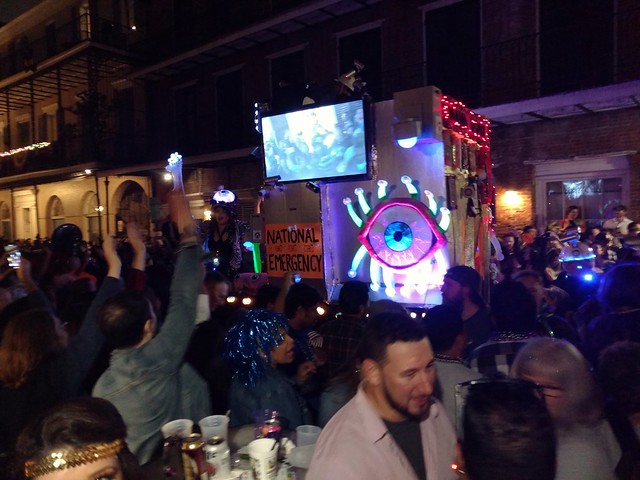
Mama Roux

Anyway, the point of all this is, Happy Mardi Gras!  We're already deep into the season and I've already got one sunburn and two moderate hangovers to show for it.  But, well, I've gone to all these parades and taken all these pictures so doggone it I'm gonna have to write about it a little bit.  In multiple parts, actually.  There's always a lot going on during Carnival season and it's already Friday. Let's see how far we can catch up before I have to go out and drink in the street some more.


The New Mardi Gras is over... or is really the Old Mardi Gras.. or..

Lego Chewbacchus
Krewe of 'tit Chewbacchus rolling on through


Thanks, in part, to the late Carnival season... and probably to police paranoia as well... the parade schedule got shuffled around a bit this year.  The most significant change saw Chewbacchus moved from the first big Saturday night, all the way up to a week ahead of Krewe Du Vieux.  On the one hand this is probably bad in that it's yet another concession to the city's stupid insistence on supporting only one parade route at a time. On the other hand, maybe Chewbacchus really does belong in the pre-season.

After all, Chewbacchus does have a lot in common with the other small scale parades and street happenings that go on in the weeks before the major parades roll.  NOLADotCom art critic Doug MacCash erroneously lumped them together with a few other recently formed parades and marching clubs into something he calls "New Mardi Gras." But there are all sorts of problems with this appellation chief among them being the fact that there's nothing particularly new about the format any of these groups present. Small, independent, maskers and marching clubs have always been a part of Carnival. In fact, the tradition is older than the larger parade style introduced to New Orleans by Comus in the 19th Century.   We have other nits to pick with MacCash on this point but a lot of this ground was covered on the last Hunkerdowncast which you can listen to here if you really want to get into it. Probably the most thoughtful discussion of Chewbacchus and its place in the Carnival continuity came from this Jules Bentley article in 2015.

I'm still not clear on MacCash's motivation, though. A lot of the time it seems like he's deliberately trolling trolling on behalf of the treps and transplants who do, in fact, comprise much of the Chewbacchus membership. Maybe he's sympathetic to the club's libertarian ethic. Or maybe he just knows this is thing that will get a rise out of people. Just ahead of Chewbacchus, Doug ran with speculation sourced  to one of the Krewe's "Overlords" about the possibility of carrying ads in the parade. 
This year, for the first time, the Chewbacchus parade may include banners or other advertisements for local breweries and distilleries that are sponsors of the krewe. A city ordinance prohibits advertisements of any kind during the officially designated Carnival Parade Season (from the second Friday before Mardi Gras, through Mardi Gras day). But Overlord Ethridge points out that since the Chewbacchus parade falls outside of those dates, it’s legal to display ads.

Anyway, she said, Chewbacchus is actually a church that venerates the “Sacred Drunken Wookiee.” So alcohol is a sort of sacred sacrament and therefore alcohol ads are simpatico.
That touched off the predictable half day or so of yelling on Twitter until someone could follow up with the krewe to discover that, no, they weren't really serious. Was that what MacCash intended? or was it just a stupid accident?  Maybe we'll never know. Sound off in the comments.

Rex dumped Kern
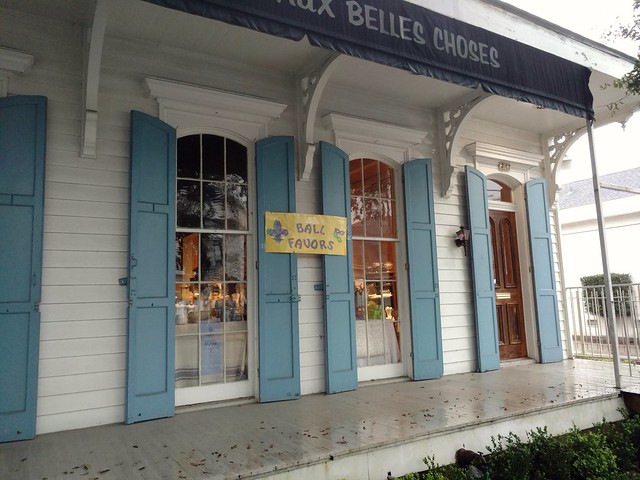
Ball Favors
Fancy shop sells fancy things to fancy people


This is going to be the last year of the longstanding relationship between the King Of Carnival and his float builder.  They will celebrate the occasion by staring into the sun together.
After this Mardi Gras, a different float-building company will take on the Rex parade floats after the Rex Organization and Kern Studios decided to end their partnership, according to a WWL-TV report.

Kern Studios has constructed the King of Carnival's floats for more than 65 years. After this year's Rex parade rolls with the theme "Visions of the Sun," another company will take on the task for at least the next five years, WWL-TV reported.
The WWL story doesn't pin down a reason for the split. We do know the Kern family isn't quite as stable as it once was but to say anything on top of that would be speculating. Also I couldn't help notice we got some comments from "Rex Organization official James Reiss."
"We're extremely proud to for 68 years to have had the backing of Kern artists in creating what we think is one of the premier parades during N.O. carnival," said Rex Organization official James Reiss. "As all business relationships do, they mature. We're extremely proud that Kern has now taken New Orleans Carnival not just to other krewes but internationally to places like China,  to Universal Studios. As they have grown, we think that we've been a big part of that growth. We're happy to see what they've done. It's just time for the two organizations to move on. It's really just an internal business decision. We're both very good friends and will remain so."
Yeah, well, good for them.  The thing is, we can't let Reiss's name pop up without mentioning again his role, and that of his peers, in realizing the vision of a new New Orleans, Reiss so helpfully laid out for us in the days after Katrina.
More than a few people in Uptown, the fashionable district surrounding St. Charles Ave., have ancestors who arrived here in the 1700s. High society is still dominated by these old-line families, represented today by prominent figures such as former New Orleans Board of Trade President Thomas Westfeldt; Richard Freeman, scion of the family that long owned the city's Coca-Cola bottling plant; and William Boatner Reily, owner of a Louisiana coffee company. Their social pecking order is dictated by the mysterious hierarchy of "krewes," groups with hereditary membership that participate in the annual carnival leading up to Mardi Gras. In recent years, the city's most powerful business circles have expanded to include some newcomers and non-whites, such as Mayor Ray Nagin, the former Cox Communications executive elected in 2002.

A few blocks from Mr. O'Dwyer, in an exclusive gated community known as Audubon Place, is the home of James Reiss, descendent of an old-line Uptown family. He fled Hurricane Katrina just before the storm and returned soon afterward by private helicopter. Mr. Reiss became wealthy as a supplier of electronic systems to shipbuilders, and he serves in Mayor Nagin's administration as chairman of the city's Regional Transit Authority. When New Orleans descended into a spiral of looting and anarchy, Mr. Reiss helicoptered in an Israeli security company to guard his Audubon Place house and those of his neighbors.

He says he has been in contact with about 40 other New Orleans business leaders since the storm. Tomorrow, he says, he and some of those leaders plan to be in Dallas, meeting with Mr. Nagin to begin mapping out a future for the city.

The power elite of New Orleans -- whether they are still in the city or have moved temporarily to enclaves such as Destin, Fla., and Vail, Colo. -- insist the remade city won't simply restore the old order. New Orleans before the flood was burdened by a teeming underclass, substandard schools and a high crime rate. The city has few corporate headquarters.

The new city must be something very different, Mr. Reiss says, with better services and fewer poor people. "Those who want to see this city rebuilt want to see it done in a completely different way: demographically, geographically and politically," he says. "I'm not just speaking for myself here. The way we've been living is not going to happen again, or we're out."
Yeah, well, good for them, too. They got everything they wanted. The schools are all charters, the "demographics" have shifted, the city is smaller, whiter, and fewer poor people can afford to live here.  And, from the looks of things, our political leadership is fairly satisfied with that. This week, the City Planning Commission considered the results of a study on affordable housing set asides that appears to recommend taking little or no action.
Forcing developers to add lower-cost apartments to their residential projects would be difficult to implement outside of New Orleans' most sought-after neighborhoods, and it likely would create only a few dozen lower-priced units per year, according to a study commissioned by the City Council.

The local housing market is strong enough to support an affordable-housing mandate, known as "inclusionary zoning," only in areas such as the Central Business District and the French Quarter, said the study, a summary of which was released Tuesday.
As we've pointed out numerous times here, inclusionary zoning and developer incentives aren't going to protect our neighborhoods from displacement and gentrification anyway. To do that we need to build actual public housing and, very likely, to implement some sort of rent control policy. By admitting that "the market" isn't going to solve the problem for us, this study actually confirms this. That isn't what the CPC wants to hear, of course. And it's certainly not what they'll hear from any of the Rex Organization men. Maybe if something happened to displace them from their homes they might finally be able to empathize just a little bit.  But probably not.

Black wreath
A black wreath lain on the fencepost at the now ruined Downman Mansion. Rex is still going to stop here on Fat Tuesday.

There's all kinds of king cakes now

Late January pricing
Also available in vodka form

King cakes used to be such a prime topic for hot takes.  Do you eat them out of season?  Do you like them filled or plain? Should the baby come in the cake or separately in the box?  Is your neighborhood bakery doing it wrong?

Most recently, I think, the thing that got everyone excited was the Dong Phuong fad and associated manufactured scarcity.  But I think it's time to declare that over now.  There also was a time when everyone enjoyed freaking out over the newest weird flavor with like... tomato sauce and pretzels on it or whatever.  But the process of one-upsmanship has become so baroque now that there are a million varieties and none of them can stand out anymore.  Do whatever you want with your king cake. Nobody is shocked. Nothing matters. 

The only sane move is to stick to basics.  So in light of that, here is a perfectly cromulent king cake guide from NOLA.com.  These are all good recommendations. I am still partial to Antoine's, though.

City government is saving Mardi Gras but also it is ruining Mardi Gras

Tent construction
A civilization rises on Napoleon Avenue


God bless Mayor Cantrell.  She has picked up and expanded on the previous administration's recent emphasis on reminding parade goers to share the public space and not obstruct it with too many ladders and tents and chairs and such. We here at the Yellow Blog have observed this problem closely for many years. We've even appeared in the local media from time to time advocating for change. It's gratifying to see the city take it seriously.

They've made it a major point in the annual get-ready-for-Carnvial press conference
The city will also be taking a hard line against those who leave items on the parade routes to try to reserve preferred spots.

Workers will clear away items such as tarps and ladders left along the routes, Parks and Parkways Director Ann McDonald said.

"We will not store items," she said. "We will not tag items. Any items that we remove will be destroyed.”
The "will be destroyed" comment got a lot of attention this week because LaToya repeated it as city workers charged down the St. Charles Avenue neutral ground making good on the threat. But it's worth noting this was the policy from the outset.  Anyway the beatings will have to continue until morale improves because people really do need to be forcefully reminded about these issues every year.  My personal observation has been that, while the enforcement effort has done some good, it hasn't obviated the problem entirely.  This week, the parade route is still tightly walled with tents, ladders, and those dang festival chairs that seem to get worse every year. If people would just put them in the back where they belong everyone would be able to move around and..... well, you've heard all this from me before.

A few weeks ago, this story got passed around about a guy offering to camp out and "save a spot" for on the neutral ground. 10 ft. by 10ft. for $2,000! This is supposed to be a free and open public celebration.  We can't allow the very public spaces dedicated to that purpose become walled off and monetized.

There is something else the city could do to decrease the high demand for real estate.  The city could allow the party to spread back out into the neighborhoods it once belonged in rather than bottle it all up along one corridor like the over-leveed Mississippi River.  One reason the St. Charles route is crowded beyond capacity with campers and ladders is it's more or less the only place anyone can go to catch a parade anymore.  It wasn't always like this as a recent Gambit commentary noted.
Older New Orleanians remember seeing the krewes of Endymion and Pontchartrain rolling through Gentilly and New Orleans East, respectively. The Krewe of Mid-City's unique, foil-wrapped floats once used to delight people in … Mid-City. And the Krewes of Freret and Carrollton used to roll down (you guessed it) Freret Street and Carrollton Avenue, respectively.

The concentration of parades on St. Charles Avenue makes things easier for the city, especially for our manpower-challenged police department, but it has taken something away from New Orleans' neighborhoods. Carnival season is a party we put on for ourselves, and it's time to ask: Can we move a few parades back to their neighborhoods?
We could move a few parades back to their neighborhoods. But the city doesn't want that. The police don't want it.  But the police and Homeland Security don't think we should be doing any of this in the first place and only tolerate it insofar as it benefits the tourism industry.  But our holidays are about more than the most crass and efficient means of turning a profit.  We're never going to put things right if all we do is listen to the police and wealthy few they serve and protect. And we're never going to solve the route overcrowding problem until we see that.

More Mardi Gras Guide to come:

Part 2: Racism, politics, and Carnival con artists

Part 3: The parade ratings matrix

Thursday, January 24, 2019

Why don't they want to be on TV?

The city administration is famously gung-ho about putting cameras on every street corner and possibly inside every bar to surviel the populace. New Orleans was even a pioneer in the movement to put a body camera on every cop... ostensibly in order to keep an eye on the police but also on every person the police interact with.  Several prominent local politicians are, this week, publicly lobbying the NFL to extend the purview of its instant replay cameras.. for.. some reason. It is safe to say we are governed by shutterbugs. 

It's weird then that City Hall would resist the notion that they themselves be filmed on the day they receive their official grades from the police monitoring team in charge of determining their level of compliance with the NOPD federal consent decree.  Why would they not want that seen?
The hearing was already being planned before an exchange of letters a month ago laid bare tensions between city leaders and the court-appointed monitors.

Mayor LaToya Cantrell and other city officials said the NOPD considers itself to be in “93 percent compliance” with the consent decree. They asked for a speedy release from the consent decree's strict mandates, and the monitors' $2.1 million per year contract.

The city also objected to carrying the hearing on public-access television.

The monitors wrote back that they were unsure as to how the city came to the 93 percent figure, and that much work still needs to be done. Meanwhile, U.S. District Judge Susie Morgan, who oversees the reform plan, said the public and television crews would be allowed to attend the hearing.
That's weird, right?  Suddenly so shy. We know they're eager to be finished with this whole thing.  The letter they wrote last month had all kinds of complaints.  Mostly, though, it seems like they're tired of having to spend over $2 million a year on the monitors. But they're so close, right?  I mean, look, they didn't even kill anybody for "nearly two years."
By some measures, the department is on its best footing in years. Between January 2017 and January 2019, New Orleans police went nearly two years without fatally shooting someone, which would have been almost unimaginable a decade ago. Meanwhile, last year the city logged its lowest homicide count since 1971.

Yet the monitors have warned that the NOPD still needs to prove its supervisors are effectively overseeing their beat cops, and that those ordinary officers follow constitutional practices when they stop and frisk people on the street.
That sounds like the kind of laudable restraint, the city would want broadcasted all over... well.. public access.. but still.  Anyway, if you're looking to tune in, the show starts at 9am and you can just watch on your computer machine

Friday, January 04, 2019

Who watches who and why

Here is a map to all of the traffic cameras in New Orleans that are no longer active as of the new year. It's the mayor's way of.. almost.. keeping a campaign promise.
As of Jan. 1, 20 of 31 cameras outside of school zones, including the one southbound one in front of Scoggin’s home, were shut off, in a boon for motorists who have long complained about being ticketed on their way to work or school.

Left up are the city's most lucrative non-school-zone cameras. Also still rolling are dozens of cameras in about 50 school zones, though the devices have been adjusted to only issue tickets during school zone hours.

The changes balance the need for motorists' safety with the mayor’s desire to remove a financial burden on the city’s residents, said Cantrell’s Chief Administrative Officer Gilbert Montaño.

“We took the cameras that were providing the least amount of tickets and turned those off,” he said in a Friday interview. “The 11 that remain on were ones where we still need a little bit of help from the public.”
Montano's phrasing is rich.  A different way of putting it would be they deactivated the cameras that were providing the least about of revenue and kept the 11 that enable the public to "help" keep the city budget in balance by graciously continuing to be "nickel-and-dimed" as the mayor once put it.

Oh also, this doesn't mean they're actually getting rid of all 31 deactivated cameras.  Some of them are just getting moved. 
Meanwhile, non-school zone cameras deactivated under the rules will likely be relocated to school zones, Montaño said. Although those locations haven’t been determined, he said the city is considering placing more cameras near high schools since most cameras now are located near schools with younger children.
Whatever part of this qualifies as LaToya keeping her campaign's founding promise is getting more and more difficult to see. But there probably isn't going to a be a political price to pay. The traffic cameras are unpopular, generally. But the public seems to be grudgingly ok with the ones in the school zones.

What is the public's feeling on mass police surveillance, though?  I'm sure there's some depressing poll out there that says everybody is for it. I just haven't seen it yet. No doubt our councilmembers have, though, since they're all gung-ho about reviving Mitch Landrieu's failed camera-in-every-corner-bar ordinance this month. It doesn't have to be a poll, actually. It's really just a matter of the right feedback from the right money to get them to move even on something as morally objectionable as this.

It's an interesting contrast, though. Generally speaking we hate the cameras pointed at our cars in case we run a few miles over the speed limit. But we love the cameras pointed at other people in case they... happen to be hanging out on the corner in a way that makes us uncomfortable. What do you think the major distinction is?

Friday, December 21, 2018

We love our cameras

Cyndi Nguyen and Kristin Palmer are bringing last year's narrowly scuttled mass surveillance ordinance back to life.
Less than a year after a similar measure was dropped, a proposal from members of the New Orleans City Council could require "nuisance" bars, clubs and liquor stores to install live-streaming video cameras inside and outside their businesses, part of a proposed ordinance that tightens restrictions for businesses that sell alcohol.

The proposed ordinance — which mirrors parts of a scrapped plan from former Mayor Mitch Landrieu — also gives the mayor’s office or New Orleans police superintendent the ability to revoke or suspend an alcohol license, if the city or its Alcoholic Beverage Control Board determines that the business “directly endangers the health, safety and welfare of the community.”
I still don't understand the universal enthusiasm for sticking cameras everywhere. Particularly since it obtains among a set of elected leaders who profess often to care very much about social justice. It's possible they all suffer an acute case of cognitive dissonance. Although Occam's razor, as always, suggests they're just full of shit.

More to the point, they're predisposed to be full of shit on account of the fact that so many of them have a personal interest in or close association with the real estate business. Which is why, for one thing, this ordinance is being carried by Palmer and Nguyen. More importantly it is why its major point of the ordinance isn't just about installing cameras. Rather the cameras are one piece of a plan that is really more about shutting down as many neighborhood bars as possible. 

Bars and music venues also can’t be built within 300 feet of a playground, church, public library or school — unless the owner has a sworn affidavit from 75 percent of property owners within a 300 foot radius.

They’d also be forbidden within “residential or park area,” and would grandfather in existing neighborhood bars, unless there’s a six month lapse in their permits and licenses.

MaCCNO also warned that real estate speculators and developers, including short-term rental operators with multiple listings, which proliferated in recent years, could abuse the complaint process to shut down area bars.

“This is an aggressively pro-gentrification ordinance and presents a clear and present danger to every small grocery, pharmacy, bar and music venue in the city,” MaCCNO said.
This ordinance is slated for committee discussion  on January 31. Between that and the Jan 10 motion on STRs, it's going to be a busy month.


Thursday, December 20, 2018

"Colossal Brother"

Holy cow
In August 2017, three months before former-Mayor Mitch Landrieu announced the opening of the city’s $5 million Real Time Crime Monitoring Center, the city spent $2.8 million to buy a suite of software from Motorola Solutions that includes artificial intelligence and object detection to help law enforcement sift through the thousands of hours of footage recorded every day.

The package includes software called BriefCam, CommandCentral Aware, CommandCentral Analytics, and CommandCentral Predictive.

“My initial reaction is, holy cow, this is not just big brother. This is colossal brother,” said Bruce Hamilton, a staff attorney at the ACLU of Louisiana. “When you take a step back, you really get the sense that the surveillance state is rapidly expanding here in New Orleans.”
At several junctures during the evolution of the surveilance "canopy," as city and police officials like to call it, that, despite our supposed hysteria, the cameras were minimally intrusive.  But here we are wondering if we need to be more mindful of our "dwell time" in public.
Still, with the software the city does have, the NOPD could, for example, pull up every piece of footage that includes a man in a red shirt on a blue bike riding north on Esplanade Avenue. Or it could pull up every person with a backpack that appeared on the corner of Broad Street and Orleans Avenue, displaying them all simultaneously on one screen with timestamps over their heads to indicate when they were there.

My question is, what does it mean to say you’re not using facial recognition technology when you’re using something that’s equally powerful?” Hamilton said. “So for instance, the city may not be able to identify me by my face, but if the city knows what I’m is wearing, or what I drive, I mean there’s any number of factors they can use to track you from place to place.”

BriefCam can also produce “heat maps” of dwell time, object interaction, and common paths. In a YouTube video from March, the head the Hartford, Connecticut crime center illustrated how he used the software to track the movement paths of everyone who walked in the frame of one of the city’s cameras to track which homes they were coming in and out of. He claimed that the analytics helped him locate a drug operation.

“How long did that take me to do?” he said in the video. “That took me a minute.”
Everybody loves it, though. 

Monday, December 10, 2018

Never leave the house

If you do, they'll know.
Like many consumers, Ms. Magrin knew that apps could track people’s movements. But as smartphones have become ubiquitous and technology more accurate, an industry of snooping on people’s daily habits has spread and grown more intrusive.

At least 75 companies receive anonymous, precise location data from apps whose users enable location services to get local news and weather or other information, The Times found. Several of those businesses claim to track up to 200 million mobile devices in the United States — about half those in use last year. The database reviewed by The Times — a sample of information gathered in 2017 and held by one company — reveals people’s travels in startling detail, accurate to within a few yards and in some cases updated more than 14,000 times a day.

The lady the Times uses as its example at the top of this story really gets around.  If they were looking at me they'd see a billion one mile trips to work and back every day with the occasional detour to Rouses.  I've aged into becoming one of these New Orleans weirdos who never leaves the neighborhood anymore. The algorithm that tracks me can be programmed on an abacus.  Last weekend I crossed Canal Street on the bike and three nearby crime cameras caught on fire.

Sorry about that.  Next time I'll read the terms of service.
Many location companies say that when phone users enable location services, their data is fair game. But, The Times found, the explanations people see when prompted to give permission are often incomplete or misleading. An app may tell users that granting access to their location will help them get traffic information, but not mention that the data will be shared and sold. That disclosure is often buried in a vague privacy policy.
"Misleading explanations." Yeah, mostly what that means is an app is either demanding or strongly implying that you enable location tracking just to get the thing to work at all. Meanwhile there's practically nothing that explicitly limits what companies can do with your data once they've acquired it.  There's just a jungle of internal policies and practices.

The article comes with a guide to disabling your phone's location service although it's not at all clear that's going to solve the problem.  Not when such an action is bound to greatly reduce your device's actual functionality.  And certainly not since there's little anybody can do to disable the city's surveillance camera "canopy." The mayor would have to call that off.  But, according to her, "we've barely begun to scratch the surface," of that that network can do. 

Friday, October 26, 2018

What do police even do?

This was never really true but there are some old fashioned folks still among us who prefer to think the police should investigate crimes when they happen and otherwise stay out of the way.  Maybe help some old ladies cross streets every now and then.  I guess it's still okay to do the wobble at Mardi Gras. Maybe let's try to get away from that if we can, though.

Again, it's never really worked that way.  American police forces have always existed primarily to protect rich people's property. This has meant everything from tracking down runaway slaves to quashing working class labor and political organizing efforts. Chiefly the police exist to enforce order, most often by means or threat of violence.

There's a quote most often ascribed to Huey Long on the question of whether or not we'd ever have fascism in America. Huey is believed to have said,  "Of course we’ll have it. We’ll have it under the guise of anti-fascism.”  Today we have as violent and sophisticated a police surveillance state as we've ever had. We've allowed it to grow under the guise of "anti-violence."
The city had been using the software since 2012. But in March, former mayor Mitch Landrieu declined to extend the Palantir agreement for a fourth time. And current Mayor LaToya Cantrell said she would not revive it.

Cantrell has kept that promise, but documents obtained by The Lens show that her administration is in the beginning stages of developing a new tool for identifying likely victims and perpetrators of gun violence, partnering with the same criminologist whose research formed the foundation of the Palantir software.

The tool is being developed by the New Orleans Gun Violence Reduction Council, which Cantrell created in May.

In an August op-ed published by NOLA.com, Cantrell said that the council’s central task is “to come up with a plan to execute the violence reduction recommendations produced by my transition team.”
See we have to train cameras on you 24/7 and plug everything we know about you, your friends, your shopping habits, grades, work life, etc. into our algorithm that predicts the future in order to protect you.  This isn't about keeping you in line. This stuff is for your own good, don't you know? Here please enjoy a relaxing session in our meditation room. It's right here behind the metal detector.
Steps from the walk-through metal detector inside New Orleans City Hall are a few beige recliners in a small, softly lit room, where an attached office allows social workers, ministers and other faith-based volunteers to lend an ear to the public and connect people to the city’s spectrum of care.

On Oct. 25, Mayor LaToya Cantrell, city officials and area faith leaders cut the ribbon for a “meditation room,” what Cantrell says is a “safe space for our people to come, to reflect, even to seek counsel if they need it.”
Don't be afraid. We want you feel supported and safe and... wait a minute... looks like we're going off script a little bit.
Another council member, Nathalie Simon, suggested increasing law enforcement resources and capacity for deterrence. “If we solve more crimes, less likely to feel like you can get away with it,” the meeting notes say. Simon is a special council at Laitram, a Harahan-based manufacturing firm.

Even in the absence of an official role in the program, it’s unclear if there’s anything that would prevent the NOPD from accessing the data and identities produced by the new program for its investigations.
Alright we just want to keep you in line, okay?  Does that mean the police have their eyes and ears on everything you do or say? Maybe. "It's unclear if there's anything that would prevent" that.