-->

Thursday, May 15, 2014

Bobby Jindal's perpetual media tour to nowhere

You never know where Bobby and/or his byline is going to show up next.

Jindal stopped at Liberty University over the weekend in order to tell the young freethinkers there about the First Amendment and what it means to them.
Jindal felt right at home. A Hindu-turned-”evangelical Catholic,” he knew how to package his First Amendment defense for maximum appeal to clean-cut Christian conformists. Anti-gay bigotry was recharacterized as an expression of traditional Christian views. Discriminating against homosexuals by denying them jobs or goods and services — that’s simply practicing one’s religion.

As the demons in this travesty of New Testament theology, Jindal ominously evoked a vast liberal elite, intolerant of religious-based speech that also happens to be anti-gay. You see it’s the free speech crowd — not the censors at a place like Liberty U — who are the small-minded one in Jindal’s world. The “politically correct crowd is tolerant of all viewpoints, except those they disagree with,” he opines in a press release from the governor’s office. (Your tax dollars at work!) It’s a switcheroo tactic he used to defend anti-gay comments by Duck Dynasty’s Phil Robertson, much like the “liberals are the real racists” meme that the right has been peddling so hard recently. Bigotry seems more justified if you see yourself in the oppressed group.

Last weekend, the St. Louis Rams made history by selecting 2013 SEC Defensive Player of the Year Michael Sam in the seventh round of the NFL Draft. Sam becomes the first openly gay football player to be drafted in the NFL.  At first glance, this may seem to you like progress. But apply a little Jindal logic and you'll see the "real bigots" are Christian athletes who, of course, will never recover. They'll always have Twitter, though.


That's former Saints linebacker Scott Shanle expressing solidarity with Florida State linebacker Demarcus Walker who clearly knows what's what. 

You see, Tim Tebow was going to be the Jackie Robinson of Christian athletes. Unfortunately, thanks to the unrelenting scorn of the godless hordes who comprise American football fandom, he was never given the chance break down the barriers to Christian participation in professional sports and showcase his remarkable talents.  Because of this tragedy we may never see an openly devout professional athlete in our lifetimes.

And now that one openly gay player has been picked in the final round of one draft, Christians everywhere are under assault.  The "double standard" at work is intolerable. Or at least that's the gist of the article Saints tight end (no snickering, please) Benjamin Watson links to here.


Saints linebacker Curtis Lofton added his voice by manually retweeting Watson's tweet.


If you look through that thread, you'll notice that Lofton was applauded for having "the courage to express your opinion" via this retweet of someone else's approval of another person's opinion.

In any case, as you can see, Jindal's lecture on the "real victims" of religious discrimination does not fall on deaf ears... for better or for worse.

Oh and one more post-script.  John Barry has been in the news a lot this year as Bobby Jindal's primary foil regarding the oil and gas industry's culpability for destroying Louisiana's coastal wetlands.  It's worth pointing out, also, that Barry's most recent book is an examination of the historical roots of American religious freedom.  As fond as Jindal is of this topic, perhaps we should see about getting him a copy.

Banana Republic

Basically we're just moving approximately 100 jobs about 80 miles to the west so that Bobby Jindal can hand out another multimillion dollar corporate incentive package.
The article goes on to quote a private business owner that employs 10 people that will be impacted as well so the math indicates Mississippi has lost around $1.3MM in annual rental payments plus somewhere between 100 and 110 jobs. To get that, Louisiana’s taxpayers are now giving Chiquita around $1.3MM in annual tax subsidies to nab those 110 jobs. Leaving aside the imaginary line that is the state line, this deal takes money out of the local economy on two levels.
Seems legit. 

Welp, it's been fun

Internet is dead. What are we gonna do now? If we can afford it I guess we'll stream a limited selection of movies.

The worst person

State Rep. Katrina Jackson
An anti-abortion bill that could potentially result in the closure of many of the state's abortion clinics passed the La. Senate Wednesday. Rep. Katrina Jackson’s (D-Monroe) HB 388, the “Unsafe Abortion Act,” passed the Senate 34-3.
Please see Lamar here and here

Wednesday, May 14, 2014

Obviously the thing to do now is build two new airports

I see no other way to resolve this.
The selection process to choose a firm to oversee construction of the city's new airport terminal ended in a tie today, and it's not yet clear how the tie will be broken. 

The city's proposal Review Committee was tasked with selecting between two joint ventures hoping to manage the $546 million construction project to build the new North Terminal.
Just build another one. Say you need it to handle the increased banana volume or something.  Put it on the Jazzland site and solve two problems at once.  

Movie time

Thirty years ago this week the World's Fair opened in New Orleans. The Fair was never a financial success but it left several lasting marks on the city and its riverfront. It's also a persistent source of nostalgia for the olds around here.

So gather 'round all you old folks and watch four (four!) freaking hours of fair coverage from 1984 Channel 6.


These are the good times

Did you know?
Will this be the year the USA's luck runs out?

With the Atlantic hurricane season starting June 1, the nation is enjoying two record streaks for a lack of hurricanes: It's been nine years since the last hit from a "major" hurricane and also nine years since a hurricane of any sort hit Florida, traditionally the most hurricane-prone state in the nation.

Both streaks began on Oct. 24, 2005, when Category 3 Hurricane Wilma slammed into southwest Florida with 120-mph winds.

A "major" hurricane is a Category 3, 4, or 5 on the Saffir-Simpson Scale of Hurricane Intensity; the minimum wind speed for a major hurricane is 111 mph.

"This is the longest period on record with no major hurricane landfalls since 1878, when reliable landfall records began," says Colorado State University meteorologist and hurricane expert Phil Klotzbach.

"Don't expect much other than bad times"

Russel Honore speaks to a St. Tammany community meeting about the Helis Oil fracking proposal Sunday. Yesterday the Parish, for all practical purposes, gave Helis the green light to begin work.


Adding: To be clear, the state and not the Parish has to approve Helis's drilling permit although that is likely a fait accompli particularly now that the local officials have approved Helis's "compromise". There is also the issue of a wetlands permit from the Army Corps of Engineers although one imagines that won't be a problem either.

Tuesday, May 13, 2014

"Rainmaker"

The saga of Jazzland continues
With the search for a developer of the former Six Flags park stagnating, the head of the New Orleans Industrial Development Board on Tuesday proposed hiring a national consultant to seek relocating or expanding companies and show corporate leaders the potential commercial sites around the city.

Alan Philipson, the economic development board's president, said over the past few months, the board has been forced to cancel meetings for lack of proposals or viable projects on the table.

He said city leaders, the New Orleans Business Alliance, and other local groups "are working diligently, around the clock" on bringing commerce to the city.

"I think we need to do our part," Philipson told the board at a meeting Tuesday. "I would like to propose that we try and find our own rainmaker out there."
Lots of positive thinking type comments in there. They're hiring a consultant so at least that means somebody will be making some money off of this property.

Still, nobody wants to develop this land for some reason.  Maybe it's just not "cool" enough.  You know, the way Arabi apparently is now. Or it could be something else.  What could that be?

The rent (for the public parkways) is also too damn high

"We have not established a fee schedule"  but here is the fee schedule.
The Bucket Brigade's experience appears to be the city's first attempt to impose a new "fair-market value" system of fees for use of the bayou and, possibly, other public spaces.

If applied across all city parks, (LA Bucket Brigade director Anne) Rolfes said, such prices would devastate nonprofits like Bucket Brigade that rely on the use of public spaces for fundraisers.

Mayor Mitch Landrieu's office declined to make any officials available for an interview regarding its fees for the bayou or other parks.

"At this time, we have not established a fee structure," Tyler Gamble, a Landrieu spokesman, said in an email.

Rolfes provided NOLA.com | The Times-Picayune with a copy of the fee schedule given to her by the city. It shows a graduated schedule of prices, based on the number of attendees at the event. Events with 5,000 attendees or more would be charged $7,500 per day.

The rent (in the projects) is too damn high

Public housing residents in New Orleans could see their rents increase by as much as 35 percent in the coming months.
The Appropriations Act now requires as of June 1 that all new flat rent tenants pay at least 80 percent of fair market value.

In New Orleans, the fair market rent for a one-bedroom apartment is $765 and 80 percent of that is $612; a $948 two-bedroom will be $758; a $1,190 three-bedroom will be $952; a $1,440 four-bedroom will be $1,152; and a $1,656 five-bedroom will be $1,324.

Previously, there was no minimum rate set for flat rates though housing agencies were asked to base them on "annual rent reasonableness assessments," HUD spokesman Brian Sullivan said.

For those people already living in housing based on the old model, HUD will only allow housing agencies to raise their rent by 35 percent.

The current HANO flat rate for a one-bedroom is $254 and a 35 percent increase brings that to $342; a $299 two-bedroom could go for $403; a $373 three-bedroom for $503; a $418 four-bedroom for $564; and a $481 five-bedroom for $649.
At his inauguration festival last week Mayor Landrieu asked rhetorically (but only rhetorically)  "What will we have done to open the circle of opportunity and prosperity to all?"  So far, we're making housing less affordable. So that's a start.

Just the tip

St. Tammany Parish and Helis Oil have reached an agreement.
The proposal by Helis President David Kerstein calls for the company to drill vertically, analyze its data and proceed with horizontal drilling and hydraulic fracturing, or fracking, only if commercially-viable quantities of oil are present, the parish government said in a news release.

The proposal, which the parish has agreed to, was announced Tuesday afternoon by Parish President Pat Brister, Parish Council Chairman Reid Falconer and state Sen. Jack Donahue. It comes a day after some 300 people, most of whom appeared to be opponents of the fracking project, gathered at the Castine Center near Mandeville to express their concerns and obtain information about Helis' proposal and fracking in general.
So Helis agrees not to spit chemicals into the aquifer until they've made really really sure there's some money in it for them. In which case, everyone is fine with it then.  Is that really what this was all about?

Train to Disneyworld

Do it! 
Megabus recently expanded with a route from New Orleans to Orlando, but officials are hoping that's only the beginning of new ways to get across the Gulf Coast. The Southern Rail Commission recently submitted an application to the feds for grant money to plan a train route between the Crescent City and the City Beautiful.

The Commission is asking for about $1 million from the U.S. Department of Transportation to plan the rail line, which would bring back service that has been offline since Hurricane Katrina. Prior to 2005, Amtrak's Sunset Limited made stops in Pascagoula, Biloxi, Mobile, Pensacola, Tallahassee and Jacksonville.

Probably should wait until Jindal is out of office so we can build one that levitates.

Kicking you off the internet

It was always going to happen this way sooner or later.
In case you haven’t noticed, the Internet revolution has been corporatized: Google promotes its own services in its search results and is investing in original content, Amazon has become a publisher and charges for placement on its homepage and in its mailings, Facebook and Twitter enjoin users to “pay to promote” their status updates, and so on. These corporations, now some of the most powerful on the planet, are more dependent on advertising dollars than the television broadcasters and newspaper publishers of yore, which means much of what we encounter online reaches us not due to merit but thanks to marketing budgets. The digital sphere is becoming less of a level playing field every day, and the end of Net neutrality will only exacerbate this growing inequity, limit diversity and further marginalize non-commercial expression.
Probably too late to do anything about it.  Really it's kind of like climate change in that regard.  It was nice living in this space while it lasted.

Ducking back in?

Come back, Vance!
McAllister, who announced May 3 he would not be a candidate after a surveillance video was leaked showing him kissing a married staffer, said he's been told that perhaps he rushed the decision.

"I can tell you my intent is not to run for re-election," McAllister said during an appearance in Alexandria," according to the Town Talk of Alexandria. "To say, I'm 100 percent sure, I would never box myself in like that."

End of the line

Old Streetcar ties

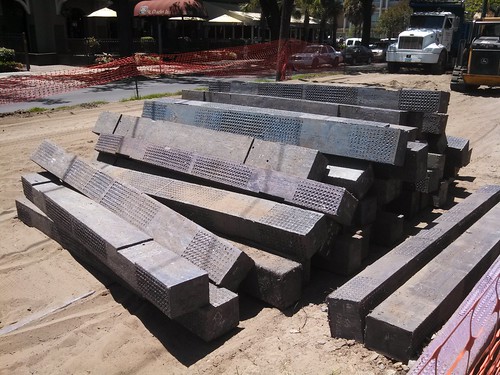
That there is a pile of old and rotting rail ties removed from the St. Charles Streetcar line earlier this month.  Don't look so hot, do they?  A quarter century ago, though, those were supposedly the top of the line product.
The wooden cross-ties have not been replaced since 1988, when the RTA undertook a $47 million program to renovate the St. Charles line's cars and replace all 13 miles of track and track bed. That project was the first complete overhaul of the line, which began operating in the mid-1830s.

At the time, the agency used azobe, a tropical hardwood that officials described as the longest-lasting option available, one that would preclude major repairs for at least two decades.

RTA officials say termite and weather-related damage has taken a toll on the cross-ties which are showing signs of breakage and rotting that could pose a threat to safety.

This time, the RTA will use a recycled plastic composite that transit executives say has become the industry standard.
Insert your preferred purple prose about New Orleans and its beautiful decay here, if you like.  Or, if you prefer, you can substitute an equally acceptable sarcastic remark about the termites or the climate or the fact that nothing works.  If you want to be really pretentious you could pull a quote from somewhere.
I came upon a boiler wallowing in the grass, then found a path leading up the hill. It turned aside for the boulders, and also for an undersized railway-truck lying there on its back with its wheels in the air. One was off. The thing looked as dead as the carcass of some animal. I came upon more pieces of decaying machinery, a stack of rusty rails. To the left a clump of trees made a shady spot, where dark things seemed to stir feebly.
In any case, I take it this is a pile of the new stuff. 

Streetcar ties

I actually don't go in for the popular schmaltz that romanticizes New Orleans as some dysfunctional pseudo-"third world" tableu vivant. So I don't think it's uniquely charming that a project like this would run behind schedule.  Rather it's just the normal course of events.  Unforseen complications arise. A dispute with a contractor causes delays. Neighbors complain, weather happens. Nothing ever gets done on time but that's okay because nothing is really supposed to.

Besides, the end of this project is clearly within sight. I could stand to be corrected on this point but, as far as I can tell,  the stretch of St. Charles between Louisiana and Jackson is all  that remains to be done and work there is currently underway.  Also there's this statement from RTA back in December. 
A spokeswoman said the entire project is scheduled to wrap up by the end of April, when presumably the buses once again will disappear from St. Charles
So they're pretty close to it now. That's pretty good, all things considered.  Trusting sort that I am, I'm going to assume that, since 2011 when this story was written, they've worked this bit out as well.
While the crossties are nearing the end of their useful lifespan, Augustine said, the track will remain functional for several years. The more critical issue, he said, is a requirement that much of the federal grant money being used for the project must be spent by 2013.
Probably depends on what they meant by "much of."   Either way it's good to see this is about done so we can get back to watching them tear up all the other roads Uptown for the SELA project.

Send them some parkettes

We keep hearing about the magic revitalizing "vibrancy" that comes with artificially imposed arts districts or high rise condo developments. But that's all stuff you see happening in places the wealthy are already interested in.  Why is no one trying to "revitalize" neighborhoods that are actually in decline?
This is not an indictment of Cobb County in particular. Rather, what’s happening in Cobb is a microcosm of the dilemma facing suburbs nationwide: a rapid spike in the number of poor people in what once were the sprawling beacons of American prosperity. Think of it as the flip side of the national urban boom: The poverty rate across all U.S. suburbs doubled in the first decade of the millennium—even as America’s cities are transforming in the other direction, toward rising affluence and hipster reinvention. If the old story of poverty in America was crumbling inner cities and drug-addled housing projects, the new story is increasingly one of downscale strip malls and long bus rides in search of ever-scarcer jobs. We can’t understand what’s working in America’s cities unless we also look at what’s not working in the vast suburbs that surround them.

Monday, May 12, 2014

Peak NOLA?

I asked this sort of as a joke last week but it really might be worth exploring.  At what point do people currently investing in the red hot New Orleans real estate market begin to consider cashing out before the long term value starts to crash?
The collapse of large parts of the ice sheet in West Antarctica appears to have begun and is almost certainly unstoppable, with global warming accelerating the pace of the disintegration, two groups of scientists reported Monday.

The finding, which had been feared by some scientists for decades, means that a rise in global sea level of at least 10 feet may now be inevitable. The rise may continue to be relatively slow for at least the next century or so, the scientists said, but sometime after that it will probably speed up so sharply as to become a crisis.
Of course, "the next century or so"  is more of a mileage-may-vary sort of proposition.  We probably aren't on the generous side of that.

All ur backyards are belong to us

There's only one reason it's even within the realm of possibility that Helis Oil won't drill its proposed fracking well in St. Tammany Parish. And that reason has nothing to do with what the residents there might want. Rather, it has to do with how far afield the location is along the targeted "Tuscaloosa shale formation"
The wells range from 10,500 to 14,500 feet deep and cost about $13 million each to build. That’s compared with the $10 million average price tag to drill and complete a well in north Louisiana’s Haynesville Shale, a natural gas field that also runs under parts of Arkansas and Texas.

Although it controls potentially as much as 60,000 acres in St. Tammany, Helis has proposed drilling only a single well so far, at a depth of about 13,000 feet. But what has some industry experts scratching their heads isn’t the depth but the location of the well, dozens of miles southeast of the Tuscaloosa formation’s core.

Overall, interest in the shale drilling effort has surged in the past year, the experts say. Most of the acreage has been leased by a few key players, and by most accounts, Helis Oil & Gas is not one of them.
If it wasn't something of wildcat operation the objections of the local NIMBYs would amount to exactly nothing.  To get that all you have to do is look around at everywhere else in the USA where we are reasonably certain about the prospects of drilling.

QOTD

This (via B&G Review) is from just signed Saints rookie free agent quarterback Logan Kilgore when asked, for some reason, to compare himself to a Manning.
“You know, I think I’m more like Eli. I think I’m a little bit…uh…maybe take that as a good thing or a bad thing.”
Anyway go look at the B&GR post. There are animated GIFs of all the free agent signees. This may be the only time you'll see many of them in action. 

tl;dr

At the outset of the recent mayoral election, Stephanie Grace characterized Michael Bagneris's candidacy as  "a campaign about nothing."  In a way she was right. Bagneris's campaign was so nonchalantly run and often tone deaf that it might as well not have been.

On the other hand, had it not been such a terrible campaign, it could have been about something. Grace pointed us to what the campaign about nothing could have been about in her weekend column about Landrieu's inauguration. 
In fact, the speech contained numerous echoes of Landrieu’s chief challenger’s campaign — not the personal conflicts and interagency grievances, but the emphasis on crime and opportunity for all in a city where spotty prosperity coexists with chronic unemployment among African-American men.

Landrieu had acknowledged these ongoing challenges during his campaign against retired Judge Michael Bagneris, of course, but he also painted a more positive overall picture. His speech Monday suggested that, personal animosity aside, the two weren’t really so far apart in assessing the city’s most daunting problems.

Bagneris halfheartedly fumbled around these themes but never really seemed to grasp them.Which probably means he cared more about, "the personal conflicts and interagency grievances" than, "the city's more daunting problems." So Grace is correct. The two men really weren't very far apart.

Anyway, I could have saved myself a whole lot of typing last week by just linking to Mitch's speech and pointing out these two statements.

There's this.
After years of trial by fire, we as a people have changed – New Orleans, we as a people have now found a new way.

The old way of ‘divide and conquer’ is gone, replaced with a new unity of purpose.

Old mistrust between business and government gives way to the mutual benefits of cooperation
 And then later there is this.
Our mission is to create a City of peace where everyone can thrive and no one is left behind.

Four years from now may seem a long way away, but time flies.

Those 1460 days will pass in a second. And what will we accomplish in our short time together?

What will we have done to open the circle of opportunity and prosperity to all?
This whole bloated thing was basically a long way of saying that if you truly buy into that first statement, you'll never be all that committed to the second.

Sunday, May 11, 2014

I, for one, look forward to Tavon Rooks's Hall Of Fame Induction

As the most obscure player the Saints drafted this weekend, Rooks is the most surefire guaranteed success. That's how this works, right?  It had better be, anyway, since the Colts selected a man named Andrew Jackson with the very next pick.  When Andrew Jackson is on the board and New Orleans passes on him to take you, it had better be worth it.

As for the rest of it, who the heck knows?  NFL draft choices are absurd risks. Frankly, I don't know why teams even bother making any.  Did anyone make the joke about the team going to Vegas to shoot craps before the draft even started?  Okay well consider that done now if it hadn't been.

As far as I can tell from watching this weekend, the Saints decided they needed a tiny receiver in order to better match up with the HUGE secondaries teams like the Seahawks have been using to corral the big receivers (Graham, Colston) their offense relies on. Apparently the key is going against the grain.. or something.

But then in the second round they decided they needed a HUGE defensive back in order to keep up with the Joneses defensively.  So, again, fuckall if I know what's going on.

Also they drafted a guy named Vinnie and some linebackers with like 50 knee surgeries between them.  Future stars all, no doubt.

Anyway,  now begins the really shitty part of the year.   The street flooding and termite swarms ushered that in quite nicely.  It's only like a ka-billion more days left until actual football season.  The best advice is try to find a safe place to hide until then.


Did it bleach with age?

YRHT is 10 years old now.

Apart from an occasional guest post by David Bellinger, or an even less frequent link or joke posted by Oyster, it's mostly dormant now... but only because its author went and got a real job... of sorts. 

Anyway, in its heyday, this was pretty much the New Orleans political blog to read. Not sure why he's messing with the design.  The old background was kind of an iconic internet structure. But I do hope its valuable archives remain available for a long time. 

Saturday, May 10, 2014

Idaho stop

What would Jesus drive?

I'm already dreading the inevitable run on unnecessary bicycle traffic law enforcement initiatives we're sure to see around here soon.  Up to now, a big part of the appeal of biking is that it's a way to get around without having to constantly worry about being pulled over. But what's happened in recent years is a lot of sanctimonious people who do things in order to model behavior for others have started biking more. Hence the building clamor for telling other cyclists what they're not allowed to do.

But instead of just complaining that terrible people are going to make terrible laws, better to point out the sensible laws that exist elsewhere.
There are already a few places in the US that allow cyclists some flexibility in dealing with stop signs and red lights. Idaho has permitted it since 1982, which is why this behavior is known as the Idaho stop.

Idaho's rule is pretty straightforward. If a cyclist approaches a stop sign, he or she needs to slow down and look for traffic. If there's already a car or another bike there, then the other vehicle has the right of way. If there's no traffic, however, the cyclist can slowly proceed. Basically, for bikers, a stop sign is a yield sign.
The basic point is that bikes are not cars. It's ok for the traffic laws to reflect this obvious fact. 

Friday, May 09, 2014

Safer than ever

Everybody back to work
Anyone who recites the “50,000 wells with one major accident” talking point apparently thinks you’re an imbecile. They want to throw you off-guard with a seemingly bold claim that masks true risk. Energy writer Loren Steffy debunked that tactic in a recent column. Only 43 wells comparable to the one in the Macondo tract have been drilled — not tens of thousands. And the “one major accident” happens to be the worst in the history of offshore drilling.

A growing amount of troubling evidence indicates workplace and environmental safety has not improved since 2010. Here’s one metric that should be deeply concerning: 20 independent oil companies working in the gulf have scored poorly on recent safety inspections.

Heckuva job

Bobby Jindal makes shrewd decisions.
Because of Bobby Jindal and Bobby Jindal alone, 277,000  (according to the study) Louisiana citizens will remain uninsured, despite the fact that federal law would provide them with the opportunity and the resources to guarantee their coverage.

277,000 may not seem like an enormous number to people who live in America’s big cities, but in Louisiana, a city of 277,000 would be the second-largest in the entire state.

Governor Jindal defends his decision to refuse Medicaid expansion on the basis that it could, at the very worst, cost Louisiana $1.7 billion over the next ten years. That projection is now definitively dubious, as it was based on a series of worst-case assumptions on enrollment and participation. More than likely, Medicaid expansion would actually make money for Louisiana.
This week, Gambit re-published an article from the Houston Press about the ACA's effect on Houston musicians and their access to coverage. Texas has also rejected the Medicaid expansion but that hasn't kept the law from having an impact.  And its impact is on attitudes as well as on health care.
One musician who came to Ozz's benefit concert was Christian Kidd of the Hates. Like Ozz, Christian and Alexis realize that much work must be done before reform provides decent, affordable coverage to the entire country.

  "You've got to start somewhere," Christian says. "I think there's people that really don't like the change and think that they can still turn this back and get rid of it."

  Christian rarely talks about his experiences with Alexis now that he has the coverage that allows his wife to monitor her disease. Much of Houston's punk and metal scene is staunchly libertarian and conservative, right down to The Hates' bass player. But regardless of politics, these musicians understand that the ACA has been a godsend to the Kidds, even if they oppose the idea on a national scale. "It does make them see the human element and not the fearmongering," Alexis says.

  Meanwhile, Christian is candid about downshifting his career with the Hates while seeing to his wife's health needs.

  "I definitely had to slow down," he admits. "I put things on hold. I grew up in a pretty conservative household. I always felt guilty because I didn't go to college and get a straitlaced job that would have allowed me to take better care of myself and others."

  What he says next speaks to the couple's recent struggles as much as to Christian's punk rock aspirations.

  "I was always pretty determined to do [music] instead, but I've always felt the sacrifices for it," he says. "You've got to do what you want to do, but it makes you aware of how things would be different if you'd become a doctor or something."
So it turns out that this terrible thing that was going to destroy America is really just a way to help you buy health insurance and feel less guilty about pursuing your dream. Once the formerly amorphous ball of HITLERSOCIALISTDEATHPANELS starts to have an impact on people's actual lives, they're less inclined to react to political demagogueing.  Candidate Jindal can't have that happening. Which is why he'll do whatever he can to limit that effect while he can.

Thursday, May 08, 2014

Prudent response

According to a very frightening National Climate Assessment report issued this week... very bad things.
New data from the National Oceanic and Atmospheric Administration is not going to make it any easier for Estopinal to get to sleep.

The federal agency charged with keeping track of sea levels, NOAA says Grand Isle has lost 1.32 inches of elevation to the Gulf of Mexico in the past five years alone — a rate of subsidence about four times faster than any other coastline in the lower 48 states, and one of the highest on the planet.

The rate is so high because the entire southeast portion of the state is sinking while seas are rising worldwide due to global warming. When subsidence is combined with sea level rise, the result is called relative sea level rise.

The latest update only confirms Grand Isle’s nation-leading average of 9.24 millimeters (.363 inches) per year over the past 65 years, or about three feet per century, said Steve Gill,  a chief scientist at NOAA. By contrast, Key West, less subject to subsidence, has been succumbing to rising seas at a rate of just 2.24 millimeters per year, according to federal charts of high tides kept over many decades at selected coastal stations.
Yikes!  Hey, are we doing anything about that?  What are the people who might try and do something about that up to?
The Louisiana Senate voted 24-15 on Wednesday in favor of legislation that would strip the east bank levee authority of its right to file suit to enforce federal or state laws governing coastal wetlands, a move likely to block the authority's July 2013 wetlands damages lawsuit against 97 oil, gas and pipeline companies.

Senate Bill 469, sponsored by Sen. Bret Allain and supported by Gov. Bobby Jindal, prohibits any state or local government agency other than the Department of Natural Resources, attorney general or Coastal Protection and Restoration Authority, from taking actions to enforce federal or state permits in coastal areas.

The legislation was tailored to kill the Southeast Louisiana Flood Protection Authority-East's suit, which Jindal contends violates state law because the authority should have received his permission first, and because it conflicts with the state's coastal restoration and protection Master Plan.
So at least we're protected from that.  Oh and also wine ice cream. They saved us from that too.  

First day of the rest of them

Cities How the fuck do they work?

Here's hoping they had a lot of fun Monday at the inaugural thingy.  If you were unable to capture the magic in person, it has been archived for you here 

The Lens is doing a thing where you, the reader, can fashion yourself a participant in the drama of online journalism and vote for which of a few selected statements you would most like to see them "fact check." Ideally they would just go ahead and check any and every statement they deemed at least suspicious enough to ask us about.  The five they've highlighted seem like an obvious good start.  But the Mayor said a bunch of other strange things too which I'd like to see addressed.

You can review the full text of his speech here.  Although, I would also recommend scrolling back through WWLTV reporter Paul Murphy's tweets. They do a nice job of stripping the speech down to its essential random aphorisms.  From among these, I've collected a few write-in candidates The Lens can add to their fact-check poll.

1) "We can become a shining city on the hill"

Which hill is he talking about? Most New Orleanians can name only one and it is not a naturally occurring hill. Also, it's probably worth pointing out that had Bienville put New Orleans on a hill in the first place a lot of the stuff we worry about today wouldn't be a problem.

2) "There is hope, a new way"

I am not so sure the way we're onto at the moment is all that new. I'd like to hope but something tells me not to. At least not until the hope is fact checked.

3) "We can create the New Orleans we always dreamed of"

Thanks to something a previous Mayor talked about once, I have occasionally dreamed of a New Orleans that is made out of actual chocolate. I don't know that we can create this place.. or even if we should.

4) "We all must move forward together"

I suspect we can probably move in several different directions at different times. Mitch says otherwise but I've seen him line dance and it's not all that coordinated.

5) "Today is first day of the rest of your life"

Please tell me I can still put this off until tomorrow.

After the celebration, though, there's plenty stuff to do.
The mayor will take his oath of office Monday at the Saenger Theatre and then go back to fighting on both the expenditure and the revenue fronts, trying to hold off big potential bills due on the city’s jail and firefighters pension fund while also pushing the Legislature to at least give voters in New Orleans the option of raising taxes on hotels, cigarettes and their property.
The tobacco tax isn't doing so well. (Update: It has now failed)

As for the hotel/motel tax, things are complicated. Last week, the mayor's proposed 1.75 cent increase ran into heavy opposition from gubernatorial candidate Jay Dardenne as well as from the lodging industry's taxpayer funded (via the Convention and Visitors' Bureau) publicity arm, NEWORLEANSWILL.

The hoteliers insist they're too busy trickling down minimal wage and benefit service industry jobs on the city to contribute anything significant to solving its financial problems. The great majority of the current hotel/motel tax goes to state entities geared toward servicing the hospitality industry.  Last year, in fact, the industry asked for and was granted the option of paying a "voluntary" 1.75 percent tax provided all of that money went directly back into its own marketing efforts.

Headquarters of New Orleans Tourism

The mayor has a second proposal in his back pocket which would ask the legislature to create a special taxing district where, theoretically, all of the tax revenue from retail and hotel taxes would accrue to the city.  It was believed the targeted district would include the redeveloped World Trade Center site but negotiations over that project abruptly fell apart last week reinforcing the impression that this is a taxing district to nowhere.

More curiously, the preliminary draft of the bill authorizing the new district appears to give governing authority to the Louisiana Stadium and Exposition District board which itself is already funded by the current hotel/motel tax.  The board would, apparently, also have the authority to add properties to the special district as it sees fit. Why would LSED be asked to make decisions which appear to route tax revenue away from itself? The answer currently is that the draft is just a "placeholder bill" whose wrinkles are expected to be ironed out later. If it moves, it will be worth watching.

Meanwhile with the tobacco tax not going anywhere and the hotels refusing to budge, the Mayor is asking homeowners to take up the slack. And it's a lot of slack.
With two of his tax increase proposals on life-support, Mayor Mitch Landrieu has doubled down on a third option that would raise property taxes in New Orleans to help pay for more police officers, improvements to the parish prison and the city's debt to the firefighters' pension fund.

Through an amendment Thursday (May 1) to House Bill 111, the administration asked a state Senate committee to double two millages for police and fire protection from 5 mills to 10 mills each. The move could generate an extra $30 million a year for the cash-strapped city.
Tourism leaders who loudly proclaim their essential role in the city's economy are refusing to contribute anything to its tax coffers that doesn't come directly back to them while residents are being asked to double their burden just to keep up basic services.

Even the Monopoly man thinks this is backwards.


But backwards would appear to be the new black when it comes to urban development policy these days. Planned gentrification is all the rage. Sociologist David Madden writes about this frequently. The following is from an op-ed published in The Guardian last year.
Here's how gentrification talk typically goes: poor neighborhoods are said to need "regeneration" or "revitalization", as if lifelessness and torpor – as opposed to impoverishment and disempowerment – were the problem. Exclusion is rebranded as creative "renewal". The liberal mission to "increase diversity" is perversely used as an excuse to turn residents out of their homes in places like Harlem or Brixton – areas famous for their long histories of independent political and cultural scenes.

After gentrification takes hold, neighborhoods are commended for having "bounced back" from poverty, ignoring the fact that poverty has usually only been bounced elsewhere.

In an insidious way, the narrative of "urban renaissance" – the tale of heroic elites redeeming a city that had been lost to the dangerous classes – permeates a lot of contemporary thinking about cities, despite being a condescending and often racist fantasy.
What does this even mean?

Removing the poors and replacing them with a better sort of resident is not merely an unfortunate side effect of  modern economic development, it's often the explicit policy goal.
Evangelists for elite-dominated urbanism sometimes argue, as New York's mayor Michael Bloomberg did recently, that attracting the super-rich is the best way to help those city-dwellers he quaintly calls "those who are less fortunate". But the trickle-down argument for gentrification ignores the fact that the "very fortunate" invariably seek to bend municipal priorities and local land uses towards their own needs, usually to the detriment of their less powerful neighbors
New York and San Francisco are the most frequently cited examples of what elitist urban policy has done to  formerly working class neighborhoods. But the phenomenon is not isolated only to those places.

Thomas Frank has written a lot lately about urban planning's obsession with creating "vibrancy" via manufactured arts and culture scenes although no one is really sure what that means much less can delineate its benefits.
How does art do these amazing things? you might ask. Reasoning backwards from the ultimate object of all civic planning—attracting and retaining top talent, of course—the Art-Place website pronounces thusly:
The ability to attract and retain talent depends, in part, on quality of place. And the best proxy for quality of place is vibrancy.
Others have spelled out the formula in more detail. We build prosperity by mobilizing art-people as vibrancy shock troops and counting on them to . . . well . . . gentrify formerly bedraggled parts of town. Once that mission is accomplished, then other vibrancy multipliers kick in. The presence of hipsters is said to be inspirational to businesses; their doings make cities interesting and attractive to the class of professionals that everyone wants; their colorful japes help companies to hire quality employees, and so on. All a city really needs to prosper is group of art-school grads, some lofts for them to live in, and a couple of thrift stores to supply them with the ironic clothes they crave. Then we just step back and watch them work their magic.

This, then, is how far it’s gone. The vibrant is the public art of today. It is Official. Our leaders think it will solve the problems of the cities large and small. Our leaders believe it will help to pull us out of our persistent economic slump.

Troubled Times Will Soon Be Gone

If you have time for it, here is a remarkable conversation between Frank and Lewis Lapham where they talk about a number of things including the institutionalized co-opting of perceived "coolness" for the purposes of consumer branding.  Here Frank addresses this specifically with respect to urban revitalization schemes.
..there are cities all over America now that are investing heavily, both of their own money and with foundation money — public-private partnerships — in the idea of planned bohemias. You know about this? (Laughs) Potemkin bohemias, fake bohemias that a given city will set up. They will hire some consultant in coolness. And he’ll come and tell them how to make a neighborhood “cool.” And the reason why you would want to make a neighborhood cool? Why do you want to do that? Well, of course, in order to attract and retain top corporate talent. Get Boeing or some other big corporation to move to your town, because it’s got all these hipsters in it. We used to joke at The Baffler Magazine, “Boeing moved to Chicago because we were there.” Everything that Mayor Daley was claiming credit for. No. We were doing it. We’re the ones who were responsible. Because my friends and I were so goddamn cool in those days. By the way, this fake bohemia thing really happens. People waste tons of money on it.
In New Orleans we love to fight the "hipster" wars.  Or, at least, we love to proclaim our exasperation with the whole conversation.  "What even is a hipster?" sigh so many so often as they miss the point. "Wouldn't you rather have (INSERT HIPSTER CLICHE OF CHOICE... ARTISINAL TOAST, PERHAPS) than blighted neighborhoods? What is it about (TOAST) that so frightens xenophobes like you?"

But no one is afraid of toast, or kale, or empanadas or whatever the thing may be. People do get squeamish about being priced out of their homes in the name of "blight reduction" though. Among the mayor's statements The Lens offers to fact-check for us is this.
In four short years, we went from having the worst blight problem in America to tearing down or fixing up blight faster than anywhere else in the country.
I would urge readers not to vote for this to be the fact-check item. For one thing, they already did fact check it.  For another, fixating too much on "blight" as a bug-a-boo plays directly into the canard that "fighting blight" is such an urgent priority that we must accept gentrification as its necessary alternative.

Here is a worthwhile essay by geographer Tom Slater which attacks the notion of gentrification vs. blight as a "false choice."
In order to situate gentrification in a more helpful political and analytical register, we must blast open this tenacious and constrictive dualism of “prosperity” (gentrification) or “blight” (disinvestment) by showing how the two are fundamentally intertwined in a wider process of capitalist urbanisation and uneven development that creates profit and class privilege for some whilst stripping many of the human need of shelter. No viable alternatives to class segregation and poverty will be found unless we ask why there are neighbourhoods of astounding affluence and of grinding poverty, why there are “new arrivals” and an “Old Guard”, why there are renovations and evictions; in short, why there is inequality. 

Despite many attempts to sugarcoat it and celebrate it, gentrification, both as term and process, has always been about class struggle. When we jettison the ludicrous journalistic embrace of “hipsters", reject the political purchase of the enormous literature on the gamut of individual preferences and lifestyles of middle-class gentrifiers, and consider instead the agency of developers, bankers and state officials, then questions such as for whom, against whom and who decides come to the forefront - and we can begin to see false choice urbanism as both red herring and preposterous sham


Leaders make deliberate choices affecting the availability of affordable housing, the funding of infrastructure, and the distribution of the tax and fee burden for services.  These are political decisions, of course. But we are expected to presume they come to us as benign technocratic solutions judiciously engineered by apolitical experts in some sterile policy lab. No such place exists. Policy choices create winners and losers.  In order to at least try and calibrate those choices to best fit the will of the majority rather than that of the elite, we elect our policymakers democratically.  And still we very frequently manage to get it all wrong.

During Mitch Landrieu's term as Mayor, New Orleans has become a nexus of trendy elite urbanist theory. Partly this is because we've been tasked with the nation's biggest and most unique rebuilding job at a time when  neoliberal trends have come into ascendance. But it's also the case because Mitch just chooses to buy into a lot of it.

Landrieu is a regular at the Aspen Ideas festival of elite consensus where he talks about favorite topics like school charterization  and  "public-private partnerships" with Goldman Sachs executive Lloyd Blankfein and media parasite Ariana Huffington and the like.  He tours the country as a sort of national poster-child for neoliberal urbanism touting a "New Orleans miracle" in the same manner a somewhat less cogent Bobby Jindal is hawking a "Louisiana Miracle" in the course of his proto-campaign for President.

In a sense, neither of them is wrong to say that the city and state have experienced boom times as of late. The state has seen low unemployment numbers in recent years thanks the nation's thirst for fossil fuels. The state has failed to reap the benefits of the oil and gas boom, though, as its finances are still an unholy mess while its infrastructure,  health care and education services.. not to mention its coastline... continue to crumble. 
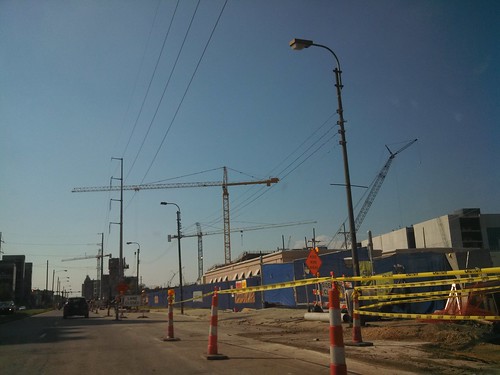
Cranes

Similarly the City Of New Orleans has been putting federal disaster recovery dollars to work rebuilding... well... everything at once.
When he took office in 2010, Landrieu adopted a “fix everything at once” approach to New Orleans’ myriad problems. Crime, blight, potholed streets, leaky sewerage, joblessness, homelessness — he said we had to tackle them all at the same time.

It was an ambitious strategy, to be sure, but the Landrieu administration seemed to sense it was necessary.

Without rapid improvements on all fronts, they feared, the city wouldn’t expand its tax base quickly enough to shoulder old debts and expensive new consent decree obligations.
Without quick growth, the administration feared we’d be revenue-starved and forced into a vicious circle of budget cuts, decreased services, and further population outflows.
Moseley kind of suggests in that column that a "fix everything at once" strategy might have been imprudent.  But I'm not sure there was any alternative.  The imperative of post-Katrina rebuilding more or less dictated a crane on every skyline once the money started rolling in. There's no reason to fault Landrieu for simply allowing federally funded rebuilding projects to proceed. A better criticism asks, as Slater puts it, "for whom, against whom" New Orleans has been "fixed."

In fact, Moseley does address this question, and this is really the crux of his column so here it is.
Critics are displeased and urge Landrieu to make budget cuts rather than confiscate more income from taxpayers. Landrieu’s allies say the mayor needs the tax revenues for budget “flexibility.” But giving the administration more flexibility comes at the expense of increasingly inflexible household budgets.

Another problem with Landrieu’s approach is that we’re expanding the tax base with an influx of transplants, a dynamic that has ignited housing inflation and a sharp increase in rents. 
But it's imprecise to say simply that the problem is we're looking to "transplants" to expand the tax base.  More to the point, we're looking to big money buyers (granted, mostly from out of town) to radically bid up housing prices.
But what was once a leisurely inspection has become, in some cases, a feeding frenzy. Agents now bring their clients in tow. Offers are sometimes discussed outside; agents describe offers being scribbled out on the hoods of cars.

Last week, one of the properties open on the tour was 1015 Arabella St. -- a double being rented out to tenants. By Friday morning, the listing agent, Lynne Ann Fowler of Latter and Blum, said the owner had received three offers and already accepted one that was "close" to the asking price of $375,000, although she said she couldn't say the exact offer while the contract is pending.

She said the house is in need of some renovation, depending on whether the new owners want to convert it to a single and live in it, or keep using it as rental property.
It's hard to imagine a sale like that going through solely for the purpose of maintaining an existing rental property.  New Orleans, particularly in its historic neighborhoods, is an investment now.  The wage earners and rent payers have to be moved out of the way in order for the asset traders to flourish.

This shouldn't come as a surprise. Renters and wage earners have become more or less structurally irrelevant people over the past 20 or 30 years. Going back as far as the late 1970s, as automation and globalization began to seriously affect the manufacturing sector of the economy, wages became uncoupled from productivity meaning a great deal of wealth could be produced while wages remained largely stagnant. Again, I'll refer you to that conversation between Lapham and Frank for some insight as to what happened next.
as long ago as 1985 or 1986, the money earned in the United States, the income earned from wages on one hand and income earned from rents which would be real estate, stocks, dividends and interest — together they’re considered rents. But the first time in the history of the United States, either in 1984 or 1985, that rentier income surpassed the income earned from wages. And we are developing right now a really, an extremely opulent rentier class. If you think of the profits that have been made in the stock market in the last 30 years and you think of the compound interest, that is why you now have apartments selling for $95 million. So we are getting a rentier class. There’s no question about that. The numbers are all there.
If you aren't a member of a highly specialized profession or some sort of asset speculator... in other words, if you're not a part of what Mitch Landrieu euphemistically calls the "knowledge economy" there really isn't much of a place for you.

These kinds of economic challenges are, of course, much bigger than New Orleans. They are born of long term trends and are international in scale.  The fact that they are being felt as acutely as they are  in New Orleans today is probably a perversely healthy sign as much as anything.  It means that the focus of the global economy is on us.  Unfortunately, the global economy also happens to be kind of terrible.
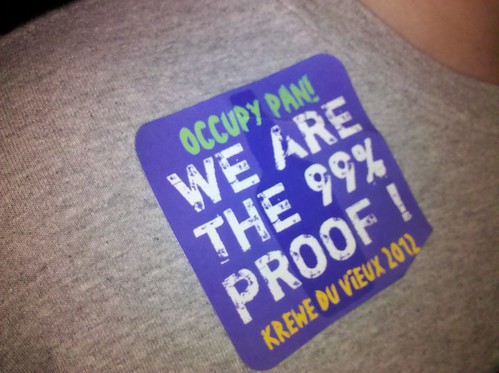
We are the 99 proof

Still, it matters how we react politically to these events in the little local space where our voices might make some small difference.  Of course, we react poorly.  In what has more or less become the consensus view, the city's "changing demographics" represent a change for the better. Many seem to believe the city cannot gentrify fast enough.

This consensus holds that the poor and working class of "old" New Orleans were themselves the primary cause of  the city's ills. In a recent documentary, developer Pres Kabacoff called them a "drag on the economy."

Last week, in his Uptown Messenger column, real estate agent Jean-Paul Villere sneered at the supposed apathy of "old" New Orleans  he saw manifested in a broken phone booth that had not been hauled away expeditiously enough for his taste.  And yet he cautiously holds out hope that, with a little more "new blood" we'll get our act together.
Right now people, we’re serving our clients (read: ourselves) poorly.  Because there’s always a reason to do or not to do something.  And while people can rationalize anything, your job is still your job, and if it’s worth doing, then it’s worth doing well, yes?  With all this new blood pouring into the Crescent City, between the entrepreneurial set, Hollywood types, and medical practitioners, my hope is the ‘not my job’ culture can be fixed along with all the other deficiencies we too often mistake for charm or endearment.  But I’m not convinced.  Yet. 
How many doctors, entrepreneurs, and "Hollywood types" does it take to haul a pay phone off to the dump? I can't wait to find out either.

In the meantime, though, I'd rather ask what explains all this downward looking class hostility?  To answer that, we look once again at how what's left of our middle class has been badly abused by the decline of the wage-based economy. And at the deliberate manipulations of the social compact designed to divide and conquer them politically.
Simply put, starting in the 1980s policymaking elites in the Western world were scared to death of oil shortages, inflationary spirals and the impact of jobs being shipped to lower-wage nations or made obsolete by increasingly powerful machines and computers. Something had to be done. Even as foreign policy became explicitly focused on securing access to oil, domestic policy became focused on quashing inflation while disguising wage stagnation. Either countries needed to move sharply to the left through increased worker protections and redistribution of incomes, or to the right by substituting an asset-based economy for the old wage-based economy. Most chose to go right — an understandable move at the time given that state Communism was still a threat to capitalist economies, but also a spent and discredited ideology. Ronald Reagan best made the case for the new economic model in a speech from 1975: 
Roughly 94 percent of the people in capitalist America make their living from wage or salary. Only 6 percent are true capitalists in the sense of deriving income from ownership of the means of production …We can win the argument once and for all by simply making more of our people Capitalists.
One of the chief ways that American and British policymakers put this vision into reality was by crippling organized labor. But while that certainly placed downward pressure on wages in the U.S. and Britain, labor was not so similarly affected in most of the rest of the developed world. Organized labor remains a powerful force throughout most of Europe, yet growing wealth inequality and a declining middle class are present trends there as well. The health of organized labor abroad has helped stem the tide, but has not managed to stop it. The less noticed but potentially more consequential way that policymakers across the industrialized world set about accomplishing this goal was to push their middle classes to invest their wealth into assets, especially stocks and real estate, then use the levers of public policy to inflate the values of those assets in order to disguise the inevitable declines in wages.
This was accomplished in a number of ways. The short of it, though, is that middle class life  in America  had less to do with communal interest institutions like, say, labor unions, or defined-benefit pensions. Instead our middle class began to see themselves as isolated mini-capitalists with 401(k)s, lines of consumer credit, and most likely a home mortgage which, although not purely a speculative investment for most people, at least provided them with a simulation of that experience.

Those who buy into this illusion are invited to view the people around them as competitors rather than neighbors.  When we imagine ourselves as individual entrants in a pageant of capitalistic virtue, we are quicker to jettison those deemed a "drag" or at least to wish their sloth rehabilitated through exposure to superior examples of character. Thus J-P Villere can demonstrate his industriousness by tweeting a photo to Entergy while he awaits the coming his professional brethren to further enlighten the rest of us. 

As the shock of each busted asset bubble puts more and more strain on a middle class striving to maintain its illusions, these anxieties only get worse. White collar skills previously thought to be safe prove as easily obsoleted by technology and globalization as the blue collar base that went before.  Housing prices crash, those 401(k)s haven't earned as well as advertised, long term career employment becomes less certain and suddenly everyone is an "entrepreneur."

And still our leaders completely miss the point. In his inaugural address Monday, Mitch Landrieu touted New Orleans as "a vibrant hub for young entrepreneurs."  Despite how ominous that sounds in light of everything, he meant it in a good way.

While it's fine for the mayor to act as the city's booster-in-chief, it's important to note that the proliferation of  "entrepreneurial innovation" he's celebrating can also be a sign of distress.
Some of these new companies are obviously helpful to the economy. But when you look at the kinds of businesses getting started, and who is starting them, it becomes clear that lots of entrepreneurship in the last few years has been symptomatic of our sick job market.
This is most especially a concern when it comes to the entrepreneurial activity that takes place within what is now known as the "sharing economy." 
A huge precondition for the sharing economy has been a depressed labor market, in which lots of people are trying to fill holes in their income by monetizing their stuff and their labor in creative ways. In many cases, people join the sharing economy because they've recently lost a full-time job and are piecing together income from several part-time gigs to replace it. In a few cases, it's because the pricing structure of the sharing economy made their old jobs less profitable. (Like full-time taxi drivers who have switched to Lyft or Uber.) In almost every case, what compels people to open up their homes and cars to complete strangers is money, not trust.
New Orleans does not have Uber or Lyft yet but it does produce a lot of action on Airbnb.  An extensive feature on Airbnb's local impact ran in the March issue of Antigravity.   While the service can seem like a godsend to marginalized homeowners struggling to keep up with bills, in the aggregate it's yet another constricting force acting on the housing market.
For one thing, it puts renters in New Orleans into direct competition for space with an endless churn of visitors able to pay $50 to $200 a night. For another, it subjects residential neighborhoods to wave after wave of super-short-term outsiders, a potent disruptive and destabilizing force in areas still fighting their way back to some semblance of stability. Tourists have no understanding of the neighborhoods they’re invading, and unlike longer-term residents, they have no incentive to get along with or respect those who live in the neighborhood. They’re here to party and enjoy themselves, and it’s in the Airbnb host’s economic interest to ensure they’re able to do so. On a NOLA.com article about the city’s ongoing failure to enforce the laws against illegal short-term rentals, one commenter said his experience of living next door to an illegal guesthouse was like “living next to a frat house.”
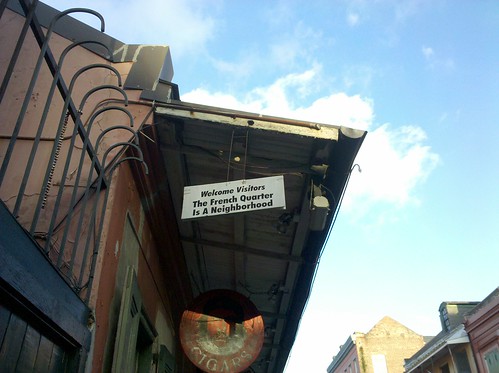
The French Quarter is a Neighborhood

Also at issue, from the city's perspective, is the potential for lost revenue.  After all Airbnb is basically one big off-the-books hotel.   The city welcomed a near-record 9.28 million visitors last year. A key challenge for the mayor and his new council faced with a severe budget crisis is figuring a way to capture the highest possible revenues from the city's most vital industry. 

The hotel/motel tax hike is already meeting with significant static in the legislature. I can't help but wonder, then, if this might help explain the dramatic rise proposed for property taxes.  Think about it. The housing market in New Orleans is on fire right now.  A lot of the pricier properties are already part time second homes.  A lot of property owners are getting into the illegal short-term rental business.  It could be that the idea here is to pay off the consent decree and fire pensions by indirectly taxing this off-the-books activity.

If this is what they're thinking, I have to admit it's kind of ingenious.  Leaving the illegal rental market alone keeps the real estate market hot. This means more house flipping, less blight, and, as neighborhoods seek to cultivate more tourist-friendly amenities, it means more "vibrancy."  The city can reach its goal of 13 million annual visitors and not one extra cent in hotel taxes need be raised. It basically hits all of the Landrieu sweet spots and takes a fiscal load off the city's back in the process.

Of course that for whom, against whom question remains troublesome. Rents, utilities, and other fees continue to rise. "Old" New Orleanians will have to stretch their entrepreneurial acumen to its limits in order to keep up. In his speech Monday, Mayor Landrieu appeared to acknowledge some responsibility to do something about that.
Our mission is to create a City of peace where everyone can thrive and no one is left behind.

Four years from now may seem a long way away, but time flies.

Those 1460 days will pass in a second. And what will we accomplish in our short time together?

What will we have done to open the circle of opportunity and prosperity to all?
So far, we haven't done much.

As noted above at some length, economic inequality is not a problem unique to New Orleans and certainly the mayor's capacity to solve it is limited. Economist Thomas Piketty has prescribed a Global Wealth Tax as his preferred policy response.  Mitch can't even get an 80 cent tobacco tax passed in the Louisiana Legislature.

"What will we have done to open the circle of opportunity and prosperity to all?"  Mitch now has fewer than 1460 days to answer his own question. Today is the first day of the rest of those.
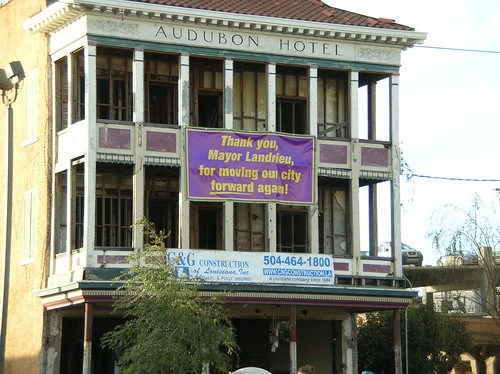

Audubon Hotel


Tuesday, May 06, 2014

Sinking ship

The weirdest thing about the rising cost of living in New Orleans is trying to figure out when the inevitable sell-off begins.  My best guess is it hits a year or two after the last big recovery construction project ends. Maybe that's after the Hospitalplex finally opens.  Maybe that's after Mitch finally drags City Hall over to Charity. 

But leaving that aside, I also wonder when all the people pouring money into real estate here start to realize that might  not exactly be a solid long-term investment given the circumstances.
Louisiana will see billions of dollars in increased disaster costs as early as 2030 resulting from the combined effects of global warming and natural processes, according to a new National Climate Assessment report released by the White House on Tuesday (May 6).

The report also warns that sea level rise – combined with naturally-occurring subsidence – continues to threaten wetlands and land bordering the state’s most populated areas, increasing their risk from storm surges; and that sea level rise driven by human-induced global warming also threatens interstate highways, railroads, ports, airports, oil and gas facilities and water supplies.
There's got to be a point at which the water gets too damn high for the rent to get any too damn higher, right?

Tomorrow is the first day of the rest of Mitch Landrieu's term

Technically yesterday was that also.. or maybe today is. I understand he's been playing on a bad knee so I'm not sure how that affects the accounting.  Yesterday, in concluding his inaugural speech he told us that, "today is the first day of the rest of our lives" which seemed like it would have trumped something so mundane as the beginning of a mayoral term so I just thought maybe he wanted an extra day.

Anyway tomorrow is a big one.
Two taxes that would shore up the New Orleans city budget will be heard in the Legislature on Wednesday.

A bill to impose an 80-cent tax on tobacco products will be heard Wednesday morning in a House committee. A bill to raise the city’s hotel tax by 1.75 percentage points will be debated Wednesday afternoon on the House floor.
I've got an already tl;dr  post about Mitch, The Universe, And Everything sitting in draft that should be up by tomorrow. 

After that, though, it's (sort of) football season again so go get ready.

The Jindal Papers

I hope someone is archiving the collected weekly pre-campaign national columns of Presidential Candidate Bobby Jindal for posterity. Taken together they invent the strangest but most fascinating of imaginary worlds.  In this week's installment we learn that Louisiana's "fiscal house is in order."
Second, we got our state’s fiscal house in order.  We cut the state budget by $9 billion or 26 percent, reducing the number of government jobs by over 28,000; we shifted from a government-run hospital system to a health system that embraces ingenuity and efficiency of experienced private partners.
As often as Jindal is published in the papers, one would think that maybe he'd take the time to read one

Don Gregory, health care adviser to the Public Affairs Research Council of Louisiana, issued a statement late Friday saying the federal decision on Jindal’s efforts to privatize charity hospitals could blow a huge hole, possibly as large as $440 million eventually, in future state government budgets.

The U.S. Centers for Medicare and Medicaid Services late Friday questioned the Jindal administration’s use of $260.8 million in advance lease payments to prop up the deals involving six public hospitals, including those in New Orleans, Lafayette and Houma. If the decision stands, the state would have to find another way to cover those payments.

“While we hope, for the sake of the citizens of Louisiana and to avoid an extraordinary budget impact, that the administration is successful with its appeal, state leaders at this point should face the reality of this potential shortfall and start planning how we will deal with this problem in our current development of the fiscal year 2015 state budget in the Legislature,” Gregory wrote.

Saturday, May 03, 2014

Where did all the money go?

Russel Honore asks,
Anti-fracking forces in St. Tammany Parish had a long wait this week for retired Army Lt. Gen. Russel Honoré, who missed a scheduled meeting at the Abita Springs Trailhead on Thursday afternoon. But when the general-turned-environmental-activist did show up at Abita Springs Town Hall that evening during an informational meeting about planned fracking in Mandeville, he was greeted like a hero.

The audience clapped and cheered as Honoré entered, and they occasionally started clamoring to hear from him instead of the panelists or audience members who were holding forth.

Organizers insisted on sticking to the program and said Honoré would speak last.

When he did so, the crowded hall seemed to transform into a tent revival. Honoré exhorted his audience, which eagerly participated in a call-and-response that lambasted fracking for failing to bring better roads, schools or prosperity to the places where it is prevalent.

Where the hell is the money going?” he asked to roars of approval.

Mumkinfest was seven years ago

Time flies faster than a buckmoth.

Sadly, Mumkinfest never grew into the annual mega-event we had hoped for. Just never could wrangle that Shell sponsorship.

Incidentally, it's May 3.  We're usually under siege from caterpillars by now.  Where are all the mumkins?

Do over

Bobby Jindal's diligent work privatizing hospitals is coming to naught.
The federal government Friday rejected the Jindal administration’s financing plan for privatizing the administration of LSU hospitals.

The U.S. Centers for Medicare and Medicaid Services questioned the administration’s use of $260.8 million in advance lease payments to prop up the deals involving six public hospitals, including those in New Orleans, Lafayette and Houma. If the decision stands, the state would have to find another way to cover those payments.

“It is not about how Louisiana manages its charity care system,” wrote Marilyn Tavenner, the administrator of the Centers for Medicare and Medicaid Services, in a letter released late Friday.
It’s how “specific financial transactions” are organized.

The private hospital companies leasing the state’s charity hospitals agreed to pay up-front a larger proportion of their long-term leases, which would result in paying lesser amounts toward the end of the contracts. But Tavenner wrote the arrangement amounted to Louisiana trying to get extra federal Medicaid dollars to repay private managers for those advanced lease payments.
If I were a suspicious person I might wonder about Jindal's relationships with the various management companies.  That used to be the sort of thing that drew attention.

Thursday, May 01, 2014

The #FreeJackie bill

The legislature is considering a law that would require elevators to be inspected in Louisiana.  You may have thought such a bill already existed.  It did not.
Louisiana doesn’t require regular safety inspections of elevators, and while some municipalities have set their own regulations, most parishes are without rules for annual checkups to make sure elevators and escalators are operating properly.
This became a local issue last year when Jackie Clarkson was late to a council meeting because she was stuck in the elevator at City Hall for 40 minutes

Currently the mayor is still quietly pushing a plan to move City Hall over to the vacant Charity Hospital Building.  No word on how an elevator inspection decree might increase the cost of such a project.

Where did all the money go?

James Gill on Bobby Jindal's "Louisiana Miracle"
The economic miracle suggested by the employment figures, meanwhile, has not exactly put state government in clover, partly, no doubt, because of the tax cuts Jindal is so proud of. He just ordered a spending freeze across all departments, and has been obliged to tap state Treasurer John Kennedy for a $40 million loan to keep the colleges open. Next year’s budget, as usual, is held together with chewing gum and baling wire.
What even is the point of a "booming" economy if we're not going to put the boom to work for us?

Also, the "boom" is almost gone.  What happens then?