-->
Showing posts with label net neutrality. Show all posts

Thursday, December 14, 2017

Will the last person to get kicked off the internet please turn off the lights?

Here is how stupid this whole thing is.
Federal Communications Commission (FCC) Chairman Ajit Pai appeared Wednesday in a video promoting his impending net neutrality repeal, dancing with a woman who has a history of promoting the so-called "Pizzagate" conspiracy.

The Pizzagate conspiracy theory, which proliferated during the final days of the 2016 presidential race, posits without evidence that high-ranking Democrats were involved in a nonexistent pedophile ring based out of a Washington, D.C. pizzeria. In December 2016, a man motivated by the conspiracy theory fired a gun in the business.

The video, produced by conservative outlet The Daily Caller, features Pai insisting that the FCC's impending, highly criticized repeal of net neutrality will not affect what users can do online.

In one clip, Pai is seen dancing alongside Martina Markota, a video producer for The Daily Caller.
People are confident this will be overturned in the courts. But Trump is packing the courts with conservative troglodytes. People are confident the next Democratic administration will reverse this but, let's face it, the telecoms own them too. By the time the opportunity comes along, everyone will have their noses in enough troughs to hem and haw it all away.

This is a huge loss. If you think the world we live in now is isolating and demoralizing, just wait til you see what it's like without an open internet.  I'm an old now so I remember that time and am not excited to go back there. 

Wednesday, December 13, 2017

Many people would prefer not to be kicked off the internet

It's not as though the Trump FCC gives a shit, but some of these people write to them anyway.
To see who will be affected, simply walk into any New York City library branch. See the students who literally cannot do their homework without our computers. See the parents and caregivers who are learning English and applying for jobs online to improve their circumstances. See the higher education students, independent researchers, and scholars who need our databases and online collections to further scholarship. Imagine how frustrated they will be, how demoralized, that they can no longer access what they need.

Wednesday, December 06, 2017

Kicking each other (and you) off the internet

I dunno. Maybe content should be universally accessible across platforms and networks instead of subject to artificial proprietary fragmentation benefiting one or another oligopolic megaliths.
The latest standoff between Google and Amazon was ridiculed by a trade association of high-speed internet providers. The group, USTelecom, has been trying to persuade skeptics that internet providers will preserve equal access to all digital services, even if the Federal Communications Commission adopts a proposal to rescind current "net neutrality" regulations .

Internet providers are committed to "protections like no content blocking or throttling," said USTelecom CEO Jonathan Spalter. "Seems like some of the biggest internet companies can't say the same. Ironic, isn't it?"


 Or maybe this is the best of all possible worlds. Who is to say?

Wednesday, November 29, 2017

Kicking you off the internet

It's actually been less of a swift kick and more of a gradual lowering of everybody down off the internet. Kind of like coastal erosion, maybe. Anyway, like I've been saying for years, this was always going to happen. Because it's always been happening.
The internet’s singular power, in its early gold-rush days, was its flexibility. People could imagine a dazzling array of new uses for the network, and as quick as that, they could build and deploy them — a site that sold you books, a site that cataloged the world’s information, an application that let you “borrow” other people’s music, a social network that could connect you to anyone.

You didn’t need permission for any of this stuff; some of these innovations ruined traditional industries, some fundamentally altered society, and many were legally dubious. But the internet meant you could just put it up, and if it worked, the rest of the world would quickly adopt it.

But if flexibility was the early internet’s promise, it was soon imperiled. In 2003, Tim Wu, a law professor now at Columbia Law School (he’s also a contributor to The New York Times), saw signs of impending corporate control over the growing internet. Broadband companies that were investing great sums to roll out faster and faster internet service to Americans were becoming wary of running an anything-goes network.

Some of the new uses of the internet threatened their bottom line. People were using online services as an alternative to paying for cable TV or long-distance phone service. They were connecting devices like Wi-Fi routers, which allowed them to share their connections with multiple devices. At the time, there were persistent reports of broadband companies seeking to block or otherwise frustrate these new services; in a few years, some broadband providers would begin blocking new services outright.
It's been fun. 

Tuesday, November 21, 2017

Kicking you off the internet

When we look back at where the most lasting damage was done by the Trump Presidency it's going to be everything going on at the EPA and this.

Federal regulators unveiled a plan Tuesday that would give Internet providers broad powers to determine what websites and online services their customers can see and use, and at what cost.

The move sets the stage for a crucial vote next month at the Federal Communications Commission that could reshape the entire digital ecosystem. The FCC’s Republican chairman, Ajit Pai, has made undoing the government's net neutrality rules one of his top priorities, and Tuesday's move hands a win to broadband companies such as AT&T, Verizon and Comcast.

Pai is taking aim at regulations that were approved two years ago under a Democratic presidency and that sought to make sure all Internet content, whether from big or small companies, would be treated equally by Internet providers.

It was always going to happen sooner or later.   The internet is simply following the same pattern of previous mass media toward more centralized and less democratic control. It's what capitalism does.  You'll see some false moralizing from #Resistance types for a while but they'll never overturn this. Eventually we all belong to Verizon.

Thursday, June 29, 2017

Kicking you off the internet

Cox thinks maybe you guys are being a little too online AF nowadays.
Cox Communications is going to set data caps on Louisiana home internet usage in July, and the small number of customers the company says are the heaviest users of streaming video and music will have to pay more.

Beginning July 6, most Cox customers in south Louisiana will have a data plan that allows them to upload or download 1 terabyte of data. That's enough to watch 140 HD movies, 150 hours of standard definition television, 1,500 short web videos, surf the internet for 3,000 hours and listen to 30,000 songs. Customers who have Cox G1GABLAST service will be capped at 2 terabytes. Those who go past the cap will be charged $10 for each additional 50 gigabytes of data used.
Here is where they finally break the promise of net neutrality. If you can only afford to use X amount of internet, and if all the big media conglomerates want to deliver their TV and movies to you via the internet, then you probably can't afford to spend much data allowance viewing or creating independent content. You probably can't afford to use the internet for connecting with peers. Eventually big media crowds everybody out.

Saturday, June 24, 2017

How's the #Resistance doing?

Pretty well, it looks like.  Many of its founders are already getting rich Making American Great Again. 
Other Democratic lobbyists have found that their corporate clients’ interests align with the Trump administration. Some, like Podesta, are taking financial planning industry cash to work on the fiduciary rule.

Steve Elmendorf, a former senior advisor to Clinton’s 2008 run, maintained a high-profile role with Clinton’s 2016 run, raising $341,000 for the campaign. He is now one of the most prominent corporate lobbyists in Washington, D.C. Records show that Elmendorf, too, lobbied on the fiduciary rule. His client, the Securities Industry and Financial Markets Association, a trade group for firms like Prudential, has made delaying the rule a major goal and celebrated Trump’s move to delay implementation.

UnitedHealth, the health insurance giant, is also an Elmendorf client. Filings made to ethics officials on Capitol Hill reveal that Elmendorf is helping UnitedHealth work on issues related to the Affordable Care Act, including the health insurance industry tax, a provision of the ACA that UnitedHealth has made clear it seeks to repeal or delay. Congressional Republicans have said that, if they are successful with their overhaul of the law, the tax will be gone.
Meanwhile we're still arguing over whether Democratic candidates who run in conservative leaning districts should advance a progressive agenda or just drift along to where the money is.  If you're in the club who gets paid no matter who wins, you can see how this might not seem like an important matter to you.

Thursday, February 26, 2015

Eventually they will kick you off the internet anyway

Just not today.
The Federal Communications Commission on Thursday, in a 3-2 vote, approved the reclassification of the Internet under Title II of the Communications Act.

Though expected, the vote was greeted with cheers—applauded as "the biggest win for the public interest in the FCC’s history"— from supporters of net neutrality, the concept that says online traffic should be relegated to fast or slow lanes determined by the large telecom companies who control much of the nation's digital networks.
All it takes is for a future administration to reverse this hiccup. And that is inevitable. 

Wednesday, February 04, 2015

Working the legacy refs

Hey, big thanks to the Obama Administration for finally taking the correct stance on Net Neutrality .  Of course, by the time the multiple court challenges are about halfway done, the next administration will be able to reverse all of this.  But, yeah, this looks nice for now. And that's really all that matters, right?

Monday, November 10, 2014

Takes two to dance

Today President Obama came out in favor of net neutrality rules that treat internet service providers as utilities.
Mr. Obama in a public statement asked the FCC on Monday to prohibit so-called "paid prioritization," which open the door for Internet providers like Comcast and Verizon to charge tech companies to send content to consumers more quickly.

If the Federal Communications Commission approves Obama's recommendations, the Internet would be regulated like other utilities such as electricity, water and telephone service.

The president said "an entrepreneur's fledgling company should have the same chance to succeed as established corporations, and...access to a high school student's blog shouldn't be unfairly slowed down to make way for advertisers with more money."
Here is a cartoon that helps explain what the President is talking about.


So, on the surface, it seems reassuring that Obama would (finally) take this public stance on the issue.  On the other hand, though, it's important to consider the timing. 

This is the first issue Obama wants to talk about on Monday morning one week after a so-called "wave" election has handed control of the next congress and all of the political momentum over to the GOP.  Typically this would mean Republicans are going to win the next several fights he gets into with them.  So it's reasonable to assume the President is moving to the front of the agenda those issues he actually cares least about but doesn't want to be held responsible for not defending. 

In other words, he's saying, "Hey guys, please steamroll me over this issue."   And, sure enough, here they come to do it.
Sen. Ted Cruz (R-TX) on Monday compared net neutrality to Obamacare shortly after President Obama expressed support for net neutrality.
It takes two sides to do this dance but, in a way, everybody wins. Well... we don't win. We still lose the internet as we knew it. But "both sides" of our political oligachy win anyway. And that's what really matters. 

Friday, August 15, 2014

Nobody got shot in the head

Hands up

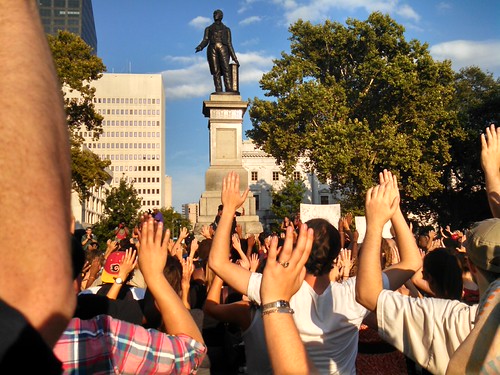
Menckles and I went down to see the National Moment of Silence vigil in Lafayette Square. Pat was there. So were a few other people I recognized and talked with a bit. The Advocate was there. I didn't talk to them. There were probably between 250 and 350 people there once the crowd filled in.

Lafayette Square

Mostly it was just people milling about with their hands in their pockets (or taking pictures of one another.) The organizing group wanted people to sign in and give them contact information but that didn't strike me as the best idea.

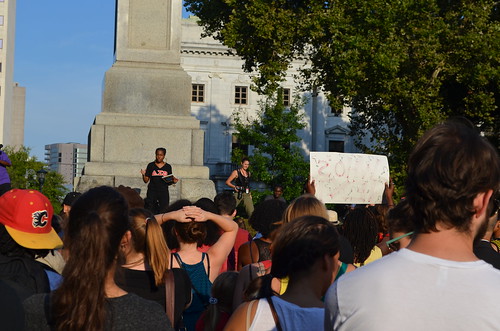
Speechifying

There were a few minutes of speechifying. Then someone read off some names of "victims of police brutality" and then there was a... well... a moment of silence.

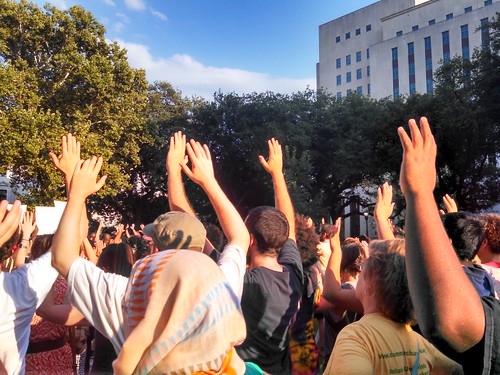
During the moment of silence, attendees were encouraged to raise their hands the way people have been doing in Ferguson. But, as you can see from this picture, they all looked like they were at a Christian rock show. It was pretty cheesy.

Hand raisiness

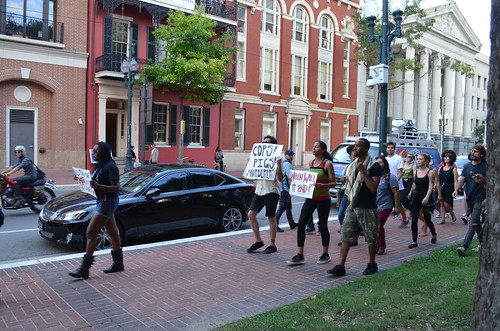
After the moment of silence the crowd broke up. A portion of them broke into a march and weaved their way downtown. 

After vigil march

Some signs

I saw later that they went inside the 8th District Police Station and hollered.  We had already ditched and were having dinner at Lucky Rooster while this was happening but, thanks to the internet (and in particular thanks to Twitter user @Small_affair who gets around to these sorts of events pretty often) I was able to locate some video footage.


This kind of made me feel bad for the poor cops who had to sit behind the desk and listen since they were just.. you know.. at work and had nothing to do with any of this but whatever.  Looks like they were in good humor anyway.


Anyway, I got pictures of the part I saw and put them on the internet since that is what one does. 

It's times like these when it's good to remember just what a valuable luxury the ability to do that is.
But I’m not quite sure that without the neutral side of the Internet—the livestreams whose “packets” were fast as commercial, corporate and moneyed speech that travels on our networks, Twitter feeds which are not determined by an opaque corporate algorithms but my own choices,—we’d be having this conversation.

So, I hope that in the coming days, there will be a lot written about race in America, about militarization of police departments, lack of living wage jobs in large geographic swaths of the country.

But keep in mind, Ferguson is also a net neutrality issue. It’s also an algorithmic filtering issue. How the internet is run, governed and filtered is a human rights issue.

Thursday, June 19, 2014

Oh well

Former FCC Commissioner Michael Copps speaking at a conference this week

He called back to an earlier speaker, who had pointed out that the internet, to most users, had become about the very core of freedom of expression: the freedom to say, read, and watch what we want. And with “the likelihood of gatekeeper control” impending, in the form of the FCC’s new proposed net neutrality rule, those freedoms are in danger.

In the end, Copps directly challenged both the FCC and current members of Congress to do more, and do better. “Our democracy depends on what happens between now and the end of this year,” he said. “Are we going to have regulators and legislators with enough gumption to make this happen?”

“I know it can,” he added, calling on the audience in the room to speak up and make their voices heard with lawmakers. But ultimately, he concluded, it all boils down to two questions:

“Whose internet is it anyway? And whose democracy is it anyway?”
We could have had a really nice internet once.  But we would have first needed to have a democracy that would have made it sustainable.

Wednesday, June 18, 2014

Kicking you off the internet

It's all theirs now.  Most of you losers do not count.  Unless you can afford to pay enough to count.
YouTube is preparing to radically change their site, adding a subscription service that is intended to help them compete in the streaming music industry. The Google GOOGL +0.45%-owned video site has already signed new licensing deals with all of the major labels, but many independents are refusing to take part. Apparently, not only are smaller, indie labels not being offered the same deals as the majors, but the contracts that Google is putting in front of them are less than fair.
Net neutrality is just a part of this but it's all of one piece.  The internet is not for regular people anymore. It belongs to big media and they are going to monetize it. There are efforts to beat some of this back but... really, come on.

Friday, May 16, 2014

Well that was wrong

This is a great conversation about Net Neutrality from a recent Bill Moyers show featuring David Carr and Susan Crawford.


Toward the end of the segment, Crawford says something very optimistic.
BILL MOYERS: The FCC is voting on May 15th to move forward with the proposal or not. That's less than two weeks away. What do you think people can do to be heard at that May 15th meeting?

SUSAN CRAWFORD: The uproar in the country is already causing the FCC to walk back from Wheeler's initial statement that he was never going to move towards treating these guys like a utility. That's already happening. Keeping that pressure up is only going to help because then they have to keep all these options on the table and act like a regulator. So writing into the FCC, writing to your congressman, keeping in touch with your senator. That really is making a difference. The White House is responding.
Yeah well that didn't happen

You can write and yell at these people all you want but they aren't going to listen to you. 

Thursday, May 15, 2014

Welp, it's been fun

Internet is dead. What are we gonna do now? If we can afford it I guess we'll stream a limited selection of movies.

Tuesday, May 13, 2014

Kicking you off the internet

It was always going to happen this way sooner or later.
In case you haven’t noticed, the Internet revolution has been corporatized: Google promotes its own services in its search results and is investing in original content, Amazon has become a publisher and charges for placement on its homepage and in its mailings, Facebook and Twitter enjoin users to “pay to promote” their status updates, and so on. These corporations, now some of the most powerful on the planet, are more dependent on advertising dollars than the television broadcasters and newspaper publishers of yore, which means much of what we encounter online reaches us not due to merit but thanks to marketing budgets. The digital sphere is becoming less of a level playing field every day, and the end of Net neutrality will only exacerbate this growing inequity, limit diversity and further marginalize non-commercial expression.
Probably too late to do anything about it.  Really it's kind of like climate change in that regard.  It was nice living in this space while it lasted.

Wednesday, March 26, 2014

Thanks, The NSA

You've successfully encouraged better internet standards.. in other countries.
Brazil's lower chamber of Congress approved groundbreaking legislation on Tuesday aimed at guaranteeing equal access to the Internet and protecting the privacy of its users in the wake of U.S. spying revelations.

To ensure passage of the bill, the government had to drop a contentious provision that would have forced global Internet companies to store data on Brazilian servers inside the country.

The rule was added last year to proposed Internet governance legislation after revelations that the U.S. National Security Agency spied on the personal communications of Brazilians, including those of President Dilma Rousseff.

Instead, the bill says companies such as Google and Facebook are subject to Brazilian laws and courts in cases involving information about Brazilians, even if the data is stored on servers abroad.
The government refused to drop another key provision on Net neutrality that was opposed by telecom companies because it bars them from charging higher prices for different content, such as video streaming and voice services such as Skype.

“Without neutrality, the Internet looks more like cable TV, where providers can offer different service packages,” Brazilian law professor Ronaldo Lemo told TechCrunch. “Basic service would include email and the social networks. ‘Premium’ would let you watch videos and listen to music. ‘Super Premium’ would let you download. Today that sounds like an aberration, but without Net neutrality, it’s a possibility.”
 Meanwhile, in this country, we're forever paying more for more limited service.  But at least some good was done in the world somewhere. 

Wednesday, January 15, 2014

Kicking you off the internet

How it works
But supporters of Net neutrality caution this is a very slippery slope. And they argue that these new business models will likely increase costs for companies operating on the Internet, and that eventually those costs will be passed onto consumers. What's more, erecting priority status for services online will result in bigger players being able to afford to pay the fees, while smaller upstarts will be blocked from competing because they won't be able to afford the fees that a Verizon or Time Warner Cable might impose.

Harvey Anderson, senior vice president of business and legal affairs for Mozilla, said the court's decision is alarming for Internet users because it will also provide broadband operators the legal ability to block any service they choose, which will undermine the once "free and unbiased Internet."
If you're not a "bigger player" who can afford the new pay to play system, you don't get to be involved anymore.

If you like what NOLA.com backed by its parent company Advance Publications presents you with, you should be pretty happy where this is going.  If you also like the diverse opinion and reporting you find from the wide variety of non-profit news organizations or independent bloggers you currently enjoy, you're probably going have to get used to a good deal less of that.

Tuesday, January 14, 2014

It's been fun, guys

But the telecoms are now free to kick you all off the internet. A federal appeals court says so.

The decision holds tremendous portent for the future of the Internet.

Net neutrality advocates fear that without rules in place, big companies like Netflix, Disney, and ESPN could gain advantage over competitors by paying ISPs to provide preferential treatment to their company's data. For example, YouTube might pay extra so that its videos load faster than Hulu's on the ISP's network.

We've already seen shades of What Could Happen in AT&T's Sponsored Data and Comcast's decision to have the Xfinity TV streaming app for the Xbox 360 not count against Comcast subscribers' data caps.
Instant Update:

Yesterday, I linked you over to this very important Gawker essay about how this is all going to go down.  Here's a critical passage.
The plutocrats are haunted, as all smarmers are haunted, by the lack of respect. Nothing is stopping anyone—any nobody—from going on a blog or on Twitter and expressing their opinion of you, no matter who you think you are. New media and social media have an immense and cruel leveling power, for people accustomed to old systems of status and prestige. On Twitter, the only answer to "Do you know who I am?" is "One more person with 140 characters to use."
Without Net Neutrality, this is no longer the case.  The plutocrats are now back in charge and they are free to shame and shout down the impudent... wherever they find them.  

Saturday, December 28, 2013

It's all about kicking you off the internet

I guess I shouldn't be as surprised as I am when supposedly savvy internet users applaud the inexorable trend toward firmer corporate control over internet content.
Blame anonymity, blame politicians, blame human nature. But a growing number of websites are reining in the Wild West of online commentary. Companies including Google and the Huffington Post are trying everything from deploying moderators to forcing people to use their real names in order to restore civil discourse. Some sites, such as Popular Science, are banning comments altogether.
Oh here we go again with the "civil discourse." You'd think that after all this time we would have graduated from this type of condescension.  But, no, the important people in the legitimate media still despise their readers. If only they understood how unimportant they really are, we wouldn't keep having these misunderstandings.  But we covered this earlier today and it's a bit of a digression anyway.

The inflated egotism of professional media persons (and other pompous laypeople) does at least partially explain why people keep missing the point about the comments controversy. Despite the loud kvetching over civility, this doesn't have anything to do with whether you have to worry your pretty little heads about someone hurting your feelings in a comment thread. Media companies don't care about that. If "civil discourse" was what mattered imagine just how different the great mass of content produced for you by professional media might look.

What this is about is moving independent voices off of the big internet media platforms. The big dogs are here now.  They're glad you're watching. They would still like to sell you to their advertisers. In fact, they'd like to sell more of you than they've ever had access to before.
Online privacy will be a thing of the past. (If you thought it already was, believe me, things could get worse.) The ISPs will try to read all of your content so they can sell you to advertisers. New “troll tolls” will force content creators and others to pay discriminatory fees just to reach people online — and will require the rest of us to pony up for “premium” content.
"Your content" in the emerging environment is mostly about the things you "like" on Facebook, the products you purchase on Amazon, the movies you watch on Netflix, the websites you visit, even the content of your private email correspondence.  What it doesn't mean anymore is your participation in the larger public dialogue.  What was once considered a leveling public square is fast becoming a pay-for-play model where your "reach" is directly related to the depth of your purse.

And this is why we're moving away from online comment forums on major media platforms. After a decade of relative democratization, the "new media" is finally taking on the familiar top-down model of old media institutions who are figuring out how to get things arranged to their liking. I don't doubt that the new discourse will be celebrated for being more "civil." But I can guarantee that it will be far less public.