-->
Showing posts with label consultants. Show all posts

Thursday, December 26, 2019

Crown jewels

City Council is adding staff to its in-house utilities regulatory office (CUNO). The idea is to give the council more directly accountable agency in its oversight of Entergy instead of outsourcing that function entirely to consulting firms. The consultants aren't being replaced. This is more about CUNO having more of a policy voice. Currently it has practically none.
“What’s unprecedented about New Orleans … is that they outsource everything,” utility industry attorney Scott Hempling told The Lens in March. “I’m not aware of any place that has any resemblance to that paucity of internal expertise and the near total dependence on outside expertise. No place.”

Instead of having zero input, the council is now aiming to have some. 


But, while more direct regulatory engagement from the democratically accountable council is a welcome shift in the right direction, that's not all that's going on here. The consulting contracts, at a combined $7 million, are some of the biggest that city councilmembers can award to anybody. And this article suggests that these moves now could mean the next time the contracts come up for bid they won't automatically default to the same two firms who have held them contracts for almost 40 years. The contracts are up for bid in 2021. As it happens, that is also when the councilmembers are up for reelection.

Sooo, well you can see where this is going.
Moreno is not the first council member to push for change. Notable predecessors include Shelley Midura, Stacy Head and Susan Guidry. Those former council members told The Lens earlier this year that the consultants were able to keep their positions in part due to political connections and contributions.

“Certainly, politics come into play,” Head said. “And these advisers have been skilled at making sure they have alliances that will benefit them in keeping relationships with council members and getting their contracts renewed.”

Another former council member, Oliver Thomas, told The Lens that because the utility committee was responsible for assigning the bulk of the council contracts’ value, it was traditionally seen as politically powerful.

“When you talk about a crown jewel committee, that’s probably the most influential council committee,” said Thomas, who was chair of the utility committee from 2006 to 2007. “That’s where you can raise money. And more importantly than being able to raise money, that’s where you place your relationships and where you can help people who are trying to get involved in that particular industry. So that’s a plum jewel.
Anyway if you're interested in following the next citywide election cycle, you'll want to pay attention to Dentons' and Legend's campaign contributions as well as those of their potential competitors.

Monday, April 08, 2019

Consultantocracy

When it comes to disentangling this knot, who even knows where to begin?
The New Orleans City Council has relied almost exclusively on outside consultants to regulate Entergy New Orleans for over 30 years. And it is those consultants that have largely decided what direction the city takes on a wide number of energy-related issues: How much can Entergy charge customers? How should the city generate or source electricity? How should the city prepare for hurricanes and deal with Entergy’s frequent outages?

But Councilwoman Helena Moreno — who chairs the council’s utility committee, which regulates Entergy — told The Lens she wants to break that structure. Specifically, she wants to expand the council’s in-house staff and expertise in order to become less reliant on contractors
That's going to be much more easily said than done. And, frankly, it's not even that easy to say.  Moreno isn't even entirely sure what she is asking for.
It remains unclear what the document will recommend, how fast Moreno will be able to move, or whether she will remain at the helm of the utility committee long enough to see the changes through.

“No one’s ever done this,” said Moreno’s Chief of Staff Andrew Tuozzolo. “New Orleans has never had this, really.”

We want to have some confidence that City Council can regulate Entergy competently and independently.  For decades they've mostly outsourced this function to consulting law firms.  During this time, the consultants have had longstanding relationships with prominent political organizations frequently cycling employees in and out of political office and/or in and out of employment by the utility itself.  So the public might be forgiven for wondering which side of the three way revolving door Jay Banks or Karen Carter Peterson is on at any given moment.  They promise they know how to keep it all straight but it can be difficult to parse as KCP demonstrates here.

Clint Vince’s law firm, Dentons, also gave $25,000 to the Louisiana Democratic Party’s political action committee between 2013 and 2018, according to state campaign finance records. State Sen. Karen Carter Peterson, the chair of the Louisiana Democratic Party since 2012, was hired by Dentons in 2014.

“Dentons does not have a relationship with the Louisiana Democratic Party,” Peterson said in an email to The Lens. “Separate and apart from my role with Dentons, I serve as chair of the Louisiana Democratic Party.”

It's kind of like trying to pull apart a dozen mardi gras beads that have gotten twisted together. They're all really just the same strings of the same lawyers, lobbyists, and political hangers on. Who knows where one begins and the other one ends?

Moreover, how do we even know who to trust with the task of sorting it all out? My favorite bit from the Lens feature article explaining this stuff comes where we learn about a critical Inspector General's report put together by.... yet another opportunistic third party consultant soliciting a job.
Vince questioned the conclusions in the Inspector General report.

He noted that the report was funded through a third-party grant. And its author — an outside consultant hired by the Office of Inspector General — later used his own findings to try and solicit a city job. According to a 2015 story by Fox 8 News, shortly after the report was released, the consultant wrote a letter to the city that said, in part, “I suggest you retain me immediately to address those issues.
So, yeah, good luck figuring this out.  Moreno wants council staff to outline a plan by June. In order to put that together, I guess they're going to need to hire some consultants. Probably there will be lot of expertise at Dentons and Legend they could put to use... for a fee, of course.

Wednesday, June 14, 2017

This is not the housing policy you're looking for

It's probably some sort of progress that we're even having a discussion about the effectiveness of these tax giveaways to developers in the first place. But the context is still an assumption that tax giveaways to developers are the best way to do housing policy.
Mayor Mitch Landrieu plans to unveil a new economic incentive policy in about five months and won't support property tax breaks for new residential real estate projects that don't include reduced-rate units in the meantime, the administration's head of economic development said Tuesday (June 13).

The mayor's office is working with consultants HR&A Advisors on a study of real estate development tax breaks and a wide range of other economic incentives, ahead of a new policy being released later this year, said Rebecca Conwell, Landrieu's senior adviser for economic development.
Love to hire private consultants to weigh in on policy for us. This firm, in particular, always has a sweet gig somewhere. 
HR&A Advisors previously worked with the city developing a resilience strategy in 2015 and also studied the state's film production tax credits at the request of the movie industry, amid debate among state lawmakers over rolling back the credits.

I'm not a news media professional but my first question about the consultant would be, do their clients also include private development companies and other organizations looking to "unlock value in underutilized assets"? Because that's what their website says.


HR&A provides a full suite of real estate development services.

We provide critical thinking for development projects, advice to public, private, not-for-profit, and institutional clients—including municipal governments, counties, quasi-public agencies, BIDs, large medical centers, universities, foundations, public development authorities, private owners, building portfolio managers, national developers, performing arts centers, and museums—to unlock potential and transform assets and places.

HR&A creates coordinated real estate strategies to unlock value in underutilized assets.

We help clients identify short, medium,  and long term actions that support organizational missions while creating value from their real estate portfolios. We recommend solutions that are flexible enough to respond to changing market conditions and evolution of our clients’ long term strategies.

I'm guessing they collect a fee from everybody no matter what the policy outcome eventually is so it's probably fine, right? Anyway it's a strange time for the city to hire a consultant to look into housing tax credits when all they really have to do is watch this Frontline report on the faltering federal Low Income Housing Tax Credit.

In a joint investigation, NPR — together with the PBS series Frontline — found that with little federal oversight, LIHTC has produced fewer units than it did 20 years ago, even though it's costing taxpayers 66 percent more in tax credits.

In 1997, the program produced more than 70,000 housing units. But in 2014, fewer than 59,000 units were built, according to data provided by the National Council of State Housing Agencies.
Or they pay attention to the ways in which "inclusionary zoning" and affordable set aside policies in other cities are not making much of a dent in the housing crisis but are definitely causing nice things for rich people to be built. Or they could remember the last time one of these trickle-down "incentive" programs backfired in New Orleans.

Actually, according to the article, they are at least indirectly acknowledging that last one.
While the study is ongoing, the administration won't support property tax reductions for any projects that fail to include a "permanent affordability" component -- typically considered at least 50 years -- or affordable housing for low-income and middle-income renters.
Still, all of this tells us we've still got a long way to go before we can say decision makers in New Orleans understand that housing policy is a human service instead of a private partnering opportunity or even something to be described with loaded business analogies like this. 
After the meeting, Conwell said there's an opportunity for the city to align the use of economic incentives with the city's various strategic plans for housing, equity, resilience and other areas. Part of that will be to scrutinize how the city benefits from incentives.

"The city is making an investment," Conwell said. "If we give up the taxes, if we forgo taxes, it's like making an investment. It's not unlike a bank making an investment ... you want some certainty in return on investment."
Like we said at the top, it's probably good that we're at least subjecting some of these incentive programs to greater scrutiny. Anything that produces a less egregiously corrupt conduit for public money to enriched developers is better than nothing.   But we're still not anywhere near to developing an effective housing policy. Not sure when that starts happening.

Tuesday, March 03, 2015

Can't reinflate the water balloon

20 years ago in Baton Rouge, a college roommate of mine came back from a geology class barely able to restrain his glee. 

"New Orleans is sinking!" he beamed.  "Y'all gonna have to move out of that shithole."

My roommate was a proud small town Cajun boy from Iota.  I don't think he actually disliked the city as much as he just enjoyed talking shit about it to me whenever he could. Anyway, today he was excited to have some new ammunition.

Having been raised in the sinking shithole, I was already aware of its peculiar and precarious geographic situation. The city was shaped like a bowl. Its land dipped below sea level. Its borders were ringed by levees and walls to keep out the water from the surrounding lakes and marshes. The lakes and marshes were, in turn, being eaten by the sea beyond them. Meanwhile the drained swamp inside the bowl was settling lower and lower each year. The problem was only going to get worse over time.

We knew all of this.  We learned about it in elementary school.  I remember a public awareness stunt that would happen at the beginning of hurricane season where some group went around town with a giant ruler that was supposed to represent the height of a storm surge in the worst case scenario.  It looked bad. But, ironically, the constant little reminders also made it seem sort of routine. The result of this public information campaign was not action so much as acceptance. Of course the city is sinking, we all thought.  Didn't you learn that in sixth grade? Geeze. Besides, I told my friend, in the meantime living there was a (sinking) ride worth taking.

You might think the experience of the Katrina flood would alter that attitude a bit.  But I'm not sure that it has.  Instead, what's happened in the 10 years since is, rather than take the actions necessary to make the city viable in the long term, we've once again simply accepted the reality of its vulnerability.  Katrina's floodline is our new giant ruler. We all know the city is doomed. Didn't you see what happened in 2005? Geeze.

It's important to keep this in mind when you read in the newspaper, perhaps for the first time this week, what many of us old timers have known for decades.  New Orleans's world class drainage system is a curse as much as it is a blessing.

Originally, the water table under New Orleans stayed high thanks to an almost annual soaking from Mississippi River floods. But when levees were raised to protect the city from those floods, the water table started dropping and the soils began to drain, dry and sink. That problem was magnified when development spread blankets of concrete and asphalt across the landscape, reducing the ability of rainfall to recharge the water table.

New Orleanians live in a city that gets an average of 60 inches of rain a year, yet they know the area’s rare droughts can cause expensive problems as well: sink holes develop in streets, houses begin to list like leaking ships, cracks spider across walls, and doors start sticking in their jambs as homes begin to move with the ground beneath them.

But for a population living in a bowl, fear of flooding from frequent torrential rains was always the greater concern, and higher priority. The result is a vast storm-water drainage system featuring some 1,300 miles of subsurface pipes leading water to a series of deep outfall canals linked to 23 pumping stations which rank among the largest in the world.

And they’re always working.

“Some of those lines just continuously drain water from the soils beneath the area and into the canals, even when there is no rain,” Waggoner said. “So there is this constant tapping into the water table.”
 What they are proposing as a remedy is a $9 billion plan they say might help stabilize the water table.
That acknowledgement began to turn into citizen action in 2013 with the release of the Greater New Orleans Urban Water Plan, which was funded by state and federal grants.  Developed by Waggoner’s firm in collaboration with water management experts from the Netherlands and around the world, the plan presents a $9 billion vision of how the Crescent City can turn its age-old enemy into a friend by raising the water table to help reduce subsidence.
Letting water pool up in order to reduce flooding sounds counterintuitive. I suspect this is part of what makes it attractive.  It makes a great Upworthy style headline. How we stopped the flooding will surprise you!

But maybe they can do some of what they say.  I suspect, though, that in order to function as intended, such a system needs to be implemented in full rather than in the compromised piecemeal way things actually happen in the real world.  So I'm skeptical.

What they can't do, though, is reinflate the sunken city. They can't even halt the subsidence, really.  Certainly they will hire some consultants. Certainly they will make names for themselves in the urban planning community which  is really what it's all about.  Remember, this is a sinking city. Everyone knows that already. The smart people are the disaster capitalists who can figure out how to enjoy the ride and peel off the profits from that while they still can.

Monday, December 15, 2014

March 23 is Darryl Berger Day

No, it's not his birthday. (Maybe it is, actually. I don't know.)  But it is the day that this committee is going to award his company the right to redevelop the WTC.
A five-member selection committee of city officials has been formed to review 10 proposals for the redevelopment of the former World Trade Center building at the foot of Canal Street. The panel is expected to select one of the projects by late March.

The committee consists of Deputy Mayor and Chief Administrative Officer Andy Kopplin; Cindy Connick, executive director of the Canal Street Development Corp.; Bill Gilchrist, the city’s director of place-based planning; City Planning Commission Executive Director Bob Rivers; and Ashleigh Gardere, executive director of the city’s Network for Economic Opportunity. 
What the heck is the "Network for Economic Opportunity"? Yeah, I wondered that too.  Turns out it's a thing they appear to have made a couple of months ago with an "innovation" grant thingie from Living Cities which is a pipeline through which wealthy people who run banks and stuff can shape public policy by pretending to have benevolent motives.  But mostly what they do is pass money around to consultants.  And, in March, they'll help decide to give a plum property over to a well connected developer too. So that's nice.

Wednesday, December 10, 2014

Thinner asphalt

Yesterday we received some cost-saving recommendations from consulting firm Alvarez and Marsal
On Monday (Dec. 8), Gov. Bobby Jindal's administration detailed how the state government -- with help from a private consultant -- is saving Louisiana $81 million during this fiscal year.

The Jindal administration paid Alvarez & Marsal $7 million to come up with recommendations for how Louisiana could cut costs and generate new revenue. The New York-based private firm released a list of suggestions in June that could supposedly save the state government $2.7 billion over several years if adopted.
The recommendations are underwhelming. We're told we should sell off some stuff, replace some lawyer with robots, charge media for traffic data, oh and this.
The Department of Transportation and Development is moving forward with plans to use thinner asphalt in road paving projects in order to save the state government money. 

Transportation Secretary Sherri LeBas said a fraction of Louisiana roads require more significant paving at this point. It makes sense to use the thinner pavement.

"I think we need to be efficient and really look at the amount of asphalt we are putting down," said LaBas.

When state Sen. Bret Allain, R-Franklin, asked LeBas directly whether the thinner asphalt would require the state to have to repave the road again sooner than it would have otherwise, the secretary deflected the question.
Seems like something is being laid on pretty thick here even if it ain't asphalt.

Thursday, November 06, 2014

The improbability of Ninth Ward self-determination


Thanks again to The Lens for creating these maps of election results. The maps of the New Orleans specific races drill all the way down to the precinct level. It sheds a lot of light on what happened Tuesday; especially with regard to some of these amendments. 

First some background on Amendment 13.

It was introduced back in June during the legislative session.
In an effort to jump-start development in parts of the Lower 9th Ward that have stood empty since Hurricane Katrina, City Hall would get permission to sell off abandoned properties in the neighborhood for $100 each under a proposal that will go before state voters in the fall.

The Legislature approved a constitutional amendment before the 2014 session ended Monday that would allow the sales. Now, the measure will head to a statewide ballot Nov. 4.

The New Orleans Redevelopment Authority, a city agency, owns about 600 properties in the 9th Ward but has attracted little interest from potential buyers over the past few years when offering them at market rates.

A constitutional amendment is needed to sell the lots for a nominal $100 fee because the Louisiana Constitution prohibits the loan, pledge or donation of property by the state or a political subdivision. The change approved by the Legislature would carve out an exception for the Lower 9th Ward properties.
The plan was conceived by State Rep. Wesley Bishop.
Bishop said he wants to use the Lower 9th Ward redevelopment plan as a pilot to see if it could work in other areas that have had trouble “repopulating since Hurricane Katrina,” such as the Desire-Florida neighborhood in the Upper 9th Ward. He said the program is patterned after one used in Baltimore, Harlem, New York, and Detroit dealing with blighted areas.

Under the program advanced by Bishop, homeowners living next to each piece of property would get the first opportunity to purchase it. After that, priority would be given to people who have lived in the neighborhood for at least 18 months, followed by veterans, teachers, first responders and former neighborhood residents.

All buyers would have to agree to redevelop the lots and live there for a minimum of five years after construction is complete.

Now there were some clear caveats involved.  The PAR guide outlines all of the arguments for and against each amendment.  There were concerns that the properties, once "donated," would be held by speculators or flipped for profit despite the restrictions in companion legislation aimed at preventing this from happening. There was also the possibility that the whole thing would be disallowed by stipulations laid out in the federal Road Home program through which many of these properties were acquired in the first place.

So it wasn't a perfect idea. But it at least appeared to have been put forth with the goal of helping  some displaced Ninth Ward residents return and rebuild if they wanted to... and, of course, reinvigorating a still much-blighted area.

The key thing to remember about this amendment, though, is that it carved out a specific exception targeted to impact only one neighborhood in one city.  But everyone in the state was asked to vote on its approval. So how did it do?

Well it did pretty well in the neighborhood it actually affected.
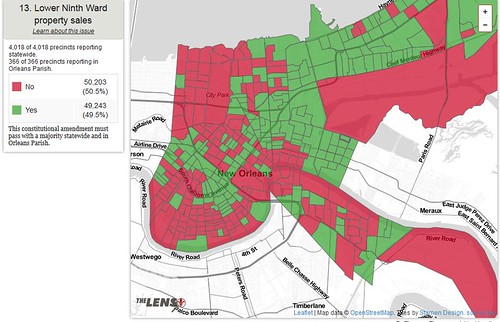
Amendment 13 Orleans Parish

I'm assuming you can find the Lower Ninth Ward on a map.  It is a solid green rectangle on the lower, eastern part of the parish here.

Of course, the amendment still narrowly failed in the parish as a whole. But it didn't fail in the Lower Nine. Instead it failed on the strength of a vote pattern that looks at least similar to geographer Richard Campanella's  famous "white teapot."
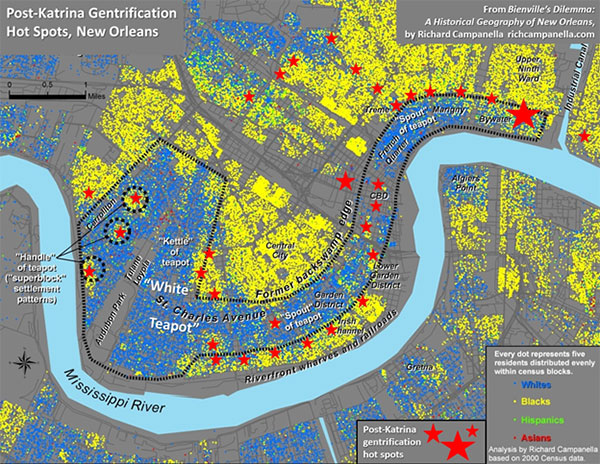


It isn't clear what the actual effect of the below-market property sales enabled by Amendment 13 would have been. But the voting pattern at least gives us an idea of what voters in Orleans parish thought it might be.  Anyway, we're not going to find out now thanks, in part, to the white teapot.

And thanks, also, to the big red boot.
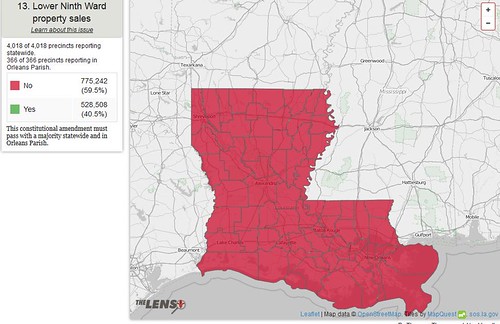
Amendment 13 Statewide

That's pretty decisive.  Looks like the most decisive people were, again, our friends up in La Salle Parish. 78% of those guys didn't want to see the New Orleans Redevelopment Authority sell any  Ninth Ward properties sold for below market value, no sir.

So, in the only geographic space in the state actually affected by Amendment 13, the measure passed. Everywhere else, not so much.

But take heart, Ninth Warders.  Just today the man who used to run the agency that would have directed this program was introduced as the city's "Chief Resilience Officer."

(Jeff) Hebert's new role as the chief resilience officer takes his ideas to turn New Orleans into a thriving city and puts them front and center with some of the world's leading economies.

"We have been doing a lot of those things already and we have to put a lot of those pieces together into one strategy and then checking with other cities with similar issues and see if there are some creative solutions we can bring home to New Orleans," Hebert said.

The Rockefeller Foundation supported the idea to identify 100 cities around the world and pump $100-million into their improvement efforts to keep them ahead of challenging times.

President of the 100 Resilient Cities, Mike Berkowitz said, "New Orleans has much to teach the world about resilience and the world to teach New Orleans and I think that is the sentiment and what this effort is all about."

Rockefeller Foundation President, Dr. Judith Rodin, said, "Post-Katrina New Orleans in our view has become a case study for the benefit of building resilient strategies."

Herbert who helped work with the city since Katrina's devastation has plans to make 2018, the 300th anniversary of the city, the platform to show how resilient New Orleans has become.

The next steps involves putting together a team to address the needs of the city. After that, they will meet with a global consultant to put a plan into action.
The voters won't let Hebert help residents get back on their feet. But we'll be damned if we're not gonna let him spend some grant money on a team of consultants to build a platform that shows how resilient we are despite it all.  Passing that up would be downright ridiculous. 

Friday, September 19, 2014

Pretty good racket

As long as there's somebody threatening legal action over sound ordinance violations, somebody's gonna have to gather some evidence.
What had been Buffa’s bathrooms are now just studs and pipes as crews work to build additional soundproofing onto the bar’s lakeside wall, which faces Torres’ house. While renovating those bathrooms, it became clear that there previously had been nothing to muffle the sound before it hit the metal sides of the building, Rogers said.

That configuration could have amplified the vibrations coming from live performers, he said. To prevent that, workers are installing new walls of gypsum and plywood inside the building that will be separated from the exterior wall by a dead zone to further dampen the noise, he said.

While still incomplete, those efforts have already paid off, Rogers said. Earlier this month, the bar hired Dave Woolworth, an acoustics expert who works as a consultant for the city, to take readings from Torres’ property as the Royal Rounders played at Buffa’s. That test, conducted with Torres’ permission, saw the band play normally before steadily amping up the volume, eventually breaching the bar’s self-imposed limit on how loudly bands can play — roughly 90 decibels, enough to force patrons to shout to be heard — 41 times, Rogers said.
Must be the only game in town.  

Saturday, August 16, 2014

Griftopia

Can't really improve on this headline

Gov. Bobby Jindal's efficiency experts hike price to $7.4 million

The price tag has nearly doubled for Gov. Bobby Jindal's hiring of an outside consulting firm to recommend new ways to balance the state budget.

The contract for Alvarez & Marsal was worth $4.2 million when the New York-based company was hired in December. But the contract since has been bumped up to $7.4 million, according to the Legislative Fiscal Office.

Tuesday, May 13, 2014

"Rainmaker"

The saga of Jazzland continues
With the search for a developer of the former Six Flags park stagnating, the head of the New Orleans Industrial Development Board on Tuesday proposed hiring a national consultant to seek relocating or expanding companies and show corporate leaders the potential commercial sites around the city.

Alan Philipson, the economic development board's president, said over the past few months, the board has been forced to cancel meetings for lack of proposals or viable projects on the table.

He said city leaders, the New Orleans Business Alliance, and other local groups "are working diligently, around the clock" on bringing commerce to the city.

"I think we need to do our part," Philipson told the board at a meeting Tuesday. "I would like to propose that we try and find our own rainmaker out there."
Lots of positive thinking type comments in there. They're hiring a consultant so at least that means somebody will be making some money off of this property.

Still, nobody wants to develop this land for some reason.  Maybe it's just not "cool" enough.  You know, the way Arabi apparently is now. Or it could be something else.  What could that be?

Wednesday, May 30, 2012

Dueling consultants

I should point out also that BCG was paid $2 million to advise city leaders to work on spiking crime stories off the front page of the paper.  This strategy would appear to be the polar opposite of former Mayor (and current disaster and "green energy" consultant) Ray Nagin's theory that the murder rate "keeps the New Orleans brand out there"

There's some debate as to just how much Nagin was ultimately compensated for this and other wisdoms he transferred to the city during his tenure as mayor although the process for working that out is underway.