The commission has also received recommendations to divide some of the
more prominent streets, picking different names depending on the
neighborhood - an idea with significant racial overtones. For example,
the commission’s current recommendation is to rename Robert E. Lee
Boulevard for musician Allen Toussaint, but an alternative would call it
Toussaint in the Black neighborhoods of Gentilly and Hibernia or Lake
Boulevard in the majority-white areas of Lakeview.
This project that was begun in order to correct a shameful legacy of white supremacy now proposes to do that by coding the notion that all the Black people live over here and all the White people live over there right into the name(s) of the street. That's what this was all about, right?
Systemic racism is a material condition that obtains through the numerous inequities linked to the development of institutions and governments over the long course of history. Redress against its embedded corrosive effects demands a complete societal overhaul of the ways we distribute wealth and administer justice. It's a collective project of building a better world for everyone.
It’s not a coincidence that corporate human resources departments
love to contract diversity consultants like DiAngelo to do anti-bias
trainings. Trainings more than pay for themselves if they can
demonstrate a commitment to an inclusive workplace in the event of later
anti-discrimination lawsuits. They’re also a lot cheaper than paying
workers better and addressing structural inequalities. The more that
blame for discrimination can be shifted on to individual racist
“Karens”, the less onus there is on powerful corporations, and the
politicians who defend them, to make real changes.
We do know, for example, of a tool far more useful than unconscious
bias trainings in creating respect and equality: unions. Recent work in
the American Journal of Political Science notes
that union membership reduced racial resentment among white workers and
made them more likely to support policies that benefit black Americans.
The difference is between offering workers a collective path to improving the actual conditions of their lives vs. forcing them to take "personal responsibility" for proving to the boss that they are on board with a performative company PR plan. It is a choice between establishing justice or defending capitalism. And the latter route always requires that we heap the burden onto relatively powerless individuals.
So it's no surprise to find irretrievably racist institutions like police departments, when confronted with demands to surrender their funding and their authority in order that a more equitable and supportive means of societal justice can be implemented, respond thusly.
New Orleans – The NOPD is proud to announce its participation in
the “Implicit vs. Explicit Bias & the Impact of Social Media”
training program led by LSU School of Public Health and RacialBias.org.
The university and 501(c)3 organization worked in collaboration
to design coursework to better equip law enforcement officers with the
tools necessary to better understand and empathize with the citizens
they serve.
Will events and like these serve their purpose? Likely, they will. But do not be deceived that the purpose is to actually alleviate or eliminate racial injustice. Instead it is to preserve the racist institutions themselves.
The beginning of June is probably a good time to roll out a few book recommendations. I'm getting the brain worms in my early old age now and I find I need to do a better job of keeping a record of what I've been reading. I used to have a Library Thing account for that. And there's still a Goodreads linked here on this very blog but I haven't used that in ages. Recently I've reverted to just keeping a boring old spreadsheet. But I'm going to try posting books here more often. Otherwise, like everything else in life, if I don't take a second to write it down, I'll never remember any of it happened. So here are some titles I've finished over the past few months. If I remember to do this more frequently, these posts won't be quite so long.
There is a long overdue movement in the treatment of slavery in popular history writing to place it in its proper context as a (if not the) founding institution of modern global capitalism. Edward Baptist's The Half Has Never Been Told and Matthew Karp's This Vast Southern Empire are a couple of relatively recent popular books I can recommend here. Also here is a twopart episode of The Dig podcast recorded during this "Slavery's Hinterlands" symposium at Brown University.
Johnson's book contributes something to this as it traces the movement of enslaved people to, through, and from New Orleans during a pivotal period centered around the Haitian revolution. The context of this book is global but most of the focus is local. Slavery marked every aspect of life in the city. Johnson describes its effect on domestic living patterns in the city's neighborhoods. She discusses its influence on popular culture and entertainment. One example of ths is an explicit characterization of the sometimes romanticized raquette matches played near Hunter's Field during this period as a brutal and exploitative use of black bodies. She also writes about the local jail's role as an aggregator and lessor of slave labor (some things never change.)
This is a short novel you can read in a day or two if you want to. I'm not sure you actually have to, though. The style is a faux parable where two main characters (their names are not given) go to work for a contractor building a new road across a recently war-torn country (also unnamed) supposedly located somewhere in the global south. Things happen along the way but it ends pretty much the way you expect. Imagine if Dave Eggers had tried to write The Road by Cormac McCarthy and this is what you would get.
This is a juvenile/YA novel that will probably show up on a lot of middle school summer reading lists this year. A young girl and her mother spend the summer away from their home in Atlanta at her grandmother's house in a small town in South Carolina. She discovers a letter in the attic that leads her and a neighbor boy to investigate a mystery from the town's past. That premise frames a story built around fictionalized historical episodes from the segregationist South combined with a sort of Count Of Monte Cristo story. Explores themes of racial justice and LGBTQ acceptance.
Data driven systems for intake and management of social services make poor people easier targets for police. Eubanks describes experiments with screening systems for welfare benefits in Indiana and homeless services in Los Angeles as well as a "predictive" tool for assessing the risk of child abuse in Allegheny County, PA. She argues that these and systems like them constitute a "digital poorhouse" and an insidious expansion of the 21st Century police state.
This is all very much worth paying attention to for New Orleanians as the City Council and Mayor implement so-called "tough love" homeless management and juvenile justice policies that can end up doing a lot of harm to vulnerable people under the very likely bad faith offer of aid.
Among protesters’ main gripes: a stagnant economy in which most still
live in deep poverty and a scandal in which the country last year lost
$100 million in newly printed bank notes destined for the central bank.
“Weah
is not governing our state the right way,” said Ishmael Hassan, who
voted for Weah in 2017 but has since become disillusioned. “The economic
situation in our country is going down the drain.”
Weah's election had been seen as a relief from the stagnation and corruption of the EJ Sirleaf government. Sirleaf came into power with high hopes after years of civil war under the dominant influence of Charles Taylor. Taylor came into power having led a revolt against the corrupt Samuel Doe. Doe came in... look this goes back a ways. Maybe we should start from the beginning.
Okay so the nation we know as Liberia finds its origin in the efforts of the, ostensibly abolitionist, but primarily white supremacist American Colonization Society. The idea behind ACS was to remove as many Americans of African descent as possible from the US by sending freed slaves to a newly founded colony on the West African coast. The Americo-Liberian colonists clashed with and quickly came to dominate the indigenous tribes living there. This continued on into the Twentieth Century as the elite colonizing classes collaborated with international corporations (most notably Firestone) to exploit Liberia's natural resources. Basically, it was run as a big rubber plantation. Later, like pretty much every Third World nation, Liberia became a pawn in the US/Soviet Cold War rivalry until that played itself out at which point matters really began to deteriorate.
You won't learn any of this by reading She Would Be King. But Moore's magical realist novel does attempt to relay some of the essence of Liberia's founding elements. Her three main characters are basically avatars of the country's ethnic mix embodied as folk heroes. They begin their stories living separate and oppressed lives in
Virginia, Jamaica and the African back country. Each discovers a unique magical gift as they move along on their journeys before coming together at the moment of the nation's independence. The novel is successful in creating a mock folk legend about the people of Liberia. It's less compelling as a beginning-to-end narrative but that's not really the primary aim.
This is a quick and engaging survey of the archaeology of urban places that isn't anywhere near as ambitious as the title might sound. It's really more a personal summary of the author's observations and general theories based on her own work in the field. Most of which is quite fascinating although here and there the reader gets a sense of a creeping Pinkerist message. Trash is good, actually. Capitalism and class hierarchy are good and permanent fixtures of human society, actually. Things that seem bad now are actually not that bad because they are not new. Probably the author doesn't mean for this to come through quite so explicitly. But if you are a reader who is sensitive to that sort of thing you might grow a little suspicious. Don't let that detract too much from what is really a delightful book, though. You're probably overthinking it.
Here's a new ProPublica report on racial disparities embedded in the bankruptcy process. Even the American debt relief system is largely segregated. Typically, black debtors are much more likely than whites to be shunted into Chapter 13 bankruptcy than into Chapter 7. Here's why that's important.
Under federal bankruptcy law, people overwhelmed by debt have a
choice: They can either file under Chapter 7, which wipes out debts and,
since most filers lack significant assets, allows them to keep what
little they have. Or they can choose Chapter 13, which usually requires
five years of payments to creditors before any debts are eliminated, but
blocks foreclosures and car repossessions as long as debtors can keep
up. In most of the country, Chapter 7 is the overwhelming choice. Only
in the South, in a band of states stretching from North Carolina to Texas, is Chapter 13 predominant.
The responsibility of knowing which path to pick falls to those
seeking relief. In Memphis, about three-quarters of filings are under
Chapter 13. That’s how Miller filed. She thought the two chapters were
“the same,” she told me.
Initially, they are. Upon filing, debtors are shielded from
garnishments and debt collectors. But whereas under Chapter 7 those
protections are generally made permanent after a few months, under
Chapter 13 they last only as long as payments are made. Most Chapter 13
filers in Memphis don’t last a year, let alone five.
As efficiently as cases are opened, they are closed — usually because
debtors fail to keep up with payments, according to a ProPublica
analysis of court data. In 2015, over 9,000 cases in the district were
dismissed — more cases than were filed in 22 other states that
year. Less than a third of Chapter 13 cases in the district result in a
discharge of debts. And when their cases are dismissed, debtors are
often in worse straits, because as they struggled to make payments, the
interest on their unpaid debts continued to mount. Once the refuge of
bankruptcy is gone, the debt floods back larger than ever. They’ve borne
the costs of bankruptcy — attorney and filing fees, a seven-year flag
on their credit reports — without receiving its primary benefit. A
system that is supposed to eliminate debt instead serves to magnify it.
There are in-depth analyses here that focus on Memphis and on Chicago where the reporters hit on a common contributing factor to the disparity.
Court debt: In our sample, 29 percent of debtors
from black tracts had this kind of debt (compared to 9 percent of
debtors from white tracts), and for 6 percent of cases, it was the
largest debt. The vast majority of this debt came from Shelby County’s
General Sessions Criminal Court, which handles traffic cases and
misdemeanors. In interviews, bankruptcy attorneys said this was
generally related to driver’s license issues. Nonpayment of a court debt
can lead to suspension of a driver’s license, and debtors often file
under Chapter 13 either to prevent suspension of a license or to have
their licenses reinstated. Debtors’ driver’s licenses are generally
reinstated upon confirmation of their cases. This type of debt is not
dischargeable in a Chapter 7.
The racial disparity for this kind of debt in bankruptcy cases is
reflective of a disparity in the suspension of driver’s licenses. We
obtained data on driver’s license suspensions in Shelby County and found
that suspensions stemming from traffic infractions (the most common
source of a suspension) were six times more common among black residents
than white residents.
Terrible harm is being done to the most vulnerable people in the country because municipalities have become ever more aggressive in their efforts to squeeze revenue out of such people. The predictable result is spiraling debt, unstable communities, and violence. In particular it has meant police violence against black people. Municipal fees were at the heart of the tensions with police preceding the murder of Michael Brown in Ferguson, MO. This John Oliver segment from two years ago on municipal violations and poverty still holds up. A national debate over civil asset forfeiture is still ongoing despite suffering a setback this year thanks to the stubborn bigotry of US Attorney General Jeff Sessions.
The compound absurdities of this show up in our current election cycle where all of the major mayoral candidates have pledged to take down at least some traffic cameras. No doubt the cameras are unpopular with voters. But even as they try to make hay of this on the campaign trail, the candidates aren't instilling any confidence that they can make good on their promises. LaToya had to go through several rounds of clarification where her position changed from taking down all cameras, to only the "newer" cameras, and then back to all the cameras before what's lately become all except for the school zone cameras. There was one forum where Desiree said she would take them all down"if we can afford it." When the entire system is rigged to make the cameras fiscally essential, that's going to prove a difficult qualifier to meet.
All of which indicates those cameras aren't going anywhere. A candidate who is serious about removing them would first have to be serious about upending the status quo of systemic violence against poor people and especially poor people of color upon which the fortunes of its privileged classes is built. None among this group fits such a description. Is there a chapter in the code that covers political bankruptcy?
Hang on a sec. Just gonna dial up AreTheMonumentsDownYet dot com. Probably still in limbo and... whoah, okay.
New Orleans officials can begin the process of removing the statue of
Confederate Gen. Robert E. Lee at Lee Circle and three other monuments
at the center of a long-running, city-led effort, a federal appeals
court ruled Monday (March 6).
In the ruling, the three-judge panel with the 5th Circuit U.S. Court
of Appeals found that the groups trying to block the removal of the
monuments, Monumental Task Committee and the Louisiana Landmarks
Society, failed to present a case that contained a legal argument that
showed the monuments should stay up. The court wrote that the groups
relied on two legal claims, "both of which wholly lack legal viability
or support."
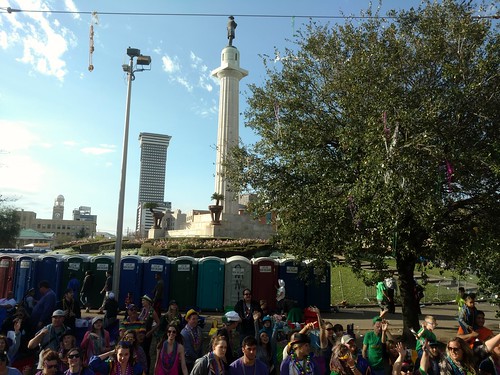
I last took a good look at the Lee monument a little over a week ago when our float passed (Tivoli) Circle. I only had a second to take a picture. I was a little bit busy at the time. But I did take a moment to think about how ridiculously long the process of getting them down has been.
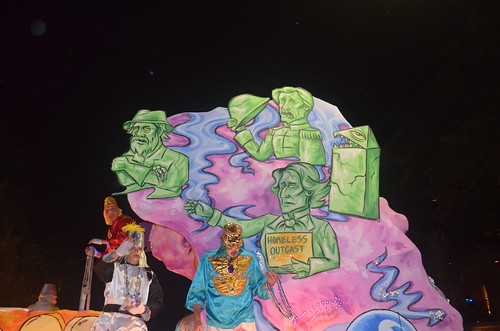
It's been so long, in fact, that earlier in the season I found myself sighing at monument floats in Druids and Chaos. It had started to seem like such old news. Can't these guys just let it go?
But then I remembered the specific subject matter in question which is all about.... not letting it go.
Well it looks like the time has finally come now. When can we get started?
Mayor Mitch Landrieu's
office said that a request for proposals will be issued within the next
day to obtain bids for a company to remove the monuments, which will be
stored in a city-owned warehouse until it's determined what will happen
to them.
Oh boy. Well let's hope all the bidding contractors make sure they've got their auto insurance up to date. As for the monuments themselves, why not just give them to these parading krewes since they love them so much? They could each make one into a recurring signature float. We'll give Lee to Chaos, Davis to D'etat, and Beauregard to Druids. The Liberty Monument, of course, will have to be dragged down St. Charles each year to the Comus Ball where Erroll Laborde will curtsy to it thus signaling the end of Carnival for another season.
President-elect Donald Trump faces a growing backlash against his
decision to name campaign chairman and former head of Breitbart News
Stephen K. Bannon as chief strategist at the White House, a choice
critics believe will empower white nationalists.
A chorus of
advocacy groups, commentators and congressional Democrats denounced
Bannon as a proponent of racist, anti-Semitic and misogynistic views as
Trump began his first full week as president-elect. Trump named Bannon
his chief strategist and senior counselor on Sunday while also
appointing Republican National Committee Chairman Reince Priebus to be
his chief of staff.
We like to think our society is in general getting a bit less racist. I
think that's probably true, and that it's probably true that The Kids
Today are a bit less racist than my generation was (when I was a kid
explicitly racist jokes were really not taboo, though by the time I hit
college they probably were). Still there's plenty of racism, and The
Kids Today have plenty of racists, too. I'm not talking about the kids
being idiots stuff, like halloween blackface*, I'm talking about real
solid racism. I know where all the racism came from when I was a kid.
It was, you know, normal. I'm not quite sure where they get it from
today.
That's easy, though. They get it from the racist parents who raised them to also be racists in a still very racist environment. I think cosmetically, we present as slightly less racist today than say 30 years ago. But that's only the result of a lot of hard work and political pressure brought to bear on institutions. (And it's real progress. Don't get me wrong. I'm just saying it shouldn't be taken as evidence that we've defeated racism by any stretch.)
Anyway, the kids are still quite racist. And it's because, contrary to popular belief, millennials didn't suddenly arrive from Mars one day. They were raised here. By people like us.
The bids were due to be opened Monday (May 23), but the city canceled the solicitation.
Landrieu's attempt to remove monuments to Robert E. Lee, Jefferson
Davis and P.G.T. Beauregard has been put on hold since March 25 when the
5th U.S. Circuit Court of Appeals issued an order saying the statues
had to be kept in place while it considered a request by
preservationists to block removal altogether.
So, you know, yay. We'll still have monuments to kick around for another summer. Which is fine by me (as long as we eventually get to take them down.) In the meantime, it's one of my favorite issues to watch people argue about. Which is what they were doing last week when Tulane Hillel hosted a monuments edition of its public debate series. I'll let you go read Alex Woodward's account of the meeting but allow me to quote his concluding paragraph.
As futile as these meetings seem, and as intense as they get,
misinformation aside, they're worth having. All the public meetings on
the monuments — from the Louisiana Endowment for the Humanities to Tulane to the City Council Chambers
— have attempted to find that common ground. Instead, at nearly every
debate or hearing, someone mentions how "divided" the city has become
under Landrieu's watch, specifically, that black New Orleanians are
speaking against the monuments, in public. If this is the first time
monument supporters are hearing the aftershocks of slavery and Jim Crow,
they haven't been listening at all.
I agree that these meetings are worthwhile. I'm less interested, though, in finding "common ground" with racists so much as I am interested in seeing them display the full ugliness of their ignorance. It is an abundantly instructive exercise and this monuments issue has been excellent for it.
Alex also points out at the opening of this article that as the same day this meeting was convened, the Louisiana Legislature was passing an obnoxious law that says persons unfortunate enough to find themselves in conflict with police could be prosecuted for "hate crime." I wish someone at the Hillel event could have asked one of the monument defenders if this means the White League rioters the Liberty Monument celebrates committed a "hate crime" against the police they murdered that day. But oh well.
Today our ineffectual Governor confirmed that he plans to sign the monstrous Blue Lives Matter bill. No doubt John Bel thinks this is the best way to find "common ground." But that's the trap such rhetoric sets for us. The only way to defeat racism and abuse is to overthrow it. And as long as our political leaders are content to reward police for their violent licentious racism, there's no reason to seek "common ground" with them.
As the rent gets too damn high in the suddenly fashionable city, we're eventually gonna have to all go live in the burbs. But first we have to figure out which burb is best for you. So everybody stand by to be sorted.
A Metairie landlord
accused of discriminating against African American renters and using
racial slurs to describe them was ordered Thursday (Nov. 5) to pay more
than $172,000 in damages. One of the firm's operators also agreed, as
part of a settlement to end litigation, never again to work in the real
estate industry.
It's going to keep happening. Not every landlord is dumb enough to leave a paper trail.
Four months later, Denise Thornton received at her workplace an
anonymous letter that contained Brion Ebey's list of prospective
renters. The list contained the names of the Thorntons as well as many
of the Fair Housing Center's undercover testers. Next to the names of
the African American people, including the Thorntons, Ebey wrote racial
slurs and "puta," the Spanish word for "whore."
On Tuesday this week we learned, as we expected to learn, that the police convicted of the Danziger Bridge shooting and cover-up will be granted a new trial because the US Attorney's office happened to have been run by NOLA.com commenters for a while during the past decade. The circumstances that allowed this to be so are their own strange and complicated sideshow. Sadly, it is less strange to us that justice in a case of police violence against young black men would prove to be this elusive for any reason. In fact, it's almost to be expected.
The British newspaper The Guardian, combining traditional reporting with "verified crowdsourced information," has counted 704 people killed by police in the United States this year, including 150 that the newspaper classified as unarmed.
Among The Guardian's other findings was that
blacks have been killed by police this year at a rate two and a half
times that of whites.
This is a protest movement against structural racism and its ugliest expression in the form of habitual murder of black people by police. In response to this outcry, conservative pundits and other racists have reflexively pointed fingers directly back at the victims.
For every unarmed black man, woman or child killed by unrestrained
police officers, there’s an intellectually impoverished response when
black people get visibly upset about it: What about black-on-black crime?
There was a time, in another surreal reality not so long ago, when
conservative pundits reflexively grimaced at even the mention of it—and,
oh, that whole notion that black people were unjustly shackled or
slaughtered in advanced Western societies.
Now black-on-black crime is a thing, with famous heavy-right rags embracing it
as frequently as they knock the black president. It’s a fresh, new,
nasty, stick-your-tongue-out retort to shut down any justifiable
complaints from grieving black communities.
Which means, sure, we can talk days on end about being black ... so
long as it pertains to black people hurting other black people. Others
have signed on, too, including some prominent black celebrities and
half-intelligentsia feeling ignored or irrelevant as the
#BlackLivesMatter banner passes them by.
"But what about black on black crime?" You hear it every time someone wants to deflect blame away from systemic racism. It is a disingenuous, innumerate, bullying, misleading and imperious way to engage with a direct cry for justice.
It's also Mitch Landrieu's go-to. This recent Atlantic puff piece about the courage of his "risky" defiance of oppressive "liberal" convention attests.
It is politically (and intellectually) risky to attribute the weaknesses
of a historically besieged group to the shortcomings of its culture. In
the years after Daniel Patrick Moynihan, who was an assistant secretary
in the Labor Department, released his seminal report on the fragile
state of black families in 1965, many conservatives came to argue that
what would save African Americans was not government programs but rather
the development of a culture of self-sufficiency and self-improvement.
Some liberals, in contrast, came to believe that the near-exclusive
conservative focus on bootstrapping (something also emphasized
periodically by prominent African Americans, including President Obama
and—now notoriously—Bill Cosby) was a way to absolve the country’s white
majority of responsibility for the conditions that led to hardship in
the first place. “Landrieu is a liberal making a conservative argument
that was once a liberal argument—he’s trying to reappropriate it,” says
Daryl Scott, a professor of African American history at Howard
University. “He’s arguing for structural reforms and personal reforms
all at the same time.”
It is "risky" to shout down at the poor and desperate that they need to fix their "culture" and be more "self-sufficient." What a bold position Mitch has staked out for himself It takes a real trailblazing visionary to stand up and proudly march urban social policy right back to 1994.
Paternalistic Democrats like the Landrieus and the Clintons have been at this game for decades. It's only this year, as Hillary anticipates criticism from Black Lives Matter activists, that Bill Clinton has begun to acknowledge the damage his wrongheaded "tough on crime" policies wrought on the generation who lived with their consequences.
Even Bill Clinton now says it's time to revisit those laws and policies. In the foreward to a new book on criminal justice reform,
the former president concedes that " ... plainly, our nation has too
many people in prison and for too long — we have overshot the mark."
Bill
Clinton was still able to win reelection with the strong support of
black voters. Virginia Sapiro and David Canon, in their book “Race,
Gender and the Clinton Presidency,” cite the former president’s cultural
fluency with African Americans, as well as his having appointed a
record number of black cabinet members and vocally defending affirmative
action, for his ability to keep that important bloc of Democratic
voters. They also said that he counted on “structural dependence” – the
notion that black voters were unlikely to vote for the GOP candidate
anyway, to allow him leeway to take positions that would signal to white
voters that he could stand up to black leaders. One such instance was
his condemnation of the rapper Sister Souljah over comments she made two
months after the L.A. riots that seemed to dismiss the slayings of some
white people during the six days of violence.
If Clinton has begun to reconsider the choices he made out of political expediency during the 90s, it's worth noting that he's mostly doing so because that is politically expedient for Hillary now. Mitch, on the other hand, is still having his "Sister Souljah moment."
Landrieu told me he understands that he would be on safer ground if he
limited his analysis to, say, the impact of discriminatory housing
policies born out of white-supremacist ideology. “You know what? The
culture developed out of a particular history. But I can’t reverse
history. I can work on the problem right in front of me. So what I’m
saying is, if I knock you off a chair, that’s on me. If you’re still on
the ground a week later, that’s on you.”
That's on you, says Mitch. Why aren't you bootstrapping yourself up, welftard? Please stop whining to me about history and fancy "intellectual" concepts like structural racism and get back up on that chair I knocked you off of.
Last month, the New York Times' resident personification of white privilege, David Brooks, wrote a widely rebuked response to Ta-Nehisi Coates's book, Between the World and Me in which Brooks chastises Coates for "distorting history" and abandoning the "American Dream."
This dream is a secular faith that has unified people across every known
divide. It has unleashed ennobling energies and mobilized heroic social
reform movements. By dissolving the dream under the acid of an
excessive realism, you trap generations in the past and destroy the
guiding star that points to a better future.
Astonishing. Brooks asserts that it is not so much the centuries of struggle and injustice that "trap generations" in a cycle of destitution but rather Coates's "excessive realism" in addressing those circumstances. In other words, "If you're still on the ground, that's on you."
Mitch had already addressed this remark to Coates himself, in fact. Here is the video of a remarkable conversation between the two this summer at Mitch's second home, The Aspen Ideas Conference.
The audience and Coates questioned Landrieu about the chair analogy —
which was interpreted as Landrieu pointing the finger at
African-Americans for cultural violence and oppression. Landrieu
clarified, "If all you do is sit on the floor and you do nothing and you
stay there waiting for the person to come back and pick you up, and
nothing changes, the laws of nature are that you're going to wind up
staying there. You've go to do something to get up."
"I don't think that's actually what's happening," Coates later
said. "Black people are struggling mightily in a situation that was put
upon them. ... The people who have lapsed, in terms of their debt to
African-Americans as citizens, is us as a society and as a government.
There's no history of a lack of responsibility among black folks."
"I did not say nor did I try to intimate that the black community
is sitting on the ground doing nothing," Landrieu said. "Let's say
together as a country that we want to save the lives of young
African-American men and figure out how to do it, and how to talk in a
way that gets us into a positive place so that we can find specific
things that all of us can do on the ground."
Mitch and the crowd go around in circles like that a few times. Mitch says a thing. The audience asks, "Hey what did you mean when you said that thing?" Mitch responds, "I did not say nor did I try to intimate" that thing. He then says the thing over again. The audience gets upset again. Mitch concludes, blah blah "both sides" need to be positive. It's fascinating to watch.
It's also incredibly frustrating to watch in the knowledge that this behavior is what is winning Mitch Landrieu applause from elites across the country for his innovative expertise in crime fighting. Especially when his most serious initiatives in that regard are the dubious slush fund of patronage known as NOLA for Life and the even more dubious scheme to hand law enforcement duties in the French Quarter over to a quasi-private police force run by an eccentric millionaire.
Landrieu conceded, though, that Torres was the ‘‘impetus’’ that led to
many of the current measures falling into place. ‘‘We have a way here of
reaching out to the private sector in everything that’s happening in
the city,’’ explained Landrieu, who has accepted on his city’s behalf
more private grants than any mayor in the nation, including $4.2 million
from Bloomberg Philanthropies in 2011. Noting similar arrangements in
areas like the city’s sewage department and its recreation programs, he
said, ‘‘It’s a new government model that’s emblematic of what the rest
of the country should be doing.’’
If you want to know what makes a meathead like Mitch a celebrity on the national neoliberal circuit it's in that paragraph. Mitch's enthusiasm for talking about even the most vile notion of libertarian dystopia such as a privatized police force like it's a triumph of reason is what's going to punch his ticket to post-mayoral success. Or so he thinks.
Mitch has a few options available after 2018, perhaps in tourism promotion or in Aspen making speeches on "resilience" for the next 20 years. But an even nicer plum might come in the form of a federal appointment by, say, a future President Clinton, as some sort of "urban crime czar." But for that to be a possibility a lot of other things need to happen first.
For one thing, Hillary needs to become President which is no simple matter. For another, the city of New Orleans has to maintain the illusion that it serves as an example of law enforcement progress rather than.. well...
By now, most New Orleanians know the broad strokes of what happened
the Sunday after Hurricane Katrina when those police officers – who
wrongly believed officers had been shot at the bridge – killed two
innocent people, wounded four innocent people and immediately went into
cover-up mode.
But it's the finer details provided by Associated Press journalist Ronnie Green
– a tightly-knit family's hunt for nourishment for an ailing diabetic,
two buddies horsing around and racing, the police stomping the camera of
a hotel maintenance worker caught photographing the bloody bridge
scene, JJ's mother growing sick with worry over his unexplained absence –
that give power to Green's new book: "Shots on the Bridge: Police Violence and Cover-up in the Wake of Katrina." Published by Beacon Press, the book goes on sale, Tuesday, Aug. 18.
Not only is there a new book out this week about Danziger, but also we now know for certain that the cops convicted in the case will be granted a new trial.
Hours before this ruling was announced, Mitch Landrieu was in Washington D.C. "thanking America" for helping to rebuild New Orleans and, of course, talking about his work crusading against the "culture of violence." Notice the rhetorical flourish he's added to his act.
The Democratic mayor said crime and racial divisions remain, not only
in New Orleans but other communities, too, and that America needs to
find a way to talk about those challenges.
"This year, unfortunately across, the nation and in New Orleans
murder is ticking up," Landrieu said. "And with nearly 15,000 Americans
lost every year to murder in this nation, a disproportionate number
young African-American men; it is clear that this crisis goes well
beyond New Orleans. It is a national disgrace and stopping murder should
be a national priority. Black lives matter."
That line brought the mayor applause from the several hundred people at the luncheon
A full year into this national protest movement against racially motivated police violence, what Mitch Landrieu has learned is that if he appropriates the words "Black Lives Matter" and uses them to talk about the murder rate in general, then a room full of Washington political and media elites will applaud.
Mitch is literally answering "Black Lives Matter" with, "Well, actually, it's about black on black crime." Conservative pundits like David Brooks are regularly excoriated for this precise dick move. But Mitch does it here... and he actually is doing something worse by twisting the words of the protest itself in such a way that they blunt its purpose. And the important people applaud him for it.
Mitch Landrieu's star is rising among the important people. And why shouldn't it? There aren't many establishment white politicians who can willfully sanitize "Black Lives Matter" and get away with it in the current environment. At the moment, in fact, I can name only one.
For much of the post-Civil rights era, Confederate perspectives were in
retreat, or so it seemed. What happened in the 1980s, however, was the
establishment of magazines, such as Southern Partisan, that published
reinterpretations. of recent American history through a Confederate
lens. By the 1990s, publishers like Pelican Books of Gretna, Louisiana,
offered new jeremiads like The South Was Right! (which boasts
on its inside cover of 120,000 copies in print) and this small but
active cohort began spreading their viewpoints through websites and by
hosting conferences on topics such as a state’s legal right to secede.
By the 2000s, supporters were able to fund the creation of research
venues such as the Abbeville Institute. In these various forums,
proponents rearticulated 19th century Confederate beliefs for a
post-Civil Rights audience, joining tired but persistent arguments about
states’ rights to articulations of laws regarding secession and the
right to nullify federal legislation.
The important thing to understand about the Confederate strain in our national politics is that it is an essential component of the mainstream. Too often it is papered over as some sort of anachronistic fringe but that description does more harm than good. Seeing the past as merely the past slows the pace of progress.
It is precisely the lie that old battles have been "won" that allows them to go on in perpetuity through new generations ignorant of the significance of what has gone before them.
As Jason reminds us, the Oklahoma story that is buzzing around this week is hardly an exception. He digs out an older post about a local "problem frat" as an example.
I originally wrote the post during the 2010 New Orleans mayoral election after candidate and now owner of the The Advocate,
John Georges, had the chutzpah to declare himself "the black candidate"
in the race while simultaneously touting his role as a former Tulane
DKE president on his political resume. My hope in making the post was
that Georges would exorcise the demons of his past by denouncing the
fraternity's actions and history of racism. Instead, he simply ignored
the entire issue. When opposing mayoral candidate Rob Couhig pressed him
about the matter on a WWL-TV candidate forum, Georges wrote it off as
simple fodder from blogs that can't be trusted.
I thought it prescient to repost this story today to remind folks that
institutionalized racism is still alive and thriving behind the closed
doors of collegiate fraternities throughout the South
But it goes beyond just "the closed doors of collegiate fraternities." In fact, the drawing power of campus greek organizations rests in the assumption that they feed into the elite circles of post-graduate society. And the fortunes of those elite circles are based on a long history of white supremacy merged with an ongoing system of political and economic oligarchy.
In other words the whole damn system is morally corrupt and always has been. It's the point I tried to make when the Steve Scalise story was in play. And it's the thing to pay attention to here. These aren't just dumb kids acting dumb. These are sons of the club following the path that club members always follow so that one day they can be in the club too.
The billboard was erected by the friends of Forrest, Inc., a
historical group that says it meant nothing racist by placing the
billboard so close to this historic Edmund Pettus Bridge.
Spokeswoman Patricia Goodwin told the News,
“That billboard was put there with positive intent to ask people who
come to Selma to explore and enjoy our 19th century history. Does it say
anything in the Constitution where a certain faction of people cannot
be offended? I’m offended by all these people walking around with their
pants hanging around their knees.”
What? All we're doing is promoting the tourist industry. Wouldn't it be better, too, if the people walking around our historic attractions would behave in a less scary way? That's all we're trying to do. Also, pull up your pants.
In a series of Facebook posts obtained by ThinkProgress, the senior
adviser for policy and communications to Rep. Aaron Schock (R-IL) posted
racial comments and endorsed gentrification of his neighborhood.
Benjamin Cole, a former Baptist pastor and energy industry spokesman,
posted a series of videos and comments on October 13, 2013 mocking two
African Americans outside his DC apartment. In the first, he compared
them to animals escaping from the National Zoo engaged in “mating
rituals.” That message included a video of a woman, shouting and
seemingly engaged in an argument with someone not visible as she walked.
In each of his posts, he used the hashtag “#gentrifytoday.”
Scalise’s initial assertion that he didn’t know about EURO’s
background when he spoke to the group — reportedly about tax policy — is
hard to believe. We’re more encouraged by Scalise’s later, less
equivocal statement of regret about accepting a speaking engagement from
extremists.
Scalise certainly isn’t the first politician who’s kept company with
odious characters. During his first race for governor, Mike Foster’s
campaign purchased mailing lists from Duke. Despite that lapse, Foster
governed well for two terms.
"Foster governed well." From what I can tell the Advocate's criteria for good governance pretty much ends at unindicted.... although I suspect there are bonus points for whiteness. Certainly there are big points for being powerful. And Scalise was well on his way up the ladder there.
For kicks, the unsigned Voice Of God editorial offers us Jeremiah Wright as presumably a David Duke equivalent proving, again, that this paper has no moral compass.. or common sense... whatsoever.
Perhaps the more compelling precedent concerns President Barack Obama,
who, before he became president, was a member of a church pastored by
the Rev. Jeremiah Wright, a cleric whose toxic pronouncements included
the suggestion that Americans somehow prompted the Sept. 11, 2001,
terrorist attacks because of aggressive foreign policy.
Ummmm, yes. 9-11 was unquestionably blowback... enacted, of course, by murderous zealots.. but encouraged by decades of disastrous, imperialistic US foreign policy. This fact does not exonerate terrorists by any means, but it is nonetheless unassailably true.
But just that someone would think to equate Wright with David Duke is astoundingly ignorant.
Here is a Bill Moyers interview with Jeremiah Wright from 2008. I would encourage the invisible person responsible for the Advocate editorial to watch the whole thing. But here is a passage where Moyers asks Wright to talk directly about the problem of a misinformed or half-informed American historical understanding.
BILL MOYERS:
What is your notion of why so many Americans seem not to want to hear
the full Monty - they don't want to seem to acknowledge that a nation
capable of greatness is also capable of cruelty?
REVEREND WRIGHT:
I think I come at that as a historian of religion. That we are
miseducated as a people. Or because we're miseducated, you end up with
the majority of the people not wanting to hear the truth. Because they
would rather cling to what they are taught. James Washington, now a
deceased church historian, says that after every revolution, the winners
of that revolution write down what the revolution was about so that
their children can learn it, whether it's true or not. They don't
learn anything at all about the Arawak, they don't learn anything at all
about the Seminole, the Cheek-Trail of Tears, the Cherokee. They don't
learn anything. No, they don't learn that. What they learn is 1776,
Crispus Attucks was the one black guy in there. Fight against the
British, the- terrible. "We hold these truths to be self-evident that
all men are created equal while we're holding slaves." No, keep that
part out. They learn that. And they cling to that. And when you start
trying to show them you only got a piece of the story, and lemme show
you the rest of the story, you run into vitriolic hatred because
you're desecrating our myth. You're desecrating what we hold sacred.
And when you're holding sacred is a miseducational system that has not
taught you the truth. I also think people don't understand condemn,
D-E-M-N, D-A-M-N. They don't understand the root, the etymology of the
word in terms of God condemning the practices that are against God's
people. But again, what is happening is I talk a truth. Reading the
scripture or the hermeneutic of a people who have-
BILL MOYERS:
Hermeneutic?
REVEREND WRIGHT:
Hermeneutic is an interpretation, it's the window from which you're
looking is your hermeneutic. And when you don't realize that I've been
framed- this whole thing has been framed through this window, there's
another world out here that I'm not looking at or taking into account,
it gives you a perspective that-- that is-- that is informed by and
limited by your hermeneutic. Dr. James Cone put it this way. The God
of the people who riding on the decks of the slave ship is not the God
of the people who are riding underneath the decks as slaves in chains.
If the God you're praying to, "Bless our slavery" is not the God to whom
these people are praying, saying, "God, get us out of slavery." And
it's not like Notre Dame playing Michigan. You're saying flip a coin;
hope God blesses the winning team, no. That the perception of God who
allows slavery, who allows rape, who allows misogyny, who allows sodomy,
who allows murder of a people, lynching, that's not the God of the
people being lynched and sodomized and raped, and carried away into a
foreign country. Same thing you find in Psalm 137. That those people
who are carried away into slavery have a very different concept of what
it means to be the people of God than the ones who carried them away.
BILL MOYERS:
And they say, "How can we sing the song of the Lord of a foreign land?"
REVEREND WRIGHT:
Correct.
From the particular hermeneutic through which the official company editorial page of The Advocate views matters, Rev Wright and David Duke are pretty much the same thing.
It's nice that they still print 7 days but maybe you really shouldn't read all of that paper.
He was arrested his senior year during a sit-in at the McCrory’s dime
store on Canal Street on Sept. 17, 1960, which was organized by the
local chapter of CORE, the Congress of Racial Equality.
Lombard, who was the senior class president at Xavier and a national
vice president of CORE, was joined at the whites-only lunch counter by
Lanny Goldfinch, a white Tulane University student, plus Cecil Carter
Jr. and the late Oretha Castle Haley, both of whom were black.
The group, known as the “CORE Four,” refused orders to leave and were arrested.
The Supreme Court, which reviewed the case even though New Orleans
had no official segregation ordinances for stores, tossed out their
criminal mischief arrests in 1963 in the case of Lombard v. Louisiana.
Days before the arrests, Mayor Chep Morrison had made a pro-segregation statement that banned such protests.
“I have today directed the superintendent of police that no
additional sit-in demonstrations ... will be permitted ... regardless of
the avowed purpose or intent of the participants,” Morrison said in a
statement released Sept. 13, 1960, following a similar sit-in at a
nearby Woolworth store. “It is my determination that the community
interest, the public safety and the economic welfare of this city
require that such demonstrations cease and that henceforth they be
prohibited by the police department.”
“These convictions, commanded as they were by the voice of the state
directing segregated service at the restaurant, cannot stand,” Chief
Justice Earl Warren wrote in the court’s decision.
You can just hear the important people talking about how bad such disruptions might be for the city's image and brand or whatever. It doesn't really take much imagination. A few weeks ago a protest against police brutality somewhat distracted the presentation of a corporate-sponsored light show at Gallier Hall. You don't have to go too far into the comments to that story before you find,
This is an embarrassment for our city as many tourists had to leave
their cabs to walk to their locations. Then to view cops with he hands
in their pockets doing nothing for over an hour as well. I would like to
know why the cops did nothing as they blocked traffic by laying in the
street last night. Is this how they will react going forward?
According to the story, one onlooker suggested that the police shoot the protesters. Presumably this would have been helpful to the tourists as well.
Mentioned this last week but let me pull this Jarvis DeBerry quote again. It captures perfectly what conservatives (I include President Obama among them, btw) are all about.
Leading
America requires declaring its goodness. And not just that. Leading
America requires declaring that America always has been good, that it
always has treasured the law. Never mind that the law failed to prohibit
the destruction of one people or the enslavement of another.
Any serious examination of our problems constitutes a failure. No one is accountable. Nothing ever gets resolved and there is never any actual justice because, "The United States of America is awesome, we are awesome," and that's all anyone ever need know.
This is from a Jarvis DeBerry column last week. He's writing about his disappointment in the President's remarks about Ferguson. But really this is a lament about the dumb nature of the job of being President.
You could make a stronger case that this nation was built on stolen
land; that it was built with stolen labor; that the descendants of those
who had their labor stolen are yet struggling to have their humanity
recognized.
You could, but the president of the United States cannot. Leading
America requires declaring its goodness. And not just that. Leading
America requires declaring that America always has been good, that it
always has treasured the law. Never mind that the law failed to prohibit
the destruction of one people or the enslavement of another.
In the case of Michael Brown, this is more disappointing than
enraging. The genre of Obama race speeches has always been bounded by
the job he was hired to do. Specifically, Barack Obama is the president
of the United States of America. More specifically, Barack Obama is the
president of a congenitally racist country, erected upon the plunder of
life, liberty, labor, and land. This plunder has not been exclusive to
black people. But black people, the community to which both Michael
Brown and Barack Obama belong, have the distinct fortune of having
survived in significant numbers. For a creedal country like America,
this poses a problem—in nearly every major American city one can find a
population of people whose very existence, whose very history, whose
very traditions, are an assault upon this country's nationalist
instincts. Black people are the chastener of their own country. Their
experience says to America, "You wear the mask."
In 2008, Barack Obama's task was to capture the presidency of a
country which historically has despised the community from which he
hails. This was no mean feat. But more importantly, it was not unprecedented.
And just as Léon Blum's prime ministership did not lead to a
post-anti-Semitic France, Barack Obama's presidency should never have
been expected to lead to a post-racist America. As it happens, there is
nothing about a congenitally racist country that necessarily prevents an
individual leader hailing from the pariah class. The office does not
care where the leader originates, so long as the leader ultimately
speaks for the state. On Monday night, watching Obama both be black and
speak for the state was torturous. One got the sense of a man fatigued
by people demanding he say something both eminently profound and only
partially true. This must be tiring.
It is beyond reasonable expectation that the President would speak "for the state" and also speak truthfully. It is beyond reasonable expectation that the President would tell us anything other than a comforting lie.
Why don't we expect better of our leaders? It's not a new question. In his new book (which I've been talking a lot about, I know), Rick Perlstein looks at the last time Americans seriously asked it of themselves. The Invisible Bridgecovers the mid-70s period dominated by Watergate and the gradual rise of Ronald Reagan from fringe nut to Presidential contender.
Among Perlstein's more intriguing themes is the country's yearning for nostalgia as a means of escape from the difficult questions of the day. When confronted with harsh questions about corruption and injustice in American life, the public gravitates toward the most comforting lie. In Perlstein's telling, voters seek a kind of comfort... a belief in their essential goodness.. first from Jimmy Carter but later in more colorful, heroic fashion from Reagan.
Here is an interview with Perlstein conducted by Thomas Frank where they talk a little bit about this. It's difficult to read this book and not find multiple parallels between that time and ours both in the political and popular cultures. Here's a passage where they talk about pop culture retro fetishes.
Well. So the culture of nostalgia in the ’70s — I mean, everything from
“Happy Days” going on the air in 1975 to Bette Midler having a huge hit
with the “Boogie Woogie Bugle Boy of Company B,” to all these
restaurants like the Ground Round and Shakey’s that kind of promise this
19th century kind of…
Yes. The vogue for the 1890s—what was up with that?
…vaudeville
experience. Yeah. Or “The Sting” which is about the 30s but has music
from the 1890s. And then, the signal example being “American Graffiti,”
which literally, the tagline of the movie was: “Where were you in ’62?”
And invites people to kind of imaginatively place themselves before the
60s happens. Which was part of the huge appeal of the POWs. This idea
that they had somehow skipped the 60s. And they are these perfect
innocents. So, yeah, they were like these Rip Van Winkles. They devote a
whole hour of the “Today Show” to explaining to the POWs what had
happened in their absence. But we’re the POWs. We want to be them. We
want to miss the 60s.
Now, where the disaster rhetoric and the
nostalgia rhetoric come together most profoundly is something around
which I organized an entire chapter which is this fascinating movie
which actually did better box office than “Gone With the Wind” — “The
Exorcist.”
What year was that?
’74, January
of ’74, in which people are waiting in lines around the block in the
middle of this really vicious winter in New York. You have this symbol
of our perfect innocence, our daughters, our young daughters, who are
basically possessed by demons, which of course was happening all the
time. This was the winter of Patty Hearst.
And to make a long
story short, the plot of the movie is that science and modernity avails
us nothing to fight these demons. If you remember, there’s this kind of
faithless priest who is a psychologist, and the mom takes the daughter
to all these doctors who have all these fancy machines and they’re not
able to do anything. And finally what restores her to sanity is this
ancient orthodox priest, this medieval rite. The exorcism. And then the
last scene is really striking, because you have the mom, who I’ve heard
is based on Shirley MacLaine, who is this kind of liberated,
pants-wearing Hollywood liberal actress. And her daughter, in the last
reel when she’s exorcized, she hugs the priest who has found his faith
again, the young priest, and mother and daughter are wearing outfits
that make them look like Jackie Kennedy in 1962.
Again the throwback.
The throwback. So again, you have the disaster being redeemed by the nostalgia. Which is Ronald Reagan.
Anyway I don't want to reproduce the whole thing here but there is this last exchange which really brings the whole thing home.
Is anyone nostalgic for the ’70s?
I
am. And for the following reason: If you read my preface, I explain
that Americans at the level of popular culture, at the level of
grassroots politics, were thinking very hard about what it would mean to
have a country they didn’t believe was God’s chosen nation. What would
it mean to not be the world’s policeman? What would it mean to conserve
our resources? What would it mean to not treat our presidents as if they
were kings? That was happening! And the tragedy of Ronald Reagan most
profoundly wasn’t policy — although that was tragic enough — but it was
robbing America of that conversation. Every time a politician stands
before a microphone and utters this useless, pathetic cliche that
America is the greatest country ever to exist, he’s basically wiping
away the possibility that we can really think critically about our
problems and our prospects. And to me, that’s tragic.
As long as we're willing to accept the comforting lie, as long as we believe that, as Deberry puts it, "leading
America requires declaring that America always has been good, that it
always has treasured the law," our political apparatus is never going to allow us to think critically about our problems.
African-American families are often steered away from the opportunity
to rent in more affluent neighborhoods in New Orleans, according to a
report released Thursday (Nov. 6) by the Greater New Orleans Fair
Housing Action Center.
The nonprofit sent two undercover "mystery shoppers," one black and
one white with matching incomes, careers and rental histories, to
Lakeview, East Carrollton, and Uptown near Audubon Park.
They attempted to view or apply for 50 apartments and 44 percent of
the time the black tester was denied the opportunity to rent or were
treated unfairly, according to the report.
Hardly shocking that this should go on in a city where gentrification is pretty much official city development policy, though.
There's a realtors' convention in town this week, by the way. Maybe we can ask some of them about redlining. Although, looks like they're already too busy with their "previtalization" party.
Update: Had trouble finding the report at the GNOFHA site earlier. Here it is.