- Slavery's Metropolis: Unfree Labor in New Orleans during the Age Of Revolutions by Rashauna Johnson (2016)
There is a long overdue movement in the treatment of slavery in popular history writing to place it in its proper context as a (if not the) founding institution of modern global capitalism. Edward Baptist's The Half Has Never Been Told and Matthew Karp's This Vast Southern Empire are a couple of relatively recent popular books I can recommend here. Also here is a two part episode of The Dig podcast recorded during this "Slavery's Hinterlands" symposium at Brown University.
Johnson's book contributes something to this as it traces the movement of enslaved people to, through, and from New Orleans during a pivotal period centered around the Haitian revolution. The context of this book is global but most of the focus is local. Slavery marked every aspect of life in the city. Johnson describes its effect on domestic living patterns in the city's neighborhoods. She discusses its influence on popular culture and entertainment. One example of ths is an explicit characterization of the sometimes romanticized raquette matches played near Hunter's Field during this period as a brutal and exploitative use of black bodies. She also writes about the local jail's role as an aggregator and lessor of slave labor (some things never change.)
Here also is a brief WWNO interview with Johnson from last May. - The Parade by Dave Eggers (2019)
This is a short novel you can read in a day or two if you want to. I'm not sure you actually have to, though. The style is a faux parable where two main characters (their names are not given) go to work for a contractor building a new road across a recently war-torn country (also unnamed) supposedly located somewhere in the global south. Things happen along the way but it ends pretty much the way you expect. Imagine if Dave Eggers had tried to write The Road by Cormac McCarthy and this is what you would get. - The Parker Inheritance by Varian Johnson (2018)
This is a juvenile/YA novel that will probably show up on a lot of middle school summer reading lists this year. A young girl and her mother spend the summer away from their home in Atlanta at her grandmother's house in a small town in South Carolina. She discovers a letter in the attic that leads her and a neighbor boy to investigate a mystery from the town's past. That premise frames a story built around fictionalized historical episodes from the segregationist South combined with a sort of Count Of Monte Cristo story. Explores themes of racial justice and LGBTQ acceptance. - Automating Inequality: How High Tech Tools Profile, Police, and Punish the Poor by Virginia Eubanks (2018)
Data driven systems for intake and management of social services make poor people easier targets for police. Eubanks describes experiments with screening systems for welfare benefits in Indiana and homeless services in Los Angeles as well as a "predictive" tool for assessing the risk of child abuse in Allegheny County, PA. She argues that these and systems like them constitute a "digital poorhouse" and an insidious expansion of the 21st Century police state.
This is all very much worth paying attention to for New Orleanians as the City Council and Mayor implement so-called "tough love" homeless management and juvenile justice policies that can end up doing a lot of harm to vulnerable people under the very likely bad faith offer of aid. - She Would Be King by Wayétu Moore (2018)
This week, protesters took to the streets in Monrovia to express frustrations with the Liberian government headed by former soccer star George Weah.
Among protesters’ main gripes: a stagnant economy in which most still live in deep poverty and a scandal in which the country last year lost $100 million in newly printed bank notes destined for the central bank.
Weah's election had been seen as a relief from the stagnation and corruption of the EJ Sirleaf government. Sirleaf came into power with high hopes after years of civil war under the dominant influence of Charles Taylor. Taylor came into power having led a revolt against the corrupt Samuel Doe. Doe came in... look this goes back a ways. Maybe we should start from the beginning.
“Weah is not governing our state the right way,” said Ishmael Hassan, who voted for Weah in 2017 but has since become disillusioned. “The economic situation in our country is going down the drain.”
Okay so the nation we know as Liberia finds its origin in the efforts of the, ostensibly abolitionist, but primarily white supremacist American Colonization Society. The idea behind ACS was to remove as many Americans of African descent as possible from the US by sending freed slaves to a newly founded colony on the West African coast. The Americo-Liberian colonists clashed with and quickly came to dominate the indigenous tribes living there. This continued on into the Twentieth Century as the elite colonizing classes collaborated with international corporations (most notably Firestone) to exploit Liberia's natural resources. Basically, it was run as a big rubber plantation. Later, like pretty much every Third World nation, Liberia became a pawn in the US/Soviet Cold War rivalry until that played itself out at which point matters really began to deteriorate.
You won't learn any of this by reading She Would Be King. But Moore's magical realist novel does attempt to relay some of the essence of Liberia's founding elements. Her three main characters are basically avatars of the country's ethnic mix embodied as folk heroes. They begin their stories living separate and oppressed lives in Virginia, Jamaica and the African back country. Each discovers a unique magical gift as they move along on their journeys before coming together at the moment of the nation's independence. The novel is successful in creating a mock folk legend about the people of Liberia. It's less compelling as a beginning-to-end narrative but that's not really the primary aim. - Cities: The First 6000 Years by Monica Smith (2019)
This is a quick and engaging survey of the archaeology of urban places that isn't anywhere near as ambitious as the title might sound. It's really more a personal summary of the author's observations and general theories based on her own work in the field. Most of which is quite fascinating although here and there the reader gets a sense of a creeping Pinkerist message. Trash is good, actually. Capitalism and class hierarchy are good and permanent fixtures of human society, actually. Things that seem bad now are actually not that bad because they are not new. Probably the author doesn't mean for this to come through quite so explicitly. But if you are a reader who is sensitive to that sort of thing you might grow a little suspicious. Don't let that detract too much from what is really a delightful book, though. You're probably overthinking it.
Showing posts with label slavery. Show all posts
Showing posts with label slavery. Show all posts
Tuesday, June 11, 2019
Summer reading
The beginning of June is probably a good time to roll out a few book recommendations. I'm getting the brain worms in my early old age now and I find I need to do a better job of keeping a record of what I've been reading. I used to have a Library Thing account for that. And there's still a Goodreads linked here on this very blog but I haven't used that in ages. Recently I've reverted to just keeping a boring old spreadsheet. But I'm going to try posting books here more often. Otherwise, like everything else in life, if I don't take a second to write it down, I'll never remember any of it happened. So here are some titles I've finished over the past few months. If I remember to do this more frequently, these posts won't be quite so long.
Thursday, November 05, 2015
I'm not sure you can still do this
I used to sneak (well... just take the elevator up) to the roof of the Omni hotel pretty regularly to look around. It's one of the nicer panoramic views of the Quarter you can get.
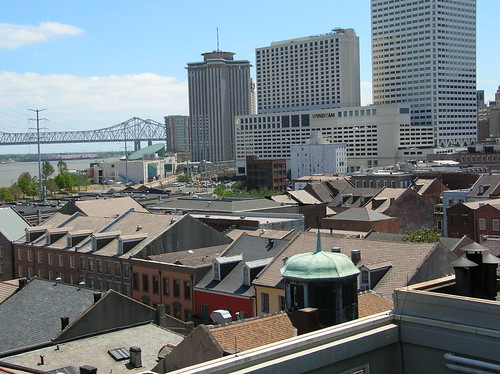
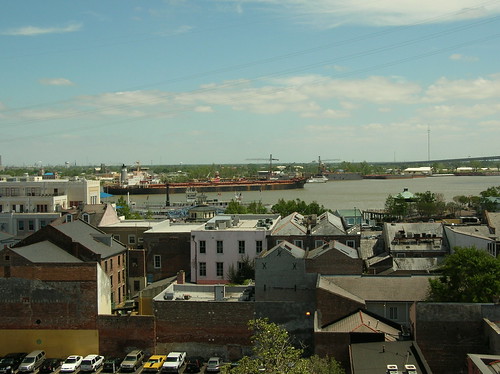
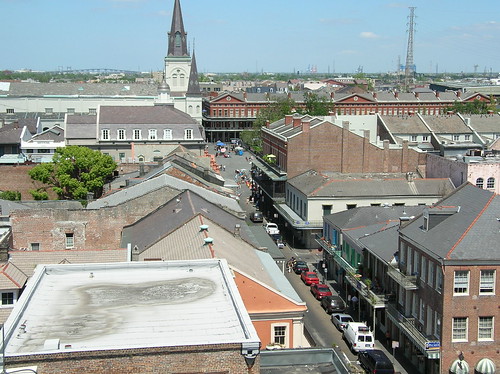
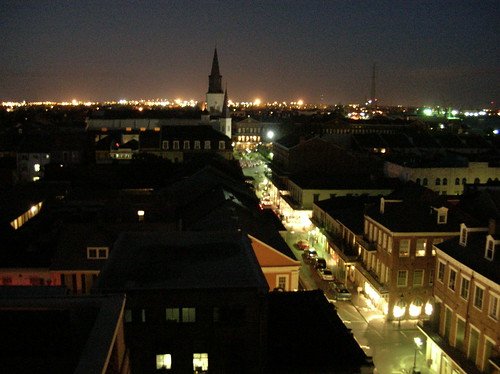
Anyway, on a semi-recent visit I discovered they had installed a card-accessible gate that kept non-guests out. So I haven't tried that in a while.
But maybe you can still get up there. At least that's what the lede here implies.
neighborhood tourism/recreation event park, for all of its charming historic architecture, deliberately obscures essential uncomfortable facts about the city's history.
Anyway, on a semi-recent visit I discovered they had installed a card-accessible gate that kept non-guests out. So I haven't tried that in a while.
But maybe you can still get up there. At least that's what the lede here implies.
There are some hotels in the French Quarter and Central Business District that have rooftop pools. If you do know this, you do one of two things: you recognize that you’re not a guest at that hotel, and you do not go swimming in that pool. Or, you realize that it’s not difficult to walk through the lobby, take the elevator to the roof, and spend the day poolside, free of charge.Yes, yes, dramatic music. But, actually, we did know that the hotel now stands on the site of one of America's largest slave markets. We last mentioned it back in August in this post about the Confederate monuments. That post, in fact, contains a similar observation to the focus of the WWNO story which is this. Our prized French Quarter
A lot of people choose option B, and they do it at the Omni Orleans on Chartres and St. Louis streets. But what these people might not know is that before the Omni Hotel, there was the St. Louis Hotel. And slaves were sold there.
There is no plaque on the wall that surrounds this private property. There are historic plaques around the city, like the one on Press Street that honors where Homer Plessy walked into the "whites-only" train car, for example. Or the one that commemorates the St. Charles Streetcar line in Lee Circle. Well, there are 52 places in New Orleans where slaves were sold. And of those 52, there are only two signs in the city of New Orleans that deal with the slave trade.But nobody cares about that in Dizneylandrieu. We're too busy moving forward with one voice or whatever to worry about whether or not the words "authentic cultural heritage" we're selling to the tourists actually mean anything.
“The official signage is on West Bank of the Mississippi River in today’s Algiers Point along the levee, and it recognizes that location’s role in transatlantic slave trade” says Greenwald. “On this side of the river there’s one plaque. It’s on Maspero’s Restaurant, across street from the St. Louis Hotel, and claims to be the site of Maspero’s Exchange. That is not correct!”
The sign claims that Maspero’s Restaurant was the site of Maspero’s Exchange, but that was actually across the street, where the St. Louis Hotel is. So of the 52 sites on the East Bank, only one is marked. And it’s wrong.
Thursday, August 06, 2015
I wanna see some history
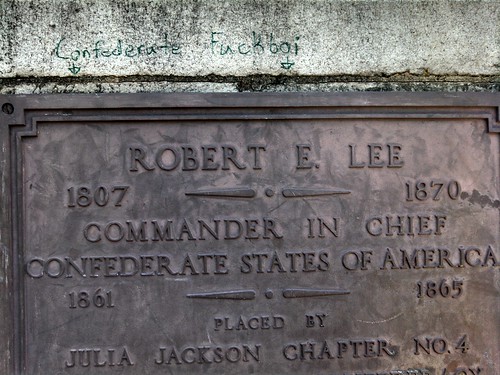
Where has the year gone? We're almost all the way to the end of Everybody Shout At The Mayor Season. The final Budget Circus Shout Session is next Monday in District E. If that seems early to you, it's because it is. Shouting at the mayor season was intentionally moved up the calendar this year in order to better serve the illusion that the shouting actually helps to shape the mayor's budget priorities. It doesn't. But, man, is it ever fun.
Still, the shift in schedule may have caused you to miss your chance to get in on the excitement. If so, you are in luck.
Following last week's invite-only daylong discussion on the future of the city's Confederate landmarks, the City of New Orleans hosts two meetings next week that are open to the public.Oh boy. Do you think they know what it is they are asking for?
The Historic District Landmarks Commission hosts a meeting in City Council chambers at City Hall (1300 Perdido St.) from 1 p.m.-3 p.m. Thursday, Aug. 13, followed by a Human Relations Commission meeting at 6 p.m.
Up for discussion are the possible relocations of several monuments to the confederacy, including a statue of Robert E. Lee at Lee Circle, a Jefferson Davis statue on Jefferson Davis Parkway, a P.G.T. Beauregard statue in front of City Park, and the Liberty Place Monument on Iberville Street.
According to a release, comment cards at the Human Relations Commission meeting must be submitted no later than 7 p.m. in order for participants to speak. The city also is accepting public comments online at www.nola.gov/hdlc or www.nola.gov/hrc. Those comments must be received by 5 p.m. Tuesday, Aug. 11 to be entered into the recordHa ha, yes they do, indeed. Well, okay, let's have it out. This will only take about all of the rest of our lives to resolve. Not that it should take that long. As I and others have said, this isn't as complicated as the reactionaries are making it out to be. The specific monuments in question represent a propaganda campaign on the part of Confederate apologists during the Jim Crow period. It is time to end that campaign. We've spent enough time trying to annotate or compromise with it to know that isn't going to work.
For example, this is the Liberty Place monument.
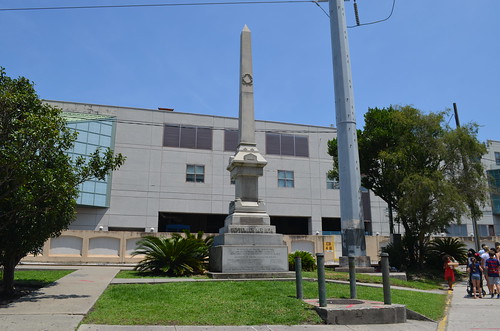
Erected in 1891, it commemorates the restoration of white supremacist government to Louisiana by purposefully misrepresenting a riot during which members of the Crescent City White League murdered Metropolitan Police and state militia as a "battle" for "Liberty." Inscriptions added later celebrated the end of reconstruction declaring, "The national election of November 1876 recognized white supremacy in the South and gave us our state."
In the 1970s another inscription was added saying, basically, "Hey we don't actually think the racist stuff we wrote on this monument before." More controversy ensued.
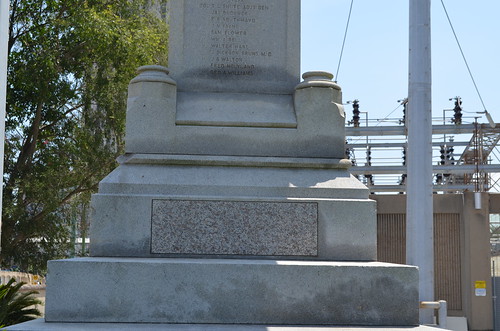
This gesture satisfied almost no one. In 1976, the NAACP Youth Council requested the monument's removal, while some decried the plaque as "historical revisionism." Furthermore, modern white supremacist groups such as the Ku Klux Klan began to see the memorial as a rallying point for planned marches and demonstrations.When they put it back they, somewhat clumsily, patched over the white supremacy inscription with this piece of marble.
In 1981, the monument nearly left public view at Mayor Ernest "Dutch" Morial's order, sparking a new round of public discussion and protest. Ultimately, the City Council blocked any move or alteration, and the monument remained on Canal Street, although partially hidden behind tall bushes.
The monument left public view in 1989, reportedly for safe keeping, amidst construction on Canal Street. Mayor Sidney Barthelemy pledged to return the marker, though his administration missed the originally stated date for its replacement. The structure stayed in storage until February 1993, when a movement led by David Duke, a former Grand Wizard of the Ku Klux Klan, sued for its return. To the chagrin of many residents, the city obliged but moved the obelisk off of Canal Street to its present site in the curve of Iberville Street, between railroad tracks and the entrance to a parking garage.
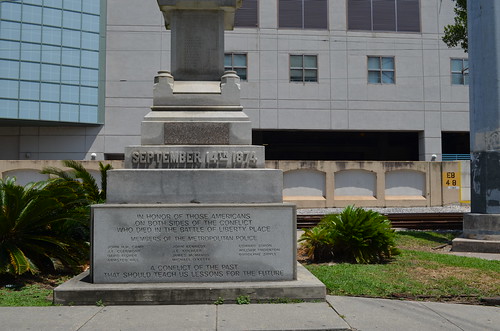
They also added a new front panel with some words about how we really need to honor "both sides" of the riot incited by the White Leaguers because doing so will "teach us lessons for the future."
I'll be the first to admit that this thoroughly stupid collection of insults and exacerbating half-remedies is full of historical significance. It should be preserved somewhere. But let's not allow it to continue on public display as a monument. There's nothing we can do to make it appropriate for that. And clearly we have tried.
The mayor wants us to consider renaming Jefferson Davis Parkway. I'm open to that, although I'm not thrilled that he wants to rename it for Norman Francis. But the monuments on the neutral ground are the real problem. Like this one to Colonel Charles Didier Dreux
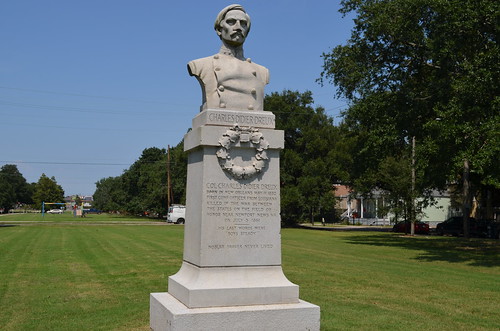
That one along with other monuments described in this article to "Poet Priest of the Confederacy" Abram J Ryan, General Albert Pike, and, of course, JD himself make the entire length of the street into a Confederate theme park.
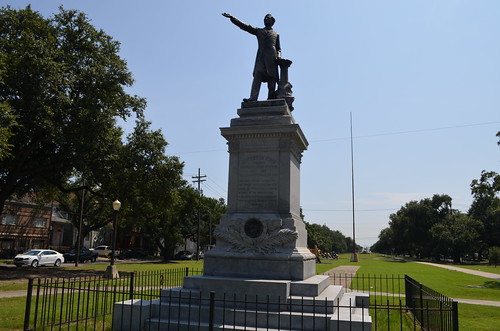
It's probably well past time for us to change that. But, if last week's District A Budget meeting is any indication, that will not be easy.
Landrieu: "It does not surprise me that some folks in this room may not feel and may not think that some people in this city are offended every time they drive by a statue that they think reveres—" "History!" one woman yells. Landrieu politely asks her to let him finish.One wonders, though, why the cries of "History!" are loudest in defense of these Jim Crow era revisionist monuments. If it's important that we ensure the memory of our city's Old South history remain at the forefront of public consciousness, why not consider the far more significant sites and events we are currently neglecting?
Here is a view of the intersection of St. Louis and Charters Streets in the French Quarter.
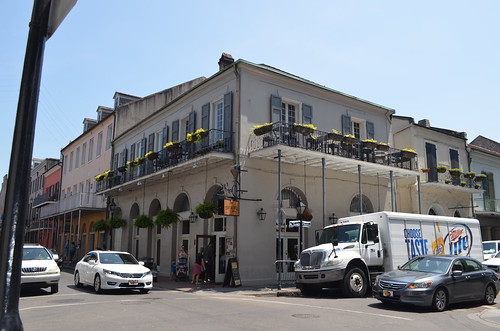
The building we're looking at in the photo is a horrendous tourist trap of a "Cajun restaurant" called Original Pierre Maspero's (est. 1788). According to an official enough looking plaque on the wall there, this was the site where Andrew Jackson met with the famous Lafitte brothers to plan the defense of New Orleans from the British. Oh and also, the plaque says matter of factly, "slaves were sold there."
The first problem for fans of History! is none of that is true. None of it is true of that building, anyway. The building that was once known as Maspero's Exchange (but also under other names) and where at least some of those things happened no longer exists. It was located across the street. On the corner from where this photo was taken, actually. Richard Campanella describes it here.
Originally called Tremoulet’s Commercial (or New Exchange) Coffee House, this business became Maspero’s Exchange in 1814, Elkin’s Exchange after Pierre Maspero’s death in 1822, and by 1826, Hewlett’s Exchange, named for new owner John Hewlett. Because of the place’s popularity and frequent management changes, newspapers and city directories ascribed a variety of names to the business at 129 (now 501) Chartres: the “Exchange Coffee House,” “New Exchange Coffee House,” “Hewlett’s Coffee House,” or “La Bourse de Hewlett.”Which brings us to another point of interest our History! buffs might want to have a look at. The stuff in the plaque about Andrew Jackson and the Lafittes is shaky. But the "slaves were sold there" bit is quite an understatement. Campanella only talks about the Exchange's importance to "the New Orleans business community." But this may be selling the scene short. In fact this was the center of the American trade in cotton and in human beings.Which is to say it was a major nexus of 19th Century global capitalism.
The two story, 55-by-62-foot edifice boasted behind its gaudy Venetian screens a 19-foot-high ceiling, four 12 lamp glass chandeliers, framed maps and oil paintings (described by one Northerner as “licentious”), wood and marble finishing, and an enormous bar with French glassware. Like many of New Orleans’ coffee houses, the upper floor contained billiards and gambling tables. Throughout the mid-antebellum years, Hewlett’s Exchange buzzed with trilingual auctioning activity, in which everything from ships to houses to land to sugar kettles to people legally changed hands.
The city’s seven auctioneers worked the block on a rotating schedule, every day except Sunday, oftentimes while maintaining other jobs elsewhere. Joseph Le Carpentier handled Mondays, Wednesdays, and Saturdays; Toussaint Mossy (president of the New Orleans Architect Company) worked Tuesdays and Fridays; H. J. Domingon, George Boyd, and Joseph Baudue got Tuesdays, Thursdays, and Saturdays; and the busy Isaac McCoy and Francois Dutillet worked six days a week. At the time of Lincoln’s visit, Hewlett’s Exchange was the New Orleans business community’s single most important public meeting site for networking, news-gathering, and wheeling-dealing.
A recently published book to read here is by historian Edward Baptist. An early chapter in The Half Has Never Been Told: Slavery and the Making of American Capitalism describes innovations in banking and credit that allowed great fortunes in commodities and slaves (who were themselves commodities) to be moved great distances at the stroke of a pen. "Innovators" like New Orleans businessman Vincent Nolte could write an order from a table at Maspero's Exchange and thousands of bales would be headed to Liverpool, or thousands of slaves shuffled off from Maryland to Alabama. Baptist calls this the entrepreneur's "right hand" power. Today we might recognize it as "disruption." (You might have to click the image to read the quote.)

Given the modern enthusiasm for wave after wave of "creative destruction" heralded at every NOLA Entrepreneur Week, you'd think our History! buffs would be thrilled to know more about the dynamic 'treps like Nolte who hung around in hip bars like Maspero's thinking up how to do Uber but for slavery.
But for some reason, they'd rather fixate on preserving the over-embellished memories of a failed rebellion bent on preserving the slave power these entrepreneurs created. Maybe they just prefer losers. Or maybe they don't have any idea what they're talking about. In any case, they're sure to be yelling about it at City Hall next week. If you have the opportunity to witness this historic event, please take notes. Otherwise someone may call it a "battle" and try to commission a monument.
Tuesday, February 01, 2011
Could be a big deal
New Orleans archdiocese to publish online baptism, marriage records of slaves
In other words, the Catholicism of the 18th Century saved the amateur genealogists of the 21st.
For years, many of the names in those records have been indexed, and the life-cycle events they describe summarized in two dozen or so massive volumes organized by surname.
Those volumes, well-known to genealogists and available at the New Orleans Public Library, can tell a researcher where and when a certain white planter or merchant was baptized, married or buried in 19th century New Orleans.
But without surnames, African slaves and some free people of color are invisible in those ledgers, Clark said.
The records of their life-cycle events are only in the original sacramental documents, which are just now coming into the light in the new online database.
Moreover, Clark said, the original sacramental records sometimes contain important marginal notations that do not make it into the bound summaries. Those apparently will be visible in the database as well.
“This means ordinary people all over the country with ancestors in early Louisiana will be able to push back much further, and that’s important, not only for Louisiana, but nationally,” Clark said.
The church records open a window into the slave experience for reasons peculiar to New Orleans’ European and Catholic roots, Clark said.
Elsewhere in colonial America, slaveholders were predominantly Congregationalist in the Northeast or members of the Church of England along the Atlantic seaboard. Neither denomination devoted itself to evangelizing African slaves, thus depriving history of church-based records of individuals’ births, deaths and sometimes their marriages, Clark said.
In other words, the Catholicism of the 18th Century saved the amateur genealogists of the 21st.
Subscribe to:
Comments (Atom)