-->
Showing posts with label Rising Tide. Show all posts

Wednesday, August 11, 2021

Howling in the wires

In August of 2007, Sam Jasper wrote this. 

The lies and the greed and the corruption in this country, from the Prez at top of the ladder to the "great hope for New Orleans" councilman, have taken this country from the top of the heap to the depths of dysfunction. Things like infrastructure for this country are tabled in order to take our tax dollars and funnel them into corporate cronies' pockets to rebuild infrastructure that we blew up elsewhere. The feds say it's the states' responsibility to take care of the infrastructure once it's built, and some states can't afford to do that. The feds can. But instead they tsk tsk, shake an accusing finger at the local leaders and go on to their meeting with some war profiteering contractor---behind closed doors, no press allowed, and no logs of the meeting kept.

Forget about any kind of social services, we can't keep our levees and bridges up.

We're all so used to it that we skim the articles, rant over dinner if we're in our cups, and go on to work the next day because lord knows the insurance companies who never have to really, I mean REALLY, take on any risk have to be paid and the energy companies who get bailouts have to be paid, and the mortgage has to be paid to keep a roof over both the mortgage company's head (even if they made hideously stupid loans for the last several years, planting false hope in many family's futures--"No PROBLEM, the balloon payment won't come up for five years!") and our own, and we have to pay our taxes next April so they won't attach our paychecks or put a lien on our house to collect the bucks they want from us so they can rebuild that fucking bridge in Baghdad for the ninth, tenth, eleventh time. Don't take a breath. Keep running, Joe, like a hamster on a wheel, you're getting older now and you have no stock portfolio, no health insurance, no retirement savings, you don't have time to do anything about the lies. Remember, though, Joe, all those bucks you're sending in with your 1040 won't do you any good if a disaster strikes, whether it be a hurricane or a heart attack.

There is no social contract. Faith in government will surely break your heart. Faith in companies will break your heart. 

Interestingly, what prompted that particular moment of exhaustion and outrage at an entire system was then councilman Oliver Thomas's announcement that he was resigning after the discovery of his having accepted roughly $19,000 in bribes from Pampy Barre.  That might seem to some today like blowing a matter of petty local corruption out of proportion. But at the time, this sort of thing made the  national news.  

As the New York Times article linked above demonstrates, all eyes were on New Orleans. Mostly those eyes were scrutinizing us to discover reasons the very bad thing that happened to us in 2005 was actually our own fault somehow.  All too happy to aid in that project were an over-stimulated gang of federal prosecutors waiting to provide grandstanding quotes like these at a moment's notice.

Some 30 school system employees have been indicted. And the United States attorney here, James B. Letten, said Monday that a long-running investigation into corruption at City Hall in the Morial administration, which has already yielded 16 convictions, would continue.

“It’s just brazen down here,” James Bernazzani, the Federal Bureau of Investigation’s special agent in charge, said at a news conference after Mr. Thomas entered his plea.

“In Louisiana they skim the cream, steal the milk, hijack the bottle and look for the cow,” said Mr. Bernazzani, who noted that his district ranked second in the nation in public corruption convictions and indictments — despite its relatively small population.

But this is cause to refer again to Sam's crisis of faith in institutions. Mr. Bernazzani, for example, would eventually go looking for a cow of his own. 

The indictment also alleges Mayfield sent $150,000 in library donations to the Youth Rescue Initiative. It claims he routed that money to the Jazz Orchestra, and himself, throughout 2012. One payment from the YRI, for $77,000, came in December 2012, the feds allege, after Mayfield had officially left the YRI board.

The president of the YRI at the time was Jim Bernazzani, former FBI special agent in charge of the bureau's local office. After Mayfield served on the YRI board, he made Bernazzani an advisory board member for the Public Library Foundation without official board approval, according to comments made last year by the current Library Foundation chairman, Bob Brown.

WWL-TV asked Bernazzani last year about Mayfield’s transfers and his use of an “Irvin Account.” Bernazzani insisted the federal investigation would show "there's nothing there."

The station called Bernazzani about the latest indictment and did not hear back.

The corruption of global capitalism is intertwined with the corruption of local politics. The same forces act on each and they feed back into each other.  Every now and then there comes along a moment of trauma so severe that the cultural bafflements and social silos that keep us from seeing these connections are removed. Such moments are irrefutably bad but they are also revelatory.  The post-Katrina period in New Orleans was such a moment.

People like Sam spent that moment looking for ways to break out of the pattern of "skimming the articles and ranting over dinner in our cups."  But they never really did. This wasn't their fault, of course. The universally embedded death drive of capitalism is bigger than any of us and will inevitably swallow us all. But that doesn't mean that communities under threat should just lie down and take it. So they did the thing that any threatened community tries to do. They reached out to neighbors. They shared information and experiences. They tried to, at least, provide a space where others could come together and build real organizing capacity.  

Mostly they wrote things down and posted them on the internet. (Which was a fairly novel tool at the time!)  A lot of that, like Sam's 2007 post about OT, is still there. But a lot of it isn't.  Around the time of the last Rising Tide, Sam approached a few of us and told us we needed to curate and preserve as much of that material as we could before time and link rot consigned it all to oblivion.  After all, sacrificing the collected cultural memories of a trauma only heighten the risk that they will be repeated.  We didn't know how to do any of that, though. We probably should have tried harder to figure it out.  

Sorry, Sam.

Thursday, September 03, 2015

Moving tourists slowly through downtown

RTA Priority 1:
Prior to the Loyola streetcar opening, the Freret and Martin Luther King bus lines were among the most direct lines running from Uptown to Canal Street. Now, however, the line stops at the Union Passenger Terminal just past the Pontchartrain Expressway, and riders who wish to continue on must wait for the streetcar to arrive, then pay 25 cents to transfer.

Consequently, ridership has decreased on the Freret bus line 42 percent “immediately,” said Rachel Heiligman of RIDE New Orleans, at last weekend’s Rising Tide conference. Some of those riders may now be going to the Claiborne line, she said.

“The bus is just no longer as useful to riders as it used to be,” Heiligman said.

The change, Heiligman said, reflects the widening gap between streetcar and bus-line recovery in the city where 19 percent of residents don’t have access to a car. In terms of daily public-transportation trips, the city has only restored 45 percent of service since Hurricane Katrina. But streetcar service has grown to 103 percent of its former trips, while bus service has decreased to 35 percent of its former status.

“Streetcar expansion has certainly emerged as the big transit priority for the Regional Transit Authority,” Heiligman said, noting that a new North Rampart line is now under construction. “We have more streetcar trips being offered today than we did pre-Katrina, but we have just about a third of our bus trips.”

Amanda Soprano, a resident who described herself as dependent on public transportation, said she feels that the reduction in the two bus lines was specifically to boost ridership of the new streetcar, in spite of its inconvenience for riders.
See also, this David Hammer report from last year about how Mitch's push to get the Loyola streetcar up and running in time for the Superbowl led to cost overruns.  Heiligman makes the same point about how they killed the Freret bus in order to juice the Loyola ridership numbers.
But Rachel Heiligman of Ride New Orleans, a nonprofit public transit advocacy group, said that because the RTA cut off the downtown segments of the Freret and Martin Luther King buses at the Union Passenger Terminal, those bus riders now must transfer to the Loyola streetcar if they want to get to Canal Street.

'What we're doing is really just shifting the ridership from one mode the bus to the streetcar,' Heiligman said.

After those bus routes were cut off at the UPT, the RTA's ridership data show both lost riders, suggesting that customers unwilling to transfer to the Loyola streetcar stopped riding altogether.

The Freret Number 12 bus lost 76,000 riders in 2013, a 40 percent decrease from the year before. The MLK Number 28 bus was down by about 5 percent, while overall RTA ridership was up 12 percent.
Here's the rest of the Rising Tide X discussion on transit issues, in case you missed it Saturday.

Rising Tide X - Transportation Panel from Jason Berry on Vimeo.
 

Monday, August 31, 2015

Honorable NOLAier mention to Sean Payton

Nolier tats


This was a fun way to blow off steam yesterday.
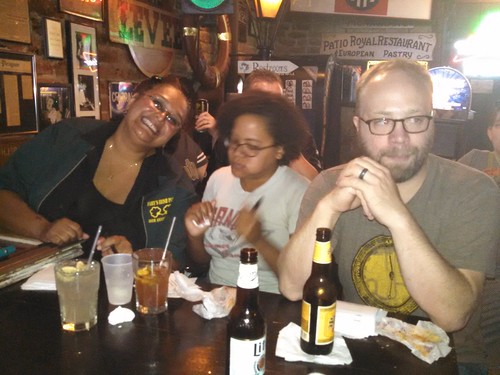
On Sunday, (artist Jeremy) Herbert’s ink won him the designation “Nolier Than Thou,” a satirical and tongue-in-cheek title bestowed during a drinking event hosted by organizers behind the grass-roots organization Rising Tide, which has hosted an annual conference since 2006 to discuss the ever-changing future of New Orleans.

Held at Molly’s at the Market, the contest was created as a way to poke fun at the city’s obsession with its own legitimacy, with residents incessantly grappling with what it means to be a New Orleanian.

“It’s reached a level where it’s worthy of satire — the amount of New Orleans pride everyone who lives here currently has,” Rising Tide organizer and artist Lance Vargas explained, laughing at the notion. “And the deeper you dig into the philosophies behind it, the more absurd it’s going to seem.”
Here's the Facebook invite we sent out.  It describes, at some length, the reasoning behind the contest as well as its mechanics.
Attire to be judged in a 10 point system in three categories:

Resilience: How long have you had it? What's it been through? What is it's current condition? What's it's personal history?

Standing: How legit is it? Is it a rarity? How rare? Did Fats Domino once own it? What's it mean to New Orleans in general?

Vibrancy: How does it communicate your Nolism? Would you be stopped on the street and exalted for your Nolism? Does it scream Nolier than thou? Do you have to explain it in your Nolier Than Thou voice with correct pronunciation of New OR-Lee-ANs? How well does it read Nolier than thou?
The three judge panel included one native New Orleanian,  one pre-K transplant, and one post-K transplant.

NOLIer Judges

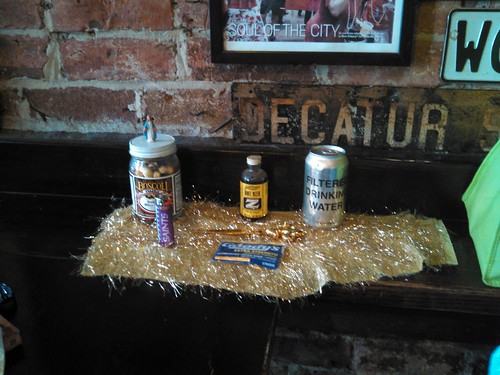
Now I don't want to go too far in the direction of impugning the integrity of the process but I am still scratching my head a bit this morning over the fact that this stunningly Nolier collection of objects didn't win some sort of  prize.
Another transplant New Orleanian, who wished to remain nameless, presented a can of Budweiser-bottled filtered drinking water that was handed out along with Meals, Ready-to-Eat after the city was devastated by Hurricane Katrina.

The can of water brought a needed, therapeutic laugh for participants who seemed ready to forget the storm the day after the city was inundated with commemorative events for Katrina’s 10th anniversary.

NOLIER Diorama

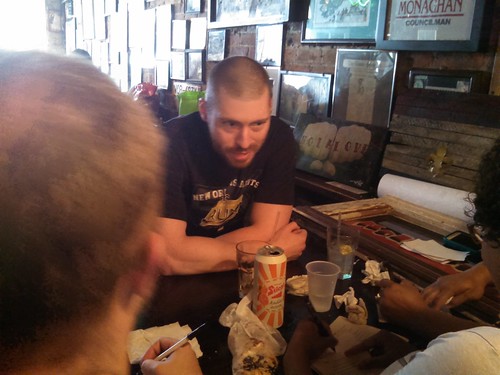
That is some vibrant, standing, resilient shit right there. Meanwhile, this guy who just showed up in a T-shirt and rambled on about being from the West Bank ended up coming in third.

West Bank

Then again, nothing in this city makes any sense so what could be Nolier than that?  I feel kinda bad for Sean Payton, though.  Nobody even knew he was playing until after the party was over.
NEW ORLEANS – Head coach Sean Payton said his decision to draw Katrina x-codes on his shirt during Sunday's preseason game against the Houston Texans wasn't planned in advance.

"I hadn't really thought about it, and I don't think anyone else really had," Payton said.

Search and rescue teams used the x-codes in the aftermath of Hurricane Katrina to mark which houses had been checked for survivors.

Payton said he was reminded Sunday of wanting to learn what each code meant, and it was "just kind of a spur of the moment" choice to honor Katrina survivors by displaying one of the x-codes on his shirt.

"It just seems fitting," Payton said. "I was at the pre-game meal and I started going through and looking up -- everyone who has lived here, many homes still have the insignias on it, east, north, south, west, it was pretty interesting to study or learn how they were used in regards to any home being searched."
Congrats to all the NOLIErs.


Update:  Oh hey here is a link to Scott Colesby's video documentation of the event.

I shot some video of Varg being a jackass I might post later if it's any good.

Wednesday, August 26, 2015

Marty McFly life preserver

Great segment on CSPAN's Washington Journal this morning with Deray McKesson.


You might be aware that McKesson will speak at this year's Rising Tide Conference Saturday August 29 at Xavier University.

Tuesday, August 25, 2015

QOTD

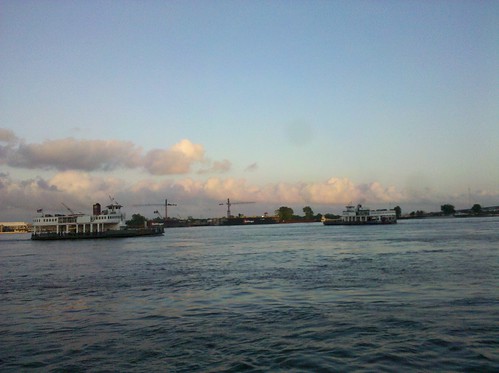
Ferry boats passing one another

Justin Augustine:
"Please ride, ride, ride, ride, ride'' the Algiers-Canal Street ferry, Transdev chief executive Justin Augustine said. Riders – and plenty of them -- are what it will take to keep an expanded weekend schedule on the ferry beyond a four-month pilot project.
From Oct. 12 through Feb. 14, the ferry will run:
  • Fridays from 6 a.m. until midnight
  • Saturdays from 10:30 a.m. until 10 p.m.
  • Sundays from 10:30 a.m. to 10 p.m.
The French conglomerate's officers announced the extended schedule during a meeting of the New Orleans Regional Transit Authority board Tuesday (Aug. 25), after Louisiana state Sen. David Heitmeier, D-Algiers, told Algiers Point residents about the upcoming changes over the weekend.
I dunno...  $2 each way for the possibility of getting stranded because the thing doesn't run 24 hours like it should sounds dicey.

I know, I know, I just said I was too busy doing Rising Tide stuff to post over here.  But did you know there's a transit panel at Rising Tide this year? If you're reading about ferries, this might be relevant to your interests.  Check it out. 

Where's my Yellow Blog today?

Sorry. I'm busy promoting and stuff.

Back later. Stay resilient.

Saturday, August 22, 2015

Robust redux

So this photo revisit is a little different.  The original subject is a photo I didn't get around to taking until 2012.  But it's of something I'd had for a long time already.

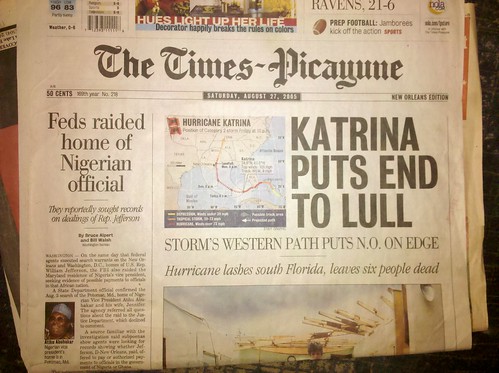
Katrina Puts End To Lull

"Katrina Puts End to Lull," it says. That's the Saturday paper. The more famous headline is the following day's "Katrina Takes Aim." But I evacuated Sunday morning and lost that day's paper. You can find pictures of it all over the internet, of course. Here's one I just googled.   "Puts end to lull" is a more intriguing headline, though.  I think it better captures the upheaval that was on the way. We were all about to be profoundly shaken out of our lull.  We may only now have begun to recapture it.

But this isn't really a post about that.  This is supposed to be one of those posts where we go back to the scene of an interesting photo from immediate post-K times and look at how it's changed. Here's how we're going to do that.

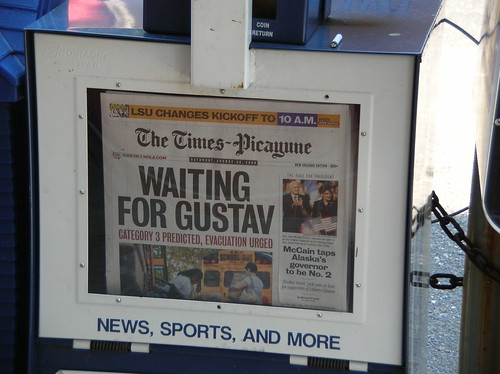
A few years after Katrina, you might remember there was an event we here at the Yellow Blog called "Crazy Freak Out '08" on account of what we were certain was a traumatized overreaction to the approach of Hurricane Gustav.  The Crazy Freak Out ended up being more valid than we anticipated as Gustav did end up setting off an evacuation.  The storm didn't destroy the city all over again but it did cause extended power outages all over town as well as angst over a bizarre "tiered" reentry plan.

As it became clear that Gustav would probably be a thing, I got out and took some pictures of the preparations.  One thing I made sure to get a shot of was the T-P front page.

Waiting For Gustav

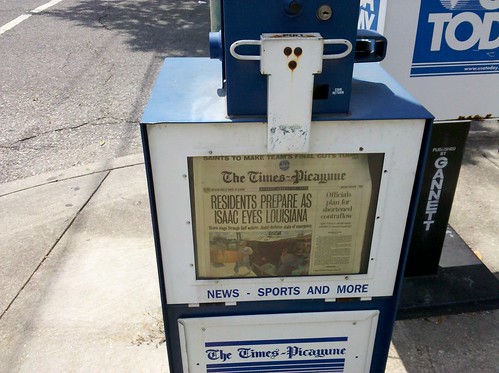
I did the same thing a few years later when we went through the drill again with Isaac.

Isaac Eyes

But something else was happening at that time to the Times-Picayune itself. Its parent company Advance Publications was implementing a nationwide "digital first" strategy which, despite the typical corporate buzzwording about being adaptable but "robust," was really all about firing lots of people.

Former T-P staff writer Rebecca Theim wrote a book about it. She recaps some of the story in this article.
In May 2012, New Orleanians and employees of The Times-Picayune learned via The New York Times that a small circle of Picayune senior editors and managers were plotting a dramatic new course for the newspaper. Advance would put the publication at the center of a bold experiment in U.S. journalism: New Orleans would become the largest American city without a daily newspaper. The daily Times-Picayune would be replaced with a three-day-a-week publication and an expanded NOLA.com, the newspaper’s website that was routinely criticized as mediocre. The changes would involve deep staff cuts at an organization that had never instituted an involuntary layoff. Additional savings would result from reduced printing and delivery costs.

Almost immediately, the community went berserk. A grassroots campaign included dedicated Facebook pages and Twitter accounts with thousands of followers, an online petition that eventually garnered close to 10,000 signatures, 1,500 yard signs supporting a daily newspaper, and public protests. A New Orleans philanthropist recruited a who’s who of city business and civic leaders to lobby against the changes, while the owner of the city’s NFL and NBA franchises publicly pursued acquiring the newspaper.

The specter of Katrina fueled the campaign. As Miller, Roberts, and LaPoe noted in Oil and Water, “… the protest underscored the significance and essence of local news, a relationship solidified by Katrina.”

Despite a valiant community effort, more than 200 employees, including one-half of the newsroom, got their pink slips. Mounting anxiety and uncertainty over future employment then prompted a rash of defections to other media outlets locally and across the country that continued well into the next year. In response, The Times-Picayune rescinded the terminations of at least 10 employees, but “digital first” and its reduced publication schedule went into effect October 1, 2012.
Since then, Advance has continued its strategy of firing its way to success.  Recently we learned that Times-Picayune staff are preparing for yet another round of cuts this fall.

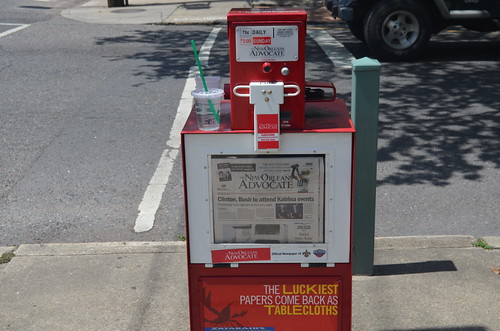
This week I went back to the corner where I'd taken those photos of the T-P paper box before Gustav and Isaac.  Katrina was back in the news, of course.  But something else was different.

Advocate Box

I should mention also that Rebecca Theim will be at Rising Tide X next Saturday talking about the changing face of local media.

Rising Tide X is August 29, 2015 at Xavier University. Check out the rest of the website for details about the extensive program. You can go for free this year but please register here. If you'd like to help defray the cost of production or order swag, there's a separate GoFundMe page here.   

Monday, August 17, 2015

We failed

New Orleans was always going to be rebuilt after the Katrina flood. The 70 billion dollars plus worth of federal funds and insurance payouts guaranteed that.  The challenge to local policy makers was to ensure that the city was rebuilt equitably. The task was to make sure that everyone who was affected by the disaster was relieved and to see that the future benefits of a rebuilt New Orleans accrued to everyone and not just to the wealthy and opportunistic.

We failed miserably to meet this challenge. The new city is more exclusive, more expensive, and a more difficult place to be if you are poor.  The bulk of the discretionary investment in rebuilding has focused on creating nice new things for rich people and tourists to enjoy.  One of many facets of life in New Orleans through which we can observe our failure is public transit.  Just take a look at this new report from the advocacy group Ride New Orleans.
The report largely focuses on the expansion of streetcar service — including the Loyola Avenue line and the line under construction on North Rampart Street and St. Claude Avenue, which some have argued serve mainly tourist areas — and the decline of bus service, which the report argues could be more flexibly used to serve the needs of residents.

Streetcars now offer about 3 percent more trips each week on the five completed lines than they did before Katrina, while buses are making only about 35 percent of the trips they made in 2005.

As a result, streetcars offer more frequent service, with one coming on an average of about every 17 minutes during peak hours, compared with buses, which require an average wait of about 38 minutes, according to the report.

While buses on two routes run every 15 minutes, the other lines have longer waits, and some routes have as much as a 60-minute wait time.
This surprises pretty much no one who has been paying attention over the past decade as RTA has repeatedly emphasized its role in "economic development" (i.e. propping up real estate values).
Justin Augustine, the agency’s general manager, said the project will take about two years to complete once the work gets started. As with the Loyola Avenue spur, which opened in January 2013, city officials hope the investment will pay off by generating economic development in a part of the city where revitalization efforts have proceeded in fits and starts.

“When we first introduced the concept, we wanted to revitalize and renew parts of the city, and we knew that along that corridor, you’d be touching five historic neighborhoods,” Augustine said, referring to the French Quarter, Iberville, the Treme, the Marigny and the Upper 9th Ward. “We’re hoping with all of our projects that we spur economic development.”
And this means, by necessity and by design, the transit agency has worked, in cooperation with developers, to deemphasize.. you know.. transit.
Pres Kabacoff, a real estate developer from the Bywater neighborhood, said he thinks the streetcar will help spur business. Kabacoff even argued that slowing down vehicle traffic might be a good thing, since having cars whip by "is not conducive for good retail development."

He added, "To the extent that people have a difficult time in traffic getting down the street it may cause them to want to live in the area and use an effective streetcar."
An "effective streetcar" slows down traffic and helps sell downtown luxury condos.  It does this at the expense of reliable bus service that helps people get where they're going on time but those people aren't who we rebuilt this city for anyway.


For more on the sorry state of New Orleans transit after the flood and on into the forseeable future, please check the schedule at this year's fast-approaching Rising Tide X.
Panel Discussion: Transportation: How'd ya Get Where Yat?

Megan Braden-Perry (Public Transit Tuesdays) moderates this conversation about how New Orleans makes infrastructure an obstacle course.

With:

Dan Favre of Bike Easy,

Rachel Heiligman of Ride NOLA,

Jeff Januszek of Fix My Streets

Amanda Soprano from #NOLATwitter.

Rising Tide X is August 29, 2015 at Xavier University. Check out the rest of the website for details about the extensive program. You can go for free this year but please register here. If you'd like to help defray the cost of production or order swag, there's a separate GoFundMe page here.   

Thursday, August 13, 2015

When is the first day of school in New Orleans?

Well... this could take a while to explain.
Valerie McGinley’s 15-year-old son started 10th grade on Monday, but his sister and three step-siblings could sleep in, riding out the varying lengths of their summer vacations.

The first day of classes in New Orleans is anything but traditional for the city’s 46,000 public school students, with 19 different start dates ranging from July 20 to Aug. 26. It’s actually over 115 different starts when including those that stagger grades by time and date.

And it’s not just the first day of school that’s disjointed.

The decentralized system’s 43 governing boards, which operate a combined 82 schools, each create calendars of breaks, teacher-training days and other time off during the year.
Keeping all those calendars straight?

“It’s insane,” McGinley said. “We have kids with three [calendars], sometimes four …” she said.
Insane. How does one even keep up?  
The varying days off and start times can make things difficult, coordinating pick-ups and who’s taking off when the kids are out of school. McGinley said she’s lucky because she has a fairly flexible university job.

“I can’t imagine any parent who is an hourly worker having to deal with this,” she said, wondering about potential lost wages or inflexible supervisors.
So the answer is one doesn't.   Although communities of parents do try to cooperate sometimes by sharing child care responsibilities or even just information such as through the "common calendar" project described in this article.

But that isn't going to solve everyone's problem.  In fact, the system is designed in such a way to make it nearly unsovlable. Jennifer Bershire described this a few weeks ago in a conversation with parent advocate Christy Rosales-Fajardo.
Fajardo is convinced that parents actually have less power in New Orleans today than they did under the previous school system. She argues that eliminating neighborhood schools has also eliminated the power of parents to come together as part of a community.  “Parents are fighting individual battles with these schools and they’re all petrified of what will happen to their kids,” she says. Meanwhile, principals in the new autonomous landscape are more powerful than ever, functioning more like CEOs who report to hand-picked nonprofit boards. “That’s the power shift,” says Fajardo.
How do parents and educators come together to meet the systemic challenge of making the schools work in New Orleans when nobody can agree on when classes begin? This is where the past 10 years of "reform" has left us.

Meanwhile, what will the  next 10 year of education in New Orleans look like?  If you're coming to Rising Tide X you can talk about it with these people.
Panel Discussion: Education in New Orleans: The Next 10 Years

For the last 10 years, New Orleans has played the blame game in education.

Reformers have shamed the past to argue for change. In return, reform has been charged with destroying public education for future children. The aftermath of Katrina should have incited passions. However, everyone seems to have profited from the debate except for public school families—the people who need more than just words.

Durable arguments have concretized into an immovable tableau that gets in the way of both justice and progress. Pointing fingers to say who did what to who doesn’t solve problems. Progress forces us to ask where do we go from here.

This session will ask participants where should New Orleans education head in the next 10 years.

Moderator: Andre Perry, Columnist

Amanda Aiken, Principal of Crocker Elementary

Sharon Clark, Principal of Sophie B. Wright Charter School

Karran Harper Royal, Parent Advocate

Jamar MckNeely, CEO of the Inspire Network

Dana Peterson, Deputy Superintendent, Recovery School District

Lamont Douglass, Parent and PTA Member at Wilson Elementary

Rising Tide X is August 29, 2015 at Xavier University. Check out the rest of the website for details about the extensive program. You can go for free this year but please register here. If you'd like to help defray the cost of production or order swag, there's a separate GoFundMe page here.  

Tuesday, August 11, 2015

Threat level up

New York Times: They Helped Make Twitter Matter in Ferguson Protests 
A year ago, these three activists were ordinary Americans: a teacher, a school administrator and a temporary government employee. Like many others, they found a voice on social media to comment on the news, describe their personal experiences and relate the everyday struggles of blacks in America.

As their social media following soared during the Ferguson protests, so did their belief in the power of Twitter to dispute official statements that did not ring true. Eventually, they used Twitter and Tumblr to fund and mobilize protests and make demands on police departments and government officials. Their high-profile status also made some of them targets of intelligence monitoring and threats.
Attached to that article is a video where,
Johnetta Elzie, DeRay Mckesson and Zellie Imani read their tweets from the past year and discuss how social media boiled after the fatal shooting by a police officer of 18-year-old Michael Brown in Ferguson, Mo., turning the nation’s attention to race and police conduct, and in the process changing their lives.
On Monday, Elzie and Mckesson, along with several other prominent civil rights leaders were arrested in St. Louis during a protest marking the anniversary of the killing of Michael Brown by police in Ferguson Missouri last year.  A week prior to this, we learned that the two had been marked by a cybersecurity contractor as "threat actors"
The report identifies DeRay McKesson and Johnetta Elzie, two prominent Black Lives Matter organizers who took part in the Baltimore protests, as "threat actors" for whom "immediate response is recommended." It describes McKesson and Elzie as "high" severity, "physical," and "#mostwanted" threats and notes both have a "massive following" on social media. It says that ZeroFox was engaged in "continuous monitoring" of their social media accounts and specifies their geographical locations at the time of the report. The report does not suggest that the pair were suspected of criminal activity but were "main coordinators of the protests."
Yikes. The NYT story where Mckesson and Elzie  read their tweets also describes their lives before the Brown incident and how they came to be subsequently honored as "threat influencers" by cyberspooks like ZeroFox.
But on Aug. 8, 2014, the day before Mr. Brown was killed, Ms. Elzie was 25 and living in St. Louis. She had just finished a job as a phone interviewer for the United States Department of Agriculture and was considering going back to school. She had a community of friends and maybe 2,000 Twitter followers, and used social media to comment on topics like makeup, movies and sports.

On the day Mr. Brown died, Ms. Elzie drove to Ferguson and started tweeting and posting photographs and videos to social media. She has not stopped. A year later, she has more than 57,000 followers on Twitter. She is now an organizing member of the group WeTheProtesters.org, along with Mr. Mckesson.

Mr. Mckesson, 30, monitored Twitter during the first few days of last August’s protests from his home in Minneapolis, where he worked as a school administrator and had 1,000 or so Twitter followers. But after watching protesters in Ferguson clash with a militarized police force, he packed his car and tweeted, “En route to Ferguson.” In the months since, Mr. Mckesson has become a full-time protester and organizer, and a go-to source for reporters covering protests around the country. He has 200,000 Twitter followers.
While few of us in New Orleans can relate to the experience of being marked as "threat actors," some of us have been referred to on occasion as "dangerous people from the internet."  What many of us can relate to is the experience of organizing a broad online support community in the wake of a national tragedy.
After the flood that followed Hurricane Katrina’s landfall, the internet became a vital connection among dispersed New Orleanians, former New Orleanians, friends of the city and of the Gulf Coast region. A surge of new blogs erupted and, combined with those that were already online, a community of bloggers with a shared interest in New Orleans and the Gulf Coast developed. In the summer of 2006, after the success of the first Geek Dinner, and to mark the anniversary of the flood, the newly formed NOLA Bloggers organized the first Rising Tide Conference, taking their shared interest in technology, the internet and social media and turning advocacy for the city into action.
Which is one of many reasons we're proud to welcome Deray Mckesson to speak at the tenth Rising Tide conference this year. The kind of grass roots organizing through social media Mckesson has excelled in really exemplifies the spirit of what brought Rising Tide together in the first place. At least that's what we've been writing on the website all these years.
Leveraging the power of bloggers and new media, the Rising Tide Conference is a launch pad for organization and action. Our day-long program of speakers and presentations is tailored to inform, entertain, enrage and inspire.

We come together to dispel myths, promote facts, highlight progress and regress, discuss recovery ideas, and promote sound policies at all levels. We aim to be a "real life" demonstration of internet activism as we continue to recover from a massive failure of government on all levels.
Giving a platform to "threat influencers" since 2006. Maybe should add some language in there about that too. 

Rising Tide X is August 29, 2015 at Xavier University. Check out the rest of the website for details about the extensive program. You can go for free this year but please register here. If you'd like to help defray the cost of production or order swag, there's a separate GoFundMe page here. 

Book season

The Katrinaversary always brings us a new set of books either about the flood itself or New Orleans in general. But obviously the tenth year is going to produce a heavier crop.  Here's Gambit's Kevin Allman with a few brief reviews to help sort through some of them.

One of these, in particular, I've been waiting in line for this one for a few months. Looks like I'll finally get my hands on it soon.  Anyway Allman sells it well.
Katrina: After the Flood

By Gary Rivlin (Simon & Schuster, $27)

Rivlin covered the aftermath of Katrina for The New York Times and pieces together a tapestry of portraits and tales that should place this as one of the definitive books on the subject. He was a fly on the wall at meetings of the Bring New Orleans Back Commission (which was, of course, about bringing back some neighborhoods and not others), and examines the 2006 mayoral race, which brought 21 challengers against Mayor Ray Nagin, who had made headlines with his "chocolate city" comment. Along the way, Rivlin tells personal stories of New Orleanians just trying to get by, like that of Cassandra Wall, who believes the stress of the storm contributed to her mother's death from cancer, and the late Mack McClendon, who worked on his destroyed house all day and slept in a formaldehyde-poisoned FEMA trailer at night.

There are fascinating quotes on nearly every page, from real estate developer Pres Kabacoff ("It took a Katrina to finally turn things around") to Nagin, who allowed talk show host Oprah Winfrey to enter the Superdome only after swearing aloud, "I, Oprah Winfrey, promise not to hold the city liable financially or otherwise as a result of me going into this doggone stinky-ass Superdome."

Rivlin also resurrects a 2006 story by The New York Times' Adam Nossiter, who described boosters imagining a New Orleans that has become "an arts-infused mecca for youthful risk-takers, a boomtown where entrepreneurs can repair to cool French Quarter bars in ancient buildings after a hard day of deal making." You be the judge.
Meanwhile, this Sunday's New York Times has collected and reviewed another slate of Katrinaversary material.  This one looks like the winner in that batch.
LEFT TO CHANCE
Hurricane Katrina and the Story of Two New Orleans Neighborhoods
By Steve Kroll-Smith, Vern Baxter and Pam Jenkins
210 pp. University of Texas. Cloth, $75; paper, $24.95.

How to analyze the role of social class in the Katrina catastrophe? Taking on this important question, the University of New Orleans sociologists Baxter and Jenkins and their former colleague Kroll-Smith, now of the University of North Carolina, Greensboro, came up with a fine plan: to compare the ordeals of two black neighborhoods, working-class Hollygrove and middle-class Pontchartrain Park.

Down-at-the-heels Hollygrove sprang up after World War I. Crisscrossed by highways, train tracks and canals, it was simply what was left after the urban planners finished drawing their maps. In contrast, Pontchartrain Park, a cynical product of the late Jim Crow-era “separate but equal” doctrine, was built as a planned community of 1,000 single-family homes arrayed around a blacks-only golf course. Socioeconomically disparate but similarly below sea level, both Hollygrove and Pontchartrain Park took on several feet of water when the levees broke.

The authors conducted 68 lengthy interviews with survivors from the two neighborhoods, running through their experiences from disaster preparation to rebuilding. But eventually Kroll-Smith, Baxter and Jenkins found themselves at a loss. So many aspects of the Katrina ordeal — where outside New Orleans one happened to have family and friends; which FEMA official answered the phone; whether a particular local bureaucrat was better swayed by a calm request or an emotional outburst — seemed, as their title puts it, left to chance. Moreover, levels of hardship couldn’t always be predicted by socioeconomic status: “Joseph Pratt, a lifelong resident of Hollygrove and jack-of-all-trades . . . hot-wired a truck, siphoned gas and drove himself and others to Baton Rouge and out of harm’s way. These are working-class skills.” In an emergency, handyman training may prove more useful than a college degree, but when a hurricane is approaching isn’t it even better to have the middle-class prerogative of owning a reliable car? “We don’t have a theory about their stories,” the authors confess. “Our goal in this book is to create a little disorder of our own.”
As it happens, you can see the authors of each of these books at Rising Tide this year.

Pam Jenkins, one of the authors of Left To Chance will be participating in a discussion at Rising Tide this year on domestic violence issues. Here's a sketch of that panel.
After Hurricane Katrina, the dynamics of domestic violence and sexual assault changed.  The issues of safety and vulnerability for women increased as the city emerged first from the immediate crisis and then, the long term recovery.  At the same time, activists and providers began to think how to provide services in this changed landscape.  This panel discusses the challenges and success of increasing women’s safety.

Pamela Jenkins, Professor emeritus, Sociology, University of New Orleans and president of the Family Justice Center Board of Directors

Mary Claire Landry, Executive Director, Family Justice Center of New Orleans
Meanwhile Gary Rivlin, whose book is also reviewed at length by NYT,  is a featured speaker... or morning keynote.. or whatever we decided to call it when we do multiple keynotes at RT. 
Gary Rivlin, an investigative reporting fellow at The Nation Institute, is a former New York Times reporter and the author of five books, including most recently Broke, USA: From Pawnshops to Poverty, Inc.—How the Working Poor Became Big Business. His work has appeared in The New York Times Magazine, Mother Jones, GQ, and Wired, among other publications
Rising Tide X is August 29 at Xavier University. Check out the rest of the website for details about the extensive program. You can go for free this year but please register here. If you'd like to help defray the cost of production or order swag, there's a separate GoFundMe page here.

Nobody actually lives here

Last week an organization called Neighbors for Neighborhoods held an organizing meeting to talk about the plague of short term rentals driving up rents and driving residents out of New Orleans neighborhoods in favor of part time second homes and tourists.  The meeting was joined by a landlords' group called Alliance for Neighborhood Prosperity apparently under the impression that it was a city sponsored public event. Most of them were turned away.
Those ANP members who did make it in were, unsurprisingly, not impressed with what they heard.

Rob White, a French Quarter resident, spent the bulk of the meeting highlighting many of the committee's grievances. For those of like mind, it was validation. For those who think otherwise, it was inflammatory. For or against, few of his remarks came as news to anyone who has been paying attention to the short-term rental debate.

Some of his points, paraphrased: Short-term rentals drive up housing costs by taking units for locals off the market. They erode neighborhood cohesion by creating neighborhoods where nobody lives. They are operated by people who openly flout the law in order to make a buck.

The so-called "sharing economy" is a sham, White said. "Sharing is when I have a ham sandwich and I give you half" When someone gives you a sandwich and then hands you the bill, that's a restaurant, he said.

In the case of the short-term rental business, the product is the neighborhood. "I'm being sold by the guy in Mississippi who rents short term," he said. "That is not sharing. That is colonization."

A half dozen of the ANP members in attendance walked out in the middle of his speech
That the landlords already feel like nobody has any right to talk to them like that should tell you enough about their position and the overwhelming likelihood that they're going to get their way from the city.   That the press spends even a moment entertaining the notion that the landlords have a legitimate beef should tell you the rest.

Anyway, if you'd like to watch the meeting, Dambala has the whole thing on video here.

Also, if you'd like to learn more about short term rentals and New Orleans neighborhoods, come see this presentation at Rising Tide.
Breonne DeDecker & her team are using research and GIS data to track Short Term Rentals in New Orleans. They're working to understand how this affects the overal rental market and figure out what sort of policy intervention could improve housing access and affordability.
Rising Tide X is August 29 at Xavier University. Check out the rest of the website for details about the extensive program. You can go for free this year but please register here. If you'd like to help defray the cost of production or order swag, there's a separate GoFundMe page here.

Saturday, September 13, 2014

Stop and say hi, kids

Rising Tide 9 is happening today at Xavier.  (Yay!)

If you're staying at home to watch it on the TV, consider clicking the donate button.

Friday, September 12, 2014

Made the big city papers

Special event this weekend you may enjoy.
New Orleans education expert Andre Perry keynotes the ninth Rising Tide conference Saturday (Sept. 13). A frequent commenter for the Hechinger Report and other news outlets, Perry ran New Orleans' first charter school network before shifting into academia.

Locals have eyed him as a potential Orleans Parish superintendent. Perry has chosen, however, instead to found a school of urban education at Davenport University in Michigan.

Perry focuses on the social purposes of education, saying the point is a stronger community, not just higher test scores. His speech Saturday will call on New Orleans private and parochial school parents to come together and create a "unified school district," according to the Rising Tide website.

The conference starts at 9:30 a.m. at Xavier University. Perry's speech is at 2 p.m.
This was on the front page of NOLA.com about an  hour ago.  If you go post a bunch of comments they might bump it back up.  Try signing in as "campstblue"

Tuesday, September 09, 2014

On 9/9, here are some notes on Rising Tide 9

You might have noticed the button has been over in the sidebar for a while now. But if it's somehow escaped anyone who is already reading this page, yes, the ninth Rising Tide Conference; New Orleans's original, most talked about, loosest, smartest, weirdest, and just all around best grass roots social-media based public affairs conference... is this Saturday at Xavier.

Take a look at the schedule. I think it's a pretty good one. There's a panel on hidden local history.  There are presentations on community organizing and civic engagement.  There is a "religion panel" where representatives from a diverse sampling of faith based communities will talk about their role in post-Katrina recovery. Not to mention also the "Tech School" component where local internet activists, businesspeople, and hobbyists share tips and tricks.

The keynote speaker is Dr. Andre Perry. Here is some of his bio lifted from his web page.
On July 1, 2013, Dr. Andre Perry became the Founding Dean of Urban Education at Davenport University in Grand Rapids, MI. Dr. Perry is responsible for planning and launching Davenport’s new College of Urban Education. Dr. Perry serves as the chief architect and advocate for the College, building relationships within the University and collaborations with external constituencies in order to build a program that will be a pioneer in urban education. As the strategic leader of the College, he develops and implements a vision and a plan for the College of Urban Education as an innovative and dynamic new force in preparing teachers and leaders for success in urban schools.

Prior to, he was the Associate Director for Educational Initiatives for the Loyola Institute for Quality and Equity in Education. Dr. Perry created academic and enrichment opportunities for Loyola University as well as for primary and secondary students in the metro area. Before Loyola, he served as the CEO of the Capital One-University of New Orleans Charter Network, which was comprised of four charter schools in New Orleans. In 2010, Perry served on Mayor-Elect Mitch Landrieu’s Transition Team as the co-chair of the Education Taskforce.
A couple of years ago, Perry turned his experience with education reform in New Orleans into a fictionalized examination of its many challenges.  The Garden Path: The Miseducation Of A City  is just out of print although, at that link there, you can see there are two copies available at Octavia Books as of this writing.  Also the public library has a copy. Peruse the remainder of his bio for Dr. Perry's many other credits.  He has been a frequent commenter on education in local and national media.  

Dr. Perry is an idealist. His latest column for The Hechinger Report where he is a regular contributor is titled "How the ideal student experience would look in NOLA" 
This public school is not designed to build up poor children, and a picture of the parent association could not be lifted from a society page. Local history is honored, but its curriculum is built to not repeat the man-made disasters of the past. Its rigorous liberal arts curriculum is rooted in five pillars. Chief among the pillars is: all students will responsibly pursue truth. Second, resources are equitably dedicated to the intellectual, emotional, and physical wellbeing of every child. Third, depth is preferred over breadth. Fourth, the values of fairness, generosity and tolerance must be demonstrated in teacher, student, and caretakers’ behavior. And fifth, teaching and learning should be documented and assessed with tools based on student’s performances on real tasks.

Dr. Perry is also a realist.  This is from a recent Washington Post article by him titled, "The attack on bad teacher tenure laws is actually an attack on black professionals"
Blacks are more likely to live in states where teachers cannot bargain collectively, and Southern states still have a higher share of black teachers. Labor laws have not been favorable to black workers.

My work in New Orleans showed me what can happen when black teachers lose protections. In the aftermath of Hurricane Katrina, the New Orleans School Board summarily and illegally fired its 7,500 teachers and staff. Based on 2000 census data, nearly 5 percent of New Orleans blacks lost their jobs with that decision. Then, citing the absence of  teachers (who had evacuated), the board chose not to renew the collective bargaining agreement with United Teachers of New Orleans. The (mostly black) teachers were gone, and there followed no systemic effort to recruit the best ones back.

Nine years later, New Orleans reformers rave about growth on test scores. But the quality of any reform must be measure against other quality of life measures to see the broader impact. The share of New Orleans’s black middle- and upper-income households dipped from 35 percent to 31 percent, while their white counterparts increased from 60 percent to 68 percent.Whites on average are paid  twice as much as blacks. Education reform, by extracting so many working-age blacks from their jobs (and, subsequently, from the middle class), has exacerbated these trends.

The speech Perry has prepared for Saturday is titled "Education is like water; put down your reform rake"
Rakes don’t organize water very well. Likewise, charter schools, vouchers and lotteries aren't the proper tools to deal with the root problems of New Orleans education. New Orleans public schools must become a “unified school district” if the needs of children, families and communities are to be met. Getting, private and parochial school parents to believe we’re all in this together has been and will be the essential problem that needs solving. 

Rising Tide 9 is this Saturday, September 13 at the Xavier University UC (1 Drexel Dr.) Tickets are ridiculously inexpensive.  Here is how to register.

Thursday, August 28, 2014

Just think of how many floodwalls we could stuff with these

This is a recent article in The Atlantic by a local printmaker who came to own a collection of some 30,000 editions of New Orleans newspapers dating back to the 19th Century.
There were papers from the The Daily-Picayune dating back to 1888, some from the The Times-Democrat, and many more from the first decade and a half of The Times-Picayune,  which was created by the merger of the Daily-Picayune and the Times-Democrat in 1914. Reading a book on the history of the Picayune, I learned of Eliza Jane Nicholson, the first female proprietor of a major American newspaper. Much of the collection, it turned out, contains her innovative publishing legacy. So I named the archive after her: The Eliza Jane Nicholson Digital Newspaper Archive.
There's much more to this.  Check out the archive's website here. It had been in the news previously, but I'm sorry to say this is the first time I've read about it. It's a fascinating project.
I’ve recruited archivists, artists, curators, graphic designers, grant writers, media history experts, and am building a team of volunteers. We're designing prototypes that re-imagine this material for the modern market. Preserving an archive like is not enough. Today's technologies and analytical tools will allow us to revisit these newspapers and extract more meaning from them than was ever possible when they were first printed. 
It reminded me that I've got a little digital newspaper archive of my own going. It's come about kind of by accident but it's there nonetheless.  Over the better part of a decade I've been taking shapshots of newspapers from time to time.  My collection marks significant events such as:

Hurricanes approaching.. or "eyeing Louisiana" .. or ending a lull.

Katrina Puts End To Lull

Waiting For Gustav

Isaac Eyes

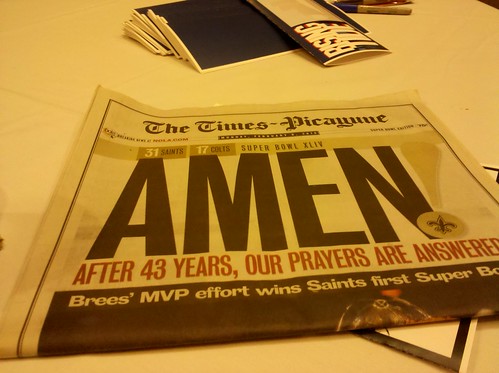
Prayers being answered

Amen

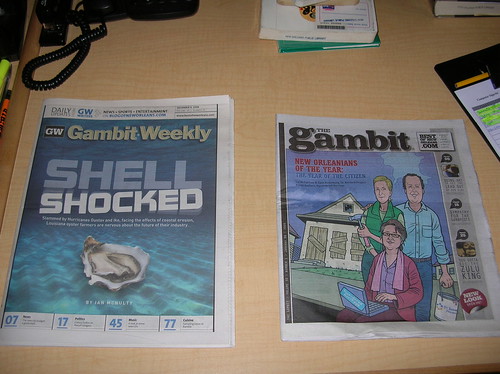
The Gambit getting smaller

Gambit vs. Gambit

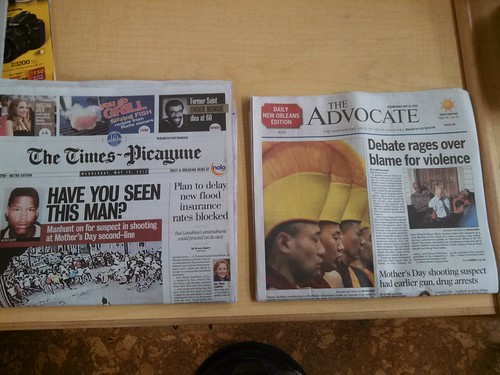
Papers going to war

War

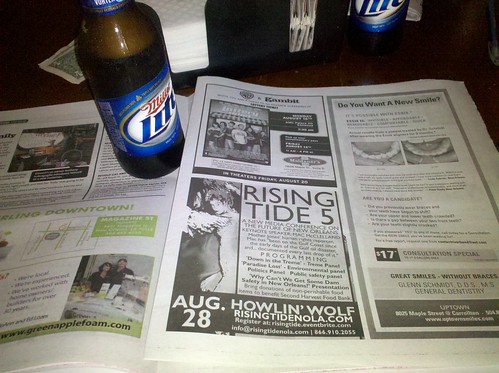
Certain special events being advertised

RT Gambit ad

BTW: Rising Tide 9 is coming September 13.  This one looks to have a surprising amount of heavy substance. It's a great time with some OK people and terrific deal.  Sign up here.

"7th Ward Roosters" running wild

Seventh Ward Rooster

"Jeff" doing various things

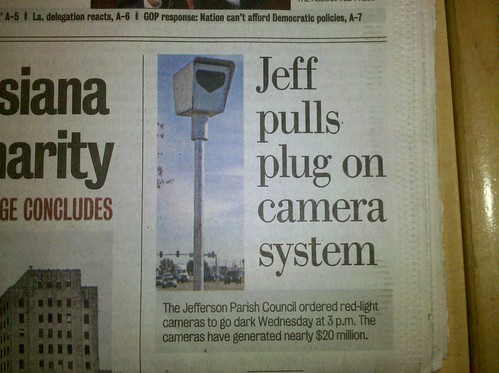
Pulling the plug

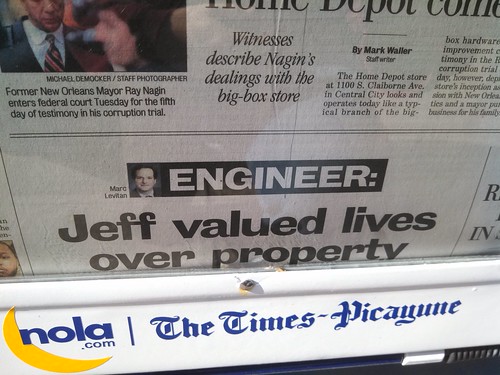
Jeff Valued Lives Over Property

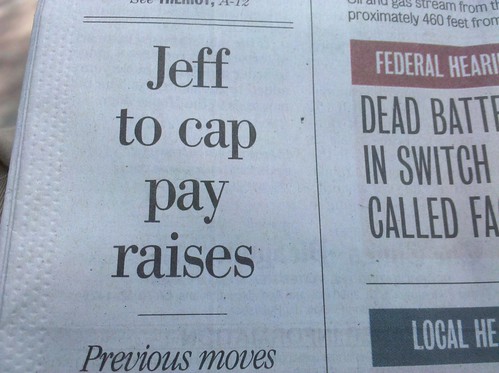
Jeff to cap pay raises

There's more.  Not sure these are.. you know.. printmaker quality or anything but at least they are free to access.

Monday, August 18, 2014

Never Forget

Ronal Serpas participated in a panel discussion at Rising Tide 5.

Hail to the Chief

By the way, RT 9 is happening September 13.  Most of the schedule is published here. I am given to understand there is more to come so stay tuned.  I had trouble this morning figuring out how to register but I figured it out so I'll save you the trouble.  Just click here. 

As for Serpas, it looks like he's gonna be just fine.  Thanks for asking, though. 


Sunday, September 15, 2013

Rising Tide 8 is in the can

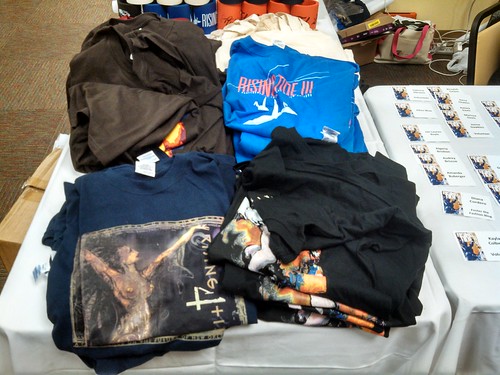
Sometimes it doesn't really feel like 8 years.  But then look at all the "vintage" swag that's piled up.

RT Swag

This subversive little blogger meet-up is practically an institution now. You never know who you might see at one of these.

John Georges in danger

You have to credit Georges for showing up at something like this, what with all the "dangerous people" you might run into.  In the interest of keeping the brand out there, though, I gave him a little razz behind his back just after I took this picture.

Don't worry. Other things happened as well.  But instead of sitting here and typing it all out while I'm trying to watch the Saints game, I'll link you over to The Lens where Steve Myers live-blogged the Charter School Accountability panel and also to Uptown Messenger where Robert Morris blogged and shared tweets from attendees throughout the day.

Saturday, September 14, 2013

What's on Teevee?

It's (or at least it should be if this thing works) the Rising Tide 8 live stream.


Tuesday, September 10, 2013

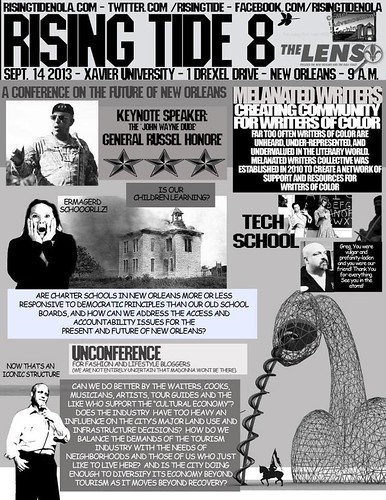
Here's a free poster for you

My suggestion is you print out a stack and stuff them in your nearest T-P Street paper box.

Rising Tide 8 poster

Also, you know, read the poster.  RT 8 looks pretty darn terrific.  It's Saturday. It's only 20 bucks if you register in advance.