-->
Showing posts with label Claiborne Avenue. Show all posts

Thursday, April 01, 2021

And there is the catch

Sorry to say this but the only reason anyone with any power can even imagine taking the Claiborne Expressway down now is the same reason it was erected in the first place. It is because we have reached a point in the cycle where tearing it down can and will benefit wealth.  This is going to be the same point I made ten years ago when the gentrification taking place in Treme first set the planners' sights on gussying up the convenient real estate they had buried under that bridge decades before.  But taking down the expressway, in and of itself is not going to magically restore the neighborhood that was broken apart by its construction. 

The 20th Century was a long time ago.  Other things are happening now and they are not great things for poor and working class people in cities. The political game now is all about moving those people out of the way, isolating them in far flung suburbs, and even taxing them if they try to drive back.  The cities (and especially this city) aren't for poor people anymore. Instead they (especially this one) are playgrounds for rich people and tourists where nobody actually lives. All of the planning and policy decisions made now are intentionally meant to facilitate this.  

For years the Claiborne overpass was a public health and "quality of life" detriment to poor people living near it. Nobody who could do anything about that cared.  But now it is in the way of real estate development so it's apparently time to take that problem seriously. 

Anyway, the Washington Post got in touch with Amy Stelly to for its story on the infrastructure bill that might fund the highway's removal. She's obviously very much aware of the problem.

While activists’ goal, in many cases, is to remove a highway, they say they also want communities most harmed by their construction to enjoy the benefits as their neighborhoods become more desirable. That could mean help for renters to buy their homes or property tax advantages.

We can’t remove highways in neighborhoods that would otherwise have been very desirable and leave it to the real estate market to govern,” Stelly said. “The people of Tremé should have the right to return when it’s beautiful.”

And, well, that's the catch, isn't it. 


Wednesday, June 01, 2016

Can't have the riff raff messing up our "high quality retail corridor"

Did you know South Claiborne was "New Orleans's next high quality retail corridor"?
On Thursday, City Councilwoman Stacy Head convened what she described as an annual summit before the council’s Governmental Affairs Committee about South Claiborne Avenue, which she hails as “New Orleans’ next high-quality retail corridor.” The discussion featured the heads of numerous city agencies, who each reviewed their departments’ commitment to improving and maintaining the busy stretch. 
It's an annual summit! Next year they'll get together again and congratulate themselves on their next strip mall. 
“The tone has totally changed,” Canada said. “Now it’s about where people want to go and what the opportunities are here. People are talking about opening multiple units in the city, instead of just saying they want to be downtown. That bodes well for South Claiborne and other areas of the city.”

On South Claiborne, Canada said she and council members have been meeting with specific shopping center owners about attracting tenants that will draw more customers. She praised the opening of Magnolia Marketplace as a model for other property owners, and offered a slide that said retail sales there have been ahead of expectations.
Funny they didn't mention the "model for other property owners" is a kickback funded by their own customers via mall-specific sales taxes but ok.

Anyway, here is Stacy Head's new project.
The next area of focus, Head said, should be the areas of the neutral grounds where the grass cannot be maintained because of all the people who spend all day “camping” in them. One option, she said, would be to provide actual outdoor seating areas that anyone can use, instead of the folding chairs and other items dragged into the neutral ground.

“They [areas of the neutral ground] are ‘bald’ because they become areas in the center of a state highway that have become gathering spaces, often with people drinking alcohol. It’s very unsafe. People have been run over because of walking in and out of the highway,” Head said. “They’re using the neutral ground as more like a camping area.”

NOPD Sixth District Commander Ronnie Stevens said his officers regularly speak to people hanging out in the neutral ground, hoping that the appearance of an officer will encourage them to move along, since the law prevents them from taking any action if loiterers are not breaking other laws. Head asked Stevens to check on one couple she is aware of living on an Entergy box on South Claiborne, who moved down from Ohio because New Orleans was such “a nice place to live and drink outside.”
Three things. 1) Some guys sitting around on milk cartons are really preventing you from "maintaining" the neutral ground? Really?  2) We can't do anything because they aren't breaking any laws. But let's send some cops out to intimidate them anyway.. you know.. because.

But mostly, 3) heck yes this is "a nice place to live and drink outside." Isn't that what we tell all the kids Airbnbing in for Fried Chicken Fest or whatever?  Or does it only become a problem when it gets in the way of you making your "retail corridor" great again?

Tuesday, August 25, 2015

Resilience March

Street signs

We're just about done with Tuesday. Let's see how far along that puts us in the Shitstorm by now.  Oh yes. Today was Resilience Day.
FEMA director Craig Fugate said he loves the word because it means whatever you want it to mean.

And if you've been paying attention over the last couple of weeks, you'd think he was right. "Resilience" has replaced similar words, or been used in sentences where it didn't necessarily need to appear, to define the City of New Orleans' philosophy as it prepares for the 10th anniversary of Hurricane Katrina and the federal levee failures. Mayor Mitch Landrieu has planted his "resilience" seed (or some form of it — "resilient," "resiliency") in speeches throughout his terms as mayor. (And if you're keeping score at home, you can add "vibrant," "new Orleans" and "NOLA for Life" to Landrieu's list.) The word has seemingly grown into a jungle of word salads with business lingo and jargon-y nothing phrases that have taken over dozens of panels, events and speeches this week. Its overuse implied it not only didn't mean anything but that there wasn't anything to be "resilient" about. But the word now defines a plan that the city will look to over the next decade and beyond.
FYI: The city's Chief Resilience Officer makes $172,000.

You laugh but, according to this Slate article, the guy might have some work to do.
After Katrina, the second line became a symbol of New Orleans’ resilience. But the survival of the parades—and the neighborhoods the revelers called home—is far from assured.
That can't be good. I mean, if you lose the "symbol of resilience" what else to resilience really is there worth having?

Anyway, this isn't an article about "resilience." It's an article about gentrification even if it doesn't know that it is. Despite the media hyper-focus on the fate of "culture bearers" who do interesting things that tourists might like to see, the escalating costs of living in New Orleans affects an entire class of people.  The fact that the "culture bearers" in question happen to be a segment of that class merely makes this an attractive story for a national outlet.

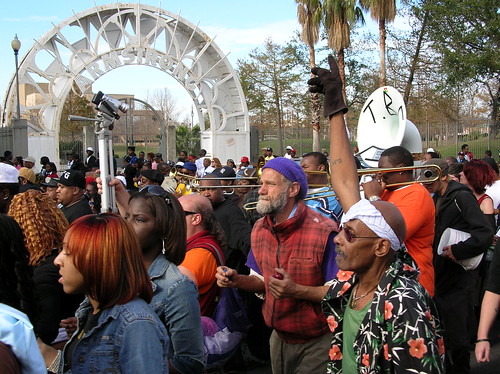
The reason this caught my attention, though, was the particular piece of resilience theater the article opens with; an "All Star Second Line" organized on MLK weekend in 2006.
Meanwhile, displaced second liners, many of whom had no transportation of their own, were renting cars and even chartering buses to get to the parade. Vallery made a desperate call to City Council President Oliver Thomas, who had strong ties to the clubs. Thomas thought this second line might be the last one the city would ever muster, that the tradition itself was at stake. “That’s why, for me, it had to happen,” he told me later. He convinced the Nagin administration that the parade would be more manageable than a crowd of people who found their way back from exile only to discover it had been canceled. He helped secure a permit for a route contained in NOPD’s First District, a loop around Treme, regarded by some as the oldest black neighborhood in the country, and a bit of the Seventh Ward, birthplace of Jelly Roll Morton and Sidney Bechet.

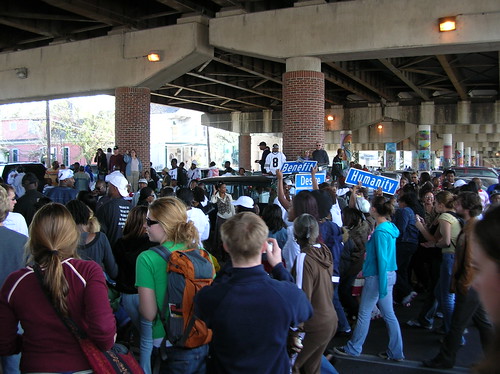
Two days later, around 300 club members and three brass bands filled St. Claude Avenue in front of the Backstreet Cultural Museum. The club members wore black shirts that said “renew orleans” across the chest. Father Jerome LeDoux came out of St. Augustine Catholic Church to bless them. Thousands of people surrounded the clubs, spilling onto side streets. From the front porch of the Backstreet, Jackson announced that the second-line community was coming home. If the club members had affordable housing and basic services, she said, they would bring the city back to life.

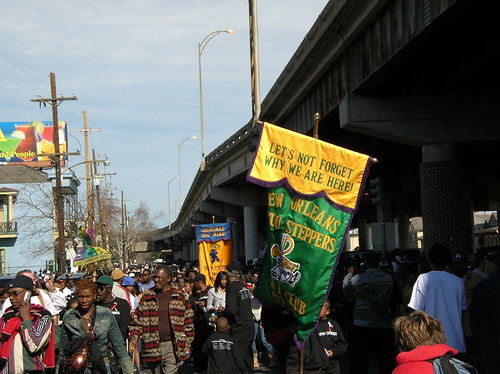
Then a bass drum thumped, the horns started to play, and the parade proved the point. Empty streets filled with people, shoulder to shoulder, flowing around piles of moldy sheetrock on the curbs and onto porches of vacant houses with holes in their roofs. Dancers spun, popped, and jumped on the hoods of drowned cars. Thomas danced along with them. “We exorcised Katrina” that day, he recalled. It was considered by many the biggest second line ever. The parade gained momentum turning onto Claiborne Avenue, and it felt to me as if the force of these thousands of people was reshaping the city. Jackson remembers the turn onto Claiborne as “the greatest moment of my life.
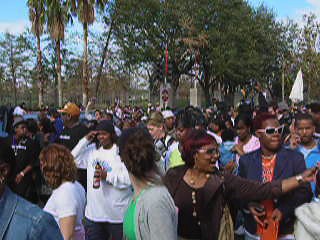
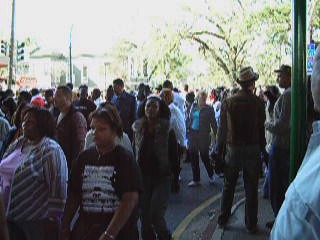
Yeah I was there to see that moment.  Here's the parade coming down Claiborne.

Banners 

Here it is later on Rampart.

Armstrong Park

Oh and hey look. I forgot I shot video.  It's not much.. that camera didn't take the highest quality video... but, well, here.

2nd line Rampart St Jan 15 2006

Here's the parade turning from Claiborne, probably onto Esplanade, I don't remember the route exactly.  This video quality isn't great but you do get a little bit of the sound of the drum echoing under the overpass.

2nd line Claiborne Jan 15 2006

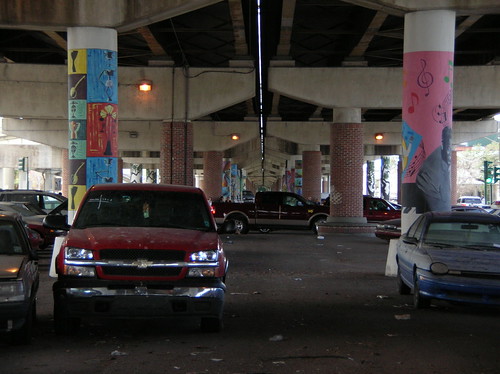
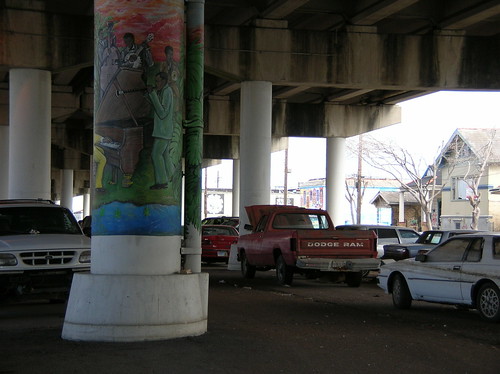
Another thing you might remember about the Claiborne overpass was the parking area beneath it had, by this time, become a repository for flooded vehicles.  I got some pictures of those that day.

Claiborne Overpass

Claiborne Ave

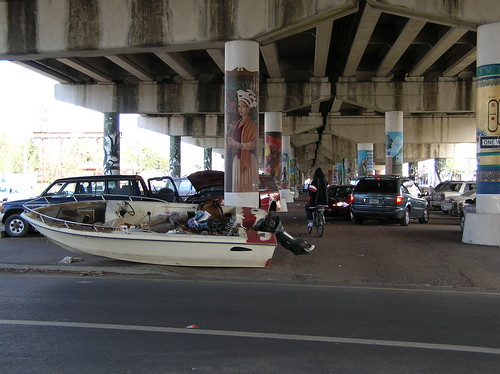
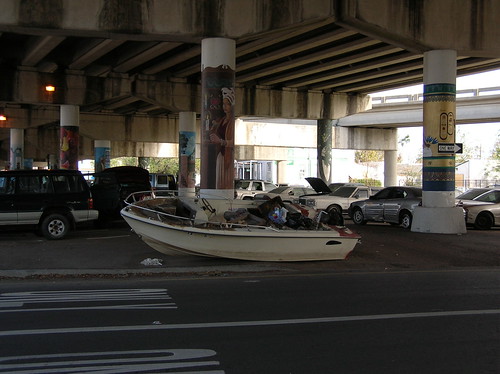
There was also this abandoned boat sitting on the curb at Bayou Road.

Boat

"Beached" boat

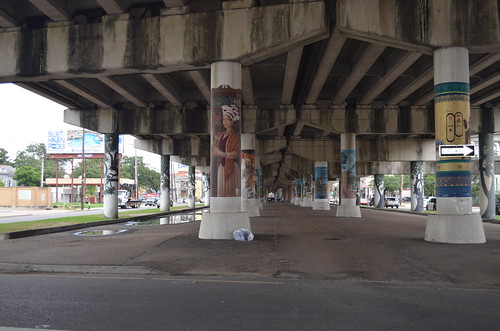
And that's where I went on Friday to revisit the scene.  The boat and cars have been cleared away. Marie Laveau seems rather indifferent either way.  She was always pretty resilient, though.

Claiborne and Bayou

Wednesday, July 31, 2013

Boutique strategy

In Saturday's Times-Pica-dot-com-media-thingy Deputy Mayor Andy Kopplin wrote a scare piece that, when pared down to its bare minimum, reads: Because Detroit filed for bankruptcy last week, New Orleans has to make "tough decisions" with regard to its pension obligation toward firefighters as well as hours and medical coverage for city employees. 
By working closely with City Council, we closed a $100 million budget gap and cut millions in contracts, travel, take home cars, credit card use and overtime. We froze hiring, moved retirees from city-funded health insurance to Medicare, and furloughed every city employee for one day every other week.
Andy Kopplin makes $175,000 per year.

Meanwhile, Kopplin says, Mayor Landrieu is doing a terrific job! There is a "building boom" afoot. The Mayor personally "added 4,000 jobs" (no explanation of which specific jobs or how the Mayor "added" them).  The city is in the midst of a real estate boom.
Realtors say that the Uptown and Garden District neighborhoods attract out-of-towners relocating to the area through the burgeoning film, biomedical, digital media and software and creative industries. Tops on the list of their house demands: a place that looks and feels like old New Orleans, a historic home, a walkable neighborhood and access to retail districts like Magazine or Maple streets.

Casey said almost every good home listing in the area has multiple offers. Five buyers for a property is not uncommon. Even the most expensive houses on the market, for people relocating to New Orleans or buying a second home here, still look like a good deal to people from other areas of the U.S.

"Our big mansions are like lunch money," Casey said. "It looks so affordable to people from the West Coast or the Northeast."
This process is readily evident along  the Garden District-Central City  "cusp" where houses are being sold and renovated at an accelerated rate.  And, as far as I've been able to observe at least, the newly renovated properties are scarcely occupied.  There's one I know of that belongs to a young couple. But four others nearby are silent much of the year except for brief periods when they are in use either by part-time resident owners or short-term renters.

I'm sure there are some benefits to the rapid growth in real estate investment for the city.  Somebody has to pay those huge water bills, after all. Not to mention the police and prison consent decrees. Oh and there's the matter of shoring up local funding for flood protection maintenance.  Kopplin's Detroit comparison may be inappropriate, but this doesn't mean we don't have to worry about money in New Orleans. The city may be on the verge of a major revenue coup if it manages to wrest control of the Wisner property just as another Oil and Gas boom rolls in. But clearly another major revenue strategy involves cultivating a wealthier tax base.

Developer Pres Kabacoff articulates this in the recent film, "Getting Back To Abnormal." The film is about the 2010 municipal elections but a major side story involves the demolition of the "Big Four" housing projects on the east bank of Orleans Parish. Often public housing redevelopment is sold as an improvement.  We're told that "mixed-income" combined-use developments "de-concentrate" poverty and ultimately provide better services for the people the projects are designed to help in the first place.  In the film, Kabacoff dispenses with those talking points and says directly that poor people in New Orleans are, "a drag on the city's economy." The redevelopment plan isn't about improving their condition as much as it is about moving them out of the way.

Kabacoff shows up again in Katy Reckdahl's Advocate story this past Sunday about the coming redevelopment of the Iberville housing complex.
The plan is likely to spark a municipal renaissance, said developer Pres Kabacoff, a partner in the endeavor. Kabacoff believes the Iberville reconstruction is as important as the construction of the Superdome, the filling of the lakefront in the 1940s or the work done by his father, Lester Kabacoff, to revitalize the riverfront before the 1984 World’s Fair.

“Every 30 or 40 years, we do something dramatic in the city,” Kabacoff said. “And this is one of those projects.”
Eliminating this particular "drag" will spark a municipal renaissance! We mean another one. In addition to the one Kopplin assures us is already well underway. Soon a whole new swath of property can be open to vacation home grade investment.  Now that we have a better class of people moving in there, we can finally move that unsightly stretch of elevated highway out of their way too.

As for the people who we forced it on in the first place...

Mary McDaniel, 52, is in limbo while her Section 8 paperwork migrates through the HANO Section 8 department.

“We got our boxes packed. We’re just waiting for them,” she said, fretting that all of the good apartments downtown will soon be snatched up, leaving her and her neighbor Cynthia Jordan, also 52, “way far away, in eastern New Orleans or Chalmette somewhere.”

All residents receive Section 8 vouchers to help them pay rent on the private market. HANO has also hired movers and relocation advisers and is paying deposits for apartments.

But for many, the shift to vouchers will be difficult, predicts longtime Citywide Tenants leader Cynthia Wiggins, who heads Guste Homes in Central City and has been critical of Section 8 as a solution for the poorest public-housing families.

Inexperienced renters are more apt to rent from unreliable landlords who fail to keep up their properties, Wiggins said. Many residents will also find their bills — rent, plus light, gas and water — astronomical when compared with Iberville rents, which maxed out at $374 but could go as low as $50, depending on income.

Lifelong Iberville resident Morris Smith, 40, a kitchen manager in a prominent New Orleans restaurant, ended up in eastern New Orleans with his wife and daughter, who also work in hospitality-industry jobs a short walk from where they used to live. Unlike many Iberville residents, his family has a car, which they’re now juggling at all hours.

With nowhere to walk to, his wife feels sad and isolated. “She’s not feeling this distance thing,” Smith said.
In the Iberville, Smith was paying $373 in rent; he now pays nearly $850 in rent and utilities, putting the squeeze on other bills, he said.

Such struggles are seen across the nation, said Massachusetts Institute of Technology urbanist Lawrence Vale, whose most recent book, “Purging the Poorest,” examines national cutbacks in public housing. Because of that, Vale said, “I take little joy in the prospect of demolished public housing unless it’s accompanied by a clear commitment to finding better alternatives for displaced residents.”

And there's your urban renaissance in a nutshell.  Sure we'll build a "liveable" "walkable" community with lots of attractive entertainment amenities right around you.  But when we're done with that, we're gonna need you to move somewhere else.  Sure you can still come to work down here... oh but we're taking the nice road down too so get ready to sit in traffic.

In a city so invested in this sort of strategy, is it any wonder its line employees are receiving lectures from its well-paid executives about the "sacrifices" they'll be making?

Monday, June 17, 2013

A transit plan in name only

Owen Courreges writing about proposed revisions to a couple of major crosstown thoroughfares suggests that some neighborhoods are becoming "landlocked" in the process.
Presently, if I want to drive to the Marigny and points further East, I usually take the Claiborne Expressway or South Rampart.  I could certainly go through the Quarter, but that’s generally a nightmare.  I could also go further north, but reaching a road north of the expressway would be a major detour.  The options are pretty well limited.

For some inexplicable reason, plans are being made to kill both the expressway and Rampart as useful thoroughfares for vehicular traffic.
Owen comes at this a little differently from the way I do.  I don't think either of these projects is driven by a policy objective (or, has he jokingly calls it, a conspiracy) to make driving less convenient.. or to keep Uptowners in Uptown.. or to keep Owen in Uptown.

I do think they're motivated more by real estate development plans than they are by transit strategy, though. And I tend to agree with Owen's assessment of their negative impact in that regard.

Tuesday, April 30, 2013

One city, many voices

The so-called  "Second Battle of New Orleans" fight to defeat the riverfront expressway has passed into mythology. It has become a fable with two distinct morals depending on who is telling the story.

For preservationists, it is their finest hour; their most unambiguous victory over the most demonstrably evil (in their minds, anyway) machinations of short-sighted development. And they allow this moment of righteousness, their big win in the Good War, to inform an almost reactionary revulsion to every and any big project that comes along.

But the Good War wasn't all that great if you happened to be on the wrong side of the atom bomb. And that's still how they feel in 7th Ward where Claiborne Avenue was eventually sacrificed to the interstate once the French Quarter was made off limits.
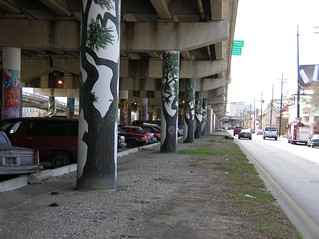
Oaks
Long gone oaks memoralized with Faux Oaks (Foaux?)

There the elevated expressway has settled into the mythology as the primary cause of every symptom of urban decline to befall the area ever since.  Never mind that crime, under-employment,  and general disinvestment in education and social services have plagued the entire city, and every city in the nation, for half a century. In the 7th Ward, everything begins and ends with that damn highway.

This is not to say that they don't have a right to complain.  The expressway may not be the root of all evil, but its placement sure didn't helped matters. But regardless of its actual impact, to the people who live in its wake, it's a constant reminder to them that big decisions aren't made with them in mind.

Interestingly, both of these not-entirely-true narratives come into play as we start to hear rumblings about the expressway being torn down and the "Claiborne Corridor"  queued for "revitalization." The preservationist crowd will see it as an opportunity to make reparations for the collateral damage they inflicted in the course of their holy war to save the French Quarter. And, no doubt, there will be support from residents eager to finally slay the dragon expressway that trampled over their neighborhood.

Hopefully, though, enough of us will be able to view the next "battle" in its own context rather than through the obfuscating fog of the last war. Lovell Beaulieu (imperfectly) pokes through some of it in a recent Tribune column about the planning process.
Another similar streetcar line is now being planned for North Rampart and St. Claude avenues. That line, which has now journeyed from the planning stages to an imminent reality, will take riders from the city’s downtown theaters and shops all the way into the Bywater, Marigny and Holy Cross neighborhoods. 

The new Rampart line did not go unnoticed by key people in attendance.

“This is just another thrill ride for tourists,” stated Jacques Morial, who lives a block from the interstate and who is determined to make sure that the communities that bore the brunt of urban decay with the highway construction in the 1960s aren’t left holding more broken promises after its planned demolition.

Morial pointed out how the Interstate that was built in the 1960s devastated the 6th and 7th wards from a cultural standpoint, as well as having a spillover effect on the 8th. When those decisions were made, African Americans had little if any political clout, and even less economic sway. Now, the conversation continues to happen behind closed doors, and it all adds to the negative perception and reality of the Livable Claiborne Communities conversation.

Nothing without us is for us,” said Morial.
Our current Mayor is fond of catchy slogans.  One of his favorites, and probably the most pernicious, goes, "One Team One Fight One Voice One City,"  as if civic governance is something we should liken to a football game where all the residents are always on the same "team."  There are many lies in this condescending little chant. The most obvious question it always raises in my mind is, how can we have a "fight" with only one "team" participating?

Of course a city contains many different voices, many opposing teams participating in many fights and the outcomes have real winners and real losers. That's just politics.  To pretend otherwise is to deny the losing side of these every day struggles, not only the material spoils, but also the recognition due anyone with a valid but opposing argument. In other words, the Mayor is telling you that when you  are priced out of your neighborhood by "revitalization" or an expressway is built on top of your house, it isn't because you lost an argument to a different "team." It's because, you actually never existed at all.

But there are winners and loser in every "Battle of New Orleans."  If the life and times of the Claiborne Expressway serve as an object lesson in anything, certainly this should be it.
Thursday, March 21, 2013

"They’re bringing the Quarters to Rocheblave"

I've got more on this and some other issues coming, but before I get to that, I wanted to highlight something that caught my eye in this NOLAFugees piece by Christine Horn which doesn't quite fit with the post I want to write. 
At a recent showing of Bury The Hatchet, a documentary film on Mardi Gras Indians, the film series’ monitor was pleased to point out to a predominantly tourist audience the idealism inherent in the proposed removal: although in the 1960s the city overlooked the concerns and opposition of Treme and 7th ward neighbors in erecting the elevated expressway, current Mayor Mitch Landrieu is poised to right the wrongs of history and return the once majestic Avenue to its former glory. The monitor went on to say that mostly everybody supports it. Special guest Big Chief Alfred Doucette disagreed.

“They might say they’re bringing back the Avenue, but they’re bringing the dollar for them. Mayor Landrieu might go on TV and say he supports my community and my culture, but he don’t,” said Doucette. Further commenting on the proposed revitalization of Claiborne and its potential expansion as a cultural economy zone, Doucette noted “They’re bringing the Quarters to Rocheblave. The city is making downtown pretty, but what about the rest? The 6th, 7th, 8th and 9th wards? And New Orleans East?”
Taking down the Claiborne overpass isn't going to bring back the neighborhoods its installation destroyed. It might help the Mayor's friends in real estate salvage the wreckage for their own profit.. at least that's what they're hoping.  But, of course, they can't say it that way.

Sunday, April 24, 2011

Can't change history, can't go back

A lot of people have nostalgic longings for the return of a ground-level N. Claiborne Avenue but I wonder if all of the nostalgic longers understand that the city they're creating will never be the city that the previous generation destroyed.

No one is proposing that we connect Eastern New Orleans to the city center via cheap, accessible, and efficient public transit. All they're proposing is that we cut off the, admittedly imperfect, highway access that currently exists. Despite what the self-congratulatory literature pumped out by yuppie professional planners would have you believe, the future of the American city will not be a golden age of compact, "walkable" development. Instead it will be something much more like the model in evidence in the third world where the elite live in compact fairly well served (through privatized and quasi-privatized agencies) neighborhoods and the rest live in isolated shanty towns on the outskirts. Cutting off Eastern New Orleans by chopping down the Claiborne expressway is a small part of that process. I'll maybe feel differently about it the day somebody shows me the monorail that will replace it.

Wednesday, October 20, 2010

The Great Lakewood-Lakeview War of 2011

You laugh now, but if New Orleans neighborhoods continue to arm themselves via private security special taxing districts, it's really only a matter of time before the inevitable hostilities erupt. All that firepower isn't just going to sit idle forever, right?

What if, for example,Lakeview decided one day to annex adjacent and relatively tiny Lakewood? (See map) Or maybe some minor but passionate disagreement over something like say a baby name could cause partisans in Milenburg to load into their Wackenhut SUVs, turn on their yellow flashing lights, invade Uptown, and lay siege to the Brees residence until the spelling of Bowen is officially changed to Beauxen. Practically anything could set off this powder keg.

Just this afternoon we learned that the city was awarded $2 million from some sort of joint HUD DOT EPA grant to study the feasibility of demolishing the Claiborne Expressway. This could be the very flashpoint we're talking about here.

Leave aside the question of whether or not 2 million dollars could have been better spent on infrastructure projects more urgent than this fashionable hipster's cause for the moment and focus on the potential fallout from this study. If intra-neighborhood hostilities erupt over post-Expressway traffic engineering, will sections capable of mustering their own security forces hold the muscle to impose their will on those who have not prepared their own deterrent?

What happens if the study concludes, yes let's tear it down and go back with the original Riverfront Expressway plan it replaced back in the 60s? Will the French Quarter be prepared to defend itself this time around? Having rejected the creation of their own security district, they'd be practically defenseless. Sure the Guardian Angels are still hanging out down there but they've got to be outgunned and out-manned by districts that have chosen to fully fund the troops in these dangerous times. Can anyone afford to have this kind of rent-a-cop gap on their hands?

Sunday, August 01, 2010

Always leaving the same effect

Yesterday morning I drove from Uptown to Gentilly in less than 10 minutes. Without the Claiborne Expressway, this trip would have taken about twice the time. Not too long ago, my daily commute took me to New Orleans East each morning in about 20-30 minutes. Without the expressway? Good lord, I would have found a new job! I don't think anyone is going to argue that the construction of the interstate altered the Treme and 7th Ward neighborhoods it traverses in an aesthetically displeasing way. I strongly disagree, however, with those who blame it for the more complex combination of troubles that have come to plague those and other non-overpassed areas of the city since then. The more I watch the City's establishment line up in favor of demolishing the overpass, the more suspicious I become.

Tearing down the expressway now 1) Cannot, by itself, magically restore the neighborhood it, admittedly, had some hand in destroying so many years ago. 2) It almost certainly will isolate and destroy the eastern neighborhoods it helped to create. Fittingly, now, like then, the neighborhoods under threat are poorer and less powerful relative to the gentrifying tourist attraction they are being sacrificed to preserve. Which prompts me to ask, again, in whose interest is this project being pushed?

Thursday, July 22, 2010

Chartered buses on an old abandoned highway

We've been through this whole conversation once before but since it's on the front page again today we'll repeat ourselves.

Tearing down the Claiborne Expressway is not a magical means to reviving the neighborhoods it traverses. It won't bring back the dead and gone tree-lined North Claiborne of the mid 20th Century. More likely it will bring about something resembling the South Claiborne of today with its drive-thru fast food and strip malls of dollar stores on every corner.

Or maybe it will make a nice throughway for charter busloads of Jazzfest visitors taking their obligatory Treme Tour. (You laugh, but see it's already taking shape.) And, of course, making it harder to get across town can only further isolate the severely under-served neighborhoods to the east of the Industrial Canal but nobody cares about those people since they don't have near as many second line parades or famous artsy residents as we tend to get back in what the Hollywood fan boys have deemed "real New Orleans".

Planning nerds like to think they can solve fundamental social and economic problems by fiddling with the aesthetics of infrastructure. But all they're really doing is giving the political leadership an excuse to treat roads and buildings as a separate matter from the people those things are supposed to serve. And when that fails, the next step is removing those people since obviously they're what's making all these pretty places so unattractive to visitors. This doesn't take long to come up in the NOLA.com comments.
The Iberville Projects need tearing down, also. They are an eyesore too and they directly infect our biggest tourist attraction. Since tourism is our biggest industry, it makes no since to threaten it with the crime the projects produces.
What the commenter doesn't say is that the most likely pretty piece of infrastructure to replace Iberville is also known to produce an awful lot of crime. But maybe that will be less infectious since it will be located so much further away from a major highway by then.

Sunday, October 25, 2009

Jack O'Lantern effect

Yes, it's a problem but no, it's not a problem that could have been equitably avoided by the BNOBC's proposed green-dotting of entire neighborhoods. At the time of the "footprint debate", people were still openly fantasizing about cleansing the city of "undesirable" residents. Minimizing the Jack O'Lantern effect was never really the priority there.

Anyway, that fight is over with. Now we have a new one to deal with. Redeveloping these neighborhoods will depend on 1) protecting the entire region from future flooding. and 2) creating new economic opportunities for current and future residents. But we would prefer not to hear the elitists and the racists rally around Jack O'Lantern "I-told-you-so"s because that isn't what any of this was about.

In other planning-related news, I agree with this guy on today's idiot page.

I-10 stretch is here to stay: a letter to the editor
October 25, 2009, 1:38AM

Re: " I-10 over Claiborne gets royal treatment," Metro, Oct. 22.

Tearing down this expressway, as proposed in the New Orleans master plan, is nearly as bad an idea as putting it there in the first place. Those who think otherwise say that it led to the demise of neighborhoods and businesses along Claiborne Avenue, yet they ignore the fact that other areas with similar socio-economic makeup suffered the same decline even without an interstate highway dividing them, e.g. St. Claude Avenue or Earhart Boulevard.

Macro-economics and big-box retail killed the mom-and-pop stores, and some existing neighborhoods have found that the highway makes a great roof for festival marketplaces and other outdoor activities.

Removing this structure is also the least "green" option. Presently, vehicles traveling along I-10 are running at or near their peak efficient speed, whereas ground level traffic would be traveling at far less fuel-efficient speeds.

Removing the highway would exacerbate already bad streets by adding heavy traffic loads to them. It would lead to major increases in traffic in normally tranquil neighborhoods.

All city officials need to do is block off the length which the master plan proposes to be demolished. It will become readily apparent that removal of a major artery like I-10 is foolishness of the highest order.

George E. Merritt

New Orleans


Again, if people have jobs and feel safe, the neighborhood will be ok. If we just tear down an overpass, all we'll get are more streets crowded with cars.

Monday, July 13, 2009

Yay for NOLA.com

I'm well aware of how we all feel about some of the ugliness that goes on in NOLA.com threads but the discussion below this article about the North Claiborne expressway fantasy is actually pretty good. Anyone familiar with the way preservationism tends to favor the powerful in this city will recognize this argument, for example.
Those who deride "Generic, suburban development" also known as strip malls with national chains:

Do you not realize that the commercial development on Claiborne in the 50s was not unique to New Orleans? Every downtown area in major American cities had similar districts. What you idolize in some romantic retelling of the past was then what strip malls are today. They were how businesses were built. That's how all American cities looked. The difference is that in New Orleans, the past was preserved.

Talk as you will about how preserving that economy was good for New Orleans. It was and is great for the wealthy. St. Charles, Magazine, Carrollton, it's great for them because it's a tourist attraction and an enjoyable, throw back way of life. It was, however, devastating to communities that could not afford to be boutique, places like Treme and Central City.

Economic progress in today's world will make life more equitable in New Orleans. Preservation and attempts to return to how it was will continue to keep New Orleans divided economically.

The rich want to keep it the same because for them, life in New Orleans is great. Change? Modernize? HELL NO, because they moved to New Orleans for the funk and the old times. Progress be damned. Moving the depressed areas forward? HELL NO if it means modernization.

IT IS AS IT WAS AND IT SHALL ALWAYS BE AS IT WAS. This is how the "liberal" white New Orleanians champion their cause of the truest reactionary conservatism in America today. It's all a vacation for them.
I'll venture to add that nobody likes "generic suburban development" architecture and many (though not all) of us are less than thrilled with the commercial (and cultural) homogenization implied by the presence of national chain retailers. But these are primarily aesthetic matters* and usually are inconsequential to the actual health of the neighborhoods preservationists often presume to be protecting. But you can't urban plan your way out of a depressed economy.

Besides, if the Claiborne expressway is torn down, what will replace it? Rather than the North Claiborne of 30 years ago, we're likely to end up with the North Claiborne of today minus the overpass plus maybe a few more Dollar Generals and an Urban Outfitters or two.... and, of course, a ridiculously inconvenient means of getting across town.

But, as I said yesterday, none of this makes any difference since it's not going to happen anyway. It's just a bit of funny talk thrown in to guard against any last-minute opposition to the master plan which, I am told, also includes a provision for granting each New Orleanian his or her own personal monorail.

*A large part of the impetus behind "Buy Local" movements is born of economic and environmental concerns. But more often than not, the "solutions" coming out of such movements are fundamentally conservative in nature, focusing on policing individual lifestyles and opposing major economic development.

Update: Cousin Pat lists (maps, really) multiple things that he thinks "would have to change should New Orleans remove its I-10 over North Claiborne Avenue." It's.. um.. a lot of things... which serves as further indication of how poorly thought out the Big Idea here really is.

Upperdate: One more thing regarding the "Buy Local" movement. This week's Gambit cover story looks at ways in which national chains are attempting to co-opt the word "local" in their ad campaigns.
Surveys and anecdotal reports from business owners suggest that these initiatives are in fact changing spending patterns. A survey of 1,100 independent retailers conducted in January by the Institute for Local Self-Reliance (where I work) found that, amid the worst economic downturn since the Depression, buy-local sentiment is giving local businesses an edge over their chain competitors. While the Commerce Department reported overall retail sales plunged almost 10 percent over the holidays, the survey found independent retailers in cities with buy-local campaigns saw sales drop an average of just 3 percent from the previous year.

None of this has slipped the notice of corporate executives and the consumer research firms that advise them. Several of these firms have begun to track the localization trend. In its annual consumer survey, the New York-based branding firm BBMG found that the number of people reporting locally produced products are "very important" to them jumped from 26 to 32 percent in the last year. "It's not just a small cadre of consumers anymore," founding partner Mitch Baranowski says.

 "Food is one of the biggest gateways, but we're seeing this idea of 'local' spread across other categories and sectors," says Michelle Barry, senior vice president of the Hartman Group. A report published by Hartman last year noted, "There is a belief that you can only be local if you are a small and authentic brand. This isn't necessarily true; big brands can use the notion of local to their advantage as well." Barry explains: "Big companies have to be much more creative in how they articulate local. ... It's a different way of thinking about local that is not quite as literal."


Funny stuff.

Saturday, July 11, 2009

Things that aren't going to happen

It's a nice thought and all but, in addition to a massive amount of disruptive construction work accross the heart of the city, removing the Claiborne overpass would also require a compensating investment in public transit infrastructure in order to mitigate the resulting traffic nightmare.

Anyway none of this matters since the "project" is only being talked up right now to combat any potential last-minute political threat to the final Master Plan. Think of it as another one of those Big Shiny Ideas that distract the public discourse for a time but aren't really meant to be implemented. It's not Ray Nagin's idea, but I'm sure he appreciates the maneuver.


Also see: In early 2006, I posted this set of photos from under the bridge where I watched an "All-star second line" make it's way through a still largely broken city.