-->
Showing posts with label cars. Show all posts

Thursday, May 28, 2020

LaSalle Street

Wait. They are getting how much?
NEW ORLEANS — The state’s Superdome commission has finally agreed to compensate the city of New Orleans for taking a block of LaSalle Street to build Champions Square in 2011.

The Louisiana Stadium and Exposition District commission, which oversees the Superdome, Smoothie King Center and other venues, approved a resolution Thursday to pay the city $2.35 million in 10 installments over five years as compensation for developing on and shutting down vehicle access to a public street
Ha ha that's practically nothing. This report also says the street "is valued at $3.3 million" but, in reality the state should owe a lot more than that in back usage fees. Maybe ten times as much.  Maybe that's why they're also planning to give the street back, at least in part. 
The LSED also agreed to reopen the stretch of LaSalle Street between Poydras and Girod streets to vehicle traffic starting Jan. 1, 2021, and then the city would go through normal temporary street closure procedures when there’s an event at Champions Square or a sporting event at the dome.
That's an interesting plot twist, anyway.  I wonder if the cars will return to LaSalle Street before or after they are banned from the French Quarter. As long as they leave enough room for all 13,000 fans to pre-game while properly social distancing, I guess it works out.  

Wednesday, August 21, 2019

Well the first question is how much is the fine

Nobody could have known that all this time Sewerage and Water Board was working to make Elon Musk's dream a reality.  So far the results are... well.. there's work to do still, obviously.
At this point, it's no surprise when workers pull trash, debris or even literal tons of Mardi Gras beads out of New Orleans' clogged drainage pipes. Entire cars in the city's underground pipes, however, are still a bit of an unusual find.

Sewerage and Water Board crews on Tuesday came across what appear to be two vehicles crammed into a drainage culvert that runs under Jefferson Davis Parkway near the Lafitte Greenway. The cars, embedded in a pile of other debris, were clogging up one of the key pipelines that feeds water to the pump station that drains parts of Mid-City, an area that has been hard hit by flooding in recent years.
So many questions. And I don't just mean, how did they get there?  I'm guessing they washed in from an open canal.  We already know abandoned cars are regularly dumped into Bayou St. John.  It would be shocking if the same thing wasn't happening in the drainage canals that lead to these culverts. But beyond that, who do they belong to? How much do they owe in parking fines?  And isn't it tragic that the owners of these vehicles did this instead of just waiting for amnesty summer to happen? Anyway it's good to know this is an option next time we're trying to avoid an NOPD checkpoint. There'll probably be a few of those over the Labor Day weekend.

Tuesday, August 25, 2015

Resilience March

Street signs

We're just about done with Tuesday. Let's see how far along that puts us in the Shitstorm by now.  Oh yes. Today was Resilience Day.
FEMA director Craig Fugate said he loves the word because it means whatever you want it to mean.

And if you've been paying attention over the last couple of weeks, you'd think he was right. "Resilience" has replaced similar words, or been used in sentences where it didn't necessarily need to appear, to define the City of New Orleans' philosophy as it prepares for the 10th anniversary of Hurricane Katrina and the federal levee failures. Mayor Mitch Landrieu has planted his "resilience" seed (or some form of it — "resilient," "resiliency") in speeches throughout his terms as mayor. (And if you're keeping score at home, you can add "vibrant," "new Orleans" and "NOLA for Life" to Landrieu's list.) The word has seemingly grown into a jungle of word salads with business lingo and jargon-y nothing phrases that have taken over dozens of panels, events and speeches this week. Its overuse implied it not only didn't mean anything but that there wasn't anything to be "resilient" about. But the word now defines a plan that the city will look to over the next decade and beyond.
FYI: The city's Chief Resilience Officer makes $172,000.

You laugh but, according to this Slate article, the guy might have some work to do.
After Katrina, the second line became a symbol of New Orleans’ resilience. But the survival of the parades—and the neighborhoods the revelers called home—is far from assured.
That can't be good. I mean, if you lose the "symbol of resilience" what else to resilience really is there worth having?

Anyway, this isn't an article about "resilience." It's an article about gentrification even if it doesn't know that it is. Despite the media hyper-focus on the fate of "culture bearers" who do interesting things that tourists might like to see, the escalating costs of living in New Orleans affects an entire class of people.  The fact that the "culture bearers" in question happen to be a segment of that class merely makes this an attractive story for a national outlet.

The reason this caught my attention, though, was the particular piece of resilience theater the article opens with; an "All Star Second Line" organized on MLK weekend in 2006.
Meanwhile, displaced second liners, many of whom had no transportation of their own, were renting cars and even chartering buses to get to the parade. Vallery made a desperate call to City Council President Oliver Thomas, who had strong ties to the clubs. Thomas thought this second line might be the last one the city would ever muster, that the tradition itself was at stake. “That’s why, for me, it had to happen,” he told me later. He convinced the Nagin administration that the parade would be more manageable than a crowd of people who found their way back from exile only to discover it had been canceled. He helped secure a permit for a route contained in NOPD’s First District, a loop around Treme, regarded by some as the oldest black neighborhood in the country, and a bit of the Seventh Ward, birthplace of Jelly Roll Morton and Sidney Bechet.

Two days later, around 300 club members and three brass bands filled St. Claude Avenue in front of the Backstreet Cultural Museum. The club members wore black shirts that said “renew orleans” across the chest. Father Jerome LeDoux came out of St. Augustine Catholic Church to bless them. Thousands of people surrounded the clubs, spilling onto side streets. From the front porch of the Backstreet, Jackson announced that the second-line community was coming home. If the club members had affordable housing and basic services, she said, they would bring the city back to life.

Then a bass drum thumped, the horns started to play, and the parade proved the point. Empty streets filled with people, shoulder to shoulder, flowing around piles of moldy sheetrock on the curbs and onto porches of vacant houses with holes in their roofs. Dancers spun, popped, and jumped on the hoods of drowned cars. Thomas danced along with them. “We exorcised Katrina” that day, he recalled. It was considered by many the biggest second line ever. The parade gained momentum turning onto Claiborne Avenue, and it felt to me as if the force of these thousands of people was reshaping the city. Jackson remembers the turn onto Claiborne as “the greatest moment of my life.
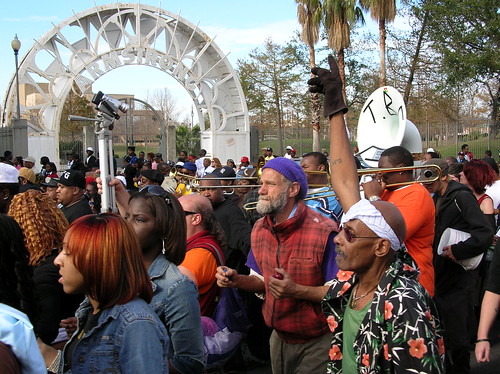
Yeah I was there to see that moment.  Here's the parade coming down Claiborne.
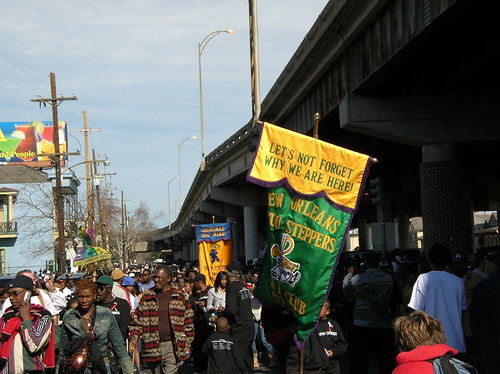
Banners 

Here it is later on Rampart.

Armstrong Park

Oh and hey look. I forgot I shot video.  It's not much.. that camera didn't take the highest quality video... but, well, here.
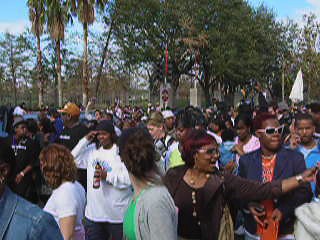
2nd line Rampart St Jan 15 2006

Here's the parade turning from Claiborne, probably onto Esplanade, I don't remember the route exactly.  This video quality isn't great but you do get a little bit of the sound of the drum echoing under the overpass.
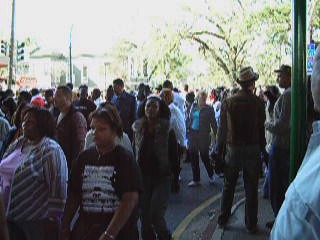
2nd line Claiborne Jan 15 2006

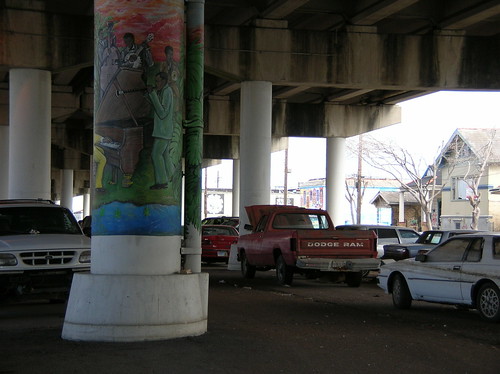
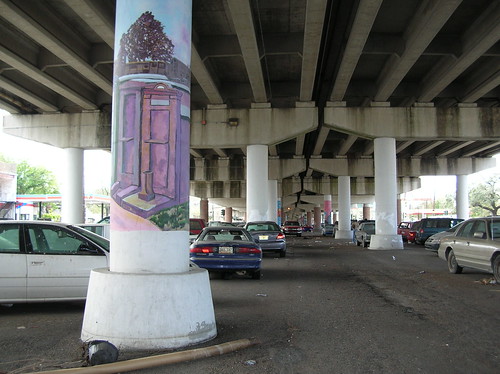
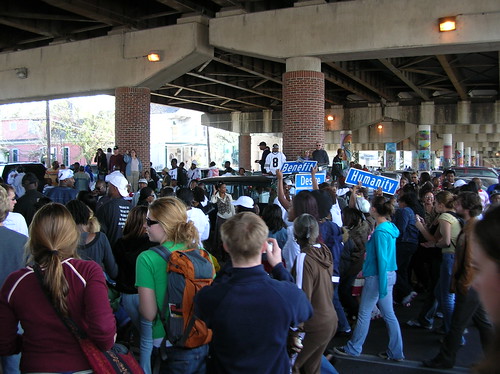
Another thing you might remember about the Claiborne overpass was the parking area beneath it had, by this time, become a repository for flooded vehicles.  I got some pictures of those that day.
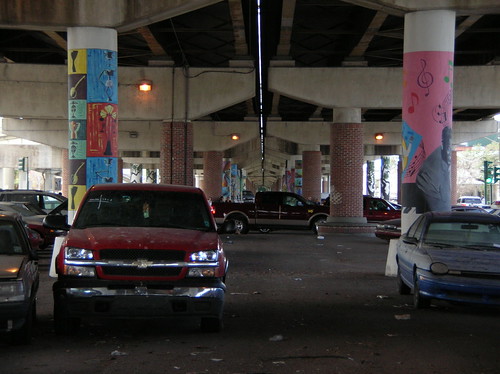
Claiborne Overpass

Claiborne Ave

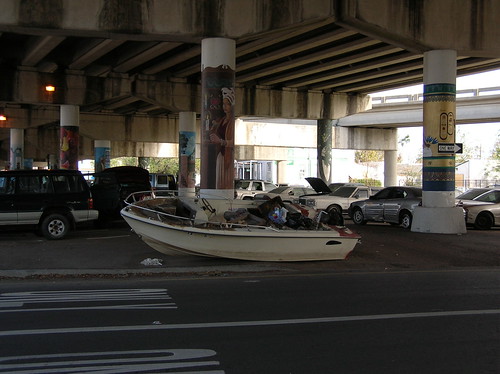
There was also this abandoned boat sitting on the curb at Bayou Road.
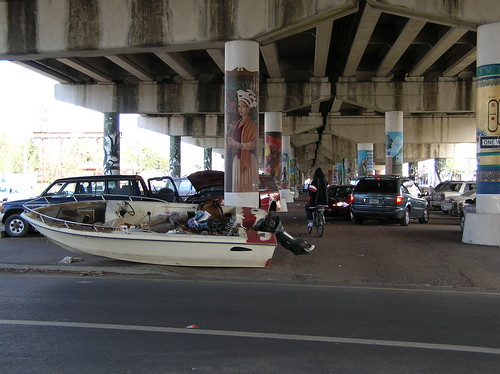
Boat

"Beached" boat

And that's where I went on Friday to revisit the scene.  The boat and cars have been cleared away. Marie Laveau seems rather indifferent either way.  She was always pretty resilient, though.
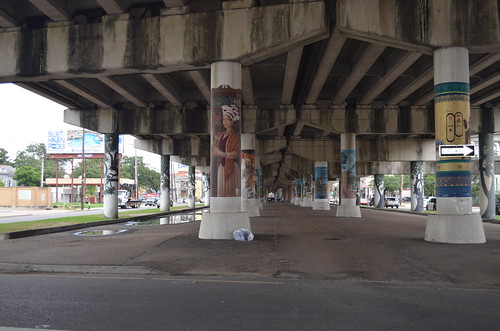
Claiborne and Bayou

Wednesday, January 23, 2013

Another clunker to throw on the "cycles" pile

Last week the timing of the Nagin indictment reminded me that I had been at this second line the weekend of his now famous "Chocolate City Speech."

Yesterday Dambala picked up another forgotten thread in the saga.
The "Katrina Cars" issue is a big deal (that first surfaced here...I know I'm being petty but if I don't say it, no one will).  I know many of you in anon land would like to see this issue surface and I would as well because I believe it ensnares at least one person of particular interest to AZ that has yet to face justice....you do the math with the links above.  
One thing to keep in mind, most of these current indictments took place circa 2008 and Mr. Fed levied them first simply to avoid the statute of limitations.   That doesn't mean there aren't more indictments on Nagin to come.
Looking through those 2006 second line photos, I find a couple of shots of these "Katrina cars" that were, at the time, being stockpiled under the Claiborne Avenue overpass.

Claiborne Overpass

DSCN0152

Claiborne Ave

There was also this abandoned boat which I'm pretty sure never belonged to Greg Meffert.

"Beached" boat

Wednesday, October 12, 2011

Long read of the day

On a day when GM is getting ready to launch its first all battery powered electric car we find this article at The Oil Drum about fossil fuel use during the Middle Ages. Really worth a look when you get the time. A quick excerpt:

Our romantic image of the Middle Ages and Renaissance as a paradise of renewable technologies results largely because of our failure to distinguish between thermal and kinetic energy. The Dutch and the Flemish, who dominated the Western European economy from about 1100 to 1700, are famous for their impressive use of wind technology, which took off in the 1100s.

The most spectacular use of windmills appeared in Holland from the late 1500s (16th century) onwards. There, the Dutch applied wind power to a wide range of industrial processes, including paper production, wood sawing, glass polishing and cement production. (See the article: "Wind powered factories: the history and future of the industrial windmill").

The industrial windmill was a marvel of pre-industrial technology, but it explains only partly why Holland became the most important economic power in the world during the 17th century. While sustainable providers of power, windmills could only deliver kinetic energy. To give just one example: you can use wind power to polish glass, but you can't make glass using a windmill. For that, you need thermal energy. And in pre-industrial times, as the history books tell us, the only way to reach high temperatures was to burn wood.

One problem, though: virtually all forests in the region had long vanished by the 1600s. Yet, during the Golden Age of the Netherlands, the Dutch not only made glass, they also produced bricks, tiles, ceramics and clay pipes, they refined salt and sugar, bleached linen, boiled soap, brewed beer, distilled spirits and baked bread. All these processes were based on a massive input of thermal energy.

Moreover, the Dutch produced much more than needed for domestic consumption. They became the largest European exporters of many of the above-mentioned industrially manufactured products. On a more modest scale, a similar production boom had happened in Flanders a few centuries earlier, in which an energy-intensive industry appeared in the near total absence of wood reserves. So how did the Dutch and the Flemish achieve this? By mining peat on a truly massive scale.