-->
Showing posts with label planners. Show all posts

Tuesday, March 03, 2015

Can't reinflate the water balloon

20 years ago in Baton Rouge, a college roommate of mine came back from a geology class barely able to restrain his glee. 

"New Orleans is sinking!" he beamed.  "Y'all gonna have to move out of that shithole."

My roommate was a proud small town Cajun boy from Iota.  I don't think he actually disliked the city as much as he just enjoyed talking shit about it to me whenever he could. Anyway, today he was excited to have some new ammunition.

Having been raised in the sinking shithole, I was already aware of its peculiar and precarious geographic situation. The city was shaped like a bowl. Its land dipped below sea level. Its borders were ringed by levees and walls to keep out the water from the surrounding lakes and marshes. The lakes and marshes were, in turn, being eaten by the sea beyond them. Meanwhile the drained swamp inside the bowl was settling lower and lower each year. The problem was only going to get worse over time.

We knew all of this.  We learned about it in elementary school.  I remember a public awareness stunt that would happen at the beginning of hurricane season where some group went around town with a giant ruler that was supposed to represent the height of a storm surge in the worst case scenario.  It looked bad. But, ironically, the constant little reminders also made it seem sort of routine. The result of this public information campaign was not action so much as acceptance. Of course the city is sinking, we all thought.  Didn't you learn that in sixth grade? Geeze. Besides, I told my friend, in the meantime living there was a (sinking) ride worth taking.

You might think the experience of the Katrina flood would alter that attitude a bit.  But I'm not sure that it has.  Instead, what's happened in the 10 years since is, rather than take the actions necessary to make the city viable in the long term, we've once again simply accepted the reality of its vulnerability.  Katrina's floodline is our new giant ruler. We all know the city is doomed. Didn't you see what happened in 2005? Geeze.

It's important to keep this in mind when you read in the newspaper, perhaps for the first time this week, what many of us old timers have known for decades.  New Orleans's world class drainage system is a curse as much as it is a blessing.

Originally, the water table under New Orleans stayed high thanks to an almost annual soaking from Mississippi River floods. But when levees were raised to protect the city from those floods, the water table started dropping and the soils began to drain, dry and sink. That problem was magnified when development spread blankets of concrete and asphalt across the landscape, reducing the ability of rainfall to recharge the water table.

New Orleanians live in a city that gets an average of 60 inches of rain a year, yet they know the area’s rare droughts can cause expensive problems as well: sink holes develop in streets, houses begin to list like leaking ships, cracks spider across walls, and doors start sticking in their jambs as homes begin to move with the ground beneath them.

But for a population living in a bowl, fear of flooding from frequent torrential rains was always the greater concern, and higher priority. The result is a vast storm-water drainage system featuring some 1,300 miles of subsurface pipes leading water to a series of deep outfall canals linked to 23 pumping stations which rank among the largest in the world.

And they’re always working.

“Some of those lines just continuously drain water from the soils beneath the area and into the canals, even when there is no rain,” Waggoner said. “So there is this constant tapping into the water table.”
 What they are proposing as a remedy is a $9 billion plan they say might help stabilize the water table.
That acknowledgement began to turn into citizen action in 2013 with the release of the Greater New Orleans Urban Water Plan, which was funded by state and federal grants.  Developed by Waggoner’s firm in collaboration with water management experts from the Netherlands and around the world, the plan presents a $9 billion vision of how the Crescent City can turn its age-old enemy into a friend by raising the water table to help reduce subsidence.
Letting water pool up in order to reduce flooding sounds counterintuitive. I suspect this is part of what makes it attractive.  It makes a great Upworthy style headline. How we stopped the flooding will surprise you!

But maybe they can do some of what they say.  I suspect, though, that in order to function as intended, such a system needs to be implemented in full rather than in the compromised piecemeal way things actually happen in the real world.  So I'm skeptical.

What they can't do, though, is reinflate the sunken city. They can't even halt the subsidence, really.  Certainly they will hire some consultants. Certainly they will make names for themselves in the urban planning community which  is really what it's all about.  Remember, this is a sinking city. Everyone knows that already. The smart people are the disaster capitalists who can figure out how to enjoy the ride and peel off the profits from that while they still can.
Tuesday, July 22, 2014

Planners gonna plan

It's because, if they say nothing, someone might figure out how unnecessary they often are.
The Deutsches Haus can once again call Mid-City home, the New Orleans City Planning Commission said Tuesday in agreeing to the German cultural organization’s proposal for a new building along Bayou St. John. But before construction can begin, the project’s architects must revise the building’s design to make the structure a little less Germanic-looking, the commission said.
Commissioners also asked about the possibility of renaming the club Gen. Pershing Haus.  

Later they got around to music criticism.


Monday, October 14, 2013

CZO public meeting

If you're Uptown and you're interested in seeing some planners tell about the horrible ideas they have about what will happen to your neighborhood, they're meeting tonight at the Dryades YMCA

Tuesday, April 30, 2013

One city, many voices

The so-called  "Second Battle of New Orleans" fight to defeat the riverfront expressway has passed into mythology. It has become a fable with two distinct morals depending on who is telling the story.

For preservationists, it is their finest hour; their most unambiguous victory over the most demonstrably evil (in their minds, anyway) machinations of short-sighted development. And they allow this moment of righteousness, their big win in the Good War, to inform an almost reactionary revulsion to every and any big project that comes along.

But the Good War wasn't all that great if you happened to be on the wrong side of the atom bomb. And that's still how they feel in 7th Ward where Claiborne Avenue was eventually sacrificed to the interstate once the French Quarter was made off limits.

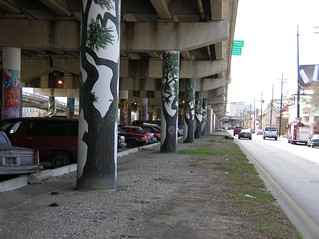
Oaks
Long gone oaks memoralized with Faux Oaks (Foaux?)

There the elevated expressway has settled into the mythology as the primary cause of every symptom of urban decline to befall the area ever since.  Never mind that crime, under-employment,  and general disinvestment in education and social services have plagued the entire city, and every city in the nation, for half a century. In the 7th Ward, everything begins and ends with that damn highway.

This is not to say that they don't have a right to complain.  The expressway may not be the root of all evil, but its placement sure didn't helped matters. But regardless of its actual impact, to the people who live in its wake, it's a constant reminder to them that big decisions aren't made with them in mind.

Interestingly, both of these not-entirely-true narratives come into play as we start to hear rumblings about the expressway being torn down and the "Claiborne Corridor"  queued for "revitalization." The preservationist crowd will see it as an opportunity to make reparations for the collateral damage they inflicted in the course of their holy war to save the French Quarter. And, no doubt, there will be support from residents eager to finally slay the dragon expressway that trampled over their neighborhood.

Hopefully, though, enough of us will be able to view the next "battle" in its own context rather than through the obfuscating fog of the last war. Lovell Beaulieu (imperfectly) pokes through some of it in a recent Tribune column about the planning process.
Another similar streetcar line is now being planned for North Rampart and St. Claude avenues. That line, which has now journeyed from the planning stages to an imminent reality, will take riders from the city’s downtown theaters and shops all the way into the Bywater, Marigny and Holy Cross neighborhoods. 

The new Rampart line did not go unnoticed by key people in attendance.

“This is just another thrill ride for tourists,” stated Jacques Morial, who lives a block from the interstate and who is determined to make sure that the communities that bore the brunt of urban decay with the highway construction in the 1960s aren’t left holding more broken promises after its planned demolition.

Morial pointed out how the Interstate that was built in the 1960s devastated the 6th and 7th wards from a cultural standpoint, as well as having a spillover effect on the 8th. When those decisions were made, African Americans had little if any political clout, and even less economic sway. Now, the conversation continues to happen behind closed doors, and it all adds to the negative perception and reality of the Livable Claiborne Communities conversation.

Nothing without us is for us,” said Morial.
Our current Mayor is fond of catchy slogans.  One of his favorites, and probably the most pernicious, goes, "One Team One Fight One Voice One City,"  as if civic governance is something we should liken to a football game where all the residents are always on the same "team."  There are many lies in this condescending little chant. The most obvious question it always raises in my mind is, how can we have a "fight" with only one "team" participating?

Of course a city contains many different voices, many opposing teams participating in many fights and the outcomes have real winners and real losers. That's just politics.  To pretend otherwise is to deny the losing side of these every day struggles, not only the material spoils, but also the recognition due anyone with a valid but opposing argument. In other words, the Mayor is telling you that when you  are priced out of your neighborhood by "revitalization" or an expressway is built on top of your house, it isn't because you lost an argument to a different "team." It's because, you actually never existed at all.

But there are winners and loser in every "Battle of New Orleans."  If the life and times of the Claiborne Expressway serve as an object lesson in anything, certainly this should be it.