-->
Showing posts with label Pres Kabacoff. Show all posts

Thursday, April 03, 2025

Somebody should really do something

Does Troy Carter know what that is?  Doesn't seem like it

Attendees told Carter that they felt helpless, confused and worried about the federal government’s actions. In response, Carter told the concerned residents to take to social media and to call elected officials in Louisiana and other states to express their dissatisfaction with Democratic leaders in Congress.

One attendee, Andrew Cosgrove, asked Carter how to increase political engagement among residents. Carter’s response — encouraging voting and organizing among church groups and on social media — did little to satisfy Cosgrove or other attendees who spoke with Verite News.  

“It seemed like he had no plan and no answers,” Cosgrove told Verite News after the town hall. “He’s saying, ‘Make sure you vote next time,’ but he’s talking to a room of folks who voted and then took time out of their night to go to a town hall meeting, so that didn’t make any sense to me.”

You see, Troy is simply the elected representative to the US Congress.  He's not really there to do anything difficult.  It falls to you, then, to exercise your much greater power to... vote sometimes and also do posts.  Whatever you do, don't yell at him about it.  Remember, he just wants all this stuff off of his desk

This might be interesting if it wasn't so predictable. I think I'm just getting old now but I do get tired of watching a cycle stuck on repeat. I used to wonder if the latest turn of the ratchet would be the one the finally breaks it. But I don't know if I still think that can ever really happen. The Democrats, in the main, seem ready to make their same familiar move: not so much opposing the radical right as figuring out how to benefit from its ascendance.

Here is a recent interview with Minnesota Governor (and 2024 VP candidate) Tim Walz where he looks forward to Trump's unilateral and illegal shuttering of federal agencies as a new "opportunity."

How much can Democrats can rebuild, of what Trump is un-building right now? We’ve seen cases where employees are laid off, a court orders them back, but they’re still laid off. Do Democrats run in 2028 on re-establishing it?

I use the analogy of the car running out of gas. Car runs out of gas, you go get a can, you pour some in, you start it up, and it’s all fine. This is the car running out of oil, and it’s broken. And what I’m saying is, he is breaking it. This is a little bit in the Ezra Klein space: Democrats need to acknowledge that not all these agencies work perfectly. All of us who teach would agree to that. You know, we say how important the Department of Education is, how it does incredible work, but we would all argue there’s ways they could be better.

I think we need to start messaging right now. We need to put our experts on this. How will we build back next time? I think it’s an opportunity. I think it’s an opportunity to create the agencies the way we saw them in the first place, functioning better, without all the barnacles. So, Trump might be doing us a favor. He stripped it down, he blew the motor up. We’re going to put a new motor in it and take off. And I think that’s how we have to start thinking about it.

He's just articulating the thing we've known for a while. Democrats actually agree with Republican austerity policy. They, too, want to dismantle what's left of the welfare state. But they don't want to be the party seen as responsible for that happening. And, of course, they want to make sure they're in position to grab whatever coins they can that spill from the smashed pinata. 

None of this is new. It's just worse now than ever because, well, that's what happens when rot runs unchecked for so long. What is DOGE, after all, besides just the latest and most extreme form of neoliberalism

One important reason for the trend toward privatization is the long-standing, bipartisan belief in Washington that private-sector contractors are inherently more efficient than government employees. The Reagan administration embraced contracting with open arms, despite early warning signs, and eventually initiated a formal commission on privatization. This was followed up by the “National Partnership for Reinventing Government,” through which President Bill Clinton promised that he would “make our Government work better” with the help of the business world. This private-sector fetish remains strong within the Trump administration, which has encouraged government workers “to move from lower productivity jobs in the public sector to higher productivity jobs in the private sector.”

Despite how widespread this perception of contractor efficiency is among policymakers, there has never been much strong evidence for it. In 1994, a Defense Department inspector general report noted that “Federal agencies often contract for services at a cost that is 25 percent to 40 percent greater than if Federal employees had been used to perform the services.” A 2011 report by the watchdog group Project on Government Oversight found that private contractors are often greatly overpaid in comparison to government workers. And in the situations where waste and abuse is identified in government programs, for-profit contractors are often the culprits.

We've been on this long path to destruction for a generation or so.  Politicians at every level of government and in both parties have specialized in smash and grab for longer than most of us have been eligible to vote for or against any of them.  Why are things so shitty? Because the entire era in which we've been alive has been about making things shittier and shittier for the sake of concentrating wealth in fewer hands. The thing that has been happening is still happening. It's happening in your city on a routine basis

Under the auspices of his charitable group, the Wisdom Foundation, and a newly created for-profit company called Civilized.ai, Wisdom and his team had been working for months with the city to integrate “newer technologies” with the city’s infrastructure. To do that, he planned to work with the city’s existing database of 311 requests. 

In late 2023, he rolled out FixNOLA, a website that catalogues and gamifies the city’s 311 data regarding road and drainage issues, creating a leaderboard to keep track of top “fixers,” a mix of contractors and volunteers who provide photographs and updates to existing 311 requests. Then, in February of this year, Wisdom launched ChatNOLA, a chatbot powered by artificial intelligence that can help log 311 requests as well as provide updates on already submitted requests while communicating in a human-like manner.

Behind the scenes, Wisdom and his nonprofit have rankled some city staffers, who noted that Wisdom is doing this work without a formal agreement with the city government. They are also concerned about whether Wisdom’s team is getting access to the personal information, such as phone numbers and home addresses, that residents enter into the city’s 311 system when they make a complaint. 

Five city employees familiar with 311 systems and protocols told Verite News that they are concerned that Wisdom, who has no background in public service administration, is creating a parallel 311 system when the city is in the process of implementing an already purchased new system for processing 311 data. (The employees declined to be identified publicly for fear of retaliation.)

The city already publishes 311 complaints on a public-facing database. But it scrubs the data of personal information, such as the complainants’ names, addresses, phone numbers and email addresses.

Neither the Wisdom Foundation nor Civilized.ai has any contract or agreement with the city outlining the terms of this work or setting limits on how it can use the personal data it collects.

You can see the continuance of this in evidence as the field of candidates for this year's municipal elections begins to take shape.  A group of donors, politicos, and other local heavy hitters is hoping to influence the campaign by publishing its own Project 2025 document of sorts.

The recommendations from the City Services Coalition, which was formed in 2024 by real estate developer Pres Kabacoff, attorney David Marcello and others, focus on streamlining the structure and management of city government.

They include a proposed overhaul of the Sewerage & Water Board, empowering the mayor’s top deputy to manage day-to-day city operations, reforming the civil service system and clarifying the role of the city attorney.

The effort comes seven months before voters head to the polls to decide who will represent them on the City Council and who will succeed Mayor LaToya Cantrell, who is term-limited and unable to seek re-election. 

The coalition, which released the 216-page policy manual during a news conference Monday afternoon, has already met with announced and prospective mayoral candidates, including Helena Moreno, Arthur Hunter and Oliver Thomas.

Basically what's going on among the local politicians, donors and consulting pros is they're all trying to maximize their potential for getting a piece of whatever new patronage conduits are created after the next round of privatization.  With all the vandalism going on at the national and state levels, locally we have opportunists not pushing back against any of that but rather positioning themselves to catch as much as they can of the money that gets shaken loose. Somebody should really do something about all of this, you say?  Well, that's what your favs are doing. The same thing they always do. 

Tuesday, March 18, 2025

The wannabees at work

The really insidious thing about the DOGE phenomenon, wherein a team of hooligans under the direction of a hostile plutocrat wreak havoc on the basic physical and social infrastructure that makes life possible for most Americans, is that.. in addition to this... the movement spawns hundreds of immitators in state and local governments accross the country.

Last month we noted that Jeff Landry has formed a DOGEesque committee to attack state services. At last notice, they were writing a report. A week ago, we learned that St. Tammany Parish is getting a DOGE committee of its own. With the New Orleans municipal elections right around the corner, it also looks like Pres Kabacoff is having his own Project 2025 drawn up. (Let's keep an eye on that one, yes?)  In January, we caught this profile of Jeff Landry advisor/patron and Harvey Gulf President Shane Guidry where he explicitly compared himself and his role in the administration to that of Elon Musk. 

Today we find Guidry behind a move by Landry to dismantle South Louisiana's flood protection. After Katrina, a grass roots movement of residents succeeded in taking corrupt and negligent levee boards out of the hands of political cronies, de-emphasizing their police powers, and professionalizing their core flood risk management function. This week, three board members resigned in protest of Landry's attempts to reverse those reforms.  They addressed their resignation letters to Guidry. 

The letter was signed jointly by board members Roy Arrigo, Thomas Fierke, and William Settoon. It is addressed not to Roy Carubba, the president of the board, but to Shane Guidry, Landry’s informal adviser in New Orleans, who is not on the levee authority’s board but has been overseeing reforms at the agency.

It alleges the agency's new leadership had diminished “morale, readiness and focus on flood protection.”

Guidry thanked the departing board members for their service. He also stressed that, under his guidance, the agency was “moving in a better direction to make sure that all flood control assets are maintained properly, which they haven’t been, and working properly, which they haven’t been,” though neither Guidry nor Carubba has provided any evidence that the city’s flood control infrastructure is faulty.

And now we're getting wild unsubstantiated assertions about what does and doesn't work from unofficial administrators of dubious legal authority.  Our wannabe DOGEs are rounding into form.

Sunday, July 07, 2019

NIMBY Nation

This Huff-Po article about the increasingly reactionary nature of urban land use politics in major US cities got a fair amount of attention this weekend. I don't know exactly why the author insists on defining the backlash as a generational thing. I know "Boomer" is lately the shorthand for middle-class, middle aged conservatives.  But it confuses the issue for too many people. What we're really trying to describe here is the tipping point in urban politics that naturally follows years of policies specifically designed to fill the cities with nice things for rich people while everyone else is left to fend for themselves.  If only rich people can live in the city, eventually the city's politics will reflect the rich people's interests.
"We have mountains of data showing that cities need more housing and better transit and shelters for homeless people,” said Matthew Lewis, the director of communications for California YIMBY, a pro-housing nonprofit. And yet cities often give in to neighborhood groups opposing this much-needed infrastructure. The proposed homeless shelter booed by Salt Lake City residents in 2017 was canceled the next day. Schwartz’s lawsuit has succeeded in delaying the bus lane on 14th Street. The tantrum-throwing Seattleites eventually won the repeal of the tax they were shouting about.

“It’s frustrating,” Lewis said. “The people with the most privilege pack the meetings, shout over everybody else and get their way.”

These organized opposition groups could also, in the longer term, form a conservative coalition in cities and pull them to the right. This is already happening in cities with high rates of homelessness, where nominally progressive residents have formed interest groups that echo conservative talking points on personal responsibility and cracking down on drug users.

“This is not an anti-homeless march,” Barry Vince, an attorney, told reporters from the local television station as he participated in an “anti-crime march” in Long Beach, California. “We’re here to march against criminals, and we want the bad guys taken down.

Lewis said he’s seen similar rhetoric begin to appear in public hearings over housing and transportation.

“It’s a pretty short leap from ‘We don’t want homeless people living here’ to ‘We don’t want refugees’ or ‘We don’t want immigrants,’” Lewis said. “I’ve seen lifelong hippies who drive electric vehicles stand up at these meetings and say, ‘There’s too many people here already.’ It’s like you’re at a Trump rally.”
Maybe it's that thing about "lifelong hippies" that prompts the "Boomer" framing in the article.  But the critical dividing line isn't based in culture or age cohort so much as class. Didn't we already know hippies grow up to be yuppies the minute they get a hold of the slightest semblance of wealth?  The article alludes to that as well but quickly takes it in the wrong direction.
Cities can also redesign community outreach to encourage input from groups that have traditionally been excluded. According to a 2017 study, older male homeowners are more likely to participate in town hall meetings and other public participation processes than other demographic groups. Another, published this month, found that becoming a property owner motivated individuals to participate in politics and to express their views on housing, traffic and development to elected leaders more often.
This is followed by a consideration of whether or not cities should limit or deflect public feedback at government meetings.  But that's just more of the anti-democratic neoliberal impulse that got us here in the first place. The issue isn't really about process. It is about political power. And right now rich people have too much of it. That's not a new problem. Nor is it a generational problem the way the article wants you to think it might be. It's just the timeless process of wealth accumulating and then defending itself.

A proper analysis of this goes beyond simple questions of YIMBY vs NIMBY.  You can't describe the politics of who is allowed to live where by whom solely in terms of cold hard "supply and demand." There are real live power relationships to consider. In New Orleans, for example, big decisions are heavily influenced by real estate developers, of course. But also there are neighborhood organizations (dominated by property owners) and historic preservationists (property owners with the kind of money that gets you onto the "philanthropy" circuit) who have stifled equitable housing and transportation policies for ages. More often than not they operate with some sort of progressive sounding rationalization.

Under the pretense of "quality of life promotion," neighborhood associations hire private police with public funds,  shut down bars and music venues, shoo the homeless away,  and ensure that bus stations doesn't have too many public restrooms. When the City Council voted to demolish the Big Four housing projects after Katrina, we were told by NIMBY liberals the cause was humanitarian
“We need affordable housing in this city,” said Shelley Stephenson Midura, a Council member who proposed the resolution that was adopted. But, she added, “public housing ought not to be the warehouse for the poor.”

New Orleans's most prominent beneficiary of those demolitions was mega-developer Pres Kabacoff. Here is an article by Roberta Gratz who, even in an article critical of the displacement for which Pres is hugely responsible, can't help but give him props as a preservationist.
Ironically, Kabacoff and his company, Historic Restoration Inc., are responsible for some of the best of the preservation projects that have helped downtown retain its traditional feel.

There's nothing "ironic" about it, though.  Preservation and gentrification often align with the same policy agenda. Which is often carried, we were reminded again today, by high powered liberal politicians.
Warren will meet “with activists, influencers and community leaders,” a campaign spokeswoman said, but didn’t provide specifics.

One of her leading supporters in the state is Pres Kabacoff, a New Orleans real estate developer who said he reached out to Warren because of her support for well-regulated capitalism.
But most of the time these are battles fought out block by block and one planning meeting at a time. Recently this mixed use development faced a gauntlet of intense neighborhood opposition in Bywater. And the Touro-Bouligny association is currently stalling a HANO project Uptown aided, we should note, by the addition of the building in question to a list of "Endangered Landmarks" maintained by a local preservationist society.

Interestingly the mayor rarely weighs in on any of this.  Over the course of her first year in office she's been more focused on the tourism grand bargain, police affairs, the traffic camera controversy, and the Sewerage and Water Board follies than zoning and housing questions. That might change at any moment. The STR wars are moving toward a conclusion... of the current phase anyway.  We may see the mayor get involved in that at some point.  But whenever she does decide to put a thumb on the scale of one of these land use matters, surely the fact that she got her start in politics as a neighborhood association president will have at least some bearing on which way that scale might tip. Just something to watch for, anyway.

Tuesday, November 20, 2018

Oh look we have a border clash

I know the old NOLigarchs map is due for some updates.  For a while there I thought I might have to extend Kabacoff's territory to Tulane Avenue. But that's now been occupied by the Israelis so we can forget about that.  Also there are other minor fiefdoms we can add when we get the time. But this is all our cartography budget can handle for now so this is what we have to go with.


We do need to point out also that the regions loosely defined on this map are not very strong on border security.  One Noligarch may in fact hold substantial amounts of valuable territory within the titular boundaries of another's domain. For example, look at all this stuff Joe Jaeger runs even though it isn't in what we've marked on our map as "Jaegerton"


As one might expect, in the world of international capital, borders are not always what they may seem.  Anyway, our map is not very nuanced.  One thing it does get right, however is the overlap and "disputed" designation of areas claimed by Motwani and by Torres.  Tensions there do continue to flare up, it seems.
Developer Sidney Torres IV has become embroiled in a legal battle with French Quarter real estate owners Kishore “Mike” and Aaron Motwani over Torres' purchase of 500 Frenchmen St., a key location in the Marigny’s busy nightclub district. In court filings, Torres claims a tenant of the building, the nightclub Vaso, is being used as a proxy through a lawsuit to win the Motwanis control of the building.
Now that Frenchmen is pretty firmly established as the new Bourbon Street as opposed to the sort of hipster anti-Bourbon Street it had been for a while, all of a sudden there is a land rush. Just a few weeks ago we learned that the Motwanis have taken ownership of the Praline Connection Restaurant which they have moved off of Frenchmen saying "“Locals couldn’t really get down here anymore." They are moving it to... get this... upper Decatur Street in the Quarter because... that would be.. less touristy?  Who knows. It's not clear to me who owns that building now so we need more information. But the Motwanis have a claim on what happens in multiple Frenchmen Street locations right now. That's interesting.

There's a lot of interesting stuff going on in this story, in fact.  To begin with we have what Torres wants us to believe is a threat, although his word is hardly to be taken at face value. Here's what he says happened anyway, which is pretty funny to think about. Note that Motwani doesn't deny he's being quoted pretty accurately whatever he may have meant.
Torres cited a voicemail he said was left on his agent’s phone, as well as a phone call that, according to a court filing by Torres, had Aaron Motwani saying that if Torres didn’t comply with demands, “It will get bloody.” Torres' attorneys, in the court filing, cited what they described as a call log Torres' agent wrote shortly after the call, as well as a recording of the voicemail.

“I want to ask nicely for you to call us back," Motwani says on the voicemail cited in court. "But if you want to handle it the other way, we can handle it the other way, too.”

Aaron Motwani said his voicemail was taken out of context and did not reference a threat of physical harm. He declined to be interviewed but sent a text message in response to questions about the calls.
So keep an eye on this. It could change the face of the map which, as we said, needs some revision anyway. Technically all of this is taking place in "Cummingsville"  according to our drawings.  Let's hope no other belligerents get drawn into the dispute.

Tuesday, September 11, 2018

Now we know what the "innovation district" was for

The "Spirit of Charity" planning process that has been going on in a parallel universe to the actual selection process for the Charity Hospital developer finally fits in to the big picture. It's basically a way to boost Kabacoff's bid
Subsidies: Unlike the Tulane Partners plan, HRI would rely on revenue from a tax-increment financing district proposed for an area of the CBD to surround the hospital. Tax increment financing uses tax revenue from future development, and in this case, HRI is proposing to divert $40 million in sales tax revenue from the 382,000 square feet of retail and 82 apartments across the street. The project would also rely on between $211 million and $224 million in tax credits. The option that includes City Hall as a major tenant would call for $91.6 million in prepaid rent, presumably from City Hall, as that financing element isn't called for in the other two scenarios.
We knew the Spirit Of Charity Innovation District meetings  headed up by Andy Kopplin and the Greater New Orleans Foundation was basically just an excuse to create a TIF.  But we weren't exactly sure who was set to benefit from that. It's not surprising that it would be Kabacoff given the way the non-profit industrial complex works around here. HRI (and, I suppose, GNOF) have also marshaled support from various other gangsters of that scene.
Tenants: LSU was provided commitment letters from Tulane University and the United Way for office space, the Historic New Orleans Foundation for museum space, Pythian Market for a grocery and Audubon Primary Academy for educational space.

Note also the "rent" from City Hall.  That's gonna be a fun budget item to talk about.  There is no public comment from LaToya or any of the councilmembers about the prospect of moving over there yet.  But  rest assured, they've been talking about it.

A recent edition of Danae Columbus's political gossip column hinted at this a few weeks ago. In that column, Columbus (a political consultant who has previously been accused of using her Uptown Messenger platform to promote her clients' interests)  described GNOF's sham public input process as "three lively, well-attended city-wide community workshops" and put a heavy thumb on the scale in favor of moving City Hall over to Charity.  It was pretty clear at that point what development model the insiders were favoring. Today's announcement only clarifies which firm's plan contains that model.

None of that is too too surprising.  But here is something else to look for.  If City Hall really does move into Charity, what happens to the old building?  Recall that this was originally Mitch's idea about 5 or 6 years ago.  Back then, he was pushing several projects at once to redevelop the area realtors now call "South Market District." These developments included the luxury/STR eligible apartment blocks that now dominate the area, a new Rouses grocery, the Loyola Avenue "streetcar to nowhere" and other curious arrangements that never panned out like this "Jazz District" partnership with the Grand Ole Opry. At the time we speculated that maybe that City Hall property would make an attractive spot for more hotel/luxury resort type development in the new downtown theme park.

Who knows what would happen to that space now? There are plans underway now to redesign Duncan Plaza.  I wonder if that picture changes a bit if the building next door suddenly needs to go "back into commerce"?  What would we do with that space?

Monday, August 20, 2018

When do we get to see the bids?

Matthews Southwest dropped out of the Charity Hospital redevelopment sweepstakes today.
Officials said the firm Matthews Southwest did not submit plans by the state-imposed deadline of 10 a.m. Monday "due to the unexpected passing of a principal team member last week."
Well that sounds like sad news. There isn't any more information about it, though. We don't know if maybe Matthews could have asked for an extension. Probably not, given the seriousness with which we take deadlines and meetings around here.  Also it is worth asking how or if this affects Matthews's involvement in the Convention Center hotel deal. It may be that they're souring on that as well, considering the circumstances.
In the opening salvo in what could become a lengthy negotiation over whether the Ernest N. Morial Convention Center moves forward with its plans to build a high-rise hotel, Mayor LaToya Cantrell has expressed “grave concerns” about the large public subsidies being sought by the developers.

In a letter last week, Cantrell said she had “grave concerns about the amount of subsidy this project will receive and the future implications of this project on tax revenue in New Orleans.”
That was an interesting turn from Cantrell last week, by the way. It's curious to see her suddenly serious about the problem of public subsidies for private developers in this one specific case. It could just be she has a friend or two at BGR.  I wondered if maybe she was just mad at Joe Jaeger over the job he did submarining the Harrah's hotel earlier this year.  But that's probably not it since at the very same time Cantrell's letter was published, the IDB was signing off on a smaller but similarly flawed package for Jaeger's and Barry Kern's indoor golf house. Not a word from LaToya about that one. Nor do we expect there to be much objection from her over the ongoing "Spirit Of Charity" process which will inevitably lead to more TIF or PILOT giveaways to several of the usual suspects. For now, at least, it's a mystery.

As for Charity Hospital itself, well that's all up to the state and LSU to decide.  And so we are given to understand the mayor doesn't officially have a lot of say in who gets that deal. Although, in reality, she probably does have considerable input.  In any case, nobody is telling us much about it yet.
LSU’s Real Estate and Facilities Foundation, which is overseeing the selection process, did not release the two proposals Monday. But the foundation said it would make them public before Oct. 4, when LSU's Board of Supervisors could select a winner.
How far in advance will we see those bids?  There's only a little over a month left.  The two finalists were also the finalists the last time we tried to get this done so you can probably get a decent idea of what's in play by looking at what they proposed then.

Thursday, July 26, 2018

The "spirit" but not necessarily substance of public input

They're making a big to-do over the GNOF-led public meetings about their proposed TIF district but the actual decision about what happens to Charity is up to these guys.
The LSU Real Estate and Facilities Foundation has selected three developers — the same groups that were picked in an earlier attempt to redevelop Charity — as finalists and asked them to submit proposals by Aug. 20. Those will be evaluated by a committee made up of state Commissioner of Administration Jay Dardenne and officials from LSU, its foundations and medical schools.

On Thursday, the foundation released portions of the submissions from the three firms that landed them on the finalist list. Three other firms also applied, though their names and submissions were not released.

The documents released are essentially resumés for the development firms. They only hint in general terms at what their final proposals will look like, offering no details about what mix of uses might eventually fill the former hospital building.
It doesn't matter if they say what they want to do, anyway. Each proposal is likely to resemble the next with the decision coming down to who has the most pull with the committee.
On Thursday, the LSU Foundation responded to concerns voiced at the meeting about transparency and released the initial responses from developers in the state's selection process. The state used those developer letters earlier this year to pick the three finalists from a total of six. The development groups are New Orleans-based HRI Properties, Matthews Southwest and a partnership between El Ad US Holdings and CCNO Development.

Those letters contained a variety of information about the firms and their commitment to redeveloping the hospital, but they were spare in detail on what they'd ultimately propose in terms of possible tenants or the ultimate use of the building.
If I were guessing I would say they're going with HRI. But the only reason I say that is because it would make a more elegant addition to the boundaries of Kabacoffia (shown on the NOligarchs map in pink below) than it would to Jaegerton (shown in purple) should it go to the Matthews group.


It could be they just pick something at random.  We would never know. Instead the public is being asked to focus its attentions on helping Andy Kopplin get his TIF, although the reason for doing that is also highly dubious.
Ultimately, the aim of the effort being led by Kopplin is twofold: to create a master plan for the mainly rundown blocks surrounding the former hospital and to serve as a vehicle for tax-increment financing that could redirect tax revenues back into the district, for the redevelopment of Charity or other purposes.

Maybe the developers get some of it. Maybe it's for "other purposes." Who knows?  They do get to say they held some meetings and got some "public input," though. That automatically makes this a very legitimate process, right?

Wednesday, July 25, 2018

Spirit of Charity District

This public input process for redeveloping Charity is curious. Tonight's public forum hasn't been publicized very well. Also, it's not really even about the building itself.  We don't know what the proposals are for that yet
A meeting being organized by the Greater New Orleans Foundation, which is leading the public engagement effort for the "Spirit of Charity Innovation District," will hold a community workshop to help residents envision what the district will look like. Design Jones LLC is assisting GNOF with a strategic plan for the district, and is helping gather public input for what it will look like.

But there will be a big piece missing from Wednesday's meeting, which will be held at the Delgado Charity School of Nursing's seventh-floor gymnasium starting at 6 p.m. at 450 S. Claiborne Ave. Although planning for the district surrounding the 1.2 million-square-foot hospital has largely been kept in public view, the plans for the building are still under development and are being overseen by the LSU Foundation (the school owns the building, a legacy of the hospital's status as a teaching institution).

The three developers -- HRI Properties, Matthews Southwest and a partnership between El Ad US Holdings and CCNO Development -- were supposed to turn in proposals five days after Wednesday's meeting, but LSU officials said on Tuesday that the date had been pushed back to Aug. 20.
A month or so ago, when we noticed the finalists had been selected, we tried to guess a little bit about what they might be up to by looking at what was on the table  during a previous round of bids that ended up being scuttled. Note that HRI was a finalist then as now. Also Matthews Southwest is in the mix. They're also a partner in the Berger/Jaeger Convention Center hotel project.  BGR put out a report this week criticizing the use of public subsidies in that endeavor. It is worth paying attention to how they are used at Charity as well.

As the T-P article linked above says, the meeting tonight is really about this "Spirit of Charity Innovation District" thingy. Here's more about that from earlier this month.
With the Spirit of Charity district, Kopplin said that city officials will be able to use a key incentive to ensure the eventual developer complies with goals set for disadvantaged business enterprise participation, as well as pursuing a mix of training and job opportunities. The tool is known as tax-increment financing, or TIFs, which is typically used for building infrastructure, using the projected future tax growth from the investments.

"There's no reason a TIF couldn't support all of those things including potentially spur economic activity around biomedical research," Kopplin said. It will require coordination between officials at the state and city levels to create a path to governance within the TIF district.

"The state and city partnership is vitally important," Kopplin said. "The city administration and the state administration seem to share a view of creating a district around (Charity Hospital) as critically important."
That is some extremely vague language explaining what the TIF would be used for but it is "critically important" that the money be put into a pile for some purpose. Partially because that's what the team of "experts" who spent five days in New Orleans  back in November said. One of them also said New Orleans is a state capital, though, so maybe not the most reliable information there.  It's also what this consultant the Landrieu people hired told them to do more of so, it must be worth something.  Look here they're trying to make one happen to help Barry Kern pay for turning the Times Picayune building into some kind of indoor golf playground. That seems legit. Anyway, TIF first and ask questions later is the order of the day.

So even though tonight's meeting won't give us any information about the plans for Charity, we can assume there are opportunities to ask them what they want to do with this TIF. Attendees could ask what exactly does it fund? They can't just say "infrastructure improvements" or "incentives" without saying specifically who benefits from them. Who gets the money? Who manages it? Who pays the taxes that fund it? What would that revenue would otherwise fund?

Most importantly, what's in it for us, if anything? Spirit? Innovation? The kids these days seem to be interested in affordable housing. Maybe someone should explain how this is supposed to help with that.

Thursday, June 07, 2018

Spirit of Charity

Who will win the Charity redevelopment derby? We are down to three contestants already
LSU has selected three development teams it says are qualified to bid for the right to redevelop Charity Hospital, the downtown New Orleans facility that was abandoned after Hurricane Katrina.

The three selections were made after a process announced in April that opened up what's long been seen as a prime redevelopment opportunity to competitive bidders. LSU officials said last month that they would select developers that "have the vision, experience and financial capability" to complete a project.
Let's see who is in here. Well there's Pres Kabacoff which is not going to surprise anybody. There's also this guy who is sort of the Kabacoff of Dallas but with a larger, international portfolio. But this group is the true curiosity.
1452 Tulane Partners: This is an ownership group that includes New Orleans-based CCNO Development LLC and El Ad US Holdings, part of the Tshuva Group, a commercial real estate conglomerate based in Israel. El Ad's holdings are in Israel, Europe, Asia and North America. They include the Plaza Hotel in New York, and more than 10,000 rental units in 10 U.S. states. CCNO projects include the adaptive reuse of the former McDonogh 16 school building and a few multi-unit residential developments. Joseph Stebbins, a former Housing Authority of New Orleans official, architect Michael Lee Mattax and contractor Richard Mithun are the principals in CCNO.
Hey, it's a good thing the City Council made sure to reject the BDS movement, right?  Otherwise these guys would be out of the running for this big pot of money and that's the real injustice, right?

We're not yet to the stage of this where we get to see the actual proposals but if we're wondering what they will look like, all we have to do is check out what these same developers proposed the last time this was tried
Previous competitive bids outlined a vision for Charity Hospital in 2015 that included a bid from New Orleans developer Joseph Stebbin that proposed a 600-unit apartment building, an extended-stay motel and housing for medical students. The company formed to bid on the property offered $30 million for the 1 million-square-foot building; overall development costs at the time were pegged at $275 million.

Also bidding on the property was New Orleans-based HRI Properties, which proposed a $194 million renovation that included apartments and a medical research tower.
So, basically, they're going to do fancy apartments glommed on to whatever window dressing best flatters the public fashion and/or nostalgia.  Here is Andy Kopplin back in April illustrating that with some empty slogan salad.  I highlighted my favs.
"After more than a dozen long years, this effort to adaptively repurpose the iconic Charity Hospital building presents an exciting opportunity to bring back a place that is sacred to many New Orleanians," Kopplin said in a statement. "Even more exciting to us here at the Foundation is the potential for using this initiative to kick-start long-standing efforts to develop the neighborhood surrounding Charity into a vibrant, job creating, inclusive and equitable innovation district that celebrates the spirit of charity and that everyone in our region can claim with pride."
In recent years, the marketing strategy for these kinds of developers has also picked up the phrase "affordable housing" because they've learned that is something people worry about.  The Advocate quotes Stebbins hitting that note in this story.
“It’ll be a modern, vertically integrated development no matter who does it. You’re going to have residential pieces, and you’re going to have an affordable (housing) piece,”
Although, as we've seen, the developments themselves rarely contribute much in the way of actually addressing the housing crisis. Token set asides (the "affordable piece") are in there to mollify the growing public concern on the one hand and to qualify for various public subisdies and land use exemptions on the other.  The more juice housing gains as a political issue, the better our politicians and developers who fund them are learning to rebrand their schemes in ways that co-opt the language of activism without actually changing the course of public policy.

In a particualry strange episode of this kabuki last week, John Bel vetoed a bill that would have banned  local "inclusionary zoning" requirements.  That's fine. That bill, like most state-level attempts at preempting local political authority, should have been vetoed.   The Governor's  veto statement, though, was almost as nonsensical as the bill itself saying, basically, that local governments will have to use it or lose it. 
“If local governments in Louisiana do not actively pursue these policies over the course of the next year, I will conclude that it is not their will to utilize these strategies and I will be inclined to sign a similar piece of legislation in the 2019 regular session,” Edwards stated in his veto.
If cities aren't implementing this policy in the first place, why ban it?  I don't know.

Anyway, from the looks of things, our new mayor is something of a branding enthusiast herself.  And, as such, she is as on board as anyone with applying the new language of faux affordability and "vibrant, job creating, inclusive and equitable innovation" or whatever toward the same old program of  handing out money and favors... oh I'm sorry..  "incentives" to the real estate mavens who elected her.
Mason Harrison, a spokesman for Cantrell, said stimulating development activity and business growth are priorities of the new mayor.

"A great deal of opportunity exists in returning vacant buildings to commerce, generating tax revenue," he said. "Businesses, however, must be offered the kinds of incentives that will make that possible, and the mayor-elect believes that we are losing to other parishes on that front."

Luckily, she has friends in Baton Rouge willing to help.  Cantrell has chosen State Rep Neil Abramson to serve as her point person in the legislature.  Last week, he introduced her (and New Orleans Saints mascot Gumbo) to the House so she could greet members with a brief speech about how much fun she had at D.C. Mardi Gras and congratulate them on the fine work they've done this year.  (This is really what she told them. I am not making that up.)

In addition to this service, Neil (on the days the House was not considering anything involving abortion) also managed to pass some legislation on the city's behalf.

For example here is HB 684 passed during the regular session.  What this does, basically, is remove a cap on the size of the tax break the city can give private entities who have entered into cooperative endeavor agreements with them. Previously, if a "private partner" were to donate "cash, equipment, goods, or services" to a city infrastructure project, then they could collect a tax break equal to one half the value of the donation or $500,000 whichever is less.

Say, for example, the management company running the St. Roch Market were to install a new sidewalk or something.  They could then recoup half of their investment in tax subsidies. Now, under Neil's version of the law, the "incentive" payment has no limit. So, in theory, a thousand dollar "donation" could merit a million dollar "incentive."

You go out and buy some new signage.. ooh.. or maybe some cameras...  and the city can more or less guarantee you're going to come out ahead.  That ought to get the ol' spirit of charity up and running. Especially if it applies to whatever deal governs the Charity development which I think it probably will.  But you can see the possibilities extend well beyond that too. 

Tuesday, April 24, 2018

Send more rich people

LOL Pres
Many of the downtown residential developments are expensive. An increase in well-paying jobs is seemingly necessary to fill those pricey units.

What you can get is migration, even without job growth. Those people that can afford to will come to this great land that we have in the downtown environment, with all the restaurants and entertainment, and the walkability. This area will do well.

The more fundamental question is, how does the (rest of the) city and metropolitan area do?
Well, there goes your YIMBY plan.  We really were all about moving the poors out of the way for the sake of replacing them with "migration, even without job growth."  In other words, these are luxury second homes where once there was affordable housing. 

Wednesday, August 09, 2017

Eat the tourists

Don't act so surprised. That's what it's supposed to do.
The New Orleans Regional Transit Authority’s largest new transit infrastructure investment since Hurricane Katrina — its North Rampart streetcar line — actually reduced convenient access to jobs in nearby areas, according to a new report.

The report was released by RIDE New Orleans, a transit advocacy group that has long argued that the RTA should prioritize buses, which carry almost exclusively local riders, over the more picturesque streetcars, which appeal to tourists.
We know that's what it's supposed to do because they told us that's what it was supposed to do when they were planning it. In this meeting, Justin Augustine didn't say anything about getting people more efficient transit. He talked about "revitalizing a corridor."
Justin Augustine, the agency’s general manager, said the project will take about two years to complete once the work gets started. As with the Loyola Avenue spur, which opened in January 2013, city officials hope the investment will pay off by generating economic development in a part of the city where revitalization efforts have proceeded in fits and starts.

“When we first introduced the concept, we wanted to revitalize and renew parts of the city, and we knew that along that corridor, you’d be touching five historic neighborhoods,” Augustine said, referring to the French Quarter, Iberville, the Treme, the Marigny and the Upper 9th Ward. “We’re hoping with all of our projects that we spur economic development.”
In this meeting, Pres Kabacoff explicitly said the way to revitalize the corridor was to make the transit slower and less reliable for people trying to get anywhere on time.
Pres Kabacoff, a real estate developer from the Bywater neighborhood, said he thinks the streetcar will help spur business. Kabacoff even argued that slowing down vehicle traffic might be a good thing, since having cars whip by "is not conducive for good retail development."

He added, "To the extent that people have a difficult time in traffic getting down the street it may cause them to want to live in the area and use an effective streetcar."
Of course nobody actually lives in the area. It's all Airbnbs um.. overnight po-boy parties and such there. But, hey, the corridor is "revitalized." Tourism is doing that. It's also killing the city.

Tuesday, December 20, 2016

Merry Christmas to the landlords

New Orleans, as you may know, has a bit of an affordable housing crisis.  Our political leaders thus far have responded by prioritizing the needs of developers, landlords, and, I guess, "the platforms" responsible for enabling short term rentals in neighborhoods where nobody is actually able to live anymore.

Their favorite policy tool has been the so-called "density bonus" recently championed by Latoya Cantrell and adopted into the CZO which allows developers to build nice things for rich people so long as they set aside a very small percentage of available units at reduced rents. We've written a bunch of times about how this is pretty much just a shell game sop to luxury developers.  So it's not too too surprising that our elected representatives are so enamored of it.

Once upon a time a similar policy was praised for making possible the development of the American Can Company into (mostly) luxury (but with a token amount of affordable) apartments.
Several other builders had tried to develop the American Can project but failed to come up with the necessary financing. Mr. Kabakoff used public-private partnerships to finance the deal. His first mortgage consists of $29 million in tax-exempt bonds from the State of Louisiana's private activity bond cap program. The program mandates that 20 percent of the housing units be set aside for low-income renters.
Pres has made this trick of diverting taxpayer subsidies into profits a specialty over the years. He didn't exactly invent this scam, though.  It has made Donald Trump very rich, for instance.
The way Donald J. Trump tells it, his first solo project as a real estate developer, the conversion of a faded railroad hotel on 42nd Street into the sleek, 30-story Grand Hyatt, was a triumph from the very beginning.

The hotel, Mr. Trump bragged in “Trump: The Art of the Deal,” his 1987 best seller, “was a hit from the first day. Gross operating profits now exceed $30 million a year.”

But that book, and numerous interviews over the years, make little mention of a crucial factor in getting the hotel built: an extraordinary 40-year tax break that has cost New York City $360 million to date in forgiven, or uncollected, taxes, with four years still to run, on a property that cost only $120 million to build in 1980.

The project set the pattern for Mr. Trump’s New York career: He used his father’s, and, later, his own, extensive political connections, and relied on a huge amount of assistance from the government and taxpayers in the form of tax breaks, grants and incentives to benefit the 15 buildings at the core of his Manhattan real estate empire

Our local representatives love Donald Trump.  Or at least they did before he got into politics.  In 2007, the City Council enthusiastically thumbsed-up a proposed Trump Tower development on Poydras Street.
The 1.6 million-square-foot tower, estimated to cost about $400 million, would fill most of the largely vacant block bounded by Poydras, Camp, Natchez and Magazine streets. It would be 716 feet high, plus a 126-foot spire, and would contain 734 luxury condominium and hotel units and a 715-space garage.

Florida developer Cliff Mowe said he hopes to break ground this summer on what would be Louisiana's tallest building. Construction is expected to take 28 months, putting completion in late 2009.

New York real estate magnate Donald Trump announced on Aug. 25, 2005, that he would join a team of Florida developers in building a 70-story tower in New Orleans. Hurricane Katrina hit four days later, but within two weeks Donald Trump Jr. said the developers would go ahead with the project.

Although financing has not been nailed down, Mowe has said several large lenders are interested in the project, in part because of Trump's involvement.

No one spoke against the proposed tower at the council meeting. The plans were approved 5-0 on the recommendation of Councilwoman Stacy Head, whose district includes the site. "This is Trump," Head told her colleagues in asking for approval. "Woo-hoo."
Woo-hoo, sure. Except by this time, the post-Katrina market for labor and materials was already souring Trump on this project. The 2008 financial crash is said to have killed it entirely. But, if you remember, this was a period during which federal recovery funding was causing New Orleans to "buck the trend" economically speaking.  Taxpayer money was pouring into the area. If only someone (looking at you, Ed Blakely) had offered Trump a sufficiently sized bucket of it, our skyline might be blessed with this jewel today.

Anyway so we never got Trump down here but we still had Pres Kabacoff and that was plenty, thank you very much. Pres hasn't risen quite as high as Trump has but he's done ok for himself in our small pond. His most recent project is even redirecting public money to Airbnb so it's nice to see him keep on the cutting edge like that.

Meanwhile, back at the Can Company, that tax exemption just expired.  You won't believe what happens next.
NEW ORLEANS -- Michael Esnault and his partner Anne Tucker have lived in the American Can Apartments building for the past six years, but they’ll soon be former tenants – through no choice of their own. They recently found a note taped to their door notifying them that they had until the end of December to vacate their apartment.

"(It’s) definitely a slap in the face," Esnault said. "I always paid the bills on time and everything else. What got me is the corporate greed."

Dozens of families are losing their leases at the Mid-City apartment building as the operators phase out all of their subsidized and low-income units. Esnault and Tucker are leasing one of the 53 units in the building set aside for low- and fixed-income families.

The American Can was built in part with government subsidies, including $29 million in tax-exempt bonds. Those bonds required the owner to keep 20 percent of the units for affordable housing for a minimum of 15 years.

That requirement expires at the end of January.

Those tenants are now losing their leases.
Where will these renters go now?  Well, you know, we're working on that. Just gotta get the right subsidy to the right millionaire first.
On Tuesday, the IDB voted to provide the project with a payment in lieu of taxes, or PILOT.  The PILOT allows the developers to pay $56,000 a year in taxes during construction, $160,000 a year once construction is complete, annual 2.5% elevations each year thereafter, and a $75,000 bump in 2025.

The IDB estimates that the PILOT will save about $6 million over the 12 years of the deal, while developers claim that the project will generate $29 million more in property taxes for the city over a 50-year period.

The development site is bounded by the Lafitte Greenway, Jefferson Davis Parkway, North Scott and Conti Streets.  In addition to the one and two bed room apartments, the mixed-use project will have ground floor retail and restaurants and parking spaces for 570 cars. The projected project cost is $66.5 million.

Entrepreneur Sydney Torres purchased the nine-acre site in 2015, and Edwards Communities has it under contract to purchase the site from Torres.  Our sources tell us that Torres plans to keep the front of the parcel closest to Bayou St. John for future development, while giving the back portion of the parcel to Edwards Communities for this project.

Edwards Communities secured city approval for the project in November and a density bonus after agreeing to include 14 affordable units in the project.
In the meantime, Merry Christmas to the evicted!  

Thursday, February 25, 2016

What's going on in Torreszonia?


Sidney is going to Make It Great Again
New Orleans businessman Sidney Torres IV has purchased the former Carmelite Monastery on the edge of the French Quarter and plans to develop the walled complex into a mix of residential and commercial uses.

The site covers nearly an entire city block bounded by North Rampart, Barracks, Burgundy and Gov. Nicholls streets.

Torres made his successful bid with the Archdiocese of New Orleans for the property late last year. The deal closed Tuesday.

He declined to say how much he bid for the site, citing a non-disclosure agreement. A spokeswoman for the archdiocese confirmed the sale but otherwise declined comment.
Did Sidney have an opinion on the long disputed Habana Outpost just a few blocks away from there? Just curious since he wants to put in a St. Roch Market now. 
He said the former church could be redeveloped as a retail building similar to the St. Roch Market and also could be available for hosting special events or ceremonies.

“We believe the archdiocese selected our bid because we share a desire that this once grand complex should be put back into regular use,” Torres said. “I will do that in a way that complements the neighborhood, is consistent with the history of the buildings and makes the historic structure beautiful and useful again.”
Making it great and beautiful and useful to somebody.  Mostly to Torres and, I guess, his "luxury housing" tenants. When they move in, they should have a nice view of the St. Claude streetcar.  There's still some doubt as to how useful an amenity that might turn out to be. Take this streetcar project in Brooklyn for example.
The $2.5 billion plan has the backing of some public transit advocates and some prominent real estate developers whose property values will rise if the streetcar gets built. But not everyone is on board.

"This isn't really a mobility enhancing technology," says Marc Scribner, a research fellow at the Competitive Enterprise Institute in Washington, D.C. "This is a government subsidy to property developers."

He points to other streetcar systems around the nation that never got up to speed — including the D.C. Streetcar, which is set to begin carrying passengers this weekend after years of delays. For months, empty cars have been rolling up and down H Street in an extended safety test. Scribner blames the troubled rollout on poor planning by the city.

"Part of the problem is, you're dealing with bureaucracies that really didn't understand what all went into this. And then part of the problem is it's just inherent with the technology," Scribner says.

He says streetcars are hard to maneuver in traffic. Any streetcar that has to share the road with cars and buses is inevitably going to be slow and unreliable. He points to Atlanta's streetcar as an example.
In other words, it is useful. But not to transit riders. In fact, we've known this in New Orleans for a long time.  The primacy of the St. Claude streetcar's usefulness to real estate developers was actually heralded during the planning process.   
Pres Kabacoff, a real estate developer from the Bywater neighborhood, said he thinks the streetcar will help spur business. Kabacoff even argued that slowing down vehicle traffic might be a good thing, since having cars whip by "is not conducive for good retail development."

He added, "To the extent that people have a difficult time in traffic getting down the street it may cause them to want to live in the area and use an effective streetcar."
The streetcar is "effective" at raising the likelihood of investment in nice things for rich people.  Torres certainly thinks so, anyway.

Update: See also 

According to transit advocacy group RIDE New Orleans bus service in New Orleans is only around 35 percent of what it was pre-Katrina, while streetcar service has more than recovered since Katrina, at 103 percent of pre-storm service. Rachel Heiligman, who served as the executive director of the group until the end of 2015, says this push for more streetcars is not just happening in New Orleans, but across the country.

In the late-2000's, cities across the country received federal grants to improve their transportation network, and many cities invested in streetcars.

“I think there was a period of time, early in the Obama administration, when streetcars were a very sexy thing — they are transit,” Heiligman said. The problem is, according to Heiligman, streetcars seem to be more about revitalizing neighborhoods than actually providing transportation.

“Once the tracks are in or even discussed as coming in, you start to see economic development go rampant, business and real estate development,” Heiligman said. “And so streetcars, in some ways, are more about economic development than transit, in my opinion.”

Friday, January 08, 2016

Do over

Governor Edwards wants to shake up the Charity Hospital redevelopment
With a new governor set to take office next week, the state is likely to delay any decision on the fate of the former Charity Hospital building in New Orleans in favor of hiring a consultant to take a new look at how to move forward, officials said Thursday.

Gov. Bobby Jindal’s administration sought ideas nearly a year ago for what to do with the 1 million-square-foot facility on Tulane Avenue, which was closed in 2005 after it was flooded by Hurricane Katrina.

The state received five responses to its request for “creative and innovative redevelopment ideas,” including one from developers who offered to buy the building and others from groups proposing to renovate it and lease the space.

The proposed uses ranged from a mental health facility to combinations of retail stores, apartments, a hotel and a biomedical facility.
Which only makes sense. It's a pretty big patronage plum in New Orleans and the new Governor has a lot of favors to pay out there.  Back in August, John Kennedy was urging Bobby Jindal to "slow down" the process in order to save some of these goodies for the next Governor, who he obviously assumed would be David Vitter, to hand out.  I wonder how he feels about it now.

Not sure why LaToya Cantrell thinks she's owed anything. 
City Councilwoman LaToya Cantrell, whose district includes the hospital, welcomed what she described as a “fresh start” to the process.

“It didn’t feel like an inclusive process,” Cantrell said of the earlier effort, which she said did not include much input from the city. “With the new leadership coming on, New Orleans will be included on a lot of different matters.”
You might remember, though, from LaToya's bizarre, "Why isn't this all about me?" rant when City Council voted to take down the Confederate monuments, that "inclusive process" is kind of her go-to soundbite.

Meanwhile, as you might expect, some of the folks who thought they'd already submitted the necessary bribes paperwork are a little put out about having to start over.  Others seem like they have a brighter attitude about it.
News of the delay drew mixed reactions from interested developers.

Michael Brandner of CHR Partners LLC, a team that includes local developers Joseph Jaeger and Joseph Stebbins, criticized the delay, saying his group was ready to buy Charity for $30 million and spend $245 million renovating it into apartments, a hotel, a biomedical facility and retail stores.

“I don’t think that anybody was expecting a group to come forward to say, ‘Look, we’ll just buy the whole thing,’ ” he said.

But Josh Collen, vice president of development with Historic Restoration Inc., which has proposed spending $194 million to revamp the hospital into an apartment complex, artist lofts, a day care center, retail stores and a medical research facility, said restarting the process makes sense.

“I’m not terribly surprised. It’s a very important building for the state and the city,” he said. “Obviously, they want to get it right and make sure they pick the right partner and find the right project.”
Roughly translated, those comments might indicate that the Lords of Jaegerton felt like they had an inside track whereas now that the process is restarting the Kabacoffians have renewed hope of annexing the territory.  If they can, then that's good news for us. A quick look at the NOligarchs map reminds us we had already drawn the boundaries in Kabacoffia's favor.


This is probably because our cartography department jumped the gun after reading HRI's proposal.  But now we're kind of rooting for them just so we don't have to backtrack.

Wednesday, August 26, 2015

Katrina envy

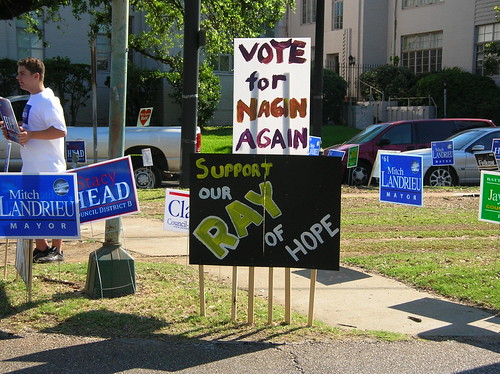
Ray of Hope

Nobody could have predicted there would be Katrina envy
A member of the Chicago Tribune editorial board is wishing for a "Hurricane Katrina" to strike and help clean up what she sees as her own corrupt city.

Kristen McQueary, who is an actual member of the Chicago Tribune's actual editorial board, met with Mayor Mitch Landrieu and somehow came away with the notion — well, I'm not sure what's more wrongheaded, that Katrina "fixed" things in New Orleans or that a Chicagoan would want the people of Chicago to go through something similar:
Envy isn't a rational response to the upcoming 10-year anniversary of Hurricane Katrina.

But with Aug. 29 fast approaching and New Orleans Mayor Mitch Landrieu making media rounds, including at the Tribune Editorial Board, I find myself wishing for a storm in Chicago — an unpredictable, haughty, devastating swirl of fury. A dramatic levee break. Geysers bursting through manhole covers. A sleeping city, forced onto the rooftops.
So that's kind of jarring.  But is it really all that different from what we've heard from conservative pundits like Ms. McQueary right from the beginning of the post-K ordeal?  The right wing campaign to use the deaths of some 1800 people as an opportunity to "fix things" in New Orleans is not a difficult thread to trace.

For instance, here is an article by New York Times columnist David Brooks published on September 8, 2005.  Its headline is, "Katrina's Silver Lining" 
As a colleague of mine says, every crisis is an opportunity. And sure enough, Hurricane Katrina has given us an amazing chance to do something serious about urban poverty.

That's because Katrina was a natural disaster that interrupted a social disaster. It separated tens of thousands of poor people from the run-down, isolated neighborhoods in which they were trapped. It disrupted the patterns that have led one generation to follow another into poverty.

It has created as close to a blank slate as we get in human affairs, and given us a chance to rebuild a city that wasn't working. We need to be realistic about how much we can actually change human behavior, but it would be a double tragedy if we didn't take advantage of these unique circumstances to do something that could serve as a spur to antipoverty programs nationwide.
Brooks goes on to recommend that a recovering New Orleans take as a model this social engineering experiment developed in (irony) Chicago. 
The most famous example of cultural integration is the Gautreaux program, in which poor families from Chicago were given the chance to move into suburban middle-class areas. The adults in these families did only slightly better than the adults left behind, but the children in the relocated families did much better.
So mere days after the storm, while flood waters are still actually draining out of the city, Brooks tells us that Katrina is an opportunity. It has provided us a "blank slate" to do "something serious about urban poverty."  And that serious thing we should do is move poor people out to the suburbs.  Scowl if you want but this was remarkably prescient. Especially for David Brooks.

At the same time that Brooks was writing that column, advice was also pouring in from libertarian think tanks like the American Enterprise Institute where tank thinker James Glassman could barely contain his enthusiasm for building "the ultimate libertarian city" upon our blank slate.
The inevitable commission that will oversee the rebuilding must realize that the world’s best designers, developers and innovators will be drawn to the city only if they are relatively unrestricted. New Orleans could become a laboratory for ideas like tax-free commercial zones and school reform. This is the ultimate libertarian city and the last thing it needs is top-down planning. Many of the city’s great attractions–the Jazz Festival, D-Day Museum and blackened redfish, for example–are of recent vintage.

I’m optimistic. New Orleans has a unique chance to make a fresh start and, in fact, become more like cities that do work (Chicago and Phoenix come to mind) while retaining its spirit of mystery, absurdity, beauty and decadence.
Brooks and Glassman were really proud of Chicago back then.  But now McQueary wants to "blank slate" it and start all over for some reason.  What the hell happened there?

In any case, such calls of opportunity did not go unheard locally.  They began to echo among our social and political leadership almost immediately.  Here is a quote from former Bring Back New Orleans Commissioner James Reiss I first read in September of 2005.
A few blocks from Mr. O'Dwyer, in an exclusive gated community known as Audubon Place, is the home of James Reiss, descendent of an old-line Uptown family. He fled Hurricane Katrina just before the storm and returned soon afterward by private helicopter. Mr. Reiss became wealthy as a supplier of electronic systems to shipbuilders, and he serves in Mayor Nagin's administration as chairman of the city's Regional Transit Authority. When New Orleans descended into a spiral of looting and anarchy, Mr. Reiss helicoptered in an Israeli security company to guard his Audubon Place house and those of his neighbors.

He says he has been in contact with about 40 other New Orleans business leaders since the storm. Tomorrow, he says, he and some of those leaders plan to be in Dallas, meeting with Mr. Nagin to begin mapping out a future for the city.

The power elite of New Orleans -- whether they are still in the city or have moved temporarily to enclaves such as Destin, Fla., and Vail, Colo. -- insist the remade city won't simply restore the old order. New Orleans before the flood was burdened by a teeming underclass, substandard schools and a high crime rate. The city has few corporate headquarters.

The new city must be something very different, Mr. Reiss says, with better services and fewer poor people. "Those who want to see this city rebuilt want to see it done in a completely different way: demographically, geographically and politically," he says. "I'm not just speaking for myself here. The way we've been living is not going to happen again, or we're out."
If you've followed this blog over the years you'll know I've never let it drop.  There I was hundreds of miles away still wondering what in New Orleans was left for me to come back to and already I could read about plans for a "new New Orleans" and who might be welcome back there.

And this became a regular theme among the city's well placed decision makers throughout the rebuilding process. Sometimes it would merely sit in the background as every NOLA Entrepreneur Week implicitly celebrated the replacement of the black middle class with younger whiter transplants and/or "volunteer entrepreneur" grifters. Or as the Cowen Intsitute or Leslie Jacobs regularly feted the firings of 7500 public school teachers.

Often, though, it was right out in the open. Shortly after the storm, Baton Rouge based Congressman Richard Baker expressed gratitude that "God" had finally "cleaned up public housing in New Orleans."

Pres Kabacoff might prefer Baker and God send some of the credit his way. Kabacoff hasn't minced words about the favors the flood did us either. For instance, there was the time he told us that poor people were a "drag on the city's economy" who needed to be moved out of the way of an "urban renaissance" led by his development company.   Or the time Kabacoff told us we didn't really want "the kind of people who if their refrigerator stops working their life falls apart" My fridge went out on me earlier this month.  If I hadn't managed to reset the motor myself, it would have been a pretty serious hardship. Maybe Katrina should have blown me out of here too.

It's not exactly clear what Ray Nagin meant in 2008 when he told a columnists' convention, "There is big money to be made in a storm."  Nagin eventually went to jail over relatively small beans. But Nagin did also spend a lot of time encouraging people to "buy some dirt" in post-Katrina New Orleans in anticipation of "this economic pie that is getting ready to explode."

These are things you might expect any cheerleading mayor to say.  Heck, they even turned out to be correct observations and sound investment advice.  But the boosterism in the wake of the disaster did jibe well enough with David Brooks's "silver lining" narrative to make the premise seem true to a lot of people.  Owen Courreges made a similar observation this week about Mayor Landrieu's own triumphalist rhetoric which has been burning at billion watt intensity all summer long.  
In his “State of the City” address given this past May, Mayor Mitch Landrieu boasted that New Orleans is “no longer recovering, no longer rebuilding.” Citing a laundry list of improved statistics, Landrieu continued: “It didn’t happen by accident. It is all part of our larger approach to government — cut, reorganize and then invest the savings in what matters most so we can grow.”
It's worth noting again that McQueary's "Chicago needs a Katrina" column was based on impressions formed during her audience with Landrieu.

Mitch isn't the only New Orleans ambassador sending these signals out into the world, though.  Here is a criminally lengthy and pretentious ESPN Magazine feature by Wright Thompson where we find the reanimated corpse of Chris Rose brought back down from the attic to share with us the following wisdom.
Since Katrina, life on the wealthy side of that fence has improved. The New New Orleans really is a safer, wealthier place with more responsible institutions. "Almost everything's better," Chris Rose says. "You know, it's the one thing that no one can speak. Nobody dares write it ... but how many people said, 'It's the best thing that ever happened to New Orleans.' Now, here's the problem: It was rich white people who were saying that when we weren't even finished burying our dead. We still hadn't even found our dead and people were saying that. Now, you look back and you gotta think about what it was like in 2005, our crime, our corruption, our police, our education. They're all better now. Would they have improved had we not had this intense, overwhelming catastrophe, which forced us to not only rebuild and recover and repopulate but also reimagine ourselves? Would that have happened? I think it's safe to say no."
The reason the lady in Chicago thinks Katrina is the best thing that ever happened to us is because our mayor basically told her that. The reason he thinks that is because a lot of his political allies as well as some subtly smug and selfish people like Chris Rose have told him that is what they believe also.

It's fine to call out McQueary's Katrina envy column as the obviously crass, insensitive, right wing propaganda that it is.  But don't overlook the fact that local Katrina pride is very much the same thing.