The threat of Louisiana’s colleges and universities having to shut down in the middle of the school year is mostly over, but the potential for painful cuts to student services remains as the Legislature continues its work to close the state budget shortfall.
The doomsday scenario was touted many times this past month by Gov. John Bel Edwards and higher education leaders, who warned severe midyear budget cuts to schools would result in institutions running out of payroll dollars by as early as April and May, and students being unable to finish the academic school year. If students were issued “incompletes” for the year, officials warned, it meant student-athletes, like LSU’s football team, would be ineligible for the following school year.
Showing posts with label higher ed. Show all posts
Showing posts with label higher ed. Show all posts
Tuesday, March 08, 2016
FYI, there will be LSU football
Crisis averted....
Thursday, February 18, 2016
Andy Kopplin's vision for UNO
Running it like a business
Can't wait to see UNO start pumping out the latest research on "super natural cows".
As state legislators grapple with a $2 billion budget gap for the next fiscal year, Kopplin said the school’s next leader will need to be creative about raising revenue. One possibility, he suggested, is reaching out to large businesses and corporations and developing partnerships that could support research at the lakefront school.It’s the only tool in the neoliberal box. There's never any social, political, or academic challenge we can't meet with a little determined public-private partnering and commercialization.
Can't wait to see UNO start pumping out the latest research on "super natural cows".
Crystal Brown, a communications representative from the University of Maryland, explained that the chocolate milk study was funded through the Maryland Industrial Partnerships program, a collaboration between the university and "commercial entities for economic development across the state of Maryland." The idea behind the program is to foster job creation through industry and university collaborations, according to Brown.The last UNO president was tasked with overseeing the dismantling of the public institution. It only makes sense that the next guy's job will involve selling off the parts.
As it turns out, the maker of Fifth Quarter Fresh chocolate milk — which comes from a dairy cooperative in Hagerstown, Maryland — funded 10 percent of the study, and the university funded the rest.
So here we have a milk manufacturer working in partnership with the University of Maryland to fund a sloppy study, and the university then blasts the results, persuading schools and the press that this milk works wonders on students' brains.
Friday, January 29, 2016
Most underreported story in New Orleans
The long decline of UNO.
For a half-century after its founding in 1958, UNO offered generations of middle-class New Orleanians an affordable pathway to a four-year college degree. But it has fallen on hard times during the past decade, beginning with the damage caused by 2005’s Hurricane Katrina and continuing with deep budget cuts and admission requirements that have seen its student body shrink by half.That's a lot of dismal evisceration of programs and firing of people and whatnot. It takes a real hero to accept the $325,000 salary plus perks such as a house and car to be the hatchet man in that scenario. Luckily, Peter Fos was available and willing.
Like its peers, UNO got few favors from former Gov. Bobby Jindal’s administration. Over the past eight years, UNO’s state support has shrunk by more than half, from $74 million in 2008-09 to almost $33 million in 2014-15. The school’s overall budget has been cut by about 20 percent over that span, to $102 million.
Enrollment has followed a similar downward trajectory, from 17,142 students registered pre-Katrina to just 8,423 last fall — UNO’s smallest class since 1967. Over that time, UNO has gone from being the state’s second-largest four-year school to its seventh-largest.
It wasn’t long before he faced his first budget challenge: In his first year, the state cut its support by more than $9 million. Then, the new admission requirements took effect, further reducing an already low enrollment. He estimates that about 750 students could no longer enroll at UNO in fall 2012.Layoffs and people taking on more work without compensation. Meanwhile, Fos pads his retirement savings. But somehow he can't imagine a "worse scenario" for himself. Who would even want that job now?
“You couldn’t have planned a worse scenario for me, to be honest with you,” he said.
To cope with less revenue, Fos made a number of controversial cutbacks, deep-sixing academic programs, eliminating hundreds of jobs and closing a popular on-campus day care center.
Mostly through attrition, UNO’s faculty has shrunk considerably, from 199 professors in 2005 to 91 professors in 2015.
As colleagues left and weren’t replaced, faculty members who stayed had to pick up added responsibilities — including teaching more classes — after going years without a raise.
New Orleans Deputy Mayor Andy Kopplin is among five candidates under consideration to lead the struggling University of New Orleans. The group also includes several university provosts, including UNO’s.Makes sense. For one thing, it's one of the few jobs available in town that would represent a pay raise for Kopplin. Plus his Teach For America experience shows he knows what it takes to separate tenured education professionals from their jobs. Add to that the fact that the university presidents end up making almost as many municipal administrative decisions in New Orleans as the Deputy Mayor does and you can see why this is a good fit.
Kopplin has served as the city’s first deputy mayor and chief administrative officer since Mayor Mitch Landrieu took office in 2010. Before that, he spent two years as a senior adviser at Teach for America and two years as executive director of the Louisiana Recovery Authority, the state agency tasked with leading the state’s recovery after Hurricanes Katrina and Rita in 2005.
Thursday, April 23, 2015
Just grifting
Quick follow-up on this from yesterday. In light of the fact that Bobby Jindal has intentionally wrecked several arms of the state government specifically in order to sell the scraps to well-placed friends, it's really no surprise that this would be what's happening to the university system now.
Consider this bit that got little notice last year about this time.
Consider this bit that got little notice last year about this time.
WASHINGTON -- Gov. Bobby Jindal didn't disclose in his newspaper column this week supporting for-profit colleges in their fight with the Obama administration that his brother, attorney Nikesh Jindal, represented the schools' association in an earlier legal fight with the administration.Side note of little importance: I found that digging through my own Jindal-tagged archives. People ask me why I still bother to type on this blog even though we have the Tweeter tubes and the Parallel Facenet for kvetching. The answer is because this is still the best way to bookmark and annotate for future reference. And you never know what you might want to remember having noticed. If I didn't post things here, I might never remember anything that happens.
The governor's spokesman said Nikesh Jindal's connection to the for-profit colleges isn't significant given that the Republican governor has for a very long time advocated for more choice and competition in education, both in primary and higher education.
But critics of the for-profit schools who contend they garner a disproportionate amount of federal education aid without providing quality education, said the governor should have been up front about his family connections.
Wednesday, April 22, 2015
Jindaled
Just selling it all off. It's what he does.
To say the least, it's been fun. But before you get too mad, remember he's only done exactly what he said he would do.
They're only going to do him more favors as the session goes on.
While neither Jindal nor any legislator has dared breathe the word privatization as it regards the state’s colleges and universities, at least one Jindal appointee, Board of Regents Chairman Roy Martin of Alexandria, has broached the subject, speaking he said, strictly as an individual. http://theadvocate.com/news/11716059-123/regents-look-at-privatizing-publicAnd if you've been paying even the slightest attention to Jindal's privatization of Medicaid, or his handling of the state Office of Group Benefits, or several other items he's placed out on the lawn for sale, you'd probably recognize this pattern by now.
The slashing of higher education budgets appears to be a pattern as governors attempt to wean colleges and universities from dependence on state funding, transitioning their status from state-supported to state-assisted to state-located. http://www.usnews.com/news/articles/2015/02/27/scott-walker-bobby-jindal-aim-to-slash-higher-ed-funding
Privatization of state colleges and universities would, of course, push tuition rates even higher, making a college education cost prohibitive for many. But that dovetails nicely with the ALEC agenda as income disparity continues to widen with ever more generous tax laws that benefit the super-rich while placing growing burdens on lower-income taxpayers. By winnowing out those who can least afford college, privatization necessarily enhances the selection process to serve the elite and at the same time, opens up additional revenue opportunities for those in position to take advantage of privatized services such as book stores, printing, food services, and general maintenance. http://gse.buffalo.edu/FAS/Johnston/privatization.html
There is already a backlog of nearly $2 billion in maintenance projects on state college and university campuses just waiting for some lucky entrepreneur with the right connections.
http://theadvocate.com/home/5997316-125/backlog-of-maintenance
To say the least, it's been fun. But before you get too mad, remember he's only done exactly what he said he would do.
When I campaigned for governor seven years ago, I promised to make the government smaller and the economy larger. That’s exactly what I have done. We cut taxes and reduced the size of government. In fact, the government is smaller by more than $9 billion and 30,000 workers.People fired. Government "smaller" as in, government sold off to cronies and/or left to rust away in limbo. Sucks to be us, I guess. But as the GOP primary heats up, don't be too shocked when Jindal starts to get credit for his strong conservative "policy ideas."
Jindal, an Ivy League-educated conservative known for his policy ideas, has already been in Iowa twice this month and returns Saturday for the Iowa Faith & Freedom Coalition spring dinner. He has been working hard to court Christian conservatives here, saying at a Des Moines event in January that it's time for the country to "turn back to God."He's got that God cred too, by the way. The legislature had his back on that this afternoon.
Senate Education votes 4-3 against repealing La. Science Education Act. Chairman Appel cast tie-breaking vote to defer the bill. #lalege
— Melinda Deslatte (@MelindaDeslatte) April 22, 2015
They're only going to do him more favors as the session goes on.
Jindaled
They're doing great things in Baton Rouge, theses days.
Being in a state of financial exigency means a university's funding situation is so difficult that the viability of the entire institution is threatened. The status makes it easier for public colleges to shut down programs and lay off tenured faculty, but it also tarnishes the school's reputation, making it harder to recruit faculty and students.Can they do anything about it? Well, they're trying to see if they can raise fees and tuition again. So at least the disintegrating university will also be unaffordable. Nice going.
"You'll never get any more faculty," said Alexander, if LSU pursues financial exigency.
Alexander's comments came on the same day that Moody's announced it was downgrading LSU's credit outlook from positive to stable, based on concerns about the the university's ability to borrow money. A downgrade is LSU's credit rating will make it more expensive to borrow money for campus building projects.
Monday, March 30, 2015
Jindaled
It's been fun.
NEW ORLEANS -- LSU's president is laying out a doomsday budget that could result in class cancellations and program cuts.It's OK if you're Bobby, though. You probably meant well.
Dr. F. King Alexander told the New Orleans Press Club that the Baton Rouge campus is looking at a possible 82 percent state budget cut.
"This is a pretty precarious time for LSU and higher education entirely in Louisiana," said Alexander.
Alexander is touring the state, drumming up support for higher education funding.
Gov. Bobby Jindal's proposed state spending plan for the next fiscal year takes more than $500 million away from state colleges and universities to help plug a $1.6 billion budget hole.
That's an $80 million cut in state funding for LSU. Dr. Alexander said that could force LSU into bankruptcy, leading to faculty layoffs, tuition increases and 2,000 classes being canceled.
Monday, March 23, 2015
The Xanax State
The annual LSU public policy research opinion survey is out. It might be worth your time to look through seeing as how this is a big election year and all. Although a lot of the findings are kind of bland. Or, at least, they don't indicate any particularly eye-popping trend.
If anything, they tell us that Louisiana residents are pretty blase about the state's numerous problems.
For example, this is from NOLA.com's summary.
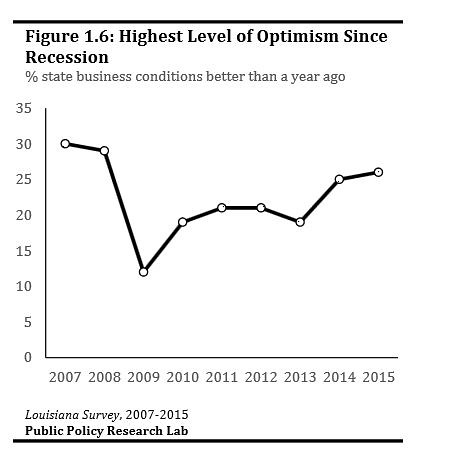
The rest of the survey goes on like that. There are slight, predictable differential opinions about the way things are going according to party. There are indistinguishable, difficult to interpret changes in degrees of "optimism" and "confidence" over a year ago. Here's one that looks to me like people may be beginning to sense the light at the end of the Jindal.

Beyond that, the survey appears to indicate that respondents, who can barely make up their minds as to whether Louisiana is on the "right or wrong track," are more or less unbothered by the state of some of our most crucial issues.
For example, here is a list of issues respondents say they are concerned about.
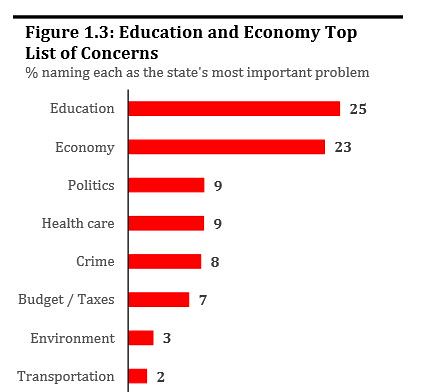
I get that "environment" is kind of a nebulous term with certain hippie-dippie connotations. But, in Louisiana... particularly in South Louisiana, our most pressing existential dilemmas are environmental issues. Strange that it would be so low a priority.
"Education" is another vague term, but a more inclusive one in terms of public opinion. It serves as a replacement for actual thought about whatever the issue might be. It's also a placeholder for people who either have no solid opinions on specific issues.. or people who choose not to share them. Everybody likes to say "education" is important even if they don't know why you're asking them about it.
Which is how we can get a result like this where "education" leads the list of concerns in a state whose public universities are facing a severe budget crisis. This morning LSU President King Alexander told the Baton Rouge Press Club that the Governor's proposed cuts are so severe that the university would, "have to furlough everybody for the entire year,” in order to meet the budget.
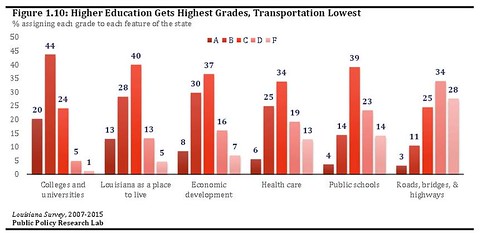
And, yet, the "optimistic" respondents to the survey are pretty pleased with higher ed in Louisiana. They give our underfunded colleges and universities mostly "As" and "Bs."
We hit something of a milestone late last year when the state unemployment rate exceeded the national rate for the first time since before the recession. We also barely noticed.
The survey writers also point to slight regional discrepancies in "optimism."
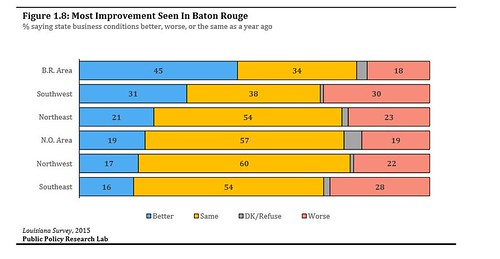
They seem pretty happy in Baton Rouge, though. Looking at that, you'd never guess there was a whole secession movement afoot there.
So, hey, Heckuva Job, Louisiana. The southern half of the state is melting into the ocean but we've barely noticed. Our one-horse petrochemical driven economy is stalling but we're pretty cool with it. We really care about "education." And we really like our universities. Bobby Jindal is about to sell them all off for campaign yard signs but our "confidence" and "optimism" are on the rise. Louisiana must be the Xanax State.
I'm not sure what this means for the election this year. I had David Vitter as the odds-on favorite but it turns out he might be a little too spicy for our tastes.
If anything, they tell us that Louisiana residents are pretty blase about the state's numerous problems.
For example, this is from NOLA.com's summary.
Louisiana residents are relatively split on whether the state is headed in the right direction, according to LSU's annual survey of Louisiana citizens.Are we doing ok? Louisiana residents are decidedly meh about it.
About 44 percent of people contacted by LSU thought Louisiana was on the right path. Around 45 percent thought the state was headed in the wrong direction, according to the recent Louisiana survey.
Overall, the number of people who think Louisiana is headed in the right direction has grown over the last two years. In 2014, more people thought Louisiana was headed in the wrong direction, than in the right direction. But Louisiana residents appear more optimistic about the state this year.
The rest of the survey goes on like that. There are slight, predictable differential opinions about the way things are going according to party. There are indistinguishable, difficult to interpret changes in degrees of "optimism" and "confidence" over a year ago. Here's one that looks to me like people may be beginning to sense the light at the end of the Jindal.
Beyond that, the survey appears to indicate that respondents, who can barely make up their minds as to whether Louisiana is on the "right or wrong track," are more or less unbothered by the state of some of our most crucial issues.
For example, here is a list of issues respondents say they are concerned about.
I get that "environment" is kind of a nebulous term with certain hippie-dippie connotations. But, in Louisiana... particularly in South Louisiana, our most pressing existential dilemmas are environmental issues. Strange that it would be so low a priority.
"Education" is another vague term, but a more inclusive one in terms of public opinion. It serves as a replacement for actual thought about whatever the issue might be. It's also a placeholder for people who either have no solid opinions on specific issues.. or people who choose not to share them. Everybody likes to say "education" is important even if they don't know why you're asking them about it.
Which is how we can get a result like this where "education" leads the list of concerns in a state whose public universities are facing a severe budget crisis. This morning LSU President King Alexander told the Baton Rouge Press Club that the Governor's proposed cuts are so severe that the university would, "have to furlough everybody for the entire year,” in order to meet the budget.
And, yet, the "optimistic" respondents to the survey are pretty pleased with higher ed in Louisiana. They give our underfunded colleges and universities mostly "As" and "Bs."
We hit something of a milestone late last year when the state unemployment rate exceeded the national rate for the first time since before the recession. We also barely noticed.
The survey writers also point to slight regional discrepancies in "optimism."
Perceptions of economic trends partly reflect the conditions residents face in different parts of the state. For example, residents of the Baton Rouge area tend to take the most optimistic view of state business conditions (see Figure 1.8). Residents of southwest Louisiana – with a regional economy especially sensitive to the rise and fall of oil prices– have far more mixed assessments.But, okay. Look at the chart they're talking about. Even "oil sensitive" Southwest Louisiana is pretty evenly split between better or worse with "meh" still holding a plurality.
They seem pretty happy in Baton Rouge, though. Looking at that, you'd never guess there was a whole secession movement afoot there.
So, hey, Heckuva Job, Louisiana. The southern half of the state is melting into the ocean but we've barely noticed. Our one-horse petrochemical driven economy is stalling but we're pretty cool with it. We really care about "education." And we really like our universities. Bobby Jindal is about to sell them all off for campaign yard signs but our "confidence" and "optimism" are on the rise. Louisiana must be the Xanax State.
I'm not sure what this means for the election this year. I had David Vitter as the odds-on favorite but it turns out he might be a little too spicy for our tastes.
Tuesday, July 22, 2014
While they still exist anyway
If you look around you'll notice that the notion of affordable public higher education is almost at thing of the past. Which leaves us with the feudal system described in this article. But if you happen to be an elite brat afflicted with a conscience, the author offers advice.
Is there anything that I can do, a lot of young people have written to ask me, to avoid becoming an out-of-touch, entitled little shit? I don’t have a satisfying answer, short of telling them to transfer to a public university.
Monday, February 17, 2014
Workforce development
The content providers at NOLA.com must have patted themselves on the back this weekend for creating yet another attention-grabbing headline.
Bobby Jindal isn't the only governor focused on workforce development
The item below the banner declaring Jindal's "focus" was less an article than it was a lazy blog post linking Jindal's recent attempt to pass off a $90 million rise in tuition and fees paid by students at Louisiana's public colleges as some sort of investment in higher ed. Maybe the NOLA.com content elves should read their own website more thoroughly.
Or they could read The Advocate where the consequences of the higher ed funding crisis were reported this morning. UNO is looking at probably 30 or so more layoffs this year.
Bobby Jindal isn't the only governor focused on workforce development
The item below the banner declaring Jindal's "focus" was less an article than it was a lazy blog post linking Jindal's recent attempt to pass off a $90 million rise in tuition and fees paid by students at Louisiana's public colleges as some sort of investment in higher ed. Maybe the NOLA.com content elves should read their own website more thoroughly.
Or they could read The Advocate where the consequences of the higher ed funding crisis were reported this morning. UNO is looking at probably 30 or so more layoffs this year.
The move is one of a slew of cost-cutting maneuvers Fos has instituted since he took the reins as the school’s president in January 2012.As institutions like UNO wither, fewer Louisianians of moderate means have access to quality higher education. But, according to the headlines, "Bobby Jindal is focused on workforce development" and "Increased higher ed funding" As long as we're cribbing our headlines from Jindal's own press releases, I guess this will always be the case.
Since then, he has cut a total of 90 staff positions, closed a children’s center and convened a committee of faculty and administrators to assist in finding upward of $6 million in savings.
The university has also been raising tuition. Full-time undergraduates from Louisiana currently pay $6,566 a year, which is about $2,300 more than they did in 2008.
The measures have not been enough to counteract UNO’s dwindling enrollment and state funding.
The school’s enrollment has been nearly sliced in half over the last decade, falling from 17,360 in 2003 to 9,323 in 2013.
Meanwhile, funding from the state has plunged from $56 million in 2008 to $32 million in the current fiscal year.
Wednesday, January 22, 2014
Every university is an oil and gas vo-tech
Jindal slashes hundreds of millions of dollars from Louisiana higher ed over a period of years. Comes back in his final year in office and offers a portion of those cuts back.. sort of.. but with strings attached.
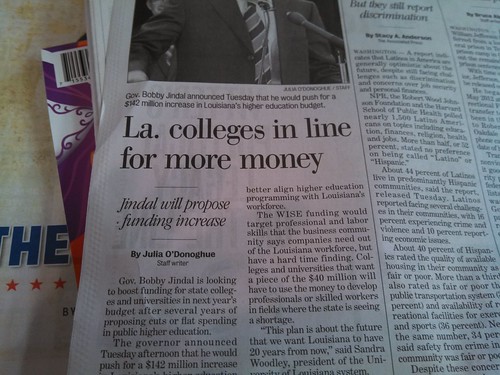
Technically, kind of true. Except that they're actually in line for about a fifth of what Jindal already cut from them.
Here's The Advocate.
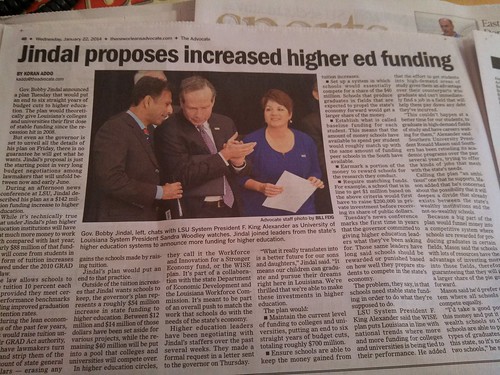
Again, just not at all descriptive of what's actually happening. Although admittedly an improvement over the headline it ran under online yesterday which was, "Jindal plans to pump $140 million into higher ed" The vestigial URL still exists
http://www.theneworleansadvocate.com/home/8159732-172/gov-jindal-plans-to-pump
Although the text has been changed. But it does tell you a little about how they think.
After several years of inflicting cuts, Bobby Jindal is set to increase state higher education funding in next year's budget. The gov announced Tuesday that he is set to propose a $141.5 million increase in state-run colleges and universities for next fiscal year, which marks a 6.66 percent increase for 2013-14. More than a quarter of that money will go toward a program that provides money to colleges to partner with private industry, and implement workforce training programs for jobs in Louisiana's biggest economic sectors like oil & gas and manufacturing.How did they find the money for their private-public vo-tech program? Simple, they raised the price families pay to send their kids to college.
While it’s technically true that under Jindal’s plan higher education institutions will have that much more money to work with compared with last year, nearly $88 million of that funding will come from students in the form of tuition increases allowed under the 2010 GRAD Act law.In other words, the best way to describe this plan is it is a tax increase on college students applied to helping the petrochemical companies operating in Louisiana train their workers. Here's how the Times-Picayune describes it in their headline.
The law allows schools to raise tuition 10 percent each year provided they meet certain performance benchmarks including improved graduation and retention rates.
But during the lean economic times of the past few years, schools would raise tuition under their GRAD Act authority, only to have lawmakers turn around and strip them of the same amount of state general fund dollars — erasing any gains the schools made by raising tuition.
Jindal’s plan would put an end to that practice.
Technically, kind of true. Except that they're actually in line for about a fifth of what Jindal already cut from them.
Here's The Advocate.
Again, just not at all descriptive of what's actually happening. Although admittedly an improvement over the headline it ran under online yesterday which was, "Jindal plans to pump $140 million into higher ed" The vestigial URL still exists
http://www.theneworleansadvocate.com/home/8159732-172/gov-jindal-plans-to-pump
Although the text has been changed. But it does tell you a little about how they think.
Thursday, July 11, 2013
Self flagellation
The Lens may be looking at this the wrong way. (Ha!) Given everything they've done to wreck the university itself, maybe the LSU board members are just trying to minimize the value of this political perk they're burdened with.
Occasional airing of the greivance
While they're busy figuring out how they're going to cut faculty, staff, and benefits more drastically, do our university presidents have anything else to do? I mean, besides determine who runs every department in the city, of course.
Details of the plan include:
- Reducing the board membership from 13 to 11 seats by eliminating three reserved for council members, some of whom in the past have meddled with the contracting process, and adding an eighth mayoral appointment. The mayor, who serves as board president, and two appointments from the Board of Liquidation, City Debt, the city's debt manager, will round out the final three seats.
- Reducing members' terms from nine years to four and limiting them to two, consecutive terms. Current board members' terms will expire as soon as their replacements are appointed.
- Creating a selection committee comprised of local university presidents and business leaders that will offer a list of three nominees for each future vacancy from which the mayor can choose an appointment.
- Mandating that the mayor appoint at least one board member from each of the city's five council districts and that membership reflect New Orleans' gender and racial makeup.
- Requiring the S&WB provide quarterly reports on its contracts to the council.
Wednesday, July 10, 2013
Bubble bursting
I don't know but I suspect the sudden enrollment problem at Loyola may be the tip of the iceberg.
Maybe Scott Cowen got out while the getting was good.
Loyola University is facing a $9.5 million budget shortfall for its next fiscal year because the number of students enrolling in the college next month is about 30 percent below the expected total, officials said Tuesday. In an attempt to reduce the deficit, Loyola President Kevin Wildes, S.J., said a hiring freeze will start Aug. 1 and voluntary severance and early-retirement packages will be offered.The universities are major employers in New Orleans. This is going to affect a lot of people. And their operations are highly dependent on various forms of credit and subsidy much of which is drying up with negative effects becoming more and more evident.
Other possible budget options, he said, include hiring temporary employees to reduce the amount Loyola would have to spend on benefits, drawing down more from the endowment interest -- a move that would require approval from the board of trustees -- and reducing the time some employees work, with some going from 37½ hours a week to 30 hours a week and others going from 12 months a year to 10 months.
Maybe Scott Cowen got out while the getting was good.
Subscribe to:
Posts (Atom)