-->
Showing posts with label privatization. Show all posts

Friday, November 15, 2024

Maybe don't run your smash and grab privatization scheme through a nesting doll of pass through grifters

Nevermind. Actually, if you're already stripping the public education system for parts, it's only natural to have as many trucks hauling it off in as many different directions as possible.

The Louisiana Legislature has agreed to pay a private company $910,000 to oversee the rollout of the state’s new school-choice program, which is set to launch next year. 

The Joint Legislative Committee on the Budget voted overwhelmingly Friday to approve a one-year contract with Odyssey, a company founded in 2021 to help states manage grant programs like the one Louisiana lawmakers approved last spring that will give households tax money to put toward private-school tuition.

The tech start-up picking up this contract is pretty much your typical middleman arbitrage operation. Back in August, we learned, that it also comes with the typical... uh.. glitches? Let's call them that for now. 

During Tuesday’s board meeting, BESE members asked about reports of problems with Odyssey-operated grant programs in other states.

For example, in Missouri, parents have complained about delays in receiving grants and problems purchasing items through the company’s platform, according to the St. Louis Post-Dispatch. In Idaho, a state review found that Odyssey approved about $180,000 in ineligible purchases by families, according to Idaho Education News. And in Iowa, the state auditor found that the education department had improperly amended Odyssey’s contract to increase payments to the company.

Not that it matters at this point.  The "smash" part of this already occurred when the legislature approved the ESA scheme to drain all the money out of public schools.  The "grab" part is just.. the grabbing.

Saturday, August 07, 2021

Congratulations?

It now looks like they are (probably) going to pass the bi-partisan infrastructure-privatization bill.  Hooray? 

While it's nice to think they might move ahead with putting some money into highways and bridges and water systems, there are fundamental problems with the way this bill would deliver such projects. We talked a little bit about that the other day and I'm sure there will be plenty opportunities to bring it up again once the consequences become apparent.  But at the moment most commentators are skipping over those details to raise questions about the process.   Like, for example, what was even the point of all this?

What may appear to be an imminent victory for bipartisan deal-making was in fact a drawn-out demonstration of how broken the Senate is as an institution. The Senate (with the White House’s support) wasted months cajoling and rehabilitating a handful of key Republicans only to pass a smaller version of something Democrats could theoretically have passed entirely on their own. Moving the bill forward only looks like a victory if one accepts the sclerosis and dysfunction of the Senate as a natural obstacle to be overcome with cunning and patience, not a self-imposed limitation on effective and responsive governance.

They could have chosen to just put all of the "infrastructure" through reconciliation and be done with it.  Instead they stripped out all the best parts and put those on a shelf that they promise...really.. fingers crossed and all... to pass right after they get this shitty thing through and pretend it's an accomplishment. 

What incentive do either of the famous trouble-Dems Sinema and Manchin have to pass the reconciliation bill now, though?  I have no idea.  Neither of them has committed to it. And then, of course, there are the labor and voting rights items the whole future of this congress and Presidency rest upon still sitting out there to be taken up later.  Does anyone think any of that is going to get done now?  I'd love to hear how.

Sunday, March 18, 2018

What did the mayor know and when did he know it?

Well, if he read the reports...
A consultant found 17 Sewerage & Water Board pumps and two power turbines out of service last May, months before heavy rains in July and August caused widespread flooding in New Orleans. Outlined in a draft report presented Wednesday (March 14), the inspectors' findings reinforce the notion that agency officials had recourse to be aware of startling problems facing the utility's drainage system prior to the summer floods.
Maybe they didn't put it in bold face on the front page or something.  Or maybe he wasn't at the meeting that day.   There's a bill in the legislature that is supposed to address that problem. 
If passed, the bill would return a City Council member to the board, require either New Orleans' mayor or the city's chief administrative officer to attend board meetings and tighten rules on quarterly reports submitted by the utility to the council. Its author, state Sen. J.P. Morrell, D-New Orleans, says it's high time for more accountability over Sewerage & Water Board's top ranks after flooding last summer revealed severe deficiencies in the utility's power and drainage systems.
Ok but you do have to wonder how they enforce that. Maybe it involves the threat of house arrest

Also it's worth pointing out that this is a partial walk back of the very S&WB reforms Morrell and the New Orleans delegation pushed through only a few years ago at the Mayor's urging. Last year, those reforms were called into question in The Lens by Jacques Morial which prompted a response from Morrell defending them.

So this new bill indicates J.P. agrees something needs to change, at least.  It doesn't go far enough unless it takes the damn university presidents out of the selection process. To this day, I still have no idea why these professional fundraisers get a say in so many local governance issues.  In any case, there's more than one S&WB issue that needs to be addressed.
The utility has previously said the drainage system is short more than $50 million in projected brick-and-mortar costs, while an estimated $80 million in emergency work is rapidly drawing down cash reserves. Black & Veatch's report accounts for a roughly $82 million shortfall by 2021. To help mend the gap, the utility's board of directors last month began the process to secure a bond sale to finance $27 million for drainage improvements.
Not sure what sort of reform the next mayor might put forward to deal with that.  Maybe we should ask the co-chair of her transition's infrastructure committee
Troy Henry and Bruce Thompson co-chair an infrastructure committee made up of four subcommittees: a subsurface committee looking at Sewerage & Water Board systems, a surface committee looking at roads and bridge, and committees looking at transportation and the implementation of a citywide water management plan.
Certainly Troy has all sorts of interesting ideas
Nevertheless, Troy Henry, the southern regional manager of United Water, is convinced that private water providers can do a better job than public utilities. He readily admits that his company and Atlanta city managers have had problems “dealing with the complexities of the system” in Atlanta and says the company is spending “multiple millions of dollars [to] win back the citizens’ and mayor’s confidence.” A biomedical and electrical engineer and former manager at IBM, Henry argues that private companies can do for water delivery what Big Blue did for computing — revolutionize technology and attract “the best and the brightest and most talented people.”

Saturday, December 16, 2017

Thank God the "Not For Sale" side won

Otherwise, we might start to worry that this unfortunate privatization business might not be behind us. 
On Thursday, a selection committee of Sewerage and Water Board officials nixed the firm that sent in the lone proposal, Metairie-based ECM Consultants Inc., because it fell short of the 25-year minimum experience requirement. ECM, records show, first registered with the secretary of state's office in 1995 - leaving it three years short.

As such, committee members - on motion from interim superintendent Bruce Adams - unanimously vetoed the proposal and decided to kick the contract solicitation back to the agency's board of directors, though one member remarked that she was "incredibly impressed" by the proposal.

Ordinarily, we'd want to keep an eye on this. S&WB leadership is very much in flux at the moment and just because they said no to ECM's "staff augmentation" proposal this week doesn't mean they are opposed in principle. And a lot of things can change five months from now when the new mayor takes over.  Thankfully for us, though, the good guys won the election and the new mayor can't possibly be seen as someone who might owe ECM any favors or anything like that. 

Thursday, December 07, 2017

Saturday, October 28, 2017

Running it like a bidness

It turns out privatizing the Sewerage and Water Board operation is not too hard to do so long as you keep saying over and over that you aren't privatizing the Sewerage and Water Board. 
WWL-TV asked the mayor about these privatization concerns in August, back when he first hired the current Emergency Management Team.

“We are not privatizing the Sewerage and Water Board,” Landrieu said on Aug. 16. “Now, people have a lot of ideas about what that is. Public-private partnerships equal that for some. I'll let them argue about that.”

Landrieu also was very clear that any contracts for outside management would be temporary, nothing beyond his term that ends in May 2018.

“What I need to do is bring in some really strong people to stabilize it and then work through what's going to happen next with the other folks. But I'm not going to bind the next mayor and next administration,” Landrieu said.

Malek-Wiley said Landrieu is going back on that promise with this request for proposals from contractors.

“You're talking about six months to three years,” he said. That sounds like tying the hands of anybody and the council into the future.”

Did the neoliberal ideology ever really go out of style in New Orleans?  One would be hard pressed to prove the case.  The branding is a bit different now which seems to satisfy some credulous observers. For example, it was six years ago, during the nadir of Naginism, that Clancy DuBos declared the Era Of Running Government Like A Business officially over.
Don't try to run government like a business. This is a lesson for us all. Businesses are dictatorships; our government is a democracy. The two are not designed to work the same way. The next time you hear some puffed-up businessman saying we should run government like a business, remind him that Greg Meffert and Mark St. Pierre were successful businessmen — and ask him if he likes how they ran things. If nothing else, we now know the danger — and the folly — of running government like a business.
Despite the danger and the folly and such, we forged right on ahead anyway. It turns out you can continue right along subverting the deliberate and transparent democratic process with only the slightest bit of re-branding.  Enter the era of the "public-private partnership."
August 13, 2010

New Orleans, LA - Mayor Mitch Landrieu today announced appointments to the NOLA Business Alliance board and launched the city’s first-ever public-private partnership for economic development, a structure that will deliver unprecedented coordination for economic development across the city.

“This is a landmark step for our city,” said Mayor Landrieu.  “For the first time, both the public and private sector will partner in a single coordinated effort to deliver new jobs and economic opportunities for this city.  And we will facilitate economic growth by linking government, the private sector and the nonprofit sector while leveraging our resources.   It’s another step in our goal to restructure and transform city government by implementing best practices that improve our quality of life.”

Studies by both the RAND Corporation and the International Economic Development Council demonstrated that a transformational structural change was needed in the City to improve the effectiveness of our economic development efforts. 
 
To that end, a new corporation named the NOLA Business Alliance was formed to serve as the official public-private partnership entity.  NOLA Business Alliance is governed by a 17-member board of directors of which seven (7) seats originate from the public sector, seven (7) seats from the private sector, and three (3) seats from non-governmental organizations.
That press release puts Mitch's name on The Business Alliance, but it's important to note the process that birthed it really started back with Nagin. The change from Nagin to Mitch is falsely described in media as a turning point of the post-Katrina period.  In fact there is a traceable continuity of governing philosophy that runs straight through the entire period with many of the same players calling the shots along the way. Under the Nagin and Landrieu administrations, the public-private model was applied to practically any governmental function we can name.  A few examples:

Mitch's NOLA For Life initiative
Aside from vague explanations, it’s difficult to determine precisely how and why 23 recipients of the money were selected out of 64 applications. Applicants with experience were rejected while new groups were awarded grants. And one politically influential recipient of the highest-level grant of $40,000 hasn’t followed through on other city and state grants it was awarded several years ago — nor did it provide required financial information in its grant application.

The public could be forgiven for thinking this is a public grant process.

Landrieu and other city officials initially took credit for securing a $1 million donation from Chevron to finance the grants, and they promised to contribute another $250,000 at the city’s disposal. But the administration and Chevron say the company’s donation was a private transaction with the foundation — the company said Landrieu’s acceptance of the donation on stage was “ceremonial” — and there’s no official pledge to donate city money to the effort. Therefore, the city said, how a private foundation chooses to make grants from a private donation is not subject to state sunshine laws or Landrieu’s own reform procedures, put in place his first days in office.
Mitch's Office of Technology
Still, the foundation’s work goes on largely outside the usual scope of accountability, even though documents abundantly demonstrate a working relationship between the foundation and city officials in the Office of Information Technology and Innovation.

The official line from City Hall is that the foundation isn’t working for the city.

“The New Orleans Police and Justice Foundation is not signing a contract or doing business on behalf of the city,” said Landrieu spokesman Berni, speaking on the proposed Sierra contract before it was scuttled.

Sidney Torres in a number of capacities, but most notably with regard to policing.
A $75,000 donation from developer and hotelier Joseph Jaeger will help keep the off-duty New Orleans police officers of the French Quarter Task Force on patrol through the month June.

"What Mr. Jaeger has done is not just an act of generosity, but also leadership," task force founder Sidney Torres IV said in a release announcing the donation. "This is exactly the kind of support this program and our city need in order to tackle the crime problem."
Housing in all sorts of ways.
The Housing Authority of New Orleans's first experience with the public-private partnership model came when HRI converted the St. Thomas housing development into the River Garden neighborhood in 2004, anchored by the city’s first Wal-Mart.

HANO then began regularly leasing its complexes to private developers under a plan that was speeded up following Katrina, when many hundreds of units were flooded and otherwise damaged.

After Katrina, HANO demolished its Big Four projects — C.J. Peete, St. Bernard, Lafitte and B.W. Cooper, which accounted for about 60 percent of public housing in the city — in order to make way for new housing models. In some cases, by 2015, fewer than half the new units had rents comparable to those in public housing. Some were market-rate, and others were in-between.

As subsidized units declined, the number of housing vouchers for privately owned apartments rose — as did the waiting list for people waiting to get them.
Replacing the "Big Four" incorporated a trick from even further back that became a staple of post-K housing policy.  
Several other builders had tried to develop the American Can project but failed to come up with the necessary financing. Mr. Kabakoff used public-private partnerships to finance the deal. His first mortgage consists of $29 million in tax-exempt bonds from the State of Louisiana's private activity bond cap program. The program mandates that 20 percent of the housing units be set aside for low-income renters.

How did that one turn out?

Look, there are a lot of these. They touch on practically every aspect of government; transit, drainage, pretty much anything where there's been a surplus of public money available to be vacuumed up by a contractor, a startup, or a non-profit  with minimal transparency or oversight.  Basically no service is worth providing for people if it doesn't help some third party get rich in the process. Here is a fun one where Paul Rainwater helped Bobby Jindal kill rural broadband access.
But, while noting that it was the Board of Regents that applied for the grant, Commissioner of Administration Paul Rainwater said that, "from the start, we've always said there were implementation and sustainability problems in the grant that had to do with a top-down, government-heavy approach that would compete with and undermine, rather than partner with, the private sector and locals."
And now Rainwater is playing a prominent role in the privatization plans at Sewerage and Water Board. Brand it whatever you like. After all this time, we're still stuck on the notion of running government "like a business" for the benefit of businesses and the political people connected to those businesses.

The latest version of that brand depends heavily on the coolness cache of the tech industry. For today's futurist-utopian progressives, selling out the fundamentals of democracy to corporate "partners" has never been more cutting edge.  Evgeny Morozov has written extensively about the interplay between the tech industry and modern neoliberal politics.  This recent column comments on Alphabet (Google) and its dabblings in urban design and management. 
Alphabet’s long-term goal is to remove barriers to the accumulation and circulation of capital in urban settings – mostly by replacing formal rules and restrictions with softer, feedback-based floating targets. It claims that in the past “prescriptive measures were necessary to protect human health, ensure safe buildings, and manage negative externalities”. Today, however, everything has changed and “cities can achieve those same goals without the inefficiency that comes with inflexible zoning and static building codes”.

This is a remarkable statement. Even neoliberal luminaries such as Friedrich Hayek and Wilhelm Röpke allowed for some non-market forms of social organisation in the urban domain. They saw planning – as opposed to market signals – as a practical necessity imposed by the physical limitations of urban spaces: there was no other cheap way of operating infrastructure, building streets, avoiding congestion.

For Alphabet, these constraints are no more: ubiquitous and continuous data flows can finally replace government rules with market signals. Now, everything is permitted – unless somebody complains. The original spirit behind Uber was quite similar: away with the rules, tests and standards, let the sovereign consumer rank the drivers and low-scoring ones will soon disappear on their own. Why not do this to landlords? After all, if you are lucky to survive a house fire, you can always exercise your consumer sovereignty and rank them down. Here the operating logic is that of Blackstone Urbanism, even if the techniques themselves are part of Google Urbanism.

Google Urbanism means the end of politics, as it assumes the impossibility of wider systemic transformations, such as limits on capital mobility and foreign ownership of land and housing. Instead it wants to mobilise the power of technology to help residents “adjust” to seemingly immutable global trends such as rising inequality and constantly rising housing costs (Alphabet wants us to believe that they are driven by costs of production, not by the seemingly endless supply of cheap credit).
During the debate Wednesday, LaToya and Desiree were asked a question about the ability of politics to respond to change on people's behalf.  I've transcribed the candidates' very different answers.
Q: "Proposed changes such as those in the Urban Water Plan may make dramatic changes to the physical face of the city. How will you address environmental justice concerns?"

CHARBONNET:  "Well you have got to make sure these changes don't just affect poor neighborhoods and those with the lesser voices in town. It's hugely important. We do have to accept change. That is just part of growth. However, I hearken back to the days of my parents' time when they had to put that Interstate over Claiborne Avenue. And how that was such a thriving neighborhood and how it changed that neighborhood forever. And there has always been the feeling that it was done in that neighborhood because it was a primarily African American neighborhood. We cannot make those mistakes again. We've got to change. But we also have to consider the lives of the people in these neighborhoods who are going to be affected."

CANTRELL: "Ensuring environmental justice has to be a priority in the city. And even as we talk about advancing the building on high dry ground. That is something that has not been well received. Even in this post-Katrina environment. Often times I get complaints about.. oh.. blocking my view to the point where, uh, me and my staff, we say it's a 'I have a view' speech. So we really have to encourage people to adapt to change. But it's all about protecting the environment. Protecting the lives of all of our people. Through the history of our city, we know that there has been definitely a disservice to predominantly minority communities. We know that. But in terms of mitigating those environmental hazards, it needs to be a priority. And it will be one under my administration. But putting in also incentives uh so that future development can occur... again with not damaging the environment." 

The question doesn't state this explicitly but Charbonnet interprets it to address the social and economic impacts of urban environmental policy.  Her concern here is making sure those with "lesser voices" don't bear the highest costs associated with implementing the Urban Water Plan.  Another way to put that is politics has a role to play in ensuring the poor and voiceless aren't bulldozed in the name of progress.

Cantrell, on the other hand, seems to discount even the idea of dissent. She tells us about a joke she and her staff have about constituent complaints about land use issues. To her the problem is more about convincing the disaffected to "adapt to change" than it is about taking seriously the harsher effect of change on those with lesser means to adapt.  Although she does express some concern for how it might affect developers.  They still need "incentives" for some reason.

It's a remarkable answer coming from a person who got her start in politics complaining to the city about the "green dot" a water management plan once placed over her neighborhood. But it does fit in well with the prevailing "Google Urbanism" Morozov is describing. No doubt the next mayor will have no trouble running her administration "like a business" too. It looks like the current mayor has already given her a head start with Sewerage and Water Board, anyway.

Thursday, August 10, 2017

When in doubt, just privatize everything

You know, the term shock doctrine tends to get thrown around a lot these days....
Landrieu spokesman Tyronne Walker said the administration is attempting to arrange for a private company to come in "as a temporary arrangement, for a finite time frame to be determined to allow for the stabilization of the system."
You know.. just until we can figure out what's going on..

Monday, April 03, 2017

Whose streets? Tom's streets

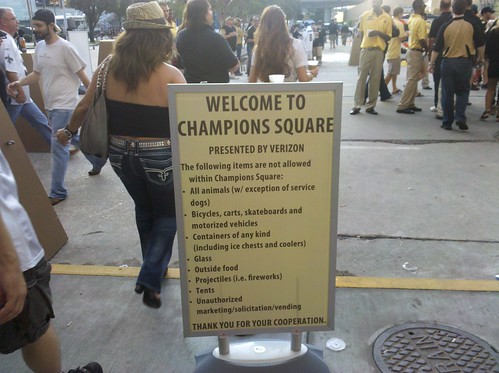
Shit you can't do in Champions Square (Presented by Verizon)

Last week the NFL voted to allow the Oakland Raiders to move to Las Vegas. The reason, as always: pure extortion.
The relocation feels like the money grab it is. Davis and the other N.F.L. owners said they were impressed with the city’s potential, but what persuaded them most was the $750 million tax subsidy lawmakers in Nevada will provide for a big, modern stadium with suites, fancy restaurants and concession stands, not to mention the prospect of a marquee naming-rights partner and other financial benefits.

Fans might not care about such amenities, but in the money-first N.F.L., the other 31 owners certainly do because they receive a cut of what every team generates in its stadium. The Raiders have been near the bottom in the amount of revenue they have produced in their deteriorating stadium, which is more than 50 years old.
Now, in a sane world, hulking landmarks like sports stadiums probably should be expected to have a shelf life well past 50 years. That's allowing for the occasional renovation or two, which the Oakland Coliseum certainly has had.  But this is professional sports where decisions on such matters are more about what the ownership cabal can squeeze out of the public.  And every franchise relocation crisis brings a new opportunity. 
The owner Jerry Jones of the Dallas Cowboys, a power broker in the league who embraced and pushed the move, had an extra incentive. He owns half of Legends, a marketing and hospitality company. Last year, he persuaded the owners to let the Rams move to Los Angeles, and his company won the contract for the new stadium the Rams are building there. Jones pulled off the same daily double with the Raiders.
So the age of any stadium isn't nearly as important as what fortunes can be derived from building a new one. The Superdome is a few years past 40. And nobody is (currently) talking about any dire need to pull the Saints out of there.  The Advocate's Nick Underhill tries to tell us this is because the team's home grown ownership and management "gets it" or some such nonsense. But those of us with longer local memories than Underhill's might disagree.

Take, for instance, this passage where Underhill unquestioningly repeats Dennis Lauscha's assurances that all is well and the good people are working to keep you happy well into the forseeable future.
The Saints have already begun discussions with SMG’s Doug Thornton about how the two sides can keep this relationship going beyond 2025. The Saints have started soliciting proposals from architects for a long-term plan for the Superdome. The goal is to start shaping what the “next generation” will look like for the area around the stadium.

“I can sincerely say that our team and Doug and his team and the state, they’re investing in the future,” Lauscha said. “(All) of us want nothing more than to make that area great and really make it the jewel of downtown.”

He added: “You have two partners who want to dance. We’ve seen when that happens — particularly in our market, but all throughout all professional sports — when that’s the case, good private-public partnerships can exist and work long-term.”
[Before we get too much further into this, let's assume that, unlike Underhill, most of us remember well that Tom Benson was determined to move the Saints out of New Orleans when the city was at its lowest point after Katrina and had to be dragged back kicking and screaming. In case you are like Nick, though, and need a refresher, I always liked Oyster's explication best.]

Anyway, about that "jewel of downtown" public-private partnership the guys are all working on. It's less of a "partnership" than it is a.. well, grift isn't really strong enough a word for what this is. A new post at AZ takes an in-depth look at it. Apologies for the long quotation.
Easy Street...courtesy of Louisiana

The 2009 deal between Benson and the State/LSED consisted of two parts.

The first was an extension of the Superdome lease by LSED through 2025 and an $85 million dollar disbursement to the LSED by the State of Louisiana for improvements to the Dome as well as scaled payments to the Saints pending the amount of money the team generated annually from 2011 to 2024.

The second part of the deal involved the newly acquired Dominion Tower and properties purchased by Benson’s Zellia, LLC. In addition to the State agencies leasing over 70% of the office space in the tower, a state organization called the Louisiana Office Facilities Corporation (essentially an extension of the LSED) agreed to lease the New Orleans Center property which included the Mall and area now known as Champions Square, as well as the aforementioned parking garage for $2.3 million annually. The LSED agreed to take on the operations of the parking garage, mall and Macy’s retail store, retaining all revenues up to the $2.3 million mark (to compensate for the rent to Zelia), then any additional revenues would be split with Zelia 50/50. The agreement called for Zelia to be responsible for any initial renovations and repairs to the properties with the LSED maintaining daily operations and maintenance.

Benson/Zelia agreed to a $10.5 million dollar investment in the property over a three-year period (from 2010) and the LSED committed to making $85 million in capital improvements over the following two years with a completion date of 2011.

Public/Private Partnerships: The Road to Prosperity for the Private

After ratifying the agreement in an LSED Board of Commissioners meeting, Commissioner Robert Bruno stated the deal was (paraphrased from meeting minutes), “One of the most complicated, creative, bipartisan examples of a public/private partnership that could ever be imagined.”

Ron Forman, then President of the LSED Board of Commissioners and CEO/President of the Audubon Institute said (paraphrased from meeting minutes), “Without Mr. Benson’s willingness to invest, it could not have happened.”

How would one not be willing to invest in a multi-million dollar contract that placed any business risk solely on the State of Louisiana? The deal guaranteed near full occupancy rate of Benson Tower on top of a guaranteed 2.3 million dollars a year lease for the Champions Square property and the parking garage in which Zelia doesn’t even have to manage (The management of the properties is contracted to the company SMG by the LSED).

All Benson had to do was purchase the properties and the state took on any and all business risk to guarantee Zelia a financial windfall.
As obscene as all that is, it's pretty well known to most New Orleanians. (Except, I guess, Nick Underill.) Ask anyone to define the boundaries of Bensonville and most probably wouldn't even need to consult the Noligarchs Map.


But a lot of people may not know about the public street Benson's fiefdom managed to absorb for what appears to be zero compensation back to the city.. or scarcely any acknowledgement of the transaction.
An entire city street, the 1400 block of LaSalle which lies between Benson Tower and the Superdome, has been appropriated into the Champions Square venue….sans any contract with the City.

The street has been completely closed to automobile traffic with numerous permanent structures erected by the LSED including gateways  on both ends of the street.  During concerts and events in the Square these gateways are closed to the general public and used as a ticketing entrance for private events.
There are numerous problems with this, as Jason goes on to point out. Most crucially, it's probably illegal in that it violates a state constitutional prohibition on public property being "loaned, pledged, or donated to or for any person, association, or corporation, public or private." It's also just a ton of money the city is leaving on the table for use of the public property. At the same time the mayor is squeezing as much as he can out of ordinary people by raising parking fees, installing traffic cameras, and taxing people for air, he's doing this multi-million dollar favor for a billionaire.

Here's something else from the AZ report that would make you spit out your $12 Dome Foam.
If the City of New Orleans is as cash-strapped as Mayor Landrieu suggested when I interviewed him, why have we left millions of dollars on the table in respect to 1400 LaSalle?

When I asked the LSED if the City has received any compensation for the use of the street from them or Zelia they replied:
"The City of New Orleans has received the economic benefit of (i) the improvements that were made to LaSalle Street, (ii) the ongoing maintenance, repair, etc. of LaSalle Street, and (iii) increased tax revenues derived from events that occur at Champions Square. "
It’s kind of hard to understand how shutting a city street off to the public, taking it out of commerce (including parking meters and fines), installing permanent fixtures....all to generate income for a private venture...is an “improvement” or benefit to the City. 

If I fix the potholes on my own street, can I put up two gateways on each end and charge people to use it?
No. No, you can't do that with your street. These Newcomb Boulevard residents found that out the hard way a few years ago. Also, this is pretty much the same argument advanced by defenders of the city's Confederate monuments now scheduled for removal.
Led by the Monumental Task Committee, the monument supporters argue that the upkeep their members have done over the years at the statues of Gen. Robert E. Lee, Confederate President Jefferson Davis and Gen. P.G.T. Beauregard gives them an ownership interest in the statues and therefore a say in what happens to them.
Of course that wasn't a winning argument for the Monumental Taksers. But it's remarkable that the city (or LSED on the state and city's behalf) would turn around and make that case now.  It's especially dubious for anyone to argue that Benson has gained some sort of property right to LaSalle street simply by virtue of presuming to collect rent from it.  On the other hand, stealing public goods and purposing them to enhance the profits of billionaires is what the NFL was built on. So who could expect anything different?

And this does seem to be the way we treat our public spaces now be they streets, parks, or federally protected wilderness. If it isn't being monetized and "put back into commerce" we no longer recognize its communal value.  But as long as Mitch Landrieu and the neoliberals are applying the privatization model to New Orleans, they probably shouldn't just be doing it for free.

Tuesday, December 06, 2016

Louisiana has a revenue problem AND a spending problem

Remember those two legislative sessions this year when a bunch of whiny babies couldn't raise enough money to fix the state budget?  Yeah, well, they didn't raise enough money
Louisiana will still have to make more than $600 million in midyear budget cuts over the next two months despite raising more than $1.5 billion in taxes last spring and cutting the popular TOPS scholarship program.

The state's budget cycle that ended in June had a $313 million budget deficit that must be made up in the current budget year. Louisiana's state taxes also aren't bringing in nearly as much money in the current year as projected. State budget chief Jay Dardenne said he expects an additional shortfall to be more than $300 million when its announced next month.

"I know many people thought we would have more money than we needed right now," said Ben Nevers, Gov. John Bel Edwards' chief of staff, during a budget meeting Monday (Dec. 6). "That just hasn't happened."

Dardenne said the governor will be proposing cuts to higher education, hospitals for the poor and uninsured as well as services for people with disabilities in the middle of the year because there isn't enough money to prevent those types of reductions.

Those cuts will be proposed despite the fact that legislators spent months in Baton Rouge last year looking for ways to spare higher education, hospitals and people with disabilities from budget cuts. The state's "rainy day" fund -- which is supposed to help cover unexpected financial shortfalls -- will also likely be used.

On the one hand, the Republicans in the state House of Representatives (with moral support from Governor Treasurer Senator Kennedy) refused to do anything to help raise the money necessary to fix the gigantic holes Bobby Jindal had blown in the budget. Louisiana has a "spending problem, not a revenue problem," Kennedy insisted. We just need to stop buying art or something.. oh and paying for poor people to go to the hospital.

On the other hand, Bobby Jindal had already blown the hospital money helping his friends get rich.  Nevertheless we were promised by Jindal and his acolytes that the privatization scheme would save the state money in the long run. (Some of us were skeptical.)  Anyway, it turns out today that a big part of the problem is.... 


So, yeah, we do have a  bit of a spending problem there. 

Thursday, June 30, 2016

The dawn of the Treppin' age

TPM is doing a feature series on the "privatization" movement. If you're like me, you might be so old you actually remember some of this stuff.  If not, well, see here. 
Writing in 1997, the Heritage Foundation’s Ron Utt (who had been Reagan’s “privatization czar”) praised Clinton for pursuing “the boldest privatization agenda put forth by any American president to date,” and noted that his proposals were “virtually all drawn from recommendations made in 1988 by President Reagan’s Commission on Privatization.” In 2006 Reason Foundation’s Robert Poole declared that “the Clinton administration’s privatization successes exceeded those of Reagan.”

In the first year of his administration Clinton assigned Vice President Gore to oversee a major initiative to “reinvent” government under the auspices of an intergovernmental task force, the National Performance Review (NPR). Clinton embraced the ideas popularized by David Osborne and Ted Gaebler, in their 1992 bestseller Reinventing Government: How the Entrepreneurial Spirit Is Transforming the Public Sector, and later on by a follow-up book by Osborne and Peter Plastrik, Banishing Bureaucracy.

The Gore initiative was about making the federal government more effective, but the idea of privatization was also baked in from the start, as it was in Osborne and Gaebler’s work.
The Clinton years were dark times. (All the times are pretty dark.) The next Clinton age is going to be a real doozy.

Thursday, September 24, 2015

Uh oh

Bobby Jindal's awful hospital privatization scheme turns out to be awful.
BATON ROUGE — LSU is seeking to end its deal with the private manager of its Shreveport and Monroe hospitals, two years after hospital operations were turned over to a research foundation as part of Gov. Bobby Jindal's effort to privatize the state's charity hospital system.

The university system sent formal notice Thursday to the Biomedical Research Foundation of Northwest Louisiana, or BRF, that it considers the hospital manager in breach of its contract. It gave the foundation until Oct. 5 to withdraw as hospital operator.

"We have exhausted all avenues to resolve our differences amicably and now must take action that we hoped would not be necessary," LSU System President F. King Alexander said in a statement.

In a July letter to the research foundation, Alexander said BRF had not established a sustainable financial model for the hospitals, had damaged the LSU Shreveport medical school's reputation and threatened the stability of both the medical school and the hospitals.
Bobby probably didn't plan for the awfulness of the thing to come crashing down quite so quickly, though.  I wonder who, if anyone, in the BRF is disappointed in the efficacy of a contribution to Believe Again or America Next.

Monday, July 06, 2015

It's possible that "saving money" was beside the point

We've pretty much decided that privatization is better because.... well, just because.
Medicaid privatization is a hallmark of Jindal’s administration , which pushed the move as a way to both save taxpayer money and improve health by better managing care. Medicaid is a joint state and federal program that provides health care to the poor.

The audit looked at cost savings since February 2012, when the state launched Bayou Health. The privatized Bayou Health insurance program serves two-thirds, or about 900,000, of Louisiana’s Medicaid recipients — mainly children and pregnant women.

Department of Health and Hospitals Undersecretary Jeff Reynolds said the agency is generally pleased with the auditor’s report.

“They say, in auditor speak, there may be savings there,” Reynolds said. “At the end of the day, they can’t quite be sure what that is.”
Who knows what the point of all this was.  Must have been something

Wednesday, April 29, 2015

Please do not send us any free money

We're pretty sure we got this. Thanks, though.
By MELINDA DESLATTE
Published: 13 minutes ago 


BATON ROUGE, La. (AP) - State senators have refused to expand Louisiana's Medicaid program so the working poor could get government-funded health insurance.
The Senate health care committee voted 5-3 Wednesday against coverage expansion legislation proposed by Bogalusa Sen. Ben Nevers, a Democrat.

A House committee was considering a similar proposal, though it faces strong opposition from Gov. Bobby Jindal and other Republican leaders.

Supporters of the expansion hoped the state's dire financial troubles and the offer of billions of federal health care dollars could send more votes their way after failing to gain passage in previous years.

Backers of Medicaid expansion say health coverage would be extended to nearly 300,000 people. Opponents say the increased coverage would be too costly for Louisiana and the federal government and would expand a broken government-run health system.
Meanwhile, hey, does anyone know where all the money went?
Two years after Gov. Bobby Jindal began privatizing the state-run charity hospital system, problems and financial questions continue to appear as lawmakers and communities sift through the spill-out effect.

The private managers that now operate the hospitals say they're $159 million short in Jindal's budget of what they need to provide adequate care for the poor and uninsured in the fiscal year that begins July 1.

The LSU medical schools in New Orleans and Shreveport are stuck with millions of dollars in annual costs associated with former and retired hospital workers they say they can't afford. 

Wednesday, April 22, 2015

Jindaled

Just selling it all off. It's what he does.
While neither Jindal nor any legislator has dared breathe the word privatization as it regards the state’s colleges and universities, at least one Jindal appointee, Board of Regents Chairman Roy Martin of Alexandria, has broached the subject, speaking he said, strictly as an individual. http://theadvocate.com/news/11716059-123/regents-look-at-privatizing-public

The slashing of higher education budgets appears to be a pattern as governors attempt to wean colleges and universities from dependence on state funding, transitioning their status from state-supported to state-assisted to state-located. http://www.usnews.com/news/articles/2015/02/27/scott-walker-bobby-jindal-aim-to-slash-higher-ed-funding

Privatization of state colleges and universities would, of course, push tuition rates even higher, making a college education cost prohibitive for many. But that dovetails nicely with the ALEC agenda as income disparity continues to widen with ever more generous tax laws that benefit the super-rich while placing growing burdens on lower-income taxpayers. By winnowing out those who can least afford college, privatization necessarily enhances the selection process to serve the elite and at the same time, opens up additional revenue opportunities for those in position to take advantage of privatized services such as book stores, printing, food services, and general maintenance. http://gse.buffalo.edu/FAS/Johnston/privatization.html

There is already a backlog of nearly $2 billion in maintenance projects on state college and university campuses just waiting for some lucky entrepreneur with the right connections.
http://theadvocate.com/home/5997316-125/backlog-of-maintenance
And if you've been paying even the slightest attention to Jindal's privatization of Medicaid, or his handling of the state Office of Group Benefits, or several other items he's placed out on the lawn for sale, you'd probably recognize this pattern by now. 

To say the least, it's been fun.  But before you get too mad, remember he's only done exactly what he said he would do.
When I campaigned for governor seven years ago, I promised to make the government smaller and the economy larger. That’s exactly what I have done. We cut taxes and reduced the size of government. In fact, the government is smaller by more than $9 billion and 30,000 workers.
People fired. Government "smaller" as in, government sold off to cronies and/or left to rust away in limbo.  Sucks to be us, I guess.  But as the GOP primary heats up, don't be too shocked when Jindal starts to get credit for his strong conservative "policy ideas." 
Jindal, an Ivy League-educated conservative known for his policy ideas, has already been in Iowa twice this month and returns Saturday for the Iowa Faith & Freedom Coalition spring dinner. He has been working hard to court Christian conservatives here, saying at a Des Moines event in January that it's time for the country to "turn back to God."
He's got that God cred too, by the way.  The legislature had his back on that this afternoon.
 

They're only going to do him more favors as the session goes on.

Wednesday, April 08, 2015

Innovation

Mitch Landrieu's New Orleans ranked number one in government by feudal beneficence.
There's a trend among U.S. cities to lean more and more on philanthropists to fund city services, and New Orleans Mayor Mitch Landrieu has been in the vanguard of the movement, according to an article in Governing, a magazine dedicated to state and local policy and politics
The article is about the Bloomberg model of taking city services out of the public decision-making sphere where elected representatives allocate a budget and relying instead on the interest of wealthy investors to determine your priorities.
As the field of city foundation partnerships evolves, says Albert Ruesga, CEO of the Greater New Orleans Foundation, mayors should be wary of relationships that erode democratic decision-making. “Cities have the power to levy taxes,” Ruesga says. “I don’t think it’s healthy for cities to forgo levying taxes for central public services and goods, thinking that they might get that money from private sources. There’s a price to civilization and we need to be willing to pay that price in our taxes.”
In effect, what they're doing is privatizing the most essential function of governing. As more of your  budget is shaped by grants, your democratic representatives become less relevant.  It also gives them fewer tough decisions to make so, of course, they love that.
Landrieu, however, thinks he’s reached a point where he can justify using public money to pay not just for the projects started by the Bloomberg innovation team, but also for the team itself. Last year, the city spent $300,000 on team activities, about a quarter of their annual cost. (All cities had to match a third of the Bloomberg grant.)

“You don’t even have to sell it to the city council. They want you to do more of it,” Landrieu says. The challenge is making sure the city has room in the budget for a new service, but he seems committed to doing that. “When the philanthropic money runs out, you’ve got to grow your economy or raise your fees or cut in other ways to pay for that service.” The reason he’s willing to make room in the budget isn’t just the impressive results so far, but the method that made them happen. The innovation model, he says, has the potential to address any number of other problems the city still needs to tackle.
Oh see there is still a use for your tax money. Landrieu thinks it's time to start using that to pay the "innovation team" directly. You don't get to vote for them but they will be making more decisions about  how to manage the private grants that will pay for your streets and parks and police task forces. Until that money runs out and you're suddenly paying higher fees and special sales taxes just to keep up.

Maybe you don't think that's fair. But, honestly, if you can't afford to join any of the philanthropic societies and dinner clubs who make all the decisions in this town, you probably don't belong here at all anymore. I think that's the message they're trying to send, anyway. 

Thursday, February 19, 2015

Pro Bono Publico.. but not so much publico

I think this was actually part of the Rex proclamation this year. Did anyone snag a copy?
Fox host Lisa "Kennedy" Montgomery suggested getting rid of the nation's public schools during a discussion on Thursday's "Outnumbered."

Kennedy's comments came during a segment about an Oklahoma bill, approved by a House committee, that seeks to eliminate AP US History. The bill asserts that the current iteration of the course doesn't show "American exceptionalism," instead highlighting "what is bad about America."

"There really shouldn't be public schools, should there?" Kennedy said."I mean we should really go to a system where parents of every stripe have a choice, have a say in the kind of education their kids get because, when we have centralized, bureaucratic education doctrines and dogmas like this, that's exactly what happens."

Wednesday, January 14, 2015

Seems like a cunning plan

Step One: Identify a city asset that is neither drains nor produces revenue.
The Public Belt Railroad, created in 1904, was designed to put all the tracks feeding the city’s ports under a single, public entity. The railroad — unique in that it is owned by a city government — owns and is responsible for about 100 miles of track and the Huey P. Long Bridge over the Mississippi River in Jefferson Parish.

The agency does not receive any taxpayer money or pay any money to the city. It is funded by revenue from the railroads that use the tracks.
Step Two: To quote Ray Nagin, "sell that sucker" off and put it back into commerce because, according to the Gospel of Aspen, privatization is always better.
Although the letter does not cite a specific price, it says the sale would allow the railroad to have access to money needed for improvements while providing an “immediate and significant cash infusion to invest back into basic city services, as well as ongoing tax revenues on property currently untaxed.”
Step Three: Identify a buyer through the usual transparent and above-the-board public bidding process.
A sale of the railroad likely would need the approval of both the board and the City Council. It also likely would require a public bid process.
Wait.. hold up.  Buyer already identified himself back before Step One even happened. He's pretty well vetted, though. 
The proposal to sell the Public Belt was sparked by interest from Thomas Coleman, a New Orleans businessman who served for four decades as the CEO of International-Matex Tank Terminals, a company — owned by his family until last year — that runs terminals and storage facilities in Louisiana and other states and a rail line in New Jersey.

Coleman is the father of Dathel Georges, who owns The New Orleans Advocate along with her husband, John Georges.
Anyway, Step Four is Profit!

Tuesday, September 30, 2014

What did Bobby Jindal know and when did he know it?

Grace:
Sure, Jindal fired Greenstein and canceled the contract when a federal subpoena arrived last year, but in this case, he’s not going to be able to brush past questions so easily.

Not only did Greenstein’s alleged misdeeds happen on Jindal’s watch and his old turf. They also call into question the administration’s commitment to, and mastery of, another professed priority: ethics.

Back when Jindal won his first term in 2007, that’s about all he talked about. He promised to create a “gold standard” and used his post-election honeymoon to muscle through a legislative package that increased disclosure, tightened lobbying rules and revamped enforcement.

The changes weren’t an end in themselves, supposedly. The ultimate aim, Jindal always said, was to send a message to companies looking to do business in Louisiana that they’d get a fair shake. That’s a particularly important goal for an administration so bent on privatization.
But long before the subpoena happened, the State Attorney General's Office and many state legislators already had reason to suspect that Greenstein wasn't quite up to that "gold standard" for ethics.  What took the Governor so long?

Also, occasionally I like to remind folks of how gullible the media can be.

Thursday, September 25, 2014

Side effects of the grifting

Bobby Jindal is leaving quite a legacy with regard to health care policy in Louisiana.  If he wants to campaign for President on his privatized market-driven wonderland he's created here, he's going to have some uncomfortable questions to answer about it.
At Interim LSU, where trained nurses see about 20 to 25 sexual assault patients per month, nurses until recently were instructed to reassure victims they would not be billed. Although the public hospital was not required by law to do so, it for years absorbed the costs of these exams and all the related medical expenses, area sexual assault victim advocates said.

"Now that's changed," Tonkovich said.

The hospital, Tonkovich said, began billing victims for exams after the state last year turned control of the hospital over from Louisiana State University to a private entity, Louisiana Children's Medical Center, now known as LCMC Health. Recent victims have received bills totaling more than $2,000, Tonkovich said.
But then, "Pay for you rape kit" is already a favorite policy among GOP superstars so maybe Jindal is just fine with this.

Tuesday, September 23, 2014

Medicaid privatization scam is scam

News today from the biggest, and also least surprising, Louisiana corruption story of the decade.
A special state grand jury in Baton Rouge Tuesday morning indicted former Jindal administration health chief, Bruce Greenstein, on nine counts of perjury related to his involvement in award of a nearly $200 million state government contract.

Greenstein’s alleged untruths occurred during sworn testimony before a state Senate confirmation hearing and at a grand jury investigation. Greenstein lives in Seattle and his attorney was not available. The grand jury returned the charges to 19th Judicial District Judge Louis Daniel.

“The grand jury is not closed so we are continuing our investigation into other aspects of the case,” Assistant Attorney General David Caldwell said. “These lies are part of the coverup of the whole process.”

The action came some 18 months after the Jindal administration abruptly canceled the contract with Maryland-based Client Network Services Inc., citing among other things “improper contact” by then state health secretary Greenstein throughout the bid and award process.
This has been a fun process to watch unfold. It was so obvious and out in the open from the very beginning that everyone knew something was wrong almost immediately. Someday they will teach it in schools.

It began when Bobby Jindal dragged his feet telling the legislature which firm had been selected for the newly privatized Medicaid claims processing contract; "the most lucrative contract in state government".

Then we found out that the contract was going to CNSI which (dramatic music) was the former employer of Jindal's newly named head of Health and Hospitals, one Bruce Greenstein.  This seemed fishy... even to members of the Louisiana State Senate.. who questioned Greenstein about his dubious claim that he had recused himself from the selection process.
In nearly three hours of testimony that took on the appearance of a courtroom drama, lawmakers challenged Greenstein's previous assertions that he erected a "firewall" to keep himself removed from the selection process.

The secretary has acknowledged that he met with officials at CNSI and other companies shortly after taking his state job last September, including a lunch with a CNSI executive during his second day on the job. Greenstein said he could not recall any conversation about the contract.

But Greenstein also has said he was aware that the state's bid requirements were changed after his arrival in a way that made CNSI eligible to apply for the job.

Sen. Karen Carter Peterson, D-New Orleans, asked Greenstein about contradictions between his earlier testimony about a firewall and emails in which Greenstein discussed the bid requirements. "The integrity and the character issues are what we're here about today," Peterson said. "I believe that you have not been truthful."

Greenstein said he had forgotten about some of the contacts until he reviewed the subpoenaed documents, but that his limited involvement did nothing to compromise the selection process. "I was not trying to mislead anyone," he said. "I was a bit nervous at the time. I know for sure that I had no conversations about how the proposals were evaluated."
 He was nervous.  Ok. He wasn't the only one.
Although the winning bidder was selected weeks ago, agency officials had refused to tell lawmakers, citing a state statute that said the contract award had to first be disclosed to a joint meeting of the health-care committees in the House and Senate. That committee might not meet until after the Legislature adjourns June 23.

That brought a torrent of criticism from senators, including allies of Gov. Bobby Jindal, who accused the administration of stonewalling and called Greenstein's integrity into question.

"It seems like somebody is trying to cover something up," said Sen. Jody Amedee, R-Gonzales.
The competing bidders also protested claiming that CNSI had lowballed its estimate. As it happened, that protest fizzled quickly.  But a month later another protest was filed against Greenstein's selections to run the managed care networks that would replace traditional Medicaid fee-for-service payments. 

The difference between the service delivery models is, in the privatized version, the contractor has a bigger black box from which to extract profit while denying services to patients. That's the big grift. It's important to remember that that is still in place.

But the CNSI thing didn't go away either.  In 2013 a Federal grand jury started looking into it prompting Jindal to cancel the contract.
The Baton Rouge-based federal grand jury subpoenaed documents related to the state’s awarding of the contract to the Gaithersburg, Md.-based Client Network Services Inc. Greenstein was a vice president with CNSI from 1995 to 1996.

The company got the contract for Medicaid claims processing in 2011 amid some complaints that the firm “low balled” the price and made erroneous assumptions in its proposal.

The contract was awarded by the state Department of Health and Hospitals and signed off on by the Jindal administration amid complaints from other vendors.

At the time, Greenstein said he took himself out of the contract dealings. Documents revealed Greenstein influenced a change in the solicitation for proposals that allowed CNSI to compete.
Recall, though, that Legislators also had evidence that Greenstein acted improperly at the time the contract was awarded and that they said so.  It was only two years after the fact that the feds finally forced Jindal to stop backing him anyway.  Greenstein resigned shortly afterward.

CNSI still sued the state for wrongful termination of the contract... because now they're left out of the grift and want to get paid somehow.  But, lo and behold, court filings in that case revealed that CNSI are, in fact, some pretty bad dudes.
In the 2009 FBI interviews, former corporate counsel Matthew Hoffman and ex-CNSI controller Jeffrey Weisenborne allege that CNSI owners lied on documents about the company’s financial health to a syndicate of banks that held lines of credit with the firm in the Maryland suburbs of Washington, D.C.

Weisenborne and Hoffman were interviewed in 2009 as part of probe by the U.S. attorney in Maryland’s Southern District.

The FBI reports are a synopsis of interviews with Weisenborne and Hoffman.

Both recount knowledge of anonymous letters received by Bank of America and M&T Bank in fall 2008 that stated CNSI employees were “being threatened for trying to report the company’s true income and that the owners were overstating revenue to the banks” or outlined “a number of fraudulent acts by CNSI. These letters also said the owners had made death threats to employees not going along with the way things were being done.”

Hoffman told the FBI he was threatened on March 7, 2009 during a meeting at CNSI offices in Rockville, Md., according to the report of a Sept. 11, 2009 interview.

The four owners were in the meeting when one of them said that if Hoffman “ever disclosed the misconduct at the company, they would have him killed.” Another owner “stepped in and said they should move on.”
So the firm Bobby Jindal and Bruce Greenstein wanted to put in charge of weighing its own profits against the health and well being of Medicaid recipients already had a history of ... allegedly.. threatening to kill people in order to protect its bottom line.

To be fair, nobody has alleged that Bruce Greenstein was involved in the death threats.  But, it turns out, that the feds did know that he was involved in rigging this contract and that "state officials" were informed of this.
The email shows that federal regulators had alerted state officials of the potential issues with the nearly $200 million contract prior to its award to a company that formerly employed the state’s health agency chief. As secretary of the state Department of Health and Hospitals, Bruce Greenstein was in charge of the agency that oversaw the contract.

Greenstein repeatedly has said he was not involved in the decision to award the contract to his former employer, Client Network Services Inc., the Maryland-based technology firm known as CNSI. But phone records and other data included in the released documents show at least 2,882 contacts between Greenstein and CNSI executives and the company’s lobbyist.

The federal Centers for Medicare and Medicaid Services, called CMS, took the whistleblower’s allegations seriously enough to pass them on to the state attorney general’s Medicaid fraud unit.
Greenstein's attorney responded to that story by saying the constant contact between Greenstein and CNSI's lobbyist was no big deal seeing as how they were both, "prolific texters." 
Neither Greenstein, who returned to Seattle, nor Creighton agreed to interviews. Attorneys for Greenstein and CNSI said the men are longtime friends who stay in close contact.

“The vast majority of the text messages and phone calls are of a personal nature and have nothing to do with the contract,” said John McLindon, Greenstein’s Baton Rouge attorney. “Bruce is a prolific texter, and I’m told that Carroll Creighton texts a lot, too.”
You really gotta like that "vast majority" bit.  If I prolifically text you a bunch of soup recipes and baseball scores but happen to slip like maybe one or two nuclear launch codes in there then what have you got?

Anyway now Greenstein is being indicted for lying under oath about all of this stuff.  But there's one thing that still sticks out and it is this.
Jindal did not respond to a request for comment. Instead, his press office released a prepared statement from Jindal’s executive counsel Thomas Enright: “We have zero-tolerance for any wrongdoing, which is why we immediately acted to terminate the contract when we learned from the AG that improper behavior might have occurred.” He said the office also asked the inspector general to conduct an independent investigation.
According to CMS, the state Attorney General's office was informed about improper behavior in 2011 before the contract was even awarded.  Bobby Jindal cancelled the contract in 2013.  Did the AG just sit on this information for 2 years?  Or did the Governor decide to just ram this thing through anyway?  In other words, what did Bobby Jindal know and when did he know it?