NOAA satellite photos show flooded neighborhoods in Houston and Galveston. I remember clicking through file folders of these some 12 years ago trying to find the one that might show if my place was ok. It was the first time a lot of us who had evacuated started to really process the scope of what had happened; block after block, neighborhood after neighborhood just totally underwater. It was devastating.
At least now there's this easy to use map interface. The kids today don't know how lucky they are.
Showing posts with label Texas. Show all posts
Showing posts with label Texas. Show all posts
Thursday, August 31, 2017
Floating balls of fire ants are having a moment
Good for them. It's about time. I still can't believe we didn't think about this during the whole Zephyrs renaming episode. Baby Cakes is still good in that it's funny that their bad idea to change the name failed on them like that. But if we had remembered this was available, things might have been different.
Tuesday, August 29, 2017
Mike Pence's Mission Accomplished
After the 2005 flooding of New Orleans, Pence's Republican Study Committee recommended we privatize the school system. We did that. It also recommended several other things we decided to try such as .
Eliminate any regulatory barriers and other disincentives that block faith-based and other charitable organizations from engaging in the recovery and reconstruction processTwelve years later, we see how these policy pursuits compound.
Fresh Food Factor is run by the local chapter of Volunteers of America, a multimillion-dollar Christian ministry that runs halfway houses, shelters, food banks, drug treatment programs and housing projects nationwide, often with government funding. For right-wing champions of charter schools, such as Betsy DeVos, President Trump's controversial education secretary, Fresh Food Factor would be a shining example for the rest of the country: a religious group serving healthy meals at charter schools that chose to partner with a civic-minded contractor. Democrats would be happy to know that the food service helps schools comply with nutrition standards established by Michelle Obama -- standards that the Trump administration recently scaled back.There's a ripple effect at work. First break up the schools and in doing so break the teachers and their union. In the process you've also broken the support staff and their union as well. You guys know this story by now, right? The ripples go out into the community at large.
Despite its parent organization's name, most Fresh Food Factor workers are not volunteers like me. Employees who cook in the warehouse kitchen or serve students in schools receive wages that start at $9 per hour. Some work full-time, but the food service relies on part-time workers and a smattering of volunteers to fill the gaps. Besides managers and truck drivers, most employees are women of color, the workers commonly called "lunch ladies" who are inseparable from mealtime in public schools. As we wrap dozens of veggie eggrolls in sheets of shiny foil, one part-time kitchen employee tells me that she is not scheduled for enough hours to make ends meet and is looking for additional work, a common story in a local economy built on tourism and low-wage service industry jobs
The mass teacher dismissal in New Orleans was reflective of a trend that reached far beyond the classroom. Thousands of jobs that supported Black middle-class people vanished at a time when residents were recovering from an unprecedented natural disaster. Some displaced families have still not returned. In the years since, property values in New Orleans have skyrocketed and working-class neighborhoods have become hipster hotspots, putting increasing pressure on lower-income renters in a gentrifying city.The few stable middle class jobs that remained in the city were gutted and wages and benefits were depressed by the very same forces that caused the cost of living to blow up and out of reach for those left struggling to make ends meet. Meanwhile, who benefits?
Volunteers of America has long been in the "affordable housing" business, using federal housing grants to construct residential buildings for lower-income, disabled and elderly people. The group's neighborhood development subsidiary in New Orleans, which was created specifically to replace housing post-Katrina, is a nonprofit that has its own for-profit subsidiary for building residences to rent out. Robert Silverman, a professor of urban planning at the University at Buffalo who focuses on the nonprofit sector, said for-profit spinoffs of nonprofit housing initiatives are becoming more common, but profit incentives also raise concerns about "mission drift."Donald Trump landed in Corpus Christi today to say stupid things on TV. But Mike Pence is expected to head up development of the administration's recovery policy. We'll take Trump's advice and wait until later to hand out the congratulations on that.
Volunteers of America is considered a church, so it does not have to file federal tax returns, and it remains unclear how top administrators and property developers are paid for their work.
"It's kind of a new trend that has been bubbling up over the past six or seven years, where a nonprofit will have a for-profit subsidiary connected to it," Silverman told Truthout. "Different rules and tax laws apply to each, but they use it as another way to generate revenue [for the parent organization]."
You're gonna like the Heckuva Job
It's gonna be the best, biggest, most beautiful Heckuva Job. You're gonna love it. Believe me. But later.
President Donald Trump said Harvey's destruction and flooding was a disaster "of epic proportions" as he visited Corpus Christi, Texas, on Tuesday (Aug. 29).We want to say Heckuva Job. We can't wait to say Heckuva Job. But we'll wait until it will be less infuriating.
"This was of epic proportions. No one has ever seen anything like this," the president said as he received a briefing from Texas state and local officials.
Trump also said his administration wants to handle the recovery "better than ever before."
"We want to be looked at in five years, in 10 years from now as this is the way to do it," Trump said speaking to reporters. Addressing Texas Gov. Greg Abbott, Trump said now is not the time to say congratulations.
"We won't say congratulations. We don't wanna do that," the president said, "we'll congratulate each other when it's all finished."
Monday, August 28, 2017
HUD, which still exists for now, says it will help
Ordinarily this would be a rote declaration from the HUD secretary in this situation, but nowadays you really can't count on anything so it's worth noting.
The most high profile post-K HUD project, Road Home, ended up costing about $13 billion and dispersed grants to 130,000 homeowners. It did this at a maddeningly slow pace and via an absurd and torturous process mostly to satisfy and idiotic political prejudice against helping people who might not "deserve" help. I'm sure Ben Carson will get all that straightened out, though.
12:25 p.m.: HUD confirms it will help with Harvey aidHUD is where the CDBG money is... for now.
Homeowners and low-income renters forced from homes by the pounding storms or flooding will have assistance available via the Department of Housing and Urban Development.
"Today, our thoughts and prayers are with those who are beginning the process of recovering from Hurricane Harvey," said HUD Secretary Ben Carson, in a release. "As FEMA begins to assess the damage and respond to the immediate needs of residents, HUD will be there to offer assistance and support the longer-term housing recovery efforts."
The most high profile post-K HUD project, Road Home, ended up costing about $13 billion and dispersed grants to 130,000 homeowners. It did this at a maddeningly slow pace and via an absurd and torturous process mostly to satisfy and idiotic political prejudice against helping people who might not "deserve" help. I'm sure Ben Carson will get all that straightened out, though.
Some numbers
I'm just trying to get an idea of the scope of this thing. These are early guesses and the storm isn't even over yet so this will change. It will likely change for the worse.
WaPo reports officials estimate some 30,000 people will end up in shelters as a result of the flood. This morning, USA Today reported a count of 5,500 so far.
Early this morning, FEMA director Brock Long said they're expecting 450,000 to register for federal assistance. That's probably a low guess. But for comparison sake, it's already roughly half of the 916,000 individual assistance requests resulting from Katrina and Rita combined.
Then there are the costs of rebuilding which will almost certainly become the subject of some sort of political standoff as congress goes to war with itself and the Trump administration over a number of budgetary issues next month.
WaPo reports officials estimate some 30,000 people will end up in shelters as a result of the flood. This morning, USA Today reported a count of 5,500 so far.
Early this morning, FEMA director Brock Long said they're expecting 450,000 to register for federal assistance. That's probably a low guess. But for comparison sake, it's already roughly half of the 916,000 individual assistance requests resulting from Katrina and Rita combined.
Then there are the costs of rebuilding which will almost certainly become the subject of some sort of political standoff as congress goes to war with itself and the Trump administration over a number of budgetary issues next month.
The federal Disaster Relief Fund administered by the Federal Emergency Management Agency had a balance of $3.8 billion at the end of July, of which $1.6 billion is already obligated, according to the most recent federal report. Trump declared Harvey a major disaster Friday, making Texas victims eligible for relief from that fund. But with damage estimates already rising into the tens of billions of dollars, the fund’s balance is almost certainly inadequate.
“All of our plans on disaster recovery are premised with the federal government coming in with a big chunk of short-term FEMA money and then a big chunk of long-term bailout money,” said Edward Richards, director of the Louisiana State University Climate Change Law and Policy Project. “With the budget coming up and the debt ceiling coming up, you could easily see this getting absolutely lost in the mix.”
One senior Democratic aide suggested that Harvey could help GOP leaders avert a government shutdown at the end of September, even though Trump threatened the shutdown as recently as last week. Adding hurricane relief to a spending bill that is otherwise unpopular among Republicans, the aide said, could help win GOP votes.
The White House had proposed an 11 percent cut to FEMA’s budget as a way to free up more money for the military. But GOP leaders had signaled they would ignore that request — at least for the next few months — and keep FEMA funding basically flat. They could come under pressure to boost FEMA’s budget, however, particularly because the Atlantic hurricane season is only about half over, and there could be more dangerous storms.
A related issue is the status of the National Flood Insurance Program. Its federal authorization expires Sept. 30, and it is more than $24 billion in debt. The program has a statutory borrowing limit of about $30 billion, and numerous new claims — which congressional aides say are likely post-Harvey — probably will require congressional action to ensure there is enough funding.
Sunday, August 27, 2017
A big bathtub
$40 billion or thereabouts. At least, that was the estimate before the actual impact was known. Right now Houston is flooding. So that can't be good.
As we know all too well in New Orleans, when there's a lot of flood damage and insufficient flood insurance, the difference is mostly made up through HUD's Community Development Block Grants program. Louisiana's infamously administrated Road Home program was funded by CDBG, for example.
Presently, HUD is guided by the gifted hands of Ben Carson and, I guess, his wife.
And Trump's budget proposes we drown the CDBG program.
Very concerning that less than 1/6 of homes in Harris County have NFIP insurance. Sadly, a big portion of losses won't be insured. #Harvey pic.twitter.com/TTiSBOSb7C— Steve Bowen (@SteveBowenWx) August 27, 2017
As we know all too well in New Orleans, when there's a lot of flood damage and insufficient flood insurance, the difference is mostly made up through HUD's Community Development Block Grants program. Louisiana's infamously administrated Road Home program was funded by CDBG, for example.
Presently, HUD is guided by the gifted hands of Ben Carson and, I guess, his wife.
At the Metropolitan Club, George W. Bush’s second secretary, Alphonso Jackson, warned Carson against cutting further into HUD’s manpower. (Many regional offices have shuttered in recent years.) Carla Hills, who ran the department under President Ford, put in a plug for the Community Development Block Grant (CDBG) program, noting that Ford had created it in 1974 precisely in order to give local governments more leeway over how to spend federal assistance.Maybe Houston is the bathtub.
The tone was collegial, built on the hopeful assumption that Carson wanted to do right by the department. “We were trying to be supportive,” Henry Cisneros, from the Clinton administration, told me. But it was hard for the ex-secretaries to get a read on Carson’s plans, not least because the whisper-voiced retired pediatric neurosurgeon was being overshadowed by an eighth person at the table: his wife, Candy. An energetic former real-estate agent who is an accomplished violinist and has co-authored four books with her husband, she had been spending far more time inside the department’s headquarters at L’Enfant Plaza than anyone could recall a secretary’s spouse doing in the past, only one of many oddities that HUD employees were encountering in the Trump era. She’d even taken the mic before Carson made his introductory speech to the department. “We’re really excited about working with — ” She broke off, as if detecting the puzzlement of the audience. “Well, he’s really.”The story of the Trump administration has been dominated by the Russia investigations, the Obamacare-repeal morass, and cataclysmic internecine warfare. But there is a whole other side to Trump’s takeover of Washington: What happens to the government itself, and all it is tasked with doing, when it is placed under the command of the Chaos President? HUD has emerged as the perfect distillation of the right’s antipathy to governing. If the great radical-conservative dream was, in Grover Norquist’s famous words, to “drown government in a bathtub,” then this was what the final gasps of one department might look like.
This event is unprecedented & all impacts are unknown & beyond anything experienced. Follow orders from officials to ensure safety. #Harvey pic.twitter.com/IjpWLey1h8— NWS (@NWS) August 27, 2017
And Trump's budget proposes we drown the CDBG program.
40-50 inches of rain
Houston is the fourth largest city in the country. Gonna need a big big, well coordinated search and rescue plan. I'm sure the current federal administration is on top of it...
Thursday, August 24, 2017

They grow up so fast
Harvey really came into his own there.
On the other hand, if we get into this....
Only source on that so far is John Bel so let's not panic too much. I mean, you know, pre-stage your assets and all if you've got them.
Hurricane Harvey has formed in the Gulf of Mexico, with Category 1 wind speeds of 80 mph, the National Hurricane Center said Thursday shortly before 12 p.m.Almost makes you proud. Honestly, though, this looks bad.
The storm is still on track toward the coast of Texas, expected to make landfall late Friday night or early Saturday morning as a Category 3 hurricane.
Conditions in the Gulf of Mexico on Thursday morning were very favorable for intensification. Satellite images showed that Harvey was a large storm, whose high-level cirrus clouds were already spreading over extreme southern Texas. Harvey had an intense ring of heavy thunderstorms surrounding the eye, and solid low-level spiral bands were forming. The eye was just beginning to appear on both visible and infrared imagery at 10 am CDT. High cirrus clouds streaming away from the center showed the presence of upper-level outflow to the north and east, which was ventilating the storm and allowing intensification to occur. Wind shear was light, 5 – 10 knots, which is favorable for intensification. The atmosphere had a high mid-level relative humidity of 70%, and the ocean was very warm, with sea surface temperatures (SSTs) of 30.5°C (87°F.) This was about 2°F above average for this time of year. Warm waters extended deep into the ocean, providing a large reservoir of heat for the storm to draw upon. The outer bands of Harvey are visible on Brownsville long-range radar.It's less bad for us, of course. Or at least it would be if we had any confidence the drainage system could handle, you know, a thunderstorm or two. We're still waiting for "clarity" on that, though.

New Orleans Mayor Mitch Landrieu addressed Tropical Storm Harvey — forecast to be a Category 3 hurricane when it hits the Texas coast — and said more clarity would be offered on Friday regarding both the forecast and the city's pumping capacity.Um, no, we are not going to have to evacuate for a thunderstorm no matter what they think they have to say in order to appear as though they are doing something. Mitch said today it's important that we all "lean forward" which is a thing he likes to say in these situations. I still don't know what that means. Maybe it helps keep you buoyant.
Landrieu remained vague about what circumstances could trigger an evacuation, even as Harvey's rains are expected to start hitting the city this weekend.
On the other hand, if we get into this....
Gov. Edwards: there is potential that Harvey could re-enter the Gulf after landfall in TX— FOX 8 New Orleans (@FOX8NOLA) August 24, 2017
Only source on that so far is John Bel so let's not panic too much. I mean, you know, pre-stage your assets and all if you've got them.
Friday, March 24, 2017
Competition
Thank the Lord for our Free Market economic system where we foster competition among states to dole out the largest taxpayer financed subsidy to international industrial behemoths so that they might spoil our wetlands and pollute our atmosphere.
The school board in a south Texas community competing with two Louisiana sites has approved an estimated $1.2 billion in tax breaks to entice Exxon Mobil Corp. and its Saudi partner to build a $9.3 billion petrochemical plant within its district along the Texas Gulf Coast.Thus the invisible hand of the market maximizes everyone's utility.
Earlier this year, Exxon Mobil officials said Ascension and St. James parishes are in the running for the petrochemical complex, though company officials have said the Portland, Texas, site is the front-runner and another Texas site is also under consideration.
Sunday, June 07, 2015
Quality of life enforcement
Uh oh. Sounds like the neighborhood association wanted a noise ordinance enforced.
Imagine if we, in New Orleans, ever got the idea that certain kinds of young people didn't belong in certain neighborhoods.
Officers responded to a disturbance around 7:15 p.m. Friday at a community pool in the northern section of the expansive Craig Ranch subdivision. Residents and a private security officer called police to complain that several teenagers did not have permission to use the pool and had refused to leave, police said. The pool is part of the residential community.And you know what happens when "tensions rise" is you get cops pulling guns on teenagers and throwing young girls to the ground by their hair.
Several people complained that the teenagers had started fighting. Three officers arrived and found a large, rowdy crowd. The department dispatched nine additional officers to respond to the incident, Conley said.
“Any time you confront a large group of people, it’s a very dynamic situation and tensions can rise very quickly,” he said.
Imagine if we, in New Orleans, ever got the idea that certain kinds of young people didn't belong in certain neighborhoods.
But youth advocates -- including Joshua Perry, the head of the juvenile public defender's office in New Orleans -- say it is a virtual certainty that curfew enforcement lopsidedly targets poor, African-American children. Remarkably, the New Orleans Police Department, which has been criticized by the federal Justice Department for racial profiling, says it does not keep track of the race of the children it arrests.Imagine, also, if we created a special, public-privately funded, "quality of life" police force to go around enforcing such a measure. What would that look like?
Some data is available, however, and it suggests curfew critics could have a point. In 2011, 93 percent of youths detained at the city's curfew center were African-American, according to statistics from the Orleans Parish Sheriff's Office that were provided to NOLA.com | The Times-Picayune by the Juvenile Justice Project of Louisiana.
Members of the city's new civilian police force, the NOLA Patrol, will begin working in the French Quarter Monday (May 18).If you're having a pool party in the Quarter, make sure you review the guest list closely.
The group, which went through 200 hours of training over five weeks, will handle quality-of-life violations and other non-emergency tasks, freeing up an understaffed New Orleans Police Department to focus on more serious crimes.
Tuesday, January 06, 2015
Bucking the trend
Remember when we used to buck the trend in the other direction?*
Well, okay, some of those affected will get some help. At least that's what their lobbyists tell us.
While I was typing that I stopped to check the price of WTI crude. $48.15 today!
*Since the beginning of the Great Recession of the late 00s, local media (especially NOLA.com) have been relentless in their promotion of the idea that Louisiana's economy had "bucked the trend." In a sense this was correct but only because the energy boom combined with the infusion of hurricane recovery project dollars to keep the unemployment rate in check. But the media narrative insisted instead on crediting the "Hollywood South" boondoggle and the rise of an overhyped "tech entrepreneurship" scene all of which was utter nonsense. Oil is crashing. Unemployment is back up. The state government is broke.
But, even as the "bucked the trend" the median income in Louisiana has remained flat since 2008. In New Orleans, though, the rent is too damn high and we're all expected to cheer. Every get the feeling you're being conned?
Nearly 40% of some 372 metro areas in the U.S. had unemployment rates below 5% in November, providing the latest sign of improving labor markets.What is happening? You guessed it. It's the same thing that's happening in Texas (but worse.)
Twelve metros had jobless rates above 10%, while 147 had rates below 5% in November, according to data released Tuesday by the Labor Department. The data aren’t adjusted for seasonal factors.
Unemployment rates were lower than a year earlier in 341 metro areas, while 27 metros had higher unemployment rates. The eight metro areas with the largest increases in the unemployment rate were in Louisiana, led by Alexandria, where the unemployment rate in November climbed to 6.8% from 5.2% one year earlier. Of Louisiana’s eight metro areas, Alexandria was also the only one to witness a year-over-year decline in the number of employed workers.
Now that oil prices have plunged nearly 51% from their June peak to $52.69 a barrel, some Texans sobered by memories of past energy busts are bracing for a fall. The argument among economists and business leaders isn’t whether the state will be hurt, but how badly.It's not "different this time." Not there, and certainly not here in Louisiana, although there are still some people who will try to tell you that. We're in for an especially rough year of rising unemployment and little money in the state budget to help those affected.
Mr. Kelleher is among the Texans predicting this won’t be a replay of the 1980s oil bust and banking crisis, which drove the state unemployment rate to 9.3%. As evidence, he and others cite a more cautious banking sector, a tax and regulatory environment favorable to business, and a state economy less dependent on energy and other resources.
“Texas has become a well-rounded state,” Mr. Kelleher said. “People did remember not to overextend themselves.”
Michael Feroli, a New York-based economist at J.P. Morgan Chase & Co., is one of the skeptics of the “this-time-is-different” camp. Although the oil-and-gas industry today makes up a smaller share of Texas’ workforce than it did in the mid-1980s, it accounts for roughly the same share of its economic output, he said. So a decline in oil prices similar to the plunge of more than 50% seen in the mid-1980s, he said, could have a similar result: recession.
“Texas is, if oil prices stay where they are, going to face a more difficult economic reality,” Mr. Feroli said.
Well, okay, some of those affected will get some help. At least that's what their lobbyists tell us.
The new year will be pivotal for the oil and gas industry in Louisiana for reasons having nothing to do with the price of oil, Louisiana Oil and Gas Association President Don Briggs says. 2015 is an election year, and the industry must work to ensure the election of conservative, business-friendly candidates who won't stand in its way, Briggs says in a column posted on the organization's website.Because we all know how business unfriendly Louisiana politicians have been standing in the way of oil and gas all these years. They are pesky like that. No more, says Briggs. There will be blood. So look forward to that.
While I was typing that I stopped to check the price of WTI crude. $48.15 today!
*Since the beginning of the Great Recession of the late 00s, local media (especially NOLA.com) have been relentless in their promotion of the idea that Louisiana's economy had "bucked the trend." In a sense this was correct but only because the energy boom combined with the infusion of hurricane recovery project dollars to keep the unemployment rate in check. But the media narrative insisted instead on crediting the "Hollywood South" boondoggle and the rise of an overhyped "tech entrepreneurship" scene all of which was utter nonsense. Oil is crashing. Unemployment is back up. The state government is broke.
But, even as the "bucked the trend" the median income in Louisiana has remained flat since 2008. In New Orleans, though, the rent is too damn high and we're all expected to cheer. Every get the feeling you're being conned?
Wednesday, November 05, 2014
Oil and Gas Lawsuits
Yesterday, amid all the other news, we learned the details of a settlement between the Southeast Lousiana Flood Protection Authority East and two oil companies named in its much talked about and kicked around lawsuit for coastal damage. Here's more from Clancy DuBos.
Meanwhile, speaking of "frivolous" Oil and Gas lawsuits, check this one out.
Two privately held Texas oil companies that were among nearly 90 defendants named in the Southeast Louisiana Flood Protection Authority-East’s (SLFPA-E) landmark environmental lawsuit have settled with the flood authority for a combined total of $50,000 in damages, according to documents filed in federal court and statements by the attorneys involved.Even the small.. call it a moral.. victory won there could never have happened had Bobby Jindal and the man he put in charge of Louisiana's coastal restoration effort, congressional candidate Garret Graves, gotten their way.
The terms of the settlement were announced a few hours after attorneys for SLFPA-E, White Oak Operating Co., L.L.C. and Chroma Operating, Inc. filed a “Joint Motion for Order of Dismissal With Prejudice” in federal court on Thursday. Parties typically file joint motions to dismiss when they have reached an out-of-court settlement. Because the SLFPA-E is a public entity, the terms of the settlement had to be made public.
While the dollar amount of the settlement seems small at first glance, the fact that two oil companies have admitted responsibility for increased public exposure to hurricane-related flooding due to their operations in coastal wetlands — and agreed to pay damages — is huge. The settlement marks the first time an admission of this kind, along with payment of damages, has ever been made by energy companies.
At a minimum, the decision by some energy defendants to settle with SLFPA-E completely undercuts, if not outright disproves, the “frivolous lawsuit” meme that Gov. Bobby Jindal, former coastal “czar” Garret Graves (who is now a candidate for Congress in the 6th District) and legislative foes of the lawsuit have parroted ever since the suit was filed in July 2013. If the suit were truly “frivolous,” as Jindal continues to claim, defendants in the energy industry (who are accustomed to environmental litigation) would not have settled — particularly when a lawsuit breaks new legal and environmental ground, as the SLFPA-E suit clearly does.This morning Graves finds himself in a runoff with former Governor Edwin Edwards. Edwards has crawfished a little on the lawsuit himself; at times appearing to support it and at others speaking more vaguely about "finding the parties responsible" for coastal erosion and holding them accountable. But it's Graves who has stayed in lock step with Bobby Jindal as a critic of the "frivolous" lawsuit. I don't think either has been asked to comment on this settlement just yet.
Meanwhile, speaking of "frivolous" Oil and Gas lawsuits, check this one out.
FORT WORTH, Texas — A North Texas city that sits atop a natural gas reserve is preparing for an extended court battle after voters made it the first in the state to ban further hydraulic fracturing — a fight that cities nationwide considering similar laws will likely be watching closely.See, it's frivolous when we (meaning our public bodies) sue them. But they, apparently can sue the hell out of us whenever we sneeze on them.. or spit up blood or whatever it is you do after drinking frack-tainted water. That's what this guy thinks, anyway.
An industry group and the state's little-known but powerful General Land Office responded quickly to the measure Denton approved Tuesday night, seeking an injunction in District Court to stop it from being enforced.
Battling the fracking ban will be Texas Land Commissioner-elect George P. Bush's first fight. The founding manager of an energy and infrastructure consultancy, Bush promoted the economic benefits of hydraulic fracturing, or fracking, throughout his campaign.Oh yee-haw the Daddy party really is back.
Monday, October 13, 2014
It's hard out here for a prop
Some Texas conservative snarksters are messing with the wrong dude here.
Conservatives attempting to step up their attacks on Texas gubernatorial nominee Wendy Davis over an ad they claim mocked her opponent’s disability ended up making offensive remarks themselves about the disabled, calling attendees at a Davis press conference “props,” and making fun of a speaker with cerebral palsy.Many of you know the "prop" in question as outstanding Louisiana politics blogger Lamar White Jr. This may be a good opportunity to order your tote bag.
Holding a press conference today to address criticism of the ad, Davis invited guest speakers impacted by opponent Greg Abbott’s attempts at tort reform that would impact their lives.
Wednesday, June 26, 2013
So that was quite a day
First there was this.
After that, it got wacky. I'm fading right now and I'm sure you'll read about this somewhere by tomorrow anyway. Basically the last ten minutes of the session involved legislators struggling like a hurried football team to get a vote off before the clock ran out at midnight as they were being disrupted by deafening crowd noise. Nothing could be more Texas than that, when you think about it.
As I type this nobody knows what happened. The Senate hasn't even officially adjourned. I'm sure they'll get around to that sooner or later. And then the whole thing will be argued in some court somewhere. I'm sure this will come up at some point. The legislative website originally recorded the vote on the abortion bill as taking place on June 26... which would mean after the deadline.
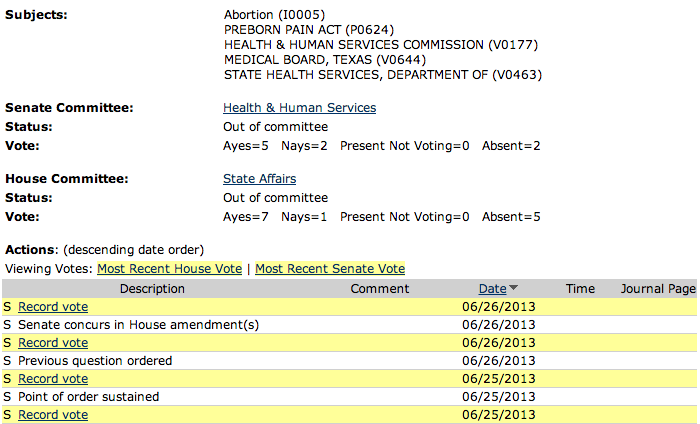
But then this was altered to read June 25.
Suffice to say the clock has been turned back in more ways than one today. From the looks of things there are still plenty of protesters left at the capitol in Austin. (Of course nothing on cable news about that still.) But I'm too tired to stay up and watch them get arrested so I'm turning in.
Can't wait to see what happens with DOMA tomorrow.
Let's be clear about what has just happened. Five unelected, life-tenured men this morning declared that overt racial discrimination in the nation's voting practices is over and no longer needs all of the special federal protections it once did. They did so, without a trace of irony, by striking down as unconstitutionally outdated a key provision of a federal law that this past election cycle alone protected the franchise for tens of millions of minority citizens.And then tonight, hundreds of thousands of people watched a YouTube feed (because all of cable news was busy running repeats of its talking heads shows) of the Texas Legislature. There Republicans decided to shut down a 10 hour filibuster of a draconian crack down on women's right to reproductive health care by arguing that comparing it to other draconian crack downs on women's right to reproductive health care isn't "germane" to the topic.
After that, it got wacky. I'm fading right now and I'm sure you'll read about this somewhere by tomorrow anyway. Basically the last ten minutes of the session involved legislators struggling like a hurried football team to get a vote off before the clock ran out at midnight as they were being disrupted by deafening crowd noise. Nothing could be more Texas than that, when you think about it.
As I type this nobody knows what happened. The Senate hasn't even officially adjourned. I'm sure they'll get around to that sooner or later. And then the whole thing will be argued in some court somewhere. I'm sure this will come up at some point. The legislative website originally recorded the vote on the abortion bill as taking place on June 26... which would mean after the deadline.
But then this was altered to read June 25.
Suffice to say the clock has been turned back in more ways than one today. From the looks of things there are still plenty of protesters left at the capitol in Austin. (Of course nothing on cable news about that still.) But I'm too tired to stay up and watch them get arrested so I'm turning in.
Can't wait to see what happens with DOMA tomorrow.
Saturday, April 20, 2013
We'll know something's gone wrong when the explosion happens
Certainly loud enough to serve as an alarm, anyway.
Actually it was more grossly negligent than that.. if this testimony from this week is any indication.
*Sort of, anyway. Batteries sold separately, of course.
Meanwhile, it's been kind of an eventful week, so it may have been easy to lose the fact of the three year anniversary of the Deepwater Horizon explosion today. Here are a few relevant links.
Phase 1 testimony in the BP trial wrapped up this week. All parties will now file briefs summarizing their arguments. Judge Barbier will then be expected to rule on the "gross negligence" question although that may take a while.
No doubt, the use of dispersants will come into play in making that determination.
The President's Oil Spill Commission released a report this week that patted everyone on the back for a job well done.... except Congress, of course, where the proverbial mistakes were made.
In the risk-management plan, West Fertilizer said the "worst-case scenario" would be an ammonia leak from a storage tank or hose. It didn't specify the likely consequences. The company said the plant had no alarms, automatic shutoff system or firewall.You may remember we came upon a similar situation during testimony at the BP trial.
Bly said BP's well site leader and Transocean crews misinterpreted a pressure test that showed that change, as well as later pressure changes, losing key reaction time.
"That risk was neither recognized or addressed until it was too late?" Sterbcow asked.
"There were signs that the well was flowing," Bly said. "It didn't seem to be recognized or reacted to."
Actually it was more grossly negligent than that.. if this testimony from this week is any indication.
(BP's vice president of drilling and completions for the Gulf Patrick) O'Bryan described hearing someone ask the rig's master, Curt Kuchta, about activating the rig's blowout preventer, a key piece of equipment intended to shut down the well in an emergency, in the final moments before the explosion. Kuchta said he lacked permission to initiate the device's emergency disconnect system from Jimmy Harrell, Transocean's offshore installation manager on the Deepwater Horizon, O'Bryan testified.So on the rig, unlike at the fertilizer plant, there were a shutoff system* and alarms and in place, but they "didn't seem to be recognized or reacted to." In a way, that might be worse, than having no emergency response system at all. We'll be able to answer that better once we know more about what went wrong at the fertilizer plant. Of course, that may take a while because...
"So after you see the fire and after you've seen mud raining on deck, you recall somebody asking Captain Kuchta about activating the BOP?" Karis asked, shifting focus for the accident to the Transocean rig crew.
O'Bryan replied: "He was pretty empathic that he couldn't do it unless he had permission."
A placid announcement from the U.S. Chemical Safety Board that it's heading to West, Texas, to investigate the massive fertilizer plant explosion shouldn't be remarkable. But it is. Such deployments are rare. Critics of the agency — which is tasked with investigating such accidents — charge that it's mismanaged and prioritizes the wrong investigations. The agency blames someone else, if indirectly: BP.And so gross negligence begets more negligence, I guess.
For the past two years, the Chemical Safety Board's budget requests have argued that its lengthy investigation into the April 2010 Deepwater Horizon explosion and spill is sapping its ability to respond to other incidents. In its 2013 budget request, a document sent to Congress in February 2012 to make the case for its federal budget allocation this year, the CSB wrote that "the burden of the ongoing Deepwater Horizon investigation and a backlog of old cases has further hampered the CSB's ability to initiate new investigations."
*Sort of, anyway. Batteries sold separately, of course.
Meanwhile, it's been kind of an eventful week, so it may have been easy to lose the fact of the three year anniversary of the Deepwater Horizon explosion today. Here are a few relevant links.
Phase 1 testimony in the BP trial wrapped up this week. All parties will now file briefs summarizing their arguments. Judge Barbier will then be expected to rule on the "gross negligence" question although that may take a while.
Given the case's complexity, legal observers and others say it could be another year before Barbier issues a ruling on the first phase that will outline the percentage of liability to be assigned to BP or its partners, and whether any of the companies should be found to have committed gross negligence or willful misconduct, which could result in a four-fold increase in Clean Water Act fines.Phase 2 begins in September and will focus on determining how much oil actually spewed into the Gulf during the several months that the well was un-capped.
Barbier has given attorneys two months to submit briefs summarizing their opinions about the evidence presented during the first phase of the trial.
So the outcome of the first phase remains in doubt and could be for some time.
No doubt, the use of dispersants will come into play in making that determination.
Not only is the chemical dispersant that was used to "clean up" the Deepwater Horizon oil disaster of 2010 extremely dangerous, it was knowingly used to make the gushing oil merely "appear invisible" all the while exacerbating levels of toxicity in the Gulf waters, according to a report released Friday, the eve of the third anniversary of the Deepwater Horizon disaster, by the Government Accountability Project.
According to the report, Deadly Dispersants in the Gulf: Are Public Health and Environmental Tragedies the New Norm for Oil Spill Cleanups?, Corexit—the dispersant chemical dumped into the Gulf of Mexico by oil giant BP and the U.S. government in the spill's aftermath—was widely applied "because it caused the false impression that the oil disappeared."
The President's Oil Spill Commission released a report this week that patted everyone on the back for a job well done.... except Congress, of course, where the proverbial mistakes were made.
The report gives the Obama administration a grade of B, the oil and gas industry a B- and Congress a D+. Congress gets credit only for enacting legislation that will funnel 80 percent of any Clean Water Act fines from the disaster to the five Gulf states, money the commission hopes will be used for coastal restoration.Way to go, guys. Not what all that that B- work is gonna do for this, though.
About 40 minutes by boat west of Port Sulphur in Plaquemines Parish, near Barataria Bay, three small spots of land are all that remain of what was once a much bigger barrier called Cat Island. One is a small, lifeless hook, easily found only by those who remember when the barrier island was five acres. A second, only slightly larger in size, is a vegetative graveyard, populated only by the bases of dead mangrove trees and bits of trash.
“This island was covered in oil,” Plaquemines Parish President Billy Nungesser said Thursday, standing just a few feet from the waters of Cat Bay. “Year after year we’d see deterioration in this island, but it was always green.”
Once, the mangrove trees rose eight feet overhead, and pelicans nested around the springtime. When the oil came up from the deep in 2010, the area became the environmental ground zero. After checking up on the island, Parish officials rushed Associated Press photographer Gerald Herbert to the area to take some of the first photographs of oil-covered brown pelicans. For those waiting nervously to see just how bad the disaster would be, there was no more potent symbol than the state bird of Louisiana covered in crude. Three years later, however, there is no sign of birdlife.
Tuesday, September 06, 2011
Texas fires
While I'm sure we all had a ton of fun tweeting about and flying helicpoters at the marsh fire last week, it comes as a relief to know that it's now out "for all intents and purposes" whatever that means.
Meanwhile, if you've been near a news emitting device during the past few days, you are no doubt aware that matters are a bit more serious in Texas. The video below was shot by the Texas Department of Parks and Wildlife. It shows the speed with which the wildfires can spread.
VirgoTex let's us know how we can help here.
Meanwhile, if you've been near a news emitting device during the past few days, you are no doubt aware that matters are a bit more serious in Texas. The video below was shot by the Texas Department of Parks and Wildlife. It shows the speed with which the wildfires can spread.
VirgoTex let's us know how we can help here.
Wednesday, September 08, 2010
Edible disasters
Don't quite get why the food metaphor fad persists in liquid trauma reporting but it does.
Coffee-colored floodwaters rushed past roller coaster tracks at a Six Flags amusement park. Bewildered residents surprised by the extent of the flooding waded through waist-deep water in the streets.
Thursday, April 23, 2009
Stop Messing With Texas
Texans have an overdeveloped sense of pride? The hell you say! Regardless of the current political climate, I promise you you can get close to 50% of Texans to answer a question about their ability to function as their own nation with a "Hell Yeah!" any day of the week. It's only been drummed into their heads since the cradle that they were once their own Republic, and that they're like... a really big state, and that God likes to watch their football team play or some such shit.
They all feel like this. Even liberal Texans are sympathetic with this creed. And guess what? That's okay. They're allowed to have fun with that. Lord knows we enjoy the Sinn Feinism in South Louisiana our own selves from time to time.
Is it a dumb thing for Texas Republicans to go around boasting that a potential act of treason (which has exactly zero chance of actually happening) is somehow evidence of their patriotism? Well, sure. But for national liberals to take this bait and smugly impugn the unique Pan-Texan sense of self is probably even dumber.
They all feel like this. Even liberal Texans are sympathetic with this creed. And guess what? That's okay. They're allowed to have fun with that. Lord knows we enjoy the Sinn Feinism in South Louisiana our own selves from time to time.
Is it a dumb thing for Texas Republicans to go around boasting that a potential act of treason (which has exactly zero chance of actually happening) is somehow evidence of their patriotism? Well, sure. But for national liberals to take this bait and smugly impugn the unique Pan-Texan sense of self is probably even dumber.
Subscribe to:
Posts (Atom)