Former Gov. Edwin Edwards is "looking good" and expects to be released from the hospital Wednesday, said Leo Honeycutt, who was by his bedside.Kathleen Blanco, on the other hand....
Edwards was hospitalized Tuesday morning but was doing well and cracking jokes by evening.
After doctors visited Edwards Wednesday morning, Honeycutt said, "Looking good to be released today." Honeycutt wrote in 2009 the authorized biography, "Edwin Edwards Governor of Louisiana."
"He's in great spirits, lucid, laughing (not drug induced)," Honeycutt said.
Showing posts with label Edwin Edwards. Show all posts
Showing posts with label Edwin Edwards. Show all posts
Wednesday, September 04, 2019
Edwin Edwards is high on life
Still alive. Not on drugs. Got it.
Monday, November 26, 2018
We're not going to fix this
This is more broken record stuff from me, I guess. But the "solution" to the climate problem people may be holding out hope for is never coming. We here in Louisiana who have had a front row seat to its consequences for decades should understand better than anyone that, even in the face of a so-called "existential threat" there is no backstop. Because every threat is really just another opportunity for those who have the power to exploit it.
This is how an "existential threat" to communities like Isle de Jean Charles is also a big money making opportunity for, yes, certainly Energy Transfer Partners, but also for the lawyers, lobbyists, and politicians who make their living enabling its avarice.
Similarly, the Governors Edwards are unconcerned with threats to anything but their own prospects.
Maybe that's a bit beside the point, but I do think it's a key reason we aren't going to fix the climate problem. If we are unable to recognize the complicity of those who exercise power, if we are unwilling even to name the culprits even as they profit by our distress, how can we even begin to protect ourselves from them?
Obviously, we can't and we won't. We aren't going to fix the climate problem. It's like Bob Marshall says here, the game is up with regard to all of that.
This is how an "existential threat" to communities like Isle de Jean Charles is also a big money making opportunity for, yes, certainly Energy Transfer Partners, but also for the lawyers, lobbyists, and politicians who make their living enabling its avarice.
On Tuesday, Nov. 27th, in St. Martinville, the owners of a 38-acre parcel of land in the Atchafalaya Swamp will face off with Energy Transfer Partners, the builders and operators of the Bayou Bridge Pipeline, over these very issues. In next week’s trial, State District Judge Keith Comeaux will attempt to sort out the issues of eminent domain, property ownership, trespassing, destruction of property, and constitutionality of the competing laws and interests.The company is going to win that. Not because they have law on their side but because they, with the help of their many friends, run this shit. This is from a Lens op-ed by Anne Rolfes published over the weekend. Rolfes talks about the several lies of the oil and chemical industries in Louisiana and names some of their most prominent enablers.
How many times did those of us who oppose Bayou Bridge have to endure company reps claiming that the pipeline project would be a jobs engine? In January 2017, former U.S. Senator Mary Landrieu, describing herself as a paid consultant to Energy Transfer Partners, the pipeline’s parent company, invoked the jobs promise at a public hearing before the state Department of Environmental Quality and the U.S. Army Corps of Engineers.It's not as if someone like Mary Landrieu can claim ignorance about the stakes here. She's from Louisiana. She's seen the damage done to our coastline, she's certainly read about our cancer rates, she's seen her own hometown catastrophically flooded. But the "existential threat" to the state is not specifically a threat to her compared to the amount of money she can make allowing more vulnerable people to suffer.
Never mind that one of the brochures that Landrieu and Bayou Bridge distributed that night pierced their own veil. The pipeline would generate all of 12 permanent jobs, the brochure revealed. Pipeline opponents spoke out, bringing that low number to the agencies’ attention. The company’s response? They edited the brochure and deleted the jobs numbers.
Similarly, the Governors Edwards are unconcerned with threats to anything but their own prospects.
St. James Parish would be the proposed pipeline’s end point. The parish is also in the crosshairs of two methanol plants, a chemical plant called Formosa and the just announced Wanhua facility. Signs at construction sites advertise temporary rooms for rent, something that in-town workers would not need.It's not necessary for EWE to be "on Formosa's payroll" as Rolfes puts it. He is a licensed broker in industrial real estate in the river parishes and so probably stands to benefit from land use decisions like this one. As for JBE, this doesn't even mention the bill he signed this year criminalizing free speech against the pipeline. Here is a blurb about that from Bayou Brief back in September.
The Formosa facility — which, like the pipeline, enjoys the support of Governor John Bel Edwards — is a $9.4 billion dollar project, called a chemical complex by project boosters. The company’s permits acknowledge that it would operate 24/7 in its production of throwaway plastics like bags and bottles, with no plan to handle the increased waste or pollution it will cause.
Despite these problems, former Governor Edwin Edwards came out of mothballs to cheer on Formosa at a public hearing. Whether he’s on Formosa’s payroll and, like Mary Landrieu, collecting fees for backing environmentally deleterious projects, is unclear.
Energy Transfer Partners also used its “corporate privilege” to help drive a new law through the Louisiana legislature this past spring. They retained the services of some heavy-hitting lobbyists and coalesced the clout of petrochemical industry groups to push passage of HB 727, now known as Act 692.I will admit, though, I did chuckle this morning at the Bayou Brief somehow leaving out any mention of Edwards with regard to this heinous law he signed. The same article also talks about the out of state private security contractors Hilliard Heintze, and Athos Group, ETP has brought in to harass and surveil its adversaries. But it does not see fit to mention that those companies are only able to operate in Louisiana because Governor Edwards chose to allow it. For all the good reporting that gets done over at Bayou Brief, it's remarkable how consistent they are at covering for certain politicians with whom they are friendly. Mary Landrieu's role in promoting the pipeline is also not mentioned there. In fact, looking through the (again, quite good for the most part) environmental reporting at the Bayou Brief, the reader is extremely hard pressed to find much criticism of Landrieu, or Edwards, or John Breaux, or even Chris John who until this month was the head of the Louisiana Mid-Continent Oil and Gas Association for a decade. I know these political figures all have something in common. What is it?
While other states – including Pennsylvania, Oklahoma, Wyoming, Ohio, and Colorado – have considered a similar measure to this ALEC (American Legislative Exchange Council) model bill, Louisiana was the only one to fully enact it. The bill designates pipelines as “critical infrastructure,” equivalent to public ports and transportation such as railroads, and public utilities like electric power generating stations and water treatment facilities. The “construction” of pipelines is now included in that definition.
And it makes “unauthorized entry,” also known as trespassing and formerly classified as a misdemeanor, onto the property of one of these facilities a felony, punishable by up to five years in prison. If more than one person is involved in the planning or commission of such an offense, it becomes a “conspiracy,” punishable by up to 12 years and a $250,000 fine.
Even though sections were added to the law declaring it was in no way to apply to “lawful and peaceful assembly or demonstration” or “recreational activities conducted in the open around a pipeline, such as boating” (nor to “prevent the owner of a property form exercising right of ownership, including use”), thirteen people have been arrested and charged with felonies under this law since it went into effect on Aug. 1.
Maybe that's a bit beside the point, but I do think it's a key reason we aren't going to fix the climate problem. If we are unable to recognize the complicity of those who exercise power, if we are unwilling even to name the culprits even as they profit by our distress, how can we even begin to protect ourselves from them?
Obviously, we can't and we won't. We aren't going to fix the climate problem. It's like Bob Marshall says here, the game is up with regard to all of that.
Marshall is trying to make a rhetorical point about "conservatism" here but this sort of thing is hardly limited to Republicans. Democrats in New Orleans have been selling "resilience" and the various grifts and scams associated with that similarly fatalist philosophy for years now. Disaster capitalism is bipartisan.I’ve been watching the growth of this suicidal approach to the crisis through my Google alert for sea level rise, which daily sends news stories on that topic to my email account. And almost every day there are one or more stories about cities or states in the GOP column seeking grants from the federal government to “adapt” to problems already being caused by climate change, or others they see rushing toward them. They might want levees, floodwalls, elevated roads, rebuilt beaches, or the planning studies for guidance on what to do as the temperature and the water continue to rise.But even as they now admit global warming is happening, they continue to elect congressional delegations who oppose any regulations that would reduce the emissions that are driving warming. They think it makes sense for a nation that has already lost $350 billion in the last decade to extreme weather events and fires linked to global warming to spend hundreds of millions more to “adapt” to these threats – without doing anything to prevent the disasters from happening again.In other words, surrender, don’t fight back.
Sunday, August 13, 2017
"Former white suprmacist"
Odd little caption from the EWE birthday tribute at NOLA.com yesterday under a photo from 1991.
Edwin Edwards, left, and David Duke, prepare to discuss their candidacies on WDSU's "Meet the Press," November 10, 1991, in New Orleans. Edwards beat Duke, a former white supremacist, in the 1991 gubernatorial election to serve his last term. Both Edwards and Duke's success embarrassed Louisiana. Edwards had been plagued by government corruption scandals during his prior time in office. Duke was a high-profile racist.I guess he must have come out of retirement recently. I kind of get what they're saying, though. In 1991, Duke really was selling himself as a "former white supremacist" in order to pretty himself up for politics. Most people didn't believe him, of course. But he still got a fair amount of "on many sides" benefit of the doubt in the press anyway. Would he even need to pretend today?
Wednesday, December 30, 2015
It always was and always will be "Entrepreneur Week"
Jim Bob Moffett resigned as chairman of Freeport McMoran yesterday. You might remember Jim Bob from his heyday in the 1980s as a "reformer" in Louisiana politics. Reformer, of course, can mean a lot of things. But conventional wisdom in the press then, very much like now, tends to apply the term to any recent arrival to the upper echelon of the city's business class.
Here's a fantastic snapshot of New Orleans 1987 I found. It's an Atlantic article by one time Times-Picayune reporter Nicholas Lemann. I really must insist that you read that article. It's great, not only for the nostalgia, but also for the sense of "le plus ca change" one gets from reading about a New Orleans beset by fears about crime (both real and imagined), racial strife, and the sense that the tourism industry was eating away at the city's soul.
Nothing is more impressive to the conventional wisdom than when "civic oligarchies" get together with a mind to "whip" the rest of us into shape. Particularly when they dress their maneuverings in the trappings of "education reform." They get to collect all sorts of awards for that. Mostly this is because of how easy it is to say, "think of the children" in any situation and come off as a serious person to the lazy minded. It's easy to say, as Moffett says in his interview, "You've got to educate the people. You have to believe in the American way of life, and it all starts with educating the masses." And have everyone praise your amazingly bold and original idea.
As it turned out, though, Moffett's truly bold idea was to see if he could get permission for his company to dump gypsum into the Mississippi River. This started to turn some of his fans against him.. at least among the number he couldn't buy.
This could lead to some interesting fits of cognitive dissonance. For example, Moffett appears in the Lemman article fresh off a clash with Edwin Edwards administration over his gypsum.
Which is why, in 1987, many in the media continued to refer to Civic Leader Moffett's falling out with the "corrupt" Edwards while championing reform candidate Buddy Roemer. That Roemer could capitalize on this "banana republic" image of the state while also promising to run a more "business friendly" administration could only be possible in the context of this stupid pretzel narrative presented by our establishment press fully encapsulated within the personal image of Jim Bob Moffett.
The illogic of the thing became even more obvious later on, when Moffett inevitably clashed with Governor Roemer over the very same gypsum controversy. Turns out the "business friendly" Roemer was even less friendly to Moffett's pollution business than the unfriendly Edwards had been. And when it came time for Roemer's ill-fated 1991 reelection campaign, Moffett would launch his own series of independently financed attack ads. Oddly, during the campaign, Edwards and not Moffett bore the brunt of the press criticism over Moffett's own self-serving turncoat. But then that really shouldn't come as a shock. Like we said, the establishment press loves them some business leaders. In 1991 Moffett was named Gambit's "New Orleanian Of The Year."
Very much like today's 'treps regularly feted at NOLA.com, Moffett really was the quintessential "volunteer entrepreneur" of his day. Later in 1991, Moffett's oil and mining company partnered with (of course) Ron Forman to create something called, and we shit you not, The Freeport-McMoRan Audubon Species Survival Center and Wilderness Park at English Turn. Naturally, Moffett decided to take an opportunity at the groundbreaking to complain about... those goddamned environmentalists.
A native of Louisiana who grew up in Texas, he attended the University of Texas at Austin on a football scholarship and received a master of science degree in geology from Tulane in 1963.Successful entrepreneur brings cutting edge business and money to New Orleans and really shakes things up. That sort of thing. But what really seems to drive the kids crazy is a hot new 'Trep with the "courage" to talk about how backwards we all are. They love that.
After working as a private independent, he formed McMoRan Oil & Gas Co. with Ken McWilliams and B.M. Rankin, deriving the company name from the beginnings of each one’s last names.
Moffett parlayed the company into one of the most successful exploration operations in the country with a 70 percent success rate in wildcatting for oil and natural gas.
In 1981, he was the chief architect of the company’s merger with Freeport Minerals Co., a name well known in Louisiana, which had its headquarters in New York. Moffett, chairman and chief executive officer of the merged company, engineered a 1985 corporate move to New Orleans.
Here's a fantastic snapshot of New Orleans 1987 I found. It's an Atlantic article by one time Times-Picayune reporter Nicholas Lemann. I really must insist that you read that article. It's great, not only for the nostalgia, but also for the sense of "le plus ca change" one gets from reading about a New Orleans beset by fears about crime (both real and imagined), racial strife, and the sense that the tourism industry was eating away at the city's soul.
There are non-aesthetic reasons to worry about New Orleans's increasing dependence on tourism. Tourism can enrich a small group of local entrepreneurs, including real-estate developers and concessionaires; some of these come from groups, like the black middle class, that were previously shut out of the business life of the city. New entry-level jobs in hotels are cold comfort for unemployed longshoremen, but they are a real help to poor blacks working as domestics or not working at all. Still, tourism is cyclical, and it's dominated by national chains whose profits go out town. And if New Orleans is primarily in the business of selling itself rather than its raw materials and its dock facilities, then being a city that satisfies its own requirements but not the outside world's might not work anymore.Anyway, it's amid this very familiar setting that Lemann describes Moffett to us.
It's a testament to Moffett's superior drive and to the flagging self-confidence of old-line New Orleans that he has been much more successful than any previous oilman at becoming a civic leader. In 1981 his independent exploration company merged with Freeport Minerals and in1985 moved its headquarters from New York to a new building across the street from the Louisiana Superdome, with its street number emblazoned in Roman numerals on its entablature. Then he, along with a group of other businessmen, founded an organization called the Business Council, modeled on civic oligarchies like the Citizens. Council, in Dallas, and the Vault, in Boston, to whip the city and the state into shape again, and the establishment stepped back to see what he could do. He got a hero's welcome in the press.
Nothing is more impressive to the conventional wisdom than when "civic oligarchies" get together with a mind to "whip" the rest of us into shape. Particularly when they dress their maneuverings in the trappings of "education reform." They get to collect all sorts of awards for that. Mostly this is because of how easy it is to say, "think of the children" in any situation and come off as a serious person to the lazy minded. It's easy to say, as Moffett says in his interview, "You've got to educate the people. You have to believe in the American way of life, and it all starts with educating the masses." And have everyone praise your amazingly bold and original idea.
As it turned out, though, Moffett's truly bold idea was to see if he could get permission for his company to dump gypsum into the Mississippi River. This started to turn some of his fans against him.. at least among the number he couldn't buy.
That he has suddenly become the pariah of the local media didn't come as that great a surprise, for Robinette has displayed a venal streak before. There he was as an anchor on WWL-TV news in the 1980s, railing righteously against Freeport McMoRan for threatening the public health with piles of radioactive gypsum along the Mississippi.Robinette serves as a pretty good stand in for Moffett's media treatment in general. The gypsum story knocked him off of his pedestal somewhat but not entirely. Instead he became a figure of convenience depending on whoever else he might be at odds with at any given time. For the most part he, like Robinette's other good friend Fred Heebe, was able to purchase enough goodwill to stay out of trouble.
Nothing could stop our great environmental crusader until Freeport boss Jim Bob Moffett up and offered him a job with a fat salary, and he dutifully metamorphosed overnight into an apologist for global pollution.
He was more or less a forgotten sell-out until he turned up as a talk show host on WWL radio just before Katrina, which had apparently changed him back into an environmentalist.
This could lead to some interesting fits of cognitive dissonance. For example, Moffett appears in the Lemman article fresh off a clash with Edwin Edwards administration over his gypsum.
Earlier this year a courageous state environmental bureaucrat denied Freeport a permit to dump gypsum into the Mississippi River. Moffett, who seemed to think he had a deal with the state (the governor's brother was once on the Freeport payroll as a lobbyist), blew his stack. He held a press conference in February at which he threatened to move his company away from New Orleans and called Louisiana a banana republic.Just to be clear, Moffett was unable to successfully bribe a public official and thus concluded he was living in a "banana republic." Oddly, he ended up being praised as much as he was criticized for making this comment anyway. Because it turns out the press does enjoy a good narrative about how romantically backwards our state is no matter how absurd the circumstances of its assertion.
Which is why, in 1987, many in the media continued to refer to Civic Leader Moffett's falling out with the "corrupt" Edwards while championing reform candidate Buddy Roemer. That Roemer could capitalize on this "banana republic" image of the state while also promising to run a more "business friendly" administration could only be possible in the context of this stupid pretzel narrative presented by our establishment press fully encapsulated within the personal image of Jim Bob Moffett.
The illogic of the thing became even more obvious later on, when Moffett inevitably clashed with Governor Roemer over the very same gypsum controversy. Turns out the "business friendly" Roemer was even less friendly to Moffett's pollution business than the unfriendly Edwards had been. And when it came time for Roemer's ill-fated 1991 reelection campaign, Moffett would launch his own series of independently financed attack ads. Oddly, during the campaign, Edwards and not Moffett bore the brunt of the press criticism over Moffett's own self-serving turncoat. But then that really shouldn't come as a shock. Like we said, the establishment press loves them some business leaders. In 1991 Moffett was named Gambit's "New Orleanian Of The Year."
Very much like today's 'treps regularly feted at NOLA.com, Moffett really was the quintessential "volunteer entrepreneur" of his day. Later in 1991, Moffett's oil and mining company partnered with (of course) Ron Forman to create something called, and we shit you not, The Freeport-McMoRan Audubon Species Survival Center and Wilderness Park at English Turn. Naturally, Moffett decided to take an opportunity at the groundbreaking to complain about... those goddamned environmentalists.
Sorry about the long pull quote there. But I had to get that bit in where Forman tells us the real problem is all the divisive "bickering name-calling" instead of, say, millionaire polluters and their ability to buy their way into respectability. Nothing ever changes.MOFFETT CRITICIZES ENVIRONMENTALISTS
Considering that the ceremony was intended to celebrate a multimillion-dollar effort to save some of the world's endangered species, the last thing most of those present expected to hear was an attack on environmentalists.
But that's what they got.
James R. "Jim Bob" Moffett, chairman of Freeport-McMoRan Inc., used the groundbreaking ceremony Friday for the Freeport-McMoRanAudubon Species Survival Center and Wilderness Park to attack environmentalists who, he said, don't appreciate businesses' contributions to environmental protection.
"They need to stop kicking us in the fanny," said Moffett, whose company is often a target of environmentalists' criticism.
"We must have economic development in this world" and it "can and must be done in concert with the environment and survival of the species," he said.
Moffett said Louisiana businesses should "get the facts" on such problems as loss of the state's wetlands and the extinction of species, then "kick their (critics') butts and send them back home."
Moffett's company is donating half the $10 million cost of the 1,200-acre Species Survival Center and Wilderness Park, which the Audubon Institute will operate in the English Turn section of Algiers.
Asked later about Moffett's remarks, L. Ron Forman, president of the Audubon Institute, said he sees "a crying need for business and environmental groups to work together if we are truly going to solve problems. The constant bickering and name-calling should stop."
Thursday, February 19, 2015
Danger Exploding Area
Edwin Edwards may soon encourage you to "buy some dirt."
Former Gov. Edwin W. Edwards won approval Thursday from the Louisiana Real Estate Commission to apply for a real estate broker’s license.One thing that won't be exploding in the area is that Sasol plant Bobby Jindal said was going to blow us back to the 19th Century. ... at least not for now. But there are plenty other highly poisonous and volatile industries situated along the corridor so Edwards definitely knows what he's talking about there.
The vote was 7-2.
The decision came after Edwards, 87, appeared before the commission to explain why it should allow him to prepare and sit for the licensing test. As a convicted felon, Edwards needed the permission of a majority of the 11-member commission to proceed.
Edwards said he thought the brokers license would help as he “works with some friends of mine” in the engineering, architecture and construction business trying to develop property along the Interstate 10-12 corridor from Lake Charles to Slidell.
He said the area is “ready to explode and development has already started.”
Wednesday, February 18, 2015
Certainly seems to be the way to get rich lately
Edwin Edwards is always looking for an angle, you know.
Former Gov. Edwin Edwards is seeking to become a licensed real estate agent in Louisiana, the 87-year-old former four-term governor and federal inmate said Wednesday.
Edwards, who lost a congressional bid in December to Republican U.S. Rep. Garret Graves, said he plans to appear Thursday in front of the Louisiana Real Estate Commission as part of the application process to obtain his real estate license.
"It's one of the things -- one of the options -- I want to do," he said of selling real estate.
Sunday, January 18, 2015
David Duke: Republican

For a few weeks now I've been promising to try and add what little bit of perspective I can to the recent blow-up over Rep. Steve Scalise's 2002 appearance at white supremacist convention in Metairie. Scalise was briefly in the news again this week after an apparently lukewarm protest in D.C. and the fact that the national press picked up a bit on his refusal to add his name to a symbolic statement that slavery was kind of a bad idea.
The key to understanding the Scalise controversy, though, is understanding that his seemingly extremist views and associations are really quite near to the mainstream of the political establishment.. not just in Louisiana.. not just in the South, even. But Louisiana is the political incubator that birthed Scalise, so we should talk about that first. It so happens that I grew up in Louisiana and therefore have quite a lot to say on the subject. So much, in fact, that it's going to take more than one long-ish post like this to get to it all. Believe me, this worries me as much as it does you. In this post, though, I'd like to focus on just how near to the mainstream of the political establishment David Duke himself was. At least in the early 90s he managed to make himself so.
For those of you who weren't around during the Peak Duke years, it might be difficult to understand that David Duke circa 1989-1991 was a slightly different figure from the more openly fringe Duke he was prior to those years and to which he reverted later.
Duke did not run for Senate or for Governor as a Klansman. He ran as a Christian conservative Republican ostensibly regretful of the "mistakes" of his youth. As such, the fact that he was indistinguishable from the mainstream of his party remains the most remarkable fact about his rise.
In order to help better understand this, I've pulled up these debates from the 1991 Governor's race. One is an LPB broadcast.
The other was presented by WWLTV. This one comes in five parts. I'm just going to embed the first one and trust you can find the others from there.
Here are the issues Duke hammers on throughout.
1) Corruption: Emphasized to some degree because it is a perceived soft spot vs Edwards.. although Duke fails to land anything like a significant blow in those exchanges.
But there's a more subtle set of references to "machine politics"which, in New Orleans, carried a certain racial tinge. And at several points Duke out and out accuses Edwards of "buying black votes" as well as of asking blacks to vote against Duke because of his "past" thus proving that Duke's opponents are, in fact, the "real racists."
In Duke's construction, this is all evidence of his status as an outsider. Duke frequently describes himself as a reforming crusader for more "honest and open" government and a break from the "politics of the past." You can watch this today and place Duke alongside any typical "Tea Party" leaning Republican and he looks like much the same quantity.
2) The Environment: This is a bit of an anachronism. It's hard to conceive of now when we think of this issue in terms of the standard national argument over global warming. But this was far from a dominant issue in 1991. Politically.. especially in Louisiana.. it was more of a fringe concern that could attract "kooks" on either the left or the right. (Coastal erosion was a known factor but only just beginning to gain political traction.)
When it was cited at all by candidates, environmentalism was held up as kind of a vague claim to virtue; not too different from being in favor of "ethics" which.. we just saw was something Duke demagogued on pretty hard. In fact, these two issues treated in just this way were something of a standard play for Louisiana conservatives of the time. (Buddy Roemer, and before him Dave Treen, was also famous for talking about "ethics" and "the environment" in ways that were scarcely any different.)
Like many phony political environmentalists of his day, Duke was not very coherent. While he decries Louisiana's status as, "the nation's largest toxic waste dump," he doesn't say much about how he would go about reversing that. In fact, he rails against big government "intrusion on business" several times.. including where it concerned a controversy over a law requiring fishers to use new turtle-safe nets which one would have thought would be an environmental concern.
3) Education: Here, again, we find Duke harping on a very mainstream reformist topic. He does take advantage of a few opportunities to do some subtle race baiting, though. There's a question at one point about a federal mandate for equitable funding for public schools in poorer neighborhoods. Duke merely says that this sounds like "redistribution" and is therefore probably bad. At other points, he talks about "affirmative action" and "forced busing" which are the sorts of education topics Duke's target voters are typically concerned with. But mostly he just says the word, "education" over and over. He rarely ventures very far outside of the "won't someone think of the children" range.
An interesting difference between then and now is that, in 1991, a "pro-education" candidate supported teacher pay raises. Today, the popular political rhetoric around education involves union busting charter schools and reliance on a high burnout, virtual temporary labor force provided through the Teach For America pipeline.
Also, notice, that in 1991 there was no talk about using state money to fund private religious schools teaching an anti-science curriculum. No one in these debates seems to think evolution is a controversial topic. In other words, education policy in Louisiana is currently to the right of David Duke.
4) Welfare Reform: Here we have the real meat and potatoes of the Duke candidacy. Welfare was the issue that he rode the hardest during his brief period of notoriety. During the debates he returned to it as often as possible. He talks about it when asked about the budget. He talks about it when asked about his legislative agenda. When asked a pointed question about why he received an unusual amount of campaign money from out of state, he says a lot of people around the country care about welfare reform.
But notice that he doesn't say anything particularly outlandish.. or at least.. anything that would be too different from what you'd hear most Republicans say. The general implication is that some people are getting something they haven't earned and it's coming off of the backs of good clean hard working people.
His go-to image is about wagons. "Too many people are riding in the wagon while not enough are pulling it." He tells us people are using welfare to buy drugs and lottery tickets. He repeatedly conjures the specter of welfare mothers having children on purpose in order to increase the size of their check. Edwards counters that this is a ridiculous idea since such a welfare baby bonus would amount to 11 dollars a week. No matter to Duke, who goes on to suggest that welfare recipients be required to take birth control. All of these horrors, of course, come at the expense of veterans, and the elderly, and the disabled according to Duke who says he is merely trying to defend basic fairness.
It's important to understand that Duke's arguments here are no more extreme than what we get from conservatives today. In some ways, they are somewhat less so. Recall that only a few years ago State Rep John Labruzzo (heir to.. roughly Duke's old district, btw) called for forced sterilization of welfare recipients.
Thursday afternoon, Rep. Charles Boustany appeared on the Angela Hill show where the two of them commiserated over what they agree is a dire need for.. yep.. welfare reform. Boustany is pushing a bill in the new congress. On the Angela show, Boustany hit a set of talking points pulled directly from the Duke playbook.
Because let me tell you one of things I did I was successful in the last congress in getting a bill passed and signed into law. So it's actually a law of the land now what that says that if I deadbeat dad is is getting welfare money... from the family.. he cannot use that money in a strip club. The casino or liquor store that became law that's my bill. I'm also the author of legislation that and I tried to get done last year and couldn't .. I'm reintroducing it.. that would deal with the drug testing. You know you go to work for company you get drug tested but taxpayer dollar shouldn't be going to buy drugs. So those kind of things I'm look at that.There was nothing in even the most inflammatory rhetoric from Duke during that election that isn't squarely within the bounds of the mainstream Republican agenda then or today.
Anyway so enjoy watching those videos. There are a few other interesting bits you might pick up on. Duke is asked to name some close advisers he might appoint in his administration. One of those names is Kenny Knight, who we have since learned is a link between Duke and Steve Scalise.
During the LPB debate (a little over 33 minutes in) there is a dramatic exchange between Duke and Norman Robinson who really lays into him over... well... Duke's many statements and publications, as well as his general having been a Nazi and a Klansman for all those years. Duke cites his Christian faith (supposedly arrived at in his older wiser years) and begins, "I regret having been intolerant but that's not how I live today."
As he talks, though Duke becomes more and more strident. First he talks about the long history of racist Louisiana politicians he is better than. Then he very quickly arrives at a, "there is racism on all sides" stance. Finally he's talking about Jesse Jackson and the fact that Norman is out to get him. It's striking but it also would fit very much within the FOX News Ferguson coverage last year.
One interpretation of the Steve Scalise story asks us to believe that Scalise's appearance at a white supremacist event was a "mistake" he made some time in his past. This is almost the exact same sort of excuse David Duke once employed in order to brush off his own past. (And, hey, maybe it's not even that much of a mistake anymore. Presidential candidate Bobby Jindal is apparently going to spend Martin Luther King Day speaking to an anti-Muslim hate group in London.)
Duke sold his new self remarkably well. He limited his racial rhetoric to code-speak while developing a platform that seemed to position him well within the mainline of reformist Louisiana political tradition. (In Louisina "reform" candidates are usually conservatives. That's more than I have time to explain right now. Read a book.) But he was never going to be accepted among the professional power players. During his term in the Legislature he was widely shunned.
Duke succeeded... maybe we can't call one victory in a State Rep race success... Duke reached the pinnacle of his career because he happened to come along at a time when white backlash voters were at their angriest, and the Duke brand offered them the primal scream of a "fuck you" vote. But, in order to reach even that level, he had to re-calibrate that brand a bit. He had to tone down his rhetoric just enough to play the part of a mainstream professional Republican.
The remarkable lesson, though, is just how easy this was to do.
The difference between Duke and Republican insiders wasn't about ideology as much as it was personality. Duke really was a weirdo and an outsider and the insiders hated him for that. During the debates, reporters and Edwards go after him for not having ever had a "real job." Duke calls himself a "small businessman."
Really? What kind of small business?
Computer consulting. And a "mailing list company."
Since then, Duke and his mailing lists have become infamous in state politics. Here he was in 1991 being called out as a hustler. And yet, in future years, that hustle would remain lucrative for him thanks to several Republican and Democratic clients.
A few years afterward, Steve Scalise would brag to Stephanie Grace that he was "David Duke but without the baggage." What Scalise meant specifically was that, unlike the professional Republicans who merely push an agenda that plays upon the prejudices and fears the white supremacist crowd, Duke had actually signed up for the movement.
In politics you can be all sorts of things and make it okay, but the one thing the real pros cannot abide is authenticity. That authenticity was both Duke's strength and his undoing. Maybe Scalise has ended up with more baggage than he bargained for after all. In all likelihood, though, he's probably still just enough of a phony to keep his job.
Saturday, December 06, 2014
Late election day round-up
I love voting. In fact, if I were writing one of those stupid Movoto listicles of Top Reasons to Live In Louisiana, voting would definitely be in the top five. Right there along with food, music, humidity, the general feeling that we're all going to be murdered/poisoned/swept away into the ocean probably sooner than later. It's exhilarating.
Voting is great. In Louisiana we vote often. 2014 opened with a citywide election in New Orleans and is closing with a statewide race. Next year we will vote on Governors. It doesn't matter whether or not you like any of the candidates. In fact, that might actually be better. After all, it's fun enough to open up Twitter and type, "Hey @BillCassidy, fuck you for looking like Beavis and saying we shouldn't retire til we're 70. You also look like the Chicken Lady"
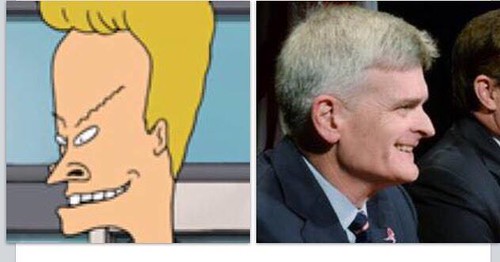
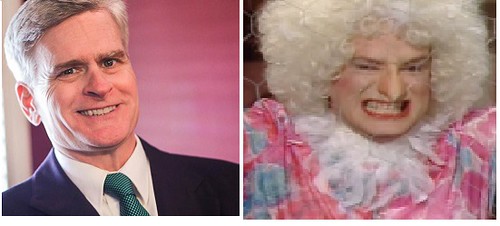
But it's even more fun when you get to have your "Fuck you" officially recorded by the Secretary of State's office from where it is then communicated out through the mass media and presented to the candidates themselves. And they definitely notice. We get to do this all the time here. According to this flier, the animals would vote if they could.
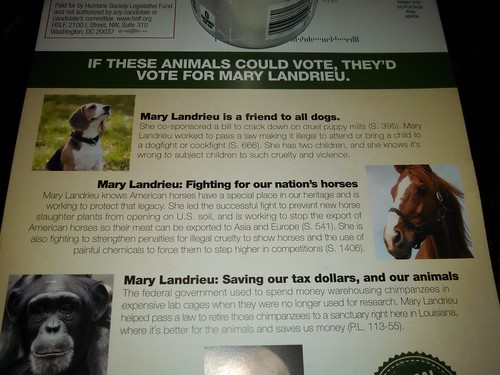
I don't know why more people don't jump at every opportunity.
Seriously, if you're going out to vote today, there's not a whole lot on your ballot.
Locally there's this school millage continuance. People don't seem to understand it well.
On some ballots, you will find a Public Service Commissioner's race. This one is also confusing because 1) Despite what Eric Skrmetta's ads say, President Obama is not running for PSC. 2) Despite what lazy people in the media say, Skrmetta's opponent, Forest Wright, is a businessman invested in solar energy and not "an environmentalist." 3) Somebody working for Wright in a tangential fashion was mysteriously firebombed at his home recently. The case has not appeared in the press since. One imagines it will be solved at some point.. or not!
Bill Cassidy (probably) has never firebombed anybody. But it's looking more and more like he did, in fact, lie on his LSU-HSC timesheets and that this basically amounts to Medicaid fraud. This could have future ramifications for him and also for LSU... although it could also come to nothing. Remember they still haven't done much about the firebombing guy yet either.
There are also some judges. Some people don't like voting for judges but I do. I think we should vote for every public office imaginable, including Head Football Coach. Anyway, there's stupid drama in some of those races too if you would like to read about it.
Congratulations to former Governor Edwin Edwards for coming back and keeping us entertained this election season. He's probably not going to win that congressional seat. That's sad for us because it means we're sending Garret Graves to Congress. Probably not so sad for EWE, though, because who wants to go to Washington DC at his age.. or any age, really? Someone should give the Governor a radio show or something, though. It would be nice to keep his sense of humor in circulation.
Finally, I feel really bad for Mary Landrieu. She's nowhere close to perfect. She listens to her friends in the oil industry before she listens to the rest of us. But, if this really is the end for her, you'd have to give her an overall grade of Could Have Been A Lot Worse. She's been an especially effective advocate for Louisiana after the Katrina flood, from which we are still recovering. The Times-Picayune's ringing endorsement of the Senator last month lays out some of the highlights.
Unfortunately it looks like the pundits proclaiming the long inevitable reddening of the "Solid South" were right. That and the avalanche of money from outside. Oh and Cassidy's inability to say anything besides "Obama" over and over.
It sucks. Mary sounds tired. Who can blame her?
But look. Vote. Send them your little "fuck you." It helps, believe me.
And then curl up with a bottle of something and, of course, your election results map, and cry it out.
At least the Saints are still in it.
Voting is great. In Louisiana we vote often. 2014 opened with a citywide election in New Orleans and is closing with a statewide race. Next year we will vote on Governors. It doesn't matter whether or not you like any of the candidates. In fact, that might actually be better. After all, it's fun enough to open up Twitter and type, "Hey @BillCassidy, fuck you for looking like Beavis and saying we shouldn't retire til we're 70. You also look like the Chicken Lady"
But it's even more fun when you get to have your "Fuck you" officially recorded by the Secretary of State's office from where it is then communicated out through the mass media and presented to the candidates themselves. And they definitely notice. We get to do this all the time here. According to this flier, the animals would vote if they could.
I don't know why more people don't jump at every opportunity.
Secretary of State Tom Schedler said he expects about 1.2 million — or 40 percent — of the state’s 2.9 million registered voters to cast ballots.So it's apparently a slow day out there. Ask them if they'll let you vote twice.
“Based on early voting statistics and historical data, I believe turnout will reach 40 to 42 percent for tomorrow’s general election,” Schedler said.
The Nov. 4 open primary vote saw 1.47 million votes cast or about 51.5 percent of registered voters. Though Landrieu led the field, 56 percent of the votes cast went to a Republican candidate.
But last month, Louisiana was part of national election and was poised to play a role in which party would control the U.S. Senate. Decisive GOP wins mean that when the new Congress is sworn in next month, Republicans will control both houses. With that, the rest of the country pretty much lost interest in what happens here.
Seriously, if you're going out to vote today, there's not a whole lot on your ballot.
Locally there's this school millage continuance. People don't seem to understand it well.
The confusion of people even fairly familiar with the unique situation of New Orleans public schools further illustrates the complex system of dozens of independently run charter schools and the handful of traditional schools — and who has control of them.The short version is, it allows money that had been used to pay off a bond issue to keep being collected for facilities maintenance. But what that also means is that it authorizes the RSD to collect and control money it did not previously collect and control at a time when, really, the RSD should be going away. So what you're really looking at there is more of a fight over territory than it is a "think of the children" matter.
This is important because whoever controls the buildings is responsible for ongoing maintenance and the condition of the facilities where students are educated. Few would dispute that students stand a better chance at a quality education when not learning under leaking roofs, moldy ceilings, peeling paint and in classrooms with unreliable heat and air conditioning. The city has a bad reputation for educating students in such decrepit facilities, but it’s often unclear who should be held accountable for making improvements and held liable when something goes wrong.
On some ballots, you will find a Public Service Commissioner's race. This one is also confusing because 1) Despite what Eric Skrmetta's ads say, President Obama is not running for PSC. 2) Despite what lazy people in the media say, Skrmetta's opponent, Forest Wright, is a businessman invested in solar energy and not "an environmentalist." 3) Somebody working for Wright in a tangential fashion was mysteriously firebombed at his home recently. The case has not appeared in the press since. One imagines it will be solved at some point.. or not!
Bill Cassidy (probably) has never firebombed anybody. But it's looking more and more like he did, in fact, lie on his LSU-HSC timesheets and that this basically amounts to Medicaid fraud. This could have future ramifications for him and also for LSU... although it could also come to nothing. Remember they still haven't done much about the firebombing guy yet either.
There are also some judges. Some people don't like voting for judges but I do. I think we should vote for every public office imaginable, including Head Football Coach. Anyway, there's stupid drama in some of those races too if you would like to read about it.
Congratulations to former Governor Edwin Edwards for coming back and keeping us entertained this election season. He's probably not going to win that congressional seat. That's sad for us because it means we're sending Garret Graves to Congress. Probably not so sad for EWE, though, because who wants to go to Washington DC at his age.. or any age, really? Someone should give the Governor a radio show or something, though. It would be nice to keep his sense of humor in circulation.
Finally, I feel really bad for Mary Landrieu. She's nowhere close to perfect. She listens to her friends in the oil industry before she listens to the rest of us. But, if this really is the end for her, you'd have to give her an overall grade of Could Have Been A Lot Worse. She's been an especially effective advocate for Louisiana after the Katrina flood, from which we are still recovering. The Times-Picayune's ringing endorsement of the Senator last month lays out some of the highlights.
The entire state has benefited from her hard work in the Senate.On top of all that, let us never forget Mary's finest hour.
In 2006, she accomplished something Louisiana leaders had tried for decades and failed to do. She persuaded Congress to force the federal government to give Louisiana and other Gulf states a share of lease revenues from offshore oil and gas wells -- which by 2017 will provide an estimated $500 million each year for restoring our coast.
Sen. Landrieu was instrumental in writing and passing the Restore Act, which ensures the vast majority of BP fines for the 2010 oil spill will go to coastal restoration -- and that Louisiana will get the largest share. She worked successfully across Gulf state and party lines. Her leadership role in the aftermath of the oil spill cannot be overstated.
She also wrote provisions into law allowing community disaster loans to be forgiven by FEMA -- which eliminated $391 million in post-Katrina debt for parish governments. And she successfully fought last year to undo exorbitant flood insurance rates that would have been devastating for Louisiana families.
President Bush faced increasingly bitter complaints today from local and state officials in the battered Gulf Coast region as he struggled to exert control over a disaster that almost surely claimed thousands of lives.
Senator Mary Landrieu of Louisiana, a Democrat, said today that she was so angry about federal failures and second-guessing that if she heard any more criticism of local efforts, even from the president, she might "punch" him.
Unfortunately it looks like the pundits proclaiming the long inevitable reddening of the "Solid South" were right. That and the avalanche of money from outside. Oh and Cassidy's inability to say anything besides "Obama" over and over.
It sucks. Mary sounds tired. Who can blame her?
But look. Vote. Send them your little "fuck you." It helps, believe me.
And then curl up with a bottle of something and, of course, your election results map, and cry it out.
At least the Saints are still in it.
Tuesday, December 02, 2014
Monday, December 01, 2014
Grifting the coast away
In the years ahead, South Louisiana will approach the coastal erosion event horizon; the point beyond which the more heavily populated places (Houma, Thibodaux, St. Bernard Parish.. New Orleans, eventually) will be inevitably lost to the sea. Of course, the land we've already sacrificed amounts to a catastrophe in its own right.
One example of such was on display this New Republic article back in October. The article described Billy Nungesser's plan to save Plaquemines Parish from floods by destroying it with chemical poison.
It, at least partially, explains the state's tax-incentive driven "Qatar on the Bayou"industrial expansion. It will probably explain what the city decides to do with the Wisner property once it finally establishes control of it. And, to a large degree, it explains the nuts and bolts of Louisiana's Coastal Master Plan.
Marshall reports for The Lens, a digital publication that collaborated with ProPublica on “Losing Ground,” an August investigation of Louisiana’s coastal erosion. The project used map simulations that drew wide media attention for a rendering of how much coastal forest has been swallowed and how far inland the Gulf is rising as south Louisiana sinks.But as the threat to more urbanized places rises, the more difficult it will be to ignore. This is not to say, though, that anything will be done to stop it. Instead, the panic will mostly focus on who can squeeze the most money out of the land before it disappears forever and how. So as we approach the sad end of this story, expect the true aim of what we'll call "coastal restoration" efforts to bear more toward maximizing profit than toward protecting communities.
“Louisiana is drowning, quickly,” Marshall wrote in the main story. “In just 80 years, some 2000 square miles of its coastal landscape have turned to open water, wiping places off maps, bringing the Gulf of Mexico to the back door of New Orleans and posing a lethal threat to an energy and shipping corridor vital to the nation’s economy.”
An area the size of Delaware has disappeared. Acreage the size of a football field sinks in the Gulf on average once an hour. The federal government recently erased more than 20 communities south of New Orleans from the map – they’re underwater now.
One example of such was on display this New Republic article back in October. The article described Billy Nungesser's plan to save Plaquemines Parish from floods by destroying it with chemical poison.
Nungesser and his critics are not as far apart as it might seem. Plaquemines Parish has made an unholy bargain with the energy industry. But nobody makes such a bargain without a reason; you only do so if you believe you’ve been forsaken. This is the situation in which Plaquemines found itself in 2006. When the White House announced its plan to rebuild the levee system after Katrina, it excluded the lower part of Plaquemines; a Bush administration representative questioned whether including the parish would be “economically justifiable,” given that its total population stood at just 15,000 before the storm. The unsubtle implication of this statement, and others like it in the months that followed, was that much of southern Louisiana would be abandoned to the Gulf of Mexico, cut off from the rest of the country like a gangrenous digit.But, of course, if the "community" belongs to a coal terminal, nobody will be able to live there. Which means the only reason we're "saving" this land will be so that someone (say, Billy Nungesser) can sell it.
The Sierra Club’s Devin Martin believes Nungesser is luring industry to Plaquemines in order to extort the federal government into paying for flood protection. “They can’t justify getting federal funding if it’s just to save poor people in a flood zone,” Martin told me. “They need industry, in at-risk places.” Under Nungesser, said Martin, “the parish has made an art out of how to acquire FEMA dollars.”
It’s true. Since Hurricane Katrina, Plaquemines Parish, with the support of Baton Rouge, has done everything possible to entice fossil-fuel corporations—the very same corporations that have imperiled the existence of the fragile coast—to expand their business on the lower Mississippi. Once situated, the energy plants serve as a blackmail note. When you have industry, in at-risk places, you need insurance. You need levees. And, most importantly, the federal government needs you.
Nungesser, while placing his emphasis differently, doesn’t disagree with this interpretation. “If I had my choice, would I choose this kind of industry?” he asked. “Maybe not. I don’t know. But I do know that we’re going to have another hurricane. I know people don’t want to leave, but it’s coming. With industry there, we have a fighting chance to save these communities.”
In 2012, the FBI launched a separate ethical investigation, but again Nungesser was not formally charged. More recently, Nungesser negotiated, on behalf of the parish, the contract to build the Port of Plaquemines on land near his home–land that he now intends to sell. “He put it where he owns land,” said Lawrence. “Now was that a coincidence, or did it happen for a reason?”As the disaster becomes more and more desperate, the key to understanding Louisiana's coastal policy will not be a question of how many homes can be saved so much as a question of who is cashing out. Think of this as a (quite literal) liquidation sale of South Louisiana.
It, at least partially, explains the state's tax-incentive driven "Qatar on the Bayou"industrial expansion. It will probably explain what the city decides to do with the Wisner property once it finally establishes control of it. And, to a large degree, it explains the nuts and bolts of Louisiana's Coastal Master Plan.
In the works, for instance, is a last-minute media blitz in which Edwards will play up the links between Garret Graves and Gov. Bobby Jindal. Edwards figures that if Republicans can damn U.S. Sen. Mary Landrieu as the handmaiden of the dreaded President Barack Obama, Graves might be similarly vulnerable as Jindal’s proté gé .Remember Jindal and Graves worked very hard this year to halt a lawsuit that could have sped the process of getting the plan fully funded. But this is really more about the direction of the money than it is the efficacy of it.
Edwards’ commercials, previewed by Louisianavoice.com, will not only stress Graves’ fealty to the floundering Jindal administration but suggest that it produced financial rewards. When Graves was Jindal’s top coastal adviser, his father’s company landed $130 million in Corps of Engineers contracts, of which $66 million was subcontracted out to companies that were suddenly consumed with a desire to make campaign contributions. They gave $250,000 to Graves and $360,000 to Jindal.
Wednesday, November 05, 2014
Oil and Gas Lawsuits
Yesterday, amid all the other news, we learned the details of a settlement between the Southeast Lousiana Flood Protection Authority East and two oil companies named in its much talked about and kicked around lawsuit for coastal damage. Here's more from Clancy DuBos.
Meanwhile, speaking of "frivolous" Oil and Gas lawsuits, check this one out.
Two privately held Texas oil companies that were among nearly 90 defendants named in the Southeast Louisiana Flood Protection Authority-East’s (SLFPA-E) landmark environmental lawsuit have settled with the flood authority for a combined total of $50,000 in damages, according to documents filed in federal court and statements by the attorneys involved.Even the small.. call it a moral.. victory won there could never have happened had Bobby Jindal and the man he put in charge of Louisiana's coastal restoration effort, congressional candidate Garret Graves, gotten their way.
The terms of the settlement were announced a few hours after attorneys for SLFPA-E, White Oak Operating Co., L.L.C. and Chroma Operating, Inc. filed a “Joint Motion for Order of Dismissal With Prejudice” in federal court on Thursday. Parties typically file joint motions to dismiss when they have reached an out-of-court settlement. Because the SLFPA-E is a public entity, the terms of the settlement had to be made public.
While the dollar amount of the settlement seems small at first glance, the fact that two oil companies have admitted responsibility for increased public exposure to hurricane-related flooding due to their operations in coastal wetlands — and agreed to pay damages — is huge. The settlement marks the first time an admission of this kind, along with payment of damages, has ever been made by energy companies.
At a minimum, the decision by some energy defendants to settle with SLFPA-E completely undercuts, if not outright disproves, the “frivolous lawsuit” meme that Gov. Bobby Jindal, former coastal “czar” Garret Graves (who is now a candidate for Congress in the 6th District) and legislative foes of the lawsuit have parroted ever since the suit was filed in July 2013. If the suit were truly “frivolous,” as Jindal continues to claim, defendants in the energy industry (who are accustomed to environmental litigation) would not have settled — particularly when a lawsuit breaks new legal and environmental ground, as the SLFPA-E suit clearly does.This morning Graves finds himself in a runoff with former Governor Edwin Edwards. Edwards has crawfished a little on the lawsuit himself; at times appearing to support it and at others speaking more vaguely about "finding the parties responsible" for coastal erosion and holding them accountable. But it's Graves who has stayed in lock step with Bobby Jindal as a critic of the "frivolous" lawsuit. I don't think either has been asked to comment on this settlement just yet.
Meanwhile, speaking of "frivolous" Oil and Gas lawsuits, check this one out.
FORT WORTH, Texas — A North Texas city that sits atop a natural gas reserve is preparing for an extended court battle after voters made it the first in the state to ban further hydraulic fracturing — a fight that cities nationwide considering similar laws will likely be watching closely.See, it's frivolous when we (meaning our public bodies) sue them. But they, apparently can sue the hell out of us whenever we sneeze on them.. or spit up blood or whatever it is you do after drinking frack-tainted water. That's what this guy thinks, anyway.
An industry group and the state's little-known but powerful General Land Office responded quickly to the measure Denton approved Tuesday night, seeking an injunction in District Court to stop it from being enforced.
Battling the fracking ban will be Texas Land Commissioner-elect George P. Bush's first fight. The founding manager of an energy and infrastructure consultancy, Bush promoted the economic benefits of hydraulic fracturing, or fracking, throughout his campaign.Oh yee-haw the Daddy party really is back.
Well what do you say?
Actually not gonna say much tonight about the national picture except just this little bit of told you so. It's just a few paragraphs in the middle of this post from this morning about why Democrats lose these kinds of elections. Nothing I haven't said a million times.
When you insist on not being for anything in particular at a time when people are grasping for answers, they are going to grasp for the answers the other guy is offering no matter how bad those answers are for everyone. The cable news pundits are already on to wondering what the GOP will be like now that they are the "governing party." But the answer is they won't change at all.
It's a dumb question anyway. Republicans aren't interested in governing. They're interested in protecting privilege while fanning the flames of phony outrage. Where will they find the outrage now? It doesn't matter. But they do have subpoena power in the Senate now so it will be a fun hunt. The point is the next two years aren't about governing. They're just pre-2016 political stagecraft.
As for the state races, we'll look at it tomorrow but a few points.
It will be interesting, now that the national question is no longer a factor, whether or not Bill Cassidy can run as well against Mary Landrieu in the runoff as he did against Barack Obama during the primary.
Edwin Edwards told a reporter tonight, "I beat nine Republicans today." He's in a runoff against one now. And that one has a shit ton of money to spend. Hope EWE enjoyed himself, though.
McAllister is out of the runoff and Zach Dasher is also out of the runoff in District 5. The Duck Dynasty has truly come to an end there.
The local stuff.. okay definitely will look at it tomorrow. Play around with The Lens's precinct maps in the meantime. These should become standard for every local election.
When you insist on not being for anything in particular at a time when people are grasping for answers, they are going to grasp for the answers the other guy is offering no matter how bad those answers are for everyone. The cable news pundits are already on to wondering what the GOP will be like now that they are the "governing party." But the answer is they won't change at all.
It's a dumb question anyway. Republicans aren't interested in governing. They're interested in protecting privilege while fanning the flames of phony outrage. Where will they find the outrage now? It doesn't matter. But they do have subpoena power in the Senate now so it will be a fun hunt. The point is the next two years aren't about governing. They're just pre-2016 political stagecraft.
As for the state races, we'll look at it tomorrow but a few points.
It will be interesting, now that the national question is no longer a factor, whether or not Bill Cassidy can run as well against Mary Landrieu in the runoff as he did against Barack Obama during the primary.
Edwin Edwards told a reporter tonight, "I beat nine Republicans today." He's in a runoff against one now. And that one has a shit ton of money to spend. Hope EWE enjoyed himself, though.
McAllister is out of the runoff and Zach Dasher is also out of the runoff in District 5. The Duck Dynasty has truly come to an end there.
The local stuff.. okay definitely will look at it tomorrow. Play around with The Lens's precinct maps in the meantime. These should become standard for every local election.
Tuesday, November 04, 2014
This ain't Columbus Day
You can stop that after 40 seconds if you want to. [YOU DON'T HAVE TO NOW. I FIXED IT] But vote.. you know... if you want to.
Here are some Election Day links for you.
Voter suppression is still very much in style.
The Crosscheck list of suspected double voters has been compiled by matching names from roughly 110 million voter records from participating states. Interstate Crosscheck is the pet project of Kansas’ controversial Republican secretary of state, Kris Kobach, known for his crusade against voter fraud.
The three states’ lists are heavily weighted with names such as Jackson, Garcia, Patel and Kim — ones common among minorities, who vote overwhelmingly Democratic. Indeed, fully 1 in 7 African-Americans in those 27 states, plus the state of Washington (which enrolled in Crosscheck but has decided not to utilize the results), are listed as under suspicion of having voted twice. This also applies to 1 in 8 Asian-Americans and 1 in 8 Hispanic voters. White voters too — 1 in 11 — are at risk of having their names scrubbed from the voter rolls, though not as vulnerable as minorities.
If even a fraction of those names are blocked from voting or purged from voter rolls, it could alter the outcome of next week’s electoral battle for control of the U.S. Senate — and perhaps prove decisive in the 2016 presidential vote count.
What's the matter with Kansas now?
Of the various Kansas races, it is the Pat Roberts–Greg Orman Senate matchup that has captured the attention of poll-parsers and odds-makers from coast to coast, because it presents them with an alluring double uncertainty: Not only is the race itself too close to call, but if the independent Greg Orman wins, we don’t know which party he will line up with. In fact, we know remarkably little about Orman’s politics generally, because he didn’t come up by conventional partisan means; he moved sideways into public life after a successful career running a private equity firm. Over the years he has had dalliances with both R’s and D’s, and today he presents himself as an anti-politician, assailing (as he put it in a TV debate a few weeks ago) “partisans of both parties” who refuse to “roll up your sleeves [and] start solving problems.”Who is benefiting from the new age of unlimited money?
As races come down to the wire all over the country, it seems ever more possible that the fate of the Senate lies in the hands of this one unknown figure, who could conceivably deliver control of that august body to either side. The possibilities have beguiled the science-minded men of the consensus, who for weeks have speculated back and forth on this or that possible scenario, with the enigmatic Orman always hovering over the outcome.
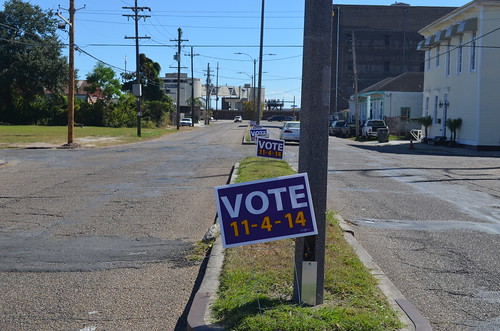
Anyway, have fun pushing the buttons out there today.
Monday, November 03, 2014
This will probably also be controversial
Because what the last day of the election needed was a follow-up on a manufactured outrage story, Edwin Edwards says he disagrees with Mary Landrieu's statement about racism playing a part in anti-Obama sentiment in Louisiana.
Well, alright, that's what the headline says. And, yes, Edwin does say he "disagrees" with the Senator. But, then, if you read his statement, it's actually pretty much the same sentiment as hers.
Anyway if anything in Edwards' quote is likely to make waves with Republicans, surely it's this.
Well, alright, that's what the headline says. And, yes, Edwin does say he "disagrees" with the Senator. But, then, if you read his statement, it's actually pretty much the same sentiment as hers.
"Now look, I'll be honest," Edwards continued, "I'm sure there are some people who don't like [President Barack Obama] and never will because he's black. But I don't think that's a significant amount."Recall that Mary's statement on the matter wandered around some stuff about how important the oil industry is before she mentioned this.. as an afterthought.
"I'll be very, very honest with you. The South has not always been the friendliest place for African-Americans. It's been a difficult time for the president to present himself in a very positive light as a leader," she said.I suppose you could call that a "disagreement" but not much of one.
Anyway if anything in Edwards' quote is likely to make waves with Republicans, surely it's this.
Edwards told TPM on Saturday that Louisiana is "a rather liberal state in racial notions and there always will be some people who have problem with people of a different race — Chinese, Japanese, Mexicans, what have you," but "by and large people will accept a person based upon his policies and performance."Republicans got all pissy when Mary Landrieu said there is racism in Louisiana. What do you think will happen when they find out EWE said it is "rather liberal"?
Monday, October 20, 2014
Not even an invitation
Bill Clinton is in Baton Rouge today as the featured speaker at a rally for Mary Landrieu's Seanate campaign primarily, but also for the other Democrats on the statewide ticket.
Except one.
Not surprising seeing as how Mary and EWE have never really gotten along all that well. But still, something of a snub.
Except one.
@JSODonoghue last time I went someplace uninvited I didn't have any fun!
— Edwin Edwards (@EdwinWEdwards) October 20, 2014
Not surprising seeing as how Mary and EWE have never really gotten along all that well. But still, something of a snub.
Thursday, October 09, 2014
Bob Mann's EWE derrangement syndrome
It's been showing up a lot lately. Mann gets a few quotes in this MoJo article about the District 6 race.
With most of the polling in-state focusing on the back-and-forth Senate race, there's no consensus on who the Republican entry in the runoff will be. But whoever emerges as the second candidate in the head-to-head race is in good shape. "I don't think Edwards could beat anybody, unless the person he's running against has committed a worse crime than him," says Bob Mann, a former aide to Democratic ex-Gov. Kathleen Blanco.Not saying his analysis is wrong. Although... Edwards vs. Lenar Whitney would be a thing I might buy a ticket to. But more to the point, there are worse things than electing an 87 year old progressive Democrat with a colorful history to serve 2 years in Congress. Many of those worse things are on the ballot. Not sure what Mann is all worked up about.
Edwards, one of a handful of Southern congressmen to support extending the Voting Rights Acts during his stint in Congress, always won black voters by huge margins. But his new district is significantly whiter than the rest of a state that's become increasingly polarized. No voter under the age of 41 has ever seen Edwards on the ballot; many of the people who ever voted for him are dead; and, also, he went to prison. "Even in his best election, he probably only got about 50 percent of the white vote," Mann says. "I don't think that's possible for any Democrat now."
Tuesday, September 30, 2014
Here comes the real campaign
We're headed into October now which means we're into the final phase of the 2014 election cycle. And so a new PPP poll is out. In the headliner race, Bill Cassidy holds a slight lead over Mary Landrieu in a hypothetical runoff. But he still isn't polling over 50% there.
Then PPP focuses on likely voters:
Other fun items from the poll: Nobody cares about Landrieu's "keg stand" thing, David Vitter leads Mitch Landrieu head-to-head for Governor, oh and Everybody Hates Bobby.
Then PPP focuses on likely voters:
There has been a lot of speculation about how turnout might influence the dynamics in a December runoff election, and on that front we find something that is at least a little disturbing for Democrats. 89% of likely voters for November also say that they will definitely vote in a runoff election if there is one. Among those voters Cassidy's lead expands to 50/45. Among the 11% of voters who say just they will probably vote, that the chances are 50/50, or that they will probably not vote Landrieu leads by 13 points at 40/27. Making sure those folks actually come back out in December will be key to her chances.So that's discouraging for Mary. Although I should also highlight this Wa-Po article from last week about the reliability of "likely voter" surveys before the final week of a campaign.
“Registered voter” polls can mislead as predictors of Election Day outcomes since even among the registered, prospective Democrats vote less often than Republicans. The differential in turnout between registered Democrats and registered Republicans is not necessarily a constant, however; the partisan disparity can vary with the two partisan groups’ relative enthusiasm and interest in the current election. Likely voter polls are designed to adjust for this enthusiasm differential.In any event, Mary will run first in the primary. Rob Maness, despite this winning alligator and Palin photo-op is still a non-factor.
But when applied early in the campaign, likely voter polls can exaggerate how much difference it makes for an election weeks ahead. Moreover, early likely voter polls are more erratic because counting fewer respondents leads to more sampling error. And when the relative enthusiasm of prospective Democratic and Republican voters oscillate over time, early likely voter polls make it seem like underlying voter preferences change more than they really do. (Also see this recent blog post.)
Other fun items from the poll: Nobody cares about Landrieu's "keg stand" thing, David Vitter leads Mitch Landrieu head-to-head for Governor, oh and Everybody Hates Bobby.
Bobby Jindal remains one of the most unpopular Governors in the country- only 34% of voters approve of the job he's doing to 55% who disapprove. Just 20% of voters in the state think he should run for President in 2016, to 68% who think he should sit it out. Even among Republicans only 29% think Jindal should seek the White House. Jindal trails Hillary Clinton 46/45 in a hypothetical match up for President in the state and Jindal would even hurt the Republican ticket in Louisiana if he was the Vice Presidential candidate- 28% say that would make them more likely to support the GOP candidate to 42% who say it would make them less likely to. Topping it all off, Louisianans say by a 47/43 spread that they'd rather have Edwin Edwards as their Governor than Jindal.Anyway, there's much more. Check it out.
Tuesday, September 23, 2014
QOTD
Mary Landrieu responding to criticism about her appearance at an LSU tailgate over the weekend.
Of minor note in this story is that Mary tactfully declined to endorse Edwin Edwards in the District 6 congressional race. But that isn't really news. The two of them have never really gotten along.
On another issue, Landrieu laughed off a question about her role on Saturday at an LSU tailgate site where she briefly held a beer spigot for a thirsty beer lover.Most people know that LSU football tailgates are a marquee stop along the Louisiana campaign trail. During major elections, you can eat pretty well just mooching off of the spreads set up by the several campaigns. A keg stand assist in this environment is basically the equivalent of a baby kiss elsewhere.
“They need to get a sense of a humor, and they need to get a life,” she said of GOP critics.
“It’s just the way we roll. The gentleman that did that is 28 years old and he has also graduated. He has a master’s in business. So I think he can make a decision for himself what he’d like to do.
“I thought I did pretty well by not doing it myself and just helping him,” Landrieu said with a laugh.
Of minor note in this story is that Mary tactfully declined to endorse Edwin Edwards in the District 6 congressional race. But that isn't really news. The two of them have never really gotten along.
Wednesday, September 10, 2014
QOTD
It's early but unlikely anyone will beat this.
@JSODonoghue @RTMannJr @LaDemos #byefelecia
— Edwin Edwards (@EdwinWEdwards) September 10, 2014
Tuesday, September 09, 2014
Can't make it any worse
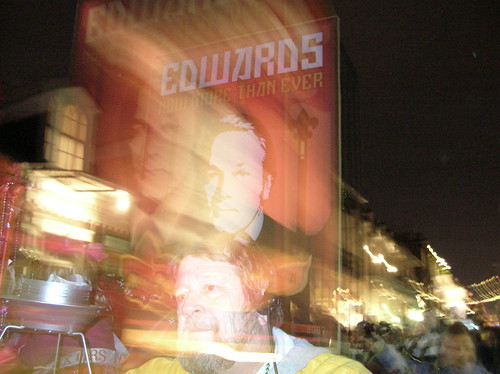
Very trippy photo of a Krewe Du Vieux "Edwards Now More Than Ever" float circa 2007
Yesterday, the Louisiana Democratic Party endorsed former Governor Edwin Edwards in the Sixth District Congressional race.
“I am pleased to have this and other endorsements from groups that are helping people who have an interest in promoting a better life for our nation and the district,” Edwards said in a statement. “I appreciate the vote of everyone because I am going to serve everyone.”Can't imagine anyone would be surprised. Edwards is the lone Democrat in a crowded field and presents the party with a legitimate chance to steal a seat. The whole thing is a fascinating story.
Louisiana Democratic Party Vice Chairman Shane Riddle said Democrats see a path to victory amid the crowded Republican slate.
“The 6th Congressional District is more challenging terrain for Democratic candidates since it was redrawn in 2011,” Riddle said. “I am impressed with the team and the energy coming from Team Edwards — and I have often been told to never count out Edwin Edwards.”
Naturally there are pearl-clutchers.
.@austinstukins @LaDemos I'll soon no longer be a Democrat. Time to become an Independent.
— Robert Mann (@RTMannJr) September 9, 2014
Seriously that's a bit much. Not that I don't sympathize. There are legitimate reasons to be fed up with the Democratic Party. In national politics, it is far too cozy with the financial industry. I know it's a tall order for any President to put the brakes on our leviathan national security/surveillance state, but the current Democrat in office has only opened the throttle wider. In Louisiana, our most prominent Democrats wholly owned by oil and gas. It can be very frustrating.
But there's absolutely no value in laying down for the sake of "optics" or the "state's image" or whatever that nonsensical vanity issue is. As Edwards himself says, electing him certainly can't make it any worse.
Edwards has no illusions about the state of partisan politics in Washington D.C. Still he is baffled by the inability to find common ground on some issues. “I find it difficult to understand why the Republican controlled House of Representatives won’t address equal pay. Won’t address minimum wage. Won't make at least an effort to provide a solution to immigration.”
Despite the realities, he is an optimist rattling off a classic EWE quip, “I tell people don’t worry I can’t make it any worse, but maybe I can make it a little better.”
As the interview wound down, Edwards spoke softy and earnestly about his reasons for running. “I like public service. I like to be in a position where I can get things done. A lot of average citizens have noone to turn to. I have experience being someone that listens and helps… I believe that I can make a contribution and I’m going to try.”
Subscribe to:
Posts (Atom)