-->
Showing posts with label banks. Show all posts

Monday, March 13, 2023

Ok but why?

This can't just be explained away as a big, "Whoops! Turns out we didn't know how banks work!"  Although Dayen does at least entertain that possibility here. I guess you kind of have to given how stupid everything does feel these days. But still, no. It can't just be that. 

Contrary to their belief, Silicon Valley big brains are not the first ones to figure out that deposit insurance doesn’t protect their payroll accounts. Companies manage this small risk of bank failure through recognized insurance strategies. There are private-sector solutions like Intrafi’s Insured Cash Sweep, which essentially cuts up large accounts into $250,000 pieces and splits them across the banks participating in its network. CDARS, another Intrafi product, is a less liquid option that segments cash into CDs. Some prior FDIC officials have expressed anger at these schemes, but there also are cash management accounts with a “sweep” feature, or additional insurance to take out (this Forbes story has several examples).

Any risk manager worth their salt at a company knows of a panoply of ways to avoid the threat of bank failure on deposits. “The pain of having to explain this,” Porter said to me.

Importantly, SVB was part of the network of cash sweep banks; it had an offer on its website about it. But according to Adam Levitin, there were only $469 million in reciprocal deposits, which is where cash sweep would show up. In other words, almost nobody banking at SVB used them.

Why not? There are a couple of options. One, Silicon Valley startups are so bad with money that they never thought of this. (It’s incredible that Roku, which has been around for a while, had nearly half a billion dollars on hand at SVB, without hedging that risk at all.) The fact that VC big brains were toying with new types of deposit insurance this weekend that already exist (it’s like Uber reinventing the bus) raises that possibility.

The other possibility is that SVB wanted that money kept with them. There are very strange stories coming out about how SVB required companies to hold their money with them in exchange for venture debt agreements, and then gave cheap “white glove” service to founders: low-interest mortgages, lines of credit, and the like. SVB might have had a reason to want their hands on that money exclusively.

Is that sort of "white glove" service not precisely the reason FNBC executive Ashton Ryan was found guilty on 46 counts of fraud? Remember that? It just happened last month.  

Prosecutors convinced the jury that Ryan was the "quarterback" of a team of conspirators, as Assistant U.S. Attorney Ryan McLaren put it in closing arguments.

The list of "scoundrels" he said conspired with Ryan included Mississippi developer Gary Gibbs, who testified that he was essentially bankrupt as far back as 2013. For years, Ryan kept lending him $1 million each month to cover up his insolvency, documents showed, as he spent the proceeds on a private jet, luxury cars and top-of-the-line fishing boats. Gibbs owed the bank $123 million by the time it collapsed.

There were similar stories for other borrowers like Kenneth Charity, a transplant from Washington D.C. who had plans to get rich in the post-Hurricane Katrina real estate market, but who could never file his taxes or other documents on time — or make meetings — as his projects floundered. Ryan kept lending to Charity until his debt reached $18 million.

Ryan's defense during his trial was laughable. In so many words, he said that he was just trying to help some guys out.  Maybe the loans were reckless or outside the bounds of what was usual, but he was being "altruistic."  He literally used this term. It's a popular one among financial criminals these days. What it amounts to, in Ryan's case, is an explicit admission of guilt. He knew the law and broke it anyway for... reasons. 

It's that what's going on at SVB? Because, as Dayen explains, any CFO at any of the firms banking there had to have known how to responsibly insure themselves against risk.  But they just... opted not to. Dayen also suggests the same firms still could have dug themselves out of the mess their own mess. (A mess they created and then triggered as if on purpose, it seems.)

SVB’s losses aren’t really that major in the grand scheme; the haircut that depositors would take under normal rules would be minimal. It might take a minute, which with payroll being due was a risk startups didn’t want to take. But they have well-heeled benefactors—the VCs shouting about the end of the world—who could have supplied whatever bridge support was needed for companies they still profess to believe in.

But they chose not to do that either. Why? So far the only answer seems to be, to see if they could.  But what else?
Sunday, December 27, 2020

I wonder who bought up all of these properties

Eyebrow raising story here about the Bank Of Louisiana's 97 year old founder and his ongoing dispute with FDIC regulators. 

G. Harrison Scott, chairman and majority shareholder of the Bank of Louisiana, is not fond of his bank’s regulator, the FDIC.

“They’re lying sons of bitches, and you can quote me on that," he said. "They lie, lie, lie, and I’ve caught them in it.”

Yeah it's not really clear from the story that he's actually caught anybody in a lie.  In fact this says his family members and partners have a plan to comply with the FDIC orders but Scott still needs to sign off on it. Basically, it says he's being stubborn and taking things personally and his daughter who is more or less running things now is trying to work around that. 

Anyway what's fascinating here is that we're told this is a case of the old man being out of step with The Way Things Are Done Now.  But I think it's an open question as to whether the "good old days" described here were really that long ago. 

Shannon Scott said that the bank was forced to sell off loans to one customer in particular, Billie Karno, a prominent owner of properties in the French Quarter, including the bars known for their "Huge Ass Beers" trademark. She said the loans were performing fine and it was easy to find another bank to take on some of them to satisfy the regulator.

"It used to be you’d take the FDIC auditor out to lunch and have a couple of cocktails and take him golfing and he’d give you a great review," said Shannon Scott. "It’s just different times, things have moved on and you either adapt and change or you get out of the business."

Attorney Henry Klein, a longtime friend of Harrison Scott and a former bank board member said: “He and Judge Comiskey, when they ran the bank together, were gentleman bankers the way bankers used to be."

I mean if these loans to Karno's businesses didn't raise objections until 2011, then what has really changed?  We can LOL at the golf and cocktails line here but the new COVID relief bill does include a so-called "three martini lunch" deduction. Surely there's still some room in this business climate for a "Huge Ass Beer" clause.  

But forget about that. That's not really what's interesting about these Bank Of Louisiana dealings. What is going on with all these foreclosed properties? 

The main complaint in the FDIC's latest action was the bank's large portfolio of foreclosed properties. It started the year with 53, which had annual carrying costs of $1.5 million annually, according to the FDIC. That's enormous for a bank with revenue through the end of September of barely over $5 million.

Shannon Scott said she has since sold off 26 of those properties and expects to make more progress well before the scheduled hearing next summer.

Would love to see some follow up reporting on what sorts of properties these are and who is buying them.  One of the most disturbing trends in housing since the 2008 financial crisis has been the consolidation of rental properties by national private equity firms. Here is a recent NYT Mag article looking at some of that.  

When credit was tight after the financial crisis, the acquiring firms, led by Blackstone, figured out a way to generate more of it by creating a new financial instrument: a single-family-rental securitization, which was a mix of residential mortgage-backed securities, collateralized by home values, and commercial real estate-backed securities, collateralized by expected rental income. In 2013, a year after Ellingwood’s home was acquired, Blackstone’s Invitation Homes securitized the first bundle of single-family rentals — 3,200 of them for 75 percent of their estimated value: $479 million. Those who bought these bonds received 3 to 5 percent in monthly interest until their principal was returned (generally in five years). Blackstone put some of that $479 million toward repaying the short-term credit lines it took out to buy the houses. Because the value of the portfolio of homes had increased since their acquisition, Blackstone could extract much of the difference as cash and buy more homes. Blackstone issued a second bond package of nearly $1 billion six months later. Other REITs like Colony American Homes quickly began doing the same, rolling homes like Ellingwood’s into a $486 million securitization.

With the securitized homes, the rental income now needed to cover not only the mortgage but also the interest payments distributed to bondholders — creating an incentive to keep occupancy and rents as high as possible. In fact, Invitation Homes’ securitized bond model assumed a 94 percent paying-occupancy rate, putting pressure on the company to evict nonpaying tenants right away.

A lot of people are hanging by a thread right now trying to stay in their homes.  Not sure any of them are going to have much success settling back rent disputes with a corporate absentee landlord over golf and cocktails.

Tuesday, April 14, 2020

Taking it coming and going

It's not enough that the fed can print trillions of dollars and just hand it over to the banks. That insulting little $1200 scrap you thought you were getting in return for letting them do that, yeah well the bank can take that too.
This week, the $1,200 CARES Act payments Congress approved in response to the coronavirus crisis will begin to appear in Americans’ bank accounts. The funds will be wired to eligible recipients who previously authorized the IRS to post their refunds (or Social Security payments) through direct deposit. This will speed relief far more quickly than having the IRS mail a check, which could take up to five months.

But the money may not make it into the hands of those who need it to pay bills, buy food, or just survive amid mass unemployment and widespread suffering. Individuals might first have to fend off their own bank, which has just been given the power to seize the $1,200 payment and use it to pay off outstanding debt.
Do we know how profoundly fucked we are? Has it even begun to sink in a little bit?

I really don't think it has.  This week, the news is still trying to get you to focus your hopes on the "Phase 4" relief bill.  Ooh maybe they'll finally get it right this time!  If there even is a  Phase 4, they definitely will not get it right. All of this is just play acting.
House Speaker Nancy Pelosi and Senate Minority Leader Charles E. Schumer said Monday that they won’t agree to the Trump administration’s insistence on more money for small business loans unless their demands are met for additional funding for hospitals, state and local governments and food stamp recipients.

But Treasury Secretary Steven Mnuchin said the Democrats’ demands should wait for another day, while the small business program needs more money now.

“We’ve committed to small businesses. We should top up that program now,” Mnuchin said at a briefing of the White House coronavirus task force. “I know the Democrats want to talk about more money for hospitals and states. Right now, we’re just sending the money out to the hospitals and states. They haven’t come close to using that money.”

The time for Pelosi and Schumer to fight for those things was before they gave the Republicans everything they wanted in the "CARES Act" bailout. Instead they got nothing and now they have nothing to bargain.  Mnuchin is asking to "fix" the SBA program (which does need fixing!) but that isn't something Republicans are going to make a deal with you over. Certainly not over anything that matters.

As far as the right is concerned, they are "winning" the COVID disaster.  The corporate-financial sector can print as much money as it ever needs or wants forever while scores of Americans are about to be force-marched back to work under the most precarious and dangerous conditions they've faced in a long time with no expectation of relief from anyone in power.  Mitch McConnell isn't about to bargain that away.  The time to force him to do that was before you gave him everything he wanted up front. 

If Democrats actually wanted the stimulus to be better they would have fought for a better stimulus. But, really, Democrats only want to appear as though they would have liked a better stimulus. The game now is have a fake fight over a bill that might not even happen so they can say later that they "fought" for you.
Prospects for resolving the congressional standoff are unclear as there appear to be few if any negotiations occurring between the two sides.

“Small businesses, hospitals, frontline workers and state and local governments across the country are struggling to keep up with this national crisis. They need more help from the federal government and they need it fast — our nurses, doctors and health-care workers need it as much as anyone else,” Schumer and Pelosi said in their statement.

“Further changes must also be made to the SBA’s assistance initiative, as many eligible small businesses continue to be excluded from the Paycheck Protection Program by big banks with significant lending capacity,” they said. “Funding for Covid-19 SBA disaster loans and grants must be significantly increased to satisfy the hundreds of billions in oversubscribed demand.”

Pelosi and Schumer had demanded an additional $150 billion for cities and states, $100 billion for hospitals and health-care systems and an additional 15 percent increase in benefits for food stamp recipients.
In truth, though, they don't give a shit.  Otherwise they wouldn't be trying to open negotiations at $150 billion for states and cities when the National Governor's Associations is already (all nice and bi-partisanly) asking for $500 billion

Nevermind that, though. In a few weeks, we will have "reopened the economy" and the conversation will already be about how soon we can cut off everyone's unemployment and force them back to work. And while that's happened we'll still be asked to thank Nancy and Chuck for having tried so hard to help.

Friday, April 03, 2020

Work lists

Delusions.  
New Orleans’ tourism-dependent economy will remain shut down until at least June, business leaders said Thursday, with no one able to say with certainty when it will fully reopen.

“Based on the fact that the governor has extended the stay in place order until April 30 and we are nowhere near our peak [in infections] in New Orleans, it will be well into May and probably June before the stay-in-place order is released and we start to go back out,” said Stephen Perry, president and CEO of New Orleans & Co., which promotes tourism. “For tourists, we’re not anticipating anything until August or September. Our industry is just watching carefully and making sure we watch every health protocol.”
Ha ha, what?  Do they mean June of next year?  Because really even that seems optimistic. But when you are Stephen Perry and your business is basically marketing, you are trained to believe that real wealth is created entirely through perception management.  In a way it's hard to blame Perry for thinking that. It's certainly made him rich, anyway.  But it's also a chronically blinkered way of understanding what's going on out there. And it's why New Orleans's tourism ownership class should be the last people anyone turns to for policy advice right now. (Too late, I know.)

What will it take to "restart the economy?" The longer we go without providing the millions of suddenly jobless Americans a means of support during the shut down, the harder it will be.  There is a plan to do this but Congress left it sitting on the shelf before they adjourned for (at least) the rest of April. In the meantime we'll just keep handing all the money we print over to large corporations and  investment banks with little or no accountability as to what they do with it.
Neither Fed nor Treasury officials would comment on the record. But the Fed quietly began to signal its discomfort with onerous conditions on Monday when it unveiled the terms of two new corporate credit programs that are likely to play a significant role in the bailout. One had no restrictions on how borrowers can use the money, while the other had extremely mild limits on stock buybacks and dividends, and only for firms that defer their loan payments.

Those two programs represent an extraordinary escalation in fighting the crisis, empowering the Fed for the first time to buy investment-grade corporate bonds and financial instruments backed by corporate bonds, with the potential to expand to even riskier corporate debt once the Treasury injects some bailout funds as a backstop.

But while the programs don’t look like the “Trump slush fund” some Democrats feared, they don’t look like the worker-first initiatives some Democrats promised. Unlike the CARE Act’s separate $360 billion small business bailout, they impose no requirements that the beneficiaries use the money to retain their employees. And unlike the 2008 bank bailout, they impose no limits on executive pay.
It's important to understand that this favoritism toward Wall Street is a deliberate policy choice. We could be doing things very differently.  The same "money printing" process the Fed employs now to float trillions of dollars out to banks could be used to put cash in the hands of ordinary Americans who very badly need it right now.  Economist Stephanie Kelton briefly explained this in a column for the Intercept last week.
Think back to 2019, when the political conversation centered around the Democratic presidential primaries and whether we could afford the kinds of ambitious spending proposals being pushed by Sanders or Warren. Neither of them admitted it at the time, but Congress could have canceled student loan debt, lowered Medicare’s eligibility age to zero, or paid to make public colleges and universities tuition-free simply by writing a bill that sent one set of instructions to the Fed. Spending or not spending money is always a political choice. 

That’s not to say that Congress can authorize multitrillion-dollar spending bills left and right without ever building in offsets to subtract dollars out of the economy. There are limits.

But the limits aren’t financial. Uncle Sam can’t run out of dollars. The U.S. government is the issuer of our currency — the U.S. dollar — which means that, unlike Greece, it can never find itself in a situation in which it has bills coming due that it can’t afford to pay. Remember, Greece gave up its sovereign currency — the drachma — and started borrowing in what is effectively a foreign currency — the euro — when it joined the Economic and Monetary Union in 2001. That’s why it (and other) countries in the eurozone experienced a debt crisis and countries like Japan, the U.K. and the U.S. did not. 

So what are the limits for a currency-issuing government like the United States? The answer is inflation. The government can’t run out of money, but it can run out of things to buy (including labor). We are constrained by our real resources — i.e. our technical know-how and the available supply of workers, factories, machines, raw materials, and so on. As long as the economy isn’t already operating at full capacity, then it is reasonable for Congress to send just one set of instructions to the Fed.
This is the point that gives lie to every conservative and neoliberal trope about "how you pay for it." What we're really bounded by is how much the economy can produce and for whom. What Kelton is saying there is we can keep printing money until we produce enough stuff to match it. The money gun is real. It's just that the choices we make about where to target it are meant to prop up the status quo rather than benefit most Americans.

Instead the biggest cash infusion into the economy will support destructive activities.  Here's how that could end up affecting the New Orleans economy in June whenever it is ready to go back to business. 
In Louisiana, four dozen hotels — ranging from some of the largest, well-known brand names in New Orleans, like the Hyatt Regency, to budget roadside inns in Lake Charles — are financed by a total of $1.1 billion of the kind of loans that can make them the potential prey for so-called vulture investors, who specialize in targeting businesses during troubled times.

The loans, called commercial mortgage-backed securities, or CMBS, differ from traditional bank mortgages in that they are pooled together, converted into bonds and sold to investors, such as hedge funds or pension managers.

That means that instead of dealing with a traditional bank when there are payment problems, hotel owners with these loans must answer to "special servicers" who represent only the interest of the bond investors.
What this means is several New Orleans hotels could find themselves vulnerable to private equity firms who specialize in carving up companies with financial vulnerability, selling off their assets, and putting their employees out of work. It's similar to what happened to Bayou Steel last year. The result is more workers are left to fend for themselves.

No worries, though. Here comes Bill Cassidy to help. In this Wall Street Journal op-ed Cassidy (along with Christopher Mores) plans to get everyone back to work sooner than later by putting them on a list.
To restart the economy, the government needs to set up coronavirus-immunity registries. At the same time, widespread testing is necessary to document immunity in those who haven’t fallen sick. A recent report from China found that 100% of patients tested two weeks after symptoms cleared had antibodies for the coronavirus. Recovering from a known coronavirus infection or having a positive antibody test is likely to indicate immunity lasting for at least some time. Those who so demonstrate that they are immune can be allowed to return to work. The whole community is freer when herd immunity is established.

Dr. Cassidy is well aware that the science on "herd immunity" to COVID 19 still has a long way to go. One "recent study from China" doesn't get you there. "Immunity lasting for at least some time" is vague, also. At this point we still don't know how long any acquired immunity lasts.  But the "allowed to return to work" is the real kicker. What he means is "compelled."

And that is what all of these policy choices taken together add up to. 10 million newly unemployed Americans' lives are meant to be kept as precarious as possible so that there will be plenty of compliant labor available when we get "back to business." We run the big money printer for Wall Street firms. We attach labyrinthine thickets of red tape to small business loans. And we give working people $1200 maybe 5 months from now.  But, hey, at least we'll have a list of who is "allowed" to work. That's real progress.

Thursday, March 12, 2020

How did he do?

Yesterday morning the President met with major financial executives to talk about ways he could help stem what is definitely not a panic in the global economy triggered by the coronavirus pandemic.
Citigroup CEO Michael Corbat said Wednesday that the current turmoil caused by the coronavirus isn’t stemming from the financial system.

“This is not a financial crisis,” Corbat said during a White House meeting. “The banks and the financial system are in strong shape and we are here to help.”

Leaders of the biggest U.S. banks were summoned to Washington by President Donald Trump to discuss ways to support small businesses and markets. Brian Moynihan of Bank of America, Charles Scharf of Wells Fargo, David Solomon of Goldman Sachs and Stephen Schwarzman of alternative investments giant Blackstone were among the CEOs present at the meeting.
Nothing to worry about. We're from Wall Street. We're here to help. Well, okay, here is the helpful thing they told the President. They told him he was doing a great job and that they also believed the media was overstating the severity of the problem. But it would be helpful if he could do something to "change the psychology of the public."

Soooo last night the President went on TV where he called for 1) An arbitrary and confusing ban on travel into the country from Europe. 2) Tax breaks for "certain individuals and businesses negatively impacted."  He didn't say what that means specifically but we did read Tuesday that Republicans were considering tax relief for hotels and oil companies. 3) A reckless "payroll tax holiday" that would endanger the stability and future of Social Security, Medicare, unemployment insurance, basically the very social safety net programs we need to be beefing up at a moment like this.

One thing we should do right away is implore liberals to hold off on their go-to declaration that "This is not normal!"  In fact, Trump's proposals are very much in line with the Republican response to every disaster.  They immediately look for ways to turn it to the advantage of the wealthy. The PATRIOT Act with its sweeping expansion of state surveillance and police powers went into effect a month after 9/11. The neocon imperialists who populated the Bush Administration then pressed us into a world-destroying war in Iraq.  The Katrina flood, itself a result of federal neglect, unleashed a torrent of corruption and failure at all levels of government enriching landlords, developers, and other schemers of great wealth while displacing thousands of New Orleanians. The 2008 financial crisis saw an immediate unprecedented bailout of the major banks while leaving most Americans to struggle with greater and greater states of precarity, underemployment, and debt. 

After the President's speech people began making lists of better ideas than his, some of which... sick leave and food aid, in particular..  made their way into an emergency relief bill, that will now have to be watered down because Mitch McConnell rejected it out of hand.  Meanwhile nobody objected to an immediate injection of $1.5 trillion into the bond markets in order so save all those bankers Trump met with yesterday.  This isn't to say some monetary stimulus is an entirely bad idea at this point. It is one of those things where a trillion dollars can suddenly materialize without anyone asking, "How are you gonna pay for that?"

But maybe it wouldn't have been  necessary if Trump had only managed to help out that that "psychology of the public" thing he was supposed to be working on.  How did that go? Not so great.
The stock market has suffered a relentless, breathtaking drop — moving deeper into bear territory. Stocks fell so fast Thursday morning that it triggered a 15-minute halt in trading for the second time this week.

The Dow Jones Industrial Average fell 2,352 points, or nearly 10% — the biggest one-day drop since 1987. The S&P 500 and the Nasdaq were each down more than 9%.

Those indexes are now down at least 27% from record highs set just last month. The Dow is now down nearly 8,400 points from its peak on Feb. 12.

Thursday's stock market drop followed a nearly 6% plunge in the Dow on Wednesday, when the blue chip index entered a bear market, defined as falling 20% from its peak. The S&P 500 is now also in a bear market, ending an 11-year winning streak

Anyway here we are muddling through another shock where the only possible policy response is we give the ruling class whatever it wants in an instant and the rest of us have to scrap and fight to justify our very existence.  It's the same story with any 21st Century crisis. Why should this be any different?   

Tuesday, November 05, 2019

Our humble new home

There's something about the background story of Fidelity Bank as described here...
Ferris points out that Fidelity Bank, as a mutual savings bank, is technically owned by its depositors and doesn't have the same pressures to constantly grow or be swallowed up.

"There is a certain type of thinking in our industry that if you cannot continue to deliver economies of scale you won't survive," he said. "But I don't think it is the only way a bank can survive and prosper. I think there is a role for community banking in Louisiana."
... that doesn't quite line up with its move to a more prominent address.
Fidelity chief executive Chris Ferris said moving from nondescript corporate offices on the 27th floor of Place St. Charles to a permanent headquarters with a visible presence in the city is, in part, a signal of stability to the bank's 350 employees amid tumult in the banking sector regionally.
A more cynical reader would ask why the conservative mutual lending institution suddenly needs to deliver a "signal of stability." If that really does have anything to do with the reason for moving, it might even be worrisome. Or maybe it's nothing. Maybe it's the perception of banking instability generally that causes us to read too much into stuff like this.

Still, it's a little weird, right?
The 111-year-old Fidelity Bank, which started life as Fidelity Homestead Association, has followed a conservative path and last made an acquisition in 2014, when it bought north shore mortgage lender Nola Lending Group. Ferris said Fidelity is not looking to get into the commoditized banking game, but would look to buy other like-minded banks to expand in the region.
Don't worry about us getting all caught up in the jungle envrionment of banks eating banks everywhere you look. We're not about any of that stuff. Anywhooo... if anybody out there is looking to get gobbled up, give us a call, okay?

Thursday, April 18, 2019

Golden age of grifting

So much money chasing money which is in turn chasing vaporware. It's a wonder this doesn't happen more often.
According to its website, DC Solar manufactured solar generators that could be deployed at construction sites, at outdoor festivals and in response to disasters to provide lighting or other power needs.

But bankruptcy documents, as well as an affidavit by an FBI special agent that was part of a forfeiture filing against the company's owners, allege that the company's investors were paid with other investors' money, and not from earnings or tax credits generated through the sale or lease of its products.

Hancock Whitney didn't specifically disclose how it came to be embroiled in the alleged scheme. On page 130 of its 138-page annual financial filing last month, it said that bank officials learned of the alleged fraud in February, the same month that DC Solar filed for bankruptcy protection.

Tuesday, May 15, 2018

Follow the money... in a circle

There's finally an indictment in the FNBC scandal. It might not be the last one.
Jeffrey Dunlap, 44, of Slidell, faces one felony count of conspiracy to commit bank fraud, in what's likely the first domino to fall. Federal prosecutors have been investigating potential criminal charges related to First NBC's stunning collapse in April 2017 collapse, and in fact, many of the latest allegations were aired in a civil lawsuit filed in November in 22nd Judicial District Court in St. Tammany Parish.

Dunlap was charged in a bill of information, which usually indicates a defendant is cooperating with the government.
The allegations in the case illustrate the sort of shell game the bank played counting various instruments as revenue producing assets. In this case, Ashton Ryan is supposed to have been, basically, lending money to himself via Dunlap's firm.
Phoenix's work on the Mandeville project, called Wadsworth Estates, spanned seven years beginning in 2009, and included utility work as well as installing drainage, roadways and other infrastructure to develop the property, located on La. 1088. Plans call for a high-end business park and commercial development.

Each time Phoenix's loan from the bank became due, Ryan referenced his own debt to the firm as incoming revenue to justify the loan's creditworthiness and extend it, according to the lawsuit, which alleges fraud, unjust enrichment and unfair trade practices.

Monday’s bill of information echoes that complaint, alleging that Dunlap schemed with Ryan so both men could “unjustly enrich themselves, disguise the true financial status of (Phoenix), and conceal the accurate performance” of the firm’s credit line.
Anyway, there's potentially a lot more.  I wonder if the scope of this will remain limited only to the Phoenix stuff, though. 

Wednesday, March 14, 2018

How we live now

This is a good article to read for #NationalWalkOutDay. It is primarily about, you guessed it, the damn interminable gun debate.  But it is also about the reasons that debate appears to be so intractable. Mostly, it is because our politics, dominated by neoliberalism as it is, is bad.  
What is neoliberalism? The many competing definitions can be confusing and even misleading. And, since the history of neoliberalism has played out in many different countries, what the word denotes in one place is not necessarily the same in others. But we shouldn’t let nuance and complexity dissuade us from using the term, because neoliberalism is an incredibly powerful concept for understanding not just contemporary American life and politics in general, but our reactions to gun violence and school shootings specifically.

Neoliberalism is at once a subspecies of capitalism and a model of governance, a vision of what politics can and should be. It sees political and social life almost exclusively through the lens of the free market, and asks us to consider ourselves and our fellow citizens primarily in terms of our economic activities: as consumers, as workers, as competitors, as human resources. Under neoliberalism, in other words, the individual is less a human subject with rights that entail obligations from the government, but rather a variable in a broader calculus of efficiency, a site for maximizing revenue and minimizing expenditure. Simply put, neoliberalism is about the withdrawal of government responsibility for political problems in favor of market-based “solutions” and individual “choices.”
It doesn't have to be this way, of course.  There are other ways of organizing politics that emphasize democracy and basic human dignity.  We don't have to swallow this crap forever.  Somebody should really tell the Democrats about this.   
The Senate on Wednesday passed the most significant loosening of financial regulations since the economic crisis a decade ago, delivering wide bipartisan support for weakening banking rules despite bitter divisions among Democrats.

The bill, which passed 67 votes to 31, would free more than two dozen banks from the toughest regulatory scrutiny put in place after the 2008 global financial crisis. Despite President Trump’s promise to do a “big number” on the Dodd-Frank Act of 2010, the new measure leaves key aspects of the earlier law in place. Nonetheless, it amounts to a sweeping rollback of banking rules aimed at protecting taxpayers from another financial crisis and future bailouts.
That's 16 Democrats voting yes. Way to go, guys.  Is that the over/under on Democrats who will vote to confirm the Torture Lady as CIA Director?  I'm gonna take the over there.

Tuesday, September 19, 2017

FNBC is looking to "lawyer up"

Some of the principles at the failed First NBC bank are starting to worry about the legal trouble they find themselves in. From the looks of things, they planned for this very scenario ahead of time.
Well before the bank failed, it took out five insurance policies aimed at protecting bank directors and officers from personal liability for bank business, court filings show. The company held roughly $60 million in insurance policies.

On Tuesday, attorneys for First NBC Bank founder and former CEO Ashton Ryan Jr. and former Chief Financial Officer Mary Beth Verdigets appeared before Magner after filing motions for their clients to begin collecting money from insurance policies, long held by the bank, to cover their mounting legal costs.

Magner deferred making a ruling on the insurance policies. At least one former bank official raised questions about how the proceeds would be tapped.

"People are getting demand letters, and they need to lawyer up," said William Aaron, a New Orleans lawyer who was a director of both the bank and its parent company. "The question is, is the court going to be a gatekeeper every time somebody needs to lawyer up?"
The Advocate reported a few weeks ago that a federal grand jury is looking into the bank now but we don't know what specific charges might be under consideration. We already knew that the bank collapsed as a result of Ryan's suspiciously risky bets on post-Katrina rebuilding tax credits that never paid off for the institution itself.

In the meantime, the scheming appears to have financed ventures benefiting some interesting public figures. Irvin Mayfield secured a pile of money from them he could throw into a pit. LaToya Cantrell bought a house which either she or the bank botched tax payments on for a while.  Then there was this elaborate scam where FNBC financed the "tuition rebate" portion of Bobby Jindal's school voucher program.
The tuition donation program is less generous but more flexible than vouchers, and it has grown fast after a slow start. Following an approach adopted by some other states, it relies on the tax code to direct money to private schools rather than the state appropriations that fuel vouchers. Last year, the tuition donation program allowed about 1,700 Louisiana children to attend 167 private schools, double the enrollment of the year before. Donors to the program are set to recoup about $7 million in taxpayer-funded rebates from last year's scholarships.
The program has been tweaked some in recent years. But it's still a means by which private schools and participating "donors" are heavily subsidized through an elaborate tax credit shuffle.
The basic setup is the same. Donors underwrite part, but not all, of a child’s private school tuition. Later, donors get back 95 cents for every dollar they give. And they can write the whole thing off as a charitable donation on their federal taxes.

Starting Jan. 1, though, donors to the program will no longer get recompensed via a state rebate that's paid out of general state tax collections.

Instead, donors will be repaid in the form of a credit on their state income taxes. That’s in line with how 16 other states already organize their own private school choice programs. Their tax payments then will be redirected out of the state treasury and into the hands of Louisiana private schools to offset student tuition.
The changes to the law will also limit participants to organizations who pay Louisiana income taxes. This will be sad news for some of the out of state participants who had been benefiting such as Chick Fil A and, yes, believe it or not, the Atlanta Falcons.

Anyway, getting back to FNBC, there's so much going on there that it's hard to pin down just what the Feds might be looking into. But you can see why they might be looking to being to lawyer up. You can also see why they might be reaching out for friends and allies who could still help them. One wonders, for example, if John Kennedy might be one such person.
WASHINGTON — In a Capitol Hill battle over the financial industry's use of arbitration clauses in contracts to limit class-action lawsuits, a key undecided Republican has attracted the attention of bank lobbyists and consumer advocates.

That person is U.S. Sen. John Kennedy, Louisiana's recent arrival in D.C. with a seat on the Senate's banking committee. So far, as the debate has started to percolate, Kennedy has kept his cards close the chest on how he might vote on a Republican-led effort to scrap an Obama-era regulation making it far easier for customers to bring class-action lawsuits against banks, credit-card companies and other financial institutions.
Kennedy is playing coy for now because he likes being feted by finance lobbyists, no doubt.  And maybe FNBC is more worried about criminal prosecution at the moment. But we're pretty sure John will be there, if not for FNBC, then for whoever the next fraud looking for legal protection might be.

Sunday, May 07, 2017

Ashton Ryan's money club

This is one of those rare good news stories about bank regulators doing their job. Maybe a little late, but ok. Also, it's not perfect either since, as usual, we see the gritters themselves are pretty much above any negative consequence by virtue of being in all the right clubs.
The bank's abrupt end marked a stark reversal of once-promising fortunes.

When First NBC was founded in 2006, it drew a who's who of backers, including Peyton and Eli Manning, the New Orleans-born star NFL quarterbacks, and set a Louisiana record for capital raised by a start-up bank.

First NBC was the creation of Ashton Ryan Jr., who chose a name that recalled First National Bank of Commerce, a prominent New Orleans bank that was acquired by Bank One in 1998.

As the new bank grew, so too did Ryan's celebrity, earning him status as the city's best-known banker, even though his bank was far from the biggest. He earned roughly $1.6 million in total compensation in 2015.

Over the years, he's been a regular presence within many of the city's civic groups, including the boards of Greater New Orleans Inc., the University of New Orleans Foundation and Junior Achievement of Greater New Orleans.
The details are a little sparse here but, from the looks of things, FNBC specialized in financing post Katrina development projects via federal tax credits in a way that allowed them to play a little too much with money that was not yet actually money.  To a certain extent, we could say this is pretty much what banks do. But there are rules and bounds to how much risk is prudent.

One especially imprudent behavior shows up here.
First NBC had made large loans to a small number of borrowers — much riskier than making a large number of small loans, because the failure of just a few big loans can be devastating. The bank's 10 biggest loans averaged about $76 million, according to its 2015 financial filings, high for a bank of its size.
Long story short, this looks like a scheme to skim short term profit off of federal recovery funds and distribute large chunks of it to our friends in the circuit of civic swells. I would love to see who those 10 biggest loans went to. That information is probably available. Maybe the Advocate should have printed it.

Tuesday, January 05, 2016

The charter racket

Spend more than a minute arguing with any charter school supporter and, inevitably, you'll run up against an argument that goes something like this. "Don't you want better schools?  Public education is in trouble. At least we're offering to do something."   But the mere existence of a need is no justification for any remedy someone makes available. This is the reason snake oil, glutten-free oatmeal, and subprime mortgages exist in the first place.

EduShyster: Your paper raises the spectre that a charter school *bubble* may be forming, particularly in urban areas where these schools are expanding the most rapidly, and often with the least oversight. Can you explain how a charter school bubble would form? And how can I bet against it?

Green: There is an intense push to increase the number of charter schools in Black, urban communities, where they’re very popular because of the dissatisfaction with traditional public schools. Because of this desire for more educational options, these communities are more likely to support policies that could lead to charter school bubbles forming. In fact, I would argue that we are at *Ground Zero* for the formation of such bubbles. Supporters of charter schools are using their popularity in Black, urban communities to push for states to remove their charter cap restrictions and to allow multiple authorizers. At the same time, private investors are lobbying states to change their rules to encourage charter school growth. The result is what we describe as a policy *bubble,* where the combination of multiple authorizers and a lack of oversight can end up creating an abundance of poor performing schools in particular communities.

EduShyster: What’s fascinating and frankly disturbing about your research is how well the subprime analogy fits, down to the edu-equivalent of predatory lending practices in particular communities. But it seems important to point out that these bubbles have their origin in worthy policy goals, like increasing home ownership, or sending more kids to college. Who would be against that?

Green: Who would be against that? That’s the power of the choice argument. Folks in poor communities and Black, urban communities obviously want better opportunities for their kids. And I don’t blame them for really pushing for better options. But I do feel that there are people taking advantage of their desire to get better opportunities by pushing forward more options for charters without ensuring that these schools are sufficiently screened. The argument that I hear all the time that drives me crazy is that *obviously this is a good choice. Look at all the parents who are standing in line.* That’s just evidence that people want a better education. That doesn’t mean that they’re actually getting it. What I’d love to see happen is that we have programs and oversight in place to ensure that their choices have meaning. I’m afraid that we’re going down a path right now where we may not be setting up those mechanisms to provide those assurances.
You see a similar argument being made right now in favor of tighter oversight in the financial sector. For example, this is from a speech delivered today by Bernie Sanders
Mr. Sanders also vowed on Tuesday that as president, he would order the Treasury Department to create a list of financial institutions that are dangerously large and break them up within his first year in office. He would overhaul the Federal Reserve by eliminating the central bank’s “internal conflicts of interest” and providing stricter oversight. He also called for changing the relationship between banks and credit rating agencies by preventing banks from choosing who rates them and by requiring the agencies to become nonprofit institutions.

Wall Street, Mr. Sanders said, would be held accountable under his administration. “Not only will big banks not be too big to fail, but big-time bankers will not be too big to jail.”
Meanwhile, however, charter operators are asking for fewer restrictions on the types of agencies issuing charters. They're moving in exactly the opposite direction and, in the process, asking for greater leverage to commit fraud against the most vulnerable slice of the population. 
If we’re going to have multiple authorizers, we have to impose standards to ensure that they do a good job, because without those standards there is really no incentive for them to ensure that these schools are operating in an acceptable manner. I should also mention putting sanctions in place to prevent the really squirrely practice of *authorizer hopping,* where schools are closed by one authorizer and then find another authorizer, which has happened quite a bit in places where oversight has been really weak, like Ohio
But, hey, at least they're trying something.

Monday, November 16, 2015

Also, she lied

That thing during the debate where Hillary told us all the big banks give her money because of 9/11.  That was bullshit on its face. But anybody who remembers back past more than five minutes ago will have surely understood that much.
In her 2000 U.S. Senate race, Clinton vacuumed in more than $1.1 million from the securities and investment industry, according to data compiled by the nonpartisan Center for Responsive Politics. That made her the third- largest recipient of Wall Street money of any member of Congress or congressional candidate running in that entire election cycle, which concluded 10 months before 9/11.
So that's a fun parlor trick to amaze your friends with and all.  But, it should also be noted, Hillary didn't just lie about her financial relationship with the banksters.  She also lied about her own policy proposal.  
In both debates and numerous interviews, Clinton uses as part of her rejection of breaking up the big banks, as well as proof that her plan for financial regulation is more superior and comprehension, versions of this quote:
Look at what happened in ’08, AIG a big insurance company, Lehman Brothers, an investment bank helped to bring our economy down. So I wanna look at the whole problem. And that’s why my proposal is much more comprehensive than anything else that’s been put forth.
This is the kind of thing smart people say when they want to dupe the ignorant by sounding informed. But upon any reasonable inspection, the statement becomes completely absurd.
Let us first be so intemperate as to point out that, in the eyes of the federal government, AIG was a bank. They bought a small savings & loan in Wilton, Connecticut, explicitly so they could choose the Office of Thrift Supervision as their regulator. OTS’ oversight was so laughable that they were the only federal agency eliminated by Dodd-Frank.

Guess what? Lehman had a thrift too, Aurora Bank, which was ALSO regulated by OTS!

I should also note that AIG couldn’t be regulated as an insurance holding company at the federal level because Gramm-Leach-Bliley expressly prohibited it. That facilitated AIG shopping around for the worst possible regulator, one that wouldn’t delve deeply into its credit default swap and securities-lending activities.

(The Volcker rule actually forced AIG to sell this thrift, incidentally, and they do have increased regulatory oversight at the federal level through being labeled a nonbank SIFI, which unlike some other firms they don’t appear to be so concerned about.)

So even on Clinton’s terms, she’s dissembling. But the real problem here is that just stating that AIG and Lehman weren’t banks tells you absolutely nothing about the role of money center banks in the crisis.
There's plenty more for you to read there but I didn't want to pull a ginormous quote from the post.  The point is Clinton is pretending she's taking a "more comprehensive approach" than just breaking up the banking trusts because, well, Hillary doesn't want to break up the banking trusts. And the reason for that is Hillary Clinton is a goddamned terrible monster who has made a lot of money from big banking trusts over the years.

But, sure, "9/11 9/11 9/11" should shut down that line of inquiry.  2016 is going to be awesome.

Wednesday, September 23, 2015

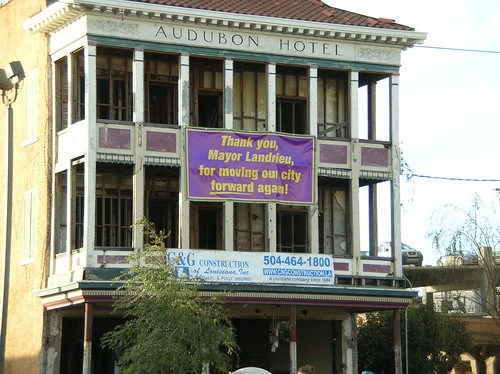
The rent is too damn high

Audubon Hotel

Rents are too damn high all over the country and they aren't coming down any time soon.
Recent research from the Harvard Joint Center for Housing Studies and Enterprise Community Partners, a real-estate research and investment organization, suggests that over the next 10 years, the rental population in the U.S. will climb by about 4 million people. (That’s actually a conservative estimate compared to the Urban Institute’s projections.)

The researchers estimate that the current rental crunch—the one where vacancies are around 7 percent, about half of renters spend more than 30 percent of their salaries on housing, and one quarter spend 50 percent or more—is only going to get worse over the next decade. Even if housing prices and income rise as quickly as inflation (about 2 percent annually) the number of severely rent-burdened Americans (those paying 50 percent or more) would increase by 11 percent over the decade, to over 13 million people in 2025.
Another thing we're going to find out over the next decade is that the policy response (such as it is) has been wholly inadequate to meet the problem.  Household incomes are not growing.  That's something we've understood for a long time.  Often we just allow the banks to fake their way through that by recklessly extending credit.  We still do that, actually.

But an interesting thing happened the last time that blew up in everyone's face.   The banks who created the credit fraud, ended up owning a lot of housing stock as a result.
The proposed merger of Starwood Waypoint and Colony is a bet that the percentage of Americans who own homes will remain unusually low. While the foreclosure crisis has receded, toughened lending standards have pushed millions of Americans out of the homebuying market.

Higher interest rates would increase borrowing costs and make it harder for some renters to buy homes.

The Federal Reserve decided last week not to raise short-term interest rates from near zero, where they have held since 2008, but the central bank is expected to revisit the matter later this year.

The U.S. homeownership rate is at its lowest level in nearly 50 years, falling to 63.5% in the second quarter, according to the Commerce Department.

In contrast, single-family rentals now add up to 13% of overall housing stock, up from 9% in 2005, according to a report by Moody’s Analytics.

Rents have been climbing steadily, though some analysts and investors question how long it can last, especially in areas with weak wage growth. Many of the rental homes scooped up by big investors are in those parts of the U.S.
In some cases, banks are finding out that they kind of prefer being landlords to financing home ownership.
It was widely deemed a temporary play: Large-scale investors buying thousands of discounted foreclosed properties during the worst of the housing crash and turning them into single-family rentals. When home prices recovered, they would surely sell them for a hefty profit. The housing market is recovering, albeit more slowly than expected. Foreclosure volume is way down and home prices are way up, but these investors are not selling.

They are buying more, and now they are buying new.

"I actually think that we're coming into perhaps the most compelling three or four years that I've seen since I've been in the business," said Doug Brien, CEO of Starwood Waypoint Residential Trust.
There are a number of negative effects we can focus on here
Banks, hedge funds, and private equity firms have been amassing those real estate holdings for a few years now, but their plan for wringing profit out of the rental market is just starting to draw real scrutiny. The New York-based hedge fund Blackstone Group is now the nation’s largest landlord after purchasing over 40,000 foreclosed family homes for the purpose of renting them out.

While firms like Blackstone often farm out the day-to-day management of the rental properties to third-party companies, those intermediaries are often also based in faraway states. Some have a track record of being unresponsive to basic things like broken sewer pipes, as the Huffington Post has reported. The banks and their intermediaries may neglect basic upkeep of these properties. In that worst-case scenario for renters, local and attentive property managers and building supers will get replaced with “Wall Street-based absentee slumlords,” in David Dayen’s phrase.

On-the-ground concerns for communities and renters go beyond neglect, however. The rising influence of financial titans turned local landlords could threaten all sorts of public services. In the case of Huber Heights, OH, the hedge fund Magnetar Capital has become the largest landlord in the whole town and is using that influence to try to extract lower property tax charges from the town — a change that would undermine funding for schools and other public services for locals, but boost the bottom line of the Illinois-based financial giant. (Magnetar’s dodgy past dealings from the subprime era also underscore an unsettling dynamic to Wall Street’s entry into the rental market: the same companies that helped turn homeowners into renters through mass foreclosures are now preparing to make even more money off of the same rental demand they helped create.)
But essentially we're looking (again) at a case of financial intermediaries serving to further concentrate wealth among the investor class rather than help purpose it toward the betterment of individual lower or middle class households.

A reasonable policy response might attack that problem directly; perhaps by writing rules that de-commodify housing or at least limit banks' capacity to act as mega-landlords, or by imposing rent controls in neighborhoods threatened by gentrification, or even by building more public housing. 

Of course, we are doing none of that.  Instead we are, as The Advocate editorial board says, waiting for "the market" to fix everything for us.  But why would it?  Incomes are stagnant. But we already know that the local labor market is decoupled from the local real estate market.  We also know that the market for affordable housing is tightening but all we seem to do is build more and more nice things for rich people.
Developers building condos on the site of the old Hubig's Pie factory in the Marigny are now turning to a plum piece of riverfront property in the Bywater.

MK RED, a partnership of Michael Bosio and Kyle Resmondo, plans to build a 55-foot, $8 million condo building with 16 residences on vacant land near the Piety Street archway bridge into Crescent Park.

They bought the property at 3200 Chartres St. in August for $1.35 million.

"It's everything going on in the Bywater," Bosio said. "You have great food locations down there. You have the new park and of course, the views. You get the whole city skyline."
In the Bywater, of course.  But also Uptown.
Phyllis Landrieu, a former Orleans Parish School Board member and aunt of the mayor, plans to replace two small homes at the corner of St. Charles Avenue with a 57-foot-tall condo building with 10 units inside. Landrieu and her supporters said that the two “ranch-style” homes are out of character with the grand nature of St. Charles Avenue, and that the proposed building will enhance the avenue’s appearance.

Landrieu’s building would be adjacent to another condo building in the same block, and it was residents of that structure who provided the most opposition to her proposal. They said they had a petition of 90 neighbors in opposition, and argued that the new building will take up too much of the lot and be too close to their building.

Elsewhere uptown.
Chris Jones, his wife Jessica Walker, and David Gindin described their vision for the redevelopment of the Audubon Hotel to the Coliseum Square Association as a 30-room boutique hotel designed to attract a younger, more international clientele. Their renovation will actually reduce the number of rooms in the building somewhat, because the older floor plans had shared bathrooms, and they intend to put a bathroom in every room.

The hotel does not have room for a restaurant, but its front desk will double as a small bar, Gindin explained. It will also be staffed 24 hours a day, he said.

“I think that’ll contribute a little bit to the security of the area,” Gindin said. “That part of St. Charles does have some issues, but part of the problem is you have an abandoned building there.”
Hey.. it's "back in commerce" and good for "the security of the area." That seems to be all we care about lately. What we don't care much about, though, is whether or not we have an affordable housing strategy. This is trickle-down economic policy.  It will help enrich some New Orleans developers and some out of town investors and.. as you can see.. some Landrieus.  But, no matter what the various mouthpieces and politicians involved tell you,  it is not going to help relieve the problem of too-damn-high rents in New Orleans.

Saturday, July 11, 2015

Moral Hazard

Somebody got "bailed out" via Greece. It wasn't the Greeks, though.
In other words, the Greek deficit was a rounding error, not a reason to panic. Unless, of course, the folks holding Greek debts, those big banks in the eurozone core, had, over the prior decade, grown to twice the size (in terms of assets) of—and with operational leverage ratios (assets divided by liabilities) twice as high as—their “too big to fail” American counterparts, which they had done. In such an over-levered world, if Greece defaulted, those banks would need to sell other similar sovereign assets to cover the losses. But all those sell contracts hitting the market at once would trigger a bank run throughout the bond markets of the eurozone that could wipe out core European banks.

Clearly something had to be done to stop the rot, and that something was the troika program for Greece, which succeeded in stopping the bond market bank run—keeping the Greeks in and the yields down—at the cost of making a quarter of Greeks unemployed and destroying nearly a third of the country’s GDP. Consequently, Greece is now just 1.7 percent of the eurozone, and the standoff of the past few months has been over tax and spending mixes of a few billion euros. Why, then, was there no deal for Greece, especially when the IMF’s own research has said that these policies are at best counterproductive, and how has such a small economy managed to generate such a mortal threat to the euro?

Part of the story, as we wrote in January, was the political risk that Syriza presented, which threatened to embolden other anti-creditor coalitions across Europe, such as Podemos in Spain. But another part lay in what the European elites buried deep within their supposed bailouts for Greece. Namely, the bailouts weren’t for Greece at all. They were bailouts-on-the-quiet for Europe’s big banks, and taxpayers in core countries are now being stuck with the bill since the Greeks have refused to pay. It is this hidden game that lies at the heart of Greece’s decision to say “no” and Europe’s inability to solve the problem.
Euro speculation led banks in France and Germany to become "too big to fail."   They were over-leveraged in Greece. So that's where the money went. It didn't stay there.
The EFSF was a company the EU set up in Luxemburg “to preserve financial stability in Europe’s economic and monetary union” by issuing bonds to the tune of 440 billion euro that would generate loans to countries in trouble.

So what did they do with that funding? They raised bonds to bail Greece’s creditors—the banks of France and Germany mainly—via loans to Greece. Greece was thus a mere conduit for a bailout. It was not a recipient in any significant way, despite what is constantly repeated in the media. Of the roughly 230 billion euro disbursed to Greece, it is estimated that only 27 billion went toward keeping the Greek state running. Indeed, by 2013 Greece was running a surplus and did not need such financing. Accordingly, 65 percent of the loans to Greece went straight through Greece to core banks for interest payments, maturing debt, and for domestic bank recapitalization demanded by the lenders. By another accounting, 90 percent of the “loans to Greece” bypassed Greece entirely.
Banksters take enormous risks. Banksters make enormous profits. Until the risks start to fall through and the banksters demand to be paid out of people's retirement funds. In the end there's really no such thing as a risk as far the banksters are concerned.  So this is a story of moral hazard. It's just not the moral hazard story our political scolds would like us to believe it is. 

Wednesday, July 08, 2015

Eric Holder's new (old) gig

You can't even really say it's despicable anymore. It's just normal.
Holder will reassume his lucrative partnership (he made $2.5 million the last year he worked there) and take his seat in an office that reportedly – this is no joke – was kept empty for him in his absence.

The office thing might have been improper, but at this point, who cares? More at issue is the extraordinary run Holder just completed as one of history's great double agents. For six years, while brilliantly disguised as the attorney general of the United States, he was actually working deep undercover, DiCaprio in The Departed-style, as the best defense lawyer Wall Street ever had.

Holder denied there was anything weird about returning to one of Wall Street's favorite defense firms after six years of letting one banker after another skate on monstrous cases of fraud, tax evasion, market manipulation, money laundering, bribery and other offenses.
Banksters run the world. Even when their computers are broken, they run it all. 

Monday, July 06, 2015

QOTD

Thomas Piketty on debts and who doesn't pay them.

DIE ZEIT: Should we Germans be happy that even the French government is aligned with the German dogma of austerity?

Thomas Piketty: Absolutely not. This is neither a reason for France, nor Germany, and especially not for Europe, to be happy. I am much more afraid that the conservatives, especially in Germany, are about to destroy Europe and the European idea, all because of their shocking ignorance of history.

ZEIT: But we Germans have already reckoned with our own history.

Piketty: But not when it comes to repaying debts! Germany’s past, in this respect, should be of great significance to today’s Germans. Look at the history of national debt: Great Britain, Germany, and France were all once in the situation of today’s Greece, and in fact had been far more indebted. The first lesson that we can take from the history of government debt is that we are not facing a brand new problem. There have been many ways to repay debts, and not just one, which is what Berlin and Paris would have the Greeks believe.

ZEIT: But shouldn’t they repay their debts?

Piketty: My book recounts the history of income and wealth, including that of nations. What struck me while I was writing is that Germany is really the single best example of a country that, throughout its history, has never repaid its external debt. Neither after the First nor the Second World War. However, it has frequently made other nations pay up, such as after the Franco-Prussian War of 1870, when it demanded massive reparations from France and indeed received them. The French state suffered for decades under this debt. The history of public debt is full of irony. It rarely follows our ideas of order and justice.

ZEIT: But surely we can’t draw the conclusion that we can do no better today?

Piketty: When I hear the Germans say that they maintain a very moral stance about debt and strongly believe that debts must be repaid, then I think: what a huge joke! Germany is the country that has never repaid its debts. It has no standing to lecture other nations.
But we're gonna keep on with this little morality play, I guess.  

Sunday, July 05, 2015

"Democracy conquers fear"

Tsipras:
Many people can ignore the will of a government. But no one can ignore the will of a people.

Today is a day of celebration, because democracy is a celebration, it is joy. And when democracy overcomes fear and extortion, then it becomes a redemption and a way out. The Greek people today send a very strong message. A message of dignity and determination. The message that they hold a choice in their hands. No one can ignore the will of a people to live. To live with determination and take their life in their own hands.

I am certain that from tomorrow we will have broken a path for all the peoples in Europe. A path of return to the founding values of democracy and solidarity in Europe, sending a strong message of determination, not only to stay but also to live with dignity in Europe. To do well and work as equals among equals. Let us therefore make this act of strong will, this celebratory act of democracy, an act of determination for a better future for all of us, both in Greece and Europe. I am very optimistic.

Polls closed about 45 minutes ago. Telephone surveys indicate a slight advantage for "no." But we know how reliable that sort of thing can be. 

What happens now? Bad things, probably. But not quite as bad as a government capitulating to the demands of international finance over the objections of its own people.  Plus now maybe they'll even make the bankers listen.. a little bit anyway.

Wednesday, July 01, 2015

Meanwhile back at the not-at-all liberal Democratic Party

Nancy Pelosi doesn't want the banksters to worry.

House Minority Leader Nancy Pelosi (D-Calif.) disagrees with Sen. Elizabeth Warren’s (D-Mass.) notion that the Obama administration is too soft on Wall Street.

While Warren has been a vocal critic of how some of President Obama’s top lieutenants policing Wall Street have done their job, Pelosi cast her perspective as an outlier among her colleagues.

When asked in a CNBC interview if the president is too soft on Wall Street, Pelosi replied, “The financial industry doesn’t agree with that.

There may be a couple people who say that, but that is not the consensus in our party,” she added.

Warren has been a thorn in the side of the Obama administration on all things financial. She led the charge to scuttle a top Treasury Department nominee over his extensive ties to the financial sector, and earlier this month, she detailed her perceived failures in Mary Jo White, the head of the Securities and Exchange Commission.

But Pelosi was quick to caution anyone from taking Warren’s argument and applying it to the entire Democratic Party.

“People will express themselves the way they do. That doesn’t mean they speak for the whole party,” she said.
 What the hell are they even any good for?

Sunday, March 22, 2015

Sounds like a real job-killer

Those 47 Republican Senators are just trying to keep Obama from imposing a job-killing Iranian nukes moratorium.
The possibility of an Iran nuclear deal depressing weapons sales was raised by Myles Walton, an analyst from Germany’s Deutsche Bank, during a Lockheed earnings call this past January 27th. Walton asked Marillyn Hewson, the chief executive of Lockheed Martin, if an Iran agreement could “impede what you see as progress in foreign military sales.” Financial industry analysts such as Walton use earnings calls as an opportunity to ask publicly-traded corporations like Lockheed about issues that might harm profitability.

Hewson replied that “that really isn’t coming up,” but stressed that “volatility all around the region” should continue to bring in new business. According to Hewson, “A lot of volatility, a lot of instability, a lot of things that are happening” in both the Middle East and the Asia-Pacific region means both are “growth areas” for Lockheed Martin.