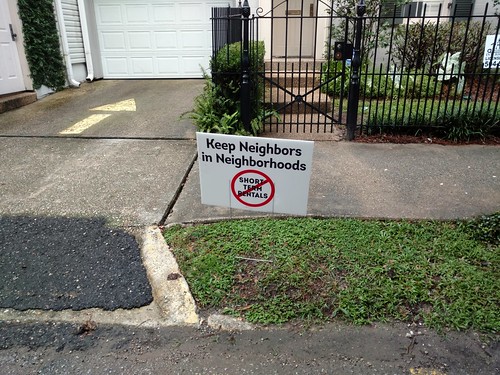
Rents are too damn high all over the country and
they aren't coming down any time soon.
Recent research
from the Harvard Joint Center for Housing Studies and Enterprise
Community Partners, a real-estate research and investment organization,
suggests that over the next 10 years, the rental population in the U.S.
will climb by about 4 million people. (That’s actually a conservative
estimate compared to the Urban Institute’s projections.)
The researchers estimate that the current rental crunch—the one where vacancies are around 7 percent, about half
of renters spend more than 30 percent of their salaries on housing, and
one quarter spend 50 percent or more—is only going to get worse over
the next decade. Even if housing prices and income rise as quickly as
inflation (about 2 percent annually) the number of severely
rent-burdened Americans (those paying 50 percent or more) would increase
by 11 percent over the decade, to over 13 million people in 2025.
Another thing we're going to find out over the next decade is that the policy response (such as it is) has been wholly inadequate to meet the problem. Household incomes are not growing. That's something we've understood for a long time. Often we just allow the banks to fake their way through that by recklessly extending credit. We still do that, actually.
But an interesting thing happened the last time that blew up in everyone's face. The banks who created the credit fraud,
ended up owning a lot of housing stock as a result.
The proposed merger of Starwood Waypoint and Colony is a bet that the
percentage of Americans who own homes will remain unusually low. While
the foreclosure crisis has receded, toughened lending standards have
pushed millions of Americans out of the homebuying market.
Higher interest rates would increase borrowing costs and make it harder for some renters to buy homes.
The
Federal Reserve decided last week not to raise short-term interest
rates from near zero, where they have held since 2008, but the central
bank is expected to revisit the matter later this year.
The U.S.
homeownership rate is at its lowest level in nearly 50 years, falling to
63.5% in the second quarter, according to the Commerce Department.
In
contrast, single-family rentals now add up to 13% of overall housing
stock, up from 9% in 2005, according to a report by Moody’s Analytics.
Rents have been climbing steadily, though some analysts and investors
question how long it can last, especially in areas with weak wage
growth. Many of the rental homes scooped up by big investors are in
those parts of the U.S.
In some cases, banks are finding out that they kind of
prefer being landlords to financing home ownership.
It was widely deemed a temporary play: Large-scale investors buying
thousands of discounted foreclosed properties during the worst of the
housing crash and turning them into single-family rentals. When home
prices recovered, they would surely sell them for a hefty profit. The
housing market is recovering, albeit more slowly than expected.
Foreclosure volume is way down and home prices are way up, but these
investors are not selling.
They are buying more, and now they are buying new.
"I actually think that we're coming into
perhaps the most compelling three or four years that I've seen since
I've been in the business," said Doug Brien, CEO of Starwood Waypoint Residential Trust.
There are a number of
negative effects we can focus on here.
Banks, hedge funds, and private equity firms have been amassing those
real estate holdings for a few years now, but their plan for wringing
profit out of the rental market is just starting to draw real scrutiny.
The New York-based hedge fund Blackstone Group is now the nation’s largest landlord after purchasing over 40,000 foreclosed family homes for the purpose of renting them out.
While firms like Blackstone often farm out the day-to-day management
of the rental properties to third-party companies, those intermediaries
are often also based in faraway states. Some have a track record of
being unresponsive to basic things like broken sewer pipes,
as the Huffington Post has reported. The banks and their intermediaries
may neglect basic upkeep of these properties. In that worst-case
scenario for renters, local and attentive property managers and building
supers will get replaced with “Wall Street-based absentee slumlords,” in David Dayen’s phrase.
On-the-ground concerns for communities and renters go beyond neglect,
however. The rising influence of financial titans turned local
landlords could threaten all sorts of public services. In the case of
Huber Heights, OH, the hedge fund Magnetar Capital has become the
largest landlord in the whole town and is using that influence to try to
extract lower property tax charges from the town — a change that would undermine funding for schools and other public services for locals, but boost the bottom line of the Illinois-based financial giant. (Magnetar’s dodgy past dealings
from the subprime era also underscore an unsettling dynamic to Wall
Street’s entry into the rental market: the same companies that helped
turn homeowners into renters through mass foreclosures are now preparing
to make even more money off of the same rental demand they helped
create.)
But essentially we're looking (again) at a case of financial intermediaries serving to further concentrate wealth among the investor class rather than help purpose it toward the betterment of individual lower or middle class households.
A reasonable policy response might attack that problem directly; perhaps by writing
rules that de-commodify housing or at least limit banks' capacity to act as mega-landlords, or by imposing rent controls in neighborhoods threatened by gentrification, or even by
building more public housing.
Of course, we are doing none of that. Instead we are, as
The Advocate editorial board says, waiting for "the market" to fix everything for us. But why would it? Incomes are stagnant. But we already know that the
local labor market is decoupled from the local real estate market. We also know that the market for affordable housing is tightening but all we seem to do is
build more and more nice things for rich people.
Developers building condos on the site of the old Hubig's Pie factory in the Marigny are now turning to a plum piece of riverfront property in the Bywater.
MK RED, a partnership of Michael Bosio and Kyle Resmondo, plans to
build a 55-foot, $8 million condo building with 16 residences on vacant
land near the Piety Street archway bridge into Crescent Park.
They bought the property at 3200 Chartres St. in August for $1.35 million.
"It's everything going on in the Bywater," Bosio said. "You have
great food locations down there. You have the new park and of course,
the views. You get the whole city skyline."
In the Bywater, of course.
But also Uptown.
Phyllis Landrieu, a former Orleans Parish School Board member and aunt
of the mayor, plans to replace two small homes at the corner of St.
Charles Avenue with a 57-foot-tall condo building with 10 units inside.
Landrieu and her supporters said that the two “ranch-style” homes are
out of character with the grand nature of St. Charles Avenue, and that
the proposed building will enhance the avenue’s appearance.
Landrieu’s building would be adjacent to another condo building in
the same block, and it was residents of that structure who provided the
most opposition to her proposal. They said they had a petition of 90
neighbors in opposition, and argued that the new building will take up
too much of the lot and be too close to their building.
Elsewhere uptown.
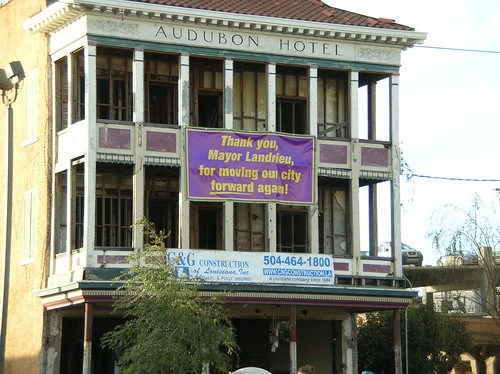
Chris Jones, his wife Jessica Walker, and David Gindin described
their vision for the redevelopment of the Audubon Hotel to the Coliseum
Square Association as a 30-room boutique hotel designed to attract a
younger, more international clientele. Their renovation will actually
reduce the number of rooms in the building somewhat, because the older
floor plans had shared bathrooms, and they intend to put a bathroom in
every room.
The hotel does not have room for a restaurant, but its front desk
will double as a small bar, Gindin explained. It will also be staffed 24
hours a day, he said.
“I think that’ll contribute a little bit to the security of the
area,” Gindin said. “That part of St. Charles does have some issues, but
part of the problem is you have an abandoned building there.”
Hey.. it's "back in commerce" and good for "the security of the area." That seems to be all we care about lately. What we don't care much about, though, is whether or not we have an affordable housing strategy. This is
trickle-down economic policy. It will help enrich some New Orleans developers and some out of town investors and.. as you can see.. some Landrieus. But, no matter what the various mouthpieces and politicians involved tell you, it is not going to help relieve the problem of too-damn-high rents in New Orleans.