-->
Showing posts with label Stephen Perry. Show all posts

Monday, January 24, 2022

Congrats, Walt

I resolved to do more posts in 2022. I haven't done more posts yet.  Will do more posts soon. Seriously. Like I said before, I've got a a big backlog of notes and outlines of things I could have written months ago but never got around to.  I've also got some "draft" posts that are really just bookmarks of single items I read in the news but didn't want to forget. I've always tried to put things like that on the blog so I can find them later. Gonna try to get back in that habit as well soon. Anyway, if I end up posting some stuff that seems like old news this is why. This is going to be a very dark year, I am afraid, for a lot of reasons.  Not sure what to do about it other than just try to keep the notes straight as it happens. 

For example, in December, we learned that Walt Leger is finally getting his "fair share" of the spoils he earned guiding the legislation that the mayor called a Fair Share for the city but which actually just gave the Convention Center more control over its slush fund and made the privately operated but publicly funded New Orleans and Co. tourism promotion corporation even richer and less accountable to the public.  

As a reward, Walt will get to run the unaccountable private tourism promotion corporation

Stephen Perry, the outspoken longtime leader of New Orleans' tourism and marketing agency, will step down at the end of next year, he said Thursday.

He will be replaced as CEO of New Orleans & Co., the private, publicly-funded nonprofit, by former state legislator Walter “Walt” Leger III, an attorney and former Speaker Pro Tempore of the Louisiana House of Representatives. Leger is currently executive vice president and general counsel at New Orleans & Co.

Friday, April 03, 2020

Work lists

Delusions.  
New Orleans’ tourism-dependent economy will remain shut down until at least June, business leaders said Thursday, with no one able to say with certainty when it will fully reopen.

“Based on the fact that the governor has extended the stay in place order until April 30 and we are nowhere near our peak [in infections] in New Orleans, it will be well into May and probably June before the stay-in-place order is released and we start to go back out,” said Stephen Perry, president and CEO of New Orleans & Co., which promotes tourism. “For tourists, we’re not anticipating anything until August or September. Our industry is just watching carefully and making sure we watch every health protocol.”
Ha ha, what?  Do they mean June of next year?  Because really even that seems optimistic. But when you are Stephen Perry and your business is basically marketing, you are trained to believe that real wealth is created entirely through perception management.  In a way it's hard to blame Perry for thinking that. It's certainly made him rich, anyway.  But it's also a chronically blinkered way of understanding what's going on out there. And it's why New Orleans's tourism ownership class should be the last people anyone turns to for policy advice right now. (Too late, I know.)

What will it take to "restart the economy?" The longer we go without providing the millions of suddenly jobless Americans a means of support during the shut down, the harder it will be.  There is a plan to do this but Congress left it sitting on the shelf before they adjourned for (at least) the rest of April. In the meantime we'll just keep handing all the money we print over to large corporations and  investment banks with little or no accountability as to what they do with it.
Neither Fed nor Treasury officials would comment on the record. But the Fed quietly began to signal its discomfort with onerous conditions on Monday when it unveiled the terms of two new corporate credit programs that are likely to play a significant role in the bailout. One had no restrictions on how borrowers can use the money, while the other had extremely mild limits on stock buybacks and dividends, and only for firms that defer their loan payments.

Those two programs represent an extraordinary escalation in fighting the crisis, empowering the Fed for the first time to buy investment-grade corporate bonds and financial instruments backed by corporate bonds, with the potential to expand to even riskier corporate debt once the Treasury injects some bailout funds as a backstop.

But while the programs don’t look like the “Trump slush fund” some Democrats feared, they don’t look like the worker-first initiatives some Democrats promised. Unlike the CARE Act’s separate $360 billion small business bailout, they impose no requirements that the beneficiaries use the money to retain their employees. And unlike the 2008 bank bailout, they impose no limits on executive pay.
It's important to understand that this favoritism toward Wall Street is a deliberate policy choice. We could be doing things very differently.  The same "money printing" process the Fed employs now to float trillions of dollars out to banks could be used to put cash in the hands of ordinary Americans who very badly need it right now.  Economist Stephanie Kelton briefly explained this in a column for the Intercept last week.
Think back to 2019, when the political conversation centered around the Democratic presidential primaries and whether we could afford the kinds of ambitious spending proposals being pushed by Sanders or Warren. Neither of them admitted it at the time, but Congress could have canceled student loan debt, lowered Medicare’s eligibility age to zero, or paid to make public colleges and universities tuition-free simply by writing a bill that sent one set of instructions to the Fed. Spending or not spending money is always a political choice. 

That’s not to say that Congress can authorize multitrillion-dollar spending bills left and right without ever building in offsets to subtract dollars out of the economy. There are limits.

But the limits aren’t financial. Uncle Sam can’t run out of dollars. The U.S. government is the issuer of our currency — the U.S. dollar — which means that, unlike Greece, it can never find itself in a situation in which it has bills coming due that it can’t afford to pay. Remember, Greece gave up its sovereign currency — the drachma — and started borrowing in what is effectively a foreign currency — the euro — when it joined the Economic and Monetary Union in 2001. That’s why it (and other) countries in the eurozone experienced a debt crisis and countries like Japan, the U.K. and the U.S. did not. 

So what are the limits for a currency-issuing government like the United States? The answer is inflation. The government can’t run out of money, but it can run out of things to buy (including labor). We are constrained by our real resources — i.e. our technical know-how and the available supply of workers, factories, machines, raw materials, and so on. As long as the economy isn’t already operating at full capacity, then it is reasonable for Congress to send just one set of instructions to the Fed.
This is the point that gives lie to every conservative and neoliberal trope about "how you pay for it." What we're really bounded by is how much the economy can produce and for whom. What Kelton is saying there is we can keep printing money until we produce enough stuff to match it. The money gun is real. It's just that the choices we make about where to target it are meant to prop up the status quo rather than benefit most Americans.

Instead the biggest cash infusion into the economy will support destructive activities.  Here's how that could end up affecting the New Orleans economy in June whenever it is ready to go back to business. 
In Louisiana, four dozen hotels — ranging from some of the largest, well-known brand names in New Orleans, like the Hyatt Regency, to budget roadside inns in Lake Charles — are financed by a total of $1.1 billion of the kind of loans that can make them the potential prey for so-called vulture investors, who specialize in targeting businesses during troubled times.

The loans, called commercial mortgage-backed securities, or CMBS, differ from traditional bank mortgages in that they are pooled together, converted into bonds and sold to investors, such as hedge funds or pension managers.

That means that instead of dealing with a traditional bank when there are payment problems, hotel owners with these loans must answer to "special servicers" who represent only the interest of the bond investors.
What this means is several New Orleans hotels could find themselves vulnerable to private equity firms who specialize in carving up companies with financial vulnerability, selling off their assets, and putting their employees out of work. It's similar to what happened to Bayou Steel last year. The result is more workers are left to fend for themselves.

No worries, though. Here comes Bill Cassidy to help. In this Wall Street Journal op-ed Cassidy (along with Christopher Mores) plans to get everyone back to work sooner than later by putting them on a list.
To restart the economy, the government needs to set up coronavirus-immunity registries. At the same time, widespread testing is necessary to document immunity in those who haven’t fallen sick. A recent report from China found that 100% of patients tested two weeks after symptoms cleared had antibodies for the coronavirus. Recovering from a known coronavirus infection or having a positive antibody test is likely to indicate immunity lasting for at least some time. Those who so demonstrate that they are immune can be allowed to return to work. The whole community is freer when herd immunity is established.

Dr. Cassidy is well aware that the science on "herd immunity" to COVID 19 still has a long way to go. One "recent study from China" doesn't get you there. "Immunity lasting for at least some time" is vague, also. At this point we still don't know how long any acquired immunity lasts.  But the "allowed to return to work" is the real kicker. What he means is "compelled."

And that is what all of these policy choices taken together add up to. 10 million newly unemployed Americans' lives are meant to be kept as precarious as possible so that there will be plenty of compliant labor available when we get "back to business." We run the big money printer for Wall Street firms. We attach labyrinthine thickets of red tape to small business loans. And we give working people $1200 maybe 5 months from now.  But, hey, at least we'll have a list of who is "allowed" to work. That's real progress.

Thursday, February 21, 2019

How would a local "wealth tax" work?

Danae Columbus seems worried here that LaToya might change her mind on the whole "take from the rich and give to the poor and all that kind of crap" thing. I'm not sure why she would worry. Anyone in New Orleans politics raising the kind of money Cantrell has clearly is already taking enough from the rich that she wouldn't want to hurt their feelings too badly.  Still, Columbus is right to point out, taxing the rich is a popular idea. And one thing we know about LaToya is she does like to be popular.
Another option that the populist Cantrell could consider is a tax on the rich, which is growing in popularity nationwide, according to the New York Times. In a recent poll by the online research platform SurveyMonkey, a majority of voters favor such an effort. Even Republicans support presidential candidate Elizabeth Warren’s proposal to increase taxes America’s wealthiest based on net worth. Many Democrats consider it a “moral issue.” Sixty-two percent of those surveyed agreed that government should try to reduce inequity. The survey suggested a 2 percent tax for those with wealth above $50 million.

Proponents like Rep. Alexandria Ocasio-Cortez consider the tax as a way to resolve inequity problems not being adequately addressed by government. Inequity continues to be an on-going issue in New Orleans, a city where a large number of under-educated, non-homeowners are stuck in low-paying tourism industry jobs. But that doesn’t mean Cantrell would want to alienate her former Garden District and Uptown base who would be natural targets. New Orleans has always been a city with wide contrasts between the haves and the have-nots. A wealth tax based on any income level could trigger a new exodus to the suburbs, especially from older tax-payers.
Okay but explain to me about how a municipal "wealth tax" would even work? Does the city even have the authority to implement such a thing?  What a radical idea. I would love to hear more. Thanks to Columbus for bringing it up.

Still, I'm not sure what the point is since nothing like that is even on the table.  Presently we're having a fight over how much of the existing tourism tax revenues should accrue to the city rather than to the various tourism facilities and promotion boards who currently receive a lion's share. 

This week, the mayor appeared on the Advocate's podcast for a brief interview about this. It would relieve Columbus to know that nothing Cantrell said there sounds particularly socialistic. In fact she took great pains there to emphasize the fact that she wishes the tourism cabal nothing but success. "I come from tourism," she says alluding to her time working for the hotels. Completely oblivious to any sort of class consciousness, LaToya talks about her time as a hotel front desk and housekeeping grunt implying that the interests of such are completely aligned with those of plutocrats like Stephen Perry who exploit that subsistence labor to arrange six figure salaries for themselves.

If Cantrell does manage to wrest a "fair share".. or at least a fairer share of Perry's bounty away from him then maybe, in a way, we could consider that a kind of "wealth tax."  Maybe it's a wealth re-appropriation.  In any case, it's still apparently different from the full communism Columbus is proposing. I do hope she explains this further.

Sunday, January 13, 2019

NO & Co. vs #CityOfYes and other potential 2019 political schisms

2019 is a statewide election year in Louisiana and candidates are starting to slot in to some of the legislative races. There's going to be a fair amount of shuffling about this year as the next wave of term limits claims its victims. In Orleans Parish both Walt Leger (House District 91) and Neil Abramson (House District 98)  are graduating and will have to replaced. Also the legislature we elect this year will be responsible for redrawing districts after the 2020 census so this is going to be particularly important. Let's try and not muck this up too badly. Not that there's a lot we can do with the choices allotted to us. Danae Columbus's latest gossip column about potential candidates does not offer much comfort, anyway.

In Leger's district, there is a guy whose actual name is Carling Dinkler IV. Dinkler is the scion of an old New Orleans family of hoteliers renowned for observing "accepted business practices" right up until the US Attorney General pressured them to stop that.
During a tumultuous era, in which racial segregation was the norm and the fight for civil rights would turn ugly, Dinkler Hotels became one of the first hospitality companies to integrate, but change came neither quickly nor easily. Referring to the unwavering attitudes of the day, Inman Allen, son of the late Atlanta mayor Ivan Allen Jr., acknowledges, "We were a segregated society in the 50s and up into the 60s." And, though the widespread violence observed in cities like Selma and Montgomery was kept at a minimum in Atlanta, many white business owners were very reluctant to accept and implement progressive reforms.

Despite a change in ownership, the Dinklers, under the auspices of a management contract, remained the primary policy makers for the hotels. While the Dinkler family was by no means a clan of bigots, their perspective on segregation was more reflective of the times and accepted business practices than personal convictions. The Dinklers ultimately yielded to the call for integration, but some prominent Atlantans like eventual Georgia governor Lester Maddox (who opted to close his Pickrick Cafeteria, an Atlanta institution, rather than serve black customers) stubbornly refused to relinquish their Jim Crow persuasions.

That said, between 1961 and 1964, the Dinkler Plaza Hotel was the focus of several protests and racial controversies, some of which made national headlines.
Here is a podcast I found wherein Carling Dinkler III tells us about the great favor done for New Orleans back when Moon Landrieu and Lester Kabacoff got together and invented tourism. Dinkler III was a founder of the New Orleans Convention and Visitors' Bureau, recently re-branded "New Orleans and Company."

New Orleans and Co. was in the news this week when it turned out its current director, Stephen Perry has some opinions on municipal budget priorities.  Specifically he believes funding the critical infrastructure that keeps amoebas out of the water you drink and, well, your city out of the water in the first place, is a "waste" compared to funding the tourism patronage machine from which he derives a half-million dollar salary.
Cantrell says the city needs the money to pay for what her administration estimates are tens of millions of dollars in infrastructure repairs. But Perry told The Lens that such a move would undercut the city’s economy, saying that new revenue would be wasted on what he characterized as an underperforming city government.

“In an unhinged interview with the Lens, J. Stephen Perry, who takes home over $430K per year to promote the City, spent most of his time tearing it down,” Action New Orleans wrote in a Tuesday morning press release. (A 2016 CVB tax filing — the most recent one available — shows that Perry’s compensation from the tourism group was closer to $460,000.)
Of course it isn't that much of a stretch for Perry, or anyone in his position to just assume that he's running the whole city anyway. Perry and the hoteliers have already hired their own police force (sort of) and contributed to the expanding French Quarter surveillance network.  In the opening gambit of its negotiations with Cantrell this year, NO and Co. proposed a hotel-specific sales tax scheme that would finance a one-time payment to the city dedicated to infrastructure. The mayor, quite rightly, rejected the offer as inadequate. But Perryet al were so impressed with themselves that they went ahead and drew up a spending plan for the money anyway as if they were purchasing actual governing authority.

When you allow the tourism cabal to hoard as much public money for doling out to cronies and developers as it does, then you can expect they're going to assume more power than they are entitled to. But just to make sure nobody gets any ideas about reining them in, they also do a fair amount of propaganda. Here's what happens when somebody checks their work.
Amid new pressure from unions and an ongoing debate over whether the city’s hospitality and tourism industry is doing enough to support its mostly low-wage workers, a local nonprofit research group has released a report estimating that the industry’s economic footprint is significantly smaller than previous industry-led estimates.

While hospitality leaders have long touted the industry’s ranks as amounting to more than 80,000 jobs, the Data Center’s report Tuesday pegs the number of New Orleans residents who make their living from tourism at closer to 30,000.

Part of the issue with such projections, the Data Center notes, is that defining what qualifies within a set industry cluster is “a rather subjective activity, leaving definitions vulnerable to pressures to make industry clusters look as large and inclusive as possible.”
On the Lens podcast episode that features Perry's "unhinged" interview, Lens editor Charles Maldonado talks about the difficulty in trying to verify the tourism industry's assertions. Perry sources a dubious claim about what percentage of city revenue derives from tourism to an offhand comment in a phone conversation he once had with Andy Kopplin.  At one point it even sounds like NO & Co. has credited 100 percent of Orleans Parish sales tax revenue to the tourism industry.

There is additional comedy in the interview so, please, give it a listen.  Perry describes himself at the beginning as a "leftist" and then promptly launches into a rote recitation of every right wing economic talking point in the book. He complains that the city actually has "a spending problem, not a revenue problem" echoing a common Republican refrain from the past several legislative sessions.  He also bristles at the notion that we should want to fund city services by taxing a "high performing organically created private sector enterprise" which suggests he should probably go back and listen to Dinkler III's fond ruminations on our carefully planned and heavily subsidized tourism economy.

Eventually this dispute between Perry's NO & Co. and LaToya's #CityOfYes is going to have to be mediated in Baton Rouge. Which is where Dinkler IV is aiming to position himself.  According to his website Dinkler The Youngerest is "inspired by President Bill Clinton’s words, 'Opportunity for All."  Good luck figuring out what that is supposed to mean.  In any case it's hard to imagine he's likely to side against the family business in any meaningful way.

Also in Columbus's column we read the names Aylin Maklansky and Aimee Adotto Freeman as potential legislative candidates.  I'm assuming she means they're both going for Abramson's seat.  Freeman is a business consultant and, I guess, a dog person, who is associated with the usual circle of upper crust New Orleans charitable non-profits including the Arts Council and this police booster organization. She also has an association with the Tulane business school which happens to be named for an A.B. Freeman. At the moment I don't know if there is any relation there. Maklansky was a candidate for City Council in District A last year. Her father owns some sort of clinic that he also wanted to be an Airbnb or something like that.

You know at one point, I was near certain that renowned affordable housing activist Stacy Head would be interested in one of these seats.  I wonder why we haven't heard anything out of her yet.

Thursday, September 22, 2016

"Third Fortune 500 Company"

Here's a report from NOLA.com on the salaries of New Orleans's leading non-profit CEOs.
A look at tax records for more than 230 nonprofits in New Orleans shows compensation for CEOs and other top-paid employees varies widely depending on the sector and size of the organization. In general, the larger the organization is and the more national in scope its peer group, the bigger its paychecks are.

At least 17 nonprofit executives in New Orleans make more than $300,000 a year, including three who were paid more than $500,000 for the year, according to a NOLA.com | The Times-Picayune analysis of the latest IRS filings available and Guidestar.org reports.
The report comes with a handy search tool in case you're looking for something that isn't in the slideshow.  Here are the top "earners."

New Orleans Non-Profiteers

What really jumps out at you here is the money thrown around by organizations in direct receipt of public money like Audubon or the Convention and Visitors Bureau. Also the Sugar Bowl seems to do pretty well thanks to its partnership with NOCVB and the Louisiana Stadium and Exposition District where we find the great bulk of our hotel/motel tax revenue directed. Add to that the fact that the Sugar Bowl exists at all thanks to the unpaid labor of college athletes risking their health for these ghouls and you start to wonder how some people sleep at night. (On stacks of cash, yes, I know.)

And then there is the NOCVB itself. Look how modest they are. 
In emailed statements, board members for the Convention and Visitors Bureau, said CEO Stephen Perry and his team manage a giant economic engine that markets the city through three domestic travel offices and five overseas, amounting to, as businessman and board member Greg Rusovich put it, "what is virtually Louisiana's third Fortune 500 company."

The board reached Perry's $439,840 compensation in 2014 by looking at what his peers were paid in 10 competing U.S. cities. The board then took the average of the five lowest paid executives.
See? Perry's half a million dollars a year is actually "low" by their definition. And for all that great work he does non-profiting off of our low wage economy (Minus 2,400 hospitality jobs over the past twelve months!)  you have to admit we're getting a real bargain there.

The hilarious thing is NOLA.com spends hardly any space in this report talking about the public investment in building these individual fortunes. All we get, really, is this one paragraph about Perry's compensation.
Where the money comes from is also a concern. New Orleans' hotel tax is a key source of funding for the board. Steve Pettus, board treasurer and managing partner at Dickie Brennan & Co., said board rules specifically stipulate CEO pay must be funded by private sector dollars.
Money being fungible and all, though, this is pretty meaningless.What it means, in practice, is that once NOCVB has finished leveraging public money away from public service and into the pockets of hoteliers, marketers, developers, etc., they can pay the CEO out of the kickbacks they receive in donations.

Friday, November 06, 2015

The Downtown Dizneylandrieu Toursit Conveyor Belt

convention ctr streetcar
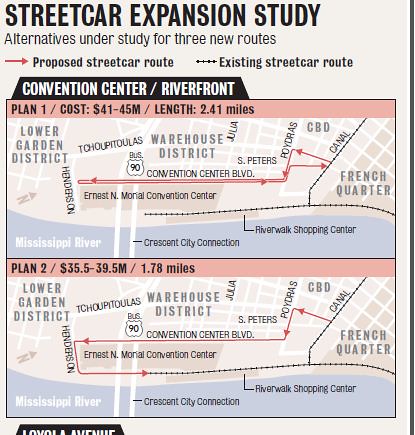
Proposals floated by RTA back in 2009 for a Convention Center streetcar loop. These options were tabled in favor of the Loyola line and the Rampart streetcar currently under construction.  

I'm not sure the city really wants locals to spend a whole lot of time downtown anymore.  Next year, the mayor wants to dramatically increase the cost of parking there. It was a little surprising this week to see New Orleans Convention and Visitors Bureau President Stephen Perry express concerns about the plan. You don't usually see him and the mayor this out of step with one another.
Perry says he’s opposed both in his role as tourism leader and as a resident; he lives in the Warehouse District, “The issue of going to 10 at night is so preposterous on so many levels,” he told Gambit. “We have been hearing endlessly over the last few days from restaurateurs and workers in hotels and restaurants.”
For a little perspective on this, here's a NOLA.com slideshow of "the lowest paying jobs in New Orleans."  I know those are annoying to click through so I'll just tell you 11 of the 15 occupations listed are in retail, food service, or housekeeping all of which comprise the backbone of the local hospitality industry.  So Perry is right. The workers his business is most dependent on will be the most stressed by the parking hike.

We know, also, the Rent Is Too Damn High in "desirable" downtown neighborhoods so fewer of these employees live within walking distance.  It would be nice if New Orleans offered efficient public transit options as an alternative to driving but we're not building those.  Instead, we're spending capital on amusement rides for visitors.
The Canal Street ferry terminal, seen for years as an impediment to opening the Mississippi riverfront, would be torn down and replaced with a pedestrian landing on a floating barge, under a plan being pursued by New Orleans city and transit leaders.

The proposal is part of a larger vision to revamp the area between the Audubon Aquarium and the former World Trade Center: upgrades to Spanish Plaza, a rail spur for a new streetcar line headed Uptown toward the Ernest N. Morial Convention Center, a bus terminal for connections and two new ferry boats.

"We are going to rebuild this foot of Canal Street," Mayor Mitch Landrieu said in a news conference Thursday (Nov. 5).
It would be nice to think that a pedestrian only ferry actually served commuters, but that's just not realistic. To do so, it would have to operate 24 hours and connect to more efficient bus lines on both sides of the river which do not currently exist.  As things are, a ferry that can't carry cars is little more than a theme park boat ride.

Worse, still, they're proposing yet another streetcar line. The purpose of this one, apparently, is to make it so that visitors don't have to walk the five blocks from the renovated Trade Mart building over to the Convention Center. This, in the interest of making the area more "walkable."

None of it does much to get residents in and out of downtown efficiently.  Is does look like it will make it more fun for tourists to ride around in circles while they're there, though. The city is hoping the centrifugal force of that will shake a little more change out of their pockets in the process.  Not that the wage earners who make it possible will see any of it. Whatever they find, they'll have to feed back into the meter.