-->
Showing posts with label City Planning Commission. Show all posts

Wednesday, April 06, 2022

Actually, the consequences are very much intended

Despite the Planning Commission's 6-2 vote against, there is little reason to believe that City Council won't turn around and just approve this "accessory dwelling" scheme anyway. No doubt, someone will argue with a straight face that this has something to do with "affordable housing" that seems to be what Kathleen Lunn is saying here.

Commissioner Kathleen Lunn voted for Wednesday's accessory dwelling proposal, while acknowledging it would lead to “unintended consequences” involving short-term rentals. She said zoning laws throttle multifamily development to an “outrageous” degree; only about 5% of New Orleans' land is zoned for multifamily housing, according to a Planning Commission staff report.

“There is no question that we need to incrementally begin to address how this city serves people who actually do live and work here,” Lunn said.

Now I know we all love to hear them "incrementally begin to address" something. But this argument doesn't make any sense.  The housing crisis in New Orleans is not merely a supply problem caused by restrictive zoning. It's a structural problem of a real estate market dominated by asset speculation, corporate power, and a relentless profit incentive that runs counter to the principle of housing as a human right. 

In that context the only possible purpose of this proposal is to create more STRs. 

Staff recommended banning short-term rentals in accessory units. But Commissioner Robert Steeg said he feared the ban would be on paper only, given the Cantrell administration’s failure to enforce short-term rental regulations. Even the accessory units dedicated to long-term tenants would do little to address the affordable housing crisis, as most would require new construction, Steeg said.

That’s going to lead to construction costs, and that’s going to lead developers - or individuals - to rent at the highest rates they can rent for,” Steeg said.

This is not an affordable housing measure. It is a plan to allow the growing STR market to exploit new territory as New Orleans returns to "normal" now that we've been told to stop caring about the pandemic. And for the Cantrell administration, "normal" means maximizing profits for tourism and real estate investors. The "unintended consequences" are very much the intended consequences.

Monday, March 11, 2019

The Sonder exception is still in the rules

The City Planning Commission is going to meet at 1:30 on Tuesday to work on Short Term Rentals again. They'll be working with a set of recommendations dutifully put forward by their poor pitiable staff who have been asked to do this several times now.   Well, here they go again. 
The rules proposed by the staff of the City Planning Commission would keep the heart of the City Council’s plan: a requirement that short-term rentals be allowed in residential areas only if the owner lives on the site. But the planners recommend allowing only one entire unit per property to be rented out at residentially zoned properties, while council members had envisioned allowing up to three.
Yeah well that is good and all but when this gets kicked up to Council, they're likely to shift it back.  Still it's encouraging to find that somebody still thinks 1 STR per homestead exemption is good policy. Pity they only think that's good enough for strictly residential zones, though.  The rules get slightly looser for mixed use and entirely too loose in commercial zones. We've talked as nauseum about the problems with this so we won't get too boring about it now.

I did want to point out that Jason Williams's gift to Sonder and Motwani is still very much intact, though.
Larger-scale operations would be allowed in commercial areas. A homestead exemption would not be required on those properties, but the staff's recommendations would prohibit most properties from using more than a quarter of their units as short-term rentals, with some exceptions such as for portions of Canal Street and Bourbon Street.
Anyway, this is far from the last stop for this business.  If you've got comments about tomorrow's CPC meeting, you might as well copy your councilmember on that too. 

Wednesday, November 07, 2018

"Obvious gross misunderstanding"

I don't know if I could count the number of times I've expressed skepticism over the efficacy of "inclusionary zoning" rules as a remedy for the affordable housing crisis.  Typically, when these policies are implemented, the formula doesn't set aside nearly enough units to meet the need. And more often than not, they actually serve as a kind of token for rationalizing.. or even subsidizing.. more luxury housing for rich people. Worst of all they're an easy out for decision makers looking to claim they have done something about housing and an excuse for stopping there.

Having said all of that, we have to recognize the unique corner the City Planning Commission finds itself painted into this week. The legislature and the governor have given them what amounts to a "use it or lose it" ultimatum.
In August, the New Orleans City Council tasked the CPC staff with studying three types of “inclusionary zoning” policies as part of the creation of a so-called “smart housing mix,” revisiting the results of a 2017 study that recommended the city adopt similar rules.

Those recommendations were shelved. This year, Gov. John Bel Edwards vetoed a measure that would prevent municipalities from instituting their own inclusionary zoning requirements, only on the condition that New Orleans decide whether it wants them, otherwise he’ll plan to sign similar legislation next year.
Even so, the commissioners are reluctant to act. Last month Mitch Landrieu's good buddy Walter Isaacson wondered out loud if housing problem would just go away on its own thanks to "market forces."  Now it's one thing for us to be suspicious that this one policy choice is itself not much better than laissez faire trickle down approach. It's something else entirely for the Planning Commissison to actually prefer trickle down as the ideal. So circumstances have conspired such that housing advocates are left with no choice but to fight tooth and nail to keep this marginal tool on the table.
Housing NOLA executive director Andreanecia Morris tells Gambit that even with the report’s recognition of the housing problem, and the years-long argument for mandated affordable housing creation, advocates face an uphill battle with a commision with an “obvious, gross misunderstanding of the circumstances as well as the need of a solution that could be brought to bear.”

“Will we exhibit the courage necessary to take up the challenge from the governor to bring this much needed program into reality?” Morris asks. “And will we consistently enforce it?”
Morris is being nice, there. We would characterize Isaacson's position as having been born more out of hostility than "misunderstanding."  Either way, CPC is going to take up the "smart housing mix" report on November 13.  Probably will be off in some broom closet or something at City Hall. The Greater New Orleans Housing Alliance has more information here.

Tuesday, October 23, 2018

Property > people

At least 16 self-storage projects are in some phase of development in the New Orleans area, according to real estate investors and industry analysts. The boom will add well over 1 million square feet of new storage space — enough square footage to cover all of Canal Street from the Mississippi River to Interstate 10.

The recent boom in New Orleans is part of a national trend, driven by shifts in the real estate market, low interest rates, and the search by investors for a high-yielding investment that will hold up even in recessions.

The $32 billion dollar self-storage industry has grown by roughly 4.5 percent annually in recent years, significantly faster than the broader economy. In the last year, investors have added $4 billion in new storage spaces.
I especially love the image the Advocate chose to illustrate the extent of the square footage since the river-to-I10 is also a rough description of where most of the above sea level land is located around here.

Anyway, the city of New Orleans... like much of the country... is in the throes of a desperate affordable housing crisis.  Meanwhile capital has decided the best, highest, use of scarce real estate is building big lifeless crates to store things rather than house people.
That has helped push up rental rates on existing spaces. Real estate consultant Kevin Hilbert said investors have begun waking up to the fact that rents on some local storage units “are on a par with” suburban luxury apartments.

“Some storage companies can get $300 a month for a 10-foot by 10-foot unit,” he said. “You can get a pretty nice apartment for $3 a square foot.”

And self-storage, which generally consists of a warehouse divided into “rooms” of varying size, requires only a fraction of the maintenance and other costs that apartment buildings incur.

Real estate investors typically borrow most of the money they use to invest in properties, so low interest rates are allowing them to borrow cheaply.
Not a thing wrong with that market-driven system, right? Not according to  City Planning Comissioners Robert Steeg and Walter Isaacson who had this to say when considering a modest inclusionary zoning plan this month.
Commissioner Robert Steeg asked the CPC staff whether the city would be better “using a carrot rather than a stick” to attract affordable development through tax incentives, and whether there are “any empirical studies or data driven analysis as to which of those two methods works best.”

Isaacson also asked whether the “large amounts of new housing units proposed and coming onto the market” may end up dropping prices into affordable ranges “just by market forces.”
Market forces are going to have us all living in orange metal sheds, I guess, but that's the best we can do.

Update:  This afternoon your friends at CPC just voted to pass a recommendation to allow the Motwani-Sonder STR Strip on Canal St.  on up to City Council. As we've noted previously, the councilmembers don't seem to give a shit about protecting your housing stock from predatory capitalism either.  A lot of people have spent several years and a lot of hard work trying to convince them to give at least a little bit of a shit.  That hasn't worked.  I honestly have no idea if anything will.

Upperdate:  Okay now we can see why this all passed CPC so easily today.  The mayor, the DDD, and a few council members already had the fix in on it
Cantrell took a more critical view of the state of Canal Street. She remains concerned about cleanliness and the presence of vagrants often seen sleeping in the street.

"We have great, great space -- we know that and it's historic. But we have to do better," Cantrell said. "Even with pressure washing the buildings, you drive Canal Street, it's nasty. ... It still feels grimy."

Weigle said that in addition to Sonder's deal involving the three Motwani buildings, the Downtown Development District is exploring creative ways to get other buildings back in commerce. On the 800 block of Canal Street, Weigle said there's a plan to combine the vacant upper floors of three separately owned buildings into a new entity that would preserve the property rights of the first-floor owners who want to continue earning revenue from their respective retail spaces.
Love tooo preserve the retailers' property rights. But not nearly as much as we love "quality of life enforcement." 
Basically, they're gonna scrub the buildings down, hollow them out, and turn them all into vacation rental properties which they will protect the investment value of by aggressively rooting all us drunks, panhandlers and bicyclists out of the neighborhood.  This is Dizneylandrieu on steroids and I'm all out of answers as to what is to be done. For a minute or two we were kind of hoping it would make a difference if we just asked our elected reps to remember the poor folks a little bit when they made their land use decisions. But it's clear they don't give a shit.  Not sure what happens next. 

Tuesday, October 09, 2018

We lost the short term rental argument

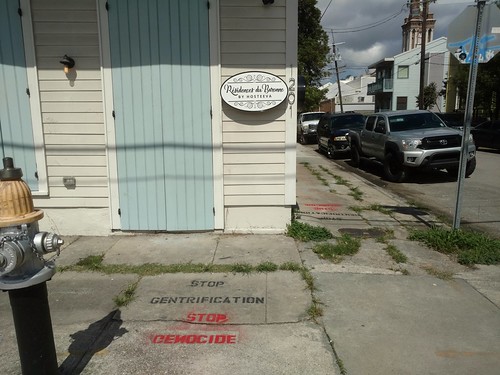
Residences du Barronne


The recommendations passed out of CPC last week are already too loose and liberal.  They shift some things around and give them different terms but, in essence, the parameters they set will almost certainly preserve the intolerable status quo. Yes, they're eliminating the "Temporary STR" licenses which were riddling neighborhoods with de-facto hotels.  But they're replacing that with a category that undoubtedly leads to the same outcome. It even opens up the possibility of tenants sub-letting apartments as Airbnbs. The requirements for that form a pretty big loophole in their own right. 
“There is general consensus that the Accessory Short Term Rental is the least problematic type since there is a requirement for a Homestead Exemption and the property owner is present during the time of the rental,” the study says.

These licenses would be marginally expanded and rechristened as “residential licenses.” And they would be split into two categories: whole-unit and partial-unit. Partial-unit licenses would allow homeowners and renters to offer up spare rooms. To allow renters to participate, the operators would have to prove their residency with a Louisiana state-issued ID and a secondary form of identification, instead of a homestead exemption.

Accessory licenses were partially designed for homeowners who want to rent out unoccupied half-doubles. Under the commission’s proposed regulations, these would fall under the residential whole-unit category. This category would expand to include three- and four-plexes, but only allow one licensed unit per lot.
This isn't actually better. It's only different.  And as the matter goes to City Council, the new rules are almost certain to be made more favorable to STR operators than they are now.  For example, it's unlikely this definition of commercial STR is unlikely to remain in place.
The third category of recommended license — commercial — would have new restrictions as well. The study suggests a complete ban of commercial rentals in some of the “least intensive neighborhood business districts,” including some commercial zones in the city’s most popular areas for short-term rentals, like Bywater and Faubourg Marigny.

In the remaining commercially zoned areas of the city, commercial permits would be restricted to one unit or 25% of all units per lot, whichever is greater. Short-term rentals would also be banned on the first floor of residential multi-story buildings in many commercial districts.
Yeah I don't know how jamming 200 STRs into these Motwani-owned buildings  on Canal Street is gonna jibe with that 25 percent rule. Probably not very well.  Jason Williams is determined to make it happen, though.
Bowen said Sonder hasn't attempted a similar approach with a larger space, but Williams said he's content with the company's current approach because it's consistent with other city goals for righting the ship on short-term rentals.

"The focus is to pull short-term rentals out of our neighborhoods where they're causing strife to put it in areas where we can put things back into commerce," Williams said. "The cherry on top, if this works -- and I think this can work -- is we can then not just have liquor stores, T-shirt shops ... but we can have Apple Store, local unique vendor, Crate & Barrel. ... We have a unique opportunity here and I don't want to squander it."
I'm so old I remember way back in 2006 when we were told the "New New Orleans" would have to be built smarter and higher and that the way to do that would be to help people come back out of the post-war swampland neighborhoods and onto the higher ground of the "historic city center."  Since that time, though, the historic neighborhoods have been aggressively cleared out and converted to STR-filled tourism sacrifice zones.  It turns out, a "smarter and higher" built city doesn't necessarily mean anyone is supposed to actually live there. 

Anyway, get used to it.  We lost this argument a long time ago so it's no surprise we're still losing it again this year.  In the same way that building more luxury apartments downtown hasn't done anything to solve the affordable housing crisis, building a Sonder hotel on Canal Street isn't going to "pull short term rentals out of the neighborhoods."   But Jason really wants that Apple Store, I guess. Good for him.

As always the people who count are the people who have money in real estate and we're gonna do whatever helps them turn that money into more money the fastest. Motwani is going to make a lot of money in this Sonder deal. Therefore, that is the best, highest use for land on high ground in downtown New Orleans.

Tuesday, September 18, 2018

Everybody is turning in their homework today

LSU made the proposals from the two remaining bidders for the Charity Hospital redevelopment available to the public today.   There are PDFs of each appended to that NOLA.com article if you really feel like pouring over all that stuff.

The oddest thing to me about the 1532 Tulane Partners group is they have an agreement with the school board to allow one or more charter schools to become tenants. I'm not sure that fits well in practice. Maybe if they're actually committed to affordable housing in the building as well then there's something to that. But it's unusual. At least for New Orleans it is.

As for HRI, they have an even  bigger problem.
Mayor LaToya Cantrell on Tuesday (Sept. 18) said the Municipal Auditorium, vacant and damaged since Hurricane Katrina, is being eyed as a site for a new City Hall, and that she's concluded the current building is past its useful life.

Cantrell's comments came during a breakfast event with the Bureau for Governmental Research during a question-and-answer session that covered topics ranging from the Sewerage & Water Board to budget issues. Her statement has the potential to throw water on plans for the redevelopment of Charity Hospital, which has been viewed by both city planning consultants and the development team at HRI Properties as a new home for City Hall and the Orleans Parish Civil Court.
HRI's proposal is worded in a way to suggest there are contingency plans but it also strongly suggests that City Hall would be their ideal anchor tenant. 

More on all of that City Hall business later, though.  It looks like the City Planning Commission also dropped their much anticipated report on short term rentals this afternoon. I've really only just glanced at that but here it is.   It's expected to be formally presented at the CPC meeting next Tuesday.

Wednesday, July 11, 2018

Just limit everybody to one

Yesterday's CPC meeting on short term rentals had its share of the usual attendant goofiness and melodrama. Eric Bay coined a new hashtag. Some people told some very personal and questionably relevant stories. A lady made her young daughter tell a story. Bingo cards were filled out. Props were introduced.  Ben Harwood (this Ben Harwood) got told.
Ben Harwood — a developer with more than a dozen STRs in Treme — said he now has vacant properties and projects-in-statis with the recent moratorium and has “no idea what’s going to happen.”

“It makes me want to sell my properties and move to another city,” he told the CPC.

One group at the meeting shouted, “Please do!”

It was weird enough. But it wasn't quite as wild as these confrontations have been in the past.  Mostly everybody said their piece according to a now well-established script. Also there wasn't a whole lot at stake yet.  That doesn't come until we start to see what the new regulations produced by this process actually look like. And the encouraging thing about that is, there's growing consensus around perhaps the most critical change people have asked for.
But operators and STR critics now are largely on the same page when it comes to demanding a homestead exemption requirement, which the previous City Council had briefly considered before abandoning in its final STR rules.

That requirement would stipulate that the owner of the STR must also live on the property. It currently is part of the conditions for “accessory”-type rentals, like a spare room or guest house or half of a shotgun double.

It would effectively wipe out temporary rentals as they’re currently defined.
As always, much depends on details so we'll wait to see how this principle we all seem to agree on now is applied to the law.  Ideally the new regulations should eliminate the tiered definitions of STRs  leaving only the "accessory" variant permitted. It should also ditch the multifarious and easily manipulated permissions applied differently according to zoning. Just limit everybody who wants to rent out their home to... their one home.  If we end up with a situation where these South Market properties financed with public money can fill up with STRs or companies like Marriot (who is getting into the business now) can own and operate a hundreds of them in neighborhoods all over town then the we still will not have gotten this right.

Sunday, July 01, 2018

Congratulations, Jared

You can say this is a story about deciding to run for office. But really it is a story about getting out of politics and into a job where you can just sit around collecting money all day. 
New Orleans Councilman Jared Brossett is officially running to be the next clerk of the Civil District Court.

Brossett has been eyeing the office since shortly after Dale Atkins, the former clerk, won a seat on the Fourth Circuit Court of Appeal in March. His plans have now been formalized, with a fundraiser for the campaign scheduled for July 10.
I'm not sure about how the timing plays out.  But I expect Brossett will take his new office shortly after the November election. After that, there will have to be another special election to fill his City Council seat.  Which means there will also be a period where District D is represented by an interim appointment.  Typically, the councilmembers are responsible for selecting the interim person. But the last time this came up, things got ugly and the mayor had to step in and name somebody. This council is still in its post-election unity afterglow where they like to talk about working as a team and whatnot so we're unlikely to see that happen this time around. Still, the choice of Brossett's replacement deserves attention. It could have a determining affect on the city's short term rental policy.

Just to catch up quickly on where we are with that, recall that about a month ago the council, at Kristin Palmer's urging, passed an Interim Zoning District measure which imposes a temporary moratorium on the issuance of one specific type of STR license. This would be the "Temporary STR License" that allows whole home rentals for 90 days in certain areas.  The IZD isn't an immediate ban on their operation, though. Currently active Temporary licenses can remain in use until whenever each individual license expires. And even then, the "pause" as it's been described in the press is just a for-now thing until we get the result of a study due sometime in the fall.

Meanwhile the Commercial licenses are still being issued. These allow unlimited use of property as permanent hotels in areas zoned for commercial and mixed-use.  That zoning terminology sounds restrictive, but actually it covers a lot of the city.  So even under the terms of Palmer's IZD, the most intense kind of STR activity continues to go unchecked. Also, the big players in hospitality are starting to get into the business now
The need for a different kind of experience is what prompted Marriott International to enter the vacation rental market dominated by Airbnb, CEO Arne Sorenson told CNBC on Monday.

Formulated with groups in mind, Marriott announced a six-month pilot program in April, in partnership with London-based home rental management company Hostmaker, which does still work with other services, including Airbnb and Home Away.

So, even though Palmer got a fair amount of credit in the media for proposing the IZD, it's not clear that's actually a step toward reining in short term rentals.  In fact, it's possible that, by the time all of this has run its course, the "paused" STRs will be back in play without having missed much business. But all of this will depend on what the council decides to do once they get their new report back from the planning commission. 

As I've stated previously, all of this looks suspiciously like a delay tactic. The further in time we get from last year's election cycle, the friendlier the political environment is likely to be for the pro-STR side. When politicians aren't immediately concerned with being held accountable to voters, the more likely they are to listen to friends and donors.

Already if you listen closely enough you can hear them trying to walk back the anti STR sentiment a bit. We already know LaToya likes to talk about "balance" above all else. Recently, I've heard  Giarrusso and Palmer  express similar sentiments regarding their empathy toward landlords and developers as well as their belief that STR revenue can fund affordable housing in other ways. At a recent Mid City Neighborhood Association meeting on the subject, Giarrusso mentioned the money STR license fees pay into the Neighborhood Housing Improvement Fund established by the city to subsidize developers who might build more affordable housing.   However the JPNSI report found that the money collected all of last year by those fees could probably build just one house.

There are other signs that momentum is already fading. Cyndi Nguyen almost voted against Palmer's "pause" because she is worried about some landlords who she thinks are "the little guy." Jarvis Deberry recently wrote about  HousingNOLA's Andreanicia Morris and her seeming fatigue with the STR issue. 
Morris, executive director of the affordable housing advocacy group HousingNOLA, confesses to being exhausted with all the emphasis on Airbnb. "The problem with the short-term rental debate," she said during an interview in Mid City June 7, "is the energy it takes up."  Expensive housing in New Orleans is an old problem, not a new one, Morris says, and there's a problem in talking about the more recent phenomenon of short-term rentals as if without them, things would automatically be good for renters and homebuyers. 
If even the housing advocates are starting to back off now, how can we expect councilmembers to stay after the STR lobby six or nine months from now? Which brings us back to Jared Brossett's decision to retire from politics and get into the business of sitting around collecting money as Clerk of Court. Up to this point, Brossett was the only member of the council with a consistent anti-STR voting record. If he's no longer around by the time the next important vote on the matter comes around, what happens then?  I'm not optimistic that this is going to end well. I don't think it's going especially well now.

Oh by the way, if you want to submit comments to the City Planning Commission in writing for use in their study the deadline is September 4. In the meantime there is a public hearing coming up on July 10 where you can go yell at them in person. I don't know what the going rate is for paid actors right now but we'll try to get that sorted out in time if we can.
Tuesday, February 27, 2018

Aylin Maklansky's father's Airbnb clinic

They're trying to sneak this in before Maklansky's boss, Nadine Ramsey, leaves the City Council in May.
Acikalin, who has contributed $5,810 to Ramsey's campaign since 2015, is currently operating one of the properties, at 920 Frenchmen St., as a short-term rental. He's barred from having guests there more than 90 days a year under its current residential zoning. He's told neighbors he wants to open a medical clinic once the site is rezoned.

But that's raised skepticism among neighbors such as Eugene Cizek, a longtime architecture professor at Tulane University who has been involved in City Planning issues in the Marigny neighborhood since the 1970s. Cizek said he's concerned that granting Acikalin's request would return the city to the "spot zoning" problem that proliferated before a citywide master plan was adopted in 2010.
Just for the sake of context, these spot upzone maneuvers have quickly become the mode of choice for property owners looking to back door their way in to the short term rental business. Typically the owner proposes some sort of commercial use for the property that just happens to also have space for STRs available. But the goal is a commercial short term rental license.
Increasingly, homes near tourist areas are being bought specifically for the purpose of converting them to AirBnBs, and a single person might masquerade as the “occupant” of numerous homes that are rented out all the time – and some companies even hire local people to play that role, Dedecker said. Property owners are also increasingly asking for spot zoning changes on homes from residential to business zoning to fit into the third category of short-term rentals, commercial, which allows more tenants and can be rented year-round.
There are a lot of these in various stages of discussion right now.

Here's one at the former Zara's Supermarket on Prytania Street.

This one, which appears to be a no-go at this point, would have been, ostensibly, an ice cream shop.

Here is a property owned by Pat Swilling.  He asked for a commercial spot-zone without even specifying what sort of business he might like to pretend to want to open there.
Councilwoman Stacy Head asked for clarification.

“I can’t tell you I’m not going to, but I’m going to do something else as well, like a mixed use,” Swilling said.

Head pressed him further.

“So you’re going to do short-term rentals. Just tell us the truth here,” Head said. “What do you want to do? That’s the question here. You said a coffee shop. I’ve got a whole list of things that have been promised to the Council that have never come true. … I’m so tired of being lied to by developers not giving us what they promised to give us.”

Head turned her question to Cantrell, asking whether it would be a coffee shop or not. The zoning requested would allow for that, Cantrell said. Swilling added that coffee shop, ice cream shop and others were all under consideration.

“Now it’s not a coffee shop,” Head retorted, saying that Swilling had failed to give the Council his vision for the property.

“That’s very disrespectful,” Cantrell said quietly as Head concluded her questioning.
Note that in all three of the above cases, LaToya Cantrell intervenes on behalf of the would-be Airbnb owner one way or another.  Here is one LaToya supports even without a bogus front business scheme. It's just a developer who wants to do STR condos.  It does help to have councilmembers on your side.  Here is a property on Bienville Street the council voted to upzone despite the Planning Commission's denial.  There's a list of CPC denials that could still be overridden depending on the Council's disposition.

And that's the real trick with regard to Maklansky's dad's "clinic."  The plan in that case was to jam the thing through before Ramsey and the rest of the Winter Council* leave office.  The attention has probably spoiled that.  The real fun begins in May when we learn, to everyone's shock, no doubt, just how pro-Airbnb the new Council and, of course, Mayor Cantrell end up being anyway. But we've still got a few months to pretend otherwise.

*I've been calling the lame ducks the "Winter Council" but the weather hasn't cooperated much with that term for almost a month now.  They're gonna be around for a while, still. Maybe we need a new thing.

Wednesday, February 07, 2018

Played to a draw

The Planning Commission,  in light of the massive opposition organized by strip club workers and an impressive show of force at the meeting, decided not to endorse the mayor and city council's plan to place a "hard cap" on the number of clubs allowed to operate in the Quarter.
The CPC voted unanimously to support a “soft cap” of up to 14 clubs in the VCE, with other openings subject to the conditional use permitting process. But three clubs were forced to close in the wake of those raids, what club workers say is a political maneuver of "attrition" that aligns with City Hall's plans for fewer clubs on the strip.

It’s a tentative win — until the City Council considers its next steps — for club workers, who marched through the busy French Quarter in the wake of raids and what they’ve argued is City Hall’s plan to “sanitize” Bourbon Street as a more “family-friendly” destination for tourists.
Backing the reduce-by-attrition principle might still be enough for the city to work with for the time being. It makes it more likely that a closure by raid or an "emergency" declaration by the mayor will be permanent.  We still have to see what the City Council does with the surveillance ordinance.  And, of course, council could always vote to override CPC anyway. So, no, this isn't over at all.

Tuesday, February 07, 2017

Kern World news


Lots of Noligarchs in the news today.  There's some from the con-profit sector which we'll get to later. This one is from the speculative land use sector, though.  The dream of Kernworld (a dependency of Jaegerton) grew one step closer to reality today at the CPC meeting.
The new owners of the former Times-Picayune building got City Planning Commission approval Tuesday (Feb. 7) for a zoning change that opens the nine-acre industrial site to entertainment, residential and other mixed-use developments.

The building at 3800 Howard Ave. in a mostly industrial area along Interstate 10 has been vacant for about one year. An ownership group that includes local developers Joe Jaeger, Arnold Kirschman, Barry Kern and Michael White wants to revive the property beyond its newspaper industry legacy, although specific plans for the property haven't been submitted to the city.

Peter Aamodt, representing Jaeger's company MCC Real Estate, said the property is one of the last swaths of underutilized land in the heart of the city, in an area with the potential to become a lively, mixed-use corridor. "A lot of people do see it as the next potential Warehouse District," Aamodt said after the vote.
If "a lot of people" turn out to be right about that, this would mean Jaeger has a substantial interest in both the old Warehouse District and the new one... as you can see on the map above.  Anyway it's nice to be able to make these kinds of investments in the full knowledge that friends and admirers on the CPC and City Council will be helpful when you need them.  Privilege has its privileges.

Also... 
Aamodt said after purchasing the property, the owners got dozens of calls for interest in the property, none of which involved industrial uses.

A residential use isn't currently being considered, he said. The new zoning would allow for about 486 residential units, he said, which would be about half the number of people the Times-Picayune once employed at the site.
Zing!

Also too. Odds have to be good that it will, in fact, be residential. 

Master plan changes

City Planning Commission today
The City Planning Commission on Tuesday (Feb. 7) will consider a wide range of proposed changes to the city's five-year-old master plan with a goal of refocusing the vision for New Orleans on the longer-term future and away from Hurricane Katrina recovery.

The master plan, approved in 2010, was designed to take the city through 2030. But the Planning Commission opened the plan up to public input for changes, now that the city has reached a decade post-Katrina. "While disaster recovery was the immediate priority, the need to plan for the city's long-term future is also necessary," the commission's guide for the master plan amendment process says.

The City Planning Commission will consider 121 proposed amendments Tuesday.  You can read all of the proposals here, and here's a look at just a select few

You can click through to NOLA.com for their selected highlights.  You can also see Pat's many comments on the amendments in this series of posts here and here and here. We, ourselves, piggybacked off of Pat's and Keith Twitchell's comments a few months ago merely to note that the thrust in general here is away from democratic processes of community engagement and toward a more top-down developer driven decision matrix.  When City Hall talks about doing better "customer service" these are the people they think of as their "customers."

Tuesday, November 01, 2016

Aspen you shall receive

These few paragraphs are from a column last week by Patrick Armstrong in Mid-City Messenger. Pat has been following, with growing trepidation, Mayor Landrieu's proposed amendments to the city Master Plan. Pat describes an administration in such a rush to make land use processes easier for developers that it's ignoring its obligation to promote open democratic decision making.
Instead of waiting on the public to get involved, technocrats consolidate and automate the process. The “experts” get to make the decisions, and if the public misses their chance to provide input, they should have been paying closer attention. Technocratic solutions remove the mess of democracy and make things easier, quicker, and cheaper for those who are most invested and connected and knowledgeable about the process. If the voters don’t like it, they can participate on election day – if they even show up to the polls.

Proposed amendments to Chapter 15 double down on resident non-participation by consolidating the big, messy, difficult democratic process into management by one small office at City Hall. Even if every city employee in that office has the best of intentions at heart, how long will it be before the sheer weight of this process demands less access from the public, and more decision making at the top?
That sounds bad. But what's it this all about, exactly? Well, it's a lot of stuff. If you want to read through all of the proposed amendments they're here on the city's website.  But what Patrick is most concerned about is the Chapter 15 neighborhood engagement process. Here's an Advocate guest column by Keith Twitchell explaining what that's all about.
Equally unquestioned is the utter disregard for community voice, as exemplified by both the process and the specifics. The most gratuitous example is the mayor’s proposal to completely write the Community Participation chapter in a way that eliminates all reference to a community-based civic engagement structure. Instead, the mayor wants to put resident participation completely under the control of the Neighborhood Engagement Office.

Given that it has only been two years since New Orleans got its first-ever community participation structure, the City Planning Neighborhood Participation Plan (NPP), why propose something that would limit engagement and the public’s voice? Though it has room for improvement (something the Planning Commission is working on right now), and will only reach its full potential when it is part of a comprehensive community participation structure, the NPP has already demonstrated on many occasions that bringing neighborhoods and developers together in a formal process benefits both.

Moreover, the administration’s reason for denying community voice is breathtaking in its solipsism and circular reasoning. In essence, they are saying “we didn’t give the people what they want, therefore they don’t want it.” This is like saying “I didn’t give you food, therefore you are not hungry.”

On top of this, the mayor has heard directly from the people that they want more community participation, not less. At a Neighborhood Roundtable last summer, with the mayor present, Chief Resiliency Officer Jeff Hebert was specifically asked if the process of developing the city’s Resilience Strategy might provide an opportunity to move forward on establishing a formal, communitywide, community-based civic engagement structure. The entire roomful of nearly 100 neighborhood leaders broke into applause in support of the question.

Thus the argument is not only specious, but flies in the face of direct evidence to the contrary. And throughout the administration’s amendments, the theme is to move away from a community-included approach to planning and development, and move toward a technocratic, top-down, “we know best” philosophy.
Hardly surprising given everything we know about how this mayor operates. We need only refer to his recent big-footing of the process over short term rentals for the most obvious example. But there are more and this Master Plan process is particularly egregious. The October slate of public meetings on this have passed  but there will be more to follow.  Here's one that takes place in the middle of the day on Election Day. Can't imagine an overflow room at that time.  Anyway note the purpose of these changes and the wording.
The Mayor’s Office of Resilience and Sustainability (ORS)  is recommending major changes to the Future Land Use map to open up development opportunities and a mix of uses and housing types in Gentilly. The suggestions of the ORS aim at preparing adaptable infrastructure for landscape in flood risk and loosening up Future Land Use categories, in shifting from a value of the preservation of current neighborhood character and use over to the continued viability of neighborhoods.

The ORS said in a report that current Future Land Use categories in Gentilly are likely too restrictive for incoming residential and commercial demand that the City expects to see in public funds more than $140 million.

A meeting about these zoning changes will take place on Nov. 8 at 1:30 p.m. in the Homeland Security Conference Room 8E16 in City Hall, located at 1300 Perdido Street. Those who can’t attend the meeting can send comments to  cpcinfo@nola.gov.
In other words, their policy goal is to give up worrying about the needs of the people who live here currently and shift priorities over to the demands of future investors. In the opening to Patrick's column, he starts off with a tongue-in-cheek bit about "technocrat" as an epithet.
Technocrat. Noun. An obscure insult used to describe a politician who promotes progress through innovation and technology at the expense of the way things have always been done. The term is most often seen on the left or liberal side of the political spectrum to describe Democratic elected officials deemed insufficiently protective of liberal or progressive interests and who attend the Aspen Institute a few times too many.
Sure, har-har. It's that that us dirty lefties might lay off a bit if  only they'd give us a moment to catch our breath.  For instance, here's today.
Mayor Mitch Landrieu has nominated author and former Time Magazine editor Walter Isaacson to New Orleans' Planning Commission, according to a statement from the mayor's office.

Isaacson, who also served as CEO of CNN, is currently the CEO of the Aspen Institute of Washington, D.C., and splits his time between there and New Orleans.

A native of New Orleans who once shucked oysters on Bourbon Street, Isaacson is also known for being Apple founder Steve Jobs' biographer and for his 2014 book, "The Innovators: How a Group of Hackers, Geniuses, and Geeks Created the Digital Revolution."
In other words, these critical matters of democratic process vs technocratic gentrification will be deliberated on by a part time resident who is the literal CEO of the freaking Aspen Institute. How are us jokers and doomsayers supposed to even keep up?  It might start to get funny again when Mayor Torres replaces Isaacson and the entire CPC with an app.  But let's not give away all of our ideas now. 

Tuesday, August 09, 2016

Hipster Dizneylandrieu

City Planning has to vote again on short term rental recommendations today.
Plans that would legalize some short-term rentals -- and establish a framework for cracking down on those that continue to flaunt the law -- have been under discussion for years. But those proposals never gained much traction until the City Planning Commission, at the direction of the City Council, began studying the issue earlier this year.

The commission, which has already weighed in on the issue once, is expected to vote Tuesday on recommendations to the council, which will have the final say on the matter.
Yeah they've already done this. But, remember, the mayor had the City Council kick it back to them because he wants them to allow for "whole home" rentals in their recommendations. If you attended the Mayor's budget meetings this year, you would have heard him deflect questions about STRs and affect a hands-off attitude. "Show up at CPC and tell them," was a frequent response of his.  But he's clearly put his own thumb on the scale here. It's disingenuous of him to pretend he hasn't.

Anyway, New Orleans isn't dealing with this issue in isolation. Other cities have already moved faster than we have to get a handle on the short term rental crisis.  One important thing that they're finding out is regulators can never assume Airbnb is acting in good faith with them.
Airbnb executives once promoted San Francisco as a city it could work with. After affordable housing advocates expressed fear that the service worsened the city’s housing crunch, Airbnb agreed to cap short-term rentals for entire homes and required hosts of such listings to register with the city. That law, which became known as the “Airbnb law” for its friendliness to the company, took effect in February 2015.
But only 20 percent of the 7,000 or so hosts required to register have done so, and Airbnb has not removed lawbreakers, according to David Campos, a member of the Board of Supervisors and a longtime opponent of Airbnb. The board hopes that fines will push Airbnb to help enforce the law it helped create.
“Airbnb is proving that it wants to play by its own rules, that it believes that it is entitled to something no business has, absolute freedom to operate free of responsibility and oversight,” Mr. Campos said. “It’s their way or the highway.”
Here's a Next City op-ed from a New York City housing advocate describing the harmful effects STRs have had there on the rental market and on the fabric of the neighborhoods. 
People choose to live in a city, a neighborhood, a building and a unit for a complex set of reasons and variables — all of which connect a group of people at a given time to a given physical place in ways that might not be so obvious, but exist nonetheless. These people add unique experiences, services and ideas to their communities for however long they remain there. Over time, a neighborhood forms an identity from those collaborations and conflicts that makes it both unique and universal. By sharing a place, purposefully or incidentally, people have shaped it.

Airbnb disrupts this, and not in the way it disrupts the hotel industry. The person with that lease, whether it’s the landlord or a professional lister, is still sharing that space with all of those people in their building and their neighborhood. There is a profound responsibility that comes with that whether they acknowledge it or not. The host has chosen to disengage from their home by turning it into a commodity. Whether or not they have the right to is almost beside the point.

The more salient point is that they are also forcing their neighbors to make that choice by turning the neighborhood into a commodity as well. The host has forced their neighbors — who see strangers coming and going constantly — to become just a little bit less engaged and connected to their home. It’s not just that they aren’t benefiting financially, it’s that they are incurring the majority of the social costs and losing what they thought their home was when they moved in. Maybe the Airbnb renter is okay with being in a cheaper “hotel,” but their neighbors didn’t sign a lease to live in any kind of hotel.

Multiply the types of trade-offs that come with Airbnb across an entire neighborhood and what we are left with is Hipster Disney World — one that looks and maybe feels “authentic,” but one that has stopped functioning as a neighborhood is supposed to. Instead, it becomes experiential marketing, make-believe for lifestyle tourists. Inevitably this devolves a neighborhood into some bland version of any other type of similar neighborhood or a kitschy version of itself.
 Local housing advocates have begun to come around too
The Greater New Orleans Housing Alliance position paper, issued Friday (June 17), departs from the group's previous stance on the legalization of short-term rentals. The newly unambiguous declaration could add fuel to an already white-hot debate.
The Housing Alliance called for the city to:
  • prohibit property owners from converting any residential unit, be it a condo in the Central Business District or a shotgun double in Faubourg Marigny, into full-time lodging for tourists;
  • force listing sites to aid in enforcement by disclosing the precise locations of the dwellings they advertise;
  • impose a 2 percent "transaction fee" on short-term rental stays, the proceeds of which would go to the city's Neighborhood Housing Improvement Fund, which supports housing for low-income residents; and
  • enforce compliance through stiff fines. 
The Housing Alliance supports allowing homeowners to rent out spare rooms in the houses in which they live, providing them with a supplemental income as property taxes and insurance costs rise. Whole-home rentals, though, should remain off limits, it said.
Will the CPC follow GNOF's recommendations today? Or will they follow the Mayor's lead and push us one step further toward Hipster Dizneylandrieu? 

Monday, June 13, 2016

Air tax

It's fun when we get to agree with Owen Courreges about something. It doesn't happen all that often. In turn, Owen rarely agrees with VCPORA. And yet here we all are in agreement. Well, except for the mayor, I guess.
In an utterly unprecedented move, Mayor Landrieu recently began to require property owners to sign lease agreements for the “air rights” to balcony features that encroach on city property, leases that can cost upwards of $4,000 per year. The agreements are normally required before a property owner can obtain necessary inspections or building permits.

What this means is that property owners are confronted with two equally-perverse incentives: 1) to not build or retain their galleries; and, 2) to refuse to cooperate with the city in securing building permits for any work performed.

Predictably, advocacy groups and sundry neighborhood organizations are up in arms. “It’s part of the fabric of the city. It doesn’t make sense to penalize people for that,” said Meg Lousteau, head of the Vieux Carre Property Owners and Residents Association (VCPORA).

Although we’re rarely on the same side of any issue, VCPORA has a point here. Landrieu’s policy makes absolutely no sense, except in a single regard – it generates revenue. One of the first tricks Landrieu learned was to task his departments to increase revenues from fines and fees through creative means. Agencies have become less reasonable and more greedy under his direction.
In a way this is similar to the extortionate criminal justice system of fines and fees we just referenced in a previous post. It's less egregious in that it's aimed at property owners in historic neighborhoods but the principle is the same. The city is on the lookout for ways to squeeze money out of, literally, thin air. And why not? I mean isn't this more or less what the whole 21st Century economy is based on?

Nowadays, imaginary value conjured out of nothing via regulatory arbitrage is the just a fancy way of saying "entrepreneurship."  Besides tourism, the amazing resilience of the city's 'Treppin elite is the mayor's favorite subject.   It's hardly surprising that any of this would be right up his alley. Doubly so when someone finds a way to combine those two areas
A formalized proposal to legalize Airbnb-style rentals in New Orleans could face it first vote Tuesday (June 14).

NOLA.com | The Times-Picayune will be in the City Council auditorium to cover the City Planning Commission's meeting live when it begins at 1:30 p.m.
That's tomorrow. The rest of that T-P article is styled as a "primer" for those who may have come late to this. But here is the key bit about what tomorrow's meeting means.
In recommending the regulatory framework majority of the commissioners voted against legalizing principal-residential rentals. However, the City Council, at the request of Mayor Mitch Landrieu, then asked the commission draft a set of amendments codifying the planning staff's initial recommendation, which included them. 
CPC, following the concerns of many residents and wary of the negative experience of "destination" cities around the world, wanted to limit the practice of turning whole homes and apartments over exclusively to Airbnb. The mayor rejected their modest recommendation and is making them do it over.

The public meeting is sure to draw a lot of attention.  The pro-STR lobbying group with the Orwellian name "Alliance for Neighborhood Prosperity" is pretty good at turning out their membership to events like these when it counts. It helps that a lot of them are professional lawyers and lobbyists who can bill the time unlike the wage earning renters who have more trouble showing up in the middle of the day. So expect a lot of hot air in the room.  If only there were a way to tax it.

Update: Ah and CPC has postponed the vote. It looks like the topic is still on the agenda? Maybe? If so the meting might still be entertai9.