The Berkley Law Clinic is suing the EPA on behalf of environmental groups in Alaska and Louisiana over its failure to adequately restrict the use of Corexit to "disperse" oil spilled into the sea during the Valdez and Macondo disasters.
This article (and presumably the lawsuit) cites several "recent studies" indicating the harmful effects of these dispersants.
Recent studies have indicated dispersants caused lung irritation, rashes, nausea and other illness in humans, as well as a host of problems for fish, deep-sea coral and other marine life. Dispersants can kill or inhibit the growth of oil-eating microbes, weakening nature’s ability to cleanup spills. New research also indicates that dispersants can have the unintended effect of transforming oil into a toxic mist able to travel for miles and penetrate deep into human lungs.
Those of us old enough to remember the 2010 Macondo spill will remember also that this was all widely understood and observed at that time. None of that stopped BP from insisting everything was perfectly safe, of course. So it is no surprise they are continuing to do so now. There is a BP contractor quoted in that story who says, "many of Corexit’s ingredients are shared by common health beauty products." So, you know, nothing to worry about. It's like Botox for the ocean.
Of course that doesn't help the many workers and fishers on the Louisiana coast who have documented health problems from exposure to these chemicals over the past decade.
Arnesen, whose family business fishes for
Gulf shrimp, crab and reef fish, said she continues to suffer from
respiratory problems and headaches eight years after exposure to
dispersants. She was aboard a vessel sprayed with dispersant while in
Barataria Bay, an area hard-hit by the spill.
“Dispersant is nasty stuff to deal with,” she said Monday. “You learn to live sick.”
Congratulations on your purchase of 770,000 gallons of Corexit. We know you have many choices in the market for poisons to dump into the ocean for no particular purpose. But we are glad you have chosen us. No, sorry, there are no refunds.
University of Miami-led study indicates that the massive amounts of dispersants BP applied directly at the spewing wellhead – about a mile below the Gulf of Mexico’s surface – failed to curb the oil’s spread, and may have increased the disaster’s ecological damage.
The explosion of the Deepwater Horizon oil rig released more than 200 million gallons of crude oil, making it the largest oil spill in U.S. history. About 770,000 gallons of the dispersant Corexit was applied at the wellhead. Another 1 million gallons was sprayed over the massive slick on the water’s surface. Dispersants loosen the tension between oil and water, allowing the oil to break up into smaller droplets. It was hoped that dispersants would lessen the disaster’s impact.
Yeah sorry about that. Maybe those features will work in the next version. But hey let's see what you did get.
The study is one of several in recent months that have questioned whether dispersant should be used at all. Other research cited in the UM study noted that dispersant appears to fight nature’s ability to clean-up after oil spills. A study by the University of Georgia indicates that dispersant kills or inhibits the growth of oil-eating microbes, including naturally-occurring bacteria that rapidly consume oil that dispersants only break apart.
Oohhhh man, remember the "magic microbes"? They really were celebrated as heroes back during the Summer of Spill and afterward when everyone was trying to tell us how no all that bad the whole thing was. And that whole time we were out there murdering the little guys. What a bummer.
Oh wait. Also....
Dispersant has also been linked to illnesses in humans and several types of marine life. The Gulf’s deep sea coral were found to suffer more from a dispersant-oil mix than oil alone.
I'm sure there is a punch line somewhere about a Trump Administration directive to ease off of holding oil producers accountable for this sort of damage but I'm too depressed to look it up right now.
The dispersant most often used during the BP Deepwater Horizon oil spill might
cause damage to cells in human lungs and in the gills of fish and
crabs, according to a study published Thursday in a peer-reviewed
scientific journal.
It's ok, though since no jobs were killed by the Corexit spray.
Cyn Sarthou, executive director of the Gulf Restoration Network, said
that federal "administration after administration" failed to develop
standards for dispersant use and that this failure was a major cause for
the uncertainty EPA and other officials faced in determining acceptable
quantities of the chemical to fight the 2010 oil spill.
"Consequently
there was little data available to EPA officials when they were
confronted with the devastating BP oil disaster," she said.
Hannah
Chang, an Earth Justice lawyer who is representing the groups in
Monday's litigation, predicted the court action "will push EPA to take
further action to follow through on its promise to get a much-needed
rule in place."
Well, they certainly have their data now. You're welcome.
The manual, “Deepwater Horizon MC252, Vessels of Opportunity Near Shore Oil Recovery Groups, Vessel Captains Hazard Communication” (available at http://goo.gl/ny9hFhttp://goo.gl/ny9hF) demonstrates apparent contradictions between BP’s official written warnings about the oil dispersant, on the one hand, and its statements to the public on the other. The discrepancies pertain to verbal claims that exposure to COREXIT, the dispersant selected by BP and approved by the EPA to treat the oil, was safe, and the health problems actually associated with COREXIT listed in a BP manual.
Note: It turns out the HHS "action" banning the use of dispersants was actually a "Yes Men" prank which I fell for. I should point out, however that my source on this was the Gambit's Twitter feed which means... you know... they fell for it first. So there. The rest of the information cited in this post is not a prank, however, and only goes to further the hoaxters' point.
HHS also announced a ban on the use of dispersant in the U.S., similar to bans on dispersant in the United Kingdom and other countries.
Residents in the Gulf Coast region have reported a variety of health complaints associated with the oil spill, from coughs and respiratory problems to headaches, dizziness and skin rashes. Equally important are the mental health issues facing those affected by the oil spill in these underserved communities.
The plan, announced near the one-year mark of the oil spill, not only responds to the current health needs of the Gulf Coast region, but also the potential for future oil spills. The HHS Action Plan draws from the Coast Guard National Response Center’s 2009 data detailing more than 2,500 reported oil industry accidents in Louisiana’s coastal waters that year and spilling more than 50 million gallons of oil into the Gulf of Mexico. On shore, oil industry facilities have averaged 10 accidents a week in recent years, according to reports filed with Louisiana authorities. These accidents released 21 million pounds of pollution and 22 million gallons of oil and associated waste in a 5-year period.
The HHS Action Plan also takes into account the effects of ongoing toxic exposure from industry. “Where people live, learn, work and play affects their health as much as their access to health care,” said Sebelius. “We have to confront the social, economic and environmental factors that have made people along the Gulf Coast so sick."
A year ago when Propublica reported on the potential hazards associated with the dispersants BP was using, one frustrating aspect of the story was the fact that the public's right to know exactly which chemicals were being sprayed onto their food supply was trumped by NALCO's right to keep that proprietary information secret.
But the dispersants contain harmful toxins of their own and can concentrate leftover oil toxins in the water, where they can kill fish and migrate great distances.
The exact makeup of the dispersants is kept secret under competitive trade laws, but a worker safety sheet for one product, called Corexit, says it includes 2-butoxyethanol, a compound associated with headaches, vomiting and reproductive problems at high doses.
“There is a chemical toxicity to the dispersant compound that in many ways is worse than oil,” said Richard Charter, a foremost expert on marine biology and oil spills who is a senior policy advisor for Marine Programs for Defenders of Wildlife and is chairman of the Gulf of the Farallones National Marine Sanctuary Advisory Council. “It’s a trade-off – you’re damned if you do, damned if you don’t -- of trying to minimize the damage coming to shore, but in so doing you may be more seriously damaging the ecosystem offshore.”
A parallel example of this can be found in the increasingly controversial practice of extracting natural gas through the process of hydraulic fracturing.
As late as 2000, shale gas was just 1% of American natural-gas supplies. Today, it is about 25% and could rise to 50% within two decades. Estimates of the entire natural-gas resource base, taking shale gas into account, are now as high as 2,500 trillion cubic feet, with a further 500 trillion cubic feet in Canada. That amounts to a more than 100-year supply of natural gas, which is used for everything from home heating and cooking to electric generation, industrial processes and petrochemical feedstocks.
The effects of the "shale gale" are also being felt in the rest of the world, changing the economics of the liquefied-natural-gas business. Its impact on international energy relations could be significant. Some proponents believe that the U.S., once thought to be short of natural gas, could even become a natural-gas exporter.
It is a revolution that has progressed in stages. Hydraulic fracturing uses the concentrated pressure of water, sand and a small amount of chemicals to promote the flow of oil and gas in a reservoir. Mitchell Energy's breakthrough was to apply one particular approach—"light sand fracking"—to break up what had seemed impermeable: hard shale rock.
Some ingredients mixed into the hydraulic fracturing fluids were common and generally harmless, like salt and citric acid. Others were unexpected, like instant coffee and walnut hulls, the report said. Many ingredients were “extremely toxic,” including benzene, a known human carcinogen, and lead.
Companies injected large amounts of other hazardous chemicals, including 11.4 million gallons of fluids containing at least one of the toxic or carcinogenic B.T.E.X. chemicals — benzene, toluene, xylene and ethylbenzene. The companies used the highest volume of fluids containing one or more carcinogens in Colorado, Oklahoma and Texas.
But the picture remains incomplete because, as is the case with dispersants, some of this information is commercially sensitive.
The E.P.A. is conducting a national study on the drinking water risks associated with hydrofracking, but assessing these risks has been made more difficult by companies’ unwillingness to publicly disclose which chemicals and in what concentrations they are used, according to internal e-mails and draft notes of the study plan.
Some companies are moving toward more disclosure, and the industry will soon start a public database of these chemicals. But the Congressional report said that reporting to this database is strictly voluntary, that disclosure will not include the chemical identity of products labeled as proprietary, and that there is no way to determine if companies are accurately reporting information for all wells.
In the meantime, depending on where you live in the US, you may want to restrict your water intake for a while. You know, at least maybe for a year, maybe longer after which perhaps the feds, very quietly, of course, might take minor action.
Some are turning up their noses at the smell tests - in which inspectors sniff seafood for chemical odors - and are demanding more thorough testing to reassure the buying public about the effects of the oil and the dispersants used to fight the slick.
"If I put fish in a barrel of water and poured oil and Dove detergent over that, and mixed it up, would you eat that fish?" asked Rusty Graybill, an oysterman and shrimp and crab fisherman from Louisiana's St. Bernard Parish. "I wouldn't feed it to you or my family. I'm afraid someone's going to get sick."
Back in June when we pointed to this AP article describing the federal seafood taint-sniffing program we were struck by just how fly-by-night and, frankly, bullshitty the whole thing seemed. Here again is the key quote from that article.
The first line of defense began with closing a third of federal waters to fishing and hundreds more square-miles of state waters. Now comes the nose.
Mahan is an agricultural extension director with the University of Florida based in Apalachicola, where some of the world's most famous oysters are culled.
"We're being trained to detect different levels of taint, which in this case is oil," Mahan said last week. "We started out sniffing different samples of oil to sort of train our noses and minds to recognize it."
So what does an oily fish smell like?
"Well, it has an oil odor to it," Mahan said. "Everyone has a nose they bring to it ... Everybody's nose works differently. For me, the oysters are a little more challenging."
Novice inspectors being trained to execute a highly subjective test didn't inspire a great deal of confidence at the time. It was hoped, however, that this was a necessity born of desperate circumstances and that a more reliable testing process would be implemented by the time officials began to consider reopening fisheries. And so now that we've reached that point in time, let's look again at the much more sophisiticated scientific basis on which those decisions are being made.
In Mississippi on Monday, FDA Commissioner Dr. Margaret Hamburg said the government is "confident all appropriate steps have been taken to ensure that seafood harvested from the waters being opened today is safe and that Gulf seafood lovers everywhere can be confident eating and enjoying the fish and shrimp that will be coming out of this area."
Similarly, BP chief operating officer Doug Suttles said Sunday that authorities "wouldn't open these waters ... if it wasn't safe to eat the fish." He said he would eat Gulf seafood and "serve it to my family."
Experts say smell tests may sound silly but are a proven technique that saves time and money. Moreover, they are the only way to check fish for chemical dispersants, though FDA spokeswoman Meghan Scott said government scientists are developing a tissue test. It is not clear when it will be ready.
Wait a minute. The FDA commissioner is "confident", Doug Suttles says he and his family "would" eat Gulf seafood themselves. And yet, all they have to go on is a testing method that... well we know that it "saves time and money" at least. This is crazy, right? Some people still think so.
Kevin Kleinow, a professor of aquatic toxicology, said he is laying off Gulf seafood until the government releases more specifics about the testing it conducted, including exactly what species are being monitored and what levels of toxic substances are being found.
He said he is also concerned that a smell test won't sniff out dispersants. "Some of them - we've done work on a number of surfactants that are used in dispersants - have very little odor," he said.
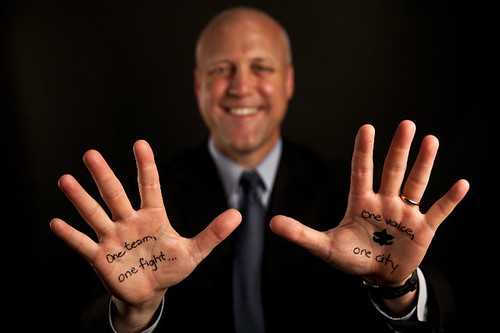
In Sunday's post, we pointed out that Governor Jindal and Mayor Landrieu have already demonstrated a preference for comfortable lies that protect business interests close to them over factual information about public safety. The ridiculous photo of the Mayor featured in that post is the result of his gleeful participation in the latest of a seemingly endless string of for-profit cause-poseur vapid art schemes that continually infect post-Katrina New Orleans with the "positivity" at the expense of honesty vibe that Mitch and many others have latched onto.
I suppose by now we're all well accustomed to these. Outbreaks like this really are the herpes of social media. They are quickly passed among the pretty people, thrive on a culture of attention-desperate self-gratification, and often involve a fair amount of prostitution. I don't mean to spend too much time picking on Dear New Orleans. Suffice to say, someone has figured out a way to promote a photography business by exploiting the intersection of current events and the need certaintypesof people have to be seen taking themselves very seriously. I only bring it up to point out that the Mayor is certainly one of those types of person.
But like it or not, this kind of borrowing civic concern to package a commercial or institutional message via individual narcissism is becoming more and more of the norm in mass communications. Which is exactly why Pepsi is so proud of its "Refresh the Gulf" initiative since it hits every one of those sweet spots. And this is why, we aren't surprised to see Dear New Orleans among the applicants proposing to spend $5,000 of Pepsi money writing on and then photographing Louisiana fishermen for the purposes of... well I'm not sure. Anyway, I'm sorry to say I probably won't be voting for that one. At least not when the competition is this stiff.
SEAFOOD COOKING CLASSES FOR THE GULF
Goals
* To raise awareness about the Gulf effort through classes and PR. * To attract 60 persons to each class. * Raise funds for the Gulf effort.
Turns out, these classes will be "raising awareness" in Chicago which is nice because we know how much the folks up there love their Gulf Lobster. On the other hand, it may have been a better idea to actually conduct the sessions in the coastal communities themselves. We hear the home cooks there are doing wonderful things with Dove detergent these days. You can almost smell it now.
NEW ORLEANS -- In the nearly two weeks since a temporary cap stopped BP's gusher at the bottom of the Gulf of Mexico, not much oil has been showing up on the surface of the water.
Scientists caution that doesn't mean the crude is gone. There's still a lot of it in the Gulf, though no one is sure quite how much or exactly where it is.
"You know it didn't just disappear," said Ernst Peebles, a biological oceanographer at the University of South Florida. "We expect that is has been dispersed pretty far by now."
---
Thomas Bianchi, a geochemist and oceanographer at Texas A&M University, said that because the dispersants have pushed oil underwater, scientists may be past the point where they can track it from the air.
"Now it's time to look at the molecular and microbial food web," he said. "We may be beyond people in white suits and booms."
He added: "There's no way to clean up water at that level in a large basin like the Gulf or these estuaries. You have to live with nature's ability to clean it up."
The amount of boats contracted by BP to skim oil, lay new boom, and replace the old ones soaked with crude will be seriously slashed, according to area leaders. The current group of about 300 vessels will be cut down to 40.
"Which is concerning for us because there has been no indication from BP they would scale back to this level," said Chris Roberts, Jefferson Parish councilman.
Roberts said he got wind of the reduction through contractors hired by BP. A spokesperson for the oil giant could neither confirm nor deny the news, but did admit to Eyewitness News there is a current scale back all along the coast.
Pointing to the well that's been capped now for over a week, BP says there's isn't enough oil in the water to warrant the same level of boats.
The downsizing could impact as many 1,000 workers, according to Roberts, and so fisherman forced into unemployment by the oil could be unemployed once more. While 76 percent of the Gulf's waters are now open to fishing, concerns remain over just what they'll find.
Providing cover for the hasty withdrawal is a sudden swell of "where-did-the-oil-go?" stories spilling out into the news continuum this week. Most notable among these is this Time Magazine story (featuring known BP flack Ivor Van Heerden) which prudently asks "Has the Damage Been Exaggerated?" at a time when the extent of that damage is still being measured and is, in all likelihood, still accruing.
I sent one text message to Bloomberg's Lizzie O'Leary, who's standing on Grand Isle, Louisiana, right now, asking how the beach looks. "Lower part past the barrier untouched with globs of oil that washed up last night," she said. By "untouched," she means by cleanup crews, and that "barrier" she's talking about is the one the press isn't allowed past. I sent another text to Drew Wheelan, who's also in Southwestern Louisiana, doing bird surveys for the American Birding Association, asking him how big the biggest tar mat on Grand Terre—the scene of those now famous horrifying oiled-bird photos—is. "20 feet by 15," he said. "But bigger ones submerged slightly."
If I managed to find that much oil with my BlackBerry without getting dressed or leaving the house, let's hope Thad Allen, who is quoted in the article as saying, "What we're trying to figure out is where is all the oil at and what can we do about it," can locate some more with the staff and craft of the United States Coast Guard at his disposal.
Gambit's Alex Woodward notes that the stream of "vanishing oil" stories fly in the face of various instances of reported oil sightings.
Coastal parishes last week all reported oil on shore or close to shore, or both. On July 28, the National Resources Defense Council issued a report showing 2,000 beach closings, advisories and notices had been issued in the Gulf region so far this year — compared with 237 in all of 2009. Oil is also blowing through boom, landing along islands off the Mississippi and Louisiana coasts. More ominously, oil is billowing under the water’s surface in large patches — some stretching for miles and sinking rapidly, thanks to BP-applied dispersants.
We landed at the Ocean Springs Airport and met with a local lawyer and conservationist who gave us a tour of the city and beach. I was in a state of disbelief when we drove past the beach area and saw kids on the beach and in the water. I wanted to run out and scream bloody murder, but I realized it was futile and that there were hundreds if not thousands of people out in that water from there to Panama City, FL. Man, if they could only have seen what I saw from the air. I don't know what the state of Mississippi is telling people, but I can absolutely, positively assure you that this spill is in the waters off their beaches.
In case you haven't been listening to local radio or watching cable news lately, here's what the State of Mississippi has been telling people.
Doubtless these ads and others like them are the fruit of BP's contribution to state tourism departments accross the Gulf coast. At the time these grants were announced, it seemed to some of us a gross misapplication of resources to devote so much money to image management in the middle of a crisis of public safety.
To some extent, such behavior is only to be expected from an oil giant like BP where propaganda is just part of the corporate playbook. And BP has implemented every page of that book. They've even been buying space to talk themselves up in places some people didn't even realize were for sale.
The ads they run every day all day on cable news channels feature one or another BP employee with personal ties to the Gulf Coast promising to "stay as long as it takes" to repair the horrible damage their company has done. And so it comes as little surprise that, since the well is nearly killed and the dramatic images of spillcam have been shut down, "as long as it takes" has suddenly become sooner than later. We don't expect BP to act in good faith with us. They're a self-interested, for profit, oil corporation. It's their job to lie themselves out of as much loss as they can. That the state and local governments whose people and coastlines have been victimized have themselves demonstrated the same enthusiasm for feel-good advertising is less defensible but perhaps explicable nonetheless.
Last Sunday, Times-Picayune outdoors editor, Bob Marshall panned Governor Jindal for making demagogic and scientifically unsound proclamations about the ongoing effort to protect the coast. While the preternaturally image conscious Jindal's hysterics are calculated to capitalize on rage at the various federal actors' performance they also serve to deflect blame from Jindal himself and an important constituency of his.
Since the oil began spewing, Jindal has been trying to convince people the reason our wetlands are being poisoned and people are out of work is those damn feds. It's a diversion. If he screams loud enough, maybe people will forget that he was a big supporter of risky deepwater drilling.
He is making villains of those responding to the disaster, not those responsible for it. The fur coat comes from an old adage that applies to many people elected to public office: "Give a gorilla a fur coat, and he thinks he's King Kong." Jindal thinks "governor" is not an office but a title, one that comes with a crown that bestows divine enlightenment: He must know more than the scientists because he was elected. That's why he can ignore the experts.
Finally, we come to panic -- which is the enduring image the nation may be getting from the most visible Louisiana politicians during this crisis. They see men screaming at cameras, raging at the federal government about this oil disaster. The same men are screaming that we need to continue drilling more wells and ignoring their own scientists' advice on how to deal with the problems.
If we have a future on this coast, we will need the nation's help in the form of tens of billions of dollars for coastal projects. Politicians spewing distortions, ignoring experts and wasting tens of millions of dollars doesn't inspire investor confidence.
Marshall doesn't say it exactly like this but the takeaway here is that, while Jindal is the Governor of Louisiana, this doesn't mean that he represents All Of Louisiana against encroachment from the sea or even from the White House. Like any elected office holder, Jindal uses that office to protect the friends who placed him there. If that means "spewing distortions, ignoring experts and wasting tens of millions of dollars" then so be it.
Likewise, New Orleans Mayor Mitch Landrieu derives his priorities through observance of the needs of his closest friends and stakeholders. Most of those friends and stakeholders happen to slither about in the city's tourist industry in one way or another. Currently, more than a few of these folks are keenly interested in presenting the attractions of the Gulf Coast in as positive a light as possible. Which is why, even as scientists are identifying real threats to the local seafood supply from the combination of oil and dispersant, the Mayor is insisting on more money to combat this and other "negative" perceptions of local tourism, regardless of whether those concerns are based in fact.
For Mitch, as he often says, it is more important that everyone in the city learn to act as "one team" speaking with "one voice" than it is for them to freely air their policy concerns, access the records of important meetings, or, say, determine the safety of their own food supply.
When people like Mitch Landrieu talk about the importance of protecting reputations and brands, it should be immediately understood that they aren't really interested in the truth if they perceive the truth as being bad for business. The fact is, you can't really have that both ways. You're either on the side of working fishermen, the Louisiana wetlands, and the public safety or you're on the side of the people exploiting those things for profit.
Landrieu's and Jindal's behavior is especially pernicious in that they pretend they're advocating on your behalf when they're really covering up ugliness on behalf of their friends. It's not really any different from BP's attempt to hide the oil. Except that nobody really expects BP to act on anyone's behalf but its own. Maybe no one should expect their elected representatives to behave any differently. But at least they could grant us the courtesy letting us speak with our own voices on the matter.
Reilly also asked Stanislaus why there was an argument about toxicity of the dispersants after the spill when the government is supposed to be prepared for their use in advance of a spill.
Still, Don Kraemer, who is leading FDA's Gulf seafood safety efforts, said the government isn't relying on testing alone.
"We couldn't possibly have enough samples to make assurances that fish is safe. The reason we have confidence in the seafood is not because of the testing, it's because of the preventive measures that are in place," such as fishing closures, he said.
FDA issued guidance last month that encourages seafood processors to heighten precautions so they know the origin of their seafood.
The federal government plans surprise inspections at docks along the Gulf Coast, though Dr. Steve Murawski, NOAA's chief scientist, acknowledged they can't be everywhere.
Last month we pointed out that chief among the Feds' inspection techniques was having inexperienced inspectors sniff harvested shrimp and oysters for "taint". One supposes the results of these NOAA tests are more encouraging than they would be had they found lots and lots of poisoned shrimp, but, at the same time, is this really a moment to start preaching the gospel of safe seafood? I'm still eating it (especially Gulf oysters) wherever and whenever anyone will sell it to me. But I'm kind of stupid and emotional about this. I'm in no way convinced that every product is one hundred percent un-tainted. And I certainly don't begrudge consumers without sentimental ties to this area their trepidation.
In an interview at EPA headquarters, Jackson, who grew up in New Orleans, acknowledged deficiencies in EPA's National Contingency Plan Product Schedule. It is supposed to list the effectiveness and toxicity of alternative dispersants authorized for use combating a spill.
But it is really just a compilation of industry-supplied data, and, in the view of Carys Mitchelmore, a leading toxicologist who teaches at the University of Maryland and has testified five times before Congress on dispersants in the past two months, a useless jumble with test results that simply don't parse.
"When I looked at that contingency table I just couldn't believe it. I thought I must be seeing things because surely they can't be posting this data," she said.
Jackson acknowledges that, "none of the testing that was done prior to this incident was what I'd call extensive and geared toward the long-term effects or effects in the sub-sea."
Instead of doing its job, EPA has largely been taking the industry's word about these products for years. How credible is any evidence they compile now under pressure to go back and do their homework decades past the due date?
Since a May 26 directive from the Environmental Protection Agency directing BP "to eliminate the surface application of dispersants," except in "rare cases," the Coast Guard has been routinely approving continued use, according to Richard Denison, a senior scientist at the Environmental Defense Fund. A check of Coast Guard records indicates that 40 requests to use dispersants by BP have been made to the Coast Guard since May 26 and that all were approved. It has allowed dispersants to be used virtually every day since the EPA directive, according to Denison. But he said that starting June 9, the Coast Guard began approving use of less dispersants than requested by BP, and also asked for use of small quantities for research to assess the effects and effectiveness of the chemicals -- designed to reduce the concentration of oil spreading through Gulf waters.
On the other hand, we are learning more about how a product like Corexit affects the toxicity of petroleum.
CNN, July 9. 2010: Rush Transcript Excerpt Susan Shaw, Marine Toxicologist:
The reason this is so toxic is because of these solvents [from dispersant] that penetrate the skin of anything that's going through the dispersed oil takes the oil into the cells -- takes the oil into the organs... and this stuff is toxic to every organ system in the body. ...
This stuff is so toxic combined... not the oil or dispersants alone. ...
CNN is warning volunteers on the current Gulf Spill of this dire information. The fact that the workers from the 1989 Alaska spill have died, surely will give current workers something to think about.
CNN and numerous other groups including Salem-News.com, have revealed the fact that this is very unhealthy work. Exposure to contaminants is something humans are supposed to avoid, but in this case it is a draw card for work in a broken national economy.
The average life expectancy for an Exxon Valdez oil spill worker according to the CNN report, is 51 years.
Oil droplets have been found beneath the shells of tiny post-larval blue crabs drifting into Mississippi coastal marshes from offshore waters.
The finding represents one of the first examples of how oil from the Deepwater Horizon spill is moving into the Gulf of Mexico's food chain. The larval crabs are eaten by all kinds of fish, from speckled trout to whale sharks, as well as by shore birds.
Again, I'm not saying I'm not still eating this stuff. But I'm one of these people who doesn't see anything wrong with texting while driving drunk so who really cares what I'm doing. Others may not have the same kind of tolerance for risk that I do. But I'm not one to deny the risk is there. Part of the reason we're in this mess in the first place is powerful oil companies like BP and their enablers and friends in our political leadership decided that ignoring the catastrophic risks of their activities at everyone else's peril was A-OK.
Meanwhile some folks are plowing right ahead with that message anyway. For the past few weeks, local food writer Lorin Gaudin has been crusading against the "foul rumors" that Louisiana seafood (despite all of the above) could possibly be unsafe. And she's been doing so in a rather breathless and blustery tone with lots of all caps words and exclamation points and stuff.
While it seems utterly ludicrous to me, apparently there are those who BELIEVE that Louisiana seafood is tainted or unsafe to eat!! Unreal. It's time to dispell those foul rumors. In converstion (not really conversing, more like heated debate about restaurant lawsuits against BP) with brilliant, Beard Award winning Jennifer English of The Food and Wine Radio network, I learned there are LOTS and LOTS of people who think Louisiana seafood might not be safe. Now really, can the world possibly think that we Louisianans would eat tainted seafood and more important, that restaurants and chefs, our world famous and fabulous restaurants and chefs, would serve tainted seafood??? Come on people, think.
Yeah, come on, people. Think!! Under what circumstances has any "world famous" purveyor of foodstuffs ever servedcustomers a taintedproduct?? What a foul ludicrous rumor!! Could anyone believe it?? Apparently some do.
To some degree, I understand what Gaudin is trying to do. Anyone connected to the Louisiana seafood industry has already had their life turned upside down by BP's destruction of Gulf fisheries. In light of this combined with memories of the absurd hostility hurled at everyone in this region following the Federal Flood, it's difficult not to take every factually murky reaction from afar as an insult. But sometimes people are really just worried about what they're eating. And sometimes those concerns are legitimate. There can be a fine line between defending local businesses and downplaying the extent of the damage BP is responsible for. And when it comes to something as crucial as food safety, I'd rather not do any of BP's lifting for them if I can avoid it.
Not at all worried about doing BP's heavy lifting for them is Ivor Van Heerden. Here, Van Heerden participates in a BP propaganda video where he really ought to be ashamed of himself for neglecting to include the obligatory reference to "iced tea".
"The public gets the perception that this is the black, heavy, tarry stuff that is in ship's bunkers and it covers everything and smothers it and just kills it, but that's not the kind of oil we're dealing with," Van Heerden says in a video on the BP website, dated July 1. "It's a very, very light oil. It's almost like diesel, and it breaks down very, very rapidly, especially here in Louisiana where it's very hot during the day and the water has suspended sediment in it so it may actually get hotter, and all of those combine with the fact that we have naturally in our system, the organisms, the microbes that break down the oil."
Meanwhile, (via Dambala) here's some video footage of Ivor's "very very light oil" coating and killing these oysters. Or at least I think that's what's happened. Better have an FDA guy come sniff them first just to be sure.
BP has told the Environmental Protection Agency that it cannot find a safe, effective and available dispersant to use instead of Corexit, and will continue to use that chemical application to help break up the growing spill in the Gulf of Mexico.
BP was responding to an EPA directive Thursday that gave BP 24 hours to identify a less toxic alternative to Corexit -- and 72 hours to start using it -- or provide the Coast Guard and EPA with a "detailed description of the alternative dispersants investigated, and the reason they believe those products did not meet the required standards."
Yet again BP gets the final call on something that seems like it ought to fall under Federal jurisdiction. Interesting little system of government we've got working for us these days. Meanwhile Billy Nungesser and Bobby Jindal are still waiting for Corps approval to start dredging their (too late but what the hey) sand barrier. Is the Corps waiting for BP? Would anyone be surprised anymore?
The hierarchy at work here appears to be something like this.
There have been 162 sea turtle strandings along the coast of the Gulf of Mexico between the Texas/Louisiana border and the panhandle of Florida this month, which could be triple the average number of dead turtles found on those beaches during May in the past five years, a NOAA senior scientist said today.
While necropsies -- animal autopsies -- of 156 of the turtles are not complete and the turtle corpses were not visibly oiled, the deaths seem linked to the spreading pool of Gulf of Mexico oil offshore from the Deepwater Horizon rig explosion, said Steve Murawski, NOAA Fisheries director of science programs, during a teleconference with reporters.
That compares to an average stranding rate of 47 for the past five years, he said.
"The stranding rate is significantly higher than background levels," Murawski said. "I have to caution that a little bit, though, because of the increased effort of looking for turtles now, compared to before the spill."
But according to EPA data, Corexit ranks far above dispersants made by competitors in toxicity and far below them in effectiveness in handling southern Louisiana crude.
Of 18 dispersants whose use EPA has approved, 12 were found to be more effective on southern Louisiana crude than Corexit, EPA data show. Two of the 12 were found to be 100 percent effective on Gulf of Mexico crude, while the two Corexit products rated 56 percent and 63 percent effective, respectively. The toxicity of the 12 was shown to be either comparable to the Corexit line or, in some cases, 10 or 20 times less, according to EPA.
I used to tell people that since the pink stuff was carcinogenic and the blue stuff was linked to Alzheimer's, every morning coffee presented the same dismal choice. I always went for the pink stuff. My reasoning for that, I would argue, was at some point when I'm lying in a hospital bed, at least I'll be able to say to myself, "Wait, what's happening? Oh yeah I'm dying of cancer. Wait, why? Because I had too much of the pink stuff." That's fine. But the alternative result of too much blue stuff being a semi-aware state of child-like consciousness struck me as unbearable. I mean, that's too close to an actual description of my regular work day as it is. And the thought that basically nothing will have changed by the time I'm ready to check out... well there's real horror there. Anyway, I stopped worrying about any of this when they came out with the yellow stuff. Nobody knows what the hell that might do to you and I hope they never find out. Otherwise it's right back to the daily dismal decision.
Which is what, I guess, BP was thinking about their use of Corexit. Everybody knows oil on the beaches is bad but the effects of the dispersant are less well-known and so given the choice between a known known and a known unknown most people feel safer if they just don't know. Except now it turns out that EPA knows a bit more than we knew they had known. And now it's even less clear that BP knows anything about anything. Obviously they could use a little help here. Perhaps EPA should use all of this data to make stronger recommendations. Isn't it their job to prescribe guidelines for safe usage of these products they're evaluating?
EPA has not taken a stance on whether one dispersant should be used over another, leaving that up to BP. All the company is required to do is to choose an EPA-approved chemical, EPA Administrator Lisa Jackson told reporters yesterday during a conference call aimed at addressing questions about dispersants being used in efforts to contain the Gulf spill. "Our regular responsibilities say, if it's on the list and they want to use it, then they are preauthorized to do so," Jackson said.
One explanation for BP's reliance on Nalco's Corexit, which its competitors say dominates the niche market for dispersants because of its industry ties, was its availability in large quantities at the time of the Gulf spill.
"Obviously, logistics and stockpiles and the ability for the responsible party to pull the materials together," Jackson said. "I'm sure that has a lot to do with the ones that they choose."
Of course. Silly me I almost forgot about how bad all that government regulation type stuff can be compared to the wise efficiencies generated by one company's dominance of a niche market. Carry on, I guess.
Meanwhile, clearly desperate, state officials are considering going back to natural sweeteners. Don't they know what that stuff does to your teeth? Or for that matter your oysters?
Oyster fishermen, normally concerned about fresh water hurting their harvest, may now prefer it to oily dispersant creeping up all across the Louisiana marsh.
Slight post-publication edits to this post may have occurred.