Apology in advance: I meant to post this yesterday afternoon but it ended up taking longer to write than I anticipated. This is why I jump from Twitter tea leaf reading into a longer bloviation on gentrification. Again, sorry about that. Since I began this post, a Gambit article as well as this NOLA Def follow-up have updated the story.
From the City Council meeting
today yesterday where they
are were discussing the new food truck regulations.
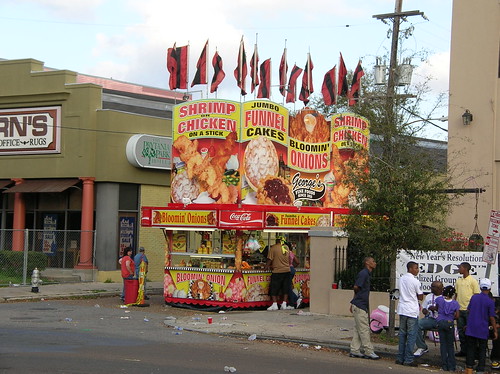
But Jackie's funnel cake and corn dog dispensaries aren't the only food services in operation along parade routes. There are also actual food trucks lurking about. They just aren't the nouveau gourmet kale and quinoa cake pop vendors the council has in mind while considering these regulations. Instead they tend to offer a less sophisticated, but certainly more "traditional New Orleans" brand of street food.
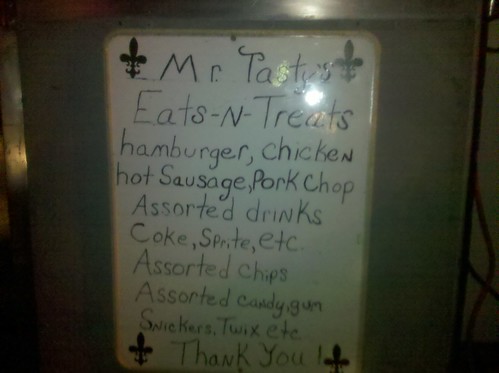
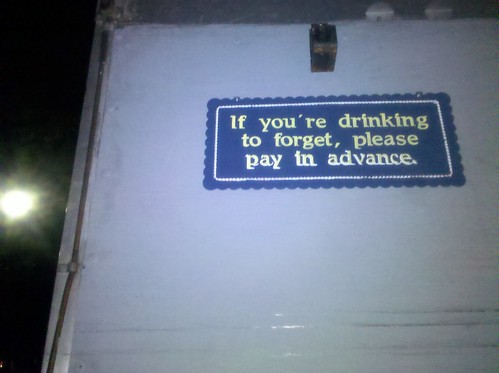
I bought a pork chop sandwich from these people. It was one fried pork chop served on a plain hamburger bun, dressed with nothing. Pretty satisfying if you've been at the parade "drinking to forget" anyway.
If I'm reading
Gambit's tweets correctly, Stacy Head seems pretty exasperated with the process right now. But then again, when is she not?
Not that the discussion isn't silly. Council appears to be trying to figure out the appropriate distance food trucks must stay from "brick and mortar" restaurants while also staying within reasonable proximity to those restaurants' restrooms. Last week
during BP trial testimony, geologist Andrew Hurst described the importance of finding what he calls the "Golden Zone" with regard to deepwater drilling.
Hurst described what he called the Golden Zone, a layer of rock
formations deep beneath the bottom of the Gulf of Mexico containing more
than 90 percent of its oil reserves, where temperatures range from 140
degrees to 248 degrees Fahrenheit. But the farther down one drills, into
the warmer temperatures, the rock containing oil becomes more fragile,
especially in the Mississippi Canyon, he said. The result is that there
is a very narrow margin in the area where the Macondo well was drilled
between the pressure needed to move drilling mud down the well to keep
the drill bit moving through rock and too much pressure that would
result in the mud fracturing the surrounding rock and disappearing,
allowing oil and gas to move up the well toward the surface, he
testified.
Fashioning these ordinances seems to require a similar degree of finesse.
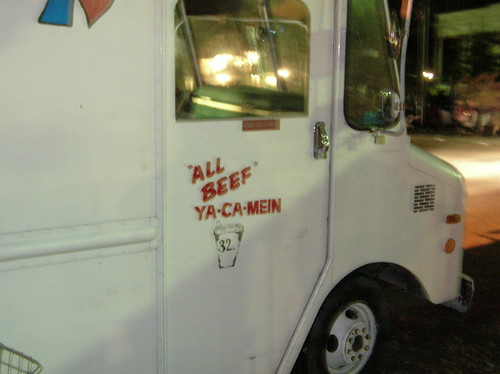
Next they will take up the issue of misleading or unnecessary quotation marks.
Meanwhile the.. um... course to digest this week with regard to all of this has been
an article from this month's Antigravity by Jules Bentley. The piece has gotten a lot of attention; some good, some bad. It's valuable, though, because it addresses aspects of the national food truck "movement" that aren't often discussed locally when this issue comes up. It turns out that, in some ways, food trucks have become something of right wing cause.
On the subject of justice, let’s get to know perhaps the biggest
power behind New Orleans food truck advocacy, and one of the most
frequent partners of the New Orleans Food Truck Coalition: the so-called
Institute for Justice.
The Institute for Justice was begun with seed money from the infamous
Koch brothers, who continue to fund it, along with the Walton siblings
who control Wal-Mart. It’s a coalition of lawyers and PR professionals
providing free legal advice and representation for conservative legal
causes all over the country, “both in the courts of law and in the court
of public opinion.” Once best-known for their attacks on affirmative
action (which they call “reverse discrimination”), the Institute has
more recently become prominent as high-profile litigators in favor of
“school choice,” aka vouchers and charter schools. They’ve got multiple
tentacles wrapped around Louisiana: the Institute’s founder became
president of the “national school choice leader” Alliance for School
Choice, which a few months ago filed suit “to intervene in the recent
lawsuits challenging the newly-expanded statewide Louisiana school
voucher program.” Yes, how dare anyone challenge Bobby Jindal’s
giveaway of taxpayer education funds to fringe religious freaks!
The Institute for Justice is very hot to strike down our laws
governing food trucks. To that end, the Institute came to New Orleans in
July 2012 to hold “Let the Food Trucks Roll,” a food truck advocacy
“symposium and rally” in conjunction with (among others) the New Orleans
Food Truck Coalition, Neighborland and the Southern Food and Beverage
Museum.
Bentley goes on to describe the way fast food companies like Taco Bell, Chick-Fil-A, etc. have, perhaps inevitably, gotten into the truck game and so have become a force behind deregulation movements in some cities.
This is all worth knowing about. But it doesn't necessarily follow that the worst-case scenario Bentley implies, "the deregulated corporate future: hundreds of chain-restaurant junk food
trucks peddling toxic, mass-advertised garbage wherever a crowd
gathers," is what's on the horizon locally.
It's difficult to picture such vendors having much success at any of our spring festivals where the local food is the major draw. One imagines they might prefer the highly touristed parts of the French Quarter. But before that can happen, they'd have to displace our native "toxic garbage" peddling Lucky Dog monopoly from that territory.
So while it's helpful to know that the fast food industry and its lobbyists are looking to horn in on a popular food trend, we don't need to assume that some of their favored reforms are in every case a bad idea. A better conclusion to draw from this is that it's often important to separate specific policy questions from the idealogues who might happen to argue on the correct side of them for whatever reason. Sometimes Rand Paul gets up and says he doesn't like drones.
He might have stupid reasons for doing that but it doesn't make him entirely wrong.
Don't get me wrong, though. I enjoyed reading this article. Jules is a talented writer who, counter to the current effete trend, is unafraid to reach into a deep rich bag of snark and let fly with a torrent of high quality hipster-bashing. For example,
“Real” food trucks—the kind of food trucks that the NOFTC cares about
and fights for—are like gastronomic EMS for hipster fuckheads: little
mobile factories reproducing a genericized leisure-class remix of world
cuisine, the kombucha-infused Sriracha empanadas that capitalism has
trained moneyed, socially aspirant young Americans to demand.
These food trucks provide a way for high-tech newcomers to avoid
having to deal with or even speak to New Orleanians; they’re another
layer of twee West Coast culture superimposed atop what’s left of our
city, to make it more comfortable for well-off “young creatives.” Just
as lower-middle-class tourist visitors to New Orleans line up around
Canal Street for the reassuring familiarity of IHOP or McDonalds, our
city’s status-conscious upper-class arrivistes can now line up for
reassuringly artisanal quinoa claptrap served by reassuringly privileged
people with reassuringly kewl tattoos.
For the record, I'd like to point out that as a mildly pro-food truck person who has sampled several of the more popular outfits around town, I've yet to find one that sells any actual quinoa. But I get it. It's hard to resist throwing it in there when writing these little jokes. I did it myself nearer the top of this post. I'm not sorry. There is a cathartic value in this and I'd like to encourage more of it.
Unfortunately we've reached a point where it also undermines communication due to the reactionary identity politics of the image conscious young urbanite. I think they've developed some sort of anti-defamation society. It's become nearly impossible to criticize any aspect our superficial commercialized fashion-conscious culture without being branded a "xenophobe."
Personally I think the kids doth protest too much, although often times I can't really blame them. During my own run through the 18-35 demo, I read enough inane
crap that was supposed to describe my tastes and tendencies that I hope
never to put anyone else in a similar box. The caveat, though, is if you're going to complain about being stereotyped in with the contemporary trend, you should be expected to think independently of it. Or at least not buy into the marketing ploys drawn from it.
The phenomenon by which popular means of expression are co-opted by
commercial or superficial interests is timeless anyway. Lately, though, we've come to see "branding" and personal expression as essentially the
same activity. Hence the almost cultish shushing of anything deemed overly critical or hot tempered. I don't know exactly when it became so incredibly gauche to make any
sort of argument that strays too far outside of, "Yay for these guys
for doing a thing!" but I find it sort of oppressive... or at least
limiting. Like the whole world took a big Xanax.
Bentley sees something like this at work with regard to the food truck movement.
Beyond using the trappings and signifiers of subculture—e.g. graffiti as
décor—hipster capitalism also brands itself as underdog or
revolutionary, employing the language and techniques of social justice
movements. New Orleans food truck advocates, like any hipster-capitalist
undertaking, aggressively seek to enlist you in their urgent, righteous
struggle. Arise, ye Facebookers, and sign this internet petition! For
freedom! For liberty! For justice! For food trucks!
He's not wrong to point out the folly of fashionable faux-activism. But I think it's okay to do this without forcing ourselves to the conclusion that the thing the douchey kids are all Facebooking the power about isn't also a nice thing to have.
But, okay, in the interest of more effective engagement I'm
forswearing future use of the word "hipster." (Except maybe on Twitter where loaded imprecise terms are actually preferred.) It starts too much of a side conversation and distracts from the more important points of one's argument. The worthy takeaways from Bentley are that New Orleans is faced with a very real gentrification problem, and that's a difficult problem to tackle because it comes with a host of attractive incidentals that lend it the guise of progress. But by describing this problem, he opens himself up to too many distracting ad-hominem accusations of "xenophobia" and the like.
A good companion article to this was
published a few weeks ago by Richard Campanella.
Campanella does his share of smirking at the dumb trendiness of his Bywater neighborhood. But his focus is describing the material implications of this aesthetic.
After the area attains full-blown “revived” status, the final cohort arrives: bona fide
gentry, including lawyers, doctors, moneyed retirees, and
alpha-professionals from places like Manhattan or San Francisco. Real
estate agents and developers are involved at every phase transition,
sometimes leading, sometimes following, always profiting.
Native tenants fare the worst in the process, often finding
themselves unable to afford the rising rent and facing eviction. Those
who own, however, might experience a windfall, their abodes now worth
ten to fifty times more than their grandparents paid.
Too often our conversations about "what kind of city we'd like to build" ignore the central question whether or not we can afford to live there. The ideal city harbors a wide diversity of opportunities for work, leisure, and entertainment. But, more importantly, it offers an affordable quality of life. If New Orleans were actually "booming" in the way its spokesmodels and political leaders claim, we would be witness to a far more chaotic arrangement of opportunity and development. Instead we're dealing with a predictable pattern of economic stratification tailored to an increasingly exclusive monoculture that is slickly sold as a "renaissance."
Still, I say it's a mistake to blame the "hipsters" and their goofy accoutrements. In truth, food trucks are actually a pretty nice amenity. They may inadvertently
signify the presence of a sinister trend but they do not cause it. I
suppose one could say the same for much of what gets classified as
"hipsterdom" in general. But I'm fine with whatever crap game of dress up
the kids want to play so long as my rent doesn't go too damn high in the
process.
Better to spend time and energy following the policymakers whose decisions directly affect our quality of life. People like Jackie Clarkson, for example, who
helpfully reminded us yesterday which world she comes from.
Before Clarkson left the meeting, she pounced on Billow as discussion
went to the 100 feet proximity requirement that would prohibit trucks
from serving within 100 feet of a restaurant:
"It's likely unconstitutional to have a proximity requirement," Billow said.
"You have to prove that to me," Clarkson replied. "You're talking
about land owners, private property rights, you're talking about tax
payers on property. I come from that world. That would have to be proven
in court for me. You don't want to go there with me on that. Don't argue that with me."
If looser restrictions on food trucks make the people in Jackie Clarkson's world uncomfortable, they can't be all that bad, right?