-->
Showing posts with label George W Bush. Show all posts

Tuesday, January 07, 2020

Was "everything fine" before Trump?

Here is one of those annoying political profile articles that treats individual politicians like Hollywood celebrities. But you should read it anyway because it is about AOC and contains a couple of items worth making note of.

The first is this little bit of reflection on one of her first public acts upon arriving in Washington.  She participated in a sit-in protest in Pelosi's office organized by the Sunrise Movement. It's kind of a forgotten episode now. But it still says something about Ocasio-Cortez's instincts.
“I was terrified,” she told me. She doesn’t regret it — though it set the stage for a very complicated year with Pelosi. “I learned a lot about how fear shapes the decisions of elected officials: ‘I know this could be bad, and this could make someone mad, and I don’t know exactly how they would drop the hammer on me or what hammers would be dropped.’ It felt like the right thing to do, and when you say that people think it’s a form of naïveté and that it’s childish, but I don’t think it was.”
It can be very easy to back out of doing what you think is the right thing because of institutional pressure to get along.  The implicit threat that publicly challenging the Speaker of the House would have debilitating consequences for a freshman Rep. was real. Typically the way to build a career and reputation in the party is to keep your head down and definitely not make anybody mad.  The only way you might decide to buck those rules is if you understand the actual nature of "the party" and which side of it you are on. 
She said the Congressional Progressive Caucus should start kicking people out if they stray too far from the party line. Other caucuses within the Democratic Party in Congress require applications, Ocasio-Cortez pointed out. But “they let anybody who the cat dragged in call themselves a progressive. There’s no standard,” she said.

The same goes for the party as a whole: “Democrats can be too big of a tent.”

It is comments like that that kept Ocasio-Cortez and the rest of the Democratic Party from reaching any kind of meaningful détente. I asked her what she thought her role would be as a member of Congress during, for instance, a Joe Biden presidency. “Oh God,” she said with a groan. “In any other country, Joe Biden and I would not be in the same party, but in America, we are.
That's the line that got this story shared all over the internet today.  For some reason people are having difficulty with it. But it's actually very easy to understand.  If you want to know which Democratic Party you happen to be in, just ask yourself whether or not "everything was fine" before Trump?
“This whole primary,” she went on, referring to the one Biden and Bernie are in, “is going to be about the soul of the Democratic Party. I think it’s a referendum on whether we think everything was fine before Trump. People who live in a lot of privilege, who think of public programs as charity, they often think there was nothing wrong before Trump. They think Hillary was the problem. But it’s much deeper than that.”
This morning, Atrios put up a blurb to the effect that the Bush Administration was also quite monstrous, you know.  Which doesn't seem like something that even needs saying to those of us old enough to have been paying attention back then. I mean I would assume anyone old enough to have a living memory of the Bush years who says Trump is any sort of unique and radical departure from that is lying.  If you are a Democrat who tells that lie, it is because your political program is specifically about guarding your own privileges with minimal or no changes to the system that grants them. Where do adherents to such an agenda get to describe themselves as "progressives"? Only in America. 

Saturday, November 10, 2018

"You cannot trust the legal process"

I'm an old dude now so this stuff is practically yesterday for me. But maybe not everybody remembers the ancient wayback past of practically yesterday. So, from time to time, it's useful to point out that, hey this shit happening right now actually happened before in the (very slight) hope that maybe it can be different this time.
In McAlevey’s book, she recounts that in her first days in West Palm Beach she worked on collecting affidavits from Floridians, mostly retirees, who believed their votes had not been correctly tallied. There were huge numbers of them, and they were furious. McAlevey asked her superiors,“So when can we actually mobilize them, put these wonderful angry senior citizens into the streets and on camera?”

The answer came back: never. She then learned that Jesse Jackson was coming to Florida to lead a rally, but organized labor would not be participating. Why? Because the Gore campaign wanted everyone to stand down. McAlevey quotes a higher up as telling her, “The Gore campaign has made the decision that this is not the image they want. They don’t want to protest. They don’t want to rock the boat. They don’t want to seem like they don’t have faith in the legal system.”

This was Gore’s central mistake. “You cannot trust ‘the legal process,’” McAlevey explains today. In reality, there is no such thing as a fair legal process separate from and immune to outside political pressure.
But pointing this out and hoping for better also sets us up to ask, is our Democrats learning?  And the answer to that question might cause us old dudes to develop ulcers. 

Friday, October 20, 2017

Comparing Presidents is sophistry

George Bush was a very bad President.  This week, many liberal commentators are using him this week as some sort of comparative barometer of decency for a cynical political purpose. The cynical political purpose isn't even that valuable. They merely mean to say, in so many words, Trump is gross.  That seems obvious enough. We shouldn't have to make ridiculous compromises with the Bush legacy in order to say that.
In his speech on Thursday, Bush criticized the Trump administration's immigration policies, remarking, "We've seen nationalism distorted into nativism, forgotten the dynamism that immigration has always brought to America." But when Bush was in office, he deported thousands of Muslim immigrants after the 9/11 attacks. As Glenn Greenwald noted at the Intercept in 2015, the former president also "quickly and secretly implemented an illegal scheme of warrantless domestic eavesdropping aimed largely at Muslims."

Before Trump took office, there was concern that his administration would create a database of Muslims, which he repeatedly threatened to do (before denying he made those threats). But Bush did actually create such a database, called the National Security Entry-Exit Registration System (NSEERS), that, according to CNN, "disproportionately targeted Arabs and Muslims and was a point of contention between rights groups and the federal government for nearly a decade." (Barack Obama's administration ended the system, saying it had become outdated.)

Trump has created a commission to study "voter fraud" in an obvious effort to intimidate voters and drive turnout down—Bush did the same thing. Trump has appointed unqualified cronies to important posts—Bush nominated his White House counsel, who had never been a judge, to the Supreme Court. Trump's administration denies climate change is a problem—so did Bush's.

It's not just that Bush was bad too. (Bush was very very bad too!) The point is that the bad Presidencies of Bush and Trump (and yes I would throw Obama in with them) do not exist in isolation from one another. One shapes the world in which the other can exist. Bush is the context from which Trump derives. Trump is a monster. Bush was one of the monsters that begat this one.  One implicates the other. There's no honest way to do a favorable/unfavorable comparison.  But there are a lot of dishonest people out there.

Monday, September 26, 2016

Monday Night Debate Ball

This is going to be one of those too-many-things-happening days.  Coach O speaks to the press at 12:30.

The Saints can vault into first place with a win against the Falcons tonight on prime time TV.

And then there's this thing where a press and public, who are by this point basically shellshocked into a kind of numb boredom, are expecting the Presidential candidates to somehow prove they can still entertain us.  It won't go well.

Especially considering the "advice" implied by this NYT collection of Bush-Gore memory blurbs.  That advice: OMG, don't be caught sighing on camera.
Shrum I didn’t think Gore’s sighs were a really big deal until I got to the spin room. Reporters kept asking about sighs, reactions, exaggerations.

Eskew I have a feeling that where we lost the debate was afterwards. The Bush people sensed vulnerability and legitimately took advantage of some of Gore’s performance flaws. And why not? You can win on policy, but not win overall if you wound yourself.
Not sure how to take "if you wound yourself" when the bored reporters were clearly wielding the knives. Those of old enough to remember the early Bush era, might know it as a nadir of political journalism leading directly to a series of escalating atrocities from the election of W up through the debacle in Iraq and the aftermath of which we'll continue to reap for a hundred years.

What have they learned from all that? Nothing, apparently.  I wonder if the Democratic candidate has learned anything, though.  Here's where her predecessor in this case study really blew it.
Shrum The second debate was a tremendous overcorrection by Gore. He kept agreeing with Bush, and Bush just clearly won.
This year's candidate sure has spent a lot of time on the campaign trail agreeing with and being endorsed by George Bush types.

Anyway don't expect anything to go too far off-script in the debate tonight. If you think this election can't get any more frustratingly dismal than it's already been, you haven't been paying attention. Even if something interesting happens, I'm sure the reporters will snap into high campaign mode and fixate on some superficiality for us.  On the other hand, maybe Trump will moon the camera or something. But it's hard to imagine how that would be much different from what he's given us all year.

As for me, I'm going to the Saints game. But don't be tweeting debate spoilers at me. I'll want to watch later. You know, just in case.

Wednesday, July 13, 2016

The sky isn't falling

Chicken Little

The worst thing about 2016 so far is, for as much trauma and disaster as there's been, for some reason, it just hasn't been as funny as you'd think.

Take the Trump show, for example. Remember when Donald Trump running for President was funny? And then how when he actually beat the other Republicans it was hilarious? That was a long time ago. That show hasn't been funny in a while. It's really just recycling the same old material.

But the hardcore fans keep trying to make it a thing.  This season, we're supposed to be worried about what happens if "Dangerous Donald" actually becomes President. But that's stupid. For one thing it isn't credible. Nothing in the polls (not even in the Quinnipiac polls we're supposed to be frightened of today) indicates he has any sort of shot at winning. For another thing, he probably doesn't even want the job in the first place. In fact, it would almost be worth electing him President just to punish him, but no one is in the mood for that now. We're too bored. 

Finally, the prospect of a Trump Presidency isn't even all that scary. If he were elected, all it would mean is a buffoon would live in the White House while we get out the old Republican binder of bureaucrats to pick who runs the government for the next four years. That will be bad, of course. But it won't be unprecedented bad. We're just talking about the same people who were around when the last Republican was President.  That guy was a buffoon too. Remember?

Friday, August 28, 2015

Bonus moment of zen

Hang in there. This nightmare will soon be behind us.  In the meantime, though...


Thursday, August 27, 2015

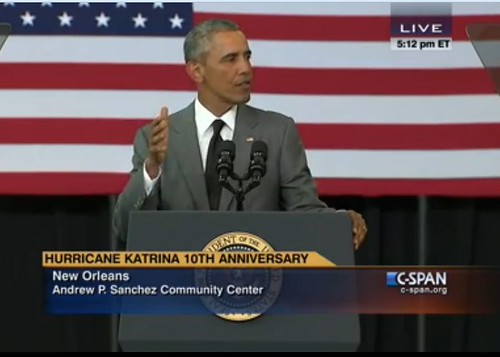
Obama's Katrina

obama katrina 10

Thursday. This is the point in the Shitstorm where it begins to rain Presidents.  Today the current President is here. His two predecessors will be in town during the weekend.

President Obama just finished speaking a few minutes ago at the Andrew P. Sanchez & Copelin-Byrd Community Center in the Ninth Ward. Here is the video. Obama says our recovery "inspires" him.  But he also talks about unemployment, poverty, lack of affordable housing, and says there is "more work to be done."

Unfortunately he doesn't have a whole lot new to say about how we're going to do that work.   He did mention climate change briefly, more or less as a slap at our stupid Governor. But he didn't dwell very long on how the rising seas and our dissolving coastline combine to imperil everything he was here to celebrate. To have spent too much time on that would draw attention to the fact that he had no new initiative to announce, no solution to offer to our continuing existential crisis. In fact, as The Lens pointed out this week, the President is already moving to defund our insufficient source of relief there.

But hey, thanks for coming. Hope the chicken was good.

The other thing that happens when a President comes to town is traffic gets jammed up for a while.  But we're used to that by now.  Both because the streets are already impassable due to every construction project imaginable happening simultaneously, and because we can remember when the feds put all sorts of things off limits.

Federal City

That is another view of the post-Katrina FEMA camp I mentioned in an earlier post today.  The photo is from late December 2005. It's one of my favorites from that time. I went back there a few weeks ago to try and recreate the scene. It's less forbidding now.

St. Louis St. at Jax lot

Thursday, August 20, 2015

All your favorites are back

This seems like a good idea.
Former President George W. Bush and former First Lady Laura Bush will visit New Orleans on Friday, Aug. 28, Landrieu said. They will return to Warren Easton Charter School, which benefited from the Gulf Coast School Library Recovery Initiative, a special fund of the Laura Bush Foundation for America's Libraries established to help Gulf Coast schools that were damaged by the hurricanes.

"At an education round table, President and Mrs. Bush will honor the exceptional work accomplished by New Orleans school leaders, non-profit partners, educators, parents and communities," the mayor's statement said.
When is the Ed Blakely commemorative bike tour?

Update: If you'd like to prepare for George Bush's visit, this game is still online

Thursday, September 12, 2013

True facts about Ed Blakely

According to ABC News Australia, former New Orleans "recovery czar" Ed Blakely is "Bringing Brooklyn's urban cool" to a shopping mall fountain in Sydney. Gambit explains.

Dr. Ed Blakely watchers know that former Mayor Ray Nagin's "recovery czar" declared mission accomplished on the rebuilding of New Orleans in 2009 and took his metaphorical "cranes in the sky" to Australia, where he now works with the University of Sydney's United States Study Centre (bless their hearts).

But now Blakely has a new challenge. He's teaming up with "urban designer" Ethan Kent to revitalize a shopping mall in the Sydney suburb of Parramatta.


That revitalization seems to center on restoring a fountain built in 1986 in the midst of the mall, a rather different task than rebuilding New Orleans. But certainly Blakely is the man for the job; as a report on ABC News Australia stated this morning, he was appointed to fix New Orleans by none other than President George W. Bush:

Professor Blakely was called in by then president George W Bush as "recovery tsar" after Katrina and has now been commissioned by Parramatta City Council to rebuild its central square, Church Street Mall.

He says the task in New Orleans was massive.

"The city fell down. 80 per cent of it was ruined," Professor Blakely said.

"We had to build it from the ground up and that's what we did.

"But I worked on a lot of other cities around the world: San Francisco, some in New York, Moscow, Paris."
There once was a time (I think this was just after the "Chocolate City" speech) when we were fond of pointing out the similarities between Mayor Ray Nagin and President Bush.  But we were pretty certain at the time that Nagin and not Bush hired Ed Blakely.  But if ABC says differently, then I suppose there's a lot we didn't know about Ed Blakely.

And that's why I did some checking.  You might be surprised at the Ed Blakely facts I found. I would like to share these facts with you now.  Not many people know these facts so you are likely learning them for the first time.  If you find them shocking please consider the feelings of others you may share them with before you do.

  • Ed Blakely was hatched in a secret laboratory operated by Monsanto in Anaheim, California at Disneyland's original Tomorrowland exhibit. In the basement.

  • Ed Blakely trained  in the meditative arts by walking a topiary labyrinth for 20 years uninterrupted while he communed with the infinite.. or possibly the ghost of Robert Moses.

  • Ed Blakely was appointed by President Rutherford Hayes to re-crack the Liberty Bell after it was repaired by well-meaning locals who didn't want to wait around for the damn gub'mint to solve their bell problem for them.

  • Ed Blakely once escaped from Liliput shouting defiantly at its inhabitants, "I don't have time to talk to little people."

  • Ed Blakely personally administered the neighborhood charrette that produced Adrien de Pauger's original plan of New Orleans.

  • Ed Blakely restored power to Superbowl XLVII by smiling brightly at a newborn child.

  • Ed Blakely once bike toured all the way from Cuba to Florida.
  •    
This afternoon, we received word that the Voyager 1 Spacecraft is believed to have finally exited the solar system and sailed  on into interstellar space. But Ed Blakely was already there so it turned around and came home.

Wednesday, May 01, 2013

And all tomorrow's missions too

Today is "Mission Accomplished Day" (10 freaking years later!)

Never forget the heroes.

Chris Matthews on MSNBC called Bush a “hero” and boomed, “He won the war. He was an effective commander. Everybody recognizes that, I believe, except a few critics.” He added: “Women like a guy who’s president. Check it out. The women like this war. I think we like having a hero as our president. It’s simple.”

PBS’ Gwen Ifill said Bush was “part Tom Cruise, part Ronald Reagan.” On NBC, Brian Williams gushed, “The pictures were beautiful. It was quite something to see the first-ever American president on a—on a carrier landing.”

Bob Schieffer on CBS said: “As far as I’m concerned, that was one of the great pictures of all time.” His guest, Joe Klein, responded: “Well, that was probably the coolest presidential image since Bill Pullman played the jet fighter pilot in the movie Independence Day. That was the first thing that came to mind for me.”
Gee aren't those three individuals embarrassed.  Guess they'll always regret the day they threw away their credibility glorifying the bloodiest obvious hypocrisy of the decade. 

Aw I'm just joshing with you, of course.  Those people are still fabulously wealthy, successful, and respected voices in political journalism. In their business you can never go broke sucking up to money and power

This is also why we're all very excited for The Advocate's future. What could possibly go wrong?

Friday, October 26, 2012

Where is W when Freedom needs him?

Last week In These Times reported on a conference call between Mitt Romney and "self-described small business owners" where Mitt suggested that they instruct their employees about voting.

I hope you make it very clear to your employees what you believe is in the best interest of your enterprise and therefore their job and their future in the upcoming elections. And whether you agree with me or you agree with President Obama, or whatever your political view, I hope, I hope you pass those along to your employees.

Here in an op-ed for The Hill, University of Oregon professor Gordon Lafer points out that President George W Bush would have condemned such tactic.

These are the kind of banana-republic tactics that our government regularly condemns when they occur abroad. The Bush Administration, for instance, rejected Ukrainian elections as illegitimate, in part because international observers found that managers of state-owned enterprises had “instructed their subordinates to vote for [the ruling party].”

One step beyond even the Kochs is GOP mega-donor Bob Murray, who required employees at an Ohio coal mine to attend a Romney campaign event. The resulting photo-op could have been at home in the old East Germany – candidate standing before a crowd of miners, replete with banner reading “Coal Country Stands With Mitt,” with no notice that miners were attending under the direction of their boss, forced to give up a day’s pay in order to serve as human props. Again, we routinely condemn such charades when carried out by foreigners. The Bush Administration criticized Armenia’s elections, for instance, after observers reported that “factory workers … were instructed to attend the incumbent’s rallies.”  But what we reject for Armenians and Ukrainians, the business lobbies now want to institute at home.

Thursday, November 04, 2010

Impeachment

If the incoming GOP majority in the House really is looking for an impeachable offense in the Obama administration, might I suggest obstruction of justice for his refusal to prosecute George W. Bush for approving these war crimes.
In his book, titled "Decision Points," Bush recounts being asked by the CIA whether it could proceed with waterboarding Mohammed, who Bush said was suspected of knowing about still-pending terrorist plots against the United States. Bush writes that his reply was "Damn right" and states that he would make the same decision again to save lives, according to a someone close to Bush who has read the book.

Thursday, November 05, 2009

Ed Blakely, red tape, and "locking people in cages"

Please read what Karen posted yesterday morning.
Post Gustav Ed Blakely did his best to show a strong show of force, and in some ways it would seem that Gustav was Blakely’s perfect storm. One that did little damage but emptied out the City of pesky residents. In fact one of the first times I met Dr. Blakely he was crowing about his suspending council meetings in Oakland after the fire. His assertion was that he could cut through the red tape if it just didn’t exist. Employing the same logic post Gustav he worked with the Mayor to craft an Executive Order to cut through that red tape and ultimately tread on constitutional rights.
The "emergency" period following the Gustav evacuation isn't discussed as often as it probably ought to be. During this time the Nagin administration assumed and abused extraordinary powers to deny citizens access to their homes for days after the emergency had passed even going so far as to unilaterally design a staged reentry program based on socio-economic caste. It maintained these extraordinary powers for weeks afterward in order to expedite questionable property demolitions outside of the legally established review process. Recently, when Ray Nagin expressed his admiration for the emergency management capabilities of totalitarian government, he wasn't just blowing funny cigar smoke at us. He was speaking quite deliberately and informed by the policies and experiences of his own administration.

In an August 2007 interview with Gambit, Ed Blakely described in detail his and Nagin's preference for governing by emergency dictate. I wrote a longer post about it at the time which you can read here if you like but what I wanted most to point out was that Blakely wasn't talking about some theoretical (although I would still say debatable) need of "emergency" governmental powers to move people out of harm's way. Rather he was more interested in longer term subversion of standards for public input or procedural transparency in the distribution of things like construction contracts. While by this point it is nothing novel to state that New Orleans under Nagin and Blakely has been an exercise in classic Bush era "Disaster Capitalism", I think it is worth noting the Gustav event as a particularly symptomatic moment in this regard.

Furthermore, Nagin's candid expression of Cuba envy underscores just how profoundly anti-democratic and dangerous the means by which we are ruled have become in these times. I'm going to share some excerpts from a recent interview between Bill Moyers and Glenn Greenwald. Moyers and Greenwald are talking about abuses of the Constitution, of the Freedom of Information Act, and of basic human dignity perpetrated by the Bush and Obama Administrations under the now familiar excuse that such abuses are "protecting" us from one or another "emergency". The entire interview is available to view online here. Take the time to watch it. It is instructive of the larger conceptual political context in which the Nagin-Blakely era in New Orleans has operated.

BILL MOYERS: No one wrote earlier or more powerfully about the claims, the extra legal claims that the Bush and Cheney Administration made after 9/11. Doing many of the things you just described, because they invoked national security and the fact that to fight terrorism you often have to use the terrorists own tactics.

To what extent has President Obama begun to deconstruct that extra-legal apparatus, the excessive secrecy, the use of extra-constitutional means of interrogation? To what extent is he undoing the infrastructure of excessive government claims that you wrote about during those last eight years?

GLENN GREENWALD: Very little. And not only is it the case that he is deconstructing that framework in only symbolic and inconsequential ways, but he's doing the reverse. Which is he is finding new and often more effective ways to embrace many of those same instruments, and to institutionalize them further. It's not the case that Obama is the equivalent of Bush and Cheney, in this regard--

[Exchange regarding the President's willingness to compromise principal in the pursuit of maintaining power]

BILL MOYERS: For example?

GLENN GREENWALD: Well, one of the principle controversies of the Bush Administration, one of the defining aspects of their radicalism, was the idea that we can take human beings who we don't capture on a battlefield, who we simply abduct and pick up, who we suspect of engaging in terrorism and put them into cages for years or decades without having to charge them with any crime.

That — simply based on executive authority — the ability to point to someone and say, "This is a terrorist," then justifies the elimination of all due process and putting them into prison forever. Obama, several months ago, said that he not only believes in that power, but wanted Congress to enact a statute that would permanently enshrine this theory of law into Presidential power.

He gave up on that because there was going to be difficulty in terms of getting the bill that he wanted passed through the Congress. So, instead what he did was he embraced the Bush/Cheney justification as to why the President can do that, which is that the Congress implicitly authorized it.

And so, we're continuing our scheme of indefinite lawless detention, free of due process, free of any charges of any kind. Where we can pick up people anywhere around the world and put them into cages. He's actively defending that power in Afghanistan, by saying that people who we abduct far away from the battlefield, far away from Afghanistan, and then ship to Afghanistan and imprison at Bagram have no rights even to habeas corpus, which the Supreme Court said at least that Guantanamo detainees have.

And so, that's just one example where for years liberals yelled and screamed vehemently that Bush was subverting the Constitution and degrading the American culture, political culture, by asserting this power. And yet, here you have Barack Obama not just refusing or taking his time undoing it, but himself actively defending and advocating it. And there's very little outcry. And that repeats itself in terms of the state secrets privilege. And the effort to block accountability for torture victims. And a whole variety of other powers that Bush and Cheney asserted to great controversy.


Here we have seen these themes brought to bear on a local level. Sure, petty corruption and arrogant officiousness exist in other parts of Imperial America. But when the arrogant petty criminals who run this town talk about making decisions according to the direction and needs of an elite "coterie of people" with little or no public accountability, it stings more acutely. Why? Well, in part, because the abuses here have been about more than just the meting out of cash by the "coterie". Here we really have been putting people into cages or "disappearing" them or.. worse.

In Zeitoun, Dave Eggers relays the story of local painter and contractor Abdulrahman Zeitoun who stayed behind during the Federal Flood to watch over his home and some of the properties he owned around town. Zeitoun spent the first few days after the storm traveling the city in a canoe, rescuing people from flooded buildings, and feeding abandoned animals until he (along with three other men) was abducted from his own building by armed security personnel and locked up at the "Camp Greyhound" temporary prison constructed in the Union Passenger Terminal.

When I read Zeitoun this summer, it made me very angry. But, like Clio, I was grateful to see this story told so well by Eggers. Zetioun stands among a very small number of "Katrina" books that manage to tell a real story about real people without falling back on ornamental cliches or guilt-driven defensive rationalizations about "Why New Orleans Matters". Instead, Zeitoun simply assumes the reader will understand that the people here "matter" because they are people. The fact that the events reported upon constitute a violation of that assumption makes the horror of it all that much more poignant. This week, Gambit's David Winkler-Schmit interviewed the author. Here's a quick bit of that.

When Zeitoun is arrested, he's brought to Camp Greyhound. The jail was constructed after the storm and was a fairly extensive project. What does this tell you about the government's priorities after the levee failures?

I started doing a lot of research into [Camp Greyhound] and it had been fairly well documented in those weeks after the hurricane, but it wasn't widely known outside of New Orleans. (Zeitoun) had figured out some math when he was locked up there about just how quickly they had assembled this outdoor prison in the wake of the storm. It has been confirmed that while people were dying in attics, struggling to eat or find water, yearning for help on rooftops and the government couldn't get anything right on a national level and was still bungling in so many ways, at the same time, there was a very efficient operation happening at the Greyhound Station. [Prisoners from Dixon Correctional Institute] and trustees from Angola were bused down along with a vast amount of materials to erect a very shiny and well-built prison. That contrast struck me and it felt very emblematic of Bush-era priorities, where it's command and control over any sort of humanitarian concerns.

What prompted this collapse of the criminal justice system, where people were arrested with little or no provocation, no investigations were made and then suspects weren't allowed to contact anyone on the outside?

It was very hard to have land lines working at Greyhound, or so they say — and if we grant them that it would be very difficult to make calls, but in lieu of that, there has to be other systems in place. It also doesn't excuse the fact that after they evacuated from Greyhound (to) Hunt (Correctional Facility in St. Gabriel, La.), they were still not given phone calls. But there was a lot of that left hand not knowing what the right hand was doing, because once a prisoner was processed through Greyhound and sent to one of the many longer-term prisons throughout the state, they were lost in the system for weeks, if not months, when no one really knew where they were. Records weren't being kept. Lawyers and human rights advocates think that what was done was an evacuation via incarceration — where they wanted to clear out the city, so anybody found within it was accused of looting or some other trumped-up charge and thrown in prison.


I was also struck by the efficiency with which "Camp Greyhound" had been constructed compared to the numerous other failures of emergency response happening concurrently. It's a fact that moves one off the point of criticizing the competence of the government in these situations and on to its priorities.

One of the most insulting things Blakely did in his Berkley interview was to lay blame for his ineffectual tenure in New Orleans at the feet of a "lazy" and "illiterate" population. It is remarkable that a man who spends as much time as he does seeking ways to belittle and subvert citizen involvement in civic affairs would be so disapproving of a supposedly disengaged citizenry. But Blakely is a two-bit carpetbagger so it's folly to take much of what he says at face value.

On the other hand, something must explain why a supposedly free people allow themselves to be ruled and misused this way; why we arrive at a government that can't deliver water to stranded citizens but can build a mini-GITMO in less than five days. Moyers asked Greenwald to speculate on it and I think he came close to hitting on something here.

GLENN GREENWALD: I think there's several aspects to it. But I think the principle one is — and interestingly, Barack Obama actually talked about this in his Presidential campaign, quite eloquently and insightfully — that there gets to be a point where citizens look at the government, and they look at both political parties, and they conclude that the system itself is so radically corrupt and the political parties are so fundamentally nonresponsive that no matter what it is that they do, they aren't going to be able to achieve any change. They feel a sense of learned helplessness. And they essentially accept whatever it is that's done to them and simply hope that it's not too bad. And I think that's the population. It's not that they're apathetic. It's that they've come to believe in their own impotence. And I think that's actually sadder and-- and more dangerous.


Like I said, I think he's close. I think there actually are a lot of justifiably angry people out there. But so many of them are so misled or so misinformed that their anger manifests in such ways as to further discourage the rest of us. I'm not sure I understand it fully but I do know it creates the sort of environment where Nagins and Blakelys of the world can flourish at our expense. But now, Blakely is gone and Nagin is on the way out. Given that Obama hasn't been much of an improvement over Bush I suppose the best we can do about the upcoming municipal elections is continue to hope that whatever comes next isn't too bad.

Note: Dave Eggers will be discussing his book at the NOCCA institute (2800 Chartres St.) on Friday at 8:00 PM. Tickets are $10.00 Click here for more information.

Wednesday, October 21, 2009

Another one for the pile

"A dictatorship would be a heck of a lot easier, there's no question about it"

--George W Bush (2001)


"One of the biggest weaknesses we had during Hurricane Katrina is it wasn't clear who was the top authority."

"The president and the governor were going back and forth. . . . In Cuba you don't have that problem. The government says, 'This is what we're doing, these are the resources we are going to deploy, ' and it pretty much happens."

--C. Ray Nagin (2009)


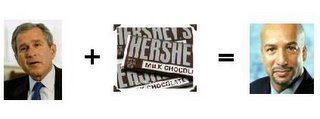
A few years back I started my own collection of Nagin/Bush parallels which I would share on the Yellow Blog from time to time. In 2006, one day after the much-celebrated "Chocolate City" speech I wrote,
There are some striking similarities between the two men. Both came to politics from the "business world". Bush ran a series of cushy family connected oil exploration ventures into the ground before becoming a useful political puppet of arms dealers and energy companies. Nagin ran Cox cable in New Orleans (as Schroeder puts it in comments to this YRHT post, "How tough a "business executive" do you have to be to work for a massive monopoly that just collects checks for a ridiculously overpriced service?") before becoming a useful political puppet of the city's white aristocracy. Both men are prone to making bewilderingly stupid statements when allowed to speak extemporaneously. Both men can appear rather surly when challenged on these statements.


I like to link back to that post as often as possible because it contains one of my prouder achievements in graphic design which I will haul back out of mothballs for you below.


That Nagin, who during the Gustav fiasco, presumed he could lie to citizens, force them from their homes, and then stage their return according to a shadowy "tier" system based on a bizarre prioritization of political and economic elites, would express such an overt affinity for totalitarian rule should surprise no one.

Update: More from Dambala

Monday, May 04, 2009

Lil' Bush

Our favorite comparison surfaces once more. This time in the NYT.
The authors of the Tulane poll, including the political consultant James Carville, said voters believed by two to one that the city was “on the wrong track,” and they compared the city’s mood to that of the nation “in the final year of the Bush administration.”


Edit: Also see... today is the first day of the rest of..
TICK, TICK, TICK . . .: The moment is likely to pass with little notice, but at the stroke of noon Monday, term-limited Mayor Ray Nagin will begin his final year in office.

The City Charter mandates that every four years, the city's newly elected chief executive and City Council members are sworn in at midday on the first Monday in May.

Tuesday, January 20, 2009

Quick observations

1) God I hate Bush

2) Are we sure Cheney didn't injure himself actually letting the door hit him in the ass on the way out?

3) Obama's speech is very much the sort of thing you might have liked to hear from your President on 9-11.

4) Although Obama mentioned the word levees, he did not say anything about New Orleans or the Gulf Coast in the infrastructure agenda portion of his speech. Kind of a bummer.

5) We set up a television in the library so that people could watch the inauguration with us. I *almost* teared up a bit when Roberts said, "Congratulations, Mr. President" but managed to keep it together.

6) At one point the camera fell on Ray Nagin in the audience. One of our patrons exclaimed, "Oh no!" and retreated to the other side of the room. "I can't watch that. It's bad enough they made me look at that other idiot (meaning Bush)" She came back to watch the rest of the speech when she felt safe from threatening images.

7) George W. Bush. God, I hate that guy.

8) Ladies and gentlemen, the new Whitehouse.gov. What does this mean for the future of Whitehouse.org?

Bush remembered to pack, right?

I sure hope Mike Brown wasn't in charge of calling U-Haul.