-->
Showing posts with label Lee Circle. Show all posts

Tuesday, December 01, 2020

Taylor Circle

Last week we moved a step closer to removing symbols of the city's legacy of white supremacy from its streets and public spaces. The committee charged with coming up with new things to call all of this stuff published its list of suggestions.  There are still a lot of things that need to happen before any of this becomes official, but the results so far are pretty good compared to what we expected. This could have ended up as a slapdash of bland cliches thrown together by tourism marketers. And maybe some of that is still evident but, mostly, this list has real depth. Rather than focus solely on entertainers, it highlights figures who fought for civil rights and escaped or defied slavery. Remember the purpose of this exercise in the first place was to counter a century's worth of damage inflicted by Jim Crow era propaganda. This list does fit that aim.  Heck, Mama D is on there. Who woulda thought?

Of course, it would fit that aim even better if the commissioners had taken our advice and renamed the traffic roundabout formerly known as Lee Circle for Dorothy Mae Taylor.  According to this, they did at least try. 

Commissioners initially considered naming Lee Circle for Dorothy Mae Taylor, the City Council member who was instrumental in desegregating Mardi Gras parades. But that plan failed to get enough votes from the commission. A proposal for Jazz Circle or Music Circle also was rejected.

“I definitely respect us trying to get a win for everyone by going with something generic but the whole purpose of forming this commission was to right wrongs and to acknowledge harm,” Commissioner Gia Hamilton said. “ I personally feel like it would be against my own personal beliefs to vote on something that’s generic.”

Before settling on (Leah) Chase, some commissioners sought to include Taylor as well and name the circle after both women jointly. That effort didn’t gain traction, either.

Nothing wrong with Leah Chase, to be clear. She belongs on this list somewhere. But it would make more sense to honor her in the Sixth or Seventh Ward neighborhoods her memory is best associated with.  Uptown was Dorothy Mae's territory. There really should be a statue of her scowling down at Rex as he passes around the circle every year (well... in the years to follow 2021, that is.) 

Anyway, despite our best efforts, and until  the"Chase Circle" designation is approved, it seems for now that the more appropriate Taylor to name it after is Phyllis.  After all she does own, or control, most of the property there. 

When Circle Bar co-owner Dave Clements arrived for an Oct. 8 meeting at the office of the bar’s landlord, prominent philanthropist and energy company executive Phyllis M. Taylor, he didn’t expect the dramatic good news/bad news dynamic that was about to play out.

The good news: Taylor would cancel the Circle Bar’s rent for the remainder of the year, and not seek back rent dating to March, when the coronavirus pandemic forced the storied Lee Circle bar/music venue to close. That gesture saved the Circle Bar, already cash-strapped before the pandemic, nearly $70,000.

The bad news: The bar would be required to start paying rent again in January, and its lease would not be extended past December 2021.

Taylor, whose fortune derives from a company responsible for one of the largest - and longest running - oil spills in US history, owns, through various companies and LLCs, the Circle Bar, the parking lot next door, and the office building across the way. She also purchased the property for and funded construction of the Greater New Orleans Foundation's massive "Center For Philanthropy" building that sits diametrically across the Circle from the bar.  

Given this information plus the fact that the "philanthropic" non-profit industrial complex completely dominates not only our economy but our entire system of government in 21st Century New Orleans,  it only makes sense that this be reflected in the nomenclature.

As for the New Orleans of the 20th Century, well, that is mostly gone now. Its old landmarks are dying away one after the other this year.  Oh well, goodbye to all that. Can't wait to find out all the exciting entrepreneurial ventures Gayle Benson is going to fund during the post-COVID phase of late capitalism. So much free real estate out there all of a sudden.

Thursday, April 12, 2018

Taylor Circle

Save All Monuments
An all-monuments-matter type household tells us how they feel during Carnival 2016  

Ever since the Confederate statues came down last year, a parlor game has blossomed on our city's op-ed pages and at public meetings and candidates' forums and whatnot over the question of what to do next with the space they occupied.  Why bother to do anything?  We just wanted the Jim Crow monuments taken down.  It's perfectly fine to just strip the name Lee off of the circle (return it to Tivoli or whatever) and just leave it alone after that. There's no pressing reason a person should be commemorated there at all.

On the other hand, if we do re-name the circle, the way to do that would be to give it a name that directly speaks back at the propaganda we have removed.  The Confederate monuments were themselves a political statement made by the white supremacists in power at the time of their erection.  If we choose to continue using that public space to express our political purpose, we should do so in a way that rebuts the original statement.

The reason I had given up on rededicating the circle at all is most of the ideas I've seen bandied about fail to address the definitive conflict that makes the space significant in the first place. Some attempt to sanitize it with tourist-friendly symbols drawn from entertainment. Some would replace monuments to the exploitative capitalism of the 19th Century with monuments to the exploitative capitalism of the 20th and 21st.  One idea that might have been acceptable was the suggestion that we acknowledge resistance to Jim Crow and rename the circle after Homer Plessy. But Plessy is already being honored in a location more appropriate to his historic act of protest.

Perhaps the worst argument I've read has been this suggestion by Arthur Hardy to create a "Mardi Gras Circle."  Hardy's stated intention to "bring us all together," is, like many of the other lame ideas,  an inappropriate attempt at sanitizing the space.  But his idea is actually even worse than that given that his subject is freighted with much of the same social and racial conflict as the Lee Monument itself.  This isn't a knock against Mardi Gras. Far it be it for us to speak against that. But re-naming Lee Circle "Mardi Gras Circle" as Hardy suggests and for the reasons he gives, degrades the social and historical significance of the circle and of the holiday.

It's fair enough for Hardy to say that the celebration of Carnival "brings people together." But that is a superficial assertion. Mardi Gras brings us together, yes. But as it does that it also heightens and  illuminates our contradictions. It's actually the underlying social and political discord that makes the communal experience of Mardi Gras such a powerful act of civic catharsis. And, sure, that's a bit more than most people are consciously grappling with while screaming at the Nyx "Dancing Queen" float for a bedazzled purse.  But any reflective treatment of the pageant, say in the form of a monument, that does not evoke this idea does not do the subject justice.  Except Hardy isn't interested in a symbol of social conflict. He's interested in something that has a benign "healing effect." In trying to do this with a Mardi Gras Circle, he confounds his own purpose.

It's a bad purpose anyway.  Twisting our own uncomfortable history into myths intended to please the powerful is how we got into this mess in the first place.  Case in point, Hardy's supporting argument is so far off base it necessitates paying reverent homage to a white supremacist organization.
As New Orleans celebrates its tricentennial, it is worth noting that Mardi Gras has been an essential part of the city’s history for more than half these 300 years. Street masking and private balls occurred in the late-1700s. In 1857, the Mistick Krewe of Comus presented the first organized Mardi Gras parade in New Orleans.
Of course it was the very members of the "Mistick Krewe" and associated Old Line Carnival organizations who established the revanchist Jim Crow government in the first place.  These clubs comprised (and in fact still comprise) the cream of the city's elite business and political class. After the fall of the Confederacy, they turned their street parades (these "bringing people together" activities Hardy is on about) into acts of un-subtle racist protest against the Reconstruction government.
During Reconstruction, New Orleans’ white elites used the pomp and ceremony of Mardi Gras to reassert symbolic and political control after the Confederacy’s defeat. The Louisiana Constitution of 1868 ushered in desegregated schools and public transportation, recognized the citizenship of African Americans, and granted the right to vote and hold office to African-American men without property requirements. Local white men perceived this new racial equality as a threat and were eager to recapture their former power.

Carnival krewes took their political arguments to the streets and manipulated their festive displays to provide evidence of the illegitimacy and incongruity of black citizenship.

The Crescent City Democratic Club, later renamed the Crescent City White League, whose stated goal was to prevent the “Africanization” of New Orleans and Louisiana, formed the city’s second krewe in 1870. The Twelfth Night Revelers regularly caricatured African-American lawmakers as bumbling crows or backward strongmen.

Comus presented its infamous “the Missing Links to Darwin’s Origin of Species” and “the Aryan Race” themes in 1873 and 1877, respectively. The former theme culminated with an anthropomorphic crowned gorilla standing in contrast against a white Comus, suggesting the innate inferiority of black men holding civic office. In like fashion, the Knights of Momus displayed comical yet grotesque representations of mixed-race people among equally grotesque animal hybrids in its 1873 parade themed “the Coming Races.”

Mardi Gras had become a mode by which former slaveholders and Confederate sympathizers could maintain symbolic power and communicate ideas of white supremacy, social Darwinism and the “Lost Cause” even under the city’s interracial Republican government.
After Reconstruction, it was these organizations who raised the funds and political will to create and install the monuments.
Two decades after occupying Union soldiers had made camp at New Orleans' Tivoli Circle, a monument to Confederate Gen. Robert E. Lee was dedicated at the site. Among the guests at the ceremony on Feb. 22, 1884, were former Confederate President Jefferson Davis, former Confederate Gen. P.G.T. Beauregard and Lee's two daughters.

Four days later, Mildred and Mary Lee attended the Comus ball.
By looking past all of this, Hardy suggests it is no longer of any relevance.  But nothing could be further from the truth.  To begin with, Comus and his acolytes continue to exert massive influence on the city's social and political hierarchy.  For proof of this, one need only observe attendees at the annually televised Rex Ball and compare those names with those that appear on campaign finance reports, or the boards of our local "philanthropic organizations" and the corrupt financial institutions that connect them.

Furthermore, the Krewes continue to militate in favor of their "Lost Cause" propaganda to this very day. Comus and Momus no longer parade in an ongoing protest against a thirty year old anti-discrimination ordinance. But their membership does through associated successor organizations.  Over the three years (yes it took that long) of debate over the monuments, Chaos and D'Etat repeatedly ran floats "satirizing" the movement to take them down.

Hardy breezes past all of this context regarding the Old Line Krewes vis a vis Confederate monuments.  Worse than that, he implicitly takes their side of the anti-discrimination dispute which he characterizes as an "attack" on the celebration itself.
Even when the celebration itself was under attack in the early 1990s when reaction to an anti-discrimination ordinance caused temporary battle lines to be drawn, it was Mardi Gras parades that brought the community back together. I’m betting that Mardi Gras Circle will have the same healing effect as we move past the recent controversies over statues and monuments.
Also, lol at that bit about the battle lines being "temporary."  The Krewes still haven't let it go.

Nor have they let go of their beloved Confederate monuments. And they appear to have the sympathetic ear of the incoming mayor on this matter. Last week she told Gambit she's willing to let the krewes "people who care about"  the Confederate monuments display them in a cemetery because, in her words, "Reverence, you know, matters."

That an African American mayor of New Orleans in 2018 is still obligated (and willing) to kiss the rings of the white supremacist Carnival royalty like this is stunning. That Hardy would write their own self-victimization white resentment bullshit into his version of the narrative tells us enough to distrust his proposal.  Our city's most famous Mardi Gras historian is a.. nearly literal, I guess.. court historian. That's not a huge surprise, of course. The niche media career he's carved out for himself depends on a willingness to tell us a top-down version of history.  Nobody rises very far in our little town without flattering a few oligarchs.

Luckily, a letter to the T-P this week provides us with what might be a solution.  
With all the public hullabaloo about Lee Circle, there have been many suggestions about renaming it. While most of those suggestions seem good, I believe I have a better one. Dorothy Mae Taylor was a longtime civil rights advocate before she was elected as the first African-American woman on the New Orleans City Council in 1986.

Taylor became famous (and some would say infamous) when she proposed an ordinance in 1991 to desegregate the gentlemen's luncheon clubs that had been the public face of the Mardi Gras krewes.

Here is a way to address every elephant in the room.  Hardy wants the circle's name to reflect the fact that Carnival parades pass there every year. This certainly does that.  Better, it does so in a more honest and meaningful way than Hardy's bland obfuscation of history would. More generally, we said we would like the re-christening of the space to directly speak back at history in a way that better reflects the best of our present values.  Well, Taylor Circle would do that too.

The only question now becomes, how would we pay for it?  I don't suppose Frank Stewart wants to chip in, does he?
Friday, April 28, 2017

EPCOT Circle

We are begrudgingly grateful to Mitch Landrieu for not getting in the way of a decades long people's campaign to take down the city's Jim Crow era Confederate monuments. It's good that it's finally happening.  What we would very much appreciate now, though, would be for him to shut up and stop making it all about him.
Mayor Mitch Landrieu mounted a passionate defense of his approach to removing the city’s monument to the Battle of Liberty Place during an interview Thursday, insisting that credible threats of violence ruled out holding any kind of ceremony or doing it in the daytime.
The problem, and this is the problem with all political big wigs, is Mitch is starting to act as though he has ownership over the issue just because he happened to be the mayor when it came to a head. I hope he doesn't go too far with that, though because his idea for what to do with Le Circle in the future is terrible. 
He also offered an idea of his own vision for the sites.

He said the circle around the Lee column could be turned into a fountain with statues representing various aspects of New Orleans’ people and culture and renamed Tricentennial Circle in honor of the city’s 300th birthday next year.
For the record, I called that two years ago. The dude is pretty predictable.   
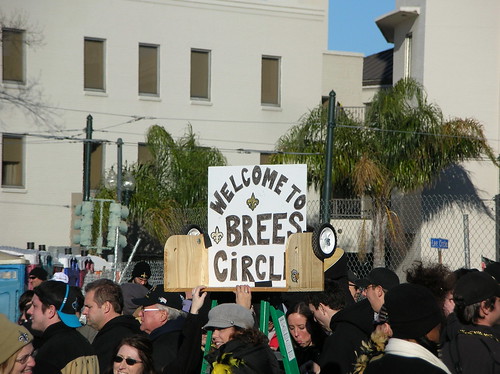
If we are going to do this, though, it's important that we, unlike the Saints fans in the picture above, take it seriously.  Mitch already makes me nervous when he throws his Tricentennial fetish in there. If we take Lee down and replace him with some sort of generic piece of modern art and christen some boring "Tricentennial Circle"  that will almost make the thing not worth doing.

It's not enough to just take down the Confederate monument and sanitize the space with post-modern nonsense. We need to imbue it with an appropriate positive historical and cultural significance in equal measure to the negative image we are supplanting. My first thought is to name it for Homer Plessy, though maybe you guys can come up with someone as deserving.

Just don't leave it up to Mitch Landrieu and his band of bland "New New Orleanians." They'll either do something inappropriately benign or name it for some pastor they're all indebted to politically.
We have to come up with something better than this.  Otherwise, Mitch is going to ruin the whole exercise. 

Tuesday, September 13, 2016

GNOF Circle

So here's a little scoop via The Lens this afternoon.  An LLC registered to Phyllis Taylor bought the Circle Bar.  Phyllis, as many of you know, is the filthy wealthy widow of oilman Pat Taylor whose name famously accrues to the Taylor Opportunity Program for Students or T.O.P.S. scholarship. Phyllis is also a primary benefactor of the Greater New Orleans Foundation and its nearly completed shimmering new headquarters on the opposite side of Lee Circle from the bar.

Can't say for certain what the plans are, but the smart money is on RIP, Circle Bar at the very least.  As far as the building is concerned, they shouldn't have too much trouble getting a demolition permit since every New Orleans oligarch who is anybody is in the GNOF club. Oh also Andy Kopplin runs it now so, yeah.

Still waiting on somebody to do something about that monument, though...


UPDATEGambit has spoken to the Circle Bar ownership. 
The Lee Circle building that houses the long-running dive bar and music venue Circle Bar has been sold. But bar owner Dave Clements says it's not going anywhere just yet.  "We’ll be there for the next five to seven years" remaining on the bar's lease, Clements told Gambit.

Oil and gas executive and philanthropist Phyllis M. Taylor bought the building at 1032 St. Charles Ave. for $1.6 million, according to real estate transfers acquired by The Lens. Taylor's purchasing entity 1032 St. Charles Ave. LLC was registered with the Louisiana Secretary of State in June.

Clements said he had 10 days in which to match the $1.6 million offer. "I was a little panicked ... but she couldn't have been nicer," he said. "So far she’s indicated she’ll honor the remaining years of the lease ... As far as that, no future plans."
 

Monday, September 21, 2015

Tahir Square

Empty pedestal actually seems strangely appropriate.
If the New Orleans City Council votes to remove four controversial monuments from public display, at least one reminder is likely to remain: the pillar that supports a bronze statue of Confederate Gen. Robert E. Lee 60 feet above Lee Circle.

That word comes in an updated report to the City Council by Chief Administrative Officer Andy Kopplin.
The report also increases the estimated cost of removing the monuments, which Kopplin has said will be paid by an anonymous donor, by $18,000. The new estimate, including a 10 percent contingency fee, puts the price tag at about $144,400.
Maybe just leave it that way for a while. An empty pedestal makes a kind of statement.

In the late 1940s, Egypt’s King Farouk had a huge granite pedestal erected in the middle of Tahrir’s wide traffic circle. The pedestal was intended for a statue of Farouk’s grandfather and the square’s namesake, khedive Ismail. The statue took longer to produce than the pedestal, however, and when the statue of Ismail finally arrived to Egypt in the summer of 1952, it was too late — the monarchy had been overthrown.

The empty pedestal nonetheless remained in place for decades, as a colossal reminder of the failure of Egypt’s monarchy. After Gamal Abdul Nasser’s death in 1970, there was talk of finally placing on the pedestal a statue of the fallen president, but that idea never materialised either. The pedestal was finally removed in the mid-1970s during construction of the Cairo Metro.

Sunday, July 12, 2015

Nobody is coming to take your fleur-de-lis

The movement to take down Confederate flags and monuments has nothing to do with "PC culture run amok." It is not an effort to censor or erase history.  Rather, it is an effort to (finally) end a specific 150 year anti-historical propaganda campaign
The most successful defenders of the Lost Cause are currently getting everyone caught up talking about statues and place names for George Washington, Thomas Jefferson, and Andrew Jackson. We've even gone off the rails so far in New Orleans that there's a "serious" discussion over the meaning of the fleur de lis and whether the city should abandon the symbol.

How does it help the so-called Confederacy to talk about bad parts of slave-owners? Well, despite their complex and often troubling places in American history, Washington, Jefferson, & Jackson were all Presidents of the UNITED States of America. There is definitely a need to further scrutinize their mythological histories with their historical realities, but not when the topic of conversation is focused on the so-called CONFEDERATE States of America and the cultural legacy of the Lost Cause in the South. Suddenly, you're rhetorically defending men who tried to destroy the United States through rebellion by referencing men who all used their office to put down rebellions or respond to threats against the United States.

Furthermore, consensus history already includes a lot about George, Tom, & Andy's slave owning, Native American fighting, and general hypocrisies. New Orleans already took names of theirs off local public schools. Most of us learn that the story of George Washington & the Cherry Tree is apocryphal - it is one of our first lessons in the difference between what we tell children at bedtime and what is the real story.
The Lost Cause mythology is a bedtime story treated as real public history. It's time for the sons and daughters of the Confederacy to grow up.  There is no slippery slope here. Anyone making that argument is intentionally trying to muddle the issue.

None of this is to say the mayor is doing some great thing simply by allowing himself to be dragged along by the activists who have seized a moment to make these corrections.  In fact, he's doing exactly what we worried he might do when this process began. He's taking the opportunity to pass out favors to political allies who are themselves questionably deserving figures.

And, of course, the mayor and council are fresh off turning two city streets into monuments for bigots just this year.
What I can't stomach about this current campaign by Landrieu is his blatant hypocrisy.

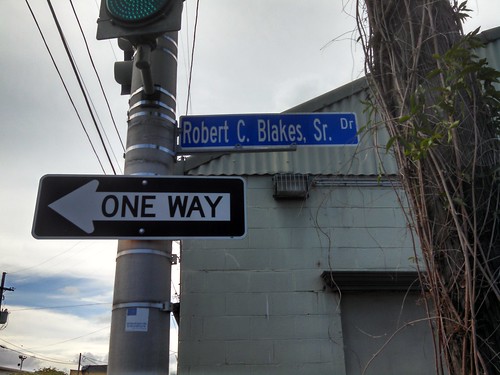
Just last month Mayor Mitch Landrieu championed the effort to rename two sections of our city's streets after the late Rev. John Raphael Jr. and Pastor Robert C. Blakes.  The effort passed through City Council in a 4 to 3 vote.

I went to City Council chambers and spoke against the move on behalf of NOSHA - New Orleans Secular Human Association.  I cited two main points on why my fellow humanists and I felt the tribute was inappropriate.  The first reason is that in the case of Raphael the street is now using a religious moniker in its official name, "Rev. John Raphael Jr. Way".  This is a clear violation of church and state as taxpayers' dollars have now gone to enshrine a particular religion in our city, in perpetuity.

But the most important issue I raised is that both of these men were hostile towards the LGBT community having made numerous bigoted remarks against gay people.  Raphael went so far as to rant at his own brother's funeral and suggest that his death (he contracted the AIDS virus) was a punishment by God for his evil, gay lifestyle.

How is it that, in June, Landrieu can support renaming city streets after two notorious bigots while lobbying to remove monuments that have been in the city over a century, citing bigotry, one month later?
If there really is any sort of  "slippery slope" it appears to be angled uphill. 

Wednesday, June 24, 2015

Don't erase history, tell it better

Progress... sort of
Just two days ago, Landrieu was noncommittal when asked whether the Lee statue should be removed, though he called for a larger discussion on it and other Confederate monuments in New Orleans. The 2018 Tricentennial Commission, whose tasks include addressing the city's complex racial history ahead of its 300th anniversary, would also examine the propriety of the monuments continued display on public property, the mayor's office said.

"These symbols say who we were in a particular time, but times change. Yet these symbols -- statues, monuments, street names, and more -- still influence who we are and how we are perceived by the world," a spokesman said in a statement. "Mayor Landrieu believes it is time to look at the symbols in this city to see if they still have relevance to our future."
Oh dear that's probably not good. It looks like Mitch is leaning toward doing this exactly the wrong way.  I'm all for taking the general down but it's important that it be done right.  Replacing it with some vaguely positive civic advertisement isn't going to cut it.

The point of removing the statue is not to whitewash the ugly history that led to its appearance in the first place.  The point is to make a powerful counterargument.   If you take the Lee statue down and don't replace it with something that screams, "HEY GUESS WHAT FUCK WHITE SUPREMACY" then you might as well just leave it up.

Otherwise you really are "erasing history" as the crypto-Confederates opposed to the statue's removal are already alleging.  Not to go for too obvious a cliche here but Faulkner was right about history. It really is "not even past." In fact, it's harmful to think of it that way.  History is just more politics from a little bit further back.  We are still living it right now. We still have a say in how it gets told. 

I still think Plessy Circle sounds pretty good.

Monday, June 22, 2015

Let's take the general down

Welcome to Brees Circle

It's time. It's way past time, really.
That (Confederate) flag, a symbol of hate and racism, doesn't fly over any government offices in New Orleans. But we still have many monuments to the Confederacy.

The most prominent one is certainly the statue to Robert E. Lee that towers over Lee Circle. Mayor Mitch Landrieu has been talking about whether the Lee monument ought to have a future as New Orleans approaches its 300th birthday.

Here's what Landrieu's office said Monday afternoon: "Mayor Landrieu has discussed with 2018 Tricentennial Commission members how we can appropriately recognize our 300-year history as a city while also looking to the future and helping New Orleans become the city we always knew she could be. Part of this process should include a close examination of the historical symbols throughout our city and what changes could be made as we approach 2018, including the Robert E. Lee statute in Lee Circle. These symbols say who we were in a particular time, but times change. Yet these symbols – statues, monuments, street names, and more – still influence who we are and how we are perceived by the world.  Mayor Landrieu believes it is time to look at the symbols in this city to see if they still have relevance to our future."
If we are going to do this, though, it's important that we, unlike the Saints fans in the picture above, take it seriously.  Mitch already makes me nervous when he throws his Tricentennial fetish in there. If we take Lee down and replace him with some sort of generic piece of modern art and christen some boring "Tricentennial Circle"  that will almost make the thing not worth doing.

It's not enough to just take down the Confederate monument and sanitize the space with post-modern nonsense. We need to imbue it with an appropriate positive historical and cultural significance in equal measure to the negative image we are supplanting.  My first thought is to name it for Homer Plessy, though maybe you guys can come up with someone as deserving.

Just don't leave it up to Mitch Landrieu and his band of bland "New New Orleanians."  They'll either do something inappropriately benign or name it for some pastor they're all indebted to politically.

Robert C Blakes Dr

We can do better than that.