-->
Showing posts with label Oretha Castle Haley Blvd. Show all posts

Thursday, August 25, 2016

Streetscapin'

OCH

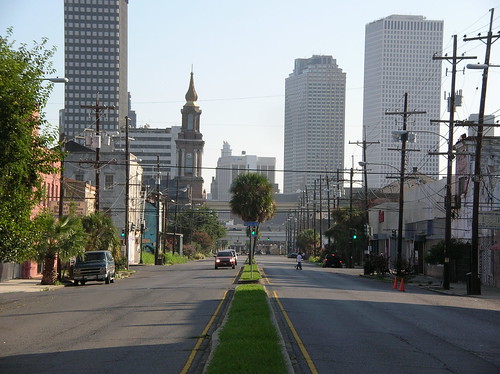
Oretha Castle Haley Blvd August 2008

Here comes the beautification crew.  
The city began construction Wednesday on a $1.8 million project designed to make it easier and more inviting for people to walk and bike on Oretha Castle Haley Boulevard in Central City.

The project, funded by federal grants, is the latest in a series of "streetscape" beautification projects officials have unveiled since Mayor Mitch Landrieu took office in 2010.

The work will stretch along O.C. Haley from Calliope Street to St. Andrew Street.

Crews will remove the neutral ground from Felicity Street to Martin Luther King Jr. Boulevard, repair damaged sidewalks and install handicapped curb ramps at intersections. They also will add a bike lane and new crosswalks, plant new landscaping and repave the asphalt roadway, among other improvements, officials said.

That last paragraph offers more detail than did the mayor's press release yesterday. The only specific it offered was the bike lane.  I started to ask for more information but the mayor's office just tweeted the same press release back at me.


Oh well.  Anyway, one reason I wanted to ask about the bike lane is, although the city is quick to advertise the progress it has made in installing painted lanes in recent years, the so-called best practices have already moved beyond this style.
BOSTON (AP) — Bike lanes are evolving. Cities are increasingly changing them to make them safer in light of fatal crashes involving cyclists and cars.

From Boston to San Francisco and New York to Tokyo, traditional bike lanes running alongside vehicle traffic are being replaced in favor of “protected” lanes or “cycletracks,” where physical barriers like concrete curbs, planters or fences separate cyclists from vehicle traffic.

“For 50 years, we’ve just been putting down a stripe of white paint, and that was how you accommodated bikes on busy streets,” says Martha Roskowski, director of People for Bikes, a Boulder, Colorado-based advocacy group that’s calling for better designed bike lanes. “What we’ve learned is that simply doesn’t work for most.”
Basically, we've been doing it wrong and other cities are already finding ways to do it better. This OCH project might have been an opportunity for us to think about how to make a better bike lane. Instead we're just gonna keep congratulating ourselves. 
“Oretha Castle Haley Boulevard is one of our city’s great boulevards, with a rich and diverse history that is uniquely New Orleans,” Landrieu said. “Today, this corridor is seeing a resurgence, and our streetscape project will complement the major public and private investments that have already been made here and trigger even more development for Central City and beyond.”
Also, notice the way Mitch can't help talking about the "public-private" nature of the corridor's gentrification resurgence. It's nice of him to overlook the grifting but that's also a factor. In reality, the benefactor here is the federal government. 
Federal Disaster Community Development Block Grant money will pay for the project, which was designed by GEC.
This week marks ten years plus one since the flooding of New Orleans following Hurricane Katrina.  And we're still benefiting from the CDBG-DR investment delivered as a result. On Tuesday the Governor informed President Obama that his staff would be requesting CDBG funding to help South Louisiana recover from this year's devastating floods. The size of this request will be critical.  As long as we're running around making suppositions like this one by State Sen Francis Thompson, we might as well capitalize on them, right?


The more money we pull down from Washington now, the more streets we can "beautify" ten years from now.  Who knows, by then, we might even know how to make a proper bike lane. 

Friday, November 11, 2011

This would be so much better than a Rocky statue

A few days ago I mentioned this Lens column about two cities' neglect of their genuine history in favor of sanitized fantasy. Philadelphia has no statue of Joe Frazier but it does have one of Rocky Balboa. New Orleans has no statue of Homer Plessy but it does have one of Mr. Peanut.

In The Lens Mark Moseley specifically mentions Plessy along with other prominent Civil Rights figures whose connections to New Orleans have gone unrecognized in our civic space. Today, Jarvis DeBerry's T-P column follows up on that a bit by highlighting one institution which, if ever built and opened, can improve that situation at least a little.

Brenda Williams, interim chair of the Louisiana Civil Rights Museum Advisory Board, said Thursday that "we have gotten final approval for a feasibility study" that will help the board decide the best New Orleans location for a museum. She hopes that study is completed within six months and that the momentum for the project then picks up. The Louisiana Legislature approved such a museum in 1999.

New Orleans needs that museum. This isn't just the city where the SCLC was founded. It's where Ruby Bridges made a solitary walk into William Frantz Elementary School. It's the city chosen by 1961's Freedom Riders as their ultimate destination.

All that happened in the 20th century, but there was a rich history of struggle and protest in and around New Orleans before then. In 1811, more than 200 enslaved men on nearby plantations armed themselves with machetes, rose up against those plantation owners and began an unsuccessful march toward New Orleans. In 1842, St. Augustine Church was built with the contributions of black Catholics who wanted a place where they could sit and worship. In 1892, activists pushing for the integration of local rail cars chose Homer Plessy as their plaintiff.


The link inserted into the online version of Deberry's column points us to this story about a preferred location for the museum on the site of the former Myrtle Banks Elementary School at Thalia St and Oretha Castle Haley Blvd.

In the school's early years, a commercial strip then known as Dryades Street thrived down the block from where neighborhood children learned reading, writing and arithmetic. According to the O.C. Haley Merchants and Business Association Web site, by the 1950s there were almost 200 shops, many of them run by Jewish merchants who lived in apartments upstairs. At a time when African Americans were not welcome on Canal Street, Dryades was the place to go for a soda, a haircut or a new suit.

It also became the headquarters of the local civil rights movement. The boycott, which targeted white-owned shops that limited black people to menial labor, resulted in the hiring of 30 black clerks and cashiers. But there was a cost: some shopkeepers abandoned the area and moved to the suburbs, marking the beginning of the neighborhood's decline.

Across town on Canal Street, Oretha Castle Haley was one of the activists arrested and charged with criminal mischief for sitting at an all-white lunch counter at McCrory's in September 1960. The case received national attention, and the U.S. Supreme Court held that the activists' convictions were unconstitutional.

Dryades Street was eventually renamed in Haley's honor, with both its name and its history making it a fitting home for a civil rights museum.


Efforts at revitalizing the OCH corridor have been going in stops and starts for several years now with some moderate successes although nothing like the what's been happening concurrently along a similar stretch of Freret Street. Recent visits to the up-and-coming Freret by us have included a thoroughly satisfying meal at the High Hat Cafe as well as a thought-provoking performance by motivational comic Lane Sperkus. I've also spent an evening at Cure which serves nice food but, with its snooty dress code and focus on "designer cocktails," is mostly an iteration of evil at its most obnoxious.

The OCH corridor boasts one renowned eatery in Cafe Reconcile as well as a potentially potent arts and entertainment scene anchored by the Zeitgeist Multi-Disciplinary Arts Center featured on the cover of this week's Gambit. But to catch up with what's happening on Freret, which is clearly the model to be emulated, the corridor has quite a way to go. The Civil Rights Museum would be one more element that could spur that kind of growth and, perhaps, fill an unfortunate gap in our city's recognition of its own history. If they ever get around to building it, that is.