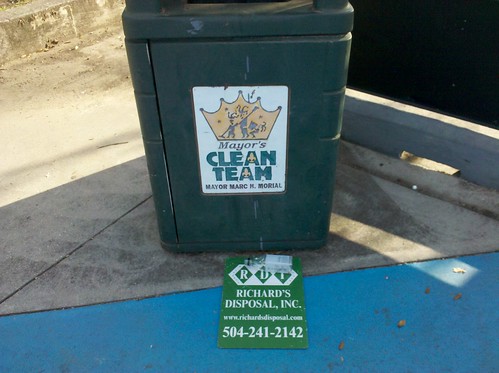
After years of squabbling with the two largest garbage contractors over the number of addresses each should be compensated for servicing, the city has finally agreed to just accept their numbers. The ingenious reasoning is,
well maybe they'll grow into it.
The administration is betting the city’s population will continue to grow while the cost of trash pickup — still more than the mayor would like — will remain almost flat, representing a relatively stable figure in a budget that has otherwise been under assault from ballooning and sometimes unpredictable expenses.
The garbage contracts are among the city’s biggest, taking up about 5 percent of the annual operating budget.
“As long as New Orleans continues to be the fastest growing city in America, which it has been for the past few years, and we fix those house counts, this is a very favorable agreement,” Deputy Mayor Andy Kopplin said in presenting the details Tuesday to the City Council’s Sanitation Committee.
Maybe that will work out for them eventually. It might be interesting to note, though, that despite the growing population,
usage of another major city service has only just exceeded half its pre-Katrina numbers.
Public transportation in New Orleans has steadily expanded since
Hurricane Katrina decimated the network in 2005. While the number of
riders every year is nowhere near the 34 million who took a bus or
streetcar trip in 2004, the system could provide as many as 18 million
rides by year's end, said Stefan Marks, Veolia's director of planning
and scheduling for the RTA. The RTA has logged 13.9 million riders
through September, a 12-percent jump over the 12.5 million passengers
that used the RTA during the first nine months of 2012.
Naturally they're asking for a fare increase.
But back to the disposal companies. What might account for the supposed padding in their contracts are the unique challenges New Orleans presents. Recall, for example,
the ugliness that erupted when Veronica White's sanitation department introduced suburban style trash bins to the narrow French Quarter streets.
The anger over the issue clashes with general delight with the
performance of the Quarter's new trash collection service. But many
French Quarter residents say the free 32-gallon, wheeled, lidded "carts"
-- although just a third the size of those the city is requiring in
most other neighborhoods -- are too big to store on their small lots or
in narrow side alleys.
The commission fears that bins left on sidewalks for many hours after
garbage trucks have passed will be eyesores and will hinder pedestrian
traffic.
Mayor Ray Nagin has promised "Disney-like" cleanliness in the French
Quarter and Central Business District, with twice-daily trash collection
and continuous sidewalk cleaning, as a way to promote tourism and
economic development.
Leaders of the two principal organizations of Quarter residents
recently took their complaints about the bins to the mayor, but Nagin
and Sanitation Director Veronica White remained adamant.
A frustrated Ralph Lupin, the Vieux Carre Commission's tough-talking
chairman, told the commission Tuesday, "I don't understand Ms. White's
obstinance other than that she's a bitch."
Then there was the time when the Nagin administration spent half a million dollars on "bomb-proof" trash cans and then decided
they didn't want them after all.
New Orleanians, it appears, will never get to find out whether the
"bombproof" trash cans the city bought for $750 a pop three years ago
were worthy of the title.
That's because all 600, purchased for a steep $450,000, have been junked.
Now Mayor Ray Nagin's administration, which staunchly defended the
original trash can purchase, has begun replacing them with a different
model. Unlike the old ones, the new ones do not feature advertisements
-- nor do they claim to frustrate terrorists.
In a recent interview, Nagin said he was never a fan of the squatty
cans, bought with a no-bid contract at the direction of former Chief
Administrative Officer Charles Rice. Rice left city government in 2005, a
few months before Hurricane Katrina.
"Those little munchkin trash cans? We got rid of those," Nagin said,
referring to the trash can deal as "a Charles Rice special."
The mayor's chief beef, apparently, was that the receptacles, known as "Jazzy Cans," were too small.
"I said to Charles, 'Where'd you find these trash cans?'" Nagin
recounted. "They're about this tall," he added, holding his hand at the
level of a table top. "I had to bend over to put stuff in 'em."
Nagin's backaches likely would have been in vain anyway. Earlier this year the city experienced
a brief period of hysteria over the frequent appearance of various "suspicious packages" none of which ever was actually placed inside a trash receptacle where the supposed "bomb-proofing" might have provided some benefit.
But it's not only bombs that require careful attention. There's also the matter of spectral decontamination which, can be a tricky issue on some lawns.


This morning, in the first day of budget hearings, the City Council considered a proposal to shut off residents' water service should they become delinquent in paying the sanitation fee attached to their bill. Stacy Head seems like she wants to punt the decision on this enforcement policy back to the Mayor.
Some may wonder why the sanitation fee appears on the city water bills in the first place. But, as we demonstrated the other day, some of these specialized pick-up jobs have been known to emerge from the sewers anyway.

The city estimates that it can raise an extra $1.6 million in trash fees simply by adding the water shutoff threat. That seems unlikely to me. But if it turns out they can't wring out that last bit, and they absolutely need help fulfilling these sanitation service obligations, they can always
go out and find a new contractor.