It's a landslide.
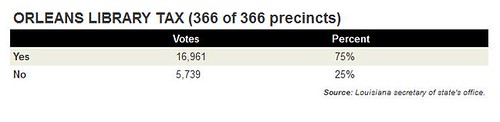
Can't really say it's too surprising given the widespread support from (almost) everyone. More on that "almost" in a bit. Last week, I rounded up all the links I could find to illustrate the widespread support of practically everybody. You can see that
here.
But it turned out this week that a bunch more people wanted you to vote for the library millage so I started collecting those articles as well. I meant to publish these before election day but I've been kind of busy with stuff so here it is now. It seems less urgent now, but if you did vote for the library millage, it's a list of the many people who agreed with your decision.
Let's start with the mayor who, even
though he had to throw in some blather about the tricentennial, said a thing.
On May 2, our city has an opportunity to renew its commitment to the
New Orleans Public Library. The request is that voters increase the
current millage by 2.5 mills for 25 years to support operations and
maintenance of the entire library system.
The price for the total millage on the average home in New Orleans will be less than $11 per month.
Cheryl and I are endorsing the proposed millage. Libraries continue
to be one of the most accessible avenues to education for any age and
are important to personal and professional development – especially to
those without access to resources at home.
Here is the Times-Picayune editorial board:
Public libraries are an essential part of a literate and informed
community. They help feed the imagination of young readers, provide a
place for research for students of all ages and connect adults to jobs.
And they can serve as neighborhood gathering places. To achieve all
that, they must be up to date and accessible.
Here is a different person who wrote in to the T-P This is a pretty good one so I will share two quotes. Here's the first.
Most of the system's 13 branches at the time were destroyed. About 80
percent of its staff was laid off, as librarians scrambled to find new
homes in places the floodwaters had not invaded. Hundreds of thousands
of books and other holdings were wiped out.
Post-storm assessment reports were predictably grim. "Fish in parking
lot. Overturned bookdrops. Major flooding. Shelves collapsed, books
floated in water," said one from a library branch in eastern New
Orleans. "Closed indefinitely."
But the city library system didn't stay down long; did not surrender
to the disaster or the naysayers. Like many community institutions,
including our own National WWII Museum, the libraries struggled back to
their feet and regained strength, helped along by private donations,
government and volunteers. With a big assist from the American Library
Association, our libraries became part of a broad rebuilding and revival
story reminiscent of the one that played out in Europe after World War
II, propelled by the Marshall Plan. Another major post-World War II
investment - in the GI Bill, giving returning service members the
additional education they needed - offers another reference point.
I happen to have a photo of the actual fish referred to above.

I know it kind of looks like they're still underwater. Phones had shitty cameras back then. Anyway, the letter goes on.
City libraries are important to our quality of life, to our city's
future - to our democracy. Sustaining them reflects, in a tangible way,
the American spirit. Now is the time for cultural institutions to rally
to their defense, urging a resounding "yes" vote on May 2.
That was the best one but let's see. What else is there?
Here's one from the Louisiana Weekly.
Our editors are usually highly resistant to enacting any new property
tax, especially in Orleans Parish where rising assessments are driving
property bills to a level that many working class homeowners are in
danger of losing their homes.
But a city cannot survive without its libraries, and if this millage
is not enacted on Saturday, at least two libraries will close and the
hours will be reduced at most of the remainder to the point that they
will be unavailable to most of the working public.
This is from The New Orleans Tribune
We suggest our readers say “YES” to both proposals. We don’t do so
lightly and it is not easy. But, we understand the need for safe and
well-maintained jail facilities. And we say “YES” to strong public
programs that are designed for the benefit of the community, such as
those offered by at the library.
The Tribune actually gets some facts wrong about both propositions in that piece. But, whatever.
Doing a much better job is Gambit where we found
this article about current literacy programs jeopardized by the library's funding crisis.
Also from Gambit, a feature article with a
more in-depth look at the library's situation.
The vote seems like an easy sell; who doesn't appreciate libraries?
Brown points to the educational and politically neutral environment that
branches across the city give to New Orleans youth: providing
educational and entertainment materials; serving as points of Internet
access in an underwired city; and creating community programming that
provides an alternative to crime and a lack of adult supervision.
But the Bureau of Governmental Research (BGR), a private, nonprofit
and non-affiliated research organization in New Orleans, issued a
report last month asking the NOPL to go back to the drawing board. Janet
Howard, president and CEO of BGR, says the library has a plan for how
it's going to spend the money, but
it doesn't have a strategic long-term plan for
its operations.
Yeah, about that. It's pretty much nonsense on its face. Brown does an adequate job of responding to it but there's more. Here's Brown.
Brown says the BGR is wrong. "I have no criticism of the BGR, I
simply disagree with their finding," he says. "I think any impression
that voters would have no idea how the funds will be spent is not true.
We have clearly articulated how the funding will be spent."
In a later email, Brown said, "The library has a detailed spending
plan, but not a strategic plan at this point," adding "any new funding
will be used for vetted, widely accepted purposes." As to spending
specifics, he said, "The question of the strategic plan is a priority
for the future; however, there are simply too many front-line
operational considerations that must be addressed first."
The
immediate plan is to continue and expand these vital services rather than drastically shut them off. There is no mystery to it. BGR, though, sets the goalposts further back than that demanding a
long term "strategic" plan. This is not because they are concerned with the actual question before the voters (do you want to keep library services or no?) but because they are pushing a more nebulous ambition.
Howard says BGR isn't against an increase in library funding per se.
"The fact that something is a good cause is not enough to say to
voters," she says. "You have to have a system that's properly executed
and you've got to have the planning. Do those things and come back."
BGR plans to look at this and other future taxes as a whole,
"because we have all these individual groups that go out and ask (for
money)," Howard says. "The sheriff goes out and asks for money, the city
can go out and ask for money, the levees can go out and ask for money —
but there's no coordination so that you come up with a concept of 'What
are the community's top priorities?'" Howard says BGR will issue
another report looking at not only property taxes, but also sales taxes
and hotel and motel taxes to see where that money is going across
Orleans Parish. That way, voters can decide whether that revenue is
being properly allocated.
BGR doesn't actually care about this election. They have
an upcoming report they want to tease. Howard showed up again
in this Lens article, talking about "long term" planning, but also pushing an even more obvious lie about the possibility of alternate funding from the city general fund. If you read the article, you'll see just how unrealistic a possibility this was.
Councilwoman Latoya Cantrell, who supports the millage proposal, did
not say whether she would support a general fund contribution for 2016.
“First and foremost, the Council has fully supported this millage and
is advocating for voter approval,” said an emailed statement,
attributed to Cantrell, from spokesman David Winkler-Schmit. “If it did
fail, allocating money from the general fund would depend on what the
other budgetary considerations are for 2016. Hopefully, this question
will become moot with the passage of the millage increase on May 2.”
Library Board Chairman Bernard Charbonnet, interviewed after the
board meeting, said he’s not holding out much hope for a large check
from City Hall if the vote fails.
“The problem is with the stressed needs of the city’s general fund. I
can’t tell you that there is any money for the library,” he said. “We
go to the City Council annually. We go to the mayor annually. And we go
with hat in hand begging for money. We just do not get it. I don’t
believe they have it, which is why we’ve come to this.”
However, if you were to skim the article and read only the headline, "Even if voters reject proposed library tax, options for increased funding still exist" you might get a different impression.
Yes, even supposedly "engaged"
Lens readers are prone to being manipulated this way.
So it's a terribly misleading way for them to have put it. If the millage had been defeated, the library would then have
to ask the city to provide for its operating budget out of the general
fund during the contentious annual budget process. The only possible result of such a scenario would have been a drastic reduction in library support.
The choice voters
had was this. Approve the millage and the library system can continue to
expand services or defeat the millage and guarantee that those services
will be cut. Is that what
The Lens would have liked to see? Who knows
but it is the position they chose to amplify. Is that what BGR would have liked to see? Maybe.
You can choose to interpret this charitably and say that BGR is merely being naive or myopic; favoring longer term "good government" reform aspirations over the practical function of a specific election. Or you can say that BGR is engaging in Tea Party-esque ideological anti-tax intransigence and dressing that up in the guise of progressive reform.
Whichever side of that you favor (it doesn't have to be all one or the other) you'll have your finger pretty squarely on the pulse of white middle class New Orleans. Which is why the overwhelming library millage victory is something an aberration. Had it been any other social service on the ballot, there would have been much stiffer opposition.
Imagine this election were an initiative to fund the kinds of things
the library actually does without using a word library in the offering.
"We would like 2.5 mils to offer free internet and staff assistance for individuals filing for SNAP benefits or applying for jobs, early literacy training for at-risk families, community meeting spaces, regular arts/entertainment/educational programming free and open to the public, oh and also to buy books, music, and films in multiple formats to lend out to anybody also for free. We'd like to run fifteen branches of this operation covering every neighborhood in the city."
My god what a socialist nightmare of a ballot proposal! If we asked them to create such an institution out of whole cloth today, certainly our upwardly mobile "new New Orleanians" would insist on farming it out to some for-profit entrepreneurial public-private partnership. Preferably one that offers small plates.
How is it, then, that this package of free stuff for everybody but especially for the poors slips by? Branding! Long established branding. A publicly funded information and social services project may sound like an anachronistic impossibility but a
library is a thing people recognize and respect. A library is something respectable people want to be associated with. There is something about the idea of having good libraries that
flatters the totebagger class of a city even if they do not use them.
Like a wall of untouched bookshelves in a fashionable home, the point of
the thing is showing it off to the neighbors.
Anyway, it all works out for the best. The library gets to go on quietly providing the many laudable services it offers any and every person in the city regardless of age, race, or class. The totebaggers get to feel good about themselves for whatever screwed up combination of conspicuous consumption and noblesse-oblige helps them sleep at night. And, of course, BGR still gets to write that big report on city finances they're so keen on. Comprehensive municipal finance reform happens to be a subject I'm interested in myself. I look forward to reading it.