-->

Tuesday, May 12, 2015

Popping popcorn

I thought I had read somewhere that they were going to leave each other alone for a while.  Oh well...

CenLamar: Louisiana’s Most Well-Known Conservative Blogger Has Long History of Scamming Readers

It's funny. But it's not all that surprising if you know anything about how media... and how right wing talk radio/blogging works.  Lamar  references this, in fact.
Perhaps this shouldn’t be too surprising. In January, Ken Vogel of Politico reported on the ways in which the conservative movement is infected by scams, particularly scam PACs that exist only to sell their own mailing lists. McKay considers these solicitations for alzheimer cures and survival knives and tips on playing the lottery to be a critical part of his business, but we shouldn’t dance around the obvious: These are blatant, predatory, paranoiac scams, and it is impossible to take anyone seriously as a writer or a political commentator when they’re actually earning a living as a snake oil salesman.
This scam-PAC system also explains several minor GOP presidential primary candidacies in any given election cycle. It's certainly why Mike Huckabee is in it this time around. It probably also explains Chris Christie, who I'm pretty sure is looking for a job in the right wing media... you know.. doing pretty much what Scott McKay does but on national TV.

Anyway, speaking as someone who runs a somewhat political blog that picks up decent traffic every now and then, I've never understood how or why anyone would ever think to turn that into a money machine of some sort.  All we're doing here, after all, is reading the news and throwing out opinions on the internet. And opinions and internets aren't exactly scarce resources of any special value.  Anyone who says otherwise is probably trying to sell you some gold or boner pills or something.

Monday, May 11, 2015

Yes, but will it even open?

NOLA.com, whose job it is to find answers to these questions, nonetheless asks us.  "Will the Mid-City hospital complex spark an economic boom?" 
Paolo Zambito, LCMC Health's senior vice president for strategy and business development, said the goal will be to focus on several destination programs: ear-nose-throat and skull-based treatments, neurosciences offering deep brain stimulation to treat Parkinson's disease, a possible burn unit and a focus on cancer with new technology.

LCMC Health officials also feel strongly about the role of clinical trials and growing the pharmaceutical industry in New Orleans, he said.

Zambito spoke Friday at a real estate seminar at the University of New Orleans that focused largely on what new hospitals opening means for the future of real estate and the local economy.  University Medical Center, operated by LCMC Health, sits next to a new $1 billion Veterans Affairs hospital, set to open next year.

The precise impact of the combined $2.1 billion medical complex on the surrounding Mid-City and downtown neighborhoods is still unclear, but many are bracing for big changes.
 So maybe! But you do have to open the thing if you want to find out.
The state’s higher education institutions would get $575 million of the $650 million, leaving health care facing a sizable shortfall.

House Appropriations Committee Chairman Jim Fannin, R-Jonesboro, said health care would get more money if the Legislature raises more revenue, makes other budget cuts or if other money is collected through higher taxes.

The shortfall in health care means less money for health care for poor children and their mothers, the developmentally disabled, the working poor who don’t have health insurance, the elderly living in state nursing homes and state aid for the public hospitals now under private management, including the big New Orleans hospital slated to open in August.

Thanks Obama forever

One interesting aspect of the developing Republican backlash against police abuse protests is that it's a convenient way for them to continue blaming Barack Obama for everything even as he's on his way out.
On Saturday Bobby Jindal, the Louisiana governor who has not yet declared his candidacy for the GOP nomination, accused the president of having a divisive tone on race. Jindal was responding to a question about recent riots in Baltimore which followed the death in police custody of Freddie Gray, a 25-year-old African American man.

“We’re not just talking about Baltimore or some of the incidents recently, but I’ve said I think for quite some time the president continues to divide us,” Jindal told reporters following a speech at the South Carolina Freedom Summit, a conservative gathering of grassroots activists.

“He tries to divide us by gender, by age, by geography, by race – and I think that’s wrong. Part of his job is to unite us and bring us together.”
This is quite an accomplishment for Obama. Remember a few years back he ended racism by being elected President.  Now apparently racism is back and it's all his fault this time.  Gonna be a fun election season. 

SELA

How's my driving?

Happy Anniversary, May Flood!
NEW ORLEANS - By all accounts, we knew that it was coming. We just didn't know how bad it would be.

That's how veteran Channel 4 anchor Bill Elder described the devastating floods of May 8 and 9, 1995, which dumped as much as two feet of water on parts of the metro area. The storms claimed seven lives, flooded hundreds of homes and businesses, and caused billions of dollars in damage and insurance claims.

"The one by which all others will be measured and remembered," is how Elder described the floods in his report the next day. Of course, Hurricane Katrina 10 years later would dwarf those days by comparison, but the memories of the May 8 flood remain vivid.
Rainfall totals measured between 10 and 20 inches over the two day deluge overwhelming the drainage system and causing widespread damage.  Twenty years later, the response to that crisis is still under construction.

Part of those floods’ legacy was to catalyze creation of the Southeast Louisiana Urban Flood Control Project, usually referred to as “SELA,” in 1996.
In the 20 years since the flood, $706 million has been spent on upgrading canals, culverts and pumps in New Orleans and Jefferson.

Another $803 million worth of projects are ongoing in New Orleans and Jefferson to bolster a system designed to handle 9 inches of rainwater in a 24-hour period.

However, there’s no denying that the massive effort has taken its toll on residents’ quality of life. Crews working on SELA’s various components have jammed traffic on many major thoroughfares, especially in Uptown New Orleans. They’ve disrupted streetcar and bus routes, and in some cases, homeowners have been prevented from parking by their homes.

“SELA has required a lot of sacrifice on our residents’ behalf,” Boyett said Friday. “It’s required an intense amount of cooperation.”

Yet, as SELA’s estimated 2018 completion date draws nearer, Boyett hopes locals haven’t run out of patience.
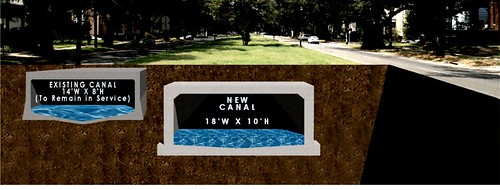
The major work uptown involves installing wider underground box culverts like this one going in underneath Napoleon Avenue.

Napoleon SELA canal

It's definitely going to get worse before it gets better.  This summer, St. Charles Avenue is going to be disrupted at all three major intersections between Louisiana and Jefferson they say until August 31st but who knows for how long, really.   Here is a Boh Brothers crew preparing for this work at Louisiana and St. Charles this morning.

SELA on Louisiana

As of right now, they're expecting the project to run until 2018. (Celebrate the Tricentennial by driving wherever the hell you want!)  But until then it'll be another few seasons of weird little inconveniences.

Napoleon neutral ground

Saturday, May 09, 2015

The purest Christians burn blue

Elbert Guillory presented a lecture on the history of science this week.
According to the Friendly Atheist, State Senator Elbert Guillory (R) was attempting to make the case for teaching “both sides” in the evolution/creationism debate  when he provided a convoluted version of the history of scientific controversies.

“There was a time, sir, when scientists thought that the world was flat. And if you get to the end of it, you’d fall off. There was another time when scientists thought that the sun revolved around the world,” Guillory explained. “And they always thought to ensure that anyone who disagreed with their science was a heretic. People were burned for not believing that the world was flat. People were really badly treated.”
Turn in your books to page 666 where you'll find terrible story of how scientific flat-Earth inquisitors purged recalcitrant clergy by throwing them onto their terrifying Bunsen pyres.  This was, actually, somewhat helpful during the religious wars of the Reformation when it was often difficult to tell an Anabaptist from a Janesenist  without finding out what color flame they produced.

Luckily this practice began to slow down after the invention of the spectrograph although some folks in these parts still rely on even older methods of sorting out what's what.
Sen. Elbert Guillory, D-Opelousas, said he had reservations with repealing the act after a spiritual healer correctly diagnosed a specific medical ailment he had. He said he thought repealing the act could "lock the door on being able to view ideas from many places, concepts from many cultures."

"Yet if I closed my mind when I saw this man -- in the dust, throwing some bones on the ground, semi-clothed -- if I had closed him off and just said, 'That's not science. I'm not going to see this doctor,' I would have shut off a very good experience for myself," Guillory said.
Senator Guillory is a candidate for Lieutenant Governor this fall. 

Friday, May 08, 2015

Friday afternoon link dump

A hodgepodge of items I've bookmarked over the past few days that might be of interest.

Deadspin: Peter King's Credulity is a Character Flaw
Peter King almost certainly does not think depression, anxiety, bipolar disorder, and/or attention disorders are “character flaws.” If Peter King thought that, he would be undermining his professional utility, which is that he does not think at all. He’s not a journalist or commentator so much as he’s a macro that imports spreadsheet data into a weekly Microsoft Word form letter. NFL front-office types input their talking points, and the macro sorts them, dutifully, and with no less agnosticism than that of your common pop-up toaster. The talking points about actual football ability—wingspan, agility, speed, arm strength—go over here, in the Upside bin. Off-field stuff gets sorted into two bins. The appealing stuff, the stuff that makes a personnel decision look good (charisma, performative Christianity, an engineering degree, a wardrobe full of flannel shirts) goes into Intangibles; the unappealing stuff, the stuff that works as a defense of passing on a talented non-quarterback (weed, arrests, mental illness) goes over here, in Character Concerns. What King accidentally illuminated, here, is not an unenlightened personal attitude toward the mentally ill, but the underlying framework and purpose of NFL character scouting.

King was writing about the "character flaws" of  defensive end Randy Gregory in that column. Gregory was considered, perhaps, a top 5 pick before stories about his marijuana use began to spread.  Many of us fans, operating under Matt Taibbi's "always draft the weed guy" theory lobbied hard for the Saints to pick Gregory last weekend.  But that didn't happen.  Now Gregory and his "character flaws" which, on Earth, are probably just personality quirks, is a Dallas Cowboy.

The Cowboys also announced this week that they have signed LSU tackle La'el Collins whose draft day was ruined by a murder investigation which, the circumstances strongly suggested, he was never actually a suspect in. After the draft, the Saints didn't lift a finger to bring him in.  This year, at training camp, when Sean Payton distributes his annual motivational T-Shirts, the slogan will be "RISK AVERSE."

King will probably want one too. Although maybe his career strategy of parroting the party line isn't is safe as it used to be.  King's rote plugging in of talking points could easily be produced by a robot with today's technology. The NFL already owns its own network. It's a wonder they haven't begun to staff it with its own Kingbots yet.

WWLTV: Landrieu: I warned Serpas about funding problems

In this interview, the mayor seems to say former police chief Ronal Serpas should have known the job was gonna suck before Mitch hired him to do it. It's very strange. 
"I brought him in," Landrieu said, "and I was really clear with him. And I said, 'Let me explain where you are coming to. This is not the New Orleans that you left. We're in a cataclysmic downfall. Not only are you not going to have everything you need, you're not going to have most of what you need.' "

Once Serpas settled in as top cop, a string of email correspondence between him and Landrieu's top advisors shows increasing alarm over the dwindling number of officers.

When Serpas took the job, he inherited 1,540 cops. But after a two-year hiring freeze, plus unchecked attrition, troop strength decreased every year Landrieu has been in office. Manpower now stands at 1,144.

In some emails, Serpas' warnings were very specific. He issued red flags about "critical vacancies" in the sex crimes unit, which was blasted in an Inspector General's report last year showing a lack of follow-up in more than 1,000 sex crimes and child abuse complaints.

He warned about slower response times, which also was the subject of a critical OIG report last year.
The story also gets into the back and forth between the Mayor and Serpas over how many cops the city should have, even as Landrieu insists that Serpas shouldn't have even been asking for help. Again.. it's very strange. 
Landrieu recalled the "academic debate" over the appropriate size of the NOPD. But he said he that because of the city's sprawling footprint and year-round tourist population, he ultimately settled on an "aspirational" troop strength of 1,600.

In the emails, Serpas stated that his data-crunching projected an ideal police force of 1,575.

The NOPD is far behind those numbers, but Landrieu stood behind his budget decisions.

"I was fully aware of Chief Serpas' thoughts. He was operating at my direction, as do all of the other department heads, in terms of do the best you with the limited amount of money that you have," he said. "And it was ultimately my decision that I made with great clarity. I wish we wouldn't have had to make the decision. That's like asking me, 'Which one of your children do you want to lose in a difficult circumstance when there's only one life vest?' "
In any case, those "aspirational" troop strength estimates are probably too high in the first place.  See Owen Courreges' columns at Uptown Messenger for more on this. We don't need that many cops.  But this is not something people want to hear.  So we're aggressively pushing in the wrong direction.

Anyway, Landrieu doesn't want to hear it.  He's the "quarterback" and shouldn't have to put up with all this stuff. This whole interview is very strange.
"We can argue until the cows come home, but once a decision is made, we've all got to get on the same team. That's how the Saints win the Super Bowl. You don't have the running back trying to tackle the quarterback. That's what's happening in this situation. That's got to stop."
Speaking of police and politics,

Wall Street Journal: U.S. Split Along Racial Lines on Backlash Against Police, Poll Finds
When asked to explain recent events in Baltimore and other cities that have seen confrontations between police and members of the African-American community, blacks and whites viewed the situation differently.

Asked to choose between two possible explanations for recent events, 60% of blacks said they reflected “long-standing frustrations about police mistreatment of African Americans.” Some 27% of black respondents said the disturbances were caused by people who used protests over an African American man dying in police custody  “as an excused to engage in looting and violence.”

But among whites, the balance of opinion flipped: 58% said people were seizing an excuse to loot, while 32% said the events reflected long-standing frustrations with police.
In this year of widespread protest over police violence, it's important not to underestimate the effect of white conservative backlash on national politics.
More generally, Republicans everywhere may be tempted to exploit the reflexive support for police officers among white citizens that is beginning to exhibit itself everywhere black protests arise. As John Judis observed at National Journal this week, the likely election of Dan Donovan--the prosecutor who appeared to work hard to avoid any grand jury indictment of the cops who killed Eric Garner--to Congress in Staten Island next Tuesday may signal a new era of racial backlash, battening on conservative anxieties already aroused by the years of attacks on Obama and manufactured fears of his supposed mania for “redistribution.”

If there is a supply of backlash voters, there will certainly be a demand, if only among the crowded GOP presidential field where the candidates will soon run out of ways to demonstrate their True Conservatism. The more historically minded of them may realize that St. Ronald Reagan himself built his California political career on a foundation of backlash to rioters, albeit student radicals more than African-Americans per se.
No doubt there will be more fuel for this fire as the 2016 election cycle approaches. One possible flashpoint could be in New Orleans where, though a series of absurdities, we've managed to reopen the Danziger case. In any case, it's bound to get uglier.

Finally, author Rick Perlstein is currently writing some of the best American political history this side of Robert Caro's Years of Lyndon Johnson series.  Perlstein's focus is the rise of the conservative movement in the latter half of the 20th Century.  His latest book, The Invisible Bridge: The Fall of Nixon and the Rise of Reagan is all about the backlash politics of the 1970s.  Here is a pretty good interview with Perlstein conducted this week on Maryland public radio.


Susan Guidry has totally checked out

I've noticed more than a few of these recently so I figured I might as well start making note of them.  District A Councilwoman Susan Guidry is far from the worst of our local pols. In fact, there's been quite a lot to like about her tenure.. insofar as it is decent to like any of these people, anyway.  

Sometimes, though, she says something that makes you wonder if she's even trying anymore. For example, here she is talking about the mayor's final approval of the WTC renovation.
“I’m very excited about the Carpenter/Woodward venture,” Councilwoman Susan Guidry said. “Bringing the Four Seasons brand to New Orleans should be a game-changer.”
What could that possibly mean?  Guidry could have submitted any bland complimentary statement about the hotel project and the company's reputation and that would have been fine.  But something in her brain went, "Oh say 'game-changer.'  That sounds like an exciting thing to say."  She can't have actually meant that the Four Seasons "brand" alone would represent some radical upheaval of the local hospitality market. That would be nonsense. 

Of course there's nothing  wrong with it either.  It's just that it's the kind of thing a person says when she doesn't actually care what she's saying anymore.

Anyway, like I said, I've noticed this a few times but I'm sorry I haven't got any more examples to show you than just this one. It's not terribly important, either. It's just a funny thing I've picked up on.  I'll try to keep a running log as one imagines the term-limited Guidry is likely to remain on autopilot for the next few years.

Meanwhile, I'm a bit worried about Mitch Landrieu.  While Guidry talks like she's already thinking about retiring after her term is up, Mitch is sounding more megalomaniacal every day. Here is his comment on the project.
Referring to a rendering of the final plan, Landrieu drew a stark contrast between the existing, vacant building and “the way the river could have always looked, had we done it right.”

“We’re going to reveal to the world New Orleans the way it always should have been,” he said.
Now we know he doesn't mean to say it like this. He can't mean that everybody who has had a hand in shaping this city from God to Bienville to Adrien de Pauger to Carlos Marcello, to Dave Dixon to Dutch Morial to freaking... I don't know.. Brad Pitt..  has profoundly fucked things up but now Mitch is going to, finally, put it right.  But it sure sounds that way.

Thursday, May 07, 2015

Always helps when they say it out loud

Also, on video.
In a video of that meeting provided to me by someone who viewed it on LABI's website (who requested anonymity for fear of reprisal), Grigsby makes it clear that LABI's main reasons for supporting this bill are not enhanced worker freedoms or saving state money. "This payroll protection thing is a big deal," Grigsby said. "And for people to say, 'Well, it doesn't really save any money,' they're just not getting the philosophical concept of what we're doing here. This is a fatal spear to the heart of the giant. It truly is." The "giant," to Grigsby, is the teachers unions.

"The most deadly and injurious crowd"

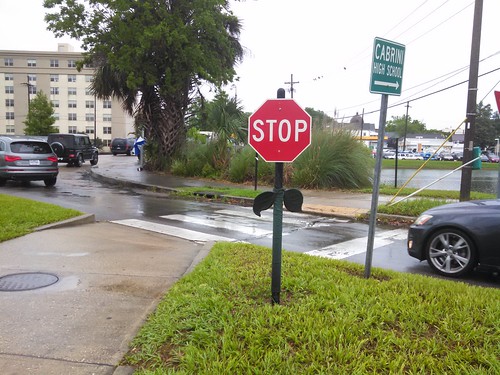
Stop flower

Okay so it's time for a new joke about the four seasons we have in New Orleans.

You know the one that goes, "Carnival, Festival, Hurricane, and Football" or "Shrimp, Crawfish, Crab, and Oyster" or "Caterpillar, Termite, Cockroach, and Mosquito" or... whatever the hell else. There's millions of these.

Anyway, here are the new ones. Feel free to print up some T-shirts or something.

1) Carnival Season
2) Kvetching About Crowd Behavior at Carnival Season
3) Jazzfest Season
4) Kvetching About Crowd Behavior at Jazzfest Season

We're squarely in the middle of the fourth one now.  
Many festgoers complained that they not only could not see but also could not move, which concert safety experts say is often a symptom of a festival that oversells its capacity.

“This can only occur when the promoter oversells an event and public safety officials fail to, or are incapable of, stopping the overcrowding influx of people,” said Paul Wertheimer, founder of Crowd Management Strategies, a Los Angeles-based international crowd safety consulting service.

Wertheimer said festival seating represents “the most deadly and injurious crowd configuration in live entertainment.”

About 460,000 people gathered at the Fair Grounds over the two weekends of Jazz Fest, which concluded Sunday night. That’s up about 6 percent from last year, when an estimated 435,000 attended the festival. This year’s attendance also represents the highest total since Hurricane Katrina. The previous peak was 450,000 people in 2012.
Quite a feat to set a record like that considering the difficult weather through most of the first weekend.  It suggests that the second Saturday crush was every bit as bad as reported by eyewitnesses.
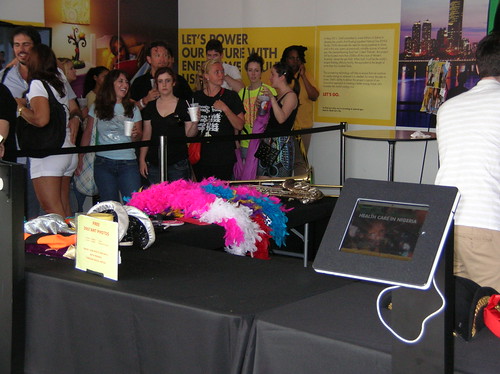
Photo tent
Souvenir photo booth at the Fairgrounds

In a move somewhat reminiscent of the Carnival time battles against the "Krewe of Chad," festival organizers instituted a new minor tweak to the rules this year. But, as was also the case with the Carnvial rules, nobody knew about it. 
In a statement to The Advocate on Sunday, festival producers said they did institute a standing-room-only policy on the track for Acura Stage performances this year, but “as with any new policy, it sometimes takes a couple of years to achieve full compliance.”

Did anybody know that? Doesn’t a change that significant seem like something that would have been news? Would compliance have been easier to get if people would have known the policy before they brought their chairs in? Wouldn’t it have made sense to remind people of this policy through the media after The Who’s set on the first weekend? No outlet, My Spilt Milk included, can get enough Jazz Fest stories while the festival is on, and television, print, and online media would all have run a story with the impact that banning chairs on the track would have. But I first heard of this change when I read the story this morning.  
It's probably not feasible to limit the use of chairs and blankets, in some cases air mattresses, around the Acura stage. But it would be nice if there were fewer. They inhibit movement and make for unfriendly and unsafe conditions when the crowd is heavy.
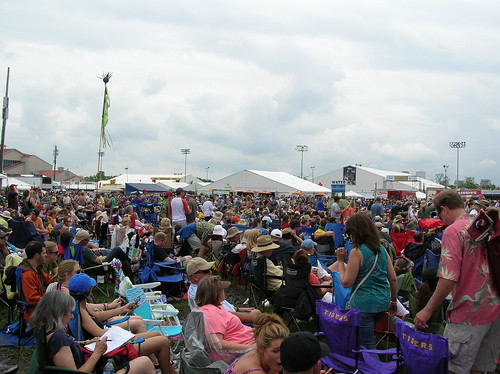
Acura Hell
Acura Stage Hell

When we went to see The Who during the first weekend we were lucky.  The rain had kept the crowd full but manageable. Even so we eventually made our way back to the track. There was more room to move around back there.
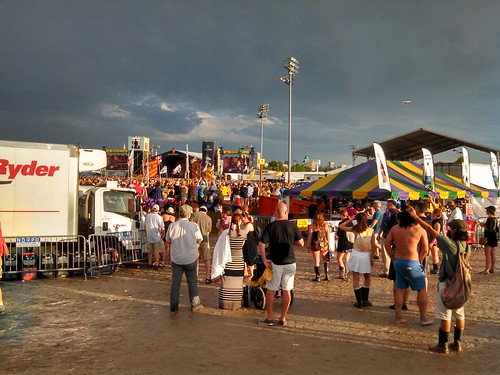
The sun came out

Lucky too since we also witnessed a medical emergency.  EMS workers had to carry a person suffering from what looked like a heat stroke out on a stretcher via the track.  This would have been considerably more difficult the following Saturday.
Wertheimer says not controlling the rules regarding individual space in a festival environment is “irresponsible.” “The Jazz Festival organizers have created a situation of mayhem that pits ticket holder against ticket holder and practically guarantees chaos and possible worse if it isn’t contained.” He warns that dense crowding in general admission environments can cause deaths or serious injuries by crushing and prevent emergency responders to locate and reach people who may be suffering from dangerous ailments like heat exhaustion or more.
As it was, Elton John day can't have been must have been tough for the people there for it. Alex Rawls argues that "Jazz Fest isn’t Jazz Fest with those numbers." 
Bouncing from stage to stage of Louisiana music before settling down for Elton John became impractical, nor could people enjoy Louisiana food. The activities that give Jazz Fest personality are prohibitively difficult when the crowds are at that level.
Some have suggested a cap on ticket sales.  I don't think that's the best solution, though. In fact, it's more likely to make the festival even more expensive and inaccessible to locals than it already is.

Which naturally brings us back to the often tiresome but still necessary question of who Jazzfest is even for anymore.   We had some fun with that question on the Parallel Internet last week over this Daily Beast article.  The author, Mark Hertsgard, is pretentious as hell in a way that makes you want to locate and punch him in the face some day. But he's not entirely wrong. 
Yet for all of Jazz Fest’s celebration of the music, food and culture of New Orleans, some locals complain that a central element is missing: the people. The daily ticket price of $70 is just too high in a city where many folks struggle to get by. In recent years, Jazz Fest’s crowds have become increasingly affluent, old, and white as the festival’s promoters, the AEG corporation, book acts such as The Eagles and this year The Who and Chicago that have precious little to do with the music of New Orleans.
That's about as close as the author comes to contributing a thought, unfortunately.  After that, he quickly falls into the lazy habit of conflating race with class.. and also race with a claim to authentic local New Orleans. And he throws in several embarrassing phrases about "the true spirit of New Orleans music" as if that means something besides whatever matches his own personal preconceptions.  Like so many upper-middle-class intellectuals who trek to New Orleans each year to offer similar commentary, he's actually the larger part of the problem he's trying to describe.
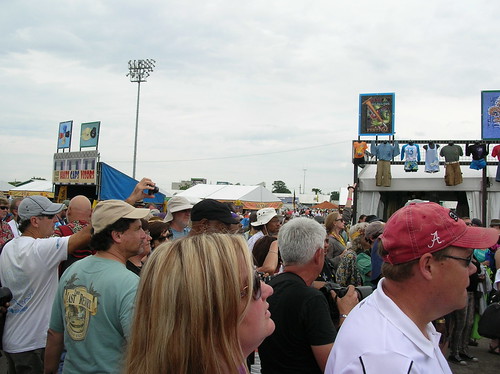
Photographers
A crowd of amateur photographers huddles around the Uncle Lionel memorial second line at Jazzfest 2013

The problem with Jazzfest isn't that it's trying to be something that it isn't... or that it's been stolen or corrupted.  The problem is Jazzfest is actually pretty terrible. And by terrible, I mean it is like smoking or eating a lot of stuffed crust pizza. It's a fun thing we do sometimes that is also very bad for us.

Of course I still go for a day when I can afford to. And when I go, I still have a good time. I'm an old dude but I still like crowds.  I like to people watch. I like music.  But I'm always aware of how disgusting the thing is at the same time.  But I'm not the only person who notices. Hertsgard concludes his piece this way.
The corporate promoters of Jazz Fest may be greedy and exclusionary, but the magic of New Orleans abides for all with the wit to embrace it.
Replace "the wit to embrace it" with "the time and money to afford it" and you're a bit closer to the point but that's good enough.  The essential contradiction of the thing is, on the one hand it's awful; expensive, exploitive, reductive, pretentious, destructive. On the other hand if you go you're probably gonna have a good time.

But if we're being honest, Jazzfest has always been a bad idea. We spend a lot of time arguing about the "Disneyfication" of the city but the annual event at the Fairgrounds has been about as NOLA Disney as a thing can be for as long as I can remember.

If you've never worked in our local hospitality industry, you might not understand the true "spirit of the Jazzfest."  It is not to be found on any stage, or plate, or street corner nearby the Fairgrounds.  Rather, it is to be found in the sweaty reddened faces of the well-to-do middle aged professionals/academics who come down to New Orleans on some kind of authenticity hajj.

Years ago, I used to check these people in to their hotel rooms.  They were by a very wide stretch the most insufferable tourists to deal with every year; entitled, mean, snotty, superior. Jazzfest is their show. More than a concert getaway, it is a validation of their intellectual and cultural righteousness. They are not shy about telling you about how much it means to them, what is says about them that they can afford to appreciate it, and what it says about you if you do not.
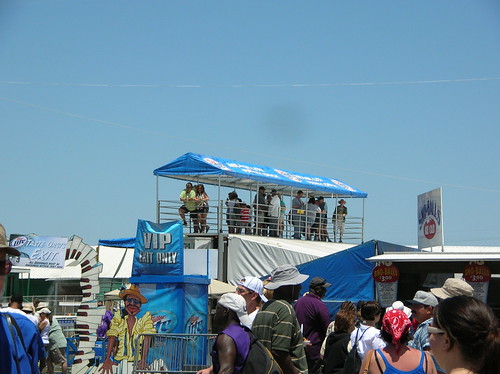
VIP Tent


Over the years I've grown tired of fighting with people who don't get that you can both enjoy yourself and understand that the thing you're enjoying is troublesome so I try not to waste time explaining that anymore. This isn't about "hating" Jazzfest. It's more complicated than that.  Unease is not hate. If I hated it I wouldn't keep going every year.

In fact, Rawls, one of the city's most prominent music writers, published a three part examination of Jazzfest angst last month.  I'd recommend you read through all of that. It's very good. He reaches some conclusions I don't necessarily agree with. Like this, for example.
Those who want New Orleans and Jazz Fest to once again be their private concern are going to be disappointed. Neither is happening. I often wonder if the desire for the better days is also a manifestation of the baby boomers’ in Jazz Fest’s audience wanting to roll back their own clocks as well, or at least get back to a simpler time when they knew all the bands, were the cool kids, and had smaller crowds to be cool in.
Except whatever "simpler time" we're supposed to be pining for never really existed.  I'm pretty old now but I can't really remember a time when Jazzfest wasn't overly commercialized, overrun by tourists, too expensive.. all the things we're complaining about. In my memory it's always been like that. I've really only recently made a kind of peace with it. But I've never lamented some lost idea of a pure Jazzfest because there never was one. 

But if you're looking though those posts for someone to blame for the dangerously high crowds, Rawls does hit upon this.
Jazz Fest producer Quint Davis has quoted Mayor Mitch Landrieu on a number of occasions as having said after Katrina, “Not having Jazz Fest is not an option.” It’s unlikely Landrieu said that solely out of concern for the well-being of music lovers. New Orleans’ shift toward a tourism-based economy was already well underway, and the mayor knew how devastating it would be for one of the bedrock events of the city’s tourist trade to skip a year. Famously, money made during Jazz Fest helps clubs, restaurants, and businesses get through the summer. It would be interesting to see the degree to which that remains true, but it certainly was in 2006, and the degree to which that idea was believed means that civic leaders don’t see any problem with giving two or more hours over to the Boss or Rod Stewart or Fleetwood Mac. At least then there would be somebody they know out there. 
A few years ago, the city hired the Boston Consulting Group to help it set goals for expanding the number of annual visitors.  Already the city is under threat of being so overrun with tourists that on any given day one might be tempted to wonder if anyone actually lives here anymore.
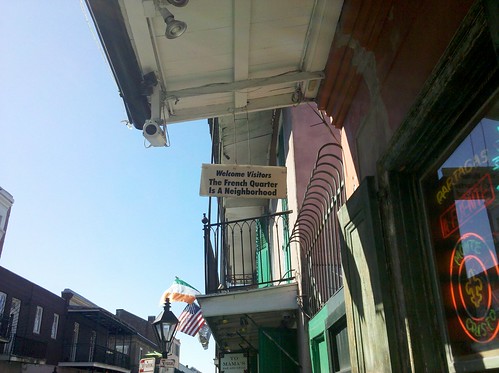
The French Quarter is a Neighborhood

Nevertheless, the BCG strategy recommends planning for 13.5  million visitors by 2018. In 2008 that number was 7.8 million.  Last year that was up to about 9.5.  So they're on their way.  If you're looking to solve the Jazzfest overcrowding problem by imposing a cap, maybe look at the number of tourists we're trying to pack into town year after year rather than number tickets sold on any given day.

Also,  The Who was awesome.

Budgetin'

The legislators are working like hell to.. well.. not so much clean up the mess they've made.. but make that mess fit within the fiscal constraints of the state budget.  It's terrible.  But also very exciting.  They've even got a big scoreboard that keeps getting tweeted out.


You can watch!  Or you can follow the details at your daily news organization of choice.

T-P/Nola.com

The Advocate

QOTD

Which movie is he talking about, though?
Party politics could break out. Rep. John Bel Edwards, D-Amite, warned House Speaker Chuck Kleckley, R-Lake Charles, that if not enough Republicans support taxes on the early votes, Democrats will start voting against the later measures.

If that happens, the bills will die and the House will adjourn earlier than expected, state Rep. Joel Robideaux, R-Lafayette and the architect of the tax package, said Thursday morning before the House session began. The House Appropriations Committee will then have to make the feared deep cuts to public colleges and universities and health care when it meets Monday to craft the Legislature’s first version of the budget, Robidaux added.

“Today could be like the ending of a Quentin Tarantino movie,” Robideaux said, “where we’re all pointing our weapons at each other threatening to pull the trigger. Hopefully that won’t happen.”
Robideaux is probably thinking about the one where all the gangsters shot each other.  Although it's worth noting that the five point palm exploding heart technique is the closest thing to medical care the state is likely to be left with in the new budget.  Bobby Jindal's already well into the part where he goes off to "walk the Earth like Kane in Kung fu" but it's hard to tell what the actual ending of that movie is anyway.

Tuesday, May 05, 2015

SELA season

Cleverly timed. They say they've timed this for "while school is out for summer" but what they really mean is there aren't as many tourists around who will want to ride on the streetcar amusement.
You thought traffic in Uptown New Orleans couldn't get any worse. Wait until June 1.

That's when the Army Corps of Engineers, in coordination with the Sewerage & Water Board and the Regional Transit Authority, will rip up streetcar tracks at three major intersections along St. Charles Avenue to continue installing major federal drainage canals.

Those crossings, at Jefferson, Napoleon and Louisiana avenues, will be compromised for 90 days, allowing crews to do the work simultaneously to minimize snarling traffic while school is out for the summer.
This just after they finished putting in the new rail ties last year.

Third Street barricade

If you're Uptown, it might be a good time to make sure your bike is in good shape. Although people keep trying to make that more complicated than it needs to be as well. 

Hurricane drought

Here is a strange fact.
In a stroke of luck, no major hurricanes rated Category 3 or higher have struck U.S. soil during the past nine years, a new study finds.

This is the country's longest "hurricane drought" in recorded history, or since 1851, the researchers said. The previous record lull lasted eight years, from 1861 to 1868, they said.
Weird to think about since this has been the decade when the fact and threat of hurricanes has loomed the largest over every day life for most of us.  This is especially true in New Orleans but elsewhere as well. And yet, it's also been the driest decade, technically speaking.

Anyway, the season is coming.

Bernie

It's nice that Bernie Sanders is going to be on TV a lot (or at least some) talking about things like rectifying income inequality, reigning in Wall Street abuses, and increasing Social Security benefits.

At the same time, his participation in the Democratic primary guarantees these issues will be left behind once the Democratic primary is over. That's not the entire point of the exercise but it is part of it.
However much he disagrees with (Hillary), Sanders will agitate for trade unionists and social movement activists to vote for the lesser of two evils. The result is that he will help corral people on the Left from taking any steps toward building a genuine alternative to the two-party status quo.

Thus, Sanders will follow the well-trodden path of other liberals like Kucinich. In the 2004 Democratic primaries, Kucinich excoriated Kerry and other candidates for voting for George W. Bush’s wars, implementing neoliberal trade agreements like NAFTA, and supporting the racist death penalty.

But Kucinich was very conscious of keeping the Left and liberals from building a third party. At one point during the campaign, he said: “The Democratic Party created third parties by running to the middle. What I’m trying to do is to go back to the big tent so that everyone who felt alienated could come back through my candidacy.”

Kucinich thus became the bait on the hook for the Democrats to catch their liberal base. After he lost the primaries, he called on his supporters to support the very candidate he had roundly criticized.

Sanders’s campaign will serve the same function. He is already serving that function by luring people on the Left, like the Occupy activists who launched People for Bernie, into a Democratic Party campaign when they might have concentrated their energies on politics outside the party.
The Kucinich comparison is apt. But Kucinich is something of a flake, whereas Bernie Sanders is not. (Well... not in exactly the same way anyhow.) The other day I told the tweeters that Sanders' run reminded me more of Jesse Jackson 1988. The know-nothings in the tweeter tube, naturally found this preposterous.  It is not.
His campaign for the Democratic presidential nomination will be, at best, a re-run of Jesse Jackson’s primary runs in 1984 and 1988. Jackson’s campaigns galvanized an entire section of the Left, channeled it toward the Democratic Party, and directed its remnants to vote for a succession of corporate candidates like Walter Mondale and Michael Dukakis.
The purpose is to keep the left engaged throughout the nominating process so that they'll at least feel like they've got something like skin in the game during the general election. Meanwhile Hillary can be sympathetic but "reasonable" and doesn't have to do as much flip-flopping once the general election begins. It's a tried and true strategy designed to sell the establishment candidate.

So enjoy Bernie while you can. It's nice to know we'll have something pleasing to listen to for a while.  Just remember, though, that's all we're going to get out of this.

Corporate welfare

Bobby Jindal doesn't like "corporate welfare" anymore.
Are Louisiana's corporations heroic job creators or greedy welfare addicts? It depends on when you ask Gov. Bobby Jindal. Two years ago, Jindal wanted to abolish the state's corporate income tax. "Louisiana's current tax climate results in competitive disadvantages for businesses and individuals by penalizing hard work and increased earnings," Jindal said in March 2013.

The plan - which also included eliminating the personal income tax - was so reckless that the state's top corporate lobby, the Louisiana Association of Business and Industry, opposed it. Jindal surrendered one day into the 2013 session.

Two years later, our governor has had an epiphany. He once said we were crushing businesses with oppressive taxes. This past week, however, Jindal told lawmakers, "The truth is, today, we have a system of corporate welfare in this state."
So, naturally, he's taking steps this year to reign that stuff in. Or not.
Gov. Bobby Jindal, a potential Republican presidential candidate, is trying to close a $1.6 billion budget hole without touching as much as $415,000 per episode in tax breaks that may be due to “Duck Dynasty.”

The A&E television reality show takes part in the nation’s most generous entertainment-tax credit program. Jindal is proposing no changes, arguing that reducing such breaks is tantamount to raising taxes. The state approves enough incentives each year to make up at least $200 million in proposed cuts that led Louisiana State University to say that it may plan for insolvency.

“You’re talking about between $200 million and $250 million a year that goes out the door to TV and film producers to come here and shoot their pictures, in a state where money is scarce,” said Jan Moller, director of the Louisiana Budget Project, which advocates policies that benefit low- and moderate-income people. “It’s irresponsible to let this part of the budget continue running amok at a time when they’re talking about closing college campuses.”
It's a shame Bobby doesn't have the courage of his convictions in this case.  Surely a program like Duck Dynasty would be proud to sink or swim based solely on the principles of the competitive marktetplace.  

We will never know just how crazy Tom Benson really is

That's a shame.
In lawsuits such as the one in New Orleans involving questions about Saints and Pelicans owner Tom Benson’s mental capacity, it’s not uncommon for the courtroom to be closed to the public for at least some of the proceedings. But Benson’s lawyers apparently don’t want to take any chances.

They filed a motion Monday asking Civil District Court Judge Kern Reese to close all preliminary hearings and any trial that may occur in the ongoing dispute between the billionaire and his daughter and her children.

They also filed a request “to exclude” Benson’s testimony.

#GiveNOLA Day

If you're playing this year, allow me to remind you that The Lens used to do a lot more cool stuff than they do now.  This is because they could use some help.

Meanwhile, in an alternate reality..

Bobby Jindal, "by all accounts," was a great success.
By all accounts, Jindal's first term as governor of the Bayou State, where he was born and raised by barely off-the-boat parents, was quite successful. He assumed office in 2008 in the wake of Hurricane Katrina and before the economic meltdown — yet managed to rebuild New Orleans, literally from scratch.
It gets even more bizarre if you want to read the rest.  Believe it or not that's an article about why Jindal is failing in the GOP primary he hasn't yet entered.  But even so, it can be seen as an indication that, on the national political stage, local facts don't matter.  In which case, Bobby still has a shot.

Forgotten choice

Bobby Jindal's obligatory campaign biography is not just any old campaign biography.  It's a History Of Forgotten Choices.
NEW YORK — Bobby Jindal, the Louisiana governor and possible Republican presidential candidate, has a book coming out in October.

Threshold Editions announced Tuesday that Jindal has a deal with the publisher for "American Will: The Forgotten Choices That Changed Our Republic."

In a statement issued through Threshold, Jindal called the book a work of history and "a call to arms" for the future as he reviews events ranging from the Louisiana Purchase to the Cold War. In a reference to the next presidential election, Threshold's announcement notes that the book offers "dramatic tales that demonstrate the courage, faith, and vision that we need in 2016."
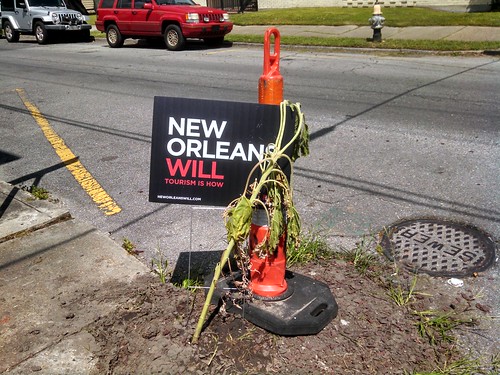
"American Will" Of course Jindal would style his book after the most annoying PR campaign in New Orleans.

New Orleans wilt

On the other hand, we can't all be the sorts of heroes who would title our book, "Blue Steel Crucifix" although that does sound like something that might come in handy at an exorcism.

In any case, consider picking up Jindal's review of "forgotten choices."  As something of a forgotten choice, himself, he's likely to know what he's talking about.

Monday, May 04, 2015

Un-Jindaling

Fun how we now have to go back and clean up Bobby Jindal's little messes.
The financial operations of the state Office of Group Benefits would get independent oversight under legislation that cleared its first legislative hurdle Monday.

The legislation comes in reaction to the Jindal administration’s handling of the health insurance program for about 230,000 state employees, teachers, retirees and their dependents. The administration has been hit with a state district court lawsuit alleging mismanagement.

A $500 million-plus reserve shrunk to less than half in just over two years. During the time period, the administration reduced premiums by nearly 10 percent as medical claims outpaced revenues coming in. The premium reduction cut the amount of money state government had to appropriate as its share of costs as the Jindal administration struggled with state budget balancing.

With fiscal disaster looming, the administration revamped the program shifting more costs to OGB members. Now double-digit premium increases are hitting plan members.
Fun, also, how we have to anticipate ways in which we might be cleaning up the mess after he's gone.
A state House panel Monday advanced legislation that would allow Louisiana hospitals to assess fees on themselves to attract more federal dollars for patient care.

The new assessment is conditioned on expansion of Medicaid coverage which Gov. Bobby Jindal has opposed strenuously.

“This governor has made very clear what his position is. There’s nothing I can do about that,” said House Speaker Chuck Kleckley. But Kleckley said he wanted the next governor who takes office in January to have the funding option.

“All four candidates have said they would look at some kind of expansion,” he said. “These are dollars that could benefit the state.”

QOTD

Judge Robin Giarrusso:
Andy Kopplin, Landrieu's chief administrative officer, attempted to plead poverty as an attorney for the city lobbed softballs his way regarding the many financial strains on the city's budget, such as federally mandated reforms of the jail and the Police Department.

Giarrusso cut them off. "I'm not interested in the city's problems," she said, shaking her head. "That doesn't matter. I've ordered you to pay this."
Well, ok, then. 

Congratulations to St. Bernard Parish on being elected Gulf of Mexico

In a matter of speaking, anyway.
For the president of the regional flood protection authority, St. Bernard Parish’s  rejection  on Saturday of a property-tax increase for  its levee and storm drainage agency had two immediate results.

“If the Lake Borgne Levee District were a business, they would be in bankruptcy because they don’t have the funds to meet their expenses,” said Stephen Estopinal, head of the Southeast Louisiana Flood Protection Authority-East, which oversees the Orleans, East Jefferson and Lake Borgne levee districts.

And second, more to the point: “Right now, if they had a major problem with their system, they couldn’t fix it because they don’t have the money,” he said.
One begins to wonder, though, what is the point of the SLFPA-E "regional" flood authority if the funding it requires to maintain the region's flood protection system does not transfer between parishes? 
The increase would have been about $38.25 per year for a homeowner with property valued at $125,000, which is the average sales price in the parish. Millage rates in Orleans and Jefferson for the same purpose are just 6.21 and 3.91 respectively, but they raise much more money because of the larger tax base.

The St. Bernard failure could affect the entire east bank because the new $14.5 billion hurricane storm surge system is designed as a perimeter wall wrapped around all three parishes. A break in one section due to poor maintenance could result in flooding pouring into adjoining areas.

While the system provides unified protection, there is no unity in funding. State law prohibits the authority from using tax dollars raised in one parish on work in another. With St. Bernard’s population cut in half by Hurricane Katrina, the Lake Borgne Levee District’s income has been unable to keeping up with expenses, including $1.4 billion in levee improvements post-Katrina.
That is what you might call a "system in name only" right?  When the next storm comes, I'm pretty sure the Gulf isn't going to worry too much about which parish paid its taxes.

Sunday, May 03, 2015

The Bill Parcells era of Saints football

It's what we've been living through for ten years.   
“Jeff has got a lot of experience, and he’s been a part of a lot of successful drafts. His opinion counts; everyone’s opinion up there counts,” Loomis said of Ireland, who also made his mark in the 2000s as the chief college scout for the Dallas Cowboys, where he worked with Payton under coach Bill Parcells.

Payton said Parcells’ influence could also be felt in the Saints’ draft room since he had “pounded” some of the same values into both himself and Ireland for years (including the importance of size).

“Here we are in this draft, and the discussion is maybe a short corner or an undersized [player], and the whole time I’m looking at [Ireland] and saying, ‘You’re taking the call from Parcells, not me.’” Payton cracked. “There are traits that he learned, and we were both fortunate to have those three years together. But he’s real savvy, smart, and he loves football. He really did a good job, and our scouting department worked extremely hard as well.

Not the first time we've read about how surprisingly influential Parcells has been on Saints operations during Payton's tenure.  Not bad results, generally.

Congratulations to the sheriff on being elected sheriff

This ballot question was a re-do after having failed back in November.  It fell apart then because people are, rightfully, dissatisfied with the state of the jail and because they.. probably also rightfully.. are distrustful of the sheriff.  But after having thrown a fit over that, voters grudgingly accepted that they had to do this.  It's really not that bad, anyway.
The proposal, championed by Sheriff Marlin Gusman and Mayor Mitch Landrieu, didn't raise taxes. Instead, it called for freezing the current tax rate at 2.8 mills and allowing the sheriff to use the revenue for the "operation, maintenance and upkeep of jails and related facilities." Money raised through the original tax was dedicated to capital projects.

Gusman asked for the additional money for jail operations to help pay for improvements required under the terms of a federal consent decree that could cost as much as $22 million a year. The sheriff's office estimated the new tax proposal would provide the sheriff's office with an additional $4.4 million in 2016.
Someday maybe we won't spend so much money incarcerating people.  Maybe the fact that we also decided to invest in supporting our communities with libraries yesterday will help with that. 

Congratulations to the library on being elected mayor

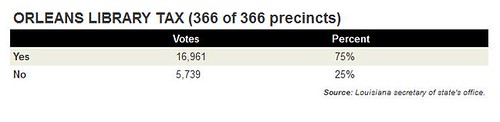
It's a landslide.

library election

Can't really say it's too surprising given the widespread support from (almost) everyone.  More on that "almost"  in a bit.  Last week, I rounded up all the links I could find to illustrate the widespread support of practically everybody.   You can see that  here.

But it turned out this week that a bunch more people wanted you to vote for the library millage so I started collecting those articles as well.  I meant to publish these before election day but I've been kind of busy with stuff so here it is now. It seems less urgent now, but if you did vote for the library millage, it's a list of the many people who agreed with your decision.

Let's start with the mayor who, even  though he had to throw in some blather about the tricentennial, said a thing.
On May 2, our city has an opportunity to renew its commitment to the New Orleans Public Library. The request is that voters increase the current millage by 2.5 mills for 25 years to support operations and maintenance of the entire library system.

The price for the total millage on the average home in New Orleans will be less than $11 per month.

Cheryl and I are endorsing the proposed millage. Libraries continue to be one of the most accessible avenues to education for any age and are important to personal and professional development – especially to those without access to resources at home.

Here is the Times-Picayune editorial board: 
Public libraries are an essential part of a literate and informed community. They help feed the imagination of young readers, provide a place for research for students of all ages and connect adults to jobs. And they can serve as neighborhood gathering places. To achieve all that, they must be up to date and accessible.
Here is a different person who wrote in to the T-P This is a pretty good one so I will share two quotes. Here's the first.
Most of the system's 13 branches at the time were destroyed. About 80 percent of its staff was laid off, as librarians scrambled to find new homes in places the floodwaters had not invaded. Hundreds of thousands of books and other holdings were wiped out.

Post-storm assessment reports were predictably grim. "Fish in parking lot. Overturned bookdrops. Major flooding. Shelves collapsed, books floated in water," said one from a library branch in eastern New Orleans. "Closed indefinitely."

But the city library system didn't stay down long; did not surrender to the disaster or the naysayers. Like many community institutions, including our own National WWII Museum, the libraries struggled back to their feet and regained strength, helped along by private donations, government and volunteers. With a big assist from the American Library Association, our libraries became part of a broad rebuilding and revival story reminiscent of the one that played out in Europe after World War II, propelled by the Marshall Plan. Another major post-World War II investment - in the GI Bill, giving returning service members the additional education they needed - offers another reference point.
I happen to have a photo of the actual fish referred to above.

Fishlot

I know it kind of looks like they're still underwater. Phones had shitty cameras back then. Anyway, the letter goes on.
City libraries are important to our quality of life, to our city's future - to our democracy. Sustaining them reflects, in a tangible way, the American spirit. Now is the time for cultural institutions to rally to their defense, urging a resounding "yes" vote on May 2.

That was the best one but let's see. What else is there?  Here's one from the Louisiana Weekly.  
Our editors are usually highly resistant to enacting any new property tax, especially in Orleans Parish where rising assessments are driving property bills to a level that many working class homeowners are in danger of losing their homes.

But a city cannot survive without its libraries, and if this millage is not enacted on Saturday, at least two libraries will close and the hours will be reduced at most of the remainder to the point that they will be unavailable to most of the working public.

This is from The New Orleans Tribune
We suggest our readers say “YES” to both proposals. We don’t do so lightly and it is not easy. But, we understand the need for safe and well-maintained jail facilities. And we say “YES” to strong public programs that are designed for the benefit of the community, such as those offered by at the library.

The Tribune actually gets some facts wrong about both propositions in that piece. But, whatever.

Doing a much better job is Gambit where we found this article about current literacy programs jeopardized by the library's funding crisis. 

Also from Gambit, a feature article with a more in-depth look at the library's situation. 
The vote seems like an easy sell; who doesn't appreciate libraries? Brown points to the educational and politically neutral environment that branches across the city give to New Orleans youth: providing educational and entertainment materials; serving as points of Internet access in an underwired city; and creating community programming that provides an alternative to crime and a lack of adult supervision.

But the Bureau of Governmental Research (BGR), a private, nonprofit and non-affiliated research organization in New Orleans, issued a report last month asking the NOPL to go back to the drawing board. Janet Howard, president and CEO of BGR, says the library has a plan for how it's going to spend the money, but it doesn't have a strategic long-term plan for its operations.
Yeah, about that.  It's pretty much nonsense on its face.  Brown does an adequate job of responding to it but there's more.  Here's Brown.
Brown says the BGR is wrong. "I have no criticism of the BGR, I simply disagree with their finding," he says. "I think any impression that voters would have no idea how the funds will be spent is not true. We have clearly articulated how the funding will be spent."

In a later email, Brown said, "The library has a detailed spending plan, but not a strategic plan at this point," adding "any new funding will be used for vetted, widely accepted purposes." As to spending specifics, he said, "The question of the strategic plan is a priority for the future; however, there are simply too many front-line operational considerations that must be addressed first."
The immediate plan is to continue and expand these vital services rather than drastically shut them off. There is no mystery to it. BGR, though, sets the goalposts further back than that demanding  a long term "strategic" plan.  This is not because they are concerned with the actual question before the voters (do you want to keep library services or no?) but because they are pushing a more nebulous ambition.  
Howard says BGR isn't against an increase in library funding per se. "The fact that something is a good cause is not enough to say to voters," she says. "You have to have a system that's properly executed and you've got to have the planning. Do those things and come back."

BGR plans to look at this and other future taxes as a whole, "because we have all these individual groups that go out and ask (for money)," Howard says. "The sheriff goes out and asks for money, the city can go out and ask for money, the levees can go out and ask for money — but there's no coordination so that you come up with a concept of 'What are the community's top priorities?'" Howard says BGR will issue another report looking at not only property taxes, but also sales taxes and hotel and motel taxes to see where that money is going across Orleans Parish. That way, voters can decide whether that revenue is being properly allocated.
BGR doesn't actually care about this election. They have an upcoming report they want to tease.  Howard showed up again in this Lens article, talking about "long term" planning, but also pushing an even more obvious lie about the possibility of alternate funding from the city general fund. If you read the article, you'll see just how unrealistic a possibility this was.
Councilwoman Latoya Cantrell, who supports the millage proposal, did not say whether she would support a general fund contribution for 2016.

“First and foremost, the Council has fully supported this millage and is advocating for voter approval,” said an emailed statement, attributed to Cantrell, from spokesman David Winkler-Schmit. “If it did fail, allocating money from the general fund would depend on what the other budgetary considerations are for 2016. Hopefully, this question will become moot with the passage of the millage increase on May 2.”

Library Board Chairman Bernard Charbonnet, interviewed after the board meeting, said he’s not holding out much hope for a large check from City Hall if the vote fails.

“The problem is with the stressed needs of the city’s general fund. I can’t tell you that there is any money for the library,”  he said. “We go to the City Council annually. We go to the mayor annually. And we go with hat in hand begging for money. We just do not get it. I don’t believe they have it, which is why we’ve come to this.”
However, if you were to skim the article and read only the headline, "Even if voters reject proposed library tax, options for increased funding still exist" you might get a different impression.

Yes, even supposedly "engaged" Lens readers are prone to being manipulated this way.  So it's a terribly misleading way for them to have put it. If the millage had been defeated, the library would then have to ask the city to provide for its operating budget out of the general fund during the contentious annual budget process. The only possible result of such a scenario would have been a drastic reduction in library support.

The choice voters had was this. Approve the millage and the library system can continue to expand services or defeat the millage and guarantee that those services will be cut. Is that what The Lens would have liked to see?  Who knows but it is the position they chose to amplify.  Is that what BGR would have liked to see?  Maybe.

You can choose to interpret this charitably and say that BGR is merely being naive or myopic; favoring longer term "good government" reform aspirations over the practical function of a specific election.  Or you can say that BGR is engaging in Tea Party-esque ideological anti-tax intransigence and dressing that up in the guise of progressive reform.

Whichever side of that you favor (it doesn't have to be all one or the other) you'll have your finger pretty squarely on the pulse of white middle class New Orleans. Which is why the overwhelming library millage victory is something an aberration.  Had it been any other social service on the ballot, there would have been much stiffer opposition. 

Imagine this election were an initiative to fund the kinds of things the library actually does without using a word library in the offering.  "We would like 2.5 mils to offer free internet and staff assistance for individuals filing for SNAP benefits or applying for jobs, early literacy training for at-risk families, community meeting spaces, regular arts/entertainment/educational programming free and open to the public, oh and also to buy books, music, and films in multiple formats to lend out to anybody also for free. We'd like to run fifteen branches of this operation covering every neighborhood in the city."

My god what a socialist nightmare of a ballot proposal!  If we asked them to create such an institution out of whole cloth today, certainly our upwardly mobile "new New Orleanians" would insist on farming it out to some for-profit entrepreneurial public-private partnership. Preferably one that offers small plates.

How is it, then, that this package of free stuff for everybody but especially for the poors slips by? Branding! Long established branding.  A publicly funded information and social services project may sound like an anachronistic impossibility but a library is a thing people recognize and respect. A library is something respectable people want to be associated with.  There is something about the idea of having good libraries that flatters the totebagger class of a city even if they do not use them.  Like a wall of untouched bookshelves in a fashionable home, the point of the thing is showing it off to the neighbors.

Anyway, it all works out for the best. The library gets to go on quietly providing the many laudable services it offers any and every person in the city regardless of age, race, or class. The totebaggers get to feel good about themselves for whatever screwed up combination of conspicuous consumption and noblesse-oblige helps them sleep at night. And, of course, BGR still gets to write that big report on city finances they're so keen on.  Comprehensive municipal finance reform happens to be a subject I'm interested in myself. I look forward to reading it.

Friday, May 01, 2015

Cash Cows

Bobby Jindal has spent the past few years arguing that Louisiana cannot accept federal funds for Medicaid expansion now in fear that it might increase the financial burden on the state at some point in the future.  This week, the Legislature agreed with the Governor for the third year in a row and rejected the expansion.
But opponents argued that the expansion would be a financial drain on state coffers over time. Phillip Joffrion, state director of the Americans for Prosperity, pointed to the escalating expenses as more people are being covered in Medicaid expansion states than originally projected.

In addition, Rep. Richard Burford, R-Stonewall, said Louisiana should not depend on the federal government as “a cash cow.”
The state of Louisiana is currently facing a $1.6 billion fiscal crisis. In December, a legislative auditor determined that state Medicaid expenses alone had increased by $900 million since Jindal's  privatization scheme (itself the source of an indictment of Jindal's former Health and Hospitals Secretary) went into effect.

But no matter.  We don't need any help from the federal government to sort this out.  Never a borrower or lender be... or something like that.

On the other hand, we would very much like to be borrowers.  How else to explain the massive payday loan Jindal hocked the state's tobacco settlement for.
At 5 p.m. on Friday, March 13, Jindal's office announced the appointment of four members to a state-run corporation that oversees Louisiana's tobacco borrowing. Four days later, the corporation's 13-member board held a hastily called meeting to approve a $750 million deal with the help of Citigroup.

That didn't sit well with Treasurer John Neely Kennedy, also a Republican, who sits on the board along with Jindal's appointees and other statewide elected officials. "This is about the last savings account left that we haven't taken money from," Kennedy complained at the March session.

The deal would pledge 40 percent of Louisiana's annual tobacco settlement revenues in bond repayment that would stretch out nearly 30 years. In 2001 and 2013, the state borrowed against the other 60 percent of its tobacco settlement money, netting about $1.2 billion. Citigroup served as an underwriter in 2013.

Turning recurring revenues like the tobacco money into upfront payouts is widely considered poor fiscal management.

"You're borrowing money from the future to pay today's expenses. That's how we got into this problem, and this is only kicking the can down the road and paying interest on top of it," said Steven Procopio, Policy Director for Public Affairs Research Council of Louisiana, a Baton Rouge research group that has studied the state's financial woes.
Can't "depend on the federal government to become a cash cow" in order to fix Jindal's mess.  But somehow Citigroup is fine.  

Creeping Portlandia

Between this and the tree-sitters in City Park, New Orleans is becoming a goddamned cartoon.
NEW ORLEANS - The freshly-reopened St. Roch market was the victim of vandals who threw paint onto the front and the side of the building. Several windows were smashed also.

Profane graffiti was was also written in at least one spot.

A photographer who shot video of the scene said that each of the windows on one side was smashed and much of the paint was on the front of the market and on one side of the building.
In a somewhat related true story event that happened to me yesterday,  I walked into a coffee shop and they were just playing this song  on the stereo in utter defiance of all self-awareness. It's getting weird around here and not in a good way.

There's nothing wrong with seeing the St. Roch Market renovation as a symbol of the trendy gentrification happening all around us.  But some idiots throwing paint at it in the middle of the night are probably as great a symbol of that themselves if not greater.  Besides, there are better ways to make ineffectual complaints against bland entertainments that annoy you while also not hurting anyone or breaking things.  It's pretty much what Twitter is for.

The worst thing is now, before anyone can start cleaning up over there, we have to wait for Fred Radtke to come paint it all gray first. Later, the mayor will give a twenty minute speech about how the market is a sign of continued "resilience."  Hope you're happy, kids.