-->

Friday, January 16, 2015

You know who else was fiscally irresponsible?

Clancy DuBos really piles on here calling Bobby Jindal "the most fiscally irresponsible governor in modern Louisiana history." Clancy wonders how Jindal thinks he's going to explain himself out on the campaign trail. 
Well, not quite nothing — he is laying the groundwork for a quixotic presidential run. I’m not sure how he’s going to explain $1 billion in cuts to higher education, especially when he’s touting himself as the savior of public education in Louisiana. Then again, the national media rarely look beyond press releases, and voters in Iowa and New Hampshire have no clue what a liar Jindal is.
That is certainly true. The societal and media impetus to always "move forward" in politics will no doubt limit attention to the the carnage Jindal is leaving behind in Louisiana.

But, in order to better understand Jindal's... um.. optimism in these matters, it helps to look back and remember that his personal hero, Ronald Reagan's lasting legacy in California has also been a fiscal nightmare.

What is commonly known as Proposition 13, was a 1978 ballot initiative that severely limited the state of California's capacity to raise revenue via income taxes.  Like Jindal's reversal of the Stelly tax plan and his later failed "tax swap proposal", Prop 13  dramatically shifted the state tax burden in the wrong direction.
It immediately reduces property-tax bills approximately 57 percent by rolling back the maximum rate of tax to 1 percent of the property’s 1975-76 assessed valuation, and restricts futures levies to 2 percent per year. The initiative further requires a two-thirds majority in both houses of the state legislature to approve increases in any other state tax.

Howard Jarvis, the chief architect of the initiative in concert with Paul Gann, a retired real estate salesman, spent $28,000 to secure 1,264,000 signatures, more than twice the 500,000 need to place his petition on the ballot. And amid the hoopla of his lavish public relations campaign, a number of insidious provisions in the initiative were obscured. For example, Proposition 13 states that property will be assessed at current market value “when purchased, newly constructed, or change in ownership has occurred.”

As houses are built and change hands, they will receive far higher assessments than voters were led to believe. And because families move more often than such corporate giants as Standard Oil, Lockheed, Chevron, and B of A [Bank of America], the heaviest property tax burden must shift from the corporations best able to bear it, to individuals.
It also plunged succeeding California governors into a state of perpetually recurring budget crisis

By then, Reagan was long gone, of course. In fact, he was already out of office by the time Prop 13 had passed. Reagan actually raised taxes on multiple occasions during his time as Governor.   But his political legacy is universally associated with the "taxpayers' revolt" that Prop 13 signaled.  This is because Reagan was not only a public spokesperson for Prop 13, he had previously campaigned in favor of similar proposals.  This video shows Reagan, in 1973, promoting a "Prop 1" initiative which ultimately failed.


Of course, for Reagan, none of this had anything to do with fiscal responsibility. Reagan was merely building a brand.
Proposition 13 was a watershed moment in American history, the first crumbling of the post New Deal consensus that supported an activist government intent on educating its citizens and providing them with an adequate safety net. California’s own native son, Ronald Reagan, rode the ideological wave of Proposition 13 right into the White House, and launched an era in which Republicans successfully devoted themselves to crippling government at all levels for decades. Proposition 13 broke California’s government.
And so it is with Jindal.  Like his hero, Reagan, Jindal has used his governorship merely as an opportunity to burnish his ideological bona-fides as he prepares to spring into national politics.  Is that working out for him?  Right now, the national zeitgeist casts Jindal as a far-right joke.  However, if we look back, we might remember that in the 1970s, the national zeitgeist  viewed Reagan in very much the same way.
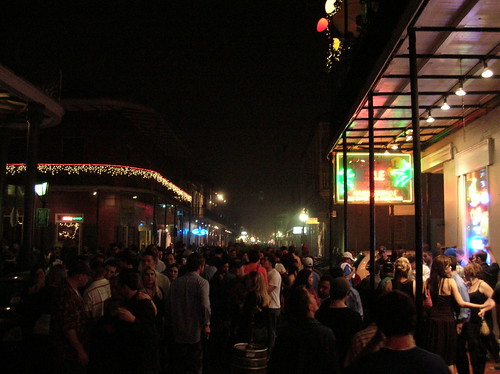
Here comes the noise crackdown

The city hired the noise consultant they expect to be the harshest.
Hammer’s hiring would be one of the first steps in the process of creating an office that would deal with environmental health and noise issues.

Hammer’s proposal came out on top against a competing offer from David Woolworth, who served as the council’s expert on sound issues during the debate over a proposed ordinance to tighten regulation on sound levels at bars and nightclubs.

Those looking for stricter noise regulations largely saw Woolworth as being in the opposing camp, and on several occasions he argued that the proposed rules would be too restrictive.

During Thursday’s evaluation session, committee members praised Woolworth’s knowledge of the city and his ability to research the issues, but they said his proposal was focused on the city’s schools and not issues in the French Quarter and Marigny, two hot spots of tension over sound issues.

Hammer, who does not live in New Orleans, got high marks for her background in environmental health and her previous experience dealing with sound issues in Chicago.

Jindaled

After eight years of Bobby Jindal's presidential campaign posturing governance, Louisiana's poorest residents bear the highest tax burden.
(State Rep. Patricia Smith) blames the state’s tax system. She says Louisiana’s tax system is riddled with credits and deductions that have been skewed toward businesses and bosses at the expense of workers.

Opinions vary widely on what makes taxes fair, Smith said. She reminded that state voters supported a plan that eliminated some of the sales tax burden on lower-income people and balanced those losses by increasing income taxes on wealthier Louisiana residents. But relentless criticism of what was called the “Stelly Plan” led to rollbacks of the income tax portion in 2007 and 2008.
You might remember that, even after the Stelly repeal, Jindal came back a few years later and proposed making matters even worse although not even the Louisiana Legislature was dumb enough to go for that.

Anyway, whatever your politics, we can all agree that Jindal's policies have put the state's fiscal house in order and certainly qualified him to run for President on this terrific success model.

Update: And, of course, if we didn't ask the poor to pay the highest taxes, how could we give all this money to movie studios

Thursday, January 15, 2015

A vape raised with the fume of sighs

This City Council hearing on the smoking ordinance made for some good TV last night.  I'm gonna reference the Gambit write-up a few times.
Before the New Orleans City Council votes on an ordinance that could ban smoking in bars and casinos citywide, the measure's authors held a "town hall"-style meeting to hear one last round of public comment. The City Council will likely hear from several speakers at the City Council meeting on Thursday, Jan. 22, but tonight's hearing made room for more than two hours of comments from all sides of the issue.
There were commenters there from all over Louisiana, some from as far away as Monroe, to tell us about how well similar smoking bans have succeeded where they are from. A lady from Alexandria said that, after a smoking ordinance passed, "bingo halls" continue to flourish there. More than one speaker talked about "bingo halls" for some reason.  I didn't realize they had such an active lobby.

That's nothing compared to the kind of rabble the vapers can rouse, though.
At the council's Jan. 7 Community Development Committee meeting, e-cig users and sellers suggested that if cigar and hookah bars are exempt from the ordinance, so should their stores, where customers can "taste" vape products.

"We don't have a problem with the regulation of electronic cigarettes," said Anthony Kolesa, who runs Smoke Cignals, adding that many e-cig supporters would back the measure if it removed them from the picture.

"We’re all fighting against Big Tobacco," Chad Rogers said. "(The smoke-free campaign) is with Big Pharmaceutical. We’re by ourselves."
Not too surprising that the vapists imagine themselves as defenders of the little guy against Big Pharma. They do give off that kind of vibe.  One vape guy was so passionate that he told us he was, "on fire," which seemed an inappropriate thing to be at this particular hearing. Another told us about his clubbed foot which, he, I guess, implied was caused by tobacco although it wasn't clear.  There was a point where I started to wonder what the overlap is between vapists and people who believe in chemtrails.

Some of the health professionals there tried to point out that, while there are no long term studies on vaping just yet, habitually inhaling a batch of nicotine spiked chemicals is probably.. you know.. not good for you. They were somewhat overshadowed by more hysterical speakers who seemed convinced that e-cigarettes were really just vessels for surreptitiously smoking weed.  One person seemed to think that people are vaping crack.  But she may have just had that confused with the "King Cake flavored e-juice."

I don't know what to say about the vape provision of the ordinance.  Vaping seems pretty gross. But I think it's only in the ordinance in the first place so as to have something to negotiate away before it passes.

A second interest group with significant representation was comprised of employees of Harrah's Casinos whose presence was.. probably not coerced, exactly... but certainly encouraged.  Of the various business owners, bar patrons, and concerned citizens arguing against the ordinance on the grounds that the "free market" was sorting the smoking issue out on its own, the Harrah's people were the least credible.

Sure, there are casinos where management is learning how to adjust to a non-smoking environment. But, in the great majority of cases, this is happening because state and local governments have required that it happen and not through the influence of some magical invisible hand of the market.

"The free market" wants casinos to allow smoking. The most efficient way to run this business depends on trapping people indoors and keeping them disoriented enough to remain in one place continuously emptying their pockets for as long as possible. Asking them to step outside, even for a cigarette is, anathema to the entire model. 

Such a model, naturally, requires casino floor employees to expose themselves to a hazardous smoke-filled environment shift after shift. This is a long-running issue in the industry playing out in labor negotiations and in the courts.
In September (2010), a former employee of the Tropicana Casino and Resort in Atlantic City, N.J., settled a lawsuit against his ex-employer for $4.5 million. The plaintiff, Vince Rennich, claimed his lung cancer was caused by 25 years of exposure to secondhand smoke at work.
A few years ago, a similar suit was brought by the family of a Harrah's New Orleans employee
The mother of a former Harrah's dealer who died of cancer last year filed the federal suit Wednesday against the casino's owner, Nevada-based Caesars Entertainment Corp.

The suit claims Maceo Bevrotte Jr.'s cancer was "directly linked" to his prolonged exposure to secondhand smoke at the casino. The suit says Bevrotte worked at Harrah's for about 15 years.
That one was dismissed but only on technical grounds.  Which is one reason the appearance of Harrah's management at  City Hall last night came off as obnoxious as it did.  It did, however, allow an opportunity for Latoya Cantrell to fire off the evening's best zinger.


In my mind, the only concern over the ordinance has to do with whether it will cause new noise complaints when smokers go outside. It was an issue raised in this Advocate article last weekend.
But the prospect of having people loitering outside late at night to smoke and perhaps drink worries owners of some bars tucked away in residential neighborhoods.

“It’s the city that’s putting this rule in place, and they’re putting more of these quality-of-life issues on the table without a real good solution to the problems that are going to arise out of them,” said Bill Walker, who has co-owned the Lost Love Lounge in the Marigny since 2010.
But even though this is a legitimate concern, it's really a separate issue from the smoking ban itself. And it's certainly no justification for requiring bartenders, food servers, casino floor workers, musicians, etc. to work in an unnecessarily hazardous environment night after night.   We love to get on TV and talk about how much "tourism matters" and how important all of these service industry jobs are.  Doesn't it follow that we should ensure those jobs are safe and healthy for the people who do them? 

Wednesday, January 14, 2015

Seems like a cunning plan

Step One: Identify a city asset that is neither drains nor produces revenue.
The Public Belt Railroad, created in 1904, was designed to put all the tracks feeding the city’s ports under a single, public entity. The railroad — unique in that it is owned by a city government — owns and is responsible for about 100 miles of track and the Huey P. Long Bridge over the Mississippi River in Jefferson Parish.

The agency does not receive any taxpayer money or pay any money to the city. It is funded by revenue from the railroads that use the tracks.
Step Two: To quote Ray Nagin, "sell that sucker" off and put it back into commerce because, according to the Gospel of Aspen, privatization is always better.
Although the letter does not cite a specific price, it says the sale would allow the railroad to have access to money needed for improvements while providing an “immediate and significant cash infusion to invest back into basic city services, as well as ongoing tax revenues on property currently untaxed.”
Step Three: Identify a buyer through the usual transparent and above-the-board public bidding process.
A sale of the railroad likely would need the approval of both the board and the City Council. It also likely would require a public bid process.
Wait.. hold up.  Buyer already identified himself back before Step One even happened. He's pretty well vetted, though. 
The proposal to sell the Public Belt was sparked by interest from Thomas Coleman, a New Orleans businessman who served for four decades as the CEO of International-Matex Tank Terminals, a company — owned by his family until last year — that runs terminals and storage facilities in Louisiana and other states and a rail line in New Jersey.

Coleman is the father of Dathel Georges, who owns The New Orleans Advocate along with her husband, John Georges.
Anyway, Step Four is Profit!

Disruption!

Looks like what we have here is an entrepreneur who tried to disrupt an infernal local government monopoly on tow truckin'. But those danged regulators had to go and break his free market spirit.
A former City of New Orleans tow truck driver has been arrested after an investigation into a woman's claim that she had to pay him a $200 bribe to avoid having her car towed from the French Quarter.

Reffel Gordon, 51, was booked Tuesday with public bribery, filing false public records and malfeasance in office over an incident that reportedly took place last summer. According to Gordon's arrest report, a woman filed a bribery complaint with the Office of the Inspector General after an encounter with Gordon last June 12.
No different from what Uber does.  Next time maybe make an app first. 

Let them eat movies

Earlier, we were talking about how 2014 was the year when people started losing hope. Here is a pretty good example of why that happens.

This is one of several blurbs this week superficially expressing "hope" for a better jobs and wages situation in the months ahead.

And here is Robert Reich to explain why that is very probably bullshit.
Jobs are coming back, but pay isn’t. The median wage is still below where it was before the Great Recession. Last month, average pay actually fell.

What’s going on? It used to be that as unemployment dropped, employers had to pay more to attract or keep the workers they needed. That’s what happened when I was labor secretary in the late 1990s.
It still could happen – but the unemployment rate would have to sink far lower than it is today, probably below 4 percent.

Yet there’s reason to believe the link between falling unemployment and rising wages has been severed.
The reasons are easy enough to discern for anyone who pays attention.  Outsourcing is easier and cheaper than ever. There are enough "discouraged workers" not counted among the labor force to make the unemployment numbers deceptive.  Employees have lost so much ground in terms of overall compensation (diminished retirement and health benefits) and job security that they're quite far from being in anything like a favorable bargaining position.   There's also this.
Meanwhile here at home, a whole new generation of smart technologies is taking over jobs that used to be done only by people.  Rather than pay higher wages, it’s cheaper for employers to install more robots.

Not even professional work is safe. The combination of advanced sensors, voice recognition, artificial intelligence, big data, text-mining, and pattern-recognition algorithms is even generating smart robots capable of quickly learning human actions.
The fundamental issue we're seeing is chronic structural underemployment.  There are more people than the labor market will support at much more than bare subsistence levels.
More than half of Louisiana families do not earn enough money to cover basic costs, a new report says.

An analysis released Tuesday by Loyola University’s Jesuit Social Research Institute found that 52 percent of Louisiana families with children are not making enough to live “a modest, dignified life.”

Based on those findings, the authors are asking policy makers and community leaders to aid struggling families by taking steps to raise wages, expand the state-level earned income tax credit and improve access to health care.
This is going to present new political challenge to "policy makers and community leaders." We need to find ways to  base our survival and comfort on something besides the increasingly arbitrary concept of a job. That will take more imagination than just expanding the earned income tax credit.

In New Orleans, though, policy makers and community leaders have determined that the thing to do is give away tax breaks to movie studios.  
A proposed $63.5 million movie studio complex inched closer to a reality Tuesday with the approval of tax breaks worth at least $3.1 million, according to the Industrial Development Board, which approved the subsidy.

If completed, the Deep South Studios complex would be one of the biggest investments in the local film industry to date. Its 19-acre campus, an as-yet undeveloped plot near the foot of the Crescent City Connection bridge, is slated to include a 262,000 square-feet of floor space spread over six sound stages, two production buildings and a half-dozen ancillary structures. 
That seems wrong.  But they did come up with it while sitting around a fancy table at premier corporate lawfirm so maybe they know something we don't.

Here comes the circus

Looks like Les Miles is going full Les Miles.
LSU isn’t just introducing one new coach Wednesday.

The school hired former Ole Miss head coach and longtime Southern California defensive line coach Ed Orgeron. New defensive coordinator Kevin Steele, formerly Alabama’s linebackers coach, and Orgeron will be introduced at a 4 p.m. news conference.

Orgeron, known as one of the nation’s most aggressive recruiters, is expected to coach the defensive line, a role that Brick Haley has had at LSU for the last six years.
Recruiting recruiting recruiting. Personality and showmanship.  Not so much... you know... coaching, though.  That's what LSU football is all about. 

The year that sucked

Last week, TPM's Josh Marshall picked up on what he thought to be an unusual number of people declaring that 2014 had been especially terrible; more than just the regular batch of "Fuck that year" proclamations you get at New Year's, that is.  So he asked readers to elaborate.

Your 2014 mileage may have varied, but I thought it was an especially craptastic year for a bunch of different reasons so I was interested in seeing the follow-up.  Here is that.

Put simply, a lot of readers told me that 2014 was the year they began to or finally did lose hope.

I mentioned yesterday that since my friends and professional acquaintances are disproportionately Democrats maybe the party's November drubbing played a role. That clearly had some effect. But there was something much more general.

Again and again, people shared a sense that things they thought were fixed or getting better were actually not getting better. And many readers shared a pessimism that they would not ever get better.

What things? Race relations (people of course mentioned Ferguson, the death of Eric Garner, the whole range of issues tied to policing and race). International crises. Syria, ISIS and the US return to Iraq. The Russian annexation of Ukraine also got a lot of mentions - pointing to an increasingly violent and rule-less world order where revisionist powers were redrawing borders through force, something we do not expect in Europe in the post-Cold War, post-Yugoslav break-up era.

Then there was the economy, rising inequality, stagnating wages, the disjuncture between the news generated out of ever-rising equity market numbers and more straightened circumstances at home.

With pessimism about race relations or the economy, you might expect a sense of discontent married to a push toward activism. But the tone of many emails was a sense not only of pessimism but readers who felt they had been naive in their earlier optimism.
I'd have to say that my own experience tracks pretty well with that.  The laundry list of bad news events is not necessarily different from what you might find in most years. But it's more difficult than ever to imagine any one of those events inspiring any sort of worthwhile reaction.

To the items enumerated by Marshall's readers, we could add some local events.

These would include two especially lame elections; the municipal races at the beginning of the year and the statewide race at the end.  Each was characterized by a disengaged public, a disinterested.. even bored press, and a general sense of inevitability of outcome.

In local politics, in particular, the sense of civic malaise is worse than anything I can remember at least since Katrina.  But even before then, there was some discernible sense amongst the public that arguing over public affairs mattered.  But recently more and more seems like it's decided behind closed doors or well in advance of any opportunity for public resistance. Once upon a time, choosing a school superintendent would have been a major contentious issue.  Now, you'd barely know it was happening.

Sometimes when there is catastrophe, there is also the sense that maybe it will be possible to do something about it.   But shocks do not necessarily portend change.  Recently we're learning that we can absorb more and more of them without consequence.  2014 seemed like a crap year for other reasons too (football was terrible, for instance) but this, the loss of hope that Marshall's readers point to, is probably the most general description as to why.

Monday, January 12, 2015

Expect delays

A hodge podge of activists and preservationists have sued to delay the Rampart Streetcar project. I see concern in there about buildings and flooding.  I don't know how valid those concerns actually are, though.  The real reasons to be wary of this streetcar are 1) it's not particularly good transit. and 2) it's therefore a waste of resources applied for the benefit of tourism and real estate interests.  

But, hey, anything that gets a conversation going, I guess.  

Where there's vape, there's.. well.. ew

Baby one

We're only one week, or if you like, one king cake baby into this year's Carnival season. But already there are controversies a' brewing. For example, why hasn't Krewe Du Vieux updated their website in over a year?  The parade rolls in three weeks and folks are eager to see the new route.  It's out there, if you know where to look.


But since hardly anybody uses Twitter, it might be time to get the print edition out on the streets.

Meanwhile, the annual contest to see who can actualize the most absurd king cake concept is well underway.
Instead of a king cake burger arms race, the 2015 Carnival season brought us fries.

Anthony Graham Blackall, a Loyola undergrad who runs the food blog Glazed & Confused, dreamed up the sweet potato king cake fries.

"In my quest to create the closest thing possible to dessert poutine," Blackall writes, "I made this absolute showstopper of a dessert chock-full of vitamin A."

The sweet potato fries are topped with brown butter cream cheese glaze, praline sauce, pecans and -- bien sûr -- purple, green and gold sugar.
That's actually tamer than I expected. When I saw the "King Cake Fries" headline I figured someone would be out deep frying slices of king cake... which, come to think of it, is kind of a strange thing to have not actually happened by now.

Case in point, the appearance of "King Cake Fries," on Twitter the other day touched off a round of people trying to name the most ridiculous king cake flavored item and often failing to outstrip the bounds of reality.

For example, King Cake Artisanal Popcorn is a thing in real life. 

But then there is this.
The Original King Cake Flavored eJuice.  The King Cake is a quintessential New Orleans tradition for Carnival time.  Our King Cake Flavor blend is hand crafted in New Orleans with the finest Organic ingredients.  The best e-juice (e-liquid) for lower prices.
During last week's city council shout-a-thon over the smoking ban, councilors and commenters puzzled over the future of the only recently born vaping industry.
Electronic cigarette smokers also are targeted in the ordinance, which lists possible forthcoming health warnings and difficulty of enforcing e-cig use as reasons it would be prohibited. E-cig supporters argue that e-cigs not only can be used as a smoking cessation tool, but that if cigar bars can be grandfathered into the ordinance, then there's no reason that vape shops can't also allow for e-cig use.

E-cigs have birthed a new industry booming across south Louisiana, and its supporters feel the City Council has overreached in its ban of a product that many feel is safe not only for its users, but to others fearing secondhand "smoke." Chad Rogers, who runs a vape shop in Terrebonne Parish, was among a large group of e-cig supporters wearing T-shirts that read, "I'm not a smoker... anymore." The group was among several speakers who argued that vaping can act as a smoking cessation tool that has not yet been vetted by government health organizations. Rogers said if cigar bars are exempt from the new ban, then vape shops should also be allowed for vaping. Musician Juliette Tworsey, who opposes the ordinance as written, said vaping can potentially save lives.
But now e-cigs are not only their very own business sector and active lobby, thanks to this "hand-crafted" and "Organic" novelty flavor, they are also part of the unique culture of New Orleans.. or something.  No way that goes down without a fight.

Speaking of novlety flavored juices, here is our first look at the king cake vodka market. As of yesterday it was running from $8.15 on the low end..

King Cake Vodka Jan 9 Low end

To $23.99 on the high end.

King Cake Vodka Jan 9 High end

I can't imagine what you're paying for with that extra fifteen dollars. (The discrepancy has been even wider in the past, in fact.) Seems excessive given that the Taaka actually won the only taste test, I've ever been aware of.

On the other hand, it might be important to pay for quality king cake themed foodstuffs. You never know what kind of shoddy product might be out there

What you voted for in 2014

The plan is to kill Social Security.  Nice going, y'all.

"Quite hip"

This is a Townhall post about Bobby Jindal that got passed around this afternoon because, for some reason, a lot of people pay attention to Townhall.  Anyway, Bobby Jindal has some.. uh.. qualities.
One of the most impressive leaders I have ever met is Louisiana Governor Bobby Jindal. A strong family man, devoted husband, father, and son, and perhaps one of the most astute and articulate politicians I know, he’s also quite hip.

With sincerity oozing from his pores, one is immediately drawn to his passion for life and his commitment to bringing about good for his neighbors, family, and the electorate who overwhelmingly voted for him four times. Not only has he turned Louisiana’s economy around, streamlined and improved its healthcare structure, but he is a leading voice in offering solutions for energy independence and public education.

Yet his effectiveness as leader and politician is rooted in his fire for God, which fans the flames of faith, Punjab—and—Cajun style.
To be fair this isn't the first time an out of state writer has described Jindal as "Cajun."  It is the first that I'm aware of to mention his pores, though.

In any case, most Louisiana observers will find themselves short on patience with these getting to know Bobby pieces.  We've already vetted the first round of these where we learned about how Jindal's "Geek Appeal" made him an "icon among Gen-Xers" and so forth. Do we really have to go through that all over again?

Links

  • John Barry takes on a favorite rhetorical ploy set out by the oil and gas industry in its argument against the SLFPA-E's lawsuit.
    It's not the levees.

    For years the state has been told that the levees have caused the tremendous land loss across coastal Louisiana, even where land loss was greatest — Terrebone, Lafourche, and western Jefferson Parish. But it ain't so. 

    Don't take my word for it. Ask the Louisiana Mid-Continent Oil and Gas Association, the trade association for Exxon Mobil, Chevron, Shell, BP, and other major oil companies. True, a U.S. Geological Survey study including industry scientists concluded that across most of the coast oil and gas operations caused "only" 36 percent of the land loss. But the percentage varies from place to place. Mid-Continent studied the area of greatest land-loss — Terrebone and Lafourche — and concluded that there "canal development tended to be the overwhelming cause of wetland losses." 

    Mid-Continent did not say what percentage was due to this "overwhelming cause," but in 2006 the Louisiana Department of Natural Resources did. DNR attributed a whopping 76 percent of land loss in the Barataria and Terrebone basins to industry canals and the "altered hydrology associated with oil and gas exploration and drilling." In that part of the state, it's not the levees.
    Last year, the legislature passed a law designed to squash the lawsuit.  Bobby Jindal is defending that law in court. 
  • Uber but for news.  Disruption has come to journalism in a big way
    The writing software, called Quill, was developed by Narrative Science, a Chicago company set up in 2010 to commercialize technology developed at Northwestern University that turns numerical data into a written story. It wasn’t long before Quill was being used to report on baseball games for TV and online sports outlets, and company earnings statements for clients such as Forbes.

    Quill’s early career success generated headlines of its own, and the software was seen by some as evidence that intelligent software might displace human workers. Narrative Science CEO Stuart Frankel says that the publicity, even if some of it was negative, was a blessing. “A lot of people felt threatened by what we were doing, and we got a lot of coverage,” he says. “It led to a lot of inquiries from all different industries and to the evolution to a different business.”

    Narrative Science is now renting out Quill’s writing skills to financial customers such as T. Rowe Price, Credit Suisse, and USAA to write up more in-depth, lengthy reports on the performance of mutual funds that are then distributed to investors or regulators.

    “It goes from the job of a small army of people over weeks to just a few seconds,” says Frankel. “We do 10- to 15-page documents for some financial clients.”

    Now that it's putting them out of work too, I wonder if maybe the mainstream of our press corps will finally pick up on how this is not such a terrific trend for people in various other industries also.... before they're all replaced by robots that is.


  • Get ready for months and months of Obama legacy talk.  You might think that this NY Mag article has blurbed it to death already, though.  Some of those are ok.  Andrew Bacevich and Mike Davis get in a few pretty good shots.  But a lot of it is pretty dumb too.

    Here's a better look at Obama's legacy  (and the useless punditocracy that enabled it) from Tom Frank.
    But let this pass. When historians seek to explain the failures of the Obama years, they will likely focus on a glaringly obvious, and indeed still more hard-headed explanation that the apologists for Obama’s enfeeblement now overlook: that perhaps Obama didn’t act forcefully to press a populist economic agenda because he didn’t want to. That maybe he didn’t do certain of the things his liberal supporters wanted him to do because he didn’t believe in them.

    Think about Obama’s legacy in this context: The most consequential issue facing Americans these days is the gradual reversion of their economy to a 19th-century pattern. In a matter of 30 years, talking about this transformation has gone from being the kind of thing you hear at union strike meetings to something that wins the National Book Award and that almost everyone recognizes to be true—I mean, even George W. Bush acknowledged the problem of growing inequality back in 2007.

    Yet the current leadership of the Democratic Party has been unable either to reverse the trend or to make political capital out of it.
  • Survival condos! Perfect marriage of the the victory of the one percent over everything with the  fetish for apocalypse survivalism so pervasive in pop culture.  At first glance, you'd think that there'd be a market for this in New Orleans.  "How much did you pay for your evacuation condo?" But I think the wealthy people buying up all of our housing are already using it as second homes anyway.


  • Speaking of people being priced out of cities in favor of nice stuff for rich people, here's Detroit.
    — A group of shopkeepers who survived 30 years of retail decline on downtown's Woodward Avenue have been given court-ordered eviction notices just as the area booms with new upscale life.

    The small retailers were based on the ground floor of the Himelhoch building, which is surrounded by hundreds of millions of dollars in investment that has meant the rebirth of historic buildings such as the Broderick Tower and the adjacent David Whitney Building. The M-1 Rail streetcar, slated to open next year, will have its Grand Circus Park stop in front of the Himelhoch's Woodward Avenue entrance.

    The seven-story Himelhoch is home to 72 rental apartments available to low-income residents, and for 31 years, most of the ground floor was leased by Larry and Dianne Mongo. The husband and wife ran everything from beauty shops to restaurants in the Himelhoch. With partner John Enot, they were spending thousands of dollars to open two small restaurants in the coming weeks.
    Thanks for staying interested in this neighborhood all the people who matter allowed to crumble for 30 years. They want it back now, though. Bye.  Coming soon to Oretha Castle Haley Blvd, btw.


  • Here's a look at the city council's proposed smoking ban.  A key issue to watch is how the new rules will work in... um... concert with the noise ordinance.
    But the prospect of having people loitering outside late at night to smoke and perhaps drink worries owners of some bars tucked away in residential neighborhoods.

    “It’s the city that’s putting this rule in place, and they’re putting more of these quality-of-life issues on the table without a real good solution to the problems that are going to arise out of them,” said Bill Walker, who has co-owned the Lost Love Lounge in the Marigny since 2010.

    Walker is in the awkward position of also serving as the head of One Marigny, a neighborhood association.

    Cantrell told The New Orleans Advocate last week that she has a solution for that, too: She plans to revive discussion on New Orleans’ seemingly dormant noise ordinance once work on the smoking ban is finished.

    “It’s kind of like having to vet it again with the new members of the council,” she said about the proposed noise ordinance, which drew widespread criticism and prompted a parade of musicians to storm the council chamber a year ago to voice their disapproval. “But I think a lot of work went into that, and that’s why I feel like we’ve got to pick it back up, because of the work, and we’ve got to finish the job on that.”
    All of a sudden you're pushing more quiet neighborhood bars into the dreaded "nuisance bar" category simply as a result of their complying with the law.  A suspicious person would suggest that the neighborhood associations who back the Latoya Cantrells of the world are just interested in shutting down bars by any means necessary anyway.  But since we're all "One City One Voice" nowadays there's really no room for suspicious people anymore.

Saturday, January 10, 2015

If you lived here you'd be at Dave and Buster's by now

The tragedy of the Rampart Streetcar project is in its final phase; the part where the aggrieved neighborhood "stakeholders" lodge their final impotent and incoherent complaints.
The Regional Transit Authority (RTA) and its international conglomerate Transdev, which oversees it, met a tough crowd tonight at Joseph A. Craig Charter School, where engineers and planners presented construction plans for the Rampart/St. Claude streetcar line that will stretch from Canal Street to Elysian Fields Avenue.

Construction on the line will start Jan. 12 and will be completed within 18 months, according to Martin Pospisil, a manager with Transdev, though many in the crowd of about 100 residents and business owners expressed skepticism of that timeline — including French Quarter resident and former mayoral candidate Leo Watermeier, who said he was "leery" of the projection based on how long it took Transdev to complete its Loyola Avenue track. Watermeier asked if there was a more realistic projection.

Pospisil explained, "Every project is different, and every project springs different issues as you start the project. So the schedule may change as different issues may come up. Certain things can happen and you have to make adjustments to your schedule."

A half dozen other residents and business owners joined Watermeier in protesting the RTA's claim that it had reached out to local stakeholders for community input. "I live, work and own three buildings on North Rampart, and I haven't been contacted," Watermeier said. 
Gotta love that, "I own three buildings," sense of entitlement.  Watermeier's complaint about lack of "community input" is dubious.  The planning process has involved a series of public meetings.  This is from a Times-Pic report on a big one back in 2013.
Most people appeared to favor the overall idea of a new streetcar, even if noise and vibration did come up as potential concerns. Leo Watermeier voiced a minority opinion when he said "I'm against the whole project," having watched in "shock and awe" at the disruption that work on the new Loyola line caused last year.
So aside from his own participation in community meetings resulting in him being quoted in the newspaper, I'm not sure what other sort of input opportunities Watermeier is expecting.  Did he want a private audience? Did he offer any of his buildings as venue for such a meeting?

Of course we shouldn't let the fact that some of those opposed to the project are spoiled babies distract us from the fact that there are legitimate complaints against it.  For example, it's not really a public transit project.. you know.. in the sense that it is intended to provide the public with better transit. 
Mari Kornhauser, who has lived in the French Quarter for more than 20 years, asked Gambit. "I never wanted this project," she said. "It's socially inequitable transportation since it's only going to Elysian FIelds. With so many people getting pushed out of these neighborhoods, and with most of the people who work in the service industry...it should go all the way to St. Bernard."

Kornhauser suggested that the $42 million being spent on the project might be better allocated for buying more buses. Justin Augustine, the RTA's general manager, however, says that the bonds being used to fund the project are streetcar-project specific.

"The bonds that we acquired were used for streetcar related projects because that was the concept at the time," Augustine told Gambit. "It's a decision you make. At the time we had just spent a lot of federal money to buy 143 buses."
Augustine is correct about the grant funds.  But Kornhauser is right about their ultimate purpose. The St. Clause line, like the recently installed Loyola streetcar isn't really about better transit service. Rather, it is a prop designed to amuse tourists and "spur development" (i.e. sell luxury condos) along gentrifying downtown corridors. It's actually a common misapplication of the grant Augustine referred to afflicting other cities.
Yet another reason for streetcar caution, offered by transit scholar David King, is that few cities were demanding the lines before the federal government began to hand out money for them. King has wondered whether this temptation makes streetcars the "latest incarnation of the people mover," those old monorail systems that a few cities rushed to pursue with federal grants. Just last week he noted how rare it was for a streetcar feasibility report to find the streetcar line unfeasible — a sign that political interests, rather than mobility needs, are driving the trend.
There's little doubt that "political interests, rather than mobility needs, are driving the trend," in New Orleans.   In this article Augustine talks about his hopes that the new line to "spur economic development" like the Loyola line supposedly has.
Justin Augustine, the agency’s general manager, said the project will take about two years to complete once the work gets started. As with the Loyola Avenue spur, which opened in January 2013, city officials hope the investment will pay off by generating economic development in a part of the city where revitalization efforts have proceeded in fits and starts.

“When we first introduced the concept, we wanted to revitalize and renew parts of the city, and we knew that along that corridor, you’d be touching five historic neighborhoods,” Augustine said, referring to the French Quarter, Iberville, the Treme, the Marigny and the Upper 9th Ward. “We’re hoping with all of our projects that we spur economic development.”
That's always what they lead with. We want to "revitalize" a corridor.  They barely mention anything about providing a transit service. It's almost as if they don't really see that as their job so much anymore. Instead, they're busy trying to meet the political expectations of city leadership.. which, again, is closely related to what tourism and real estate developers are interested in.
(October 2014) The New Orleans Industrial Development Board this week approved a property tax break for the third phase of the downtown South Market District development, a mix of apartments, retail and parking under construction off Loyola Avenue.

The Beacon building is the planned $39.6 million third phase of the development, set to be at the corner of Girod Street and O'Keefe Avenue with 20,000 square feet of retail space on the ground floor and 126 apartments.

The Domain Companies' plans for the whole $250 million project call for shops, restaurants, a hotel, 700 apartments and parking. 
The Loyola streetcar was a show piece for the Super Bowl crowd a few years ago and an "amenity" to help sell these condos.   The Rampart streetcar will serve a similar purpose as Pres Kabacoff explained during that 2013 meeting Leo Watermeir attended.
Pres Kabacoff, a real estate developer from the Bywater neighborhood, said he thinks the streetcar will help spur business. Kabacoff even argued that slowing down vehicle traffic might be a good thing, since having cars whip by "is not conducive for good retail development."

He added, "To the extent that people have a difficult time in traffic getting down the street it may cause them to want to live in the area and use an effective streetcar."
The explicit plan is to make the public transit system less efficient in order to make the targeted corridor more attractive to whoever can afford to live there. 

And it's nice for tourists.  Once the Rampart line is up and running, they'll be able to get from Habana Outpost all the way to Dave and Buster's riding streetcars from one "vital" end of the corridor to the other.

Running in place

Pelican
A pelican at Mardi Gras time 


Almost to the midpoint of the season and the Pelicans are still sitting at .500.  If you've followed them this year, you probably know enough by now to expect better.  They're not the best roster in the league but they do feature its most exciting young superstar and certainly enough supporting talent to qualify for the playoffs.   When everything is in gear, they can pretty much play with anyone.  But they're still just barely hanging in among the somewhat respectable.

The good news is, in New Orleans, Basketball Season doesn't begin in earnest until after Carnival.  I know it's fashionable to complain about this but I really don't think there's anything wrong with it. It's just a quirk of the local calendar, the franchise is going to have to work around.

Every NBA franchise operates within circumstances unique to its own market.  The Pelicans are always going to be second to the Saints during football season. They are far from the only basketball team in a football town.  They just have the added civic distraction of Carnival season to work around. I would argue that it's probably a worthwhile concession.

What this means, though, is if the Pelicans want to climb out of the basement in terms of average attendance, then they'll have to be out of the basement in the standings when the part of the year comes around when people are finally paying attention.  They've got about another month to do that.

Thursday, January 08, 2015

Cowboys fans for Vitter

In other breaking news, apparently Barack Obama is running for Governor of Louisiana this year.
New Jersey Gov. Chris Christie is sending out a letter this week asking people to donate to Sen. David Vitter's Louisiana gubernatorial campaign.

"My friend, David Vitter has been one of the most active and vocal Republicans in the U.S. Senate. I know he will continue to be a conservative leader and fight against the Obama agenda of higher taxes, bigger government, and government run healthcare as Governor," writes Christie in the letter sent to frequent political donors in Louisiana and other parts of the country.
Also you might not have heard this one but Bobby Jindal is running for President, apparently.
Neither Christie nor Vitter get along with Gov. Bobby Jindal, which also makes their alliance interesting. Christie is potentially facing Jindal in the 2016 Republican primary for president. Vitter is unlikely to endorse Jindal in the race, but maybe he could get behind Christie? 

Shrug

Weird times for Jefferson Parish Carnival
For the second year in a row, the Krewe of Atlas has fallen off the Metairie Mardi Gras season parade schedule. Initially planned to roll on the final day of the Family Gras festival, the krewe backed out in 2014, citing a lack of revenue. This year, the krewe is not able to assemble a top-notch parade, Atlas President Daniel Murray said in a letter released Thursday by the Jefferson Parish government administration.
It was not too very long ago when we used to worry about all the Orleans Parish parades folding up shop while all the action moved out to the 'burbs. That isn't happening anymore. 

Wednesday, January 07, 2015

Mysteries of the season

Phellows Phavor


That's a "phavor" which was phrown to us by the Phunny Phorty Phellows as we watched their streetcar roll down St. Charles last night marking the beginning of Carnival season. It's just a little plastic baggie containing a printed card and a kitchen magnet made out of a bottle cap and a king cake baby.

One aspect of this that I enjoy is PPP is one of the few remaining Carnival events whose progress is un-tracked by any of the various apps or websites.  This means that if you aren't seeing them off with the ever-increasing crowd of well-wishers at the barn (here is some amateur video I found of that scene) then you'll have to rely on some old fashioned guess work based on the start time and your spot along the route.  I find this refreshing.

Don't get me wrong. I'm certainly no Luddite when it comes to parade tracking.  The rise of, first Twitter, and then the GPS enabled apps introduced by local TV stations in recent years to help parade-goers figure out when and where to be has been a godsend.

But there's a certain nostalgia that comes with having to resort to the old art of guessing. It restores a lost sense of mystery that feels right for this particular occasion. All we're doing, after all, is waiting around to witness a brief moment of seasonal heraldry. There's more ritual in this than party. Might as well add some atmosphere.

Meanwhile, the less welcome mysterious air surrounding the plan for the Uptown parade route finally dissipated somewhat yesterday.
The good news: The parades will roll and the route will remain unchanged.

The bad — if unsurprising — news: “If you’re used to being on the neutral ground on Napoleon, you should start looking for another spot,” said Lt. Col. Jerry Sneed, the city’s deputy mayor for public safety and homeland security.

The city and the U.S. Army Corps of Engineers, which is managing the massive drainage project known as SELA, are working together to minimize disruptions to the parade schedule and plan to contain the construction zone — which now spreads into the roadway in either direction — so that floats can pass, Sneed said.

There may be minor adjustments to the staging areas for krewes, but other than the fenced-off neutral ground, most paradegoers should not notice much of a difference, he said.

“It’s always inconvenient when you do have construction, but that’s part of the process of rebuilding the city,” Mayor Mitch Landrieu said after a ceremonial “Kings Day” event at Mardi Gras World celebrating the beginning of Carnival. “Of course, you know the No. 1 complaint is we need better infrastructure. Of course, now the complaint is that we have too much too fast. So we try to manage all of it, but we’ll be OK.”

Officials are still trying to determine which areas of the neutral ground might be accessible for parade viewers. Corps spokesman Rene Poche said that information should be available in the coming weeks.
The neutral ground on Napoleon is currently a mess of mud and heavy equipment. It's not possible to interrupt that work in a way that will make the area suitable for use by parade-goers.

Napoleon Avenue canal

That much is easy to understand.  But, this week, the construction has pushed on out into the intersection of Napoleon and Magazine.

Digging into the street

One hopes there's a plan to open those lanes back up by the time the parades start to roll.  It's not easy to imagine the plus-sized Thoth or Muses floats making their customary left turn with the intersection in that state. But then, I guess, what fun would this be without at least some small sense of mystery?

Not quite yet

Rob Ryan Has Left The Building

He's back for one more round.
Rob Ryan's job is "safe" and he will remain the New Orleans Saints' defensive coordinator for the 2015 season, according to a source familiar with the situation.

However, the source added, there are looming changes to the defensive coaching staff as well as personnel on that side of the ball. Within the past few days the Saints already have parted ways with three assistants, longtime tight ends coach Terry Malone, receivers coach Henry Ellard and assistant secondary coach Andre Curtis.
So Ryan stays but somebody else has to go.  Joe Vitt, perhaps?  Could it be that there really isn't enough room for two avuncular goofballs on this staff? 

This is what you elected them to do

The House Republicans of the 114th Congress, on their first day on the job, went to work setting up their very own manufactured Social Security "crisis."
They proved it Tuesday when they included a new rule in their rules package governing the 114th Congress that will prevent it from authorizing what has been routine reallocations of funds between the two Social Security programs, the retirement fund and the disability program. Reallocating funds between the programs has been entirely non-controversial and routine—Congress has done it 11 times, from and to both programs when one needs shoring up. But now House Republicans want to end that, presumably with the aim of forcing a crisis in 2016, when Social Security trustees say the disability program will run short.
But, hey, don't be too surprised.  They ran on this and won.  I know Bill Cassidy is on the Senate side but his highly generic nationalized campaign platform included a proposal to raise the retirement age to 70.
The most robust exchanges of the night took place when the three candidates argued about how to keep federal benefits for seniors -- like Social Security and Medicare -- solvent.

On Social Security, Cassidy is in favor of raising the minimum age for receiving Social Security benefits to 70 years old, but only for people who are currently young and can prepare for their retirement accordingly, he said.

Both Landrieu and Maness were adamant people should not have to wait until 70 to receive their Social Security payments. "People cannot work until their 70 and I think that is very bad policy," Landrieu said.
Next year, the Republicans are setting themselves up to chip away at the program by pitting the elderly against the disabled.  Maybe that sounds harsh but you elected them to do this stuff. 

Tuesday, January 06, 2015

"New" New Orleans

Wall Street Journal on the New Orleans noise wars.
Now, as a yet undefined “new” New Orleans rubs up against whatever is left of the old one, brass bands have been shut down on their customary street corners. Music clubs have increasingly been hit with lawsuits and visited by the police responding to phoned-in complaints. A revival of rarely enforced ordinances has met a fresh groundswell of activism. All this has happened in the context of swift gentrification of neighborhoods such as Tremé, long a hothouse for indigenous culture.

In any city, gentrification raises questions: What happens when those who build upon cultural cachet don’t want that culture next door? But even long-standing residents of the city’s historic neighborhoods have had a sometimes uneasy coexistence with the city’s largely organic culture, and their legitimate quality-of-life expectations (noise, crowds, and such) beg for clear and enforceable rules. Yet in New Orleans such concerns are underscored by an exceptional truth—a functional jazz culture that is, for many, elemental to daily life and social cohesion.
Yeah.. I guess.  But I wish we could talk about this more in terms of pure right and wrong rather than in terms of what is or isn't "authentic NOLA" that tourists expect to see.  Street music and late hours should be desirable elements of city life in general, shouldn't they? 

Also, "long a hothouse for indigenous culture."  Ugh, what does that even mean?  Stop writing  about New Orleans like it's some sort of cartoon.  People live here.. or at least they used to before the rent got too damn high.  People like to have a good and loose time while they're living.  Don't they like that everywhere?

Bucking the trend

Remember when we used to buck the trend in the other direction?*
Nearly 40% of some 372 metro areas in the U.S. had unemployment rates below 5% in November, providing the latest sign of improving labor markets.

Twelve metros had jobless rates above 10%, while 147 had rates below 5% in November, according to data released Tuesday by the Labor Department. The data aren’t adjusted for seasonal factors.

Unemployment rates were lower than a year earlier in 341 metro areas, while 27 metros had higher unemployment rates. The eight metro areas with the largest increases in the unemployment rate were in Louisiana, led by Alexandria, where the unemployment rate in November climbed to 6.8% from 5.2% one year earlier. Of Louisiana’s eight metro areas, Alexandria was also the only one to witness a year-over-year decline in the number of employed workers.
What is happening?  You guessed it. It's the same thing that's happening in Texas (but worse.)
Now that oil prices have plunged nearly 51% from their June peak to $52.69 a barrel, some Texans sobered by memories of past energy busts are bracing for a fall. The argument among economists and business leaders isn’t whether the state will be hurt, but how badly.

Mr. Kelleher is among the Texans predicting this won’t be a replay of the 1980s oil bust and banking crisis, which drove the state unemployment rate to 9.3%. As evidence, he and others cite a more cautious banking sector, a tax and regulatory environment favorable to business, and a state economy less dependent on energy and other resources.

“Texas has become a well-rounded state,” Mr. Kelleher said. “People did remember not to overextend themselves.”

Michael Feroli, a New York-based economist at J.P. Morgan Chase & Co., is one of the skeptics of the “this-time-is-different” camp. Although the oil-and-gas industry today makes up a smaller share of Texas’ workforce than it did in the mid-1980s, it accounts for roughly the same share of its economic output, he said. So a decline in oil prices similar to the plunge of more than 50% seen in the mid-1980s, he said, could have a similar result: recession.

“Texas is, if oil prices stay where they are, going to face a more difficult economic reality,” Mr. Feroli said.
It's not "different this time." Not there, and certainly not here in Louisiana, although there are still some  people who will try to tell you that. We're in for an especially rough year of rising unemployment and little money in the state budget to help those affected.

Well, okay, some of those affected will get some help.  At least that's what their lobbyists tell us.
The new year will be pivotal for the oil and gas industry in Louisiana for reasons having nothing to do with the price of oil, Louisiana Oil and Gas Association President Don Briggs says. 2015 is an election year, and the industry must work to ensure the election of conservative, business-friendly candidates who won't stand in its way, Briggs says in a column posted on the organization's website.
Because we all know how business unfriendly Louisiana politicians have been standing in the way of oil and gas all these years. They are pesky like that.  No more, says Briggs. There will be blood. So look forward to that. 

While I was typing that I stopped to check the price of WTI crude.  $48.15 today!

*Since the beginning of the Great Recession of the late 00s, local media (especially NOLA.com) have been relentless in their promotion of the idea that Louisiana's economy had "bucked the trend."  In a sense this was correct but only because the energy boom combined with the infusion of hurricane recovery project dollars to keep the unemployment rate in check.   But the media narrative insisted instead on crediting the "Hollywood South" boondoggle and the rise of an overhyped "tech entrepreneurship" scene all of which was utter nonsense.  Oil is crashing. Unemployment is back up. The state government is broke. 

But, even as the "bucked the trend" the median income in Louisiana has remained flat since 2008. In New Orleans, though, the rent is too damn high and we're all expected to cheer.  Every get the feeling you're being conned?


Bad idea

PANO President Michael Glasser invokes the image of NYPD officers turning their backs on Mayor DeBlasio in a complaint against Mayor Landrieu's stewardship of NOPD.  
Invoking a recent demonstration in New York City in which officers there collectively turned their backs on the mayor after shooting deaths of two officers, Michael Glasser, president of the quasi-union police association, says NOPD’s own ranks are “telling me they are thinking about whether to turn their backs on their mayor.”

“With daily crime rising and mega-events such as Mardi Gras looming in the near future — and a nearly five-year loss of personnel averaging one officer lost every three days in spite of aggressive hiring campaigns — NOPD officers are watching the events in New York and thinking,” Glasser wrote.

“The fact is, it is you, Mr. Landrieu, who has turned YOUR back on THEM,” he added.
This is a bad idea for several reasons.  The police union's complaint against Landrieu is about personnel management.  Under Landrieu, NOPD brass has taken several questionable measures to subvert civil service rules, most notably the creation of a "commander" position that allowed former Chief Serpas to more quickly hire and promote personal favorites.   Now the mayor and his allies have succeeded in destroying civil service  altogether despite PANO's legal challenges to these "reforms."

Glasser is expressing legitimate gripes. This point, in particular is worth noting.
Glasser also accused the mayor of killing a progressive pay package for officers and replacing it with “a nominal and perfunctory raise, knowing full well it would be offset by rising health care costs.”

“The week the raise was announced, eight NOPD officers left to join the State Police,” Glasser wrote. “The very same State Police you implore to stay here; officers you beg to come back wearing a State Police uniform but would not lift a finger to keep here wearing their NOPD uniform. And again, the citizens pay the price.”
This week on Twitter, folks were asking just how many NOPD have deserted to the State Police recently.  Anecdotally, I know of at least one case but Glasser is claiming it's a widespread phenomenon. 

Despite all of this, Glasser's suggestion that NOPD adopt.. or even reference.. the "turn your back" protests is bad news.  The NYPD gesture is meant to defend what they apparently see as their own entitlement to brutally murder.. citizens without being called to account. For Glasser, borrowing the imagery of that disgusting display in order to make his legitimate argument is not going to win him many friends... at least not among the public. 

Furthermore, Glasser's scaremongering that crime is "on the rise" in New Orleans is itself a dubious claim.  It does tap into a prevailing anxiety but, while violent crime is a problem, it isn't demonstrably any worse than what we've been accustomed to. In 2014, we saw the murder rate decline while the number of "non-fatal shootings" increased. Maybe our aim is worse. That's not exactly good news but it also isn't Armageddon. 

On the other hand, outsized local hysteria over violent crime is a sort of an evergreen issue.  And as the city continues to gentrify, that hysteria is only likely to get louder. Which means that NOPD always has a well of public sympathy to draw from.  But not if they squander it by tacitly endorsing the NYPD's racist and muderous ugliness.

Maybe this time they'll even try practicing a little

The Saints are going back to the Greenbrier for training camp this year.  Probably the most discouraging news of 2015 so far.

The Green Room is (gonna be non) smoking

However will we burn the joints down now?
Tomorrow, the New Orleans City Council holds its first public meeting on a measure that could extend a smoking ban to bars and casinos. District B City Councilwoman LaToya Cantrell's ordinance, as written, also bans all tobacco products and their use within 25 feet of all businesses. Cantrell and supporters, including many public health organizations and city officials, including Mayor Mitch Landrieu and health department director Charlotte Parent, say that an extended smoking ban is a public health measure meant to protect to all employees regardless of their workplace.

Opponents fear not only losing business by forcing smokers on the sidewalk, but creating a logistical problem in especially business-dense areas like the French Quarter, where many businesses are within 25 feet of one another. (District C Councilwoman Nadine Ramsey, whose district includes the French Quarter, already is trying to exempt cigar bars from the measure.)
I really really can't stand cigarette smoke.  And this gets worse as I get older, I'm finding. But even as much as I'd personally benefit from smoke-free bars, I'm still ambivalent about this ordinance.

Cigar bars, on the other hand, just shut that crap down entirely. 

There are two Scalise stories

One of them is about the fundamental moral corruption underlying pretty much all the political, economic power in the State of Louisiana stretching back for generations.  There have been a lot of editorials published about the Scalise business over the past week. Most of them barely touch on this, the essential point of the story, at all.  Many, in fact, intentionally downplay the entire thing as an aberration or a "mistake" by Scalise. Everyone you see writing those articles is pretty much part of the problem.  Anyway, I'd like to take a stab at explaining this in detail if I get some time later. 

The other story is the Washington D.C. based petty politics surrounding the question of House leadership in the new Congress. Scalise, might could have been a contender for Speaker today. But, now, probably not. Although, it wouldn't have been too far fetched for the "coup" faction to vote him in anyway.  Just as a way to troll the White House.. which is probably the reaction this was designed to trigger.

First you do the cooking post

2014 was the worst year.  Let's try not to have another one of those.

We're only five days into 2015 and already there's a lot of stuff to deal with. I've got some bullshit I'd like to jump in with on Scalise-a-thon with but I'm holding back just a bit longer with that. In the meantime, be sure and see Lamar's latest. He focuses on some of the points those rallying to Scalise's cause have raised regarding the topic of his talk (no, it wasn't about the Stelly plan) and the group to which it was addressed (no, it wasn't just some neighborhood association.)

But before we get into that, I want to try something first.  This probably won't work, but I want to do something to exorcise the bad taste of 2014. Superstition dictates that we adhere to certain culinary traditions in order to engender better fortune in the New Year. So maybe the thing to do to kick off January on the Yellow Blog is for me to figure an excuse to put some food pictures up here.

I am an old person now so I've seen New Year's Eve in New Orleans in many different settings; from the living room to the bar room, from the suburbs to the city... and with varied intensities of ordinance going off; from sparklers to fireworks,  from snap-pops to gunshots. I've seen New Years arrive in crowded restaurants, on quiet porches, and in lonely depressing back offices.

You can squeeze yourself in amongst the crowds along the riverfront on the east bank, or you can get a little more elbow room (and a prettier view) from the levee on the west bank.  You can count the New Year in with a few friends in the yard or with a crowd of strangers on Bourbon Street. This crowd was ringing in 2006 just a few short months after Katrina.

Bourbon Street New Year's Eve

One New Year's Eve back during the long ago before time, I had just finished a late shift and was transiting down Bourbon just as midnight was arriving.  As I moved from block to block, different crowds were counting down along with a series of not-exactly synchronous clocks.  This meant that I got to see the new year arrive at Conti Street, and then again at St. Louis, and then a third time at Toulouse.  I'm not sure if I'm owed a few extra years back from the universe because of this.  I am no longer participating in Daylight Savings Time just in case.

In recent years, we've discovered that, if we take a short walk from home, the neutral ground on St. Charles Avenue near Felicity Street is a perfectly cromulent spot from which to view the downtown fireworks and sip champagne from the bottle if that's what you're into.  The advantage of staying close to home, is it gives you time to cook your black eyed peas that evening.  You probably know how this works, but here are some photos anyway.

Some friends drove in from Alabama for a post-Christmas visit.  They brought us gifts including this hog jowl, which is a good place to start.

Jowl

Here it is rendering out the fat.  Yes, it smells like bacon.

Pig jowl

This is just onion, garlic, celery, bell pepper, and parsley.  Yes, of course, when you add it to the jowl fat it smells like candy pie.

Vegetables in jowl renderings

Then, after that cooks down, this happens.

Peas in pot 

And then it gets covered in water.  Let's see, what else is in there? There's the jowl bits added back along with some additional ham seasoning. It's basically a big pig meat soup.  Then there's thyme and marjoram, salt and pepper, some cayenne... things that you have in your home right now, probably!

Peas ready to cook

Just bring it to a boil and then simmer it for one to two hours until it thickens up... you know how to do this, I know. That's not the point. The point is, look!

Black eyed peas and mustard greens

Oh yeah, I made greens too.  You know how to do that as well, I'm sure.

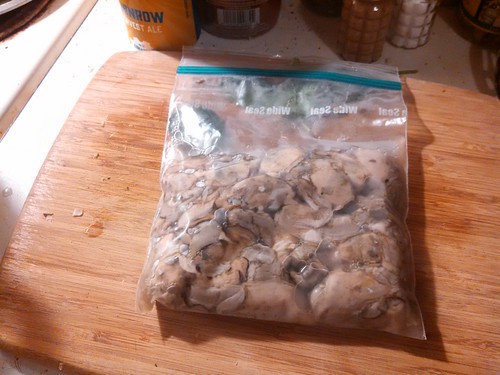
Oh hey,  you know what to do with leftover oysters, though?  After Varg's New Year's Day party there were a few sacks of those still laying around too. Might as well post what happened to those, while we're at it.  I was given a ziploc bag full.

Bag of oysters

Here is what happened with that.

This is a whole clove of chopped garlic.

Garlic

This is a bunch of chopped parsely.

Parsley

This is a fennel bulb.  I chopped that up too.

Fennel

Here we have a quick "blonde" roux made with 3/4 stick of butter and.. about yay much.. flour.

White roux

Here are all those chopped vegetables sauteeing in the roux.

Sautéed vegetables in white roux

Meanwhile, as all that is happening, here is a cup of some moderately priced savingnon blanc.

Palissade savingon blanc

And here is about 3/4 cup of heavy cream.

Cream

And that's a bunch of spinach.

Spinach

In this pot is what all that looks like after the liquids have come to a simmer and the oysters and spinach added to poach with the lid on for a little while.

Poached oysters and spinach

And here is all that stuff combined with the vegetables in the roux base.  (Add salt and pepper and cayenne.)

Oyster sauce

Here is some pasta cut into novelty shapes.

Bow tie pasta

And that's what all that is.

Oyster pasta


And that's how we're starting 2015 (pretty much a week late, I guess, but no matter.) Now for the bad news.....

Saturday, January 03, 2015

Disruption!

One way to get around the cost of hiring police and meeting the associated salary and pension obligations is to outsource the whole operation.
New Orleans Mayor Mitch Landrieu has kicked off the new year by renewing his calls to assign more Louisiana State Police troopers to patrol the city.

In a letter to Gov. Bobby Jindal dated Friday (Jan. 2), Landrieu asks for a "sizable contingent" of troopers to support the while it continues to seek recruits to fill its thinned ranks
See the LSP is like Uber but for police protection.  The service is just contracted out and called in on an as-needed basis. Mitch needs some sort of app.

The mayor's request drew a sharp rebuke from the city's police union president, who called Landrieu's letter a "tacit admission of failure."

"It's unrealistic to expect the state to continually use their resources when the city is responsible for itself," said Capt. Michael Glasser with the Police Association of New Orleans. "I'm sure every other city would like state police. They are not entitled to it, and neither are we."

Glasser blamed the Landrieu administration for "standing on the fence watching as the attrition rate destroyed the police department."

"The irony is, a lot of the state troopers he's asking for were wearing NOPD uniforms a year ago," Glasser said.