On the previous Tuesday, the wind caught by this Art for Art's Sake banner caused a larger electrical outage in the city than did anything associated with Hurricane Nate.
As the storm made its final approach, Mitch put on his bright blue embroidered L.L. Bean weather jacket and issued emergency instructions at this press conference.
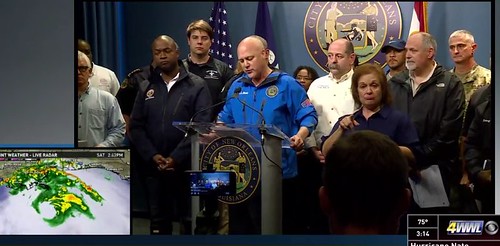
Among those instructions was a 7pm to 7am curfew. People immediately complained, as they do. That evening, as it became clearer that the city was no longer under threat, and as local TV made a point of reporting that nobody downtown was actually observing the curfew anyway, the mayor went ahead and lifted it after about an hour. The next day, though, he complained, as he does.
"We followed the protocols to a T," he said of the storm preparations. "One of the things that the public has a hard time understanding is the amount of time it takes actually to ramp up, and the kind of harm that can be caused if they're out when something untoward happens."Condescension is a common habit among politicos. But you see it most frequently from authoritarians like Mitch. The public didn't have "a hard time understanding" what was going on Saturday. Aside from the LSU game, Nate and its potential hazards were the only thing on Channel 4 all day. Furthermore, adults living in New Orleans tend to know how to handle themselves in these situations. Imposing a mandatory curfew on them isn't just an inconvenience. It is a threat to the already fragile right of free citizens to move about unperturbed by law enforcement.
Theoretically, curfews on adults are subject to strict scrutiny. But you can see here there are circumstances where courts have acquiesced to some erosion of our freedom of movement.
Adult Curfews & Strict ScrutinyIt is in no way clear that the "threat" posed by Nate rose to the status of a "compelling state interest" in forcibly keeping everybody inside. It's perfectly reasonable for the city to recommend that people don't go out. It was also a good idea to proactively barricade underpasses and roads along the lakefront in order to keep people from unwittingly driving into flood waters.
Curfews directed at adults touch upon fundamental constitutional rights and thus are subject to strict judicial scrutiny. The U. S. Supreme Court has ruled that "[t]he right to walk the streets, or to meet publicly with one's friends for a noble purpose or for no purpose at all—and to do so whenever one pleases—is an integral component of life in a free and ordered society." Papachristou v. City of Jacksonville, 405 US 156, 164, 31 L. Ed. 2d 110, 92 S. Ct 839 (1972).
To satisfy strict-scrutiny analysis, a government-imposed curfew on adults must be supported by a compelling state interest that is narrowly tailored to serve the curfew's objective. Courts are loath to find that an interest advanced by the government is compelling. The more justifications that courts find to uphold a curfew on adults, the more watered-down becomes the fundamental right to travel and to associate with others in public places at all times of the day.
The U.S. Supreme Court has ruled that this right may be legitimately curtailed when a community has been ravaged by flood, fire, or disease, or when its safety and Welfare are otherwise threatened. Zemel v. Rusk, 381 U.S. 1, 85 S. Ct. 1271, 14 L. Ed. 2d 179 (1965). The California Court of Appeals cited this ruling in a case that reviewed an order issued by the city of Long Beach, California, which declared a state of emergency and imposed curfews on all adults (and minors) within the city's confines after widespread civil disorder broke out following the Rodney G. King beating trial, in which four white Los Angeles police officers were acquitted of using excessive force in subduing an African-American motorist following a high-speed traffic chase. In re Juan C., 28 Cal. App. 4th 1093, 33 Cal. Rptr. 2d 919 (Cal. App. 1994).
"Rioting, looting and burning," the California court wrote, "pose a similar threat to the safety and welfare of a community, and provide a compelling reason to impose a curfew." "The right to travel is a hollow promise when members of the community face the possibility of being beaten or shot by an unruly mob if they attempt to exercise this right," the court continued, and "[t]emporary restrictions on the right… are a reasonable means of reclaiming order from anarchy so that all might exercise their constitutional rights freely and safely."
It's another matter altogether when we assume the right to stop and arrest people just for being outside. Look what happens when police are allowed to think they can just do that.
The allegations first burst into public view two years ago with a lawsuit from former officer Daniel Swear alleging that he was forced to resign for speaking out against the quota system.Maybe a budget shortfall is a "compelling state interest" too all of a sudden. Is it too much to ask that the mayor of New Orleans at least consider these sorts of issues before shouting down at us all about our responsibilities during a minor weather event?
As that case heads to a December trial, documents filed in court this week provide a wealth of new information about the inner workings of a tight-knit police force of just over 100 officers.
In at least two instances, ranking officers were caught on tape talking about the department's “quotas."
A captain is accused of marking up a whiteboard to chart officers’ monthly arrests. Swear and two other officers say the same captain ordered them to hit the streets to gin up fees that would help make up for a potential $1 million budget shortfall.
The Gretna Police Department denies the allegations of arrest quotas. In court documents, its lawyers have cast all four of the people making the accusations as "former Gretna Police Department officers with axes to grind."
But regardless of how Swear’s case shakes out in court, his lawsuit provides a rare window into police practices in Gretna, which has been dubbed the arrest capital of the world for the eye-popping numbers of people who get booked there.