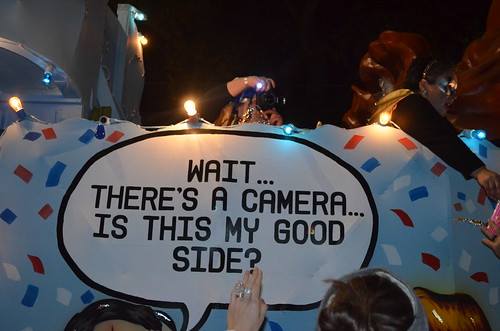
Meanwhile here is that one float in Krewe D'Etat everybody got a kick out of.




A federal judge on Friday (Feb. 13) dismissed a controversial wetlands damage lawsuit filed by the east bank levee authority against more than 80 oil, gas and pipeline companies, ruling that the authority failed to make a valid claim against the energy firms.As we all know by now, healthy wetlands are an indispensable element of the natural and man-made systems that protect the inhabited parts of South Louisiana from storm surge during hurricanes. One assumes the Flood Protection Authority would have some interest in making claims against damage to that system.
The Southeast Louisiana Flood Protection Authority-East contended that dredging of navigation canals and other actions by the companies caused wetland damage that reduced or would reduce the effectiveness of the recently-rebuilt levee system protecting most of metro New Orleans.
The suit attempted to get the energy companies to either repair the damage or pay damages to the authority, with the money used to improve the levee system.
But U.S. District Court Judge Nannette Jolivette Brown found that the levee authority's standing as a third party to federal and state permits granted to the energy companies was not strong enough to justify a financial claim against the companies.
Brown also disagreed with the levee authority's attempt to find the energy companies liable under provisions of Louisiana law governing the flow of water over property, which is called "natural servitude of drain". The levee authority contended that the energy companies were responsible for storm surge posing an increased threat to the levees because of the erosion the companies caused.Because levees are on higher ground the levee board has no jurisdiction where it concerns the marshland that actually makes those levees effective. Weren't we supposed to have evolved beyond this sort of self-defeating thinking post-K?
But the state law is written to protect downstream landowners from problems caused by upstream users, and the levees are on higher ground. Brown said several cases cited by the authority did not adequately support their position turning that provision of the law around.
The ruling also was praised by the administration of Gov. Bobby Jindal, who opposed the suit.And not likely under the next one either.
"We appreciate the judge's ruling and are pleased that this frivolous lawsuit has come to an end," said Shannon Bates, deputy communications director for the governor. "We've maintained that this was not a claim SLPFA had the authority to bring, and we are glad the court agreed."

During a discussion in the United States Friday morning, London Mayor Boris Johnson said Louisiana Gov. Bobby Jindal’s recent claims regarding the existence of so-called “no-go zones” in his city are “complete nonsense.”Bobby doesn't care, of course. He's telling a different sort of "truth." It doesn't have to be technically true, it just has to be a thing that his intended audience knows.
“I would be more than happy personally to escort Gov. Jindal around any area that he thinks is a no-go zone, and I will show him what a happy, thriving community it is with people jumbled up in all sorts of ways,” Johnson said during a Politico Playbook breakfast in Washington, D.C

New Orleanians' king cake consumption over time pic.twitter.com/Lhsjy7Orpf
— Bradley Warshauer (@bradleypw) February 12, 2015


NEW ORLEANS (WVUE) - When Miley Cyrus made the move from music to movies, one of her first releases was shot in Louisiana, back in 2011. "So Undercover" had a budget of nearly $14 million.I wonder how many people actually understand that the state just writes out checks to these movies studios and receives only about 23 cents on the dollar return on investment.
“It received a straight-to-DVD release in 2013,” says media critic Matt Brennan. ”It barely made a splash and I hadn't heard of it until I looked at it for this interview.”
But Louisiana taxpayers helped plug the movie's budget gap by writing a $3 million check - taxpayer money, handed over directly to this flop, as part of the state's film incentive program.
“It's an unaffordable program,” says Jan Moller, who leads the nonprofit Louisiana Budget Project in Baton Rouge.
Moller says the Motion Picture Investor Tax Credit program is sucking money from higher education and healthcare. “This is an open-ended entitlement program that is costing the state more than $200 million a year,” Moller says, “at a time when we have a $1.4 billion shortfall.”

Year after year, Louisiana didn't have enough money to cover its expenses, yet Gov. Bobby Jindal refused to roll back income tax cuts or ever-increasing corporate tax breaks. Instead, he raided reserve funds and sold off state property.
Jindal suggested job growth from his economic development wins would replenish those assets once the recession ended. It hasn't — and money from the lucrative oil industry has taken a nose dive with crude prices. Now, the Republican is running out of short-term patches and is struggling to plug a $1.6 billion budget hole just as he tries to build support for a possible 2016 presidential run.
Funding for higher education and health care services will almost certainly be subject to cuts deeper than what they already have endured in recent years, and Jindal's successor will have to repay a string of debts and IOUs.
"They've used all the smoke that was in the can and all the mirrors that they could buy and now they're out of tricks. Their solution is to gut higher education like a fish," said Republican state Treasurer John Kennedy.
Three different physicians will evaluate Tom Benson’s mental health to see if he is still fit to make business decisions about the Saints, Pelicans and other assets in his business empire, a judge ordered Tuesday.Of course Team Rita wanted to have Benson's brain dissected and checked by a team of specialists for post-concussion syndrome or something like that. Benson's people preferred the test be limited to a brief recitation of the 5 times table. So they reached a compromise of sorts.
Benson, feuding with the relatives he has decided to cut out of his succession plans, was resisting the idea of an independent evaluation. He said he was willing to meet privately with Civil District Court Judge Kern Reese, but he argued that a psychiatric exam was too intrusive.
Reese did reject the particular evaluation called for by psychiatrist Ted Bloch III, who was proposed by Benson’s estranged relatives. The judge said that exam would be too invasive — it involved performing extensive questioning, blood work and neuropsychological testing over the course of several days.What they're going to do is put Benson to a series of problems and see how he scores.
Instead, Reese said that Benson would undergo a standard exam used in these types of cases. Bloch and two other physicians — one chosen by Benson’s lawyers and another chosen jointly by that doctor and Bloch — will have until March 13 to complete their reports. The three-physician team must be assembled by Feb. 25, Reese said.

We found more. On May 4, 2012, the state announced International Paper would invest $44 million in their Bogalusa mill to retain 411 jobs. The state offered International Paper a $2.2 million tax credit and industrial tax exemptions. Remember, the state announced that deal on May 4.Meanwhile...
Two weeks later, on May 18, International Paper told the state it would lay off 64 workers at another plant in Louisiana.
“That's a terrible juxtaposition of events,” LeRoy says. “It suggests that they were holding back, perhaps, on the layoffs until after they got the award.”
International Paper sent this brief statement in response to our inquiries:
We received the state incentive only after committing to invest $30 million dollars in capital improvements at our Bogalusa mill. We appreciate the cooperation from the state and are proud to employ 2000 workers across Louisiana.
In 2008, the Commerce and Industry Board approved a tax break of $1,985,260 for Libbey Glass in Shreveport. State records show the company promised to create 46 new jobs. But they actually reduced their workforce by 147. Nonetheless, the board approved their tax break renewal and let Libbey continue to receive its incentive.
“I think, in this time and day when unemployment has been so high for so long, we shouldn't be paying companies to lay people off,” LeRoy says. “We call this ‘payoffs for layoffs.'”
Widespread layoffs, hundreds of classes eliminated, academic programs jettisoned and a flagship university that can’t compete with its peers around the nation — those are among the grim scenarios LSU leaders outlined in internal documents as the threat of budget cuts looms.We need to layoff everyone in the university system so that we can pay for all these tax incentives that go toward laying people off elsewhere. In it's own way, it has a certain elegance.
Gov. Bobby Jindal’s administration is considering deep budget slashing to higher education for the fiscal year that begins July 1 to help close a $1.6 billion shortfall.
LSU campuses from Shreveport to New Orleans were asked to explain how a reduction between 35 percent and 40 percent in state financing — about $141.5 million to the university system — would affect their operations. The documents, compiled for LSU system President F. King Alexander, were obtained through a public records request.
The potential implications of such hefty cuts were summed up in stark terms: 1,433 faculty and staff jobs eliminated; 1,572 courses cut; 28 academic programs shut down across campuses; and six institutions declaring some form of financial emergency.
At the system’s flagship university in Baton Rouge, the documents say 27 percent of faculty positions would have to be cut, along with 1,400 classes, jeopardizing the accreditation of the engineering and business colleges. Some campus buildings would be closed.
Mayor Mitch Landrieu on Monday unveiled the list of local groups receiving Edward Wisner grants this year, apparently signaling the status quo remains in place for the contested piece of coastal real estate that has produced the revenue for Wisner grants going back decades.Back in September the Wisner heirs fighting to maintain control of the land trust that produces these grants lost rather decisively to the city in court but are still holding out hope that the State Supreme Court will take up their appeal.
More than 60 organizations, ranging from the Louisiana Children’s Museum to St. Augustine High School, will share about $1.2 million this year.
Some of the heirs have said they worry Landrieu will simply sell off the land, part of which holds Port Fourchon, a hub for vessels serving offshore rigs.
The proceeds of such a sale would presumably be split among all of the beneficiaries that get a cut of the land’s proceeds today, including the city, Tulane University, the Salvation Army, LSU and a collection of some 50 different individuals. But the land would be gone as a regular source of income.
The mayor so far has not made any moves in that direction, although he said Monday that his administration is in the middle of evaluating how much the land is really worth.
He compared it to the Public Belt Railway, another city property that Landrieu has said he would be willing to at least consider selling. “I’m going to make sure that asset is valued correctly,” he said.
The governor ignored the specific question — about Jindal’s cuts to per-student spending for higher ed being the deepest in the nation — and instead delivered a sermon that included a boast about “eight credit upgrades” for the state and the “strongest credit rating we’ve seen in decades.”There's a parlor game going where we try and figure out which cabinet positions under the next Republican President Jindal has disqualified himself for before his little campaign.. or whatever this is has gotten off the ground.
Unmentioned: That just last week, Moody’s issued a “credit negative” report on Louisiana and said its problems have been intensified by its reliance on $1 billion in temporary patchwork funding being used to prop up the budget this year. The Republican state treasurer, John Kennedy, protested “budget gimmicks” and years of being “fiscally irresponsible.”
Minutes later, when Simendinger asked Jindal to explain why the big state deficit “qualifies you to run for president,” the governor replied with a string of non-sequiturs.
“In New Orleans, 90 percent of our kids are in charter schools.”
“It used to take 10 days to get a prescription if you were uninsured in Baton Rouge, and now it takes 10 minutes.”
“In ethics rankings we were bottom five for legislative disclosure, and now we’re in the top five.”
Jindal's speech in London was his failed application for next Sec. of State. Today is his application for Sec. of Ed.
— Karl's in Charge (@karlschott) February 9, 2015
At a hastily-called news conference Saturday (Feb.7), a host of parish, state and federal officials announced that a U.S. Department of Agriculture scientist investigating the bacteria that led to the death of a monkey at the center last year had fallen ill and that tests revealed she had the bacteria in her blood. Investigators say it's too early to determine definitively if the scientist became sick as a result of her work at the center or whether she may have been exposed to Burkholderia pseudomallei as a result of her travels.A hastily called press conference alerts the area that they do not need to worry about this thing they would not otherwise have been aware of. That is very reassuring. Right after having been very frightening.
The bacteria are rarely transmitted from person to person or animal to person. Melioidosis is primarily a tropical climate disease and is widespread in southeast Asia and northern Australia. The bacteria that cause the disease are found in contaminated soil and water and spread to humans and animals through direct contact with the contaminated material, usually through an open cut.
Officials have said there's no reason to believe that the bacteria have spread beyond the primate center and there are no reports of sick individuals at the research facility, which employs about 300 people.
















But here’s what Jindal doesn’t say: Louisiana’s budget is hemorrhaging red ink, and it’s getting worse. He inherited a $900 million surplus when he became governor seven years ago, and his administration’s own budget documents now show the state is facing deficits of more than $1 billion for as far as the eye can see. There are no easy solutions today because Jindal has increasingly balanced the budget by resorting to one-time fixes, depleting the state’s reserve funds and taking money meant for other purposes.Aaaaand Jindal's entire tenure as Governor involved an oil boom plus a "trend bucking" stimulus of federal funded hurricane rebuilding activity. How the hell do you fuck that up this badly?

New Orleans and flags have had a long-standing relationship. Nine official flags have flown over the city: Spanish flag of Castile and Léon; white flag of Bourbon France; Bourbon Spain; French Tricolor; U.S. flag beginning with the 15 stars and stripes of 1803; the flag of Independent Louisiana; the Stars and Bars of the Confederate States of America; the state of Louisiana flag; and the City of New Orleans flag.
During this time of year, we can add another to this list -- the Mardi Gras flag. (A concept I first saw described in an article by Edward Branley on the GoNola site.) Who created the first official flag of the Carnival season? None other than Rex, which also originated the traditional Carnival colors of purple (justice), green (faith) and gold (power). According to a representative, "In Mardi Gras' earliest days, large banners were used to promote Mardi Gras every year. By the late 1870s, Rex had created its own flag." And so a new custom began.
Of this city's 10th flag, there are many incarnations, with many people flying ones they find in local stores or online. Many of the krewes have their own designs, with their own rules on when to fly the them.
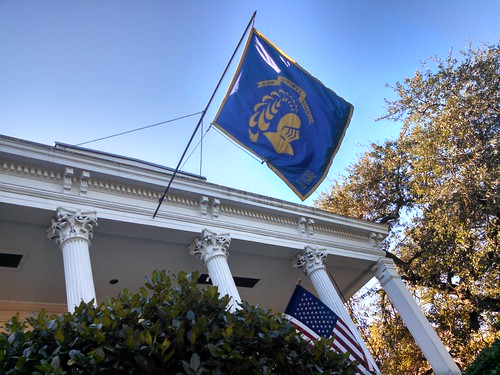
Every year during Carnival the former kings (or their descendants) fly these flags at their homes. The bottom right of each flag denotes the year in which this particular king reigned. This flag belongs to Rex from 1983. (It hasn't been very well maintained)That's the flag at the top of this post, BTW. Anyway.. sorry to go on quoting myself but rather than rewrite the same point...
The Old Line Krewes are tied to a history of racial hatred and upper class arrogance that goes far beyond the 1991 anti-discrimination controversy. (A good book to start with here is James Gill's Lords of Misrule: Mardi Gras and the Politics of Race in New Orleans ) But Carnival doesn't only belong to the rich.A goodly part of it does belong to the juxtaposition of rich and poor, though. More on that in a bit. In any case, I'm grateful to the neo-Confederates for indicating the locations of their homes with these flags. They help Steve Scalise know where not to accidentally give a speech. Here are some of those flags.

The Krewe of Isis, a mainstay in Jefferson Parish for more than 40 years, has no plans to change its name in response to current events in the Middle East.Here is a welcome message from Boh Brothers.
Happy Fucking Carnival: pic.twitter.com/Ka9yf4t0We
— 504 Not Found (@Adrastosno) February 6, 2015
Mardi Gras as it existed through the first half of the 1800s was unruly, a day of social levelling in which the poor controlled the streets. James Gill, in his tremendous and tremendously enjoyable book, Lords of Misrule: Mardi Gras and the Politics of Race in New Orleans , reminds us that for our city’s only partially obsolete hereditary ruling classes, “[the holiday’s] real significance lay in the annual reaffirmation of social eminence over merit.” Their Mardi Gras was grand— private balls and parties, removed from the hoi polloi.While the aristocrats were safely ensconced inside, the world outside became a more raucous (and threatening) scene.
In her terrific, deep-diving 2008 FSU PhD thesis, “Setting the Stage: Dance and Gender in Old-Line New Orleans Carnival Balls, 1870-1920,” Jennifer Atkins also aggregates a great deal of the better writing on Carnival’s class- conflict aspects, including Mikhail Bakhtin’s assertion that the collective voices of the oppressed raised during Carnival render the streets, even if temporarily, “a democratized space.” “In the process of asserting status and power,” Atkins writes, “protests from disenfranchised groups, though performed in the surrealistic carnival world, can be very real threats to society."Comus was, for its day, what today's tech industry might call an act of disruption. It was an end run around regulation for the betterment of a hegemonic class of elites.
If Carnival in the streets was to continue, its power must be put back in the hands of the already powerful. There was talk among the Creole aristocracy of cancelling Mardi Gras, but a group of Americans, showing the entrepreneurial spirit typical of their kind, came up with a better idea. These Americans—not Creoles, not New Orleanians or even Louisianians— created the first organized Mardi Gras parade with floats. Drawing from the work of English poet Milton, the first Comus parade had two floats. One featured Comus, an ancient god of festivity whom Milton cast as a deceiving necromancer, and the other featured the Devil. They rolled in open and unpunished defiance of the bans on masking and music-making.Comus took on some of the forms of popular Carnival... the outdoor music and masking.. formalized them, and in the process, sanitized them to a degree.
Krewe du Vieux is quite conscious of itself not just as an insurrection, but also as a resurrection, an effort to recover from the anti-carnivalesque aspects of the 19th century Uptown Carnival model. Their mission statement expresses this ambition explicitly: “We believe in exposing the world to the true nature of Mardi Gras — and in exposing ourselves to the world.” Since Katrina, Krewe du Vieux has been joined by several other downtown parading clubs — ‘ti Rex, Chewbacchus, Red Beans — each of which follows the Krewe du Vieux model far more faithfully than the Uptown one, especially by keeping dues affordable.But Bentley adds a twist to this that Cannon doesn't. Bentley recognizes, in Chewbacchus, a deliberate.. almost commercialized.. turn away from the notion of social upheaval.
But the ultimate expression of the carnivalesque instinct in our time is what happens downtown on Fat Tuesday itself. Here the line between spectator and performer is almost totally erased as thousands — whether costumed, masked or merely bystanders — converge in the streets in a utopian vision of mass civic participation. And on this day — if only for a day — we also witness New Orleans’ idealized sense of itself come down to earth to shape the city’s social reality.
Cybernetic Carnival seeks to appropriate e.g. the irreverence of Krewe du Vieux, reducing that Krewe’s incisive political and social satire to a directionless but consumer-attractive pose of “subversiveness.” Instead of engaging current events or the foibles of the powerful, Chewbacchus participants engage in a post-modern remixing of consumer culture: a Hollywood-film alien mixed with a burlesque dancer mixed with a robot from a Japanese cartoon.Just as Comus sanitized the "threatening" class conflict of 19th Century Carnival, so too does the emergence of Chewbacchus seek to blunt the satirical bent of modern Carnival. So goes, Bentley's thesis anyway. It's not as black and white as all of that in reality.
In a 2006 interview with former Disney CEO Michael Eisner, Williams said he witnessed a body floating in the French Quarter area of the city. "When you look out of your hotel window in the French Quarter and watch a man float by face down, when you see bodies that you last saw in Banda Aceh, Indonesia, and swore to yourself that you would never see in your country," Williams told Eisner, who suggested in the interview that Williams emerged from former NBC News anchor Tom Brokaw's shadow with his Katrina coverage.Now that we have Dr. Lutz and Sean Payton's combined record of where "it used to be wet," we can finally start mapping that. Keep in mind, though, that this map would differ from any record of where the floodwaters actually were. It turns out that, even though Dr. Lutz was in the quarter himself at the time, he's not most reliable source on this. There really was some water near Williams's hotel. Not a tremendous amount, but definitely some.
Citing former city health director Brobson Lutz, the Advocate reported that the French Quarter was largely dry. "We were never wet. It was never wet," Lutz told the Advocate.
Defenders of on-demand work emphasize its flexibility. Workers can put in whatever time they want, work around their schedules, fill in the downtime in their calendars.
“People are monetizing their own downtime,” Arun Sundararajan, a professor at New York University’s business school, told the New York Times.
But this argument confuses “downtime” with the time people normally reserve for the rest of their lives.
There are still only twenty-four hours in a day. When “downtime” is turned into work time, and that work time is unpredictable and low-paid, what happens to personal relationships? Family? One’s own health?
Other proponents of on-demand work point to studies, such as one recently commissioned by Uber, showing Uber’s on-demand workers to be “happy.”
But how many of them would be happier with a good-paying job offering regular hours?
This is definitely not the first time the topic of homeless (or college) placeholders has come up in relation to Galatoire's Friday lunch, especially during the insanely-packed Mardi Gras season. Local critics including Ian McNulty have reported on the subject over the years. A Tiger Droppings forum once mentioned somebody who actually organized the homeless people to wait in line, and even tourists on Chowhound have brought up the subject before heading to New Orleans. For what it's worth, waiting in line is a commandment of New Orleans culture, and hiring a "day laborer" is not the standard for most patrons of Galatoire's... right, guys? Erm, like, right, guys? Biaggio DiGiavanni, the exec. director of Osanam Inn homeless shelter ("five minutes away from Galatoire's"), tells the Daily Beast otherwise:That's Eater commenting on a Daily Beast article just to be clear. Maybe since the Galatoire's cattle call is how it's always been done, there's a tendency to ridicule outside media for affecting shock at it. The Eater reporter seems to play to that sentiment a little anyway.
It's competitive and the homeless people are aware of this line and they think if they can make a couple quick bucks they will hang around Galatoire's. Now more people are trying to get those spots.But naturally this wouldn't be a truly New Orleans experience without this same homeless shelter director turning right around and approving the situation:
"Here's a homeless person and a chance to pick up a whole bunch of money just for standing around... It gives them something to do."Right.
Hardberger is a former chief justice of the Texas 4th Circuit Court of Appeals. Rickhoff mentioned Hardberger's time in office as mayor helping Gulf Coast residents after Hurricane Katrina. Hardberger served two terms as mayor from 2005 through 2009. After the storm, Hardberger said his city and the Saints team conducted talks over moving the team to San Antonio.Some of Hardberger's famous remarks from 2005 while his talks with Benson were ongoing.
“The Saints are not working against this,” Hardberger said. “Benson has said on numerous occasions he wants to be in San Antonio. The players want to be here the coaches want to be here. Now, (Benson) is a businessman. But I believe him when he says he ultimately wants the team to be here and stay here.I wonder if Hardberger still believes Benson, ultimately wants the team to be in San Antonio. Because that might be relevant to his involvement now.
Two bartenders who filed a lawsuit claiming that Pat O'Brien's managers stole from the tip jar and withheld overtime pay scored a victory Wednesday (Feb. 4) when a federal judge gave their case collective action status. The ruling allows other former and current bartenders to join the lawsuit against the French Quarter bar.Tourism Matters, though, so I guess we shouldn't poke it too hard.
Then there’s this possibility: Though the oil has apparently separated from the water itself, it’s now burrowed so deep that it will take substantially longer to decompose. “There’s less oxygen down there,” Chanton told Live Science. “It might be there for a long period of time, a little reservoir of contamination.” He added in a statement: “Fish will likely ingest contaminants because worms ingest the sediment, and fish eat the worms. It’s a conduit for contamination into the food web.”Worth it, though, right?
The salary gap between public relations specialists and news reporters has widened over the past decade – to almost $20,000 a year, according to 2013 U.S. Bureau of Labor Statistics data analyzed by the Pew Research Center. At the same time, the public relations field has expanded to a degree that these specialists now outnumber reporters by nearly 5 to 1 (BLS data include part-time and full-time employees, but not self-employed.)Only chumps go into news. The real money is in telling pretty lies. Of course some of these numbers may be a statistical anomaly. For example, the low-wage writers who produce NOLA.com content still aren't technically counted as PR professionals for some reason.
In 2013, according to BLS data, public relations specialists earned a median annual income of $54,940 compared with $35,600 for reporters. In other words, journalists on average earn just 65% of what those in public relations earn. That is a greater income gap than in 2004 when journalists were paid 71 cents of every dollar earned by those in public relations ($43,830 versus $31,320).
Most of that widening has come from salary growth in the public relations industry during a time when salary increases in the journalism field did not even keep up with inflation.
You wouldn't necessarily know it at first blush. Sure, maybe reading it in the context of this story it's apparent, but otherwise it feels like a pretty standard, if a tad dry, AP news item. The obvious tell doesn't come until the end of an article: "This story was generated by Automated Insights." According to AI's public relations manager James Kotecki, the Wordsmith platform generates millions of articles per week; other partners include Allstate, Comcast, and Yahoo, whose fantasy football reports are automated. Kotecki estimates the company's system can produce 2,000 articles per second if need be.But there are some things even those robots can't do. For instance, they still can't quite replicate the phony smarm necessary to run a corporate social media ad campaign.
For the campaign, which was called “Make it Happy” and introduced in an ad spot during the Super Bowl, Coke invited people to reply to negative tweets with the hashtag “#MakeItHappy”.Whoops! Don't you just hate when your smarmbot accidentally goes #MakeitHitler all over your shitty commercial. But then if you're gonna "tackle the pervasive negativity polluting social media" maybe a cynical, disingenuous ad campaign set up to run on autopilot isn't the best way to go about that.
The idea was that an automatic algorithm would then convert the tweets, using an encoding system called ASCII, into pictures of happy things – such as an adorable mouse, a palm tree wearing sunglasses or a chicken drumstick wearing a cowboy hat.
In a press release, Coca-Cola said its aim was to “tackle the pervasive negativity polluting social media feeds and comment threads across the internet”.
But Gawker, noticing that one response had the “14 words” white nationalist slogan re-published in the shape of a dog, had other ideas.
The media company’s editorial labs director, Adam Pash, created a Twitter bot, @MeinCoke, and set it up to tweet lines from Mein Kampf and then link to them with the #MakeItHappy tag – triggering Coca-Cola’s own Twitter bot to turn them into cutesy pictures.
By Wednesday, the campaign had been suspended entirely. In a statement to AdWeek, a spokesperson for Coca-Cola said: “The #MakeItHappy message is simple: the internet is what we make it, and we hoped to inspire people to make it a more positive place. It’s unfortunate that Gawker is trying to turn this campaign into something that it isn’t.”All they wanted to do was teach the world to sing... or something like that. When will you humans learn it's not polite to point out that phony smarmbots are, in fact, phony smarmbots? How "negative!"
The statement concluded: “Building a bot that attempts to spread hate through #MakeItHappy is a perfect example of the pervasive online negativity Coca-Cola wanted to address with this campaign.”
In a series of Facebook posts obtained by ThinkProgress, the senior adviser for policy and communications to Rep. Aaron Schock (R-IL) posted racial comments and endorsed gentrification of his neighborhood.
Benjamin Cole, a former Baptist pastor and energy industry spokesman, posted a series of videos and comments on October 13, 2013 mocking two African Americans outside his DC apartment. In the first, he compared them to animals escaping from the National Zoo engaged in “mating rituals.” That message included a video of a woman, shouting and seemingly engaged in an argument with someone not visible as she walked. In each of his posts, he used the hashtag “#gentrifytoday.”
Like many people who build security software, Koch believes that offering the underlying software code for free is the best way to demonstrate that there are no hidden backdoors in it giving access to spy agencies or others. However, this means that many important computer security tools are built and maintained by volunteers.
Now, more than a year after Snowden's revelations, Koch is still struggling to raise enough money to pay himself and to fulfill his dream of hiring a full-time programmer. He says he's made about $25,000 per year since 2001 — a fraction of what he could earn in private industry. In December, he launched a fundraising campaign that has garnered about $43,000 to date — far short of his goal of $137,000 — which would allow him to pay himself a decent salary and hire a full-time developer.
Beatty says ceding to funders by not covering particular stories “would be a dereliction of duty on our part.Simply put, if what you're writing isn't pissing off powerful people, then what you're writing really isn't news. But if your "news" operation depends on maintaining friendships with those same people, then, if you want to stay in business, eventually you learn to produce a news-ish product instead. Otherwise, you're pretty much doomed. As a reader, it's possible to stay informed via the news-ish papers, but it's nicer when the bullshit filter has already been applied a few times before you get to it.
“We all know when we’re doing a story that’s going to hurt us,” Beatty says, adding that covering those stories nonetheless is tantamount to maintaining journalistic integrity.
Like a number of nonprofit news outlets around the country, The Lens is in the process of discovering whether that commitment to what Beatty calls “the kind of reporting that upsets people by design” will ultimately garner support or be its ruin, media watchers say.
There's more to becoming a bicycle-friendly city than striping in bike lanes, Duckworth said. "City Hall has an obligation to protect these essential taxpayer investments by fining scofflaws who obstruct bike lanes. Otherwise we will see more unnecessary cyclist deaths," Duckworth said.I don't know enforcement is really what's at issue.. at least not in the sense that THE CITY NEEDS TO FINE MORE PEOPLE, as that quote suggests. But rather, the problem is the city is for whatever keeps the important people happy.
In other words, we really haven't even begun to realize the benefits of this change and now they're proposing to take it away from us.Louisiana had always received the same share of offshore royalties as inland states, even though tens of thousands of miles of pipelines run from those rigs through its coast. Research shows canals and pipelines related to those activities are responsible for at least 36 percent of the 1,880 square miles of coastal wetlands the state has lost in the past 70 years.The 2007 bill, passed in the wake of the devastation caused by Hurricanes Katrina and Rita, changed that system by dedicating 37.5 percent of all royalties from specific areas of the Gulf to the four coastal states with energy development – Louisiana, Mississippi Alabama and Texas.Louisiana has taken in less $10 million total across the seven years since the bill passed, but that amount is expected to increase dramatically in 2017 because vast new areas of the Gulf will be included. The state is estimating annual income of as much as $178 million a year, depending on the rate of pumping and the price of leases and oil. Its estimated income could jump to as much as $600 million annually after 2055 when a cap on the states’ share is lifted.
I think we probably need to consider the alarming idea that this is going to be the right’s overall approach to dealing with health care. They have no real ideas for how to deliver affordable health care to every citizen and they have no methods for controlling the spiraling costs of the former system. In order to maintain their “free-market” health care philosophy they are going to have to make it clear that you must get rich if you expect to live through catastrophic illness or accidents. If you are sick, it’s up to you to figure out how to pay for your care and shelter. That’s the only solution available to them.Unsurprisingly, many Republicans are backing your child's basic freedom to die of measles... or whatever you get from employees with unwashed hands.
As a libertarian theorist posited in the Washington Post last week,”people could die and that’s ok”:
[It] is an acceptable price to pay for certain goals — including more cash for other programs, such as those that help the poor; less government coercion and more individual liberty; more health-care choice for consumers, allowing them to find plans that better fit their needs; more money for taxpayers to spend themselves; and less federal health-care spending.
Louisiana Gov. Bobby Jindal (R) on Tuesday said Louisiana requires all school children to be vaccinated, and for good reason.On the other hand, Jindal's statement emphasizes personal choice.
"I have no reservations about whether or not it is a good idea and desirable for all children to be vaccinated. There is a lot of fear-mongering out there on this," he said in a statement. "I think it is irresponsible for leaders to undermine the public's confidence in vaccinations that have been tested and proven to protect public health. Science supports them and they keep our children safe from potentially deadly but preventable diseases."
.@ChrisChristie got in LOTS of trouble over his vaccination comments, @BobbyJindal takes a different approach. pic.twitter.com/IijTVPKdGX
— Julia O'Donoghue (@JSODonoghue) February 3, 2015
(Reuters) - The United States government has taken a new, though preliminary, step to encourage commercial development of the moon.
According to documents obtained by Reuters, U.S. companies can stake claims to lunar territory through an existing licensing process for space launches.
The Federal Aviation Administration, in a previously undisclosed late-December letter to Bigelow Aerospace, said the agency intends to “leverage the FAA’s existing launch licensing authority to encourage private sector investments in space systems by ensuring that commercial activities can be conducted on a non-interference basis.”
In other words, experts said, Bigelow could set up one of its proposed inflatable habitats on the moon, and expect to have exclusive rights to that territory - as well as related areas that might be tapped for mining, exploration and other activities.
Asked if he has plans to run for political office, Honoré said he is thinking about it. He also said that while many of the potential candidates for governor have had disparaging things to say about environmental regulators, he hasn’t heard any of them talking about environmental concerns.Pretty sure nothing will come of that. But I still wonder why John Georges showed up to introduce him at Rising Tide two years ago.
“I heard one of the candidates say he’s going to put his boot on the neck of EPA,” Honoré said.
WASHINGTON -- President Barack Obama is proposing that off-shore revenue sharing -- slated to begin in 2017 -- be scrapped with a plan that would provide "broad natural resource, watershed and conservation benefits for the entire nation." The proposal is part of the president's $4 trillion budget, unveiled Monday (Feburary 2).Ha ha, freshman Senator Bill Cassidy will do everything in his power to help. Great.
The revenue sharing, part of 2006 energy legislation co-sponsored by Sen. Mary Landrieu, D-La., was expected to generate hundreds of millions of dollars in revenue annually for Louisiana for coastal restoration.
Sen. Bill Cassidy, R-Baton Rouge, who defeated Landrieu in the 2014 Louisiana Senate race, immediately promised a fight on the two Senate committees with jurisdiction over the revenue sharing legislation -- Appropriations and Energy. Last year, Landrieu chaired the Energy Committee.
"I will do everything in my power to use my seats on these committees to not only block the President's raid on oil and gas revenues, but fight to increase Louisiana's share of offshore revenue," Cassidy said. "Funding for coastal restoration must remain a promise to Louisiana and other Gulf Coast states."
The actuary said Social Security integration could be appropriate, but it wouldn't save the city much money and it would penalize low-wage workers.
The city, like any private employer, pays for half of a worker's Social Security costs, so it's not unreasonable for the city to deduct those contributions from an employee's pension package, the actuary said, but doing so would represent a "radical change" in the plan's structure. It might not be legal to apply it to current employees, he said.
The actuary also noted that Social Security's benefits are proportionately more generous at the low end of the wage scale, so the workers who benefit most from the current system are those at the bottom rung of the employment ladder. If pension benefits were reduced as a function of Social Security payments, as Head's scenario would do, low-paid workers would take the biggest hit.
The move also would provide relatively little budget relief, according to his analysis. The most aggressive of Head's scenarios would apply Social Security integration to all employees with less than 15 years service. That would improve the fund balance by .3 percent and save the city $1.5 million in 2014, and more over time as the share of employees covered by the new plan increased.
NEW ORLEANS, LA (WVUE) -A worker in an Entergy truck was carjacked at gunpoint Tuesday, and moments later a woman was held up by men in same truck.If you're gonna ride around New Orleans robbing people, an Entergy truck is probably the best vehicle to use for that.
At about 1 p.m., the worker was approached by two black males in the 4400 block of Duplessis Street. The men produced a handgun, robbed the victim of his cash and stole the Entergy truck.
Moments later, a woman was robbed of her purse in the 1900 block of Wickfield. The suspects fled the scene in the truck, which was found unoccupied at Pratt and Mirabeau.
NEW ORLEANS - Mayor Mitch Landrieu's ongoing battle against the city's persistent crime problem hit home over the weekend when one of his family's cars was stolen and later recovered, according to Jefferson Parish Sheriff's Office.Mitch's new TV ad will demand that Sidney Torres present his plan for dealing with the crime problem.
A Jefferson Parish deputy recovered the 2009 Jeep Grand Cherokee Saturday evening at about 7:30 p.m., about seven hours after it was reported stolen. The deputy was driving through the city when he received an alert on an anti-theft vehicle tracking device, according to a JPSO press release.
A car carrying New Orleans Saints and Pelicans owner Tom Benson was involved in a traffic incident that injured a security guard outside the Smoothie King Center after a Pelicans game, New Orleans police spokesman Tyler Gamble said Saturday. The security guard "suffered a foot injury and was transported to a hospital," Gamble said.It's worth mentioning that all Rita did was verbally abuse and fire the employees. Don't think she ran any of them over.
The mishap occurred Friday about 9:30 p.m. in a VIP parking lot near the arena. Benson's driver, Blake Romig, and the security guard gave conflicting statements of what happened, Gamble said. No citations were issued.