Monday, September 11, 2017
They shouldn't be playing the London game anyway
If I were king of football, we wouldn't be disrupting teams' schedules and inconveniencing their home fans by shipping them off to London every year. It's especially a hardship on the Dolphins now given that they're also playing 16 weeks with no bye. But we know the NFL doesn't care about any of that so.. it's off to London.
#NeverForget
Bill Cassidy is still trying to kill Medicaid for some reason.
Probably because of bipartisanship or something.
WASHINGTON — For months, Louisiana Senator Bill Cassidy has poured his time into possible replacements for the Affordable Care Act. And he's continued to plug away, even after most other Republicans moved on to other priorities after this summer's dramatic defeat of their proposal to overhaul Obamacare.
A deadline for Republicans to undo the healthcare law on a party-line vote in the Senate, widely viewed as their only shot at repeal, looms at the end of the month. The exact language of Cassidy’s plan remains a work in progress. Meanwhile, some of his Republican colleagues have sounded skeptical notes about its chances.
Yet Cassidy, who plans to unveil a new draft of the bill he’s been writing with Sen. Lindsey Graham of South Carolina on Monday, struck an optimistic note in an interview this week.
Probably because of bipartisanship or something.
Sunday, September 10, 2017
Never open anything up
So it turns out that those S&WB bills people have been complaining about recently were indeed the bullcrap we thought they were.
That's one way to avoid a new stormwater fee, I guess. Any way you can raise funds is good, though, because the costs do tend to expand over there.
About 4,700 customers — roughly 3.5 percent of all S&WB accounts — were essentially charged double for the same month of service: once based on an estimate of how much water and sewer service they used and another based on an actual meter reading.
Officials do not yet know how much the overcharges amount to.
The S&WB often relies on estimates when determining how much to bill, something that Erin Burns, a spokeswoman for Mayor Mitch Landrieu, said is caused by “a shortage of meter reading personnel and a high turnover rate in the department,” which prevent the utility from having enough staff to read each meter every month.
For the thousands of customers affected by the overbilling, an estimated bill was entered into the system just before the meter was read, leading to a double bill, Burns said in an email.
That's one way to avoid a new stormwater fee, I guess. Any way you can raise funds is good, though, because the costs do tend to expand over there.
NEW ORLEANS -- The Sewerage & Water Board could have saved millions of dollars if it had purchased a brand new turbine to power some of the city’s most important drainage pumps, rather than spending the last five years in a costly – and so far futile – effort to repair a 1920s-era piece of equipment that it purchased, used, more than 50 years ago.The contract kept getting loaded up with decisions to refurbish rather than replace components. The excuses for those decisions are looking less and less credible. And, as much as we hate to give credit to Stacy Head for anything, this is a pretty good line from her that works on multiple levels.
That’s WWL-TV’s conclusion after reviewing a cost analysis by one of the Sewerage & Water Board’s consultants, along with dozens of contract and billing records from the ongoing refurbishment of nettlesome Turbine No. 4.
It’s clear that the board was caught off-guard almost immediately by the difficulties fixing Turbine No. 4. At a January 2013 committee meeting, then-deputy superintendent Madeline Fong Goddard told board members, “Turbine 4 was opened up by the contractor and found to be sadly very damaged and not easily repairable.”Well the whole can of worms is open now. That's probably less good than it seems, though. I get the impression that we're not on a path to weeding out the corruption and inefficiency so much just contracting the corruption and inefficiency out to Veolia. They've already moving in over there. It's probably only a matter of time before a more formal relationship is established. That might depend on who the next mayor is. But it's difficult to tell what the current candidates might think about the question.
To which Councilwoman Stacy Head, then a member of the S&WB, interjected, “Never open anything up!” and laughed.
Friday, September 08, 2017
Evacuation is not fun

Well wishers above I-59 display encouraging signs to people evacuating from Hurricane Gustav in 2008
Everybody's needs and situation are different. We always try like hell to keep from leaving. But if you have to go, you have to go. It is not fun out on the road, though. I don't even want to think about what it's like being stuck in this.
Residents of the Miami area and the Florida Keys streamed north in packed vehicles Friday, anxiously rushing to dodge Hurricane Irma as the deadly storm took aim at the state after devastating the Caribbean.
The dramatic mass exodus from South Florida could turn into one of the largest evacuations in US history, CNN senior meteorologist Dave Hennen said. Miami-Dade, Broward and Palm Beach counties are home to about 6 million people combined.
Thursday, September 07, 2017
LaToya loves STRs
Imagine espousing a housing position so wrong that even of Stacy Head thinks you are off-base.
Should we try and puzzle out what LaToya means by that botched line about "policymakers" and "too many affordable units"? It's not clear even she knows what she means. Cantrell, like all of the major candidates in this dumb JV election, is a herd animal. None of them is running for mayor to advance some grand cause. They're just here because they've risen far enough within their own social/civic spheres to get the sense that this might be their turn at the top. Sure, there are issues and stuff that voters might want to hear about. But the candidates exist at a remove from all of that so they rely on staff, and survey research, and friends and advisors to tell them what to say.
Not that that helps a whole heck of a lot. In the case above, we assume someone has told LaToya a "mistakes were made" version of the past decade of housing policy she and her allies have presided over. Sure, all we did was knock down public housing and build a bunch of nice things for rich people but "the sentiment coming from policymakers" was that was the right thing to do. It's an ironclad rule of establishment politics that it's fine to be continually wrong about everything so long as you are wrong for the right reasons. That is, so long as you are also the right people. In LaToya's circle, landlords and real estate developers are always the right people.
And that must be why she's still listening when the same right people are telling her short term rentals really aren't a problem. Evidence to contrary abounds. We like to think we've done a decent job keeping track of that on this here website. The Jane Place Neighborhood Sustainability Initiative has been studying the local market since the passage of the local STR law and will present its findings on September 27. That's a free event, if you're interested.
For what it's worth, Desiree Charbonnet who, make no mistake, is also an empty husk of a candidate grasping to say whatever words test the best among strategically significant demos, has published a contrasting position on STRs on her website under a big bold red heading
City Councilwoman Stacy Head said the request on Laurel Street, particularly, takes two housing units off the long-term rental market and converts them into tourist housing. Head said she supported the legalization of short-term rentals in commercial areas, but did not intend to convert residential neighborhoods to commercial zoning to allow them to proliferate.
“This seems to be in conflict with your cry for more affordable housing,” Head said to Cantrell. She explained later, “I do not believe we should allow the creeping into neighborhoods that are otherwise residential by changing the zoning to commercial.”
The short-term rental issue should not be blamed for the city’s lack of affordable housing, Cantrell shot back. That, she said, was the result of intentional efforts by city leaders after Hurricane Katrina.
“Affordability and the crisis that we’re in in the city of New Orleans is not because of short-term rentals,” Cantrell replied. “It’s because the issue of housing was not a priority in the post-Katrina environment. Resources allocated for the city of New Orleans, millions in fact, were reallocated because there was sentiment coming from policymakers in this city that New Orleans was on the path of having too many affordable units.”
Should we try and puzzle out what LaToya means by that botched line about "policymakers" and "too many affordable units"? It's not clear even she knows what she means. Cantrell, like all of the major candidates in this dumb JV election, is a herd animal. None of them is running for mayor to advance some grand cause. They're just here because they've risen far enough within their own social/civic spheres to get the sense that this might be their turn at the top. Sure, there are issues and stuff that voters might want to hear about. But the candidates exist at a remove from all of that so they rely on staff, and survey research, and friends and advisors to tell them what to say.
Not that that helps a whole heck of a lot. In the case above, we assume someone has told LaToya a "mistakes were made" version of the past decade of housing policy she and her allies have presided over. Sure, all we did was knock down public housing and build a bunch of nice things for rich people but "the sentiment coming from policymakers" was that was the right thing to do. It's an ironclad rule of establishment politics that it's fine to be continually wrong about everything so long as you are wrong for the right reasons. That is, so long as you are also the right people. In LaToya's circle, landlords and real estate developers are always the right people.
And that must be why she's still listening when the same right people are telling her short term rentals really aren't a problem. Evidence to contrary abounds. We like to think we've done a decent job keeping track of that on this here website. The Jane Place Neighborhood Sustainability Initiative has been studying the local market since the passage of the local STR law and will present its findings on September 27. That's a free event, if you're interested.
For what it's worth, Desiree Charbonnet who, make no mistake, is also an empty husk of a candidate grasping to say whatever words test the best among strategically significant demos, has published a contrasting position on STRs on her website under a big bold red heading
Yes, that is poorly framed. "Technological advances" aren't causing the problem. The technology in question is just the internet. STRs are spiking and housing is unaffordable because we have an unhealthy economic system based on asset ownership and regulatory arbitrage rather than on sustainable, equitable wealth creation. The problem is that our elected representatives are deliberately enabling this. Having said that, Charbonnet is proposing to tie STR permits to homestead exemptions which is something City Council specifically voted not to do last year. It's not the most daring plan but it is something. So far it's the closest thing to a substantive conflict between two candidates on a critical issue so it's worth following as the public forums ramp up.SHORT-TERM RENTALS CAN MAKE THINGS WORSE
Technological advances have produced a spike in short-term rentals (via AirBnB, VRBO, etc.), which can change the character of neighborhoods and remove affordable rental housing from the market. New Orleans is a city where 60% of residents rent, so the damaging effects are profound and make a citywide impact. In short, housing policy is not just about buildings; it’s about the very social fabric of our city. It’s also not just about new construction, but also about helping people stay in their neighborhoods.
Wednesday, September 06, 2017
Probably opened the Stargate or something
Careful. Who really knows what those old turbines are capable of?
New Orleans firefighters had responded to an apparent fire at a New Orleans Sewerage and Water Board facility in the Leonidas neighborhood Wednesday afternoon.So the testing is going well, it would appear. The other day the mayor said, "Every day we get stronger and soon we'll be back … in a better place than we have been in a very long time." Are they absolutely sure they aren't trying to open an interdimensional portal in there? Because that's probably the easiest way to get to "a better place" at this point.
The facility is located in the 8800 block of South Claiborne Avenue. Smoke could be smelled in the air outside the facility, although it was not immediately clear if there was damage, or how significant it was.
New Orleans Homeland Security Chief Aaron Miller and Mayor Mitch Landrieu were both on scene speaking with fire personnel.
One nearby resident said he heard what he thought was an explosion, followed by smoke before firefighters arrived.
Tuesday, September 05, 2017
Worst ever
I like to take a lot of what comes out of the New Orleans Inspector General's office with a grain of salt. After all, it's as much a political instrument as any of the public bodies it reports on. That doesn't necessarily mean what it produces is worthless. Only that a lot of it isn't always what it might seem. Anyway, the language Quatreveaux uses here is certainly attention grabbing.
Meanwhile, David Hammer has started looking into some long-running issues with the state of those infamous power turbines.
New Orleans Inspector General Ed Quatrevaux ratcheted up his criticism of the Sewerage & Water Board on Friday, calling it "the worst government entity I have encountered in 40 years as a government manager."I mentioned Quatrevaux's S&WB concerns last week here. There are many. You can read his summarizing letter to the mayor here.
Quatrevaux previously had issued numerous reports critical of the board's business practices and has called for it to be folded into city government rather than remaining a quasi-independent agency.
Meanwhile, David Hammer has started looking into some long-running issues with the state of those infamous power turbines.
On Aug. 16, WWL-TV asked Landrieu, who is also the president of the Sewerage & Water Board, why the Turbine No. 4 repairs have taken so long.So what I've been given to understand about how this stuff works is when the contractor makes a decision to "refurbish" rather than "replace" a specific part, that changes and extends the contract. This turbine is a very old piece of equipment with lots of specialized and/or obsolete components so there are plenty of opportunities to make that sort of decision. Sooner or later we're talking about a lot more money and time than was probably necessary in the first place. So long as it gets spread around to right people and nobody gets hurt, it's all "honest graft." Unfortunately, as it turns out, it's kind of important that this particular piece of equipment gets fixed on time and correctly so......
“That particular (turbine) had to be completely refurbished, not just fixed. And it was in the process of getting fixed,” he said. “It was supposed to be finished in December. So, one of the things we did was ask them to work really hard and move it up to six weeks. It’s not like you can just snap your fingers and move it up three years.”
But the project was never supposed to take more than a year in the first place.
Triggers
LOL Bob Breck made a "typo".
Of course, that won't stop your local officials from overreacting in the extreme, as is their wont.
The thing to understand about the timing of an evacuation call is it's as much about protecting officials from criticism as it is about protecting the public from harm. In fact there is no simple solution to what might be the best, safest decision for everyone. Not every individual in the path of a storm faces the same danger. Maybe some are less likely to flood than others. Some are not in the best condition due to health, age, etc. to up and run without difficulty. A lot of people simply can't afford to go and stay away from home for very long. Not to mention, every storm is a unique event and the factors that determine what is the safest way to react are different every time. By imposing a too rigid evacuation protocol, officials run the risk of putting many in greater danger than necessary.
So the "triggers," as the mayor's office all but comes out and says here are arbitrary.
Before I begin…let me correct a typo from my last blog. I mentioned a Cat. 6 hurricane. There is no such thing. The top end of the scale is Cat. 5. My bad, but perhaps it’s how I feel about the strength of this storm?This hurricane goes to 11, apparently. Bob was never one to shy away from feeling the weather at us. Neither, by the way, has anyone on your social media feed where it seems everyone has decided we can steer the storms away from us through sheer force of our collective emoting via hyperbolic typos similar to Bob's. I know it's a big storm, y'all. And I know everyone is jumpy because another big storm just hit. But the same rules apply to this one as any other. The models are only as good as the models ever are and no prediction beyond three days is even worth looking at.
Of course, that won't stop your local officials from overreacting in the extreme, as is their wont.
The typical trigger for a local evacuation has long been the approach of a storm with Category 3 winds or greater. But that threshold has been lowered to a Category 1 with heavy rain-making potential, in light of the city’s diminished drainage capacity, the Governor’s Office of Homeland Security and Emergency Preparedness said.
“We are prepared to execute what we would normally execute for a Category 3 or higher. We are prepared to pull those triggers on perhaps a Category 1 with a lot of rainfall,” said Christopher Guilbeaux, an assistant deputy director with GOHSEP.
New Orleans would likely also clear out if any rain event — with or without strong winds — is forecast to bring 20 inches of rain to the area, according to GOHSEP.
The thing to understand about the timing of an evacuation call is it's as much about protecting officials from criticism as it is about protecting the public from harm. In fact there is no simple solution to what might be the best, safest decision for everyone. Not every individual in the path of a storm faces the same danger. Maybe some are less likely to flood than others. Some are not in the best condition due to health, age, etc. to up and run without difficulty. A lot of people simply can't afford to go and stay away from home for very long. Not to mention, every storm is a unique event and the factors that determine what is the safest way to react are different every time. By imposing a too rigid evacuation protocol, officials run the risk of putting many in greater danger than necessary.
So the "triggers," as the mayor's office all but comes out and says here are arbitrary.
GOHSEP’s revelation of the triggers being considered appeared to peeve Mayor Mitch Landrieu’s administration, which has been hesitant to publicly cite new thresholds for evacuations as repairs are being made to the city's pumps. Instead, administration officials have said they would consider storms on a case-by-case basis.From the looks of things, though, the Governor's office is going to err on the side of covering its own ass. Just something to take into account if and when we have to interpret their actions as Irma or whatever storm that gets into the Gulf next approaches.
And city officials on Friday said any previously announced threshold for evacuation could change, depending on a specific storm’s track, strength and character. They also said that they, not the governor's office, should be considered the final authority on when and whether citizens should leave.
Friday, September 01, 2017
Friday news pump
We're getting an update from S&WB this afternoon after their meeting.
Meanwhile, LaToya Cantrell gave a speech this week about the city's drainage issues. Obviously this is going to be a top theme in the campaign now given the events of last month. And I suppose we should be relieved to see infrastructure displace crime as the number one issue. At the same time it's hard to feel encouraged. This isn't a case of new priorities emerging thanks to an engaged electorate or a diligent press. And we sure as hell aren't benefiting from strong candidates. Instead, the campaign narrative has refocused because a disastrous flood happened. Are our politics really only capable of producing nothing but cynical reaction? Actually, don't answer that.
As for Cantrell's "plan," it's a big mash up of the hottest takes from the last few weeks. If you've heard your friends, neighbors, or media personalities do any drainsplaining lately, odds are LaToya has a shout out to something you've heard about. Get more money from the Convention Center, lift the property tax exemption from nonprofits, fold S&WB into City Hall, levy that (highly questionable) stormwater drainage fee we wrote about the other day. She even suggests finding money somewhere in the WTC redevelopment deal which is something Desiree Charbonnet highlighted in her housing plan. It's dubious whether any of these ideas is readily workable. Some of them are not even good ideas.
But that isn't the point. This isn't a coherent policy document. It's a big kitchen sink campaign flier. All it does is list things people might like to hear while promising not to tax them too much "until later."
NEW ORLEANS, LA. - City officials are scheduled to give an update Friday on the status of repairs at New Orleans’ drainage pumping stations.Right, so Paul Rainwater gets introduced as the Coach O of the board for now. Watch for that today.
Members of the Sewerage and Water Board will hold a special meeting to discuss repairs and possibly appoint a new interim director. The meeting starts at 1 p.m.
The meeting will include the leadership already in place at the S&WB as well as the team Mayor Mitch Landrieu put in place to lead during hurricane season. The mayor is confident that the team will make necessary changes within the S&WB.
Meanwhile, LaToya Cantrell gave a speech this week about the city's drainage issues. Obviously this is going to be a top theme in the campaign now given the events of last month. And I suppose we should be relieved to see infrastructure displace crime as the number one issue. At the same time it's hard to feel encouraged. This isn't a case of new priorities emerging thanks to an engaged electorate or a diligent press. And we sure as hell aren't benefiting from strong candidates. Instead, the campaign narrative has refocused because a disastrous flood happened. Are our politics really only capable of producing nothing but cynical reaction? Actually, don't answer that.
As for Cantrell's "plan," it's a big mash up of the hottest takes from the last few weeks. If you've heard your friends, neighbors, or media personalities do any drainsplaining lately, odds are LaToya has a shout out to something you've heard about. Get more money from the Convention Center, lift the property tax exemption from nonprofits, fold S&WB into City Hall, levy that (highly questionable) stormwater drainage fee we wrote about the other day. She even suggests finding money somewhere in the WTC redevelopment deal which is something Desiree Charbonnet highlighted in her housing plan. It's dubious whether any of these ideas is readily workable. Some of them are not even good ideas.
But that isn't the point. This isn't a coherent policy document. It's a big kitchen sink campaign flier. All it does is list things people might like to hear while promising not to tax them too much "until later."
The Landrieu administration has begun to design a fee built on how much rainwater runs off private properties into the public drainage system. Cantrell said she would support such a fee, but her approach would single out universities, hospitals and other nonprofit entities exempt from city property taxes.People like that. The wealthier property owners LaToya tends to favor like that, especially. They also like prison labor. Maybe we can give them that and clean storm drains. Is that asking too much? Maybe not.
It would not include tax-paying property owners until a later stage, she said.
"This is something I believe will be significant to improving the revenue source and stream to ensure we improve the overall infrastructure of our city," Cantrell said.
She pitched using local inmates, through a partnership with the Orleans Parish Sheriff's Office, as "boots on the ground, helping, again, improve our infrastructure," but she didn't elaborate on what type of work they would do.Something for everybody in this plan.
Thursday, August 31, 2017
What do people do all day?
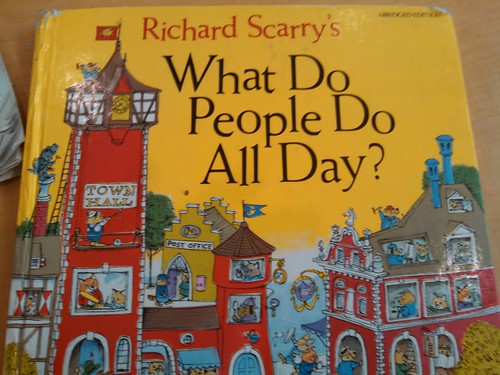
I had been planning to say a few things last week about this Gambit cover story but, well, a lot of worse things have been happening.
I've got pretty much the same bone to pick as everyone else who commented, though. It looks like it wants to be an article about the high cost of living in New Orleans but the framing is basically, "Oh noes, it's super hard for well educated, young, ambitious professional types to get started on their dream six figure career path in this city!" It's tone deaf to say the least.
The reason that happens is pretty simple to explain. Gambit's business model is about selling ad space to local businesses whose products and services match the tastes of young, ambitious professional types. That's why we find such people as the protagonists of this story. Unfortunately, that doesn't make the story immediately relatable for the rest of us plebs even though we're actually the ones being erased from the landscape by stagnant wages and skyrocketing rents.
The second issue with the story is stagnant wages and skyrocketing costs of living are a crisis facing working class people in cities all over America. It's not a uniquely New Orleans failing. But it has to be written this way because Gambit caters to a sensibility we can call the NOLA inferiority complex. It's a widely held belief among upper middle class whites especially that there's something extra dysfunctional about New Orleans which sets it apart from what you might find elsewhere. I've never been convinced this is the case. But it has long been a popular rationalization among young, ambitious, professional types when the wider national job markets they have access to by virtue of their class privilege incentivize them to move away. It's the negging undertone we find in every "leaving New Orleans love letter."
There's more to say, especially after the story was referenced by an even bigger insult of an article that appeared in CityLab this week. But that's already too much. Maybe we'll come back to it. In the meantime, please do see this "Labor Day" post by the author of the Gambit piece which I think serves as a pretty good follow-up. Yes, she still insists that New Orleans is "unusually difficult" for the yuppies. Never mind that. But look past it and you'll see...
But it does indicate that — as national studies and reports have suggested — the greater workforce is changing rapidly, and our conception of what "regular Americans" do for work may be a little outdated.That's the story right there. The work most people are obliged to do does not sustain most people. The problems of some recent Tulane grads weighing the costs/benefits of maximizing their value in the national market vs the charms of consuming the local "culture" really are a world removed from it.
Most Americans do not work in factories, or in coal mines. Only some people work in professional fields such as business, technology or law. By far the most common jobs for Americans are service-sector jobs, whether that be in retail, food service or customer service; office assistant jobs such as secretaries and clerks; or jobs in the growing field of health care and caretaking. Caretaking and food service in particular make up two of three of the fastest-growing jobs in America, according to a recent edition of the Current Population Survey — construction jobs were in the top spot.
The takeaway is that it's way past time to stop thinking of service-sector jobs as temporary gigs for people in high school or part-time workers. Certainly early labor advocates would have argued for workplace protections and better wages for people in these fields, who now form the backbone of the American workforce. And the same standard should hold true in health care, where many aides, assistants and home care workers aren't well-compensated relative to better-credentialed nurses and doctors.
I think we can all remember what this was like
NOAA satellite photos show flooded neighborhoods in Houston and Galveston. I remember clicking through file folders of these some 12 years ago trying to find the one that might show if my place was ok. It was the first time a lot of us who had evacuated started to really process the scope of what had happened; block after block, neighborhood after neighborhood just totally underwater. It was devastating.
At least now there's this easy to use map interface. The kids today don't know how lucky they are.
At least now there's this easy to use map interface. The kids today don't know how lucky they are.
Floating balls of fire ants are having a moment
Good for them. It's about time. I still can't believe we didn't think about this during the whole Zephyrs renaming episode. Baby Cakes is still good in that it's funny that their bad idea to change the name failed on them like that. But if we had remembered this was available, things might have been different.
Who is going to throw them something?
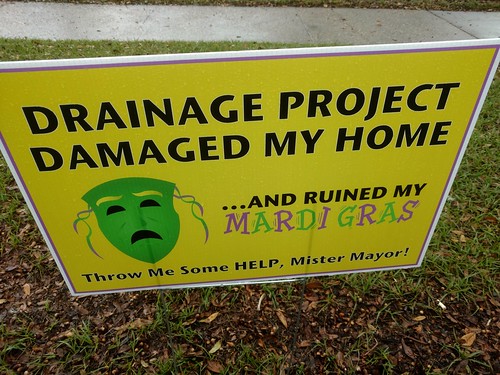
Signs like the one above were posted along Napoleon Avenue during Carnival this year. A few months later, they printed a similar format which claimed SELA had also "ruined my Jazzfest." That was confusing. Maybe the sight of a crack in the wall distracted these homeowners and made them sad as they watched the parades pass from their front porches. Not sure that would "ruin" things for me but ok. How it affected their Jazzfest is anybody's guess.
In any case, it's looking more and more like the mayor is going to have to throw them something after all.
The Sewerage & Water Board has lost its latest attempt to blame federal contractors for damage to homes along the Uptown New Orleans routes of several new underground drainage canals.We don't want to go too far in the direction of defending the Sewerage and Water Board, but it should be said they're in kind of a tight spot in this situation. SELA is a federal project overseen by the Army Corps of Engineers. The Corps, though, is immune from litigation as are any contractors employed to do the work so long as the Corps signs off on the specs. So, if you are an aggrieved property owner looking to get paid, you're going to have to get it out of S&WB.
The U.S. 5th Circuit Court of Appeals ruled Monday (Aug. 28) that the Sewerage & Water Board couldn't hold liable federal contractors hired under the Southeast Louisiana Urban Flood Control Program, or SELA.
That leaves the embattled city agency staring down a possible $86 million payout to roughly 275 plaintiffs.
Appellate judges Thomas Reavley, Edward Prado and James Graves agreed with a lower court ruling that the Sewerage & Water Board had failed to prove the contractors hadn't followed federally agreed-upon plans when installing the canals.
But, uh... to put it lightly, they've got their own problems these days. And according to the mayor, at least, those problems are going to require a whole new source of revenue.
Deputy Mayor Ryan Berni said a new millage for drainage is a possibility, but there's also been a movement to create a more complex fee structure that would credit property owners for the amount of water-permeable property they have. Owners of properties that absorb rainfall would pay less than someone who generates more runoff. For example, a lot with a large lawn or another retaining features would face a lower fee than a parcel with an impermeable surface.It's not clear what they're actually going to propose yet. One talking point they've run up the flagpole is the possibility that a new drainage fee could circumvent exemptions which keep nonprofits and religious organizations from paying property taxes. That's been a longstanding issue in municipal politics. Fittingly enough, though, it's one of those issues everybody complains about but nobody ever mitigates. You, know, like our regularly apocalyptic weather.
The Bureau of Governmental Research endorsed stormwater fees in a February report. It pointed out that while New Orleans is "one of the nation's most stormwater-challenged cities," it doesn't have a way to collect money directly from property owners who use its drainage system.
Anyway, it seems to me if broadening the tax base were really what they were after here, they'd attack that directly. Most likely this is just another push to raise revenue via regressive fees instead of through property taxes. That's pretty much been the bread and butter policy choice throughout the Landrieu years especially. According to the somewhat unreliable BGR, they're going to need $54.5 million in new revenue over the next decade and it has to come from somewhere.
According to the also somewhat unreliable Inspector General, though, S&WB's problems go far beyond figuring out how to raise more money.
The current drainage crisis that has gripped the S&WB gave Quatrevaux another platform to bolster his case. In his letter, he listed a series of investigations his office has done in the past five years that he said exposes the shortcomings of the agency's management. They mainly focused on accounting weaknesses that may have made the agency vulnerable to fraud and abuse.I'm not sure what to make of some of Quatrevaux's arguments. I'm especially wary of the way he tends to point his finger at S&WB line employees and I have absolutely no truck with what I see in some of this as an attack on their pensions and benefits. Having said that, he raises some troubling issues with regard to management practices; i.e. sloppy accounting, reliance on overtime in place of adequate staffing,etc. This passage makes the most critical point.
"The recent drainage failures demonstrate that an organization cannot perform poorly in finance and administration yet perform well in operations," Quatrevaux wrote.
It is logical to consider how the many problems of the S&WB might be solved by organizational restructuring. From a theoretical view, there is a continuum from city control on one end to privatization at the other. But what is the S&WB now? It is not a city department but an independent entity that is legally impervious to city controls. The S&WB sits halfway down the continuum from city control to privatization, neither fish nor fowl.A similar argument was made by Jacques Morial a few weeks ago in this Lens op-ed. Morial agrees with Quatrevaux's recommendation to fold S&WB back into City Hall. But while Quatrevaux's letter is focused on getting us to a more efficient management structure, Morial adds an appeal to more direct democracy. Morial pulls no punches in his piece. He is especially critical of a recent structural reform backed by Landrieu and BGR.
The fundamental problem with the Sewerage & Water Board is that it is an institution impervious to change—it has ossified. Its celebrated independence permitted decades of technological progress to bypass the S&WB. Fees or millages increased when the inefficiencies could not be paid with current funds. The problem is structural, and the passing characters—mayors, directors, members of the S&WB—almost irrelevant.
A turnaround in such an organizational culture would be very difficult to achieve: the S&WB must be replaced with a modern organizational structure, one that makes elected officials responsible for the organization’s performance.
The gist of SB 47 was to expel the City Council from the S&WB’s board of directors. For years, three members of the Council had been seated on that board. In their place, the bill established a system whereby directors would be appointed by the mayor from a list of nominees put forward by the presidents of local universities.We aren't exactly sure what the new fee proposal will look like yet. But anything mayor pushes with heavy BGR backing is worthy of heavy scrutiny. If Quatreveaux is to be believed, it's worth questioning just how steep such a measure really needs to be. Whatever the amount, I suspect we'll be looking at an attempt to impose a regressive fee based on a notional measure of drainage "usage" rather than a more progressive property millage. After all, it would be shame if those Napoleon Avenue property owners went through all the trouble of making the mayor and S&WB "throw them something" only to find they were footing a fair portion of the bill themselves.
While all the men and women who have served in recent years as presidents of local universities are honorable, civic-minded leaders, their responsibility is to their institutions and their boards of trustees. These academic leaders are not accountable to the voters in any way, notwithstanding their noble service to the community and the vital role their institutions play in our city.
Leading the charge to purge the S&WB’s accountability to the voters was the august Bureau of Governmental Research, founded by social elites in 1930 as an anti-populist organization with a secret membership roster, not unlike the exclusive carnival krewes whose members comprised the group. But the BGR is neither representative, nor credible. Many of its board members do not live in New Orleans. Not a single African American serves on the BGR’s staff. Its board members have been awarded no-bid contracts with city agencies, and have been appointed by Landrieu to city boards or commissions. At least one of its officers has been embroiled in his own ugly conflict-of-interest scandal.
Wednesday, August 30, 2017
People like brake lights
I keep coming back to this article Jonathan Swarz wrote back in January. Trump was about to take power and many Americans exhausted by the 2016 were having a dark teatime over it. What do you do when it's all gone to shit? This seemed like a good thought to start with.
When and where are the next Democratic and Republican Party meetings in your neighborhood? You don’t know, because neither the Democrats nor Republicans are political parties in the historical sense. Mostly they just demand we send them money and then yell at us about voting every few years.Well we still don't have political party that functions in any way like that. But we have seen several organizations spring to life in recent months who are trying. One such example is DSA. Here's your New Orleans chapter at work last week.
While it has almost passed out of Americans’ living memory, parties used to have regular, local meetings where everyone got together, yammered about politics for a while, and then drank beer. Elections were the culmination of what parties did, not the starting point.
A healthy political party would foster community and provide people with concrete things to do between elections. Mike McCurry, one of Bill Clinton’s press secretaries, once suggested that Democrats should turn themselves into a pool of neighborhood volunteers “so that when people are trying to accomplish something, they would say: Call the Democrats, they always have people.”
Or they could get members involved in a local fight for a $15 minimum wage. Or helping women get a safe abortion. Or restoring funding cuts to local colleges. Or whatever members decide. That’s politics.
How does repairing brake lights aide DSA's mission?Fixing brake lights is a small thing. But it's a nice small thing. It's a great way to start breaking through the morass of the media horror show and reconnecting the political and the practical. Politics is about bringing people together to help them get the things they need and like. People like brake lights. Why not start there?
In a few ways: There's the aspect of helping people avoid any kind of interaction with the justice system, so keeping people from getting tickets and everything serves the mission of prison abolition and all that, which we've gotten started with.
Also, there's also an aspect of building power outside of the electoral politics system. In New Orleans, it's really hard to create change through regular electoral politics because it's so closed, and it's hard to break into it. Doing service like this is a way of making that change on the outside, and helping people meet their basic needs in a way the government will not.
Helping people meet basic needs like that helps us build a stronger working-class base. To get a ticket for a brake light can ruin your whole month, it can ruin a few months, it can ruin your life for a longer than that. It's such a small thing we can do to change that for people.
Let's hope we don't regret this
The Saints briefly thought about cancelling tomorrow night's final fake football game against the Ravens. That would have been fine. Cancel all the fake games. They are bad. Football is dangerous anyway. At least this could have been a chance to set a precedent. Even if the NFL thinks thy absolutely have to have pre-season, maybe this could show they don't need four weeks of it. But, oh well.
Good luck. Just remember this when everybody breaks a leg tomorrow.
Tomorrow night's Saints-Ravens game at the @MBSuperdome is on as scheduled— New Orleans Saints (@Saints) August 30, 2017
Good luck. Just remember this when everybody breaks a leg tomorrow.
Tuesday, August 29, 2017
Are you better off than you were 12 years ago?
I love this ridiculous city.
It's Katrinaversary 12 today. I guess I've mentioned it a little. But mostly, and rightly, our attention has been focused on Texas where they're reliving a version of our tragedy for us. What Harvey is doing and how it's doing it, is different from what Katrina did. But there is a lot about the experience that is resonant including the slow motion unfolding of events.
Katrina blew through in one morning, but the disaster occurred over the several days that followed as levees failed, water rushed in, rose and sat there while people waited days for relief. The terrible President showed up and made a bad speech. It would be another month before most of us were allowed back.
Harvey arrived near Corpus on Friday. The water is still rising in Houston right now. The terrible President is there giving bad speeches. They're on a familiar track. We don't know how much it will cost or how long the "recovery" period will last there.
In New Orleans, we threw a big victory party after a nice round ten years. But that was really just for appearances. In reality, there still isn't anything about life here that doesn't trace back to the flood in one way or another. Although we style ourselves "recovered" we're really still dealing with the disaster. I'd argue there have been more failures than successes along the way but people don't like to hear that kind of talk.
Still it's reassuring that we're sable to laugh at our own dismal state of affairs more often than not. The little banner at the pump station was the most inspiring image I came across on this anniversary. So, despite everything that's gone wrong and is currently going even more wrong, it is true that some version of this city convincingly similar to what we were before still exists. Maybe that's the best they can hope for in Texas now. But I hope they'll do better.
"I think I can, I think I can" written in duct tape on a blue tarp outside S&WB pump station 1 @WWLTV pic.twitter.com/aDQtnYUIop— Katie Moore (@katiecmoore) August 29, 2017
It's Katrinaversary 12 today. I guess I've mentioned it a little. But mostly, and rightly, our attention has been focused on Texas where they're reliving a version of our tragedy for us. What Harvey is doing and how it's doing it, is different from what Katrina did. But there is a lot about the experience that is resonant including the slow motion unfolding of events.
Katrina blew through in one morning, but the disaster occurred over the several days that followed as levees failed, water rushed in, rose and sat there while people waited days for relief. The terrible President showed up and made a bad speech. It would be another month before most of us were allowed back.
Harvey arrived near Corpus on Friday. The water is still rising in Houston right now. The terrible President is there giving bad speeches. They're on a familiar track. We don't know how much it will cost or how long the "recovery" period will last there.
In New Orleans, we threw a big victory party after a nice round ten years. But that was really just for appearances. In reality, there still isn't anything about life here that doesn't trace back to the flood in one way or another. Although we style ourselves "recovered" we're really still dealing with the disaster. I'd argue there have been more failures than successes along the way but people don't like to hear that kind of talk.
Still it's reassuring that we're sable to laugh at our own dismal state of affairs more often than not. The little banner at the pump station was the most inspiring image I came across on this anniversary. So, despite everything that's gone wrong and is currently going even more wrong, it is true that some version of this city convincingly similar to what we were before still exists. Maybe that's the best they can hope for in Texas now. But I hope they'll do better.
Mike Pence's Mission Accomplished
After the 2005 flooding of New Orleans, Pence's Republican Study Committee recommended we privatize the school system. We did that. It also recommended several other things we decided to try such as .
Eliminate any regulatory barriers and other disincentives that block faith-based and other charitable organizations from engaging in the recovery and reconstruction processTwelve years later, we see how these policy pursuits compound.
Fresh Food Factor is run by the local chapter of Volunteers of America, a multimillion-dollar Christian ministry that runs halfway houses, shelters, food banks, drug treatment programs and housing projects nationwide, often with government funding. For right-wing champions of charter schools, such as Betsy DeVos, President Trump's controversial education secretary, Fresh Food Factor would be a shining example for the rest of the country: a religious group serving healthy meals at charter schools that chose to partner with a civic-minded contractor. Democrats would be happy to know that the food service helps schools comply with nutrition standards established by Michelle Obama -- standards that the Trump administration recently scaled back.There's a ripple effect at work. First break up the schools and in doing so break the teachers and their union. In the process you've also broken the support staff and their union as well. You guys know this story by now, right? The ripples go out into the community at large.
Despite its parent organization's name, most Fresh Food Factor workers are not volunteers like me. Employees who cook in the warehouse kitchen or serve students in schools receive wages that start at $9 per hour. Some work full-time, but the food service relies on part-time workers and a smattering of volunteers to fill the gaps. Besides managers and truck drivers, most employees are women of color, the workers commonly called "lunch ladies" who are inseparable from mealtime in public schools. As we wrap dozens of veggie eggrolls in sheets of shiny foil, one part-time kitchen employee tells me that she is not scheduled for enough hours to make ends meet and is looking for additional work, a common story in a local economy built on tourism and low-wage service industry jobs
The mass teacher dismissal in New Orleans was reflective of a trend that reached far beyond the classroom. Thousands of jobs that supported Black middle-class people vanished at a time when residents were recovering from an unprecedented natural disaster. Some displaced families have still not returned. In the years since, property values in New Orleans have skyrocketed and working-class neighborhoods have become hipster hotspots, putting increasing pressure on lower-income renters in a gentrifying city.The few stable middle class jobs that remained in the city were gutted and wages and benefits were depressed by the very same forces that caused the cost of living to blow up and out of reach for those left struggling to make ends meet. Meanwhile, who benefits?
Volunteers of America has long been in the "affordable housing" business, using federal housing grants to construct residential buildings for lower-income, disabled and elderly people. The group's neighborhood development subsidiary in New Orleans, which was created specifically to replace housing post-Katrina, is a nonprofit that has its own for-profit subsidiary for building residences to rent out. Robert Silverman, a professor of urban planning at the University at Buffalo who focuses on the nonprofit sector, said for-profit spinoffs of nonprofit housing initiatives are becoming more common, but profit incentives also raise concerns about "mission drift."Donald Trump landed in Corpus Christi today to say stupid things on TV. But Mike Pence is expected to head up development of the administration's recovery policy. We'll take Trump's advice and wait until later to hand out the congratulations on that.
Volunteers of America is considered a church, so it does not have to file federal tax returns, and it remains unclear how top administrators and property developers are paid for their work.
"It's kind of a new trend that has been bubbling up over the past six or seven years, where a nonprofit will have a for-profit subsidiary connected to it," Silverman told Truthout. "Different rules and tax laws apply to each, but they use it as another way to generate revenue [for the parent organization]."
You're gonna like the Heckuva Job
It's gonna be the best, biggest, most beautiful Heckuva Job. You're gonna love it. Believe me. But later.
President Donald Trump said Harvey's destruction and flooding was a disaster "of epic proportions" as he visited Corpus Christi, Texas, on Tuesday (Aug. 29).We want to say Heckuva Job. We can't wait to say Heckuva Job. But we'll wait until it will be less infuriating.
"This was of epic proportions. No one has ever seen anything like this," the president said as he received a briefing from Texas state and local officials.
Trump also said his administration wants to handle the recovery "better than ever before."
"We want to be looked at in five years, in 10 years from now as this is the way to do it," Trump said speaking to reporters. Addressing Texas Gov. Greg Abbott, Trump said now is not the time to say congratulations.
"We won't say congratulations. We don't wanna do that," the president said, "we'll congratulate each other when it's all finished."
Always check first
I read this story and thought, well now everybody is going to get a Whataburger a tattoo. But something told me that might already be a thing.
The beginning of the effort
The Vice President had a few things to say on Monday.
Today, on the anniversary of the day that set us in motion toward this fate, we look out our windows (we aren't allowed outside) to see conditions reminiscent of, though thankfully not identical to, those of this day in 2005. We look just one state over, though, and find drama and devastation on a scale much more comparable to that in our memory. We also find Mike Pence telling us this is the "beginning of the effort" for recovery there as well. That is already beginning to look familiar.
We can't wait to see what that effort looks like once it really gets rolling. The good news for Pence is, he's probably already got a template to work with. He helped put it together after Katrina.Vice President Mike Pence is stressing that the federal government will support Harvey recovery efforts going forward.In an interview with Houston radio station KTRH Monday morning, Pence said the federal government will make the resources available to see Texas through rescue operations and recovery.Pence noted that given the “magnitude of the flooding” that “it will be years coming back.”The vice president stressed that President Donald Trump has been “continuously engaged” on Harvey, noting that it is still the “beginning of the effort.” He said details of Trump’s visit to Texas will be “forthcoming.”
At the time Katrina hit New Orleans, Pence was chairman of the powerful and highly ideological Republican Study Committee (RSC), a caucus of conservative lawmakers. On 13 September 2005 – just 15 days after the levees were breached, and with parts of New Orleans still under water – the RSC convened a fateful meeting at the offices of the Heritage Foundation in Washington DC. Under Pence’s leadership, the group came up with a list of “Pro-Free-Market Ideas for Responding to Hurricane Katrina and High Gas Prices” – 32 pseudo-relief policies in all, each one straight out of the disaster capitalism playbook.Pence's group recommended the suspension of labor laws and environmental standards, a school voucher scheme, as well as a number of tax breaks and "incentives" benefiting the wealthy contractors and developers who turned a city's misery into profit. You know, standard disaster response type stuff. Some of the worst elements of what we still insist on calling the "recovery" of New Orleans after the flood can be traced back to the opportunism expressed in Pence's response plan. The smaller, whiter, tenuous, unsafe, unhealthy, and somehow unaffordable city we've built in the past 12 years owes much to that "pro-market" neoliberal blueprint.
Today, on the anniversary of the day that set us in motion toward this fate, we look out our windows (we aren't allowed outside) to see conditions reminiscent of, though thankfully not identical to, those of this day in 2005. We look just one state over, though, and find drama and devastation on a scale much more comparable to that in our memory. We also find Mike Pence telling us this is the "beginning of the effort" for recovery there as well. That is already beginning to look familiar.
Also:Michael Brown is currently on CNBC pushing for flood insurance privatization.— Niels Lesniewski (@nielslesniewski) August 28, 2017
As surely as flooding disasters like Hurrricane Harvey are followed by health concerns and homelessness, they’re followed by calls to legalize price-gouging.And this is just the beginning. No doubt Vice President (for now?) Pence has plenty more in store for the next 12 years or so.
And sure enough, the waters were still rising all across the Houston area when the first such calls were heard. They came from conservative economists Tim Worstall of Britain’s Adam Smith Institute, writing in Forbes, and Mark Perry of the American Enterprise Institute, whose piece appeared on the AEI website and at Newsweek. Both demonstrated the chief flaw of such analyses: They were based on irreproachable textbook economics, and showed no sensitivity whatsoever to how things work on the ground during a major catastrophe.
Monday, August 28, 2017
HUD, which still exists for now, says it will help
Ordinarily this would be a rote declaration from the HUD secretary in this situation, but nowadays you really can't count on anything so it's worth noting.
The most high profile post-K HUD project, Road Home, ended up costing about $13 billion and dispersed grants to 130,000 homeowners. It did this at a maddeningly slow pace and via an absurd and torturous process mostly to satisfy and idiotic political prejudice against helping people who might not "deserve" help. I'm sure Ben Carson will get all that straightened out, though.
12:25 p.m.: HUD confirms it will help with Harvey aidHUD is where the CDBG money is... for now.
Homeowners and low-income renters forced from homes by the pounding storms or flooding will have assistance available via the Department of Housing and Urban Development.
"Today, our thoughts and prayers are with those who are beginning the process of recovering from Hurricane Harvey," said HUD Secretary Ben Carson, in a release. "As FEMA begins to assess the damage and respond to the immediate needs of residents, HUD will be there to offer assistance and support the longer-term housing recovery efforts."
The most high profile post-K HUD project, Road Home, ended up costing about $13 billion and dispersed grants to 130,000 homeowners. It did this at a maddeningly slow pace and via an absurd and torturous process mostly to satisfy and idiotic political prejudice against helping people who might not "deserve" help. I'm sure Ben Carson will get all that straightened out, though.
Some numbers
I'm just trying to get an idea of the scope of this thing. These are early guesses and the storm isn't even over yet so this will change. It will likely change for the worse.
WaPo reports officials estimate some 30,000 people will end up in shelters as a result of the flood. This morning, USA Today reported a count of 5,500 so far.
Early this morning, FEMA director Brock Long said they're expecting 450,000 to register for federal assistance. That's probably a low guess. But for comparison sake, it's already roughly half of the 916,000 individual assistance requests resulting from Katrina and Rita combined.
Then there are the costs of rebuilding which will almost certainly become the subject of some sort of political standoff as congress goes to war with itself and the Trump administration over a number of budgetary issues next month.
The federal Disaster Relief Fund administered by the Federal Emergency Management Agency had a balance of $3.8 billion at the end of July, of which $1.6 billion is already obligated, according to the most recent federal report. Trump declared Harvey a major disaster Friday, making Texas victims eligible for relief from that fund. But with damage estimates already rising into the tens of billions of dollars, the fund’s balance is almost certainly inadequate.
“All of our plans on disaster recovery are premised with the federal government coming in with a big chunk of short-term FEMA money and then a big chunk of long-term bailout money,” said Edward Richards, director of the Louisiana State University Climate Change Law and Policy Project. “With the budget coming up and the debt ceiling coming up, you could easily see this getting absolutely lost in the mix.”
One senior Democratic aide suggested that Harvey could help GOP leaders avert a government shutdown at the end of September, even though Trump threatened the shutdown as recently as last week. Adding hurricane relief to a spending bill that is otherwise unpopular among Republicans, the aide said, could help win GOP votes.
The White House had proposed an 11 percent cut to FEMA’s budget as a way to free up more money for the military. But GOP leaders had signaled they would ignore that request — at least for the next few months — and keep FEMA funding basically flat. They could come under pressure to boost FEMA’s budget, however, particularly because the Atlantic hurricane season is only about half over, and there could be more dangerous storms.
A related issue is the status of the National Flood Insurance Program. Its federal authorization expires Sept. 30, and it is more than $24 billion in debt. The program has a statutory borrowing limit of about $30 billion, and numerous new claims — which congressional aides say are likely post-Harvey — probably will require congressional action to ensure there is enough funding.
Sunday, August 27, 2017
Why didn't they evacuate?
As always, there are many many reasons not to evacuate. It's never a clear cut decision for an individual. Where will you go? How will you get there? Can you afford to go? Are you healthy enough to go? Can you afford to stay there? How sure are you of being able or allowed to come back? Also, what if evacuating literally kills you?
Houston area officials who urged people to stay home before the storm may have been remembering that the city government was strongly criticized after the disastrous evacuation before Hurricane Rita in 2005.Therefore evacuation shouldn't be a clear cut decision for public officials to make. There's no such thing as a "mandatory evacuation." Or, at least, we shouldn't be thinking in those terms. Give people the best information and advice. And, by all means, do whatever is possible to help them go if that's the best thing. But it's not possible or helpful to make them go. It's also not helpful to blame them if they choose not to.
In the hours before Rita struck the Houston area in September 2005, government officials issued an evacuation order, and some 2.5 million people hit the road at the same time, according to the Houston Chronicle.
More than 100 people died in the mass exit from the city — almost as many as were killed by the hurricane itself.
Dozens were injured or died of heat stroke waiting in traffic for nearly a full day. Fights broke out on clogged highways. A charter bus carrying people from a nursing home exploded on the side of Interstate 45, killing 24 people inside
A big bathtub
$40 billion or thereabouts. At least, that was the estimate before the actual impact was known. Right now Houston is flooding. So that can't be good.
As we know all too well in New Orleans, when there's a lot of flood damage and insufficient flood insurance, the difference is mostly made up through HUD's Community Development Block Grants program. Louisiana's infamously administrated Road Home program was funded by CDBG, for example.
Presently, HUD is guided by the gifted hands of Ben Carson and, I guess, his wife.
And Trump's budget proposes we drown the CDBG program.
Very concerning that less than 1/6 of homes in Harris County have NFIP insurance. Sadly, a big portion of losses won't be insured. #Harvey pic.twitter.com/TTiSBOSb7C— Steve Bowen (@SteveBowenWx) August 27, 2017
As we know all too well in New Orleans, when there's a lot of flood damage and insufficient flood insurance, the difference is mostly made up through HUD's Community Development Block Grants program. Louisiana's infamously administrated Road Home program was funded by CDBG, for example.
Presently, HUD is guided by the gifted hands of Ben Carson and, I guess, his wife.
At the Metropolitan Club, George W. Bush’s second secretary, Alphonso Jackson, warned Carson against cutting further into HUD’s manpower. (Many regional offices have shuttered in recent years.) Carla Hills, who ran the department under President Ford, put in a plug for the Community Development Block Grant (CDBG) program, noting that Ford had created it in 1974 precisely in order to give local governments more leeway over how to spend federal assistance.Maybe Houston is the bathtub.
The tone was collegial, built on the hopeful assumption that Carson wanted to do right by the department. “We were trying to be supportive,” Henry Cisneros, from the Clinton administration, told me. But it was hard for the ex-secretaries to get a read on Carson’s plans, not least because the whisper-voiced retired pediatric neurosurgeon was being overshadowed by an eighth person at the table: his wife, Candy. An energetic former real-estate agent who is an accomplished violinist and has co-authored four books with her husband, she had been spending far more time inside the department’s headquarters at L’Enfant Plaza than anyone could recall a secretary’s spouse doing in the past, only one of many oddities that HUD employees were encountering in the Trump era. She’d even taken the mic before Carson made his introductory speech to the department. “We’re really excited about working with — ” She broke off, as if detecting the puzzlement of the audience. “Well, he’s really.”The story of the Trump administration has been dominated by the Russia investigations, the Obamacare-repeal morass, and cataclysmic internecine warfare. But there is a whole other side to Trump’s takeover of Washington: What happens to the government itself, and all it is tasked with doing, when it is placed under the command of the Chaos President? HUD has emerged as the perfect distillation of the right’s antipathy to governing. If the great radical-conservative dream was, in Grover Norquist’s famous words, to “drown government in a bathtub,” then this was what the final gasps of one department might look like.
This event is unprecedented & all impacts are unknown & beyond anything experienced. Follow orders from officials to ensure safety. #Harvey pic.twitter.com/IjpWLey1h8— NWS (@NWS) August 27, 2017
And Trump's budget proposes we drown the CDBG program.
40-50 inches of rain
Houston is the fourth largest city in the country. Gonna need a big big, well coordinated search and rescue plan. I'm sure the current federal administration is on top of it...
Saturday, August 26, 2017
More drainsplaining to come
I've fallen behind a bit this week. Oyster wrote up a good synthesis on the S&WB follies about a little over a week ago that shouldn't be missed. There's much more to discuss here, obviously.
Free stuff
Today, the New Orleans DSA chapter will be out on the corner of Orleans and Broad replacing people's broken tail lights for free. It's a nice thing to do and it might help prevent a few unpleasant encounters with law enforcement. Details here.
Can we please stop praising Bill Cassidy?
Are we finally ready to get over our obsession over Bill Cassidy's "bipartisanship"? You might think it would be enough now that he is continuing to lead the charge against the Affordable Care Act even after the defeat of last month's repeal effort. This week, Gambit highlighted the release of a CBPP report that's been in the works for a while. The report shows the potential devastating effect of passing the latest version of Repeal/Replace Cassidy has been hawking.
And yet any given afternoon this past month, we have been liable to find local commentators like Stephanie Grace here hopeful, as ever, that Cassidy finally has an opportunity to get together with some Serious People and "actually do some good."
The week prior, Grace based yet another column on the ridiculous premise that, during the latest round of Obamacre Follies, Bill Cassidy represented some "less draconian" approach to denying people health care. Grace asserts in that column, "There's a lot of work left to do in the middle," implying that Cassidy really wants to approach health care policy from what we are to presume is a reasonable, "centrist" position. By framing the debate this way, Grace does her readers and anyone concerned about health care policy a disservice. Cassidy is trying do work "in the middle." Therefore Casssidy's radical proposal to cut and block grant Medicaid is suddenly a "centrist" position. In searching for a virtuous middle to praise, we've allowed the the bounds of the discussion to list still further to the right.
Also curious has been Grace's continual fascination with Cassidy's citing of the so-called "Jimmy Kimmel Test," which came into the vernacular because a professional celebrity interviewer told a story about how the pre-existing conditions provision of the ACA affected him personally. Because no hardships actually exist in this country until they are experienced by millionaires on TV, Kimmel's name became attached to anyone wishing to express vaguely defined doubts about the various repeal bills. The "test" itself was defined differently by different people. It could have meant a requirement that pre-existing conditions remain protected, but Cassidy never committed to such a thing so that didn't really happen. Generally it just meant, let's not make Jimmy Kimmel immediately sad.
And the thing that makes Jimmy Kimmel the most sad is "partisanship." Which made this an especially stupid test.
I suppose it's fine that celebrity muffinheads like Kimmel don't really understand this. But it's more difficult to understand how someone like Grace, whose job it is to write about politics, does not. Or that she pretends not to when it suits her or her paper's preference for promoting "bipartisanship" as a virtue unto itself. Media gatekeepers who trade in this delusion are not only obscuring the substance of the policy debate they describe. By setting the limits of what is politically possible when the health care of millions of Americans is at stake, they may even be endangering lives.
The Center on Budget and Policy Priorities (CBPP), a Washington, D.C.-based think tank, released a new analysis this morning evaluating the effects of the Cassidy-Graham amendment attached to the Senate's most recent health care plan. Should Cassidy-Graham form the basis of a new ACA repeal effort, as some have speculated it might, the report warns it may share many problems with earlier Senate plans. According to the analysis, under a Cassidy-Graham plan, Louisiana could lose $2.3 billion in health care funding by 2026.
"In general, the plan would effectively punish states that have been especially successful at enrolling low- and moderate-income people in the Medicaid expansion," the report said. (More than 400,000 people in Louisiana are estimated to be covered under the state's Medicaid expansion.) "It would cause many millions of people to lose coverage, radically restructure and deeply cut Medicaid [and] increase out-of-pocket costs for individual market consumers."
And yet any given afternoon this past month, we have been liable to find local commentators like Stephanie Grace here hopeful, as ever, that Cassidy finally has an opportunity to get together with some Serious People and "actually do some good."
While President Donald Trump has tauntingly threatened to let Obamacare "implode" by withholding key payments due insurers who offer policies on the law's exchanges, HELP chairman Lamar Alexander of Tennessee and Democratic ranking member Patty Murray of Washington have scheduled hearings next month aimed shoring them up instead. So Cassidy — along with the two other Republican opponents of skinny repeal, Collins and Alaska's Lisa Murkowski, who are also on the committee — may finally get to do something on health care.What the "some good" that we're expecting to be done here could actually be, Grace doesn't say. It is implied, though, that the aforementioned bipartisan support would be all the validation she or any of us should require of any policy.
Unlike all those repeal and replace proposals that died, this is an effort that would likely get bipartisan support. And more importantly, it could actually do some good.
The week prior, Grace based yet another column on the ridiculous premise that, during the latest round of Obamacre Follies, Bill Cassidy represented some "less draconian" approach to denying people health care. Grace asserts in that column, "There's a lot of work left to do in the middle," implying that Cassidy really wants to approach health care policy from what we are to presume is a reasonable, "centrist" position. By framing the debate this way, Grace does her readers and anyone concerned about health care policy a disservice. Cassidy is trying do work "in the middle." Therefore Casssidy's radical proposal to cut and block grant Medicaid is suddenly a "centrist" position. In searching for a virtuous middle to praise, we've allowed the the bounds of the discussion to list still further to the right.
Also curious has been Grace's continual fascination with Cassidy's citing of the so-called "Jimmy Kimmel Test," which came into the vernacular because a professional celebrity interviewer told a story about how the pre-existing conditions provision of the ACA affected him personally. Because no hardships actually exist in this country until they are experienced by millionaires on TV, Kimmel's name became attached to anyone wishing to express vaguely defined doubts about the various repeal bills. The "test" itself was defined differently by different people. It could have meant a requirement that pre-existing conditions remain protected, but Cassidy never committed to such a thing so that didn't really happen. Generally it just meant, let's not make Jimmy Kimmel immediately sad.
And the thing that makes Jimmy Kimmel the most sad is "partisanship." Which made this an especially stupid test.
Note that Kimmel laid the blame for this “nonsense” at the feet of “partisan squabbles.” In his telling, the fault lies not with one of the “teams” but with the games they play in Washington, at the expense of the rest of us. But this is an untenable analysis of the political present.All politics is a "partisan squabble." Politics is a thing what we have to do because we have serious disagreements about policy goals. Some of us want to make quality health care available to everyone regardless of their material circumstances. Others among us would prefer to give rich people huge tax cuts regardless of the consequences. There's no "bi-partisan solution" to this. There is conflict. From that conflict inevitably comes imperfect results and even what we might call compromise. But there are also winners and losers determined in the process. So it matters which "team" you are on. Which means, also, you have to be on one.
Kimmel might have paused to ask exactly why the positive change in health care reform that he described occurred in 2014. If he had, he might have noticed that it was the result of another “partisan squabble”—i.e., a bill that the Democratic Party had pushed and passed and that the entire Republican Party had made it their singular mission to oppose.
I suppose it's fine that celebrity muffinheads like Kimmel don't really understand this. But it's more difficult to understand how someone like Grace, whose job it is to write about politics, does not. Or that she pretends not to when it suits her or her paper's preference for promoting "bipartisanship" as a virtue unto itself. Media gatekeepers who trade in this delusion are not only obscuring the substance of the policy debate they describe. By setting the limits of what is politically possible when the health care of millions of Americans is at stake, they may even be endangering lives.
Thursday, August 24, 2017
Campaign pronounced dead
What is up with this?
Orleans Parish Coroner Dr. Jeffrey Rouse is calling off his re-election campaign, in which his only challenger is a convicted felon he defeated for the post 3 1/2 years ago.This office has a sordid history with regard to the role it has played in our famous systemic criminal justice corruption. So it raises eyebrows when the coroner just up and quits like this. The closest thing to a reason this article provides is that doing the work made Rouse sad.
Nearing the end of his first term in office, Rouse made the stunning announcement in a statement issued Thursday, long after the deadline to get his name off the ballot for the Oct. 14 race pitting him against Dr. Dwight McKenna, 75, publisher of The New Orleans Tribune newspaper.
Votes cast in favor of Rouse, who intends to complete his first term, will still count.
So, if he wins, he would have to hand in a resignation that would take effect at the start of his second term to avoid serving it. That would set up his deputy coroner as an interim replacement, until voters could choose a replacement during a special election which would most likely be held in the spring next year.
Nonetheless, Rouse on Thursday endorsed the idea of McKenna being his successor, going so far as to congratulate him "on becoming the first African-American coroner of our great city."

They grow up so fast
Harvey really came into his own there.
On the other hand, if we get into this....
Only source on that so far is John Bel so let's not panic too much. I mean, you know, pre-stage your assets and all if you've got them.
Hurricane Harvey has formed in the Gulf of Mexico, with Category 1 wind speeds of 80 mph, the National Hurricane Center said Thursday shortly before 12 p.m.Almost makes you proud. Honestly, though, this looks bad.
The storm is still on track toward the coast of Texas, expected to make landfall late Friday night or early Saturday morning as a Category 3 hurricane.
Conditions in the Gulf of Mexico on Thursday morning were very favorable for intensification. Satellite images showed that Harvey was a large storm, whose high-level cirrus clouds were already spreading over extreme southern Texas. Harvey had an intense ring of heavy thunderstorms surrounding the eye, and solid low-level spiral bands were forming. The eye was just beginning to appear on both visible and infrared imagery at 10 am CDT. High cirrus clouds streaming away from the center showed the presence of upper-level outflow to the north and east, which was ventilating the storm and allowing intensification to occur. Wind shear was light, 5 – 10 knots, which is favorable for intensification. The atmosphere had a high mid-level relative humidity of 70%, and the ocean was very warm, with sea surface temperatures (SSTs) of 30.5°C (87°F.) This was about 2°F above average for this time of year. Warm waters extended deep into the ocean, providing a large reservoir of heat for the storm to draw upon. The outer bands of Harvey are visible on Brownsville long-range radar.It's less bad for us, of course. Or at least it would be if we had any confidence the drainage system could handle, you know, a thunderstorm or two. We're still waiting for "clarity" on that, though.

New Orleans Mayor Mitch Landrieu addressed Tropical Storm Harvey — forecast to be a Category 3 hurricane when it hits the Texas coast — and said more clarity would be offered on Friday regarding both the forecast and the city's pumping capacity.Um, no, we are not going to have to evacuate for a thunderstorm no matter what they think they have to say in order to appear as though they are doing something. Mitch said today it's important that we all "lean forward" which is a thing he likes to say in these situations. I still don't know what that means. Maybe it helps keep you buoyant.
Landrieu remained vague about what circumstances could trigger an evacuation, even as Harvey's rains are expected to start hitting the city this weekend.
On the other hand, if we get into this....
Gov. Edwards: there is potential that Harvey could re-enter the Gulf after landfall in TX— FOX 8 New Orleans (@FOX8NOLA) August 24, 2017
Only source on that so far is John Bel so let's not panic too much. I mean, you know, pre-stage your assets and all if you've got them.
Wednesday, August 23, 2017
Starting QB will start at QB
Seems pretty obvious that the "QB competition" this summer was just Orgeron keeping his blue chip freshman happy. At least, I hope that's all it was. If Etling had not been named the starter this week, LSU fans would have been right to start worrying.
Now that that's out of the way, they can get back to what's really important. Like the new kitty, for example. As to that, by the way, I fail to see why people choose to be mad. The tiger was in need of sheltering and now it will be well taken care of. Maybe this will be the last Mike. But that only makes sense if there are no captive tigers in need of quality care the next time the space is vacant.
Now that that's out of the way, they can get back to what's really important. Like the new kitty, for example. As to that, by the way, I fail to see why people choose to be mad. The tiger was in need of sheltering and now it will be well taken care of. Maybe this will be the last Mike. But that only makes sense if there are no captive tigers in need of quality care the next time the space is vacant.
But emails
The Advocate has been combing through S&WB internal communications to see if they can nail down who knew what and when. They emphatically state over and over in this article that they can't find any evidence that mayor's office was "in the loop" with regard to the pump problems. You can decide if you think that's actually a good or a bad thing. Anyway, we do know that, internally at least, S&WB was aware there were problems on the horizon.
“This is enough power to continue potable water pumping operations, but we will not have sufficient power capacity to perform any drainage pumping based upon SWB supplied power,” Becker wrote on July 28. “For the next several weeks, with the height of hurricane season approaching, we are going to be dependent upon Entergy power to operate our drainage system.”
Tuesday, August 22, 2017
It's doing what it was supposed to do
People who depend on public transit to get downtown to work in the fine restaurants and hotels there complain that RTA does a better job at getting tourists from those hotels to the those restaurants than at getting them to and from work. RTA says the workers, "don't understand the system.
“The RTA commonly denies our claim that New Orleans public transportation is created in favor of tourists instead of the workers, but these statistics are clear. … The Rampart line cost $75 million, but it actually decreased access to jobs,” said Ashley Pintos, a member of the New Orleans Hospitality Workers Committee.Augustine isn't quite right, though. The problem isn't that people don't understand the system, the problem is the system is working as intended. We've explained this many times by now.
Visibly exasperated, RTA General Manager Justin Augustine shot back that the Rampart line still brings riders to Canal Street, where they can transfer to numerous other lines.
He disputed RIDE’s claim that convenient access to more than 1,000 jobs was reduced when the Rampart streetcar came online, while acknowledging that the project, originally intended to take riders all the way from Canal Street to the Lower 9th Ward without forcing them to transfer to a bus, instead ended up stopping at Elysian Fields Avenue, due to limited funding.
“In terms of negative impact along the Rampart Street corridor, there is no negative impact,” he said.
“As I read the report, there are some things — and I’m not here to bash anybody’s report — but I think there’s a disconnect in terms of understanding how the system works,” Augustine said. “You hear people get up in public and then make statements as if they are fact.”
Why the JP Sheriff's race matters
Ok that's kind of a dumb post title. The Sheriff of Jefferson Parish is one of the most powerful and consequential political offices in the state. Of course it "matters" who holds it. But there is one item buried near the bottom of this juicy Advocate profile of Shane Guidry I think is worth making note of.
Guidry and Normand served as co-chairs of Landry’s transition team. But the sheriff and the attorney general have been at odds over Normand’s refusal to have his deputies seek out and arrest potential illegal immigrants, in defiance of a demand by the Trump administration that Landry backs.The outgoing sheriff, whatever else we may think of him, at least had enough clout to buck the preferences of State Attorney General and even the President of the United States with regard to one of their most cruel and highly politicized policy priorities. Given everything else this article says about Guidry's importance, not to mention Landry's ambitions, we can expect the pressure to victimize immigrants to increase. Will the next sheriff retain anything approaching Normand's independence? That's a big question.
Saturday, August 19, 2017
What did the mayor not know and when did he not know it?
An under reported bit of context to the whole drainage saga is Mitch Landrieu and Cedric Grant have been trying to dump Civil Service for quite some time now.
In fact, in his 2012 pitch for a rate increase, the mayor wanted to "be very clear" about the danger we were in.
Until he didn't.
It's still highly likely that the incoming team of "experts in various fields" will favor more privatization, regardless of the "vehement denials" we read about here.
The move to push Grant out the door sooner in favor of yet to be named consultants, doesn't bode well, though. At the end of the day, it's still more or less impossible for the Mitch Landrieus of the world to imagine any solution that isn't heavily flavored with public-private partnerships. When in doubt, contract it out. And there's never more doubt to work with than in the middle of a crisis. So far we're only vaguely aware of how this crisis impacts upper management at S&WB. They're "retiring" with upper management pensions. The consequences for the employees there are likely to be far worse.
Human Resources Director Sharon Judkins told the board of directors Wednesday (Aug. 16) that the S&WB was short 290 people at the end of July, based on its budget for 1,500 employees. It also has 240 workers eligible to retire, including 121 who are participating in the agency's five-year deferred retirement option program, or DROP.It wasn't just Grant trying to lobby Baton Rouge for these changes. The mayor has a hand in that too. Mitch spent last week implausibly feigning ignorance of some basic information about the status of pumps and turbines. Here he says he was never notified of a power failure back in March of this year. But longtime subscribers to regular water service in New Orleans find this dubious given the near constant attention these issues have gotten from one boil order to the next throughout Landrieu's term in office. Even the most casual observers are aware there have been problems.
Those averages have plagued the board for months, if not years. In response, outgoing S&WB Executive Director Cedric Grant earlier this year had tried to eliminate civil service requirements for all future employees. But he failed to sway the state Legislature.
In fact, in his 2012 pitch for a rate increase, the mayor wanted to "be very clear" about the danger we were in.
"I want to be very clear about this, the city is in a position of danger right now. The power plant at the Sewerage and Water Board has broken five times since Katrina," Mayor Landrieu said in an address back in 2012.And this was after a 2010 post-boil order examination where new emergency protocols were supposedly put in place.
But at a news conference a few days later, Sneed said that message didn't arrive for several hours and that it didn't include an official copy of the advisory, which Sneed insisted was needed in order to issue the alert.So somewhere along the line we went from, "we will send a cop to knock on the mayor's door at 2 am if necessary," to, "nobody told the mayor for months that the turbines were on fire." It's possible this happened after Cedric Grant took over. I guess Mitch really really trusted him for some reason.
"In the middle of the night, e-mail is good, but it needs to be followed up by phone calls to ensure that we got those messages," he said. "All those problems have been corrected, and we feel confident that the issues won't happen again."
St. Martin and Sneed said on Friday that they have changed their emergency protocols as a result. In the future, they said, they will call senior city officials at their home and cell phones -- or dispatch police to rouse them, if necessary -- when major problems occur at night.
Until he didn't.
Sewerage & Water Board Executive Director Cedric Grant will leave much sooner than he indicated, possibly starting his retirement as early as next week, sources told WWL-TV Friday.Grant will be fine, as we are all well aware by now. He's got a big pension waiting for him. That's more than we can say for most of the S&WB line employees, though. And as city leaders move ahead with plans to "reform" municipal pensions or contract more and more work out, that's only going to get worse.
His departure would clear the way for a soon-to-be-named management team which apparently will be made up of at least five state and national experts from various fields.
It's still highly likely that the incoming team of "experts in various fields" will favor more privatization, regardless of the "vehement denials" we read about here.
The state senator now plans to introduce a bill to put City Council members back on the utility's board of directors, which would undo changes in state law that he had helped Landrieu and the council make four years ago.J.P. might be taking this a bit personally. But at least he's pushing in the right direction now. He has to because Morial's argument is correct. The recent reforms are fundamentally undemocratic and S&WB needs better public oversight than that. Morial actually proposed doing away with the board altogether. But if we can't have that, at least let's have more accountability to the citiznery and less to the freaking university presidents.
Morrell said Thursday (Aug. 17) that his proposal is a direct response to accusations that the Landrieu administration is attempting to privatize the 119-year-old public utility. The mayor and his spokespeople have vehemently denied any plans to privatize, saying they are hiring outside companies under temporary contracts to figure out what went wrong during the Aug. 5 flood and to help right the S&WB ship.
The final straw for Morrell came from an opinion piece by Jacques Morial, which was posted on The Lens website Wednesday. In it, Morial blasted Morrell and state Rep. Walt Leger, D-New Orleans, for carrying legislation in 2013 to remove council members from the S&WB. Morial equated that action to a first step toward privatization.
The move to push Grant out the door sooner in favor of yet to be named consultants, doesn't bode well, though. At the end of the day, it's still more or less impossible for the Mitch Landrieus of the world to imagine any solution that isn't heavily flavored with public-private partnerships. When in doubt, contract it out. And there's never more doubt to work with than in the middle of a crisis. So far we're only vaguely aware of how this crisis impacts upper management at S&WB. They're "retiring" with upper management pensions. The consequences for the employees there are likely to be far worse.
Subscribe to:
Posts (Atom)